Nation in Conflict 1861

After Action Reports
User avatar
golden delicious
Posts: 4145
Joined: Tue Sep 05, 2000 8:00 am
Location: London, Surrey, United Kingdom

RE: Nation in Conflict 1861

Post by golden delicious »

ORIGINAL: Raindem


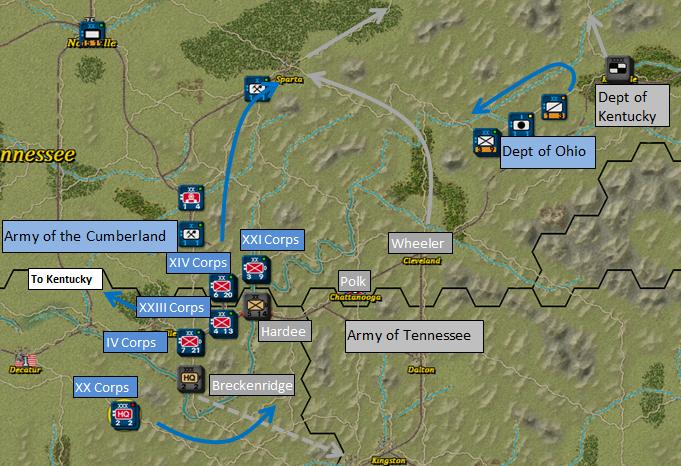
The Chattanooga campaign has begun. The entire Army of the Cumberland was forced to advance along a single rail line bordered by mountains. This made Confederate delaying actions relatively easy. A player’s first instinct may be to use the roads to the north of Chattanooga to bypass it. But the overextended supply setting would result in units being out of supply before they reached the Chattanooga-Knoxville rail line, and make them easy targets for Rebel counterattacks. Nope. The Union was going to have to slug its way forward here. Cavalry from the Department of Ohio (Burnside) did split off to occupy Sparta. But this was simply a move to keep an eye of the army’s flank rather than a prelude to a bypass.

When the Union’s route of advance became apparent, the Confederates adjusted their defensive positions. Hardee moved to the Tennessee River crossing that the Union would now have to use to get to Chattanooga. Breckenridge gave up Decatur to cover the river crossing south of Huntsville.

The Union sustained heavy losses in repeated attacks trying to take the river crossing held by Hardee. Historically, the Confederates pulled back around this time. But their position was so strong right now I decided to just leave them there and force the Union to overcome it.

So the Union plan was modified as follows: The Department of Ohio mustered up at Sparta and headed east to bypass the Army of Tennessee and attack Knoxville directly. Supply could have been a problem so the rail spur to Sparta was repaired and a supply unit added to the army. At the same time, XX Corps (Hooker) captured an undefended Decatur and attempted to swing around Breckenridge’s rear. IV Corps (Keyes) passed through Huntsville before engaging Breckenridge from the front.

I'm not that familiar with the Civil War- but given the horrendous terrain around Chattanooga and the crossing at Decatur being taken without any opposition, wouldn't a push into Alabama be simpler than trying to get into Georgia? I guess Atlanta's a richer prize than Birmingham, but Montgomery is down the road too and I think more of a major city in 1864 than it is now. Sherman could just as easily have driven to the sea at Mobile as he did at Savannah (given that the Union navy could be strong wherever it chose), and terrorising Alabama would have had much the same effect as terrorising Georgia.
"What did you read at university?"
"War Studies"
"War? Huh. What is it good for?"
"Absolutely nothing."
Raindem
Posts: 694
Joined: Sat Jul 15, 2000 8:00 am
Location: Arizona

RE: Nation in Conflict 1861

Post by Raindem »

As a point of strategy you're probably right. The route through central Alabama and Georgia would be a much easier campaign. However, the Chattanooga-Knoxville-Atlanta triad is worth 10 VPs, whereas Selma-Montgomery-Columbus are worth 3. So you'd have to eventually turn back north anyway. Atlanta would be an easy capture from the south. But Chattanooga and Knoxville are surrounded by mountains on all sides. Now, if you could simultaneously cut the Wytheville-Knoxville line that puts all of the Confederate defenders out of supply. In theory, the Union could win without Chattanooga or Knoxville, but you'd have to push deeper into the Carolinas. Or capture Richmond early. That's doable. Extend the rail line from Lexington KY to Charleston WV. Transfer the Army of the Cumberland there and penetrate into the heart of Virginia through Lynchburg.

The Union has numerous options available. I chose the direct attack on Chattanooga because that's what they did historically. I'm afraid though it may have cost them the game.

Grab them by the balls. Their hearts and minds will follow.
User avatar
golden delicious
Posts: 4145
Joined: Tue Sep 05, 2000 8:00 am
Location: London, Surrey, United Kingdom

RE: Nation in Conflict 1861

Post by golden delicious »

ORIGINAL: Raindem

The Union has numerous options available. I chose the direct attack on Chattanooga because that's what they did historically. I'm afraid though it may have cost them the game.

Yeah I figured you were essentially demonstrating the scenario by repeating the historic moves.
"What did you read at university?"
"War Studies"
"War? Huh. What is it good for?"
"Absolutely nothing."
Raindem
Posts: 694
Joined: Sat Jul 15, 2000 8:00 am
Location: Arizona

RE: Nation in Conflict 1861

Post by Raindem »

Fall 1863
Turns 62-69

The Department of Ohio reached Knoxville in an exhausted state and was in no condition to attack. The Army of the Cumberland (now under Thomas) continued its costly and mostly unsuccessful attacks on Confederate river positions. But there were signs that the Rebels were starting to crack. The struggle for the Huntsville-Chattanooga line river crossing was a battle of attrition in which the Confederates couldn’t keep up. The Union was replacing their losses. The Confederacy was not, and their position was starting to weaken. Southwest of there, XX Corps (Hooker) had nearly completed it’s sweep to Breckenridge’s rear. Breckenridge didn’t have the resources to hold off both the IV Corps (Keyes) and XX Corps attacking from different directions. So to avoid being trapped on the wrong side of the Tennessee River, Breckenridge retreated to Rome, GA. Now the Union could peel away the remainder of the Confederate positions.

About this time, the Confederates noticed the large gap between the Department of Ohio and the left flank of the Army of the Cumberland. Wheeler was in a perfect position to take advantage of this and launched a cavalry raid into central Tennessee. At the same time Forrest became active again in northern Mississippi (although the damage caused was negligable since the Union had already finished their campaign in Mississippi). Wheeler’s raid caused a chain reaction of events. The Department of Ohio did an about-face to move closer to supply and to block Wheeler’s return route to friendly territory. The Army of the Cumberland had to pause its advance and detach a couple corps to protect the rail lines. Forrest’s raid in the west was being dealt with by the Department of Kentucky and Grierson’s cavalry.

After the Department of Ohio broke contact to backtrack to the west, the Confederate Department of Kentucky decided to support the raid by invading eastern Kentucky. There were no Union combat troops up there. Only garrisons. Frankfort and Lexington were quickly captured (but later taken back). So yet another corps, the XXIII (Rosecrans), had to be pulled out of combat and sent north. The entire Chattanooga campaign was halted until these fires were put out. But put out they were. It was amazing how many extra troops the Union could come up with by waking everyone up who was on garrison duty. By the time all the little roundup operations were completed, the Confederacy had lost 60% of its western theater cavalry. Both the Confederate Departments of Kentucky and the Gulf (which had supported Forrest's raid) had taken serious hits. But the Army of Tennessee was in good shape and, more importantly, they still held Chattanooga. And it would be some time before the Army of the Cumberland could resume the drive.

Image
Grab them by the balls. Their hearts and minds will follow.
User avatar
golden delicious
Posts: 4145
Joined: Tue Sep 05, 2000 8:00 am
Location: London, Surrey, United Kingdom

RE: Nation in Conflict 1861

Post by golden delicious »

ORIGINAL: Raindem

But the Army of Tennessee was in good shape and, more importantly, they still held Chattanooga. And it would be some time before the Army of the Cumberland could resume the drive.

A really nice example of a diversionary attack. The Confederacy seizes the initiative with these attacks and ties down a much larger portion of the Union force than if these troops had simply been added to the Army of Tennessee, to be ground away by attrition along with the rest.
"What did you read at university?"
"War Studies"
"War? Huh. What is it good for?"
"Absolutely nothing."
Raindem
Posts: 694
Joined: Sat Jul 15, 2000 8:00 am
Location: Arizona

RE: Nation in Conflict 1861

Post by Raindem »

Exactly. The Union is forced to operate with a huge tail guarding its supply lines. But there is always room for a cavalry division to slip through (disengagement effects are turned off in this scenario).

Unfortunately, the scale doesn't permit the same effects in the east. When J.E.B. Stuart heads off on an adventure he usually runs into a gaggle of Union troops.
Grab them by the balls. Their hearts and minds will follow.
User avatar
golden delicious
Posts: 4145
Joined: Tue Sep 05, 2000 8:00 am
Location: London, Surrey, United Kingdom

RE: Nation in Conflict 1861

Post by golden delicious »

ORIGINAL: Raindem

Unfortunately, the scale doesn't permit the same effects in the east. When J.E.B. Stuart heads off on an adventure he usually runs into a gaggle of Union troops.

Does this happen because divisions shouldn't really be able to screen a 10 mile front- or because the Union can comfortably hold the line in Virginia with fewer pieces and so has more to play with on the flank?

It'd be interesting to look at the scenario with units at the corps scale but with the option to divide. This would give you a more historic capacity to concentrate force at a desired point and punish an opponent so screens a wide front.
"What did you read at university?"
"War Studies"
"War? Huh. What is it good for?"
"Absolutely nothing."
Raindem
Posts: 694
Joined: Sat Jul 15, 2000 8:00 am
Location: Arizona

RE: Nation in Conflict 1861

Post by Raindem »

It's not that a division couldn't screen a 10 mile front. It's just that they didn't use them that way. Communication was so poor they had to keep everyone physically close. I had considered a house rule - all divisions must remain adjacent to their HQ, and all Corps HQs must be adjacent to the army HQ. But that's overdoing it. There are numerous examples of units being detached and sent to another theater.

I like your idea of increasing the unit scale to corps. Hadn't even thought of approaching it from that direction. It would save me about 100 events that are tied up with the Command & Control system. This is no easy change, though. The OOB will have to be re-constructed from scratch. But the more I think about this idea the more I like its potential. I might just make a test scenario to try it out.
Grab them by the balls. Their hearts and minds will follow.
User avatar
golden delicious
Posts: 4145
Joined: Tue Sep 05, 2000 8:00 am
Location: London, Surrey, United Kingdom

RE: Nation in Conflict 1861

Post by golden delicious »

ORIGINAL: Raindem

I like your idea of increasing the unit scale to corps. Hadn't even thought of approaching it from that direction. It would save me about 100 events that are tied up with the Command & Control system. This is no easy change, though. The OOB will have to be re-constructed from scratch. But the more I think about this idea the more I like its potential. I might just make a test scenario to try it out.

Good man. I was expecting you to come up with an extended rationalisation for keeping things the way they are.

It's heartbreaking of course because at corps scale your units really do wind up being fairly faceless lumps. It may also cause weirdness where the broken down elements will have a lower proficiency, and if you lose a division from each of two corps you can't combine them back into a whole corps (and as you noted there's no reconstitution).

The other thing is that as your unit count gets smaller, individual small units become more valuable for their ability to block supply through ZOCs etc. and so eliminating these becomes an important design consideration.
"What did you read at university?"
"War Studies"
"War? Huh. What is it good for?"
"Absolutely nothing."
User avatar
Curtis Lemay
Posts: 15105
Joined: Fri Sep 17, 2004 3:12 pm
Location: Houston, TX

RE: Nation in Conflict 1861

Post by Curtis Lemay »

What is your "Combat Density Penalty Rate"? It should be very low. This was before HE, so forces were motivated to concentrate rather than spread out. The more concentrated a force was, the more powerful it became. After HE, that changed, and forces were motivated to not get too dense. But, if there's no penalty for concentrating, players will be motivated to keep forces as concentrated as circumstances allow. And, if they spread out, they'll be vulnerable to their more concentrated enemy.

Forces only spread out in those circumstances for foraging purposes (which you're probably not able to model, yet).
My TOAW web site:

Bob Cross's TOAW Site
Raindem
Posts: 694
Joined: Sat Jul 15, 2000 8:00 am
Location: Arizona

RE: Nation in Conflict 1861

Post by Raindem »

The combat density penalty is set to zero. But you can still only stack three corps into a hex due to the hard limit of 9. This change would allow an entire army to combine into one hex. I'm hoping players would be more motivated to concentrate as you suggest. During play testing, however, the tendency seemed to be to keep spreading out. I call it "frontage creep".

Ben, yes the scenario would lose some of its historical flavor since all those corps HQs named for the commander would disappear, as would the differences between individual divisions. I would probably have to allow reconstitution in this case if it didn't upset the balance too much.
Grab them by the balls. Their hearts and minds will follow.
User avatar
golden delicious
Posts: 4145
Joined: Tue Sep 05, 2000 8:00 am
Location: London, Surrey, United Kingdom

RE: Nation in Conflict 1861

Post by golden delicious »

ORIGINAL: Curtis Lemay


Forces only spread out in those circumstances for foraging purposes (which you're probably not able to model, yet).

Not at this scale- but for a campaign one could distribute temporary supply points around the map. The player gets into a new area and up pops a supply point- for two turns or whatever.

Of course the difficulty is one can also forage for artillery shells etc. One would want a workaround for that. Then map it at perhaps 1 mile per hex and you could maybe model something like that Gettysburg campaign.
"What did you read at university?"
"War Studies"
"War? Huh. What is it good for?"
"Absolutely nothing."
Raindem
Posts: 694
Joined: Sat Jul 15, 2000 8:00 am
Location: Arizona

RE: Nation in Conflict 1861

Post by Raindem »

Back to the action...

Winter 1863-64
Turns 70-76

Here is a shot of the entire playing area and updated positions of the significant troop groupings. As you can see, the Confederacy has been cut in half along the Mississippi, but still holds on to its heartland. The Union covered a lot of ground in 1863, but it didn’t translate into VPs. The year started with a 55 VP Confederate advantage. By year’s end that had only been reduced to a 49 VP edge. In the east, the Union was no closer to Richmond than they were two years ago.

Image

In early February 1864 the Union launched a trans-Mississippi campaign to clean up pockets of Confederate resistance. For this campaign the Union had the Department of Kansas (Curtis) in Springfield, the Department of Arkansas (Steele) in Little Rock (as soon as they got back from helping to chase down Forrest in northern Mississippi), and XVI Corps (Hurlbut) from the Army of the Tennessee. The Department of Kentucky (Buell) was not far out of theater, but they were needed to guard against cavalry raids. There was also the Department of Missouri (Schofield) in Jefferson City, but they were reluctant to leave the state while Quantrill’s Raiders were still on the loose.

The Confederacy had the Army of Arkansas (Price) in northern Arkansas and the Missouri State Guard in Fayetteville. The Army of the West (A.S. Johnston) was split. A detachment was at Fort Smith and the main army at Shreveport. In Monroe there were 3 divisions of stragglers from the Department of the Gulf that were trapped on the west side of the Mississippi when the Department withdrew to Meridian. Last but not least, the omnipresent Van Dorn cavalry corps was in Camden. If all of these forces had been consolidated then they could have fought the Union to a standstill. But the Confederacy gave up on coordinated operations in the trans-MS theater after Little Rock fell.

The Union did not know exactly where the Confederate troops were deployed. But they knew where the VP cities were. So the plan was simply to move on to the next objective and deal with whatever Confederate troops were encountered along the way. Supply was going to be tricky. The Yanks are not as good at living off the land as the Rebs. So a rail crew was brought in to repair the Jackson-Monroe line. The rest of the necessary supply would be made up with supply depots, of which the Union had six.

The Department of Kansas started off the show by marching its 11,000 men on Fayetteville. A frontal attack failed. A follow up flanking maneuver was blocked. They then pulled back to the Missouri border to lick their wounds. Next out of the gate was XVI Corps which crossed the Mississippi at Vicksburg and drove towards the enemy grouping at Monroe. A flanking maneuver was likewise blocked. But with the help of over 50 gunboats from Admiral Foote’s Western Flotilla, the Rebels were defeated and fled to Shreveport. The next Union target was Camden. The Union Department of Arkansas struck out from Little Rock while XVI Corps headed northwest from Monroe. The only Confederate troops in Camden were Van Dorn’s cavalry, which was ill-suited to defend against an attack by this much infantry approaching from different directions. Accordingly, they fled south to Shreveport to join the other defeated Confederate forces that have gathered there. Camden fell without a fight.

The campaign ended with only a portion of its goals realized. Camden and Monroe were taken. But Fayetteville, Ft. Smith, Shreveport, and all of Texas were still in Confederate possession.

Image

It’s late enough in the game that Victory Conditions need to be considered. There are a total of 100 VPs which the Confederacy controls at the start. In most games the Union would be able to capture enough VPs to win by TOAW scoring methods. So extra VPs are awarded to the Confederacy at regular intervals during the game as long as they hold Richmond. This gives the Union incentive to capture the Rebel capital and models the political pressure that Union generals were under to go “On to Richmond!”

Each side also has a chance for Sudden Death Victory (SDV). For the Union, they must reach a certain VP level prior to the start of 1865. For the Confederacy, they must drive the EEV high enough that it fails one of the event checks that are made at specific points in the game. For either player to achieve a SDV he must perform significantly better than his historical counterpart. If both players perform historically it should end in a draw or marginal Union victory depending on the loss penalty for each side.
Grab them by the balls. Their hearts and minds will follow.
Cfant
Posts: 513
Joined: Sun Dec 12, 2010 10:16 am

RE: Nation in Conflict 1861

Post by Cfant »

How does the scenario play out? I mean, in TOAW it's somehow strange to keep your units together like an army of the Civil War. And supply can completely cut off by cavalry raids. Does it feel plausible? A friend of mine once made a TOAW scenario about the roman conquest of britain in 42 a.c. It didn't work out for the same reasons.
Raindem
Posts: 694
Joined: Sat Jul 15, 2000 8:00 am
Location: Arizona

RE: Nation in Conflict 1861

Post by Raindem »

Not sure I get your question. Are you asking does the scenario encourage ACW era tactics? It does. Let's look at the Confederate problem first, since they are on the defensive most of the game.

They physically don't have enough units to form a front line from Richmond to Memphis (combination of scale, scenario settings, and the fact that most units can't divide). So they are going to have to pick and choose where to concentrate their forces. They know the Union needs those VP cities. They know the Union's supply situation keeps them close to the rail lines. Finally, the Confederacy doesn't have the manpower reserve to allow their units to get picked off one by one from being too spread out. The end result is that they are better off keeping the forces together. The entire army might be a little more spread out than it was in real life, but not by a large margin.

Now let's look at the Union problem. They are unable to take advantage of those huge gaps in Rebel lines. Supply settings keep them tethered to the rail heads. So when they approach an objective they might try to flank it (not bypass it completely) to leverage the defenders out. Sometimes the Confederates can block them and sometimes they can't. In these situations a small front line may start to form. But as soon as the Union realizes the defenders can't be flanked, the proper course of action is direct concentrated attacks. As for those cavalry raids you mentioned, the Union can't stop them. The best way to deal with them is to leave some forces in the rear to guard supply.

Players new to the scenario, especially if they are used to WW1 or WW2 scenarios, may find it odd at first to fight with open flanks. So there's a bit of a learning curve as far as tactics go. But both players will find that it's beneficial to keep their armies in close proximity.

Hope that answers your question.
Grab them by the balls. Their hearts and minds will follow.
User avatar
golden delicious
Posts: 4145
Joined: Tue Sep 05, 2000 8:00 am
Location: London, Surrey, United Kingdom

RE: Nation in Conflict 1861

Post by golden delicious »

How do you handle recon? In a real campaign, I would expect a large army to have scouts out in every direction to find out the location of enemy forces, well beyond the single hex sight range of the unit, but well below the level of a whole unit moving out at this scale.

I wouldn't want to have to keep sweeping cavalry units across my front as this would be both annoying for the player and unrealistic as the scouting forces would be much smaller. However you can't rely on theatre recon as this would show just as well what's going on deep in enemy territory as it would movements within range of scouts.
"What did you read at university?"
"War Studies"
"War? Huh. What is it good for?"
"Absolutely nothing."
Raindem
Posts: 694
Joined: Sat Jul 15, 2000 8:00 am
Location: Arizona

RE: Nation in Conflict 1861

Post by Raindem »

Theater Recon is set to 0% for both sides. So for now it's handled with cavalry sweeps. It's not that annoying. All you really need to know is where the main concentration of the enemy is. Discover one corps and the others won't be far away.

As the Union, you sweep directly in front of your advancing army so you have an idea of what's waiting for you at the next objective. Of course, the defenders may have their own cavalry screening the army so then it becomes more difficult. As the Confederacy, the cavalry sweeps should include to the sides to uncover anyone trying to sneak around your flank.

I like it this way because it encourages the players to use cavalry in an historical role. Not as shock troops. And the need for recon adds risk to those deep cavalry raids the Confederate player loves to do. It leaves your army blind. "Where is J.E.B. Stuart?", Robert E. Lee at Gettysburg.
Grab them by the balls. Their hearts and minds will follow.
User avatar
golden delicious
Posts: 4145
Joined: Tue Sep 05, 2000 8:00 am
Location: London, Surrey, United Kingdom

RE: Nation in Conflict 1861

Post by golden delicious »

ORIGINAL: Raindem

Theater Recon is set to 0% for both sides. So for now it's handled with cavalry sweeps. It's not that annoying. All you really need to know is where the main concentration of the enemy is. Discover one corps and the others won't be far away.

As the Union, you sweep directly in front of your advancing army so you have an idea of what's waiting for you at the next objective. Of course, the defenders may have their own cavalry screening the army so then it becomes more difficult. As the Confederacy, the cavalry sweeps should include to the sides to uncover anyone trying to sneak around your flank.

I like it this way because it encourages the players to use cavalry in an historical role. Not as shock troops. And the need for recon adds risk to those deep cavalry raids the Confederate player loves to do. It leaves your army blind. "Where is J.E.B. Stuart?", Robert E. Lee at Gettysburg.

OK, are the cavalry at division scale too or are they smaller? Otherwise I feel like you will wind up mounting a major opposition just to find out where the other guy is.

Do you recommend hex ownership visibility on or off? I would think that if one has taken the time to pacify the countryside and deposit garrisons over the place, it would be hard to a field army to sneak up without making a lot of noise; conversely if you've just advanced into enemy country you really don't know what is out there. Cavalry raids would be another matter- it might be worth considering having hex ownership visible but give cavalry the guerrilla icon.
"What did you read at university?"
"War Studies"
"War? Huh. What is it good for?"
"Absolutely nothing."
Raindem
Posts: 694
Joined: Sat Jul 15, 2000 8:00 am
Location: Arizona

RE: Nation in Conflict 1861

Post by Raindem »

ORIGINAL: golden delicious
OK, are the cavalry at division scale too or are they smaller? Otherwise I feel like you will wind up mounting a major opposition just to find out where the other guy is.

Currently, cavalry are at division level also. No breakdowns. I can always use the real division icon and allow breakdowns for them. Or if I wind up going to corps sized units I have the option to leave the cavalry the way they are. In actual games I haven't noticed any difficulty in keeping track of the enemy. And it has proven to be difficult to sneak up on them with a large force. But I'll take a closer look at it.
Do you recommend hex ownership visibility on or off? I would think that if one has taken the time to pacify the countryside and deposit garrisons over the place, it would be hard to a field army to sneak up without making a lot of noise; conversely if you've just advanced into enemy country you really don't know what is out there. Cavalry raids would be another matter- it might be worth considering having hex ownership visible but give cavalry the guerrilla icon.

Hex possession is currently set to Off in the designer presets. Also note that the MP cost to convert enemy hexes is higher than default in this scenario. Combine those two factors and it is just not feasible for the Union to go off looking for clusters of enemy controlled hexes. And it's not that important in this scenario. They need the cities and rail lines and that's about it. So what if there are a bunch of disgruntled locals in the rear?

I've considered the guerilla icon for cavalry units. Actually, I first tried using it as a secondary icon but never finished evaluating the effects. Certainly worth exploring further. I agree cavalry do need some kind of special ability beyond moving faster. I don't think the Recon flag in the database does enough to empower them in this era of warfare.
Grab them by the balls. Their hearts and minds will follow.
User avatar
golden delicious
Posts: 4145
Joined: Tue Sep 05, 2000 8:00 am
Location: London, Surrey, United Kingdom

RE: Nation in Conflict 1861

Post by golden delicious »

ORIGINAL: Raindem


I've considered the guerilla icon for cavalry units. Actually, I first tried using it as a secondary icon but never finished evaluating the effects. Certainly worth exploring further. I agree cavalry do need some kind of special ability beyond moving faster. I don't think the Recon flag in the database does enough to empower them in this era of warfare.

What recon % do they wind up with? You could consider cutting the strength of the cavalry equipment in the units but boosting the numbers, which should leave the unit more or less the same as it was but with a higher recon %. Then you guarantee them fast movement into enemy hexes and you make it really painful to withdraw from an enemy with superior cavalry.
"What did you read at university?"
"War Studies"
"War? Huh. What is it good for?"
"Absolutely nothing."
Post Reply

Return to “After Action Reports”