ORIGINAL: Nix77
At least the preliminary results hint that the AFV losses seem too high in the current patch. I'll try to get some results from an AI vs AI simulation when I have the time to do so.
Judging from the few results seen by myself, and other examples on the forum, battles with low manpower losses but dramatically high AFV losses seem common. How does that add up in the long run? Malyhin's almost 8k AFV lost in 4 weeks seems like a high number to me.
SU total losses during the war were around 83k tanks, 13k SPGs and 37k APC/halftracks, that's a total of 133k during the whole war. 8k during the opening month suggests nearly 100k/year losses, which of course is a high assumption due to the opening pockets creating huge AFV losses too.
There's an important point here which you and some other people may be overlooking.
From a technical/mathematical perspective, it is actually
NOT correct to look at the total number of AFV losses during the war (or over any reasonably long period of time such as a year or half a year) as a metric of whether the game's variables for AFV losses are calibrated correctly. The reason for this is that for pretty much ANY way that the combat is set up within remotely reasonable bounds, over the course of a long period of time,
the sole determinant of aggregate losses are production.
Losses will always approach production asymptotically over a sufficiently long period of time, at least until you get to the point where production is totally out-stripping losses because the enemy is totally defeated and has barely anything left (i.e. Soviets in 1945). For fundamentally the same reason, the amount of water that flows out of a lake or evaporates will always over a sufficiently long period of time tend to equal the aggregate amount of water that flowed into the lake from its tributaries (and similarly for all sorts of other physical and other systems).
So instead of looking at total losses over a long period of time, the metrics that should be looked at and compared to historical data are the
RATIO of AFV's lost per turn as compared to the total amount of AFVs you have at the start of each turn (i.e. combat intensity), or alternatively the total size/level of the AFV stocks that each side has in their OOB over time, which in effect is measuring the same thing as that ratio (source: I do mathematical modeling).
AFV losses, as well as all other losses in the game of men/planes/guns/etc follow a fairly simple mathematical process, which has a stable equilibrium level of amounts of equipment each side will tend towards having, as long as combat intensity is roughly consistent and production doesn't vary dramatically, as long as combat intensity is not at super-low levels/non-existent (in which case the equilibrium could be infinity). The reason for that is that losses are at least partly a positive function of how much equipment you have in your OOB.
If you start a turn with 13000 AFVs, other things equal you are going to lose more AFVs than if you start the turn with 3000 AFVs - that is the equilibrating mechanism through which losses adjust over time to match production.
Specifically, the system can be mathematically expressed in the form of two simple difference equations, where OOB stands for the amount of equipment in total in the OOB, P stands for the amount produced each turn, L stands for the amount of equipment lost each turn, and CI stands for combat intensity (or the proportion of equipment that is on average lost each turn). The value of CI will always be bounded between 0 and 1, since it is physically impossible to either lose negative equipment or to lose more equipment than you have.
Equation 1: OOB(t+1) = OOB(t) + P(t) - L(t)
Equation 2: L(t) = CI * OOB(t)
Substituting: OOB(t+1) = OOB(t) + P(t) - CI * OOB(t)
Re-arranging: OOB(t+1) = OOB(t) * [1 - CI] + P(t)
Drop the t's to solve for the equilibrium of the system: OOB(t+1) = OOB(t) * [1 - CI] + P(t)
Equilibrium solution: OOB = P / CI
This means that the equilibrium size of the amount of AFVs (or any other equipment) that you will have is
solely determined by production and combat intensity. Any time that production changes (e.g. going to a new year when the game updates production stats) or that combat intensity changes (e.g. a change in the weather leading to fewer attacks in mud/winter), the equilibrium will shift, but as long as production and combat intensity remain roughly constant, the equilibrium will also remain roughly constant.
So, how do you take this mathematical understanding and apply it to balance losses and combat intensity in the game to ensure it matches history? Take another look at the graph of the total size of the Soviet AFV OOB in my StB game. Notice that my AFV stock started at around 13,000 (which I presume is a roughly historical value based on the game designer's research) and then immediately starts going down. But as it is going down, the rate by which it goes down gradually decreases and it starts to stabilize. It looks to me like probably the equilibrium value of Soviet AFVs, given the production and combat intensity, was maybe something in the range of 7000 or so. So I started the scenario with an AFV stock that was far from equilibrium, and then over time it started approaching equilibrium.

Now compare that to this:
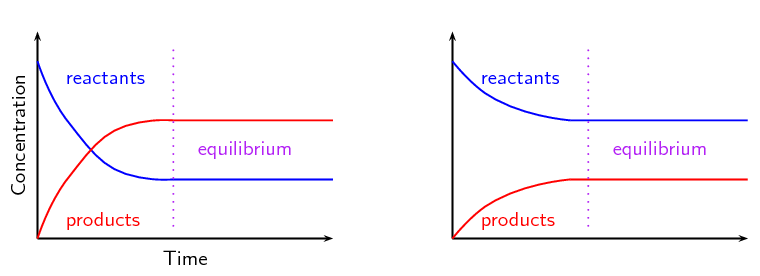
The way that "reagants" go down gradually and then stabilize looks quite similar,
and that is not a coincidence, it is a reflection of the game's system approaching a (temporary) equilibrium similar to how the chemical system is doing so.
At the start of the war in 1941, each side had AFV stocks that began far from their equilibrium values. As a result, e.g. the Soviet AFV stock in 1941 quickly dropped by many thousands. Then it started to go back up as production picked up and as the combat intensity declined a bit (a lower proportion of each side's total AFVs was lost per week after the initial huge battles like Brody and Raseinai etc). By the time the StB scenario begins, the war had been going for long enough that it is reasonable to suppose that the AFV stock was at something approximately in the general neighborhood of its current historical equilibrium level.
So, the fact that my AFV stock was going down from 13,000 (roughly the true historical level) down towards 7,000 or so tells us that the historical equilibrium of Soviet AFVs during the winter of 1942-43 was quite a bit higher than the game's equilibrium level of Soviet AFVs. The only possible explanations for that are either that the game has production wrong (we can pretty safely rule that out) or that combat intensity with AFVs in my StB game was quite a bit higher than historical AFV combat intensity. And there are two possible explanations for why combat intensity for Soviet AFVs has been higher in my StB game than historical - either AFV losses were simply too high as compared to what would be historically accurate (in which case they would be even more too high in this new patch), or else I was playing more aggressively than the Soviets did historically and being more aggressive in using my AFVs and getting them into combat. The true explanation is probably some of both, to be honest.
So to accurately calibrate AFV losses, as well as plane losses etc including the much discussed operational losses, what you need to do is to try to figure out exactly how aggressively equipment was being used in combat historically (i.e. were the historical Soviet more or less aggressive than me), reproduce that same level of historical aggressiveness in the game, and then compare the equilibrium OOB levels that the game tends towards to known historical rough equilibrium levels, based on any periods of time when your research gives you approximately accurate statistics on the true historical OOB sizes of various equipment types.
But what you
don't do is compare overall historical losses to overall losses in the game. The game will basically always reproduce historical losses, for the simple reason that the game has historical production and that losses are an increasing function of your OOB. So that metric would essentially ALWAYS tell you that the game is correctly calibrated, even when it is not, because that is the wrong variable to look at and it does not have any relation to an equilibrium value, as a technical/mathematical matter!


