Page 2 of 2

Re: Westfront 1914

Posted: Mon Aug 03, 2026 3:09 pm
by Metatron
19aoutjourn.png
19aoutjourn.png (1.89 MiB) Viewed 397 times
Source of the journals: https://gallica.bnf.fr/accueil/fr/html/accueil-fr

19 August 1914

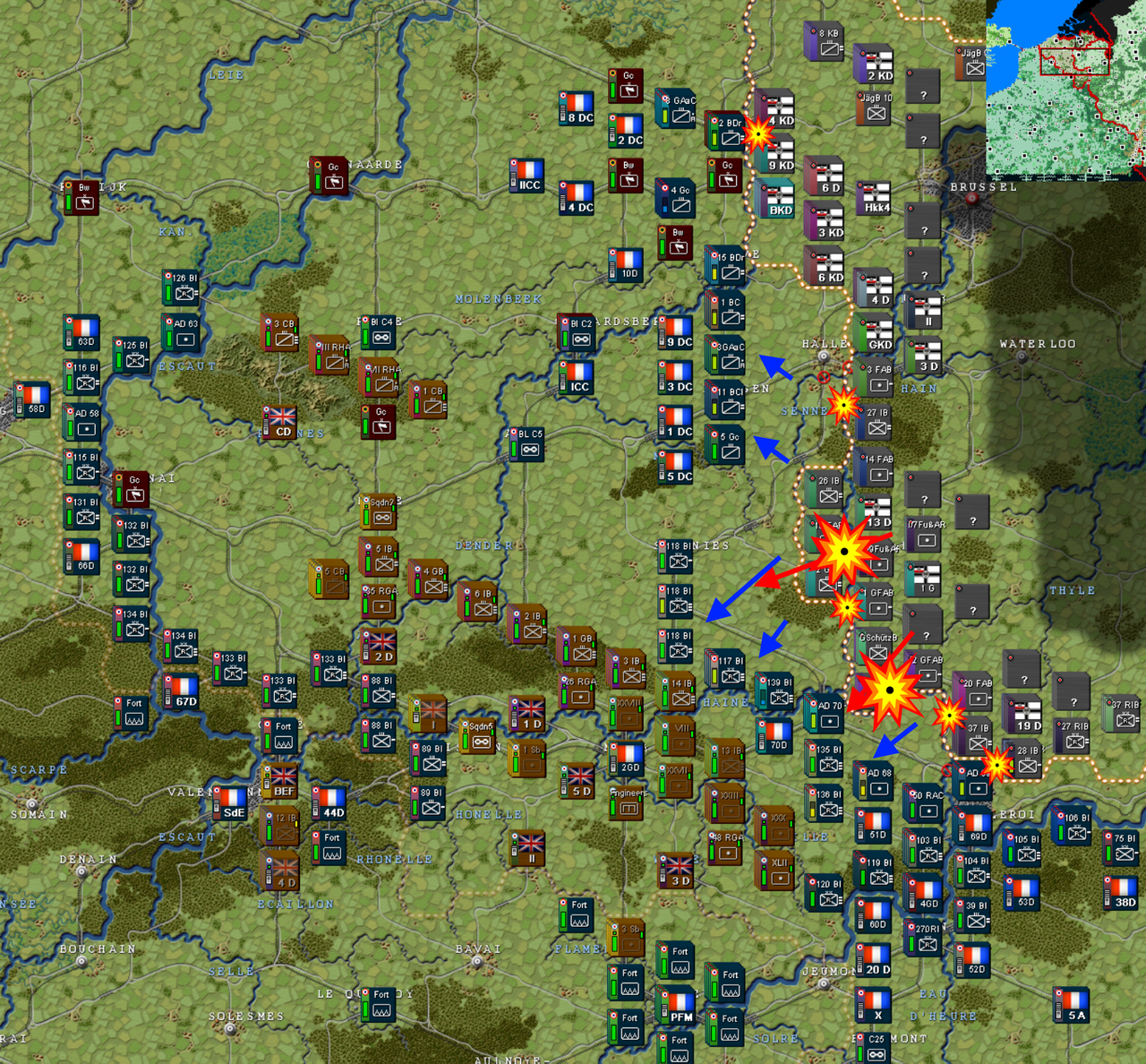
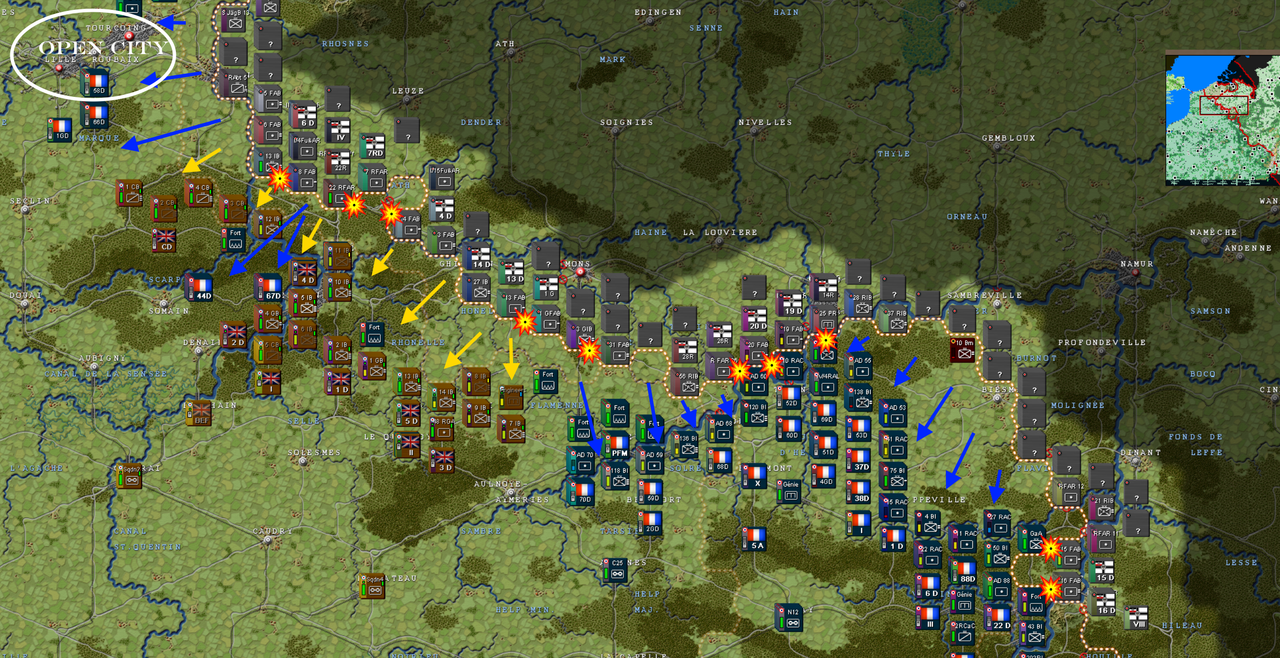
More French reserves arrive from southern France and North Africa but it is a lack of artillery that really hampers the French defenses. Joffre tries to strip as much artillery from quiet fronts but the Ministère de la Guerre (Ministry of War) still refuses to free the artillery reserves of the French fortified system to operate on the field. The fall of Namur is beginning and the battle of Charleroi and the Sambre is picking up steam.

Left flank:
Image

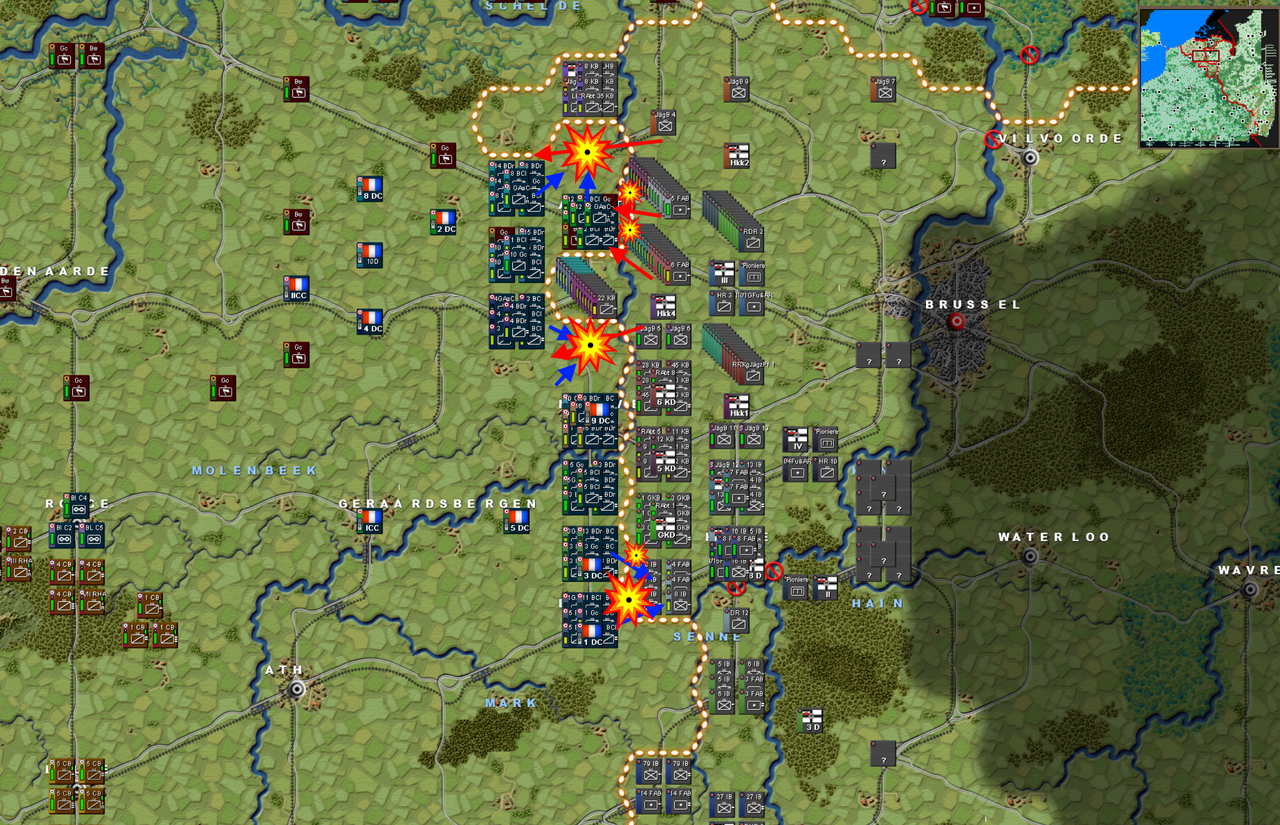
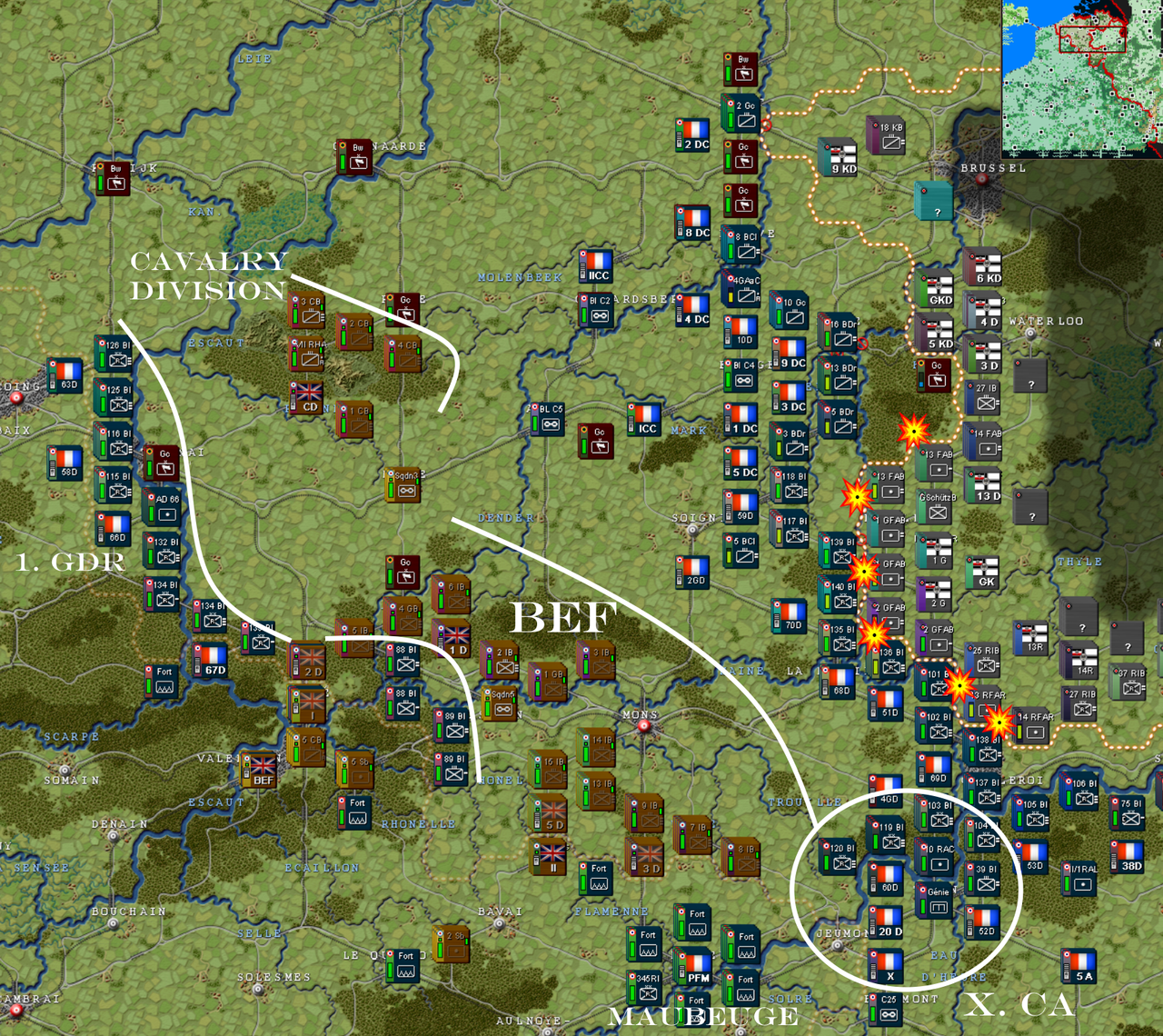
The Germans advance on the rivers and are greeted by artillery fire that inflicts significant casualties in the open fields, but the sheer numbers of divisions and heavy artillery about to arrive will doom the French reserve formations meant to slow down the German advance. Hopefully the BEF will have finished it's deployment in the forests around Mons tomorrow to allow the French reserves to fall back behind them. The British Cavalry division meanwhile is deploying in the Flemish Ardennes covering the left flank of the BEF.

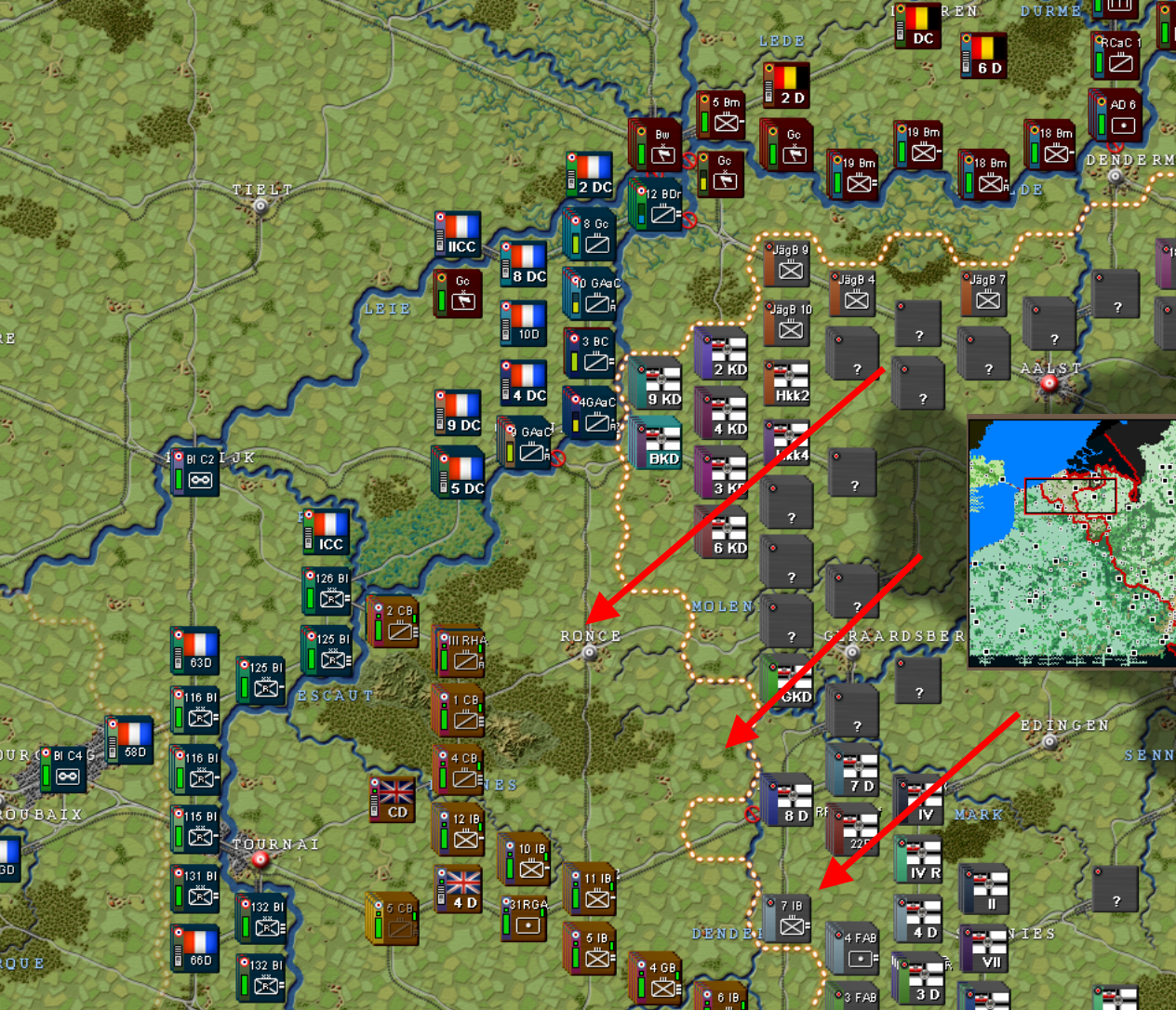
French and German cavalry are mirroring their movement in front of Bruxelles, one of the largest clashes of cavalry in history might be around the corner unless one side denies the engagement.

The anchor of the allied line on the left flank and the link between the French and British armies will be X. Corps d'armée (X.CA) setting up around Thuin to stop any flanking attack against 5. Armée in the Charleroi-Namur area.

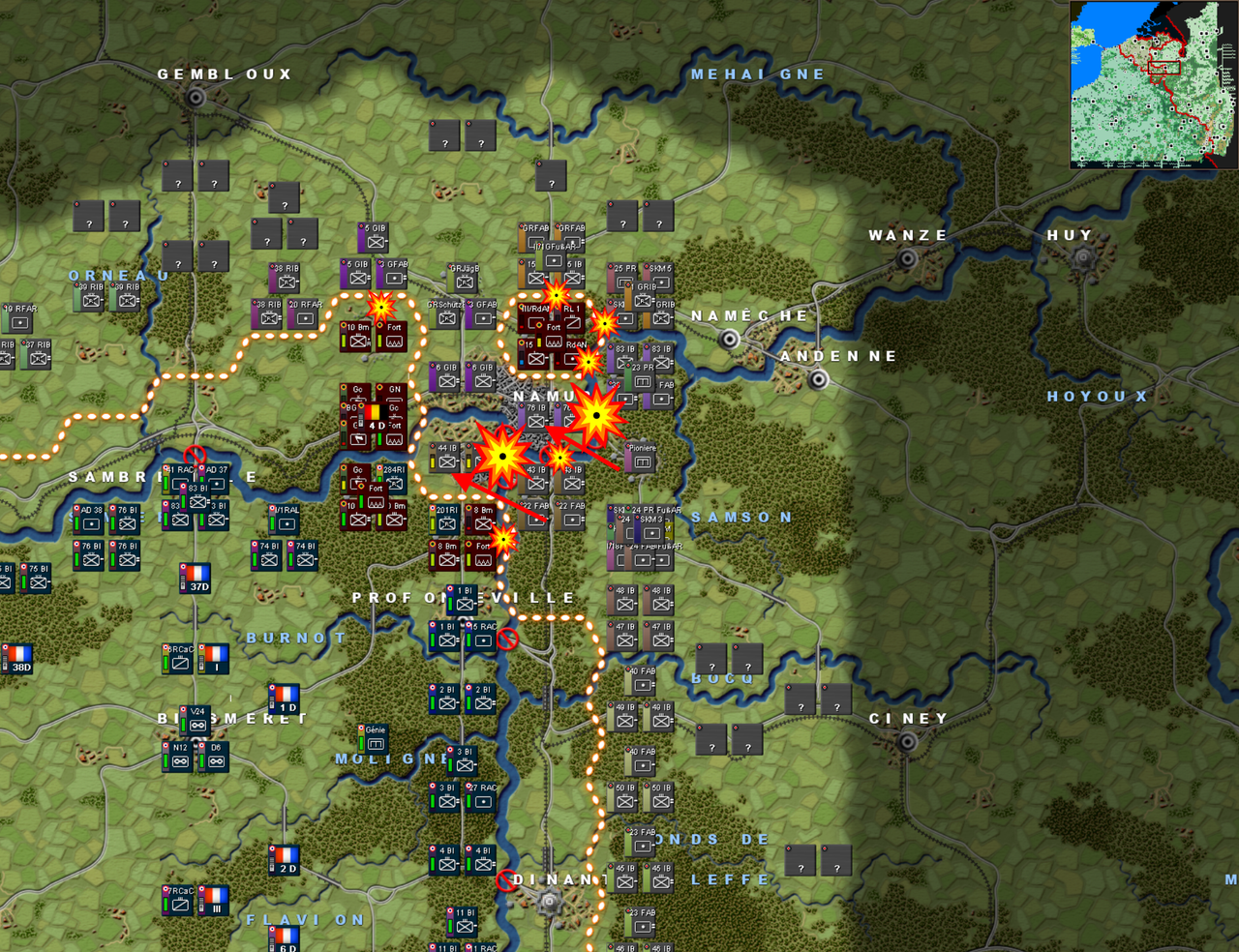
Namur:
Image

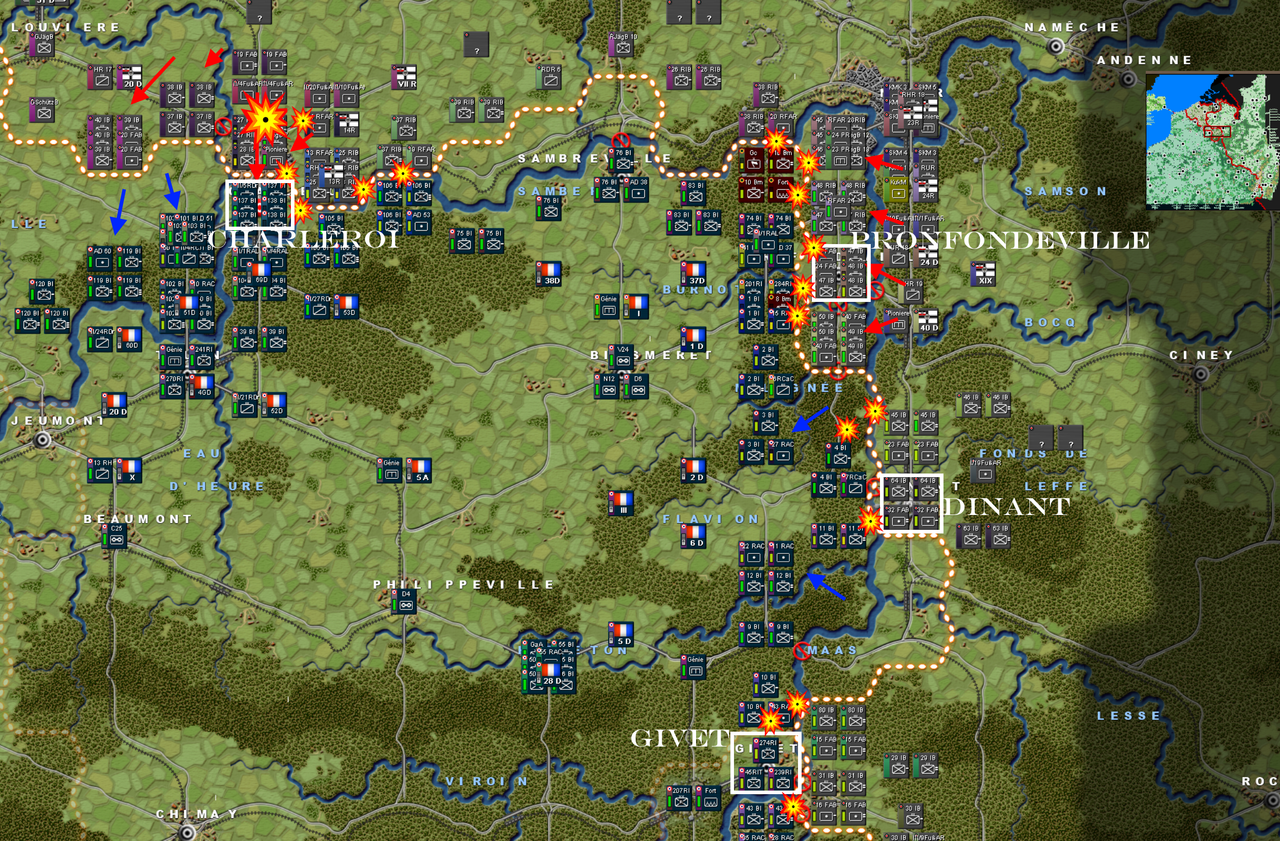
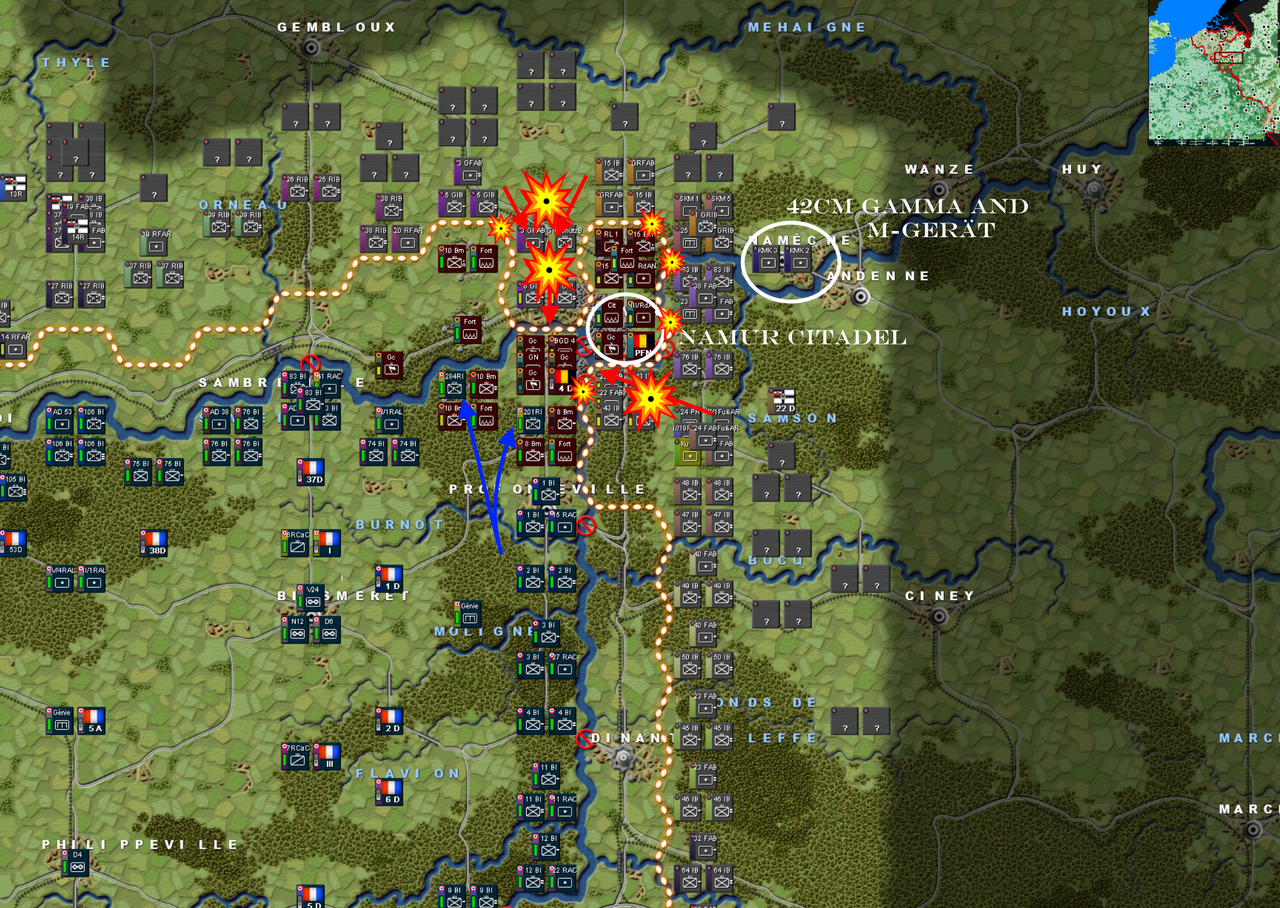
Fort de Cognelée breaks under the fire of 42cm German super heavy guns and 3. German Guard Division penetrates the Namur defenses pushing into the suburbs of Namur and reaching the Sambre almost cutting Namur off. Similarly fort de Dave is taken by storm by 22. German Division leaving Namur teetering on the verge of collapse, leaving the citadel of Namur and the fort de Marchovelette exposed from behind.

Elements of the Namur Garde Civique and two regiments of 10. Belgian Brigade manage to cross the Meuse and Sambre before German artillery interdicts the crossing to reinforce the forts of Malonne and St Héribert one the right bank of the Sambre.

The French finally decide to send some reinforcement to the southern Belgian forts to stop any German crossing of the Sambre: 201. and 284. Régiments de réserve of I. CA taking position alongside the forts of Malonne and St Héribert.

Center:
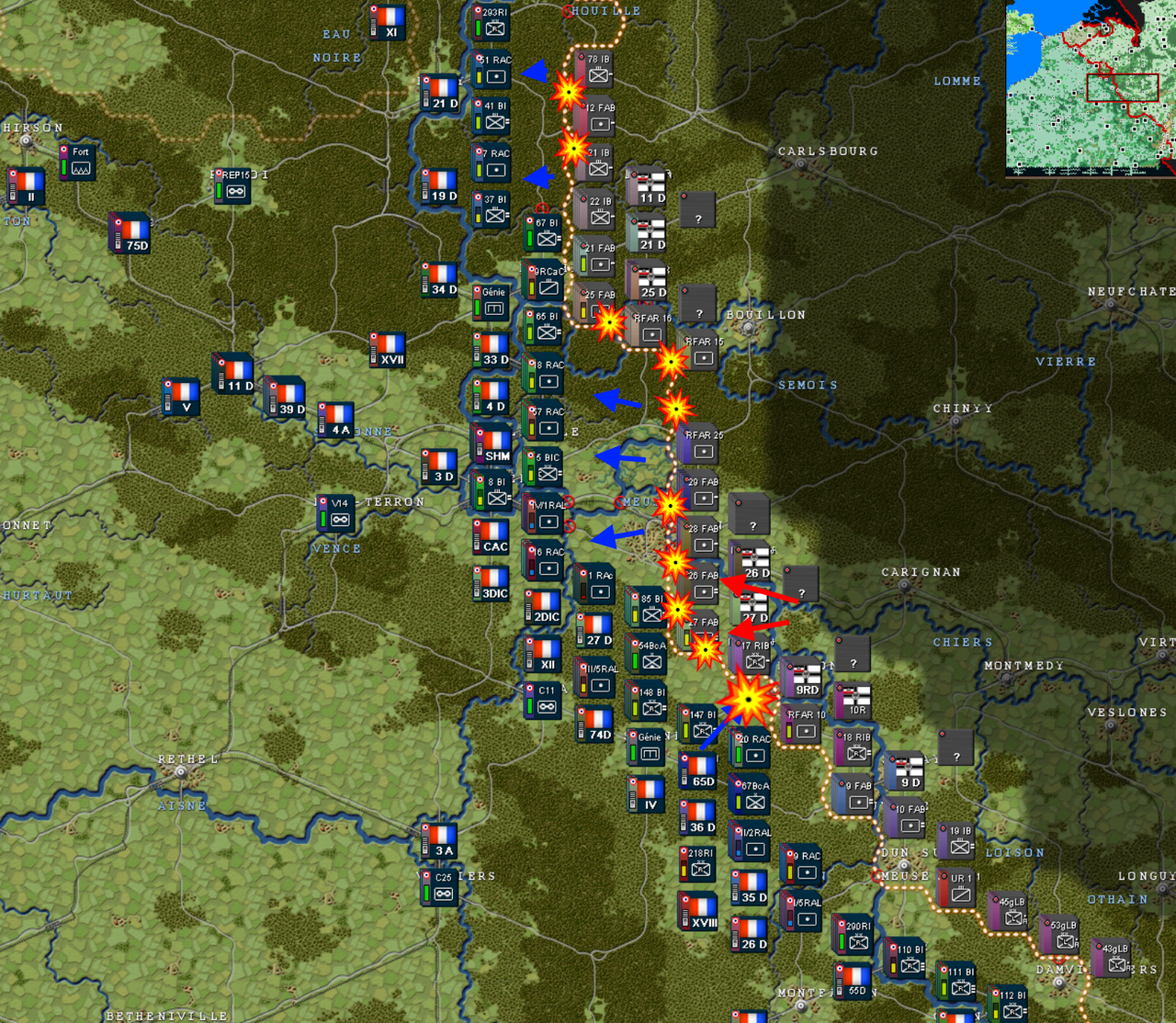
Chiers front:
Image

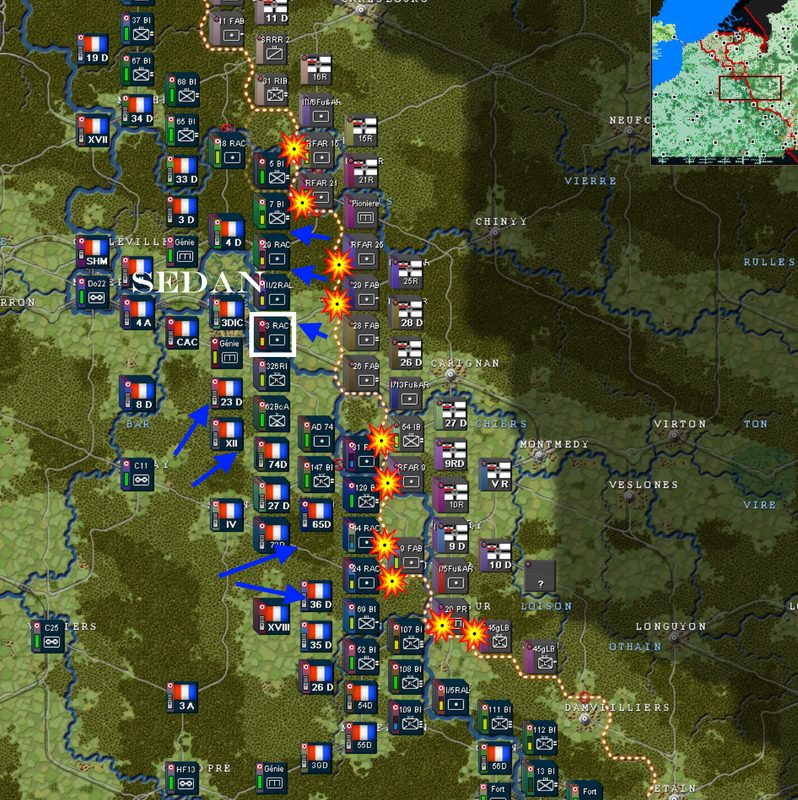
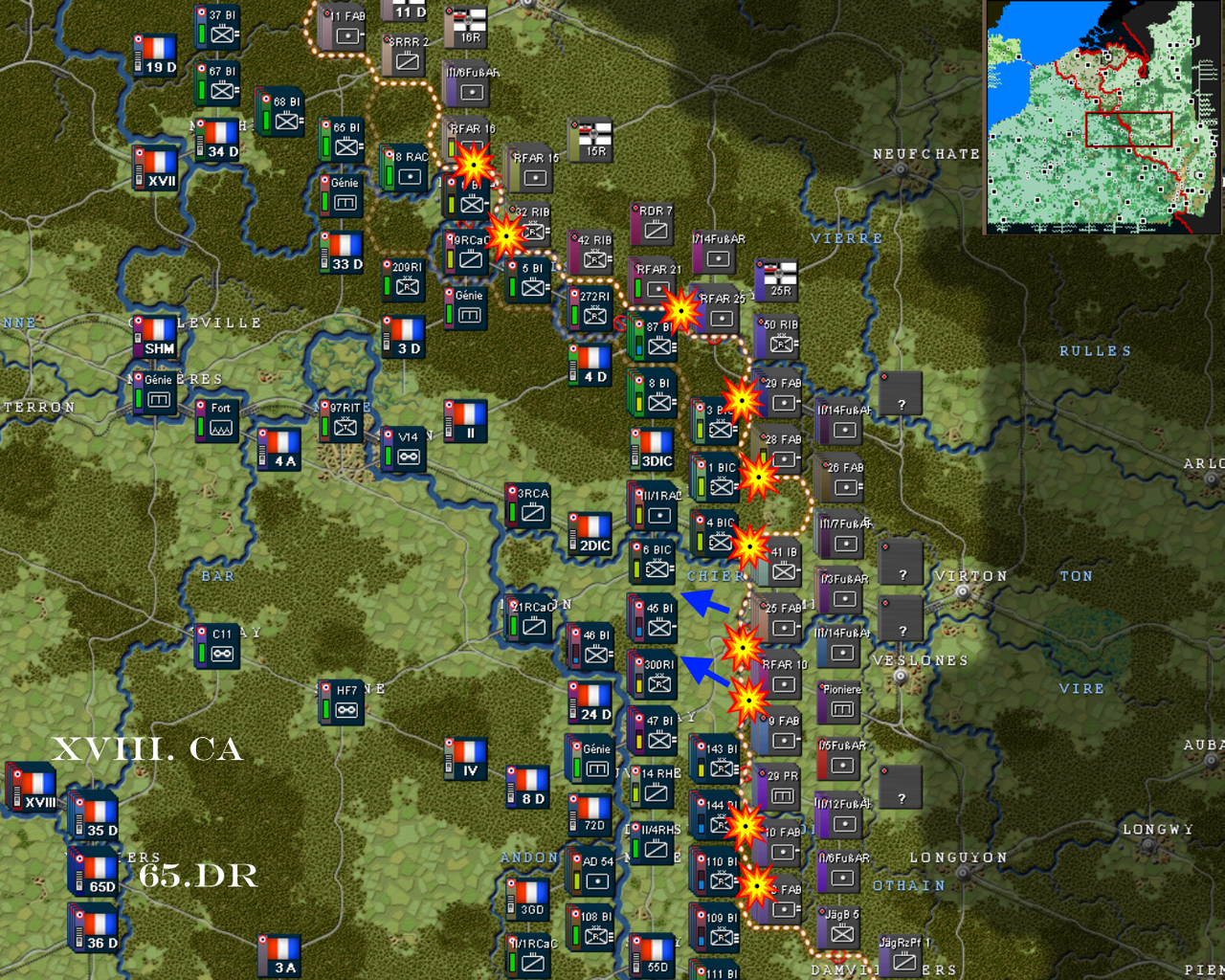
The German advance slows down as they meet the colonial troops of 2. and 3. Division coloniale. Both side feed more men into the battle and artillery continues take it's toll on both sides.

With more reinforcement still some days away Foch doesn't have much choice but to prepare to have his four reserve divisions holding his center and right to fall back behind the Meuse soon.

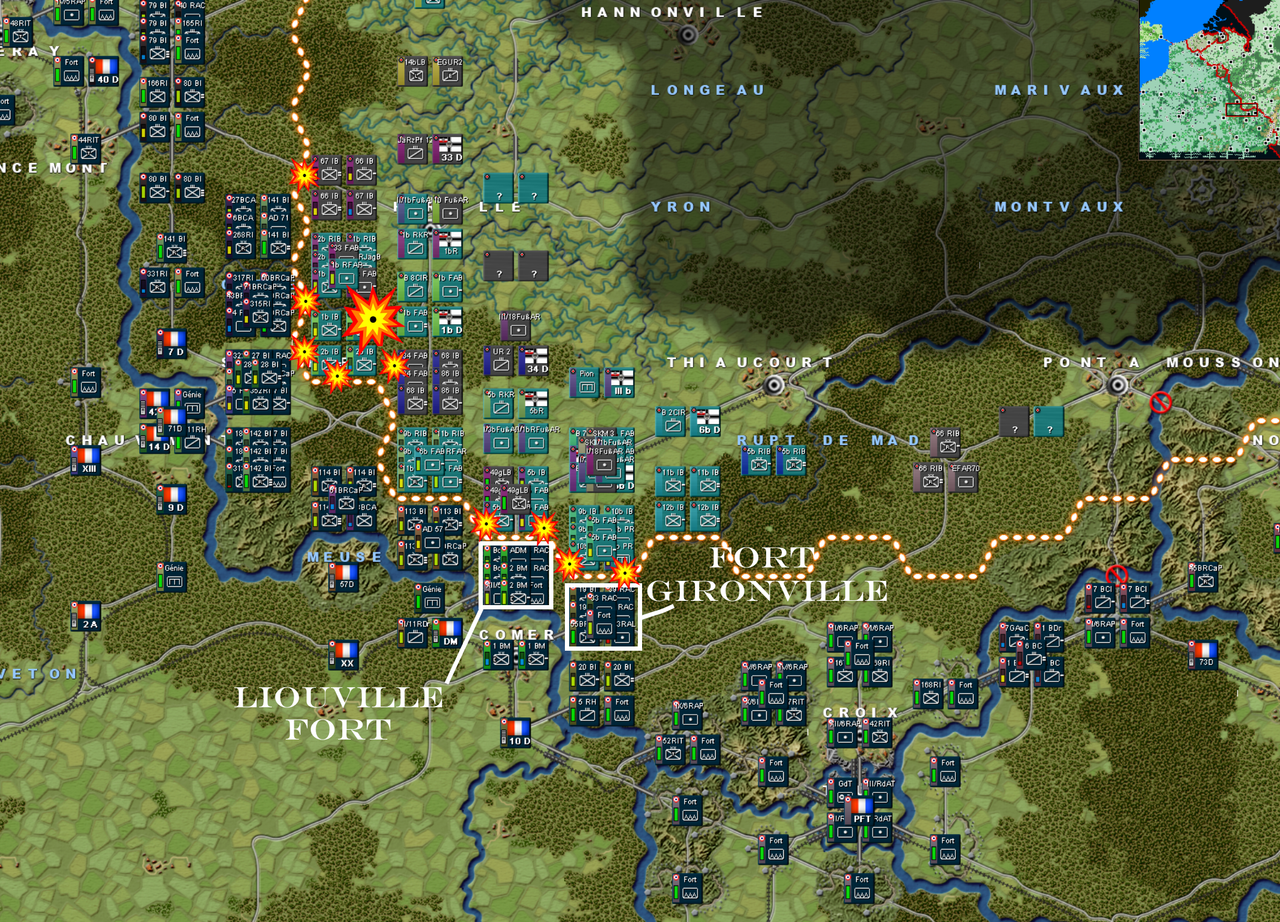
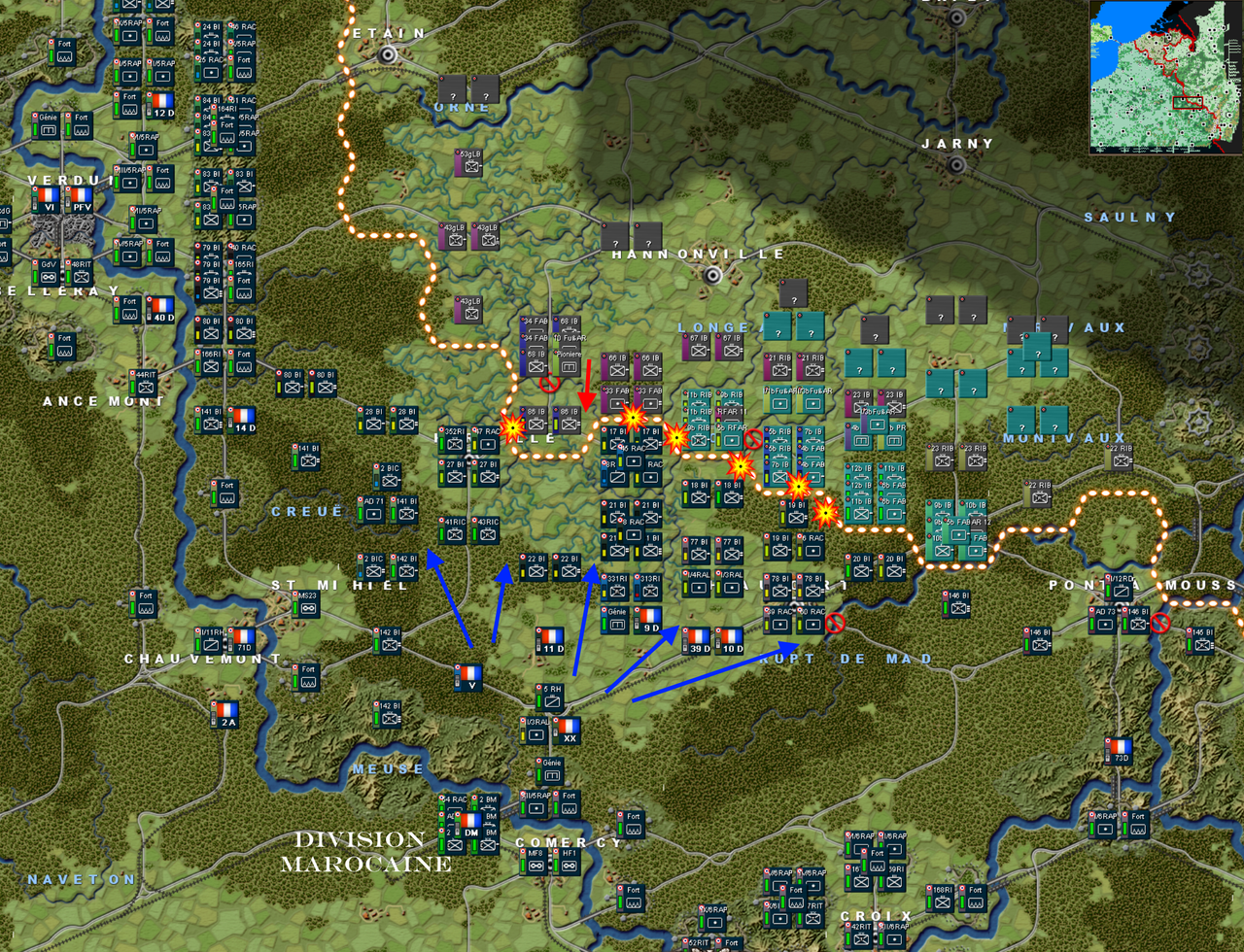
Wöevre front:
Image

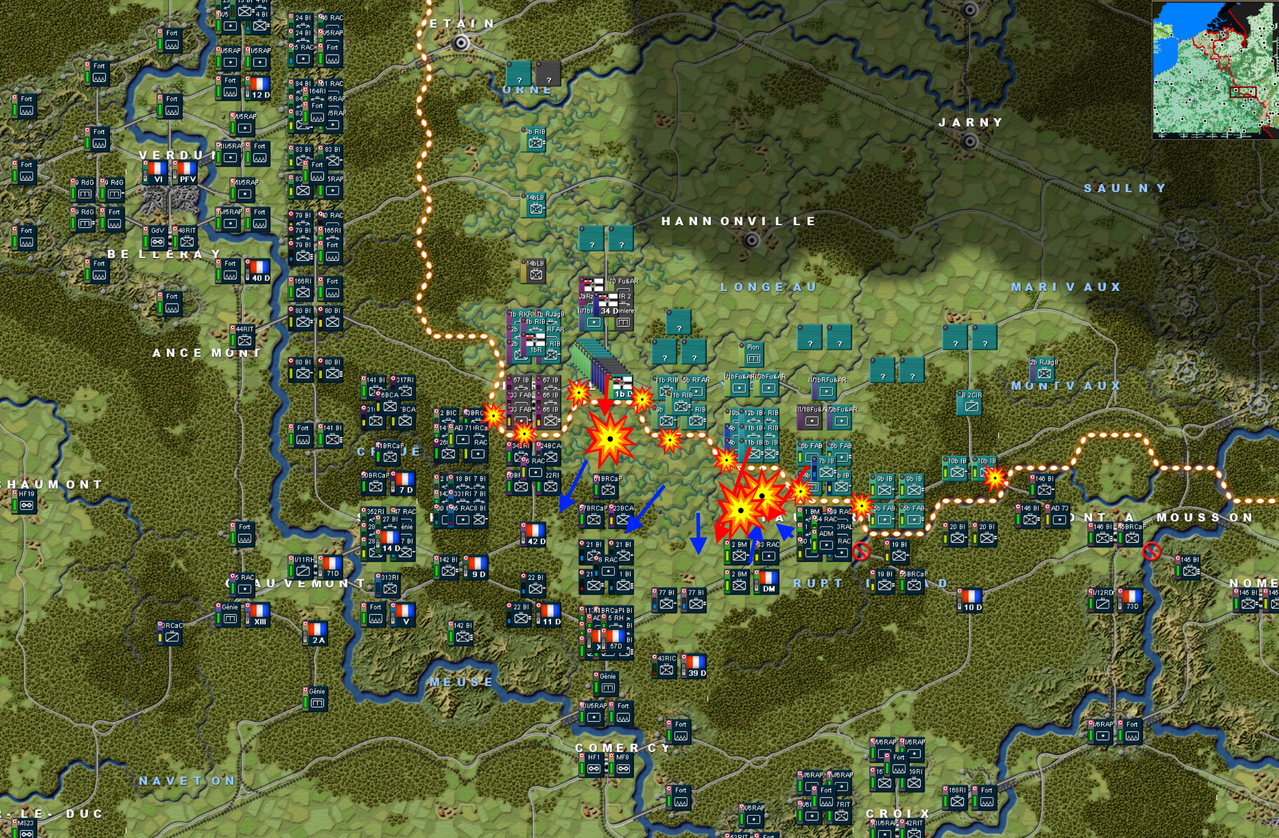
The Bavarian divisions did not loose any time and together with XVI. German Corps are starting their offensive. De Castelnau quickly moves all his reserves into place and calls for more artillery from Lorraine to be delivered quickly.


In other news:
- General Foch takes over 3. Armée. Hopefully he will do better than his predecessor and halt the German attack north of Verdun.
- The Division Marocaine is transported to Comercy to reinforce 2. Armée. It is given the 54. Régiment d'artillerie de campagne from Lorraine to further bolster it's firepower with now 72 canons de 75mm available to the division of George Humbert.
- 65. and 74. Divisions de réserve arrive from the Armée des Alpes. One already arrives at Vouziers today, the other one should arrive tomorrow. They both have a complement of chasseurs alpins (alpine troops) and will be deployed in the Argonnes in support of 3. Armée.

Conclusion:

Both sides are stripping Loraine and Alsace of any troop of value to feed the slaughter around Verdun and the upcoming battle of the left flank. The lack of artillery really hurts the French but on the open fields of Belgium the French 75mm gun and the British artillery should be able to cut down the German infantry that will have to attack frontally.
Re: Westfront 1914

Posted: Tue Aug 04, 2026 4:34 pm
by Metatron
20aoutjourn.png
20aoutjourn.png (1.73 MiB) Viewed 377 times
Source of the journals: https://gallica.bnf.fr/accueil/fr/html/accueil-fr

20 August 1914

The city and citadel of Namur fall to the Germans while the fighting around Verdun continues ferociously.
Left flank:
Image

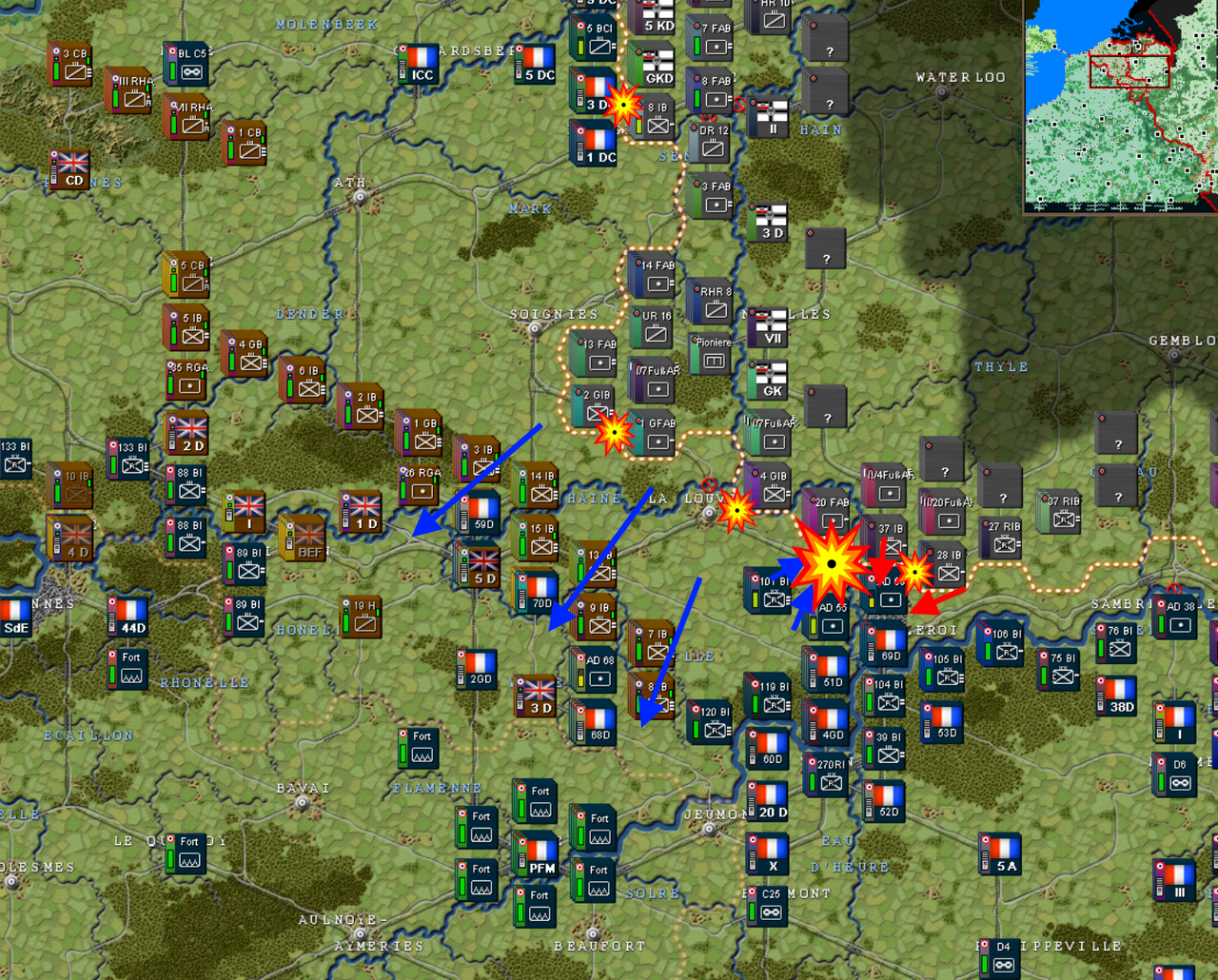
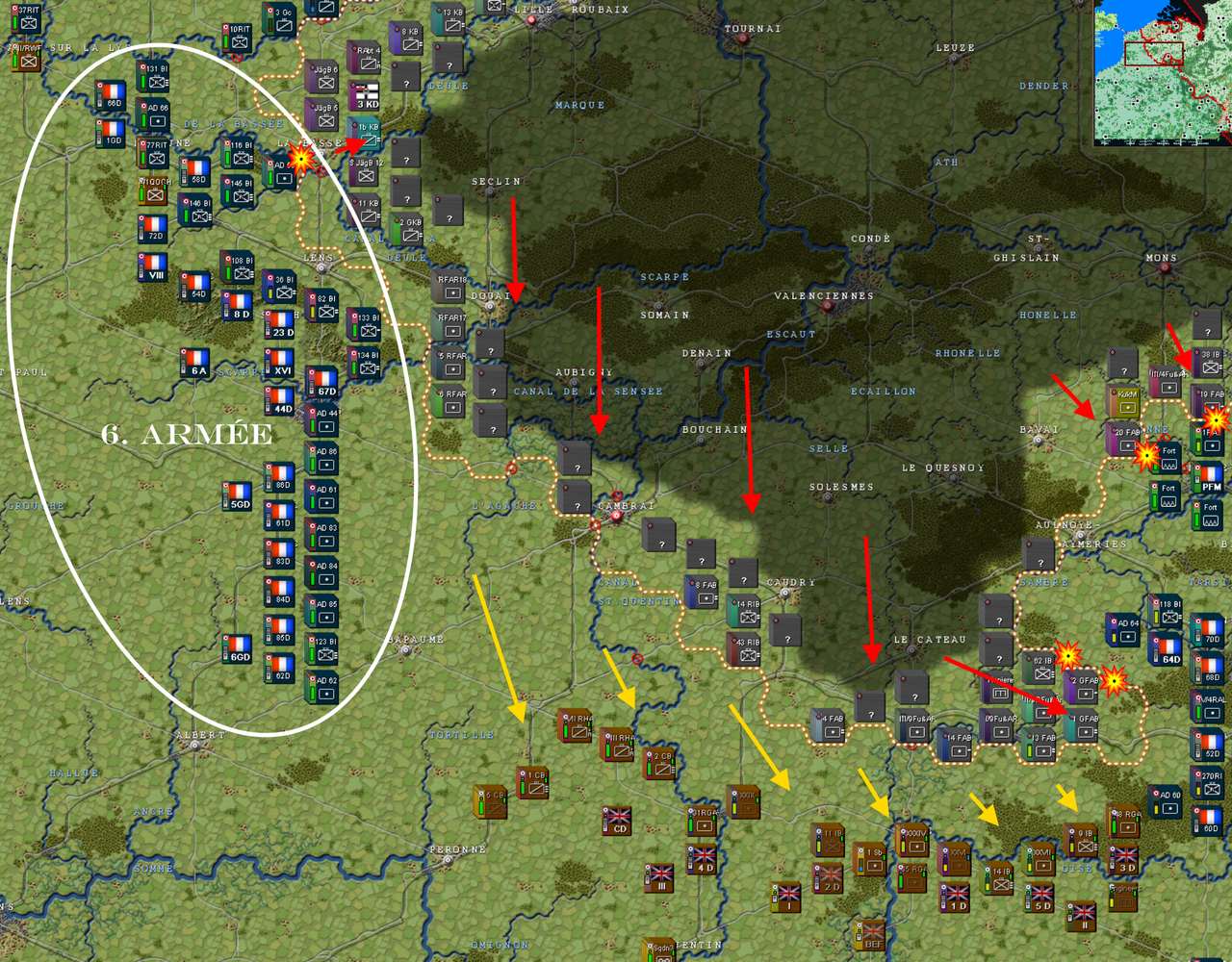
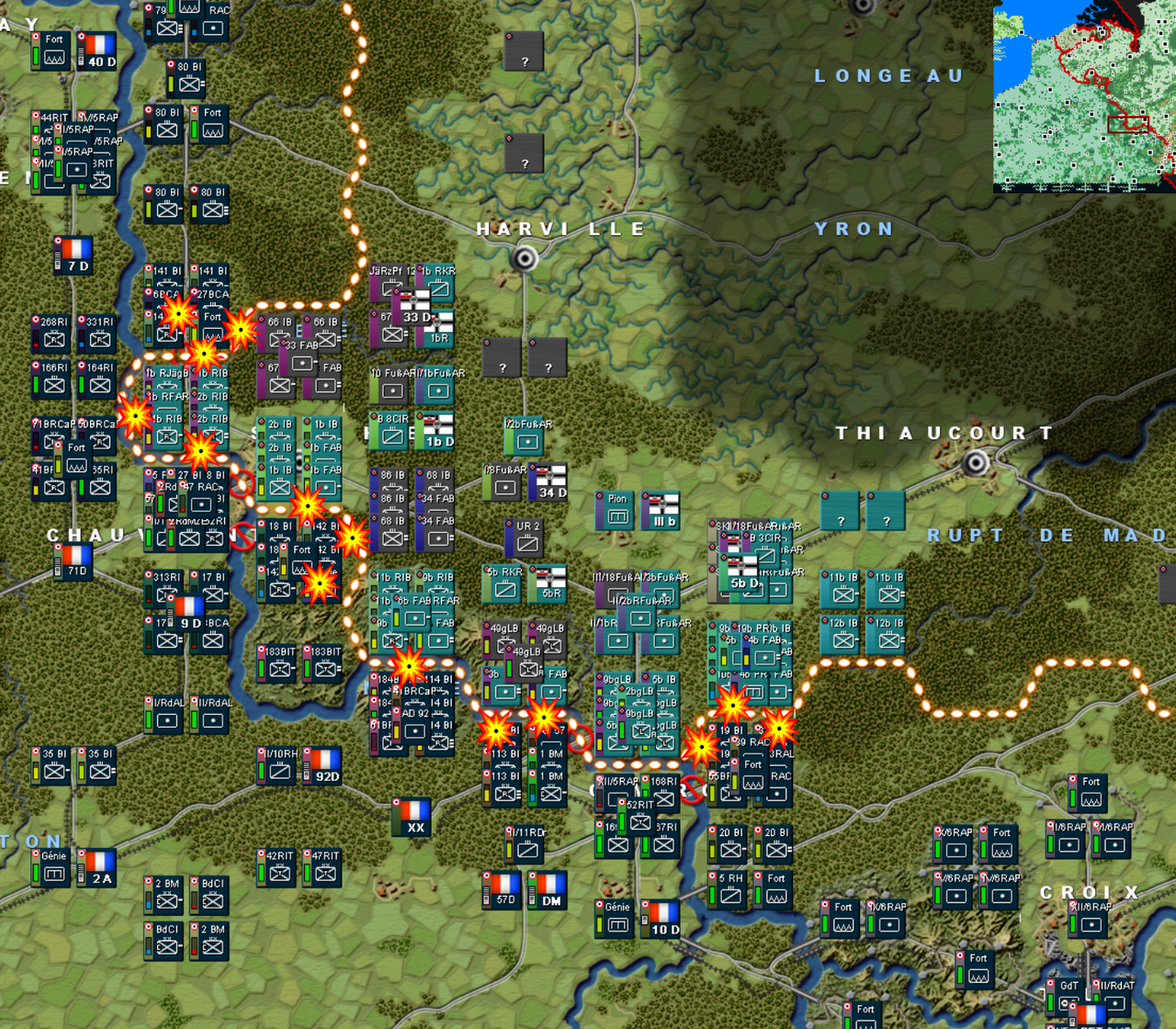
The German Guard Corps crashes into French reservists near Nivelles and crosses the canal of Louvière in force. Oskar von Hutier brilliantly organizes the attack for 1. German Guard Division which essentially annihilates 139. Brigade d'infanterie (139. BI). The French reserve divisions fall back towards Charleroi and Mons as planned since the BEF is now in place. Lanzerac has large amounts of his artillery massed in and around Charleroi hoping to bludgeon the German spearhead.

Namur:
Image

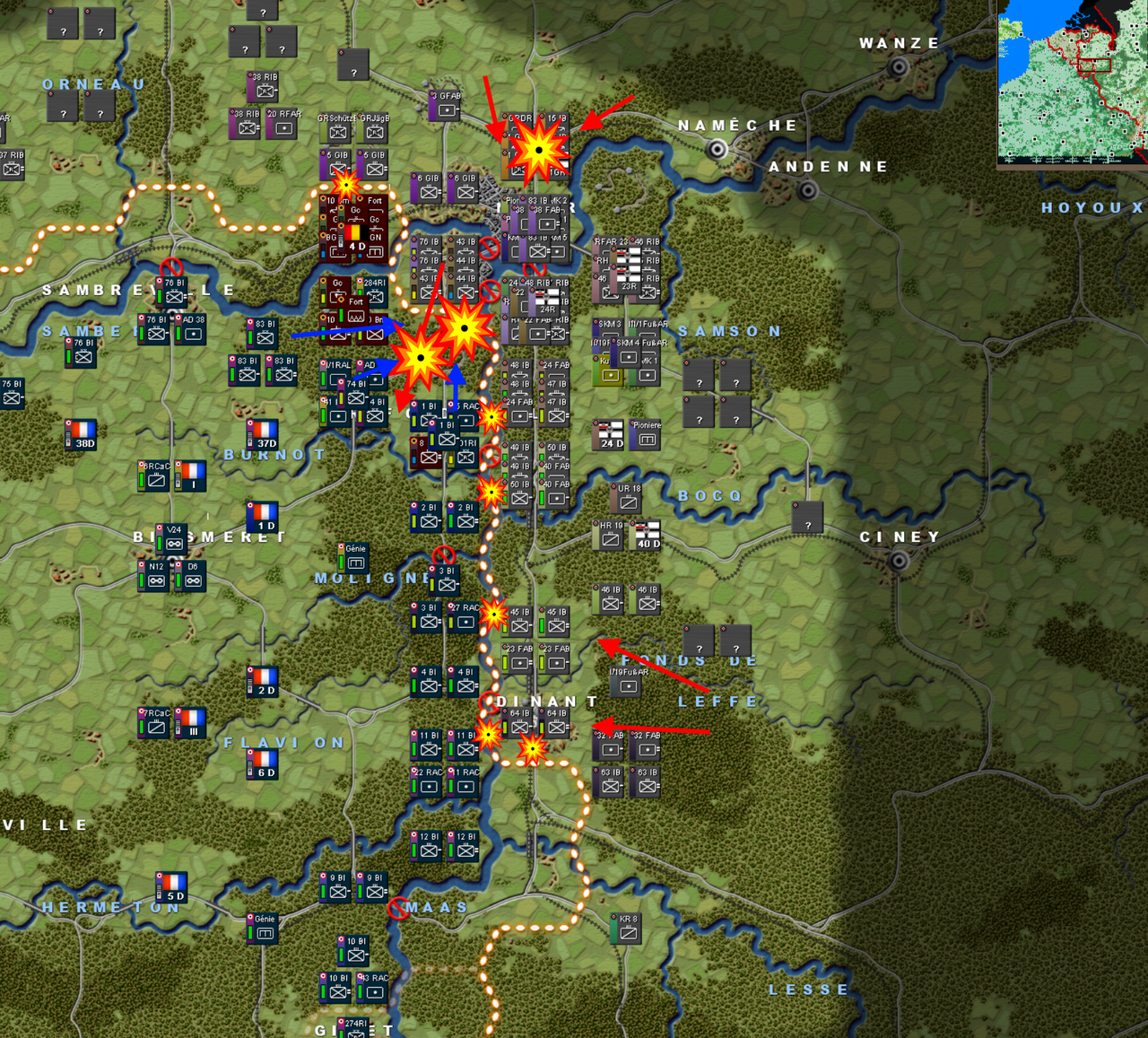
German XI. Corps continues it's assault again st Namur and manages to storm the citadel and the town as well as crossing the Meuse to reach forts de Malonne and St. Héribert. German super heavy artillery switches target one after another and the forts are hammered into dust. Fort de Marchovelette is now encircled.

Image
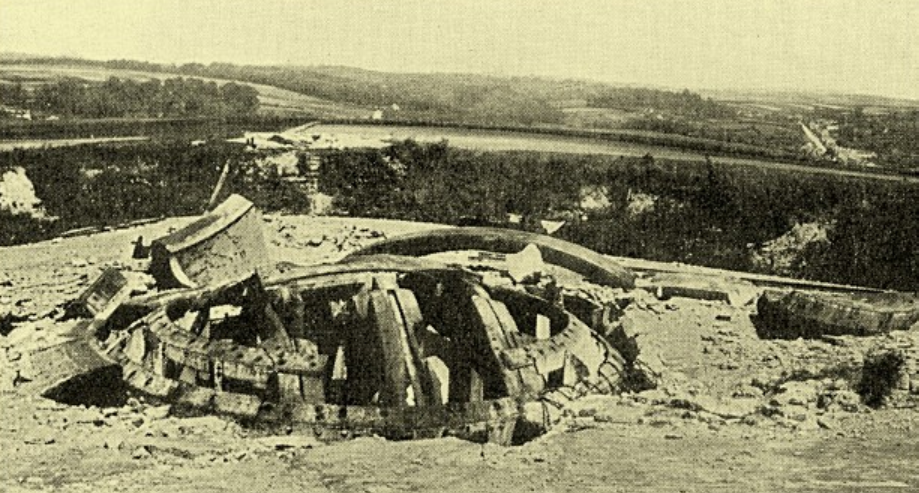
A 15cm armoured turret of fort de Marchovelette destroyed after several days of artillery fire.

Center:
Chiers front:
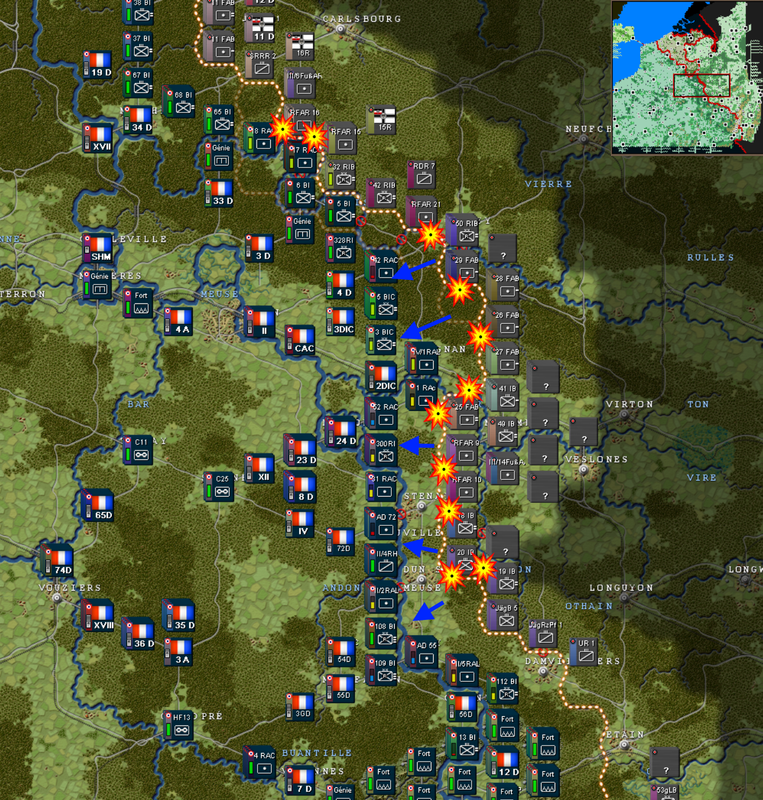
Image

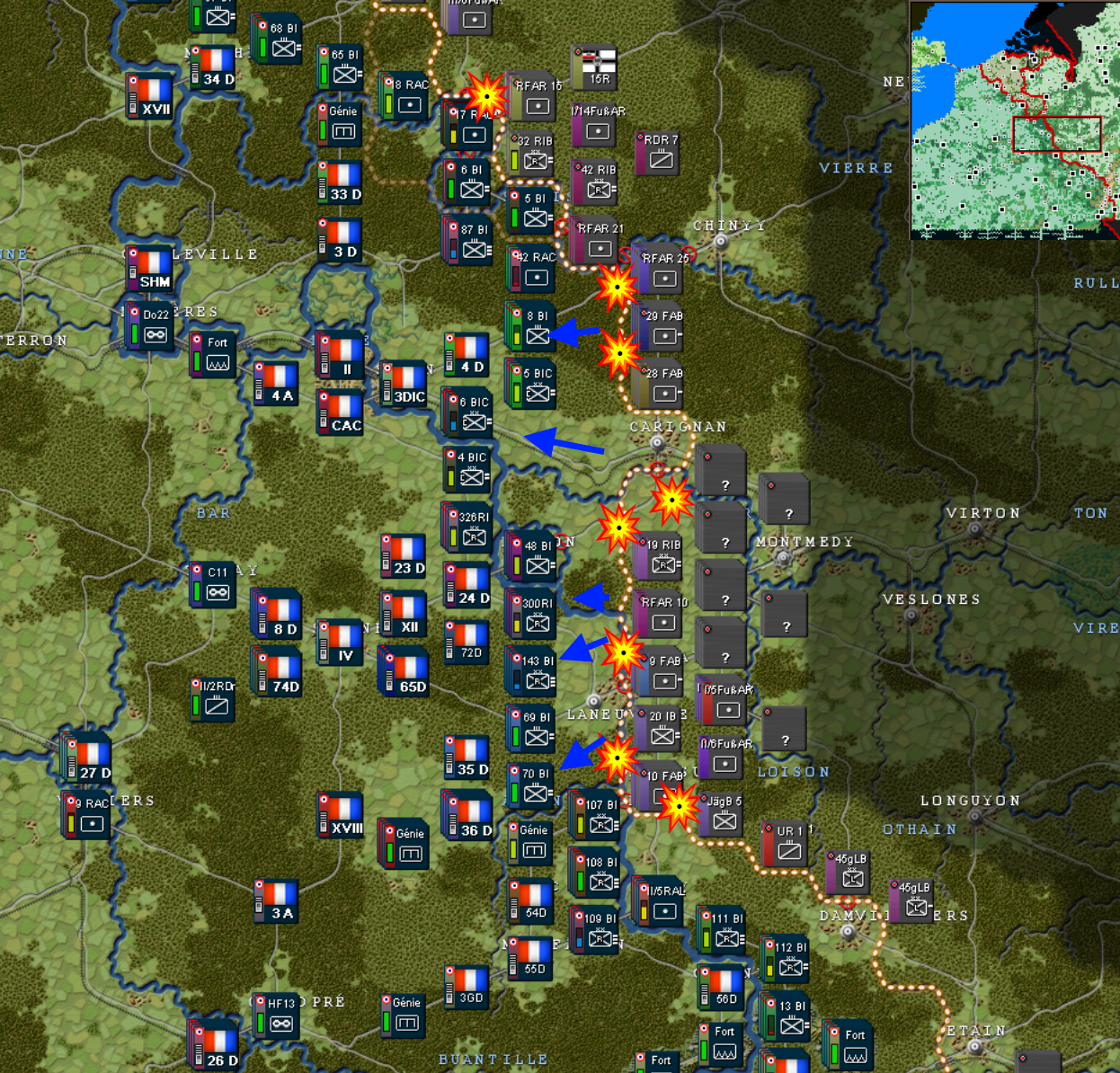
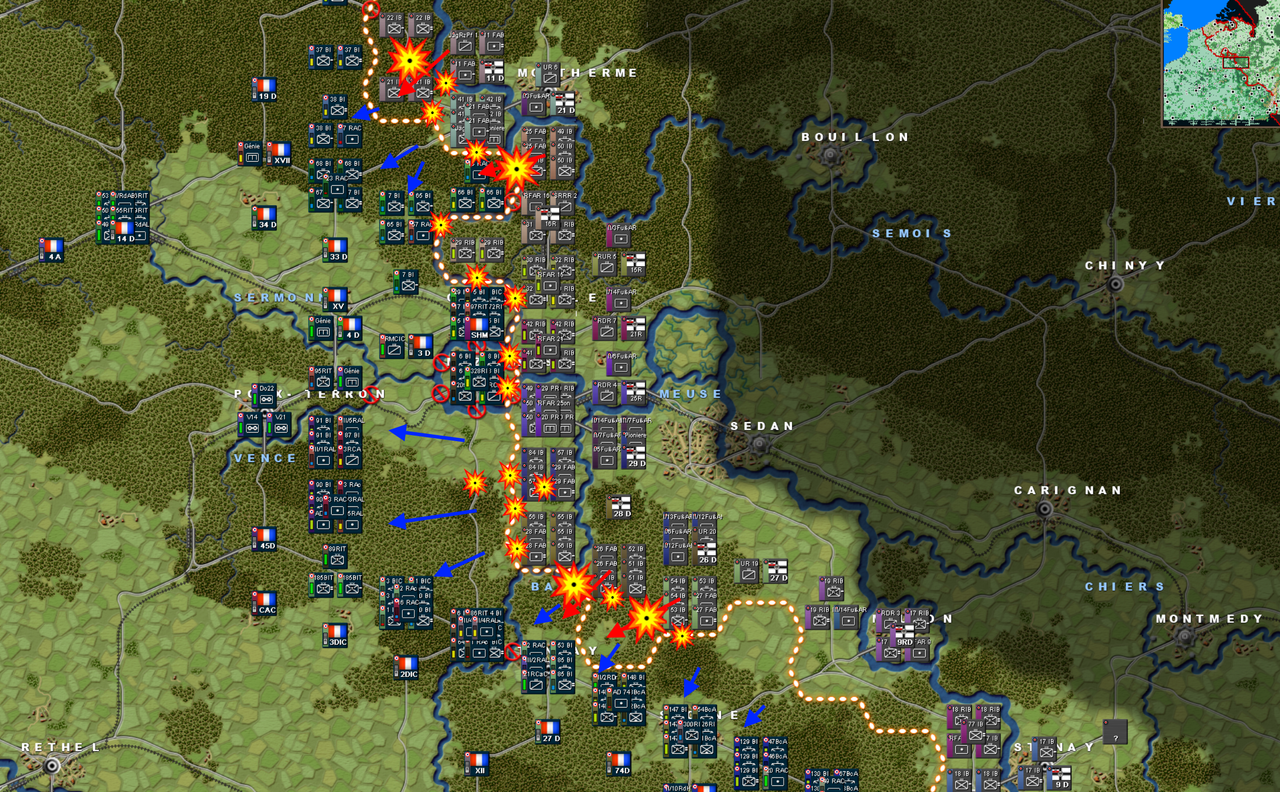
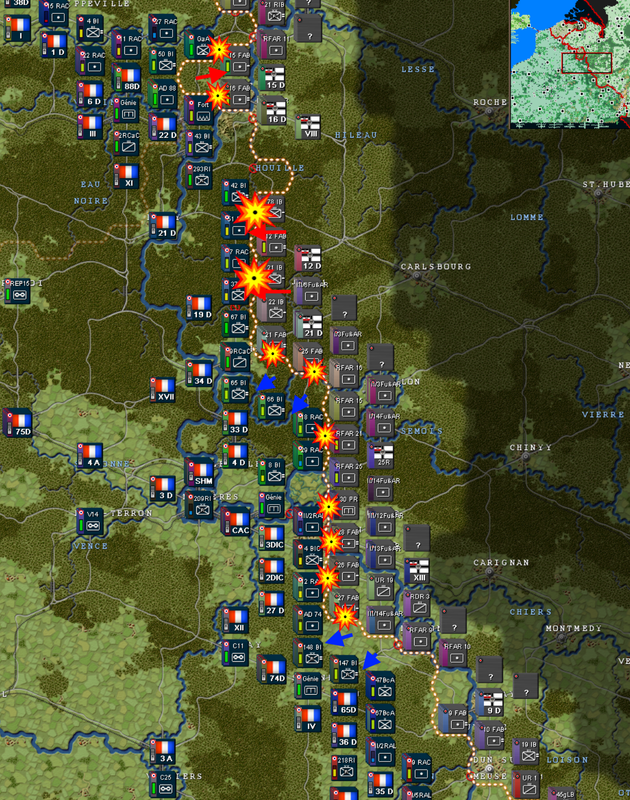
German 5. Army is concentrated into a very narrow area and is concentrating all it's artillery to smash any defensive position that 3. Groupe de divisions de réserve (3. GDR) tries to hold. Foch newly in command orders finally to fall back behind the Meuse river and to blow the bridges while his reinforcement arrive.

Further north 4. Armée of de Langle de Cary still tries to hold on to Carignan but the Corps colonial might have to fall back to Sedan sooner rather than later if it doesn't want to take on the entire German 5. Army.
Woëvre front:
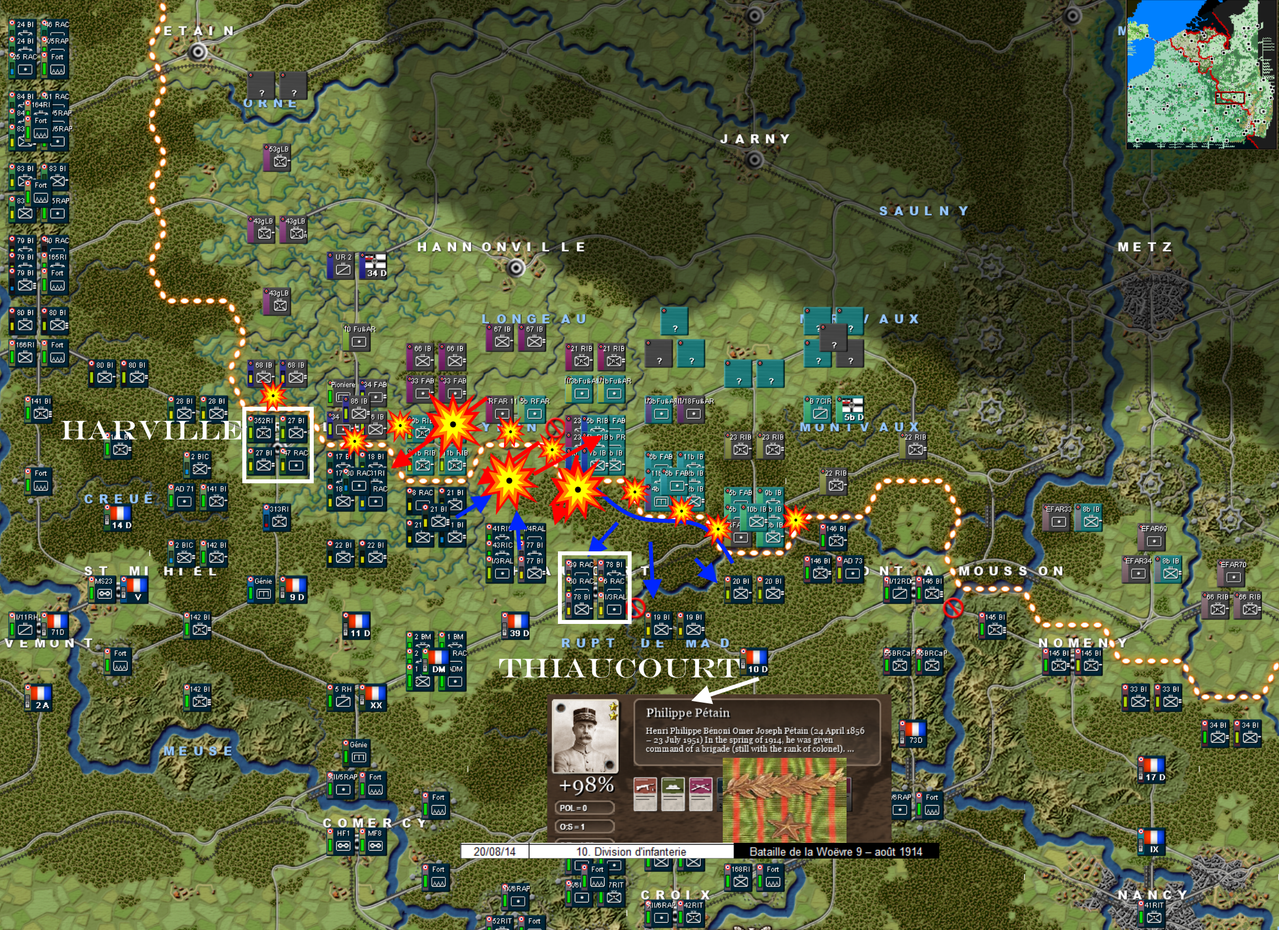
Image

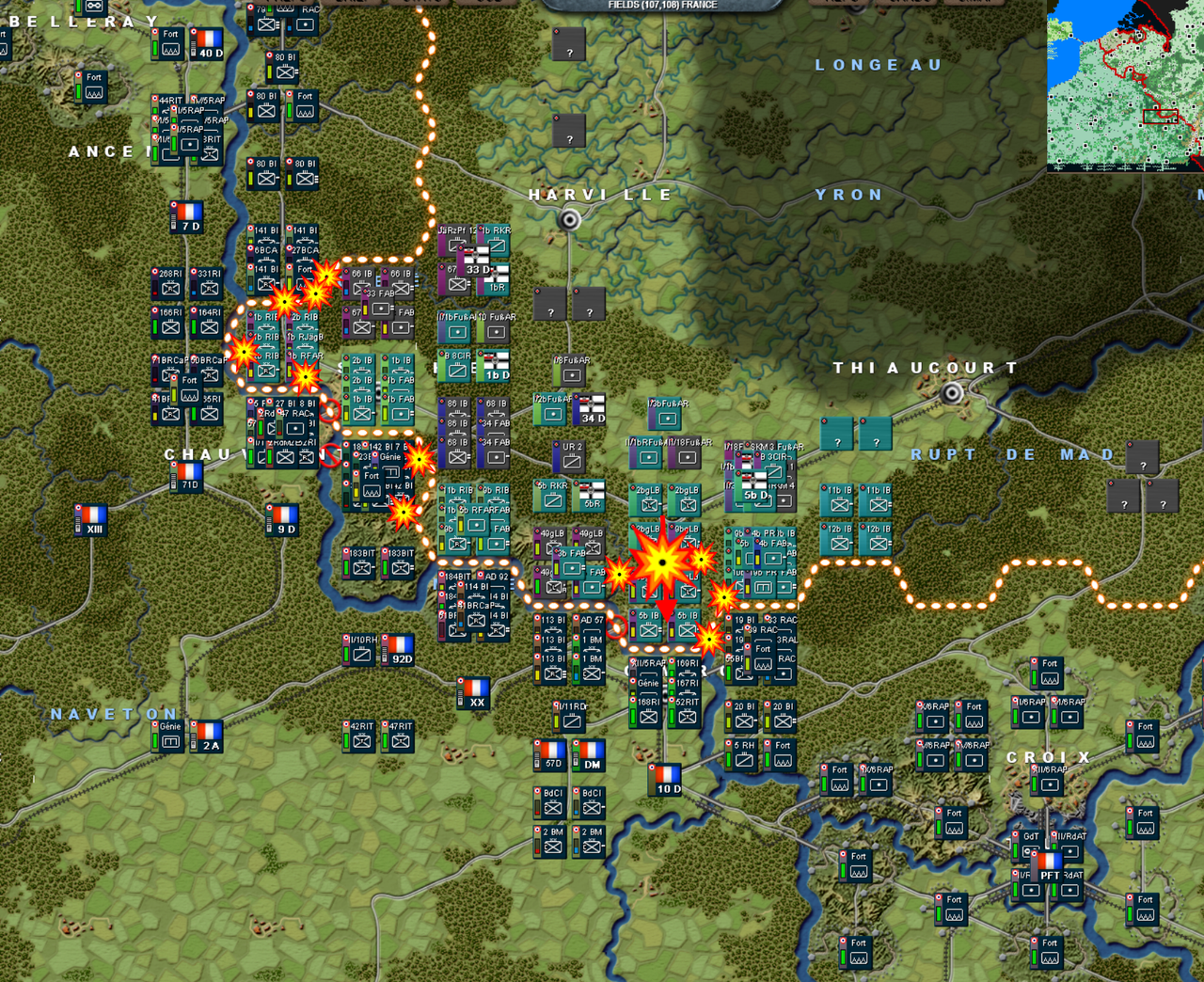
The Bavarians attack in force today using some heavy artillery and launching frontal infantry assaults but while 39. Division d'infanterie is forced back, general Pétain's 10. Division d'infanterie (10. DI) holds it's ground admirably holding off an entire Bavarian Corps by itself and inflicting heavy casualties. Concentrating artillery against the most vulnerable Bavarian units XX. Corps d'armée launches a counter attack that repulses 4. Bavarian Division with heavy casualties. It is the best performance of the French army so far with both sides suffering around 8500 casualties during the day's fighting instead of the 1:2 or 1:3 casualty ratios that prevailed until now to the disadvantage of the French.
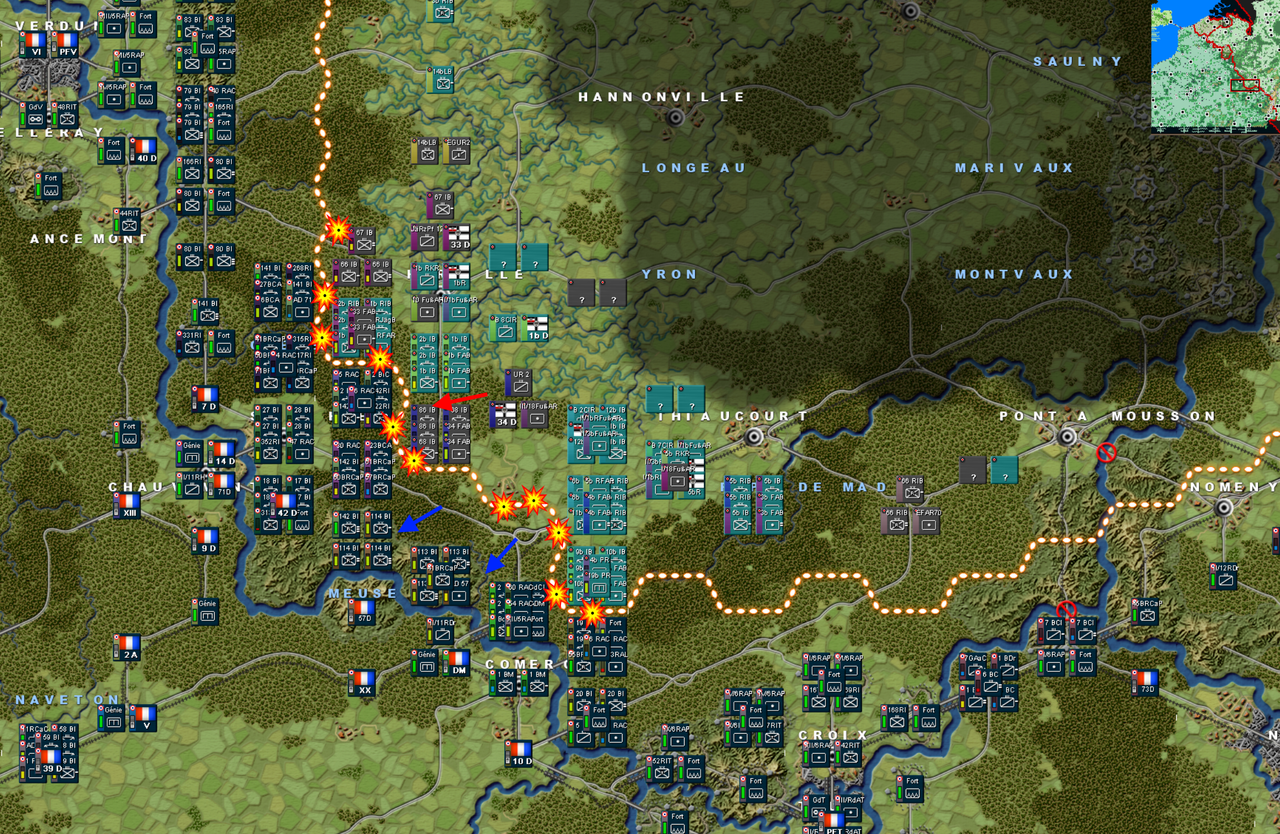
Nonetheless general de Villaret orders 10. DI to fall back to avoid being crushed by concentrated German heavy artillery fire and preserve the unit. Meanwhile the Division Marocaine moves foward to continue the pugnacious defense of the Thiaucourt-Harville line.

In other news:
- 10. Division d'infanterie was named at the Citation à l'ordre de l'armée of the 20. August 1914 for it's tenacious defense during the battle of the Woëvre.
- 4. Division of the BEF arrived at Valenciennes today but the rest of III. Corps will only arrive in more than a week.
- Good news from the eastern front, it looks like the Russian Army is entering East Prussia earlier than expected and is threatening to cut off the German 8. Army from the Oder river.

Conclusion:

Good generals and massed artillery proved in the Woëvre that the Boches can be stopped. It remains to be seen if Foch can do the same to hold the Meuse north of Verdun while the British and 5. Armée need to do the same on the Sambre and around Mons.

Re: Westfront 1914

Posted: Wed Aug 05, 2026 3:41 pm
by Metatron
21aoutjourn.png
21aoutjourn.png (1.72 MiB) Viewed 362 times
Source of the journals: https://gallica.bnf.fr/accueil/fr/html/accueil-fr

21 August 1914

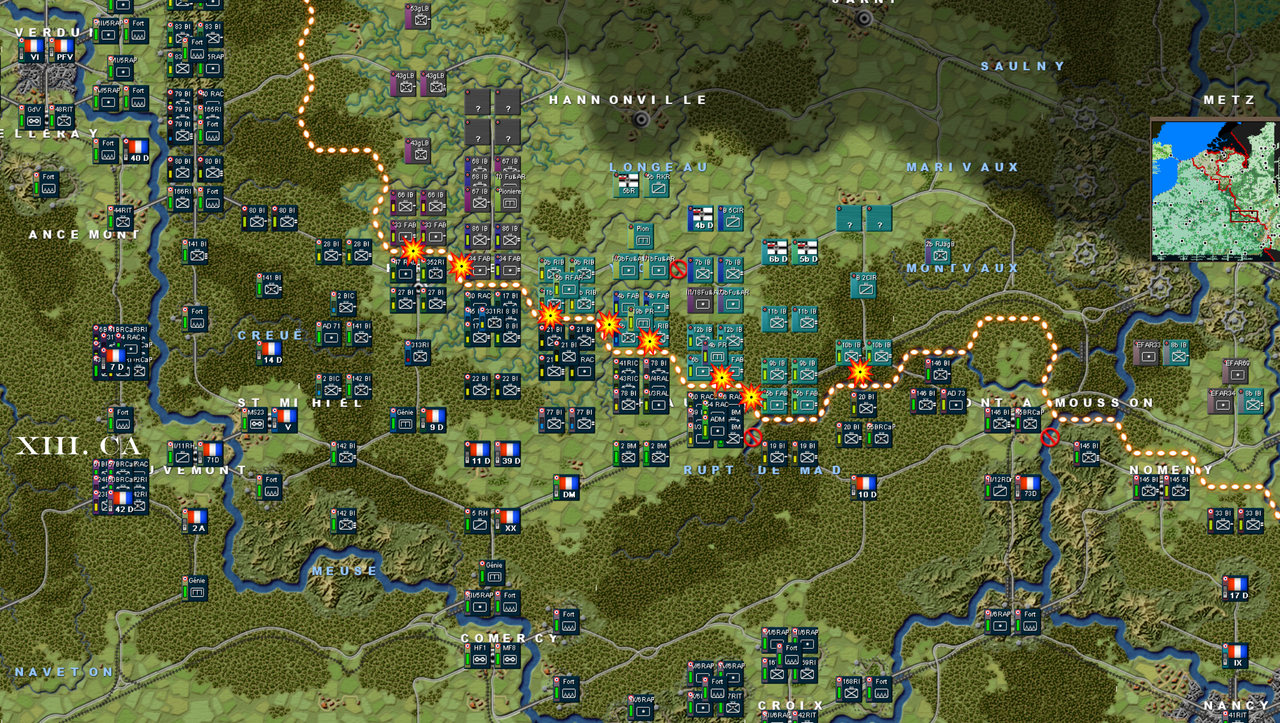
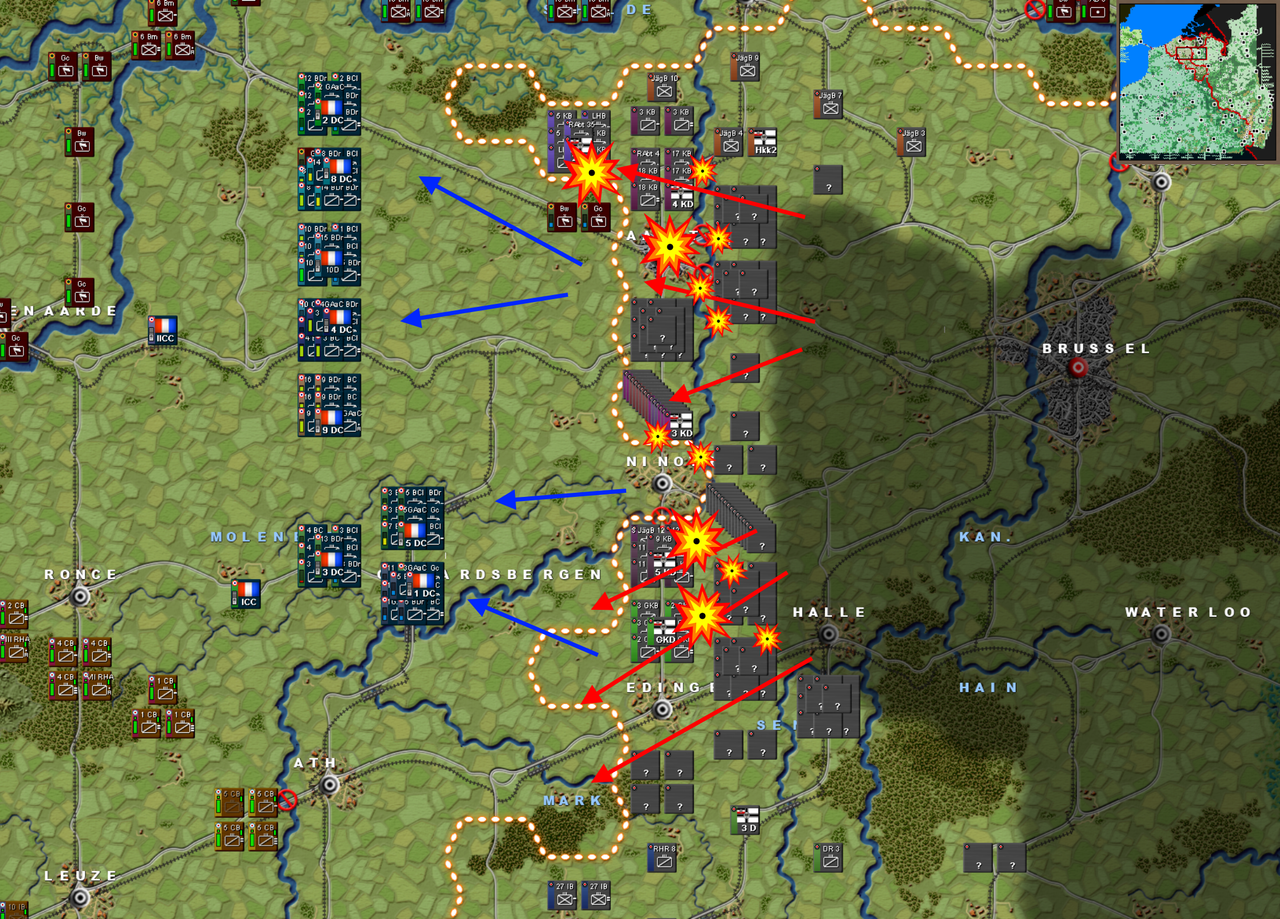
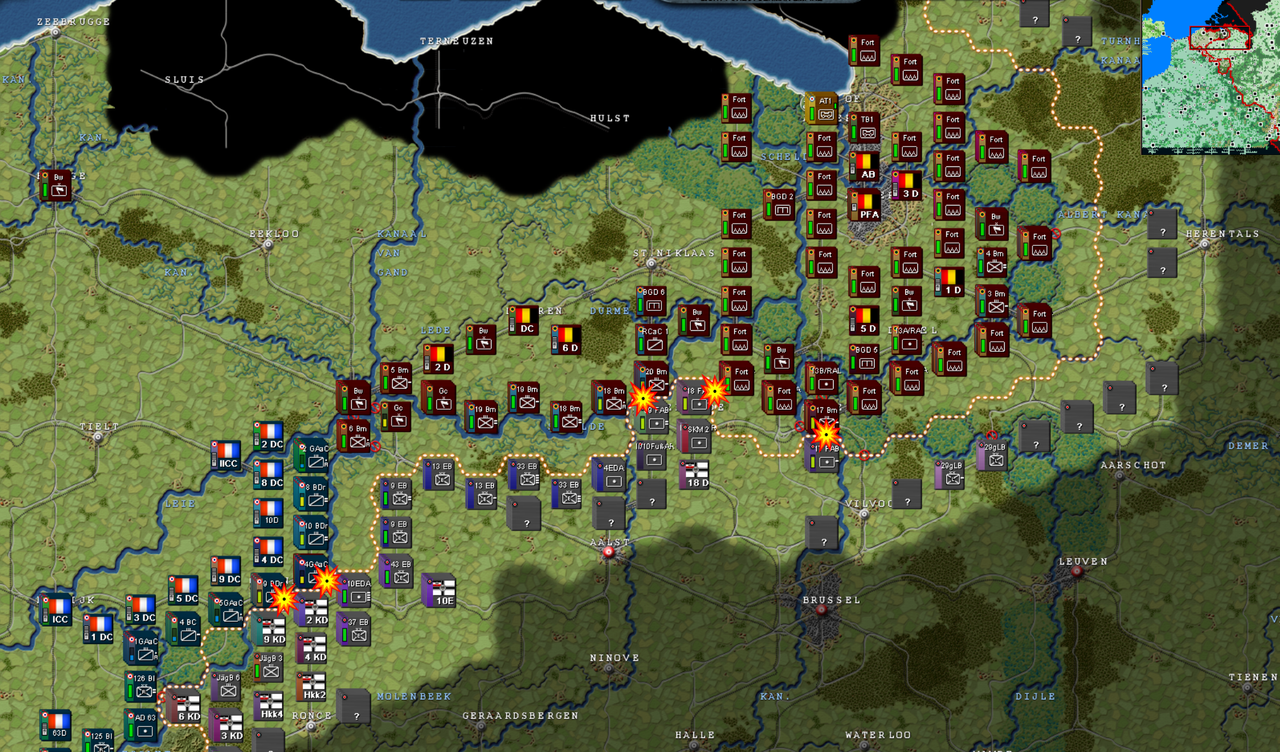
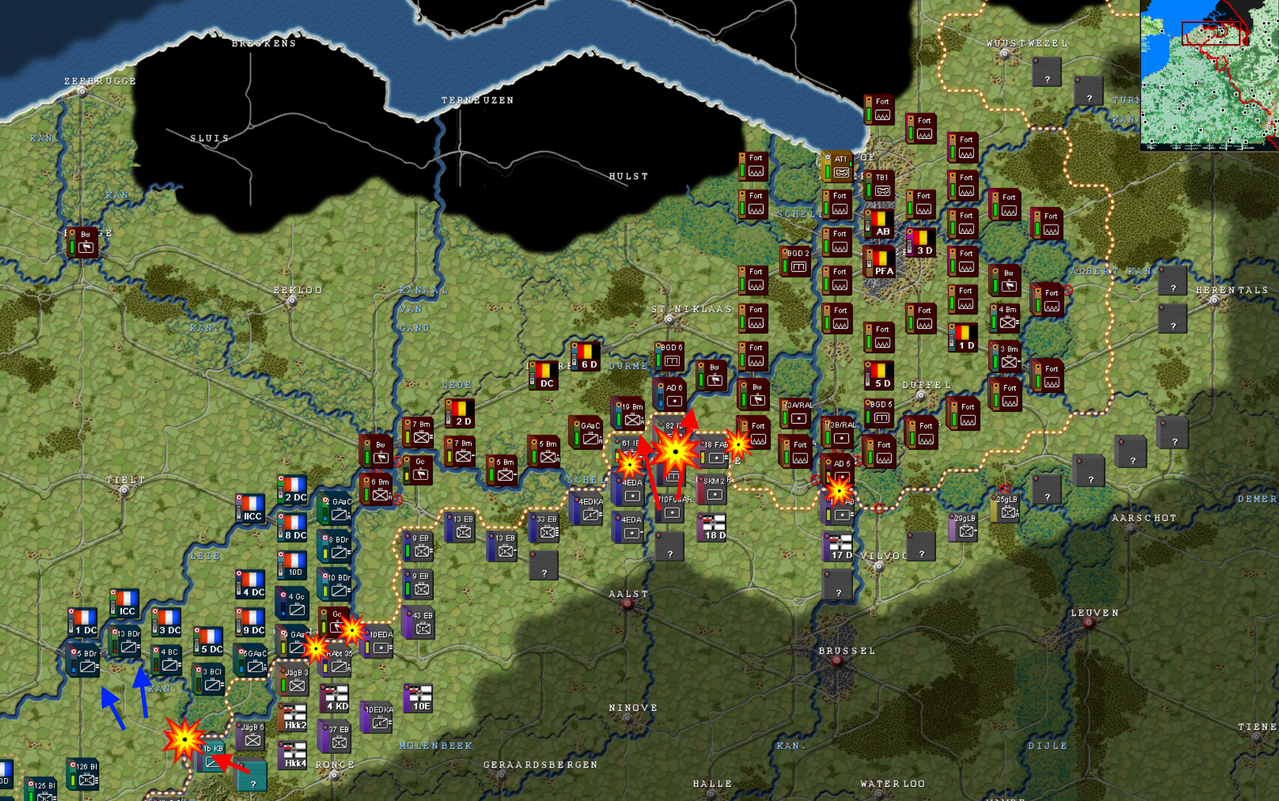
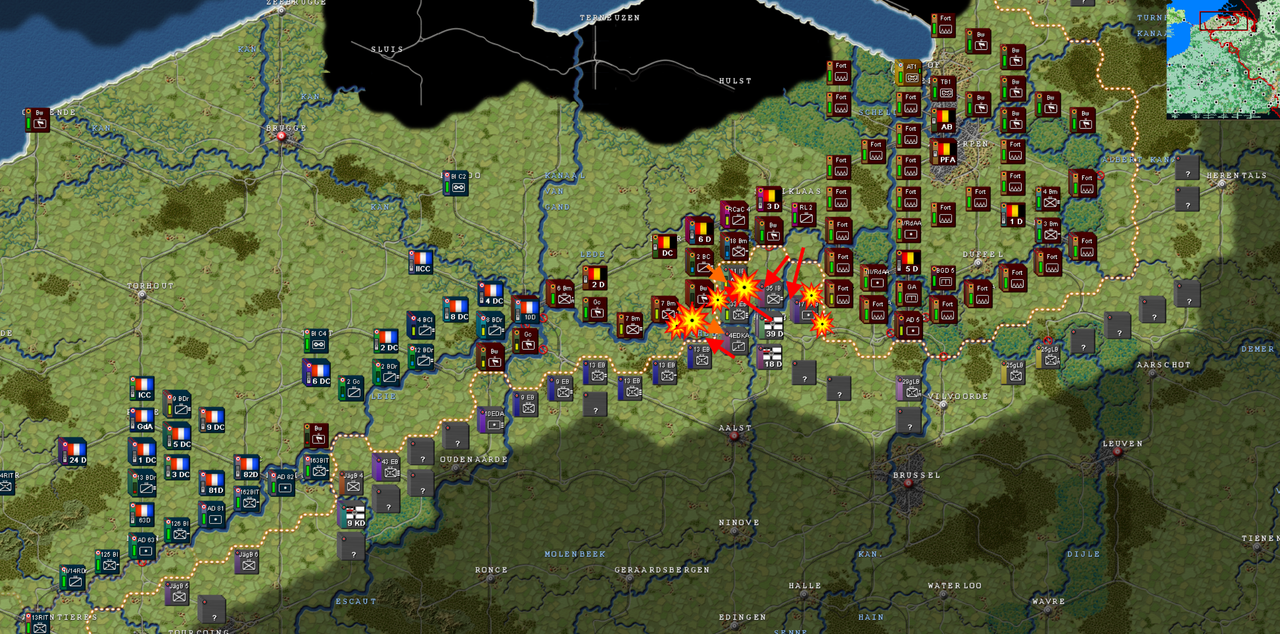
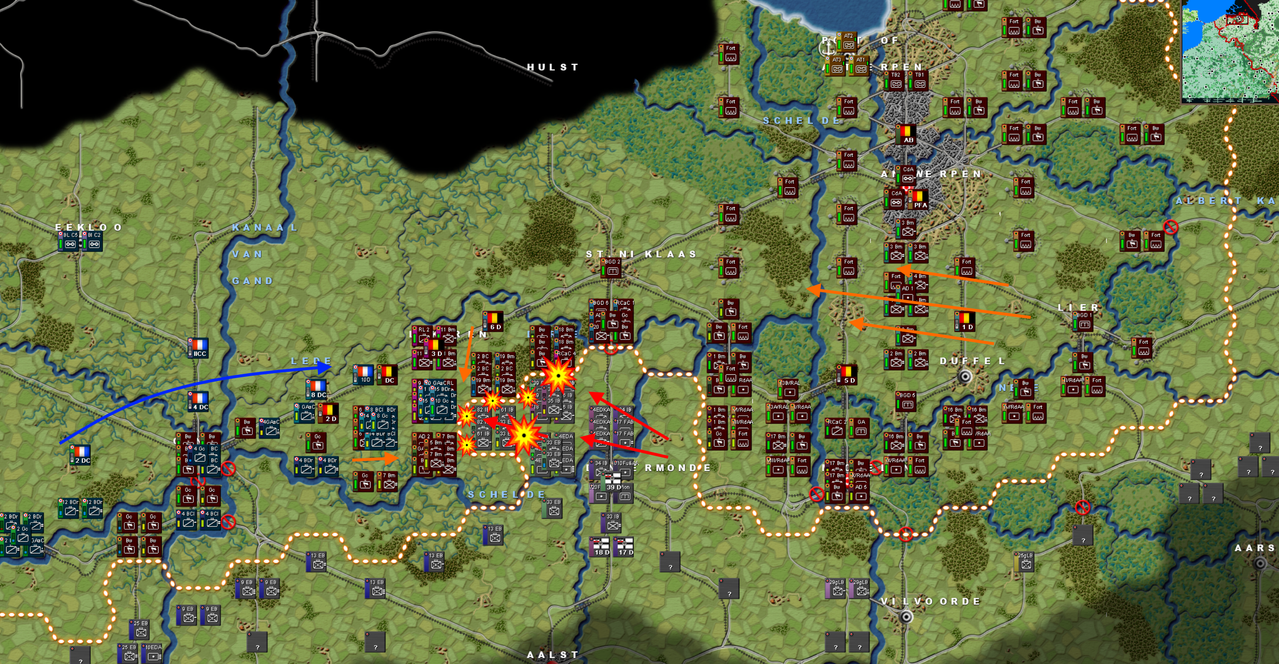
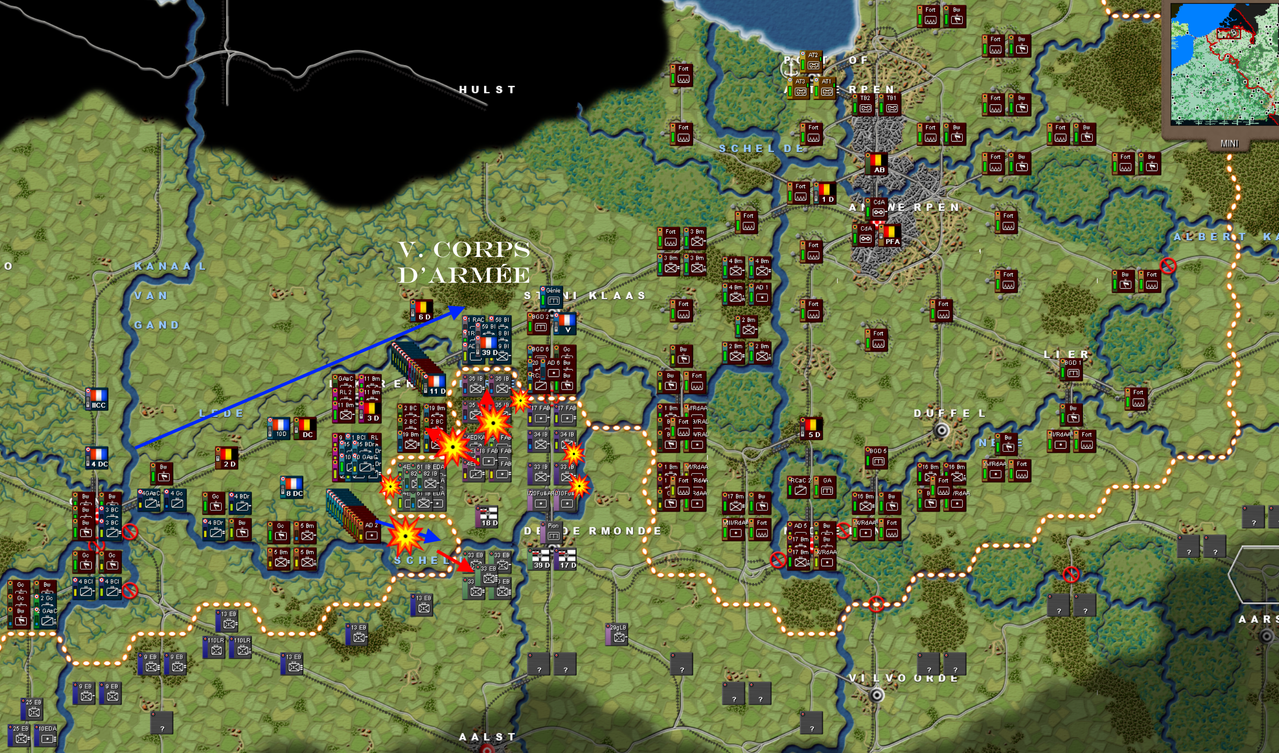
A massive cavalry battle begins around Aalst for the control over the river Dender. Concentrated French artillery allows an effective defense locally but the pressure of the German 5. Army is still too great for the defenders of the Meuse north of Verdun.

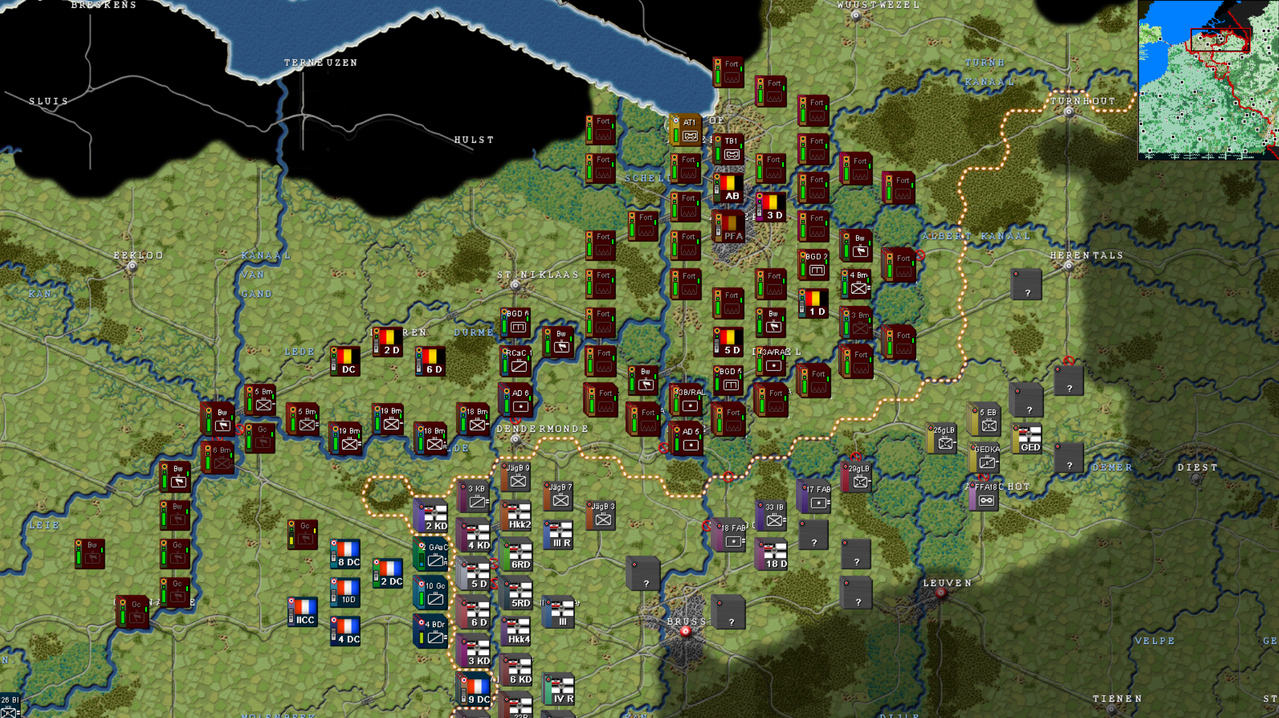
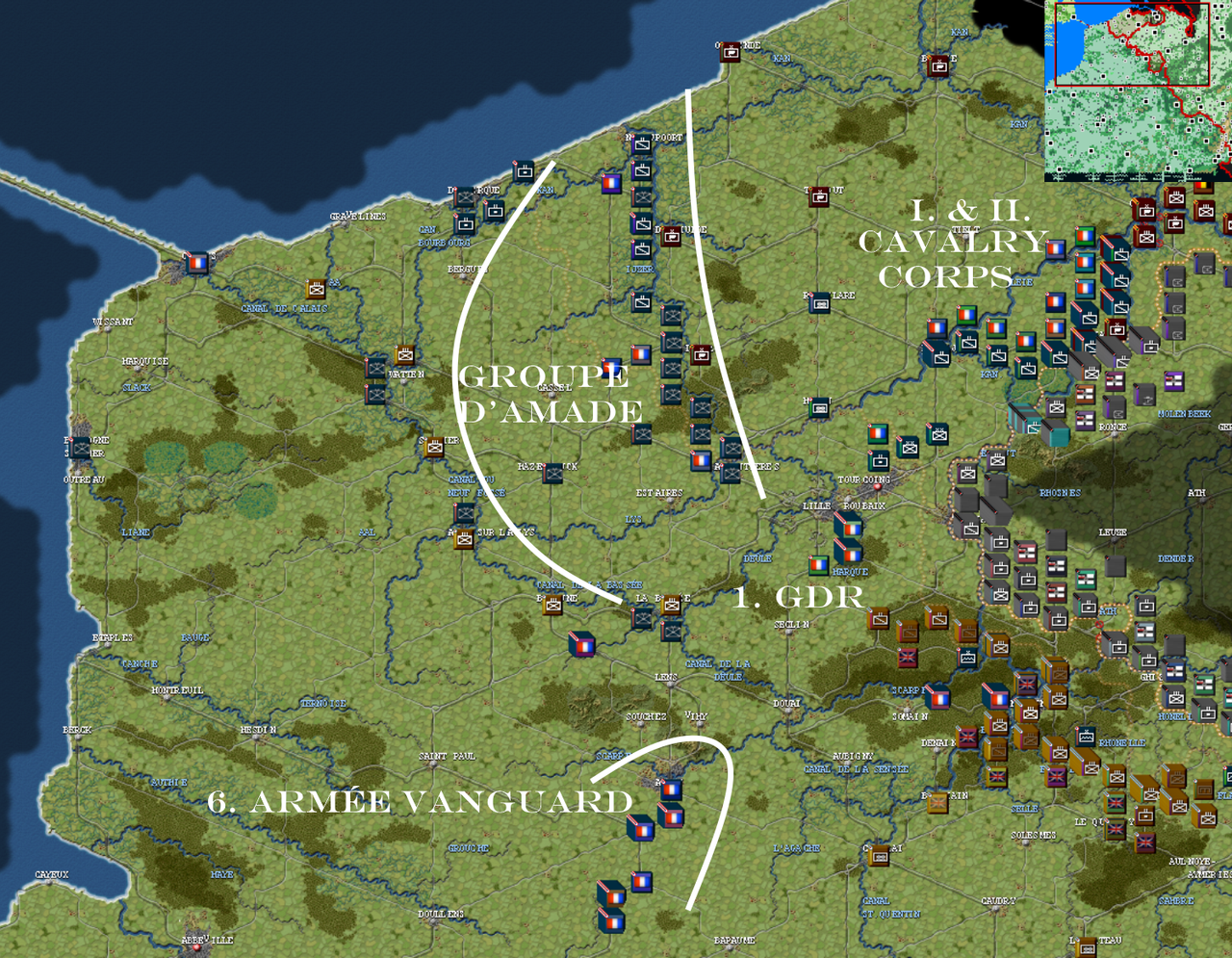
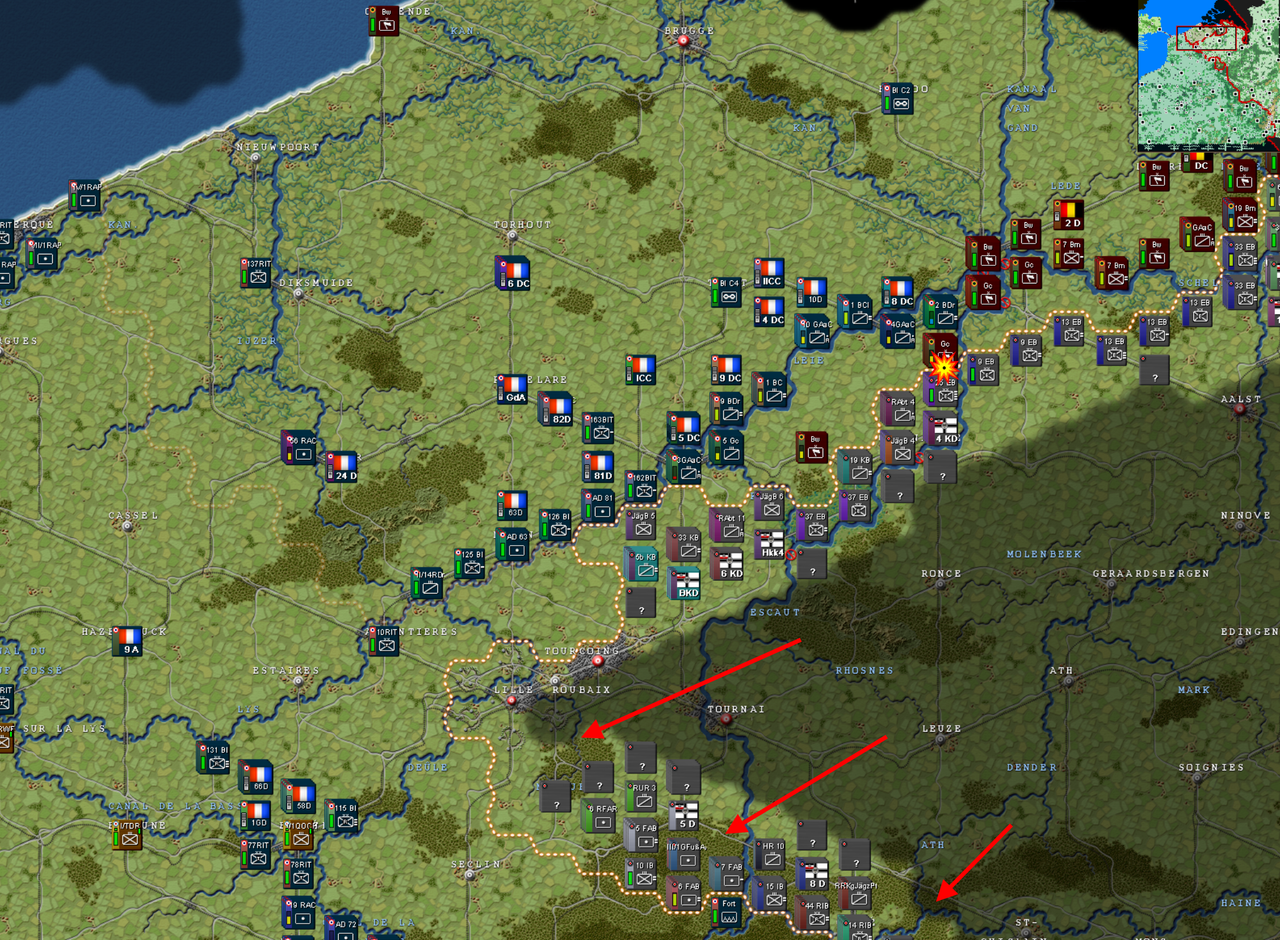
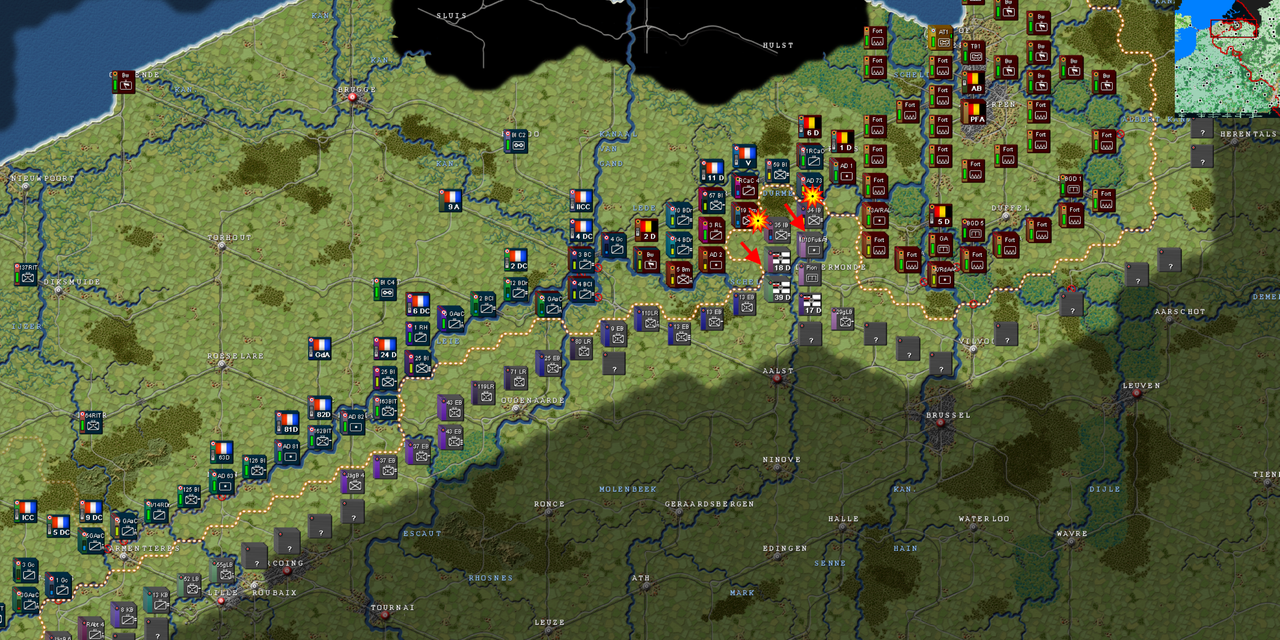
Coastal situation:
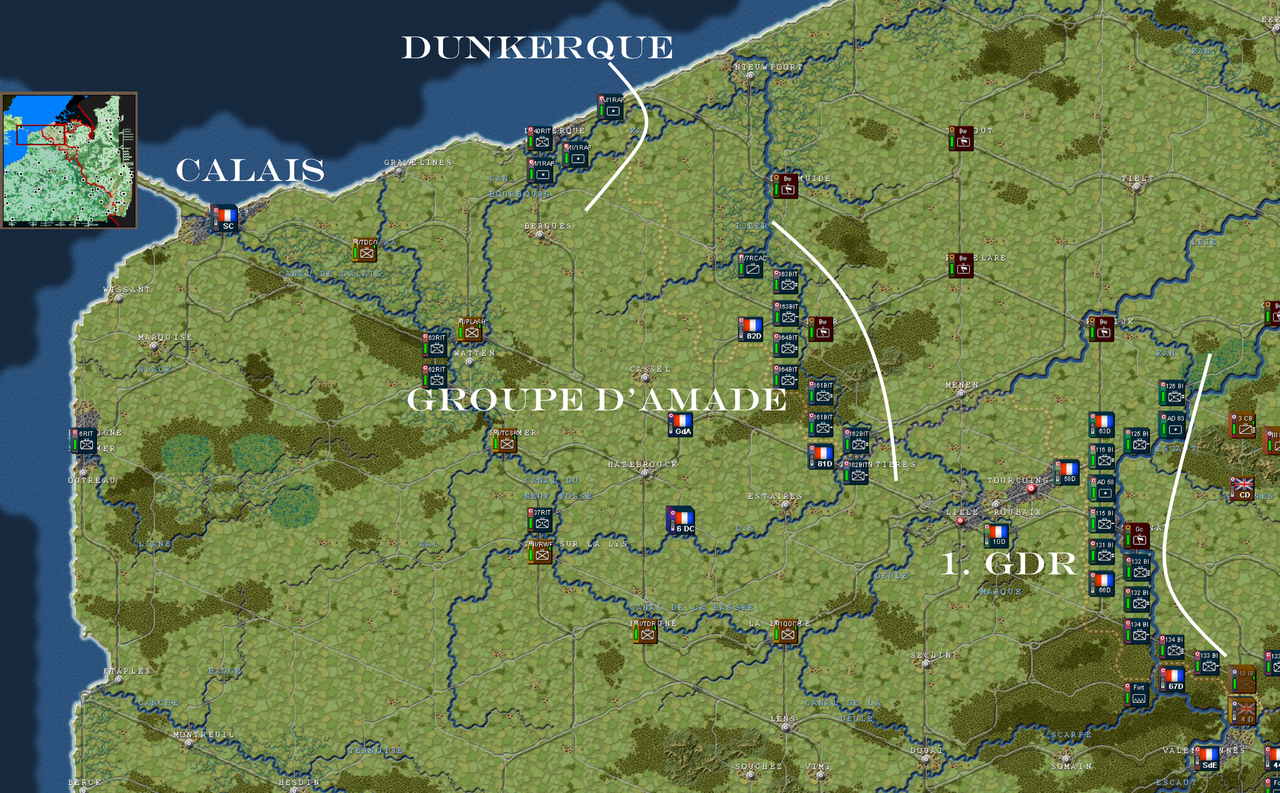
Image
Smaller territorial units and British battalions have set up to defend the rivers of Flanders and stop any attempt by German cavalry to quickly outflank the British army. The small forts of Dunkerque anchors this line on the sea while Groupe d'Amade (including the reformed 6. Division de cavalerie) and 1. Groupe de division de réserve are set up on the Ijzer and the Escaut.

Left flank:
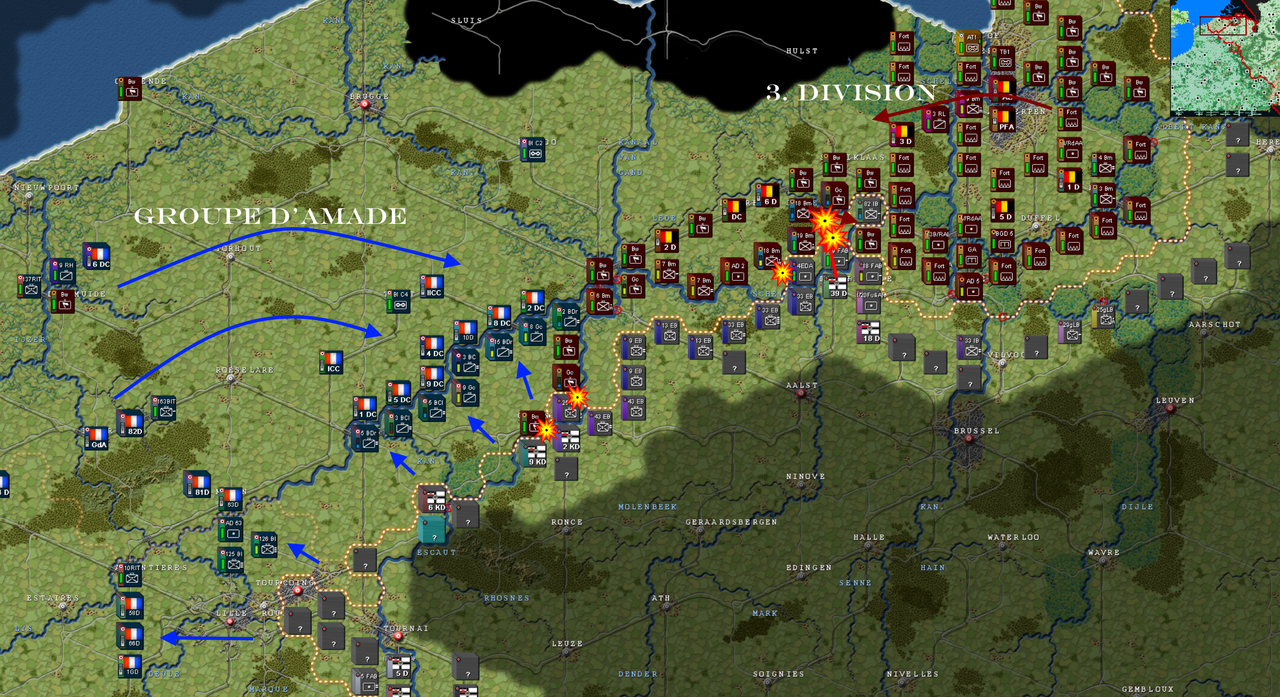
Aalst area:
Image

2. Division de cavalerie hold the town of Aalst against the combined attacks of German 4. and 9. Cavalry Divisions. As the German cavalry crosses the Dender around Aalst I. and II. Corps de cavalerie counter attack.

2. and 4. German cavalry division retreat in the face of the French charges in open fields. 2. Division de cavalerie (2. DC) participating in both the defense and the counter attacks is named in the Citation à l'ordre de l'armée of the day. On the right flank of the French cavalry corps' 1. DC and 3. DC smash into the German 4. Infantry Division inflicting heavy casualties on the vanguard units.

By ends day 3500 French horsemen are among the casualties but the Germans count 5500 casualties. Aalst and the Dender hold for now but German infantry divisions are arriving from Bruxelles.

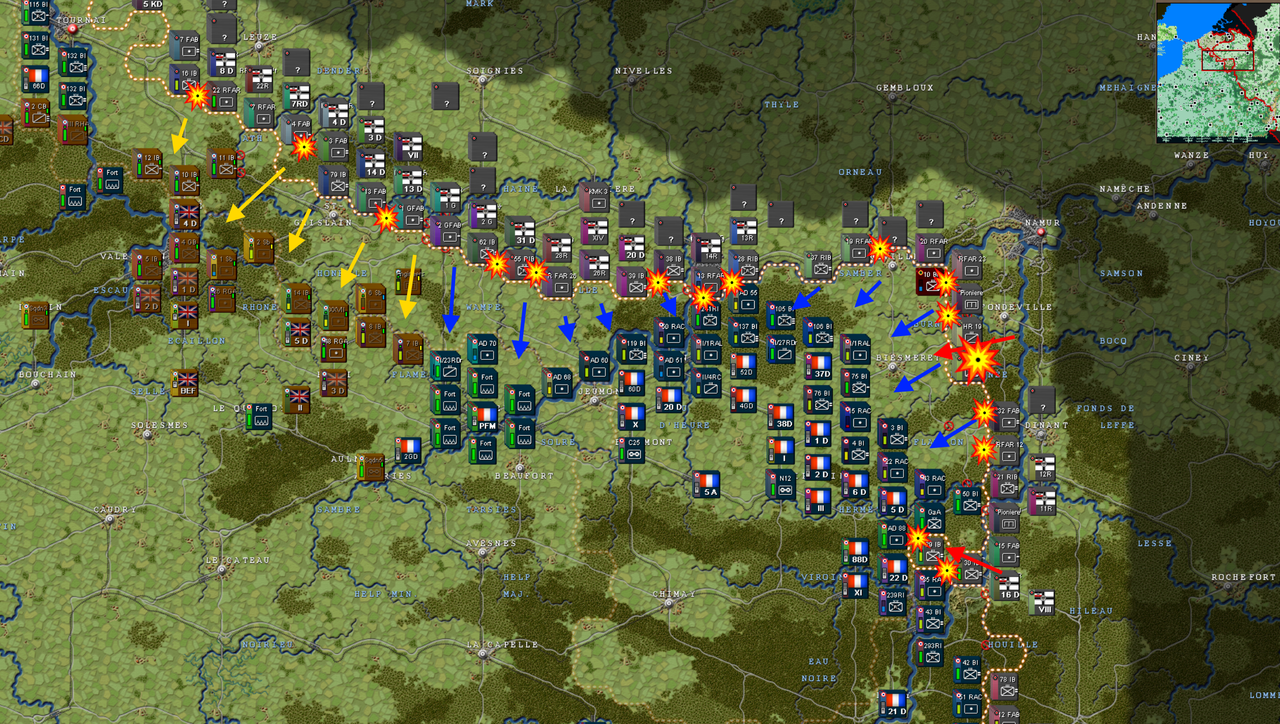
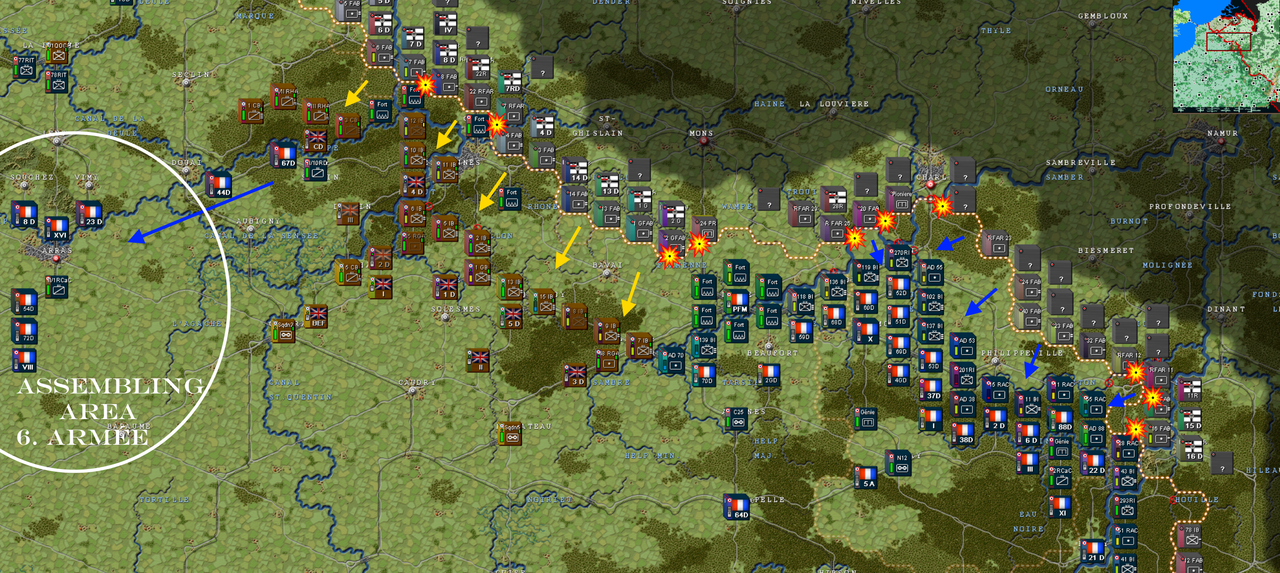
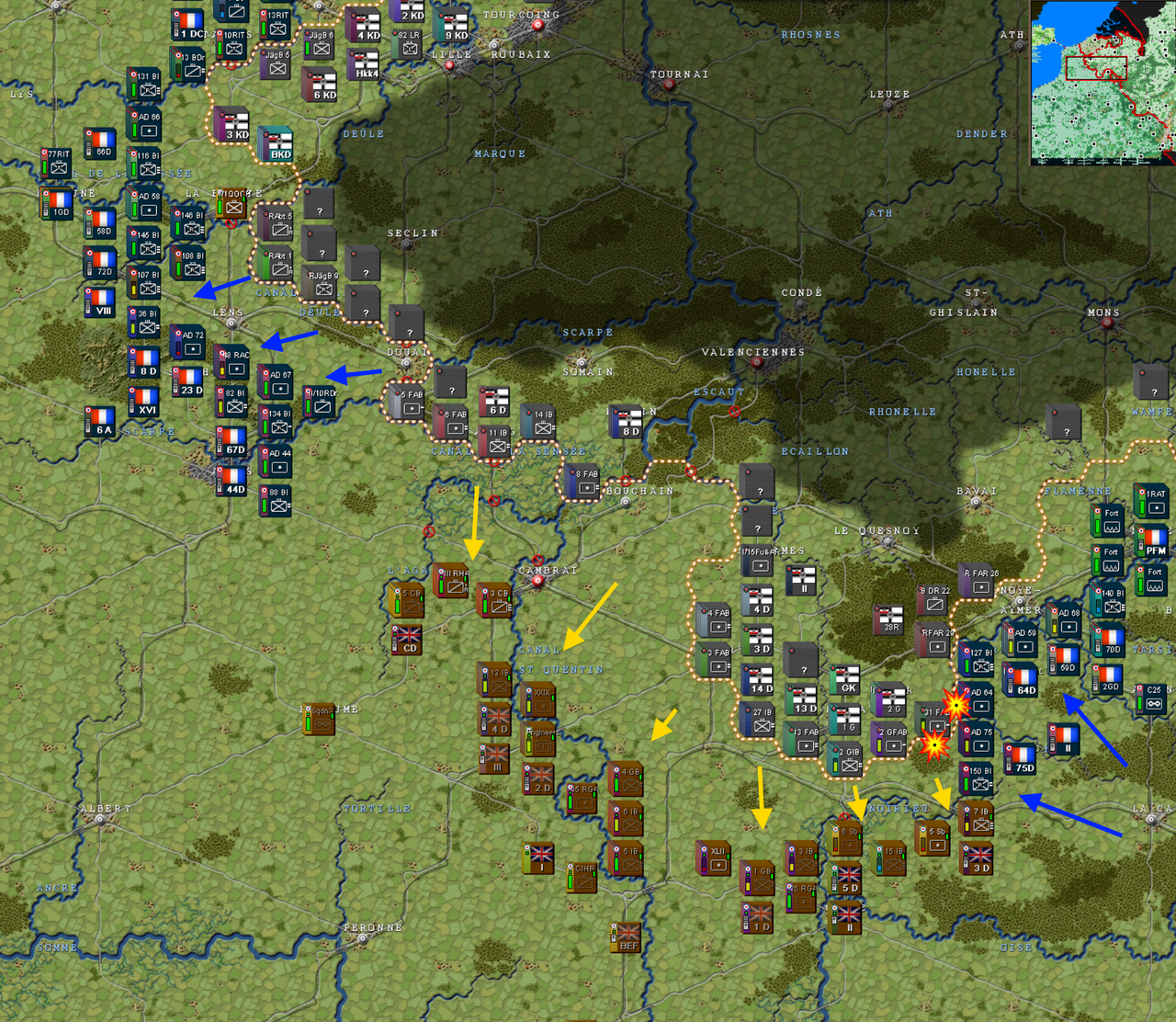
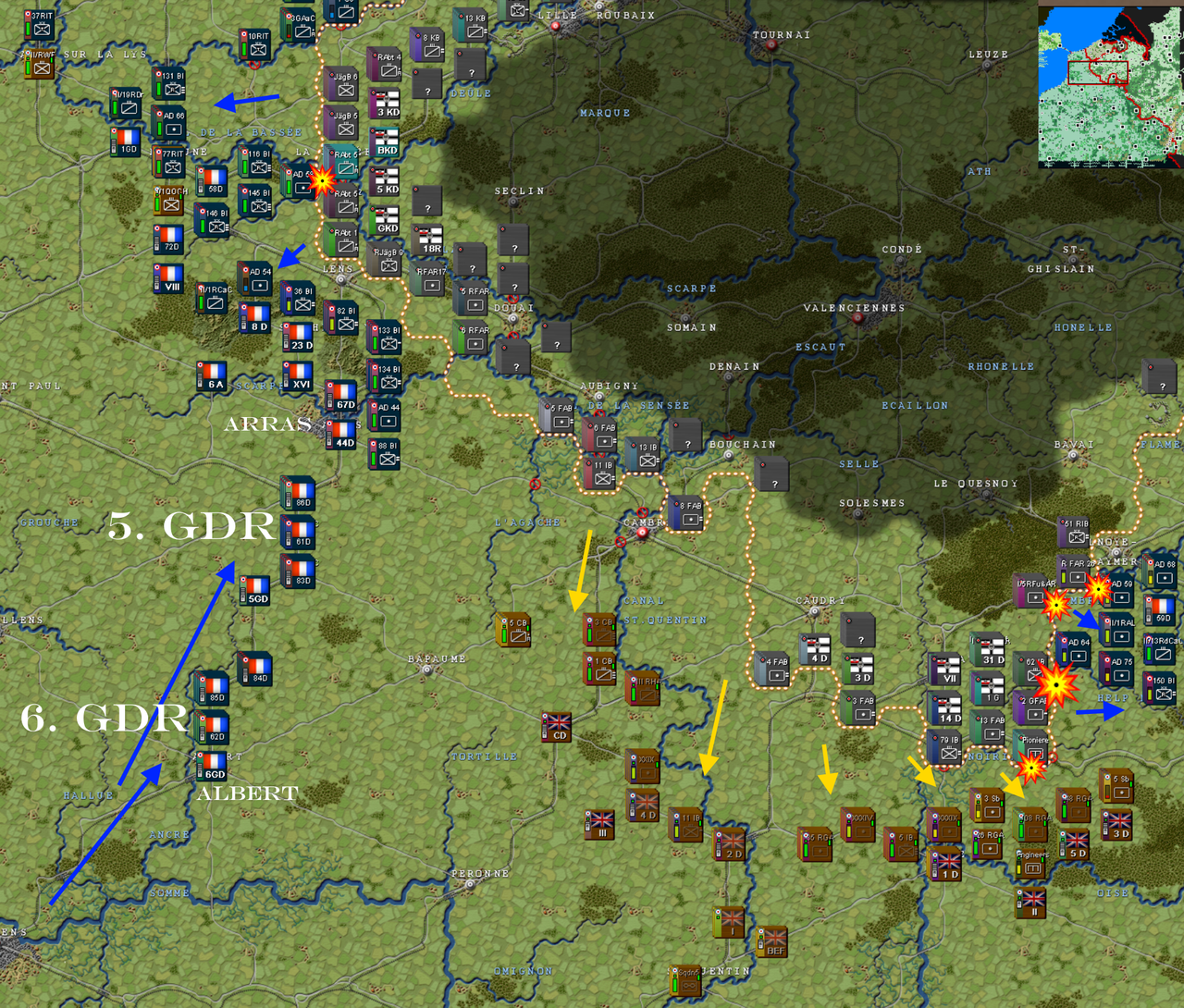
Mons-Charleroi area:
Image

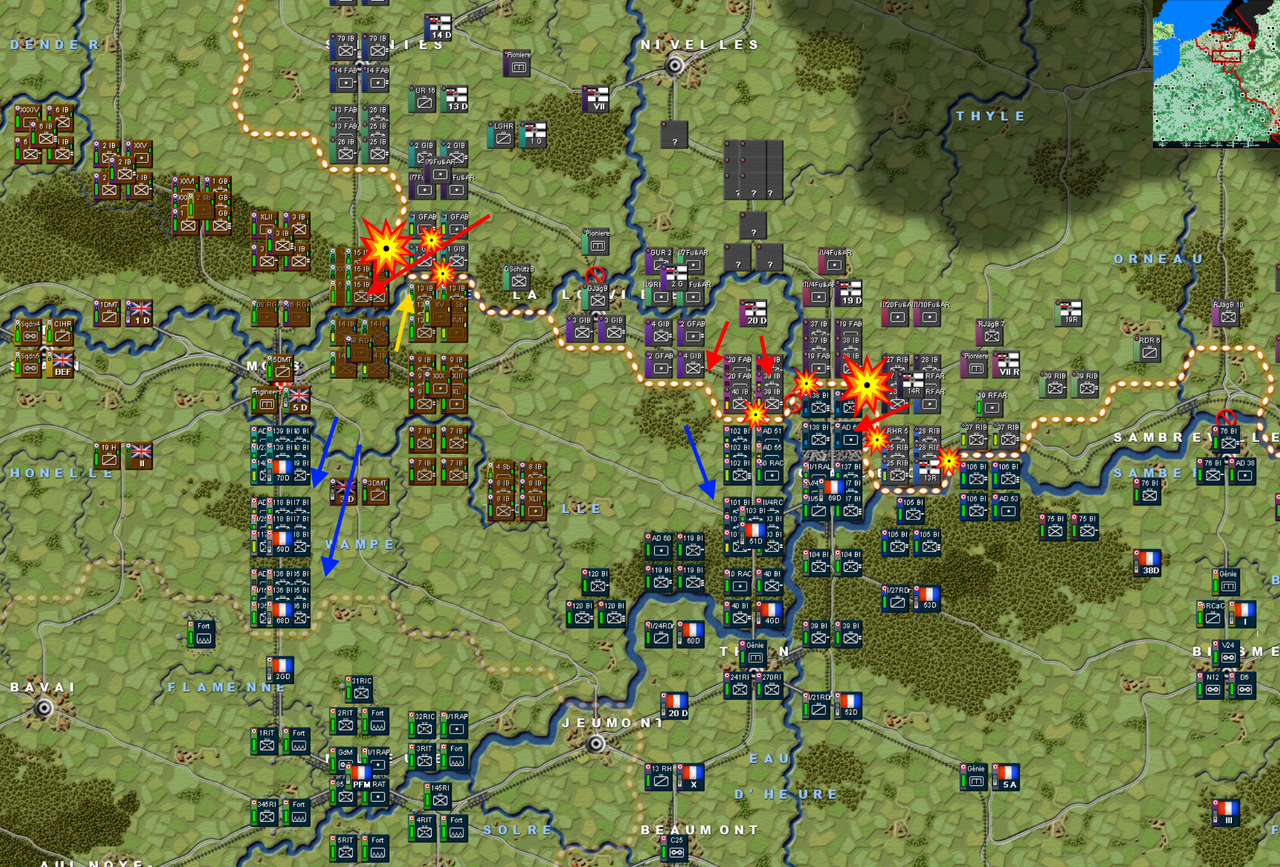
The French reserve divisions move behind the BEF on the left flank of the French army but around Charleroi they dig in supported by X. Corps d'armée and a heavy concentration of artillery.

The northern suburbs of Charleroi are under fire from the German heavy artillery but 138. Brigade d'infanterie holds strong fighting off attacks by German 19. Division.

On the left bank of the Haine river the advancing columns of 20. German Division are hammered by the concentrated French artillery and 51. Division de réserve launches a successful counter attack pushing the Germans back.

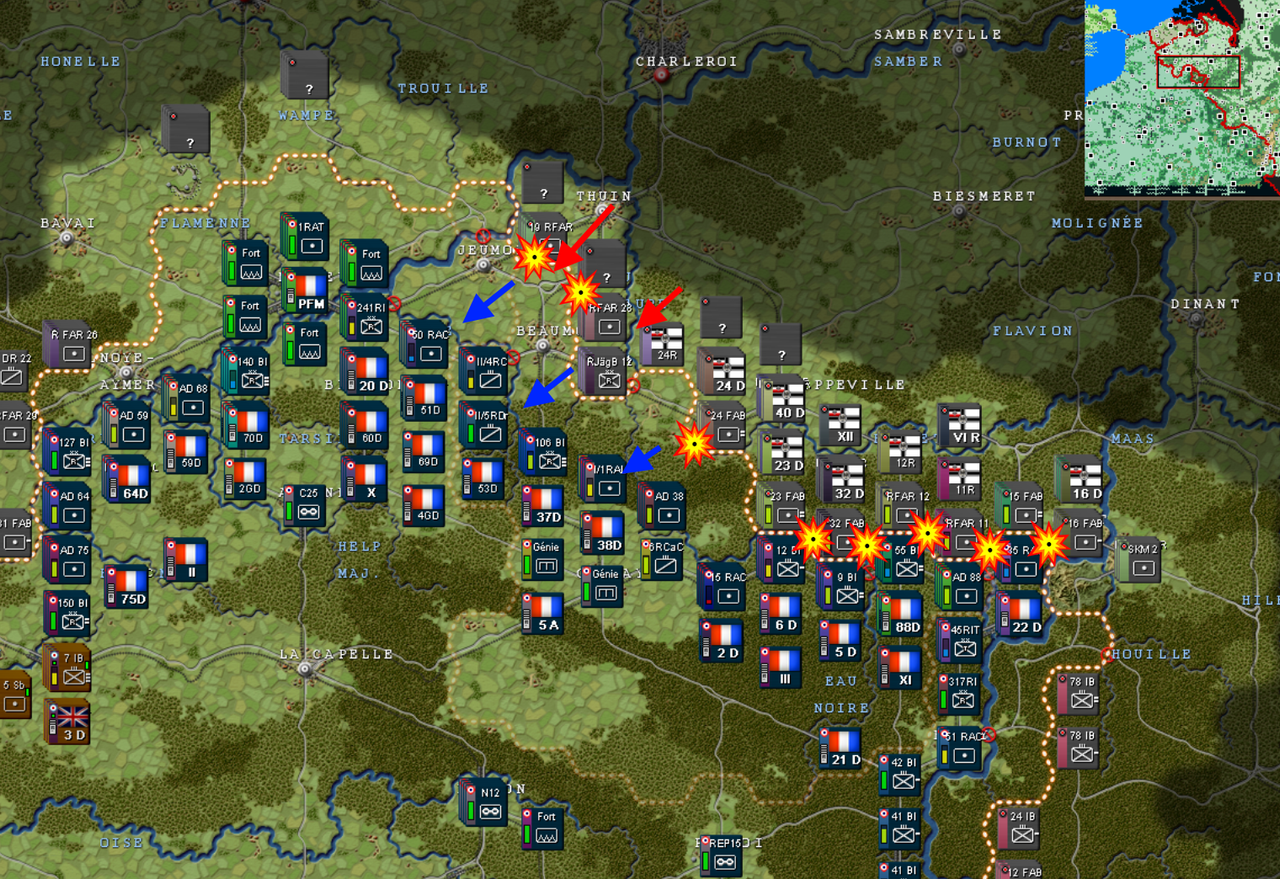
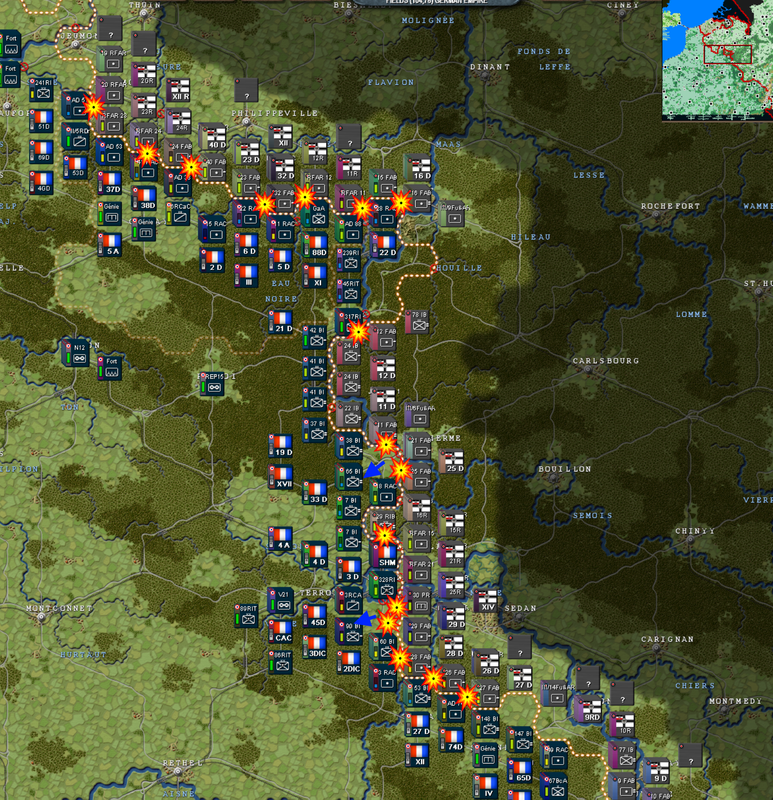
Namur:
Image

The fort de Marchovelette is crushed under heavy German fire and stormed in the morning while during the afternoon the garrisons of the fort d'Enimes and fort de St. Héribert panic when faced with probing attacks and the Boches capture both. Alarmed by the threat to his center general d'Esperey of I. Corps d'armée has his artillery shift and concentrate against the German 22. Division which just captured fort St. Héribert. 116 canons de 75mm and 12 Obusiers 120C Mle 1890 unleash death on the German spearhead and the zouaves and tirailleurs indigènes of 74. Brigade d'infanterie push back the Germans. For this deed the brigade is named in the Citation à l'ordre de l'armée of the day.

With the fall of Namur and the fort of Marchovetlette it looks like the 3. German Army is starting to put pressure on the Meuse around Dinant, this may announce a combined offensive against 5. Armée from both flanks.

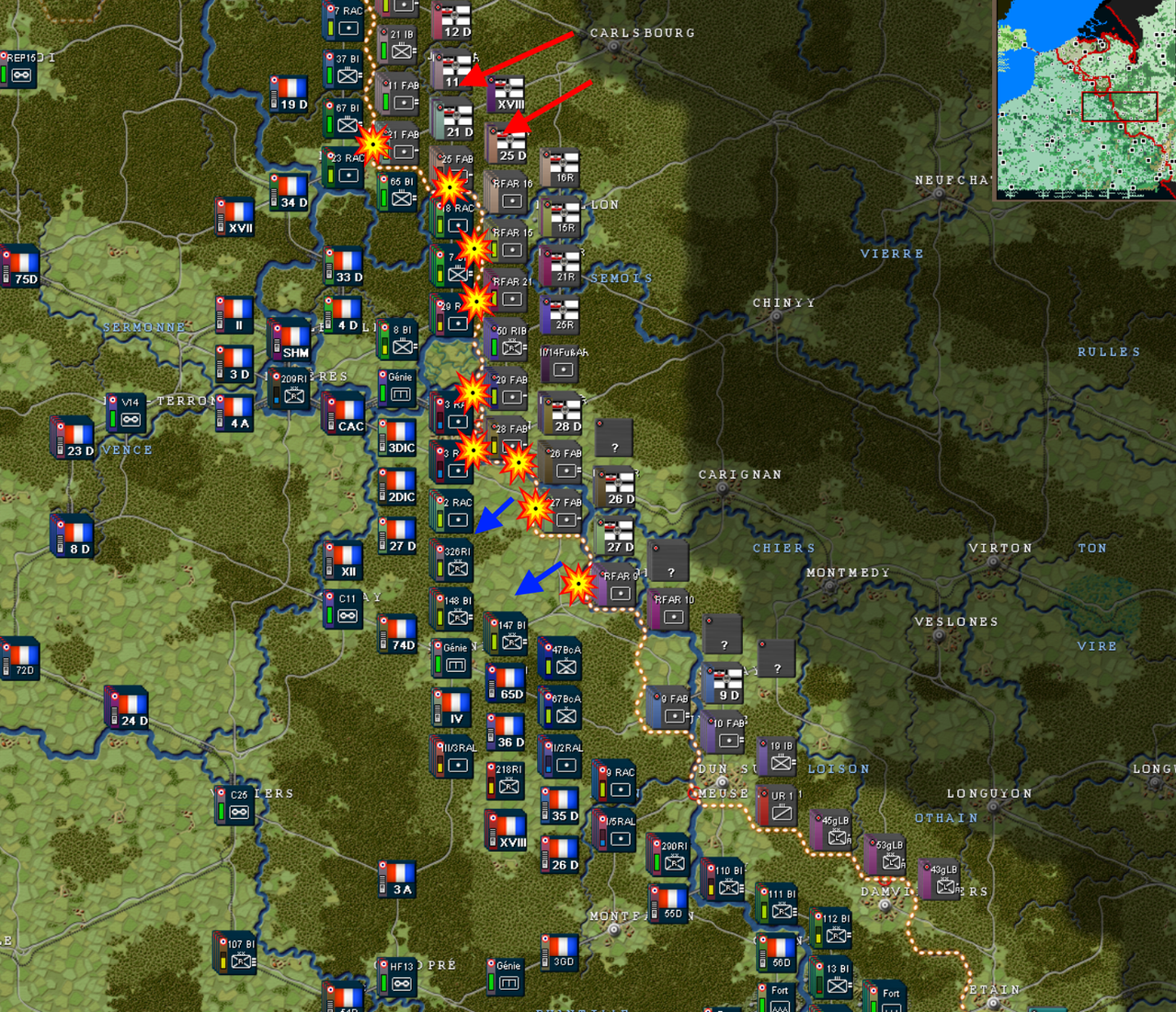
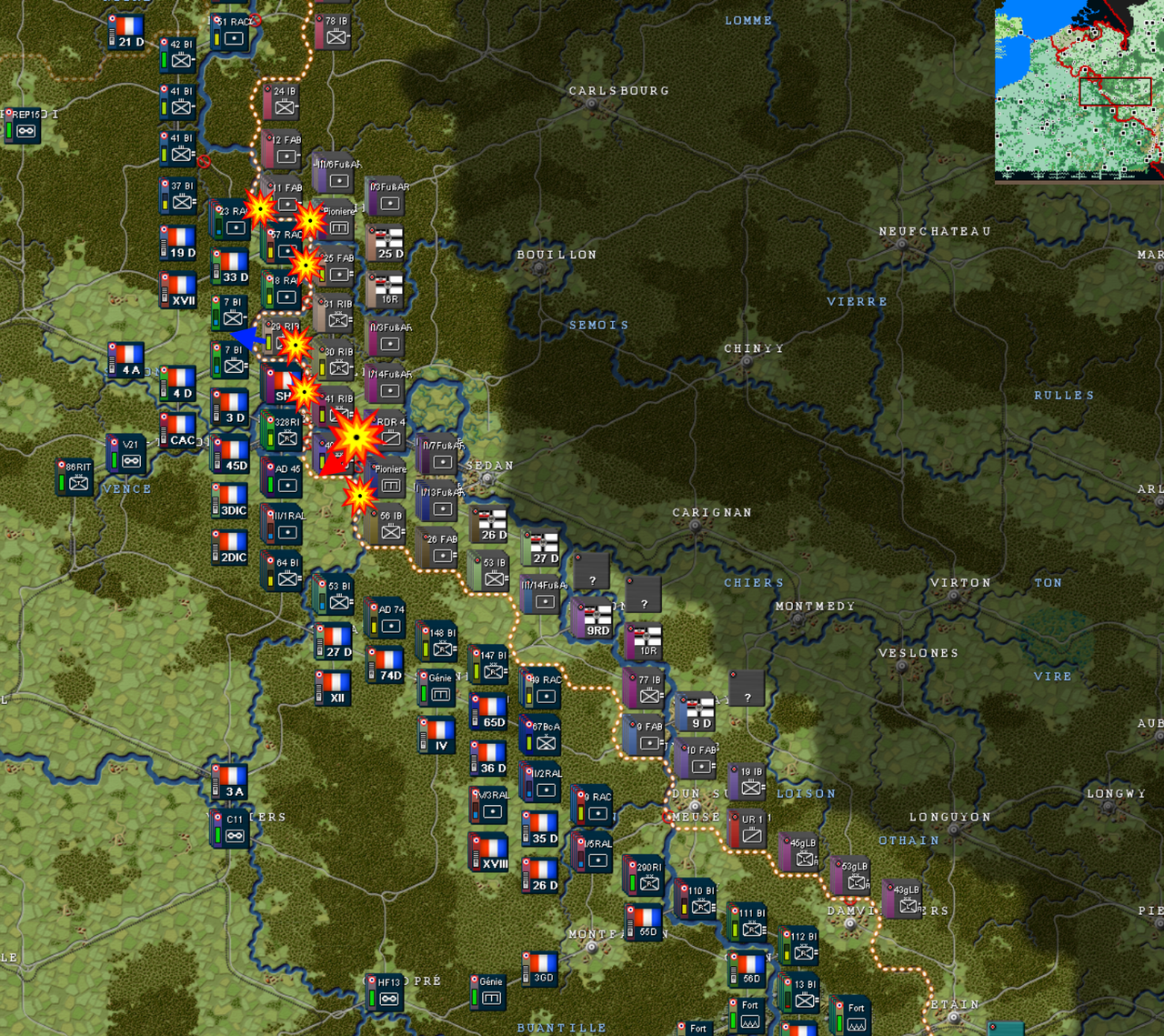
Center:
Chiers area:
Image

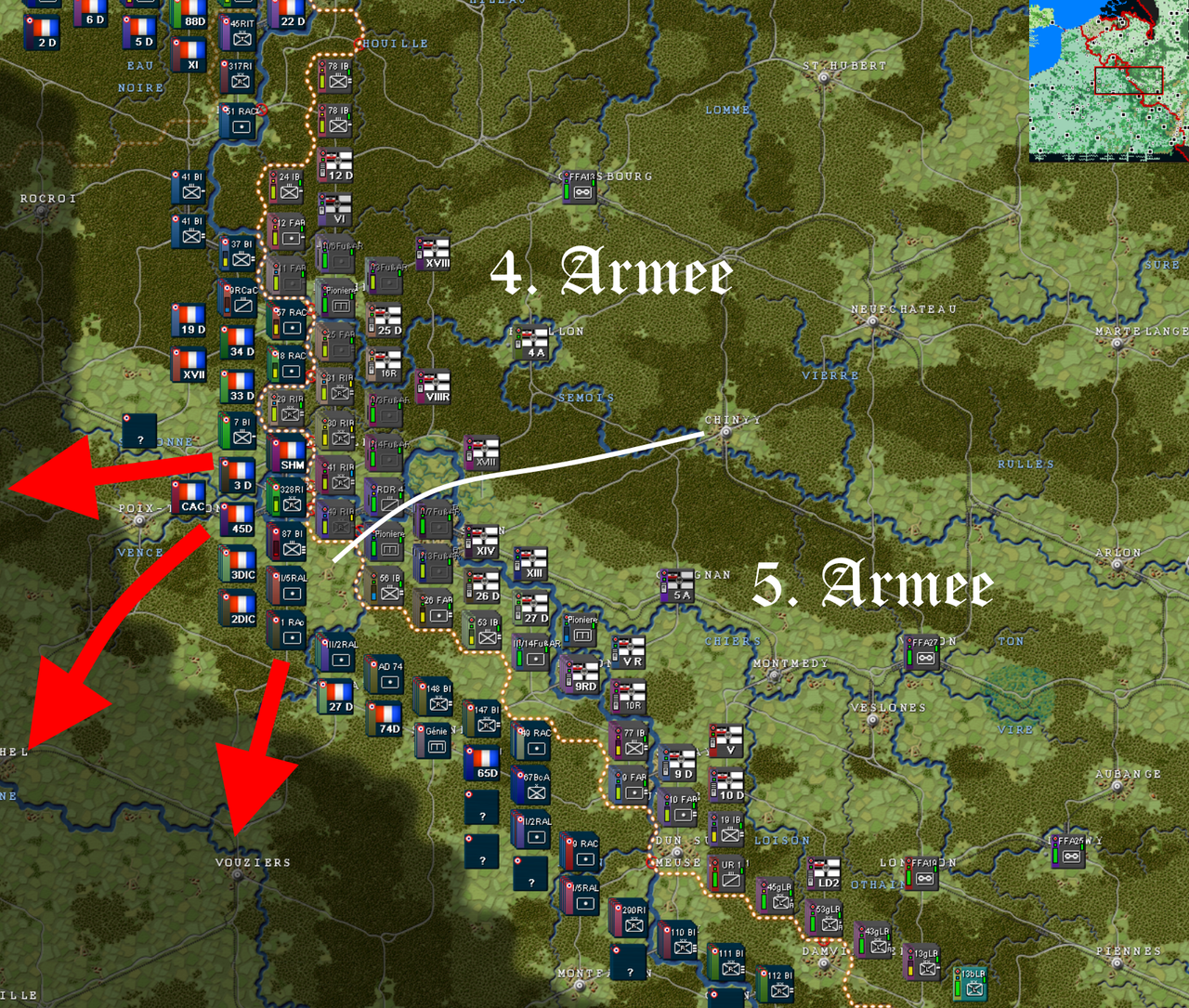
4. Armée has to abandon Carignan and is falling back towards Sedan as slowly as possible. Similarly 3. Armée has to pull back to avoid the concentrated German artillery and leaving the Meuse crossings fairly vulnerable. But general Foch's reserve are finally arriving with 65. and 74. Division de réserve strengthening his left while XVIII. Corps d'armée arrives to hold his center.

In the back line of 3. Armée even more reserves arrive: three artillery regiments, 26. Division d'infanterie and 27. Division d'infanterie (both reinforced with an additional artillery regiment). 4. Armée also receives two artillery regiments to beef up the local artillery capacities.

The only bad news here is that these are some of the last reserves GQG can realistically pull out of Lorraine and Alsace: only 28. Division d'infanterie and 57. Division de réserve are left.

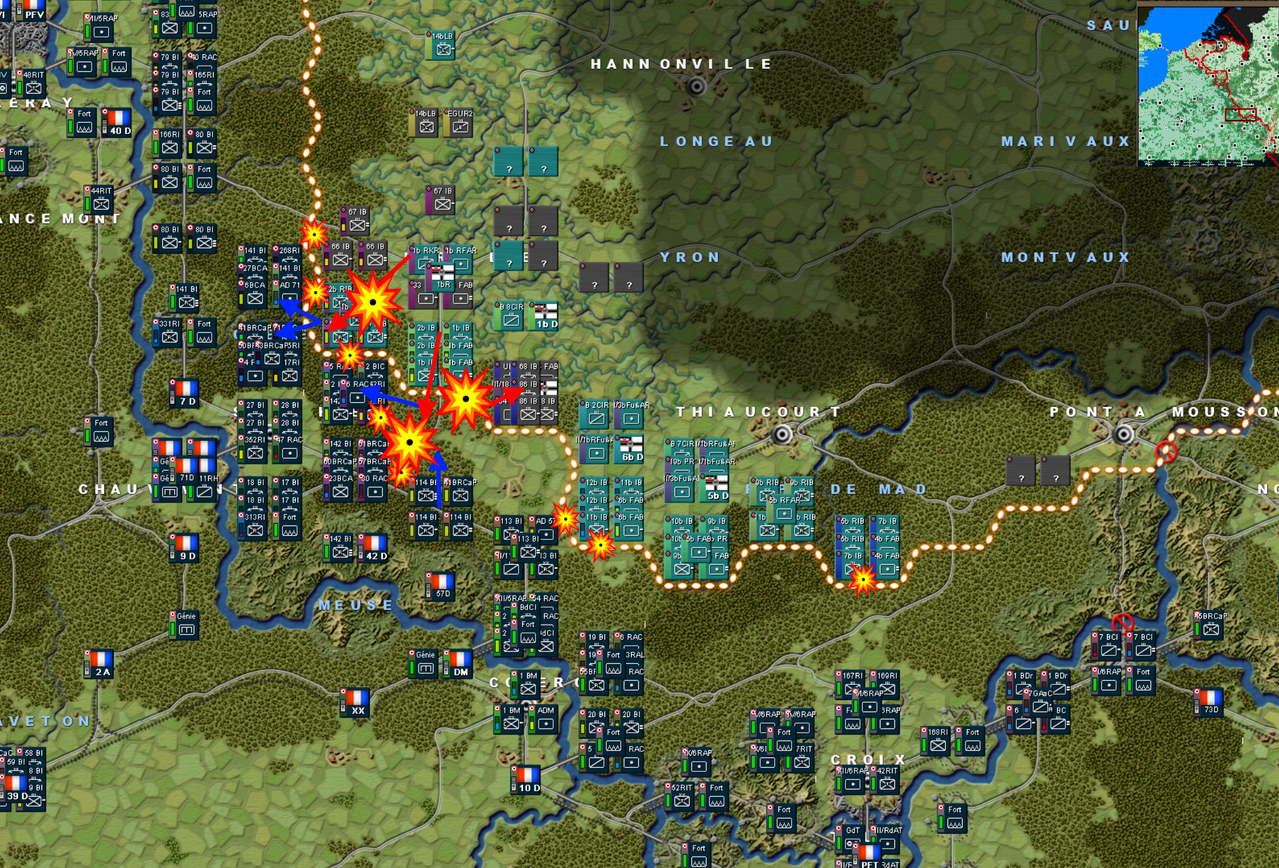
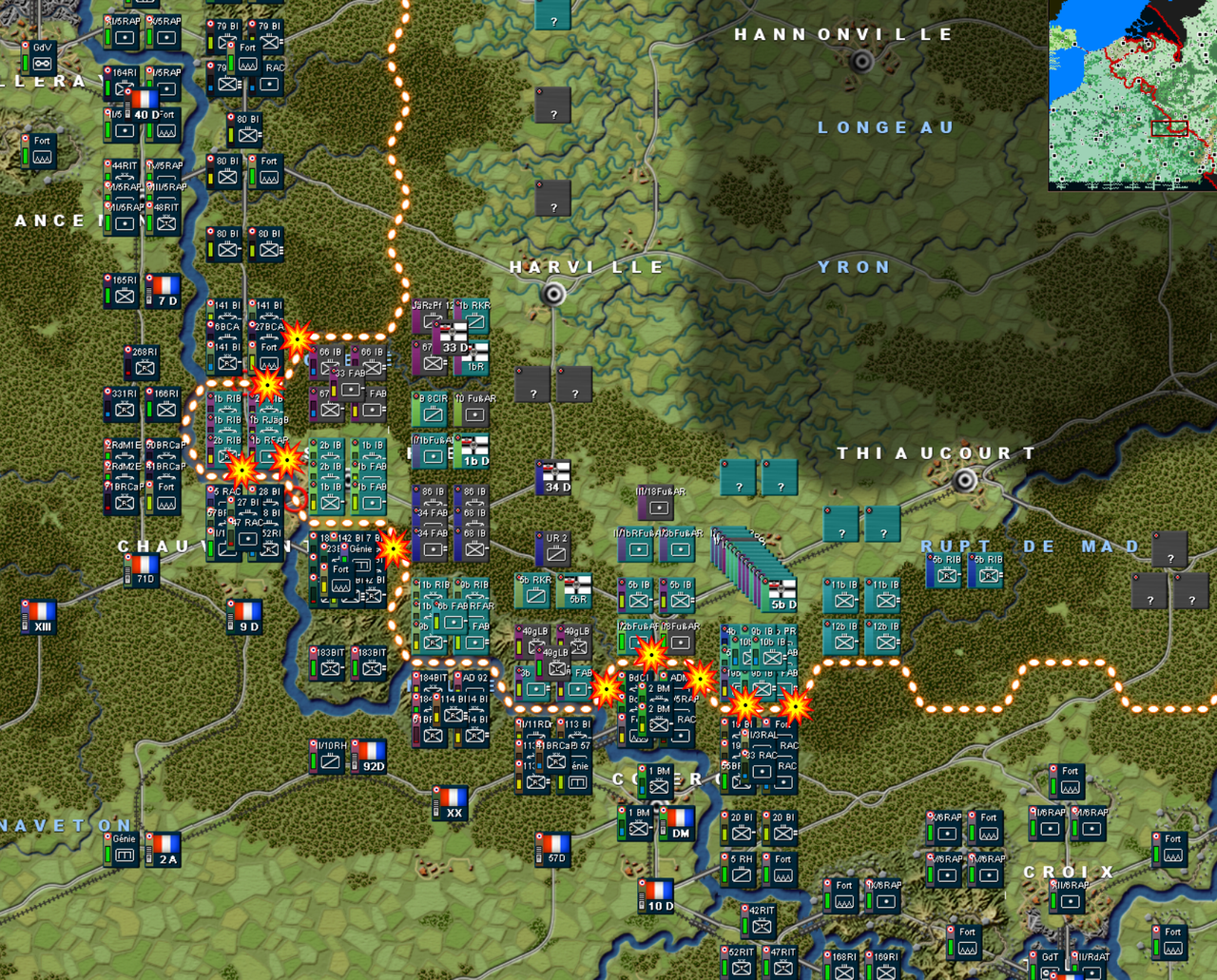
Woëvre area:
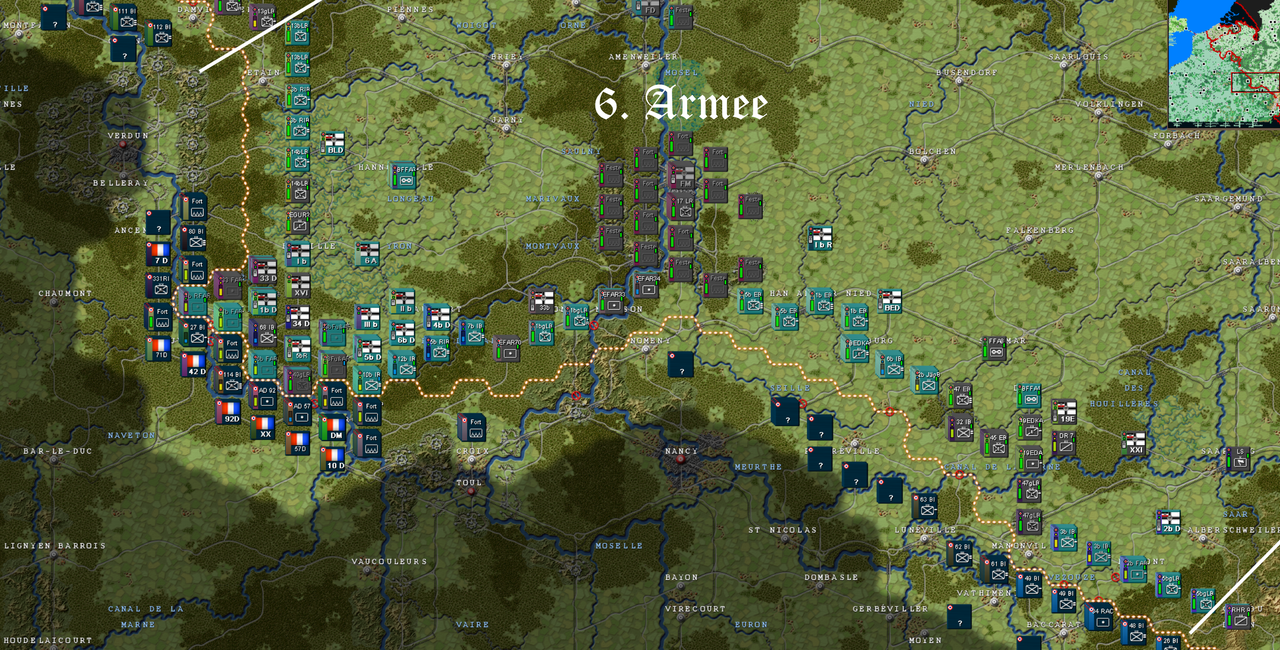
Image

The French line holds well here as the Bavarians regroup before a probable next attack in the coming days. The Division Marocaine takes over the defense of Thiaucourt while XIII. Corps d'armée starts to arrive to relieve the pressure on V. Corps d'armée.

In other news:
- Joseph Joffre visits the 65. Division d'infanterie
- Sir John French visits the 2. Division
- Jean-Gabriel Rouquerol takes over the command 1. Division d'infanterie from Alexandre Gallet blamed for the rapid fall of fort St. Héribert.
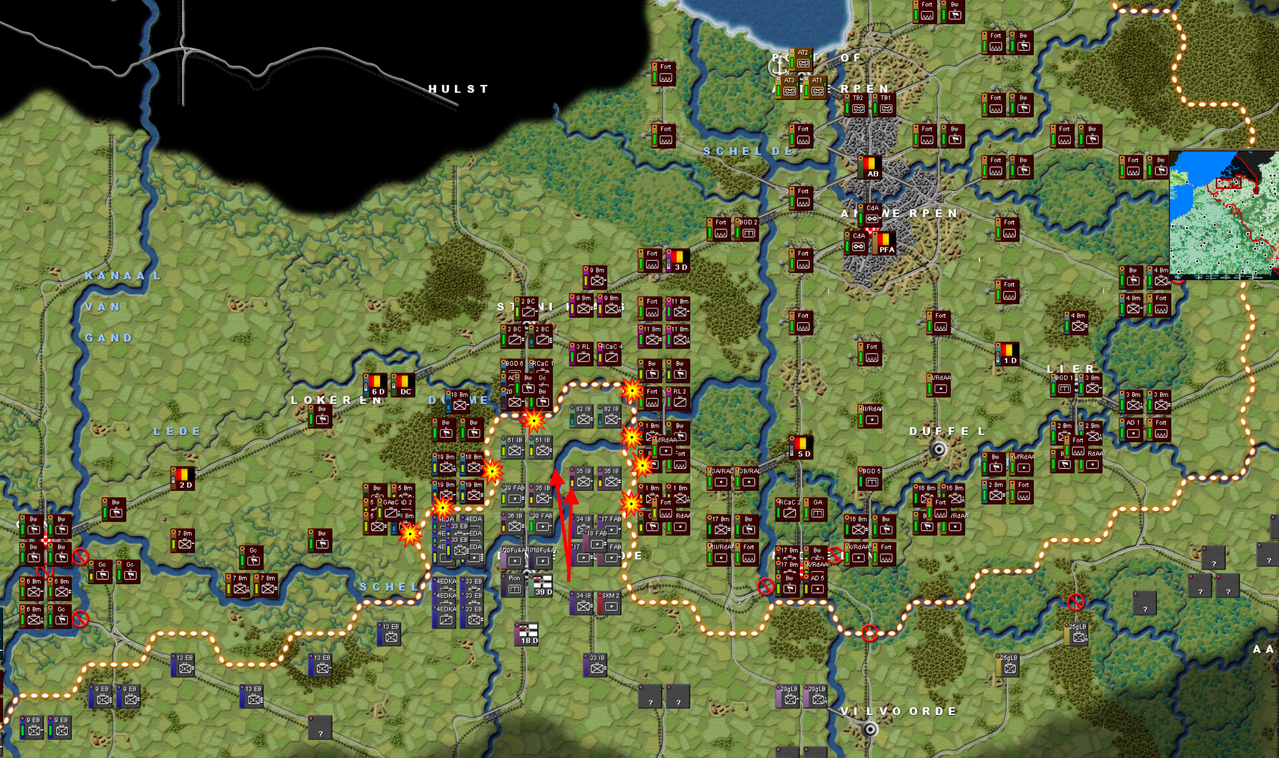
- Fort de Breendonk is the first fortification of Antwerpen to open fire on German troops as the two 12cm and two 15cm turrets of the fort fire at German Jägers operating on the flank of the cavalry advance towards Aalst.

Conclusion:

Bringing in over a dozen divisions and concentrating the artillery as much as possible has yielded some good results but the casualty rates still mostly favors the Germans especially in the battle of the Chiers. To avoid having it's back broken the French army might need to retreat at some point to amass even more divisions and artillery for a proper counter strike.

Re: Westfront 1914

Posted: Thu Aug 06, 2026 6:08 pm
by Metatron
22aoutjourn.png
22aoutjourn.png (1.84 MiB) Viewed 339 times
Source of the journals: https://gallica.bnf.fr/accueil/fr/html/accueil-fr

22 August 1914

The battle of the Dender ends as German infantry divisions arrive to support their cavalry forcing the French back while the BEF experience it's first contact with the Boches.

News from Antwerpen:
Image

German Landwehr and Ersatz units are starting to secure the eastern perimeter of the Antwerpen outer fort line. The western perimeter is extended all the way to Gent.

Left flank:
Aalst area:
Image

The artillery of III. and IV. German Corps help the cavalry renewing the attack and crossing the Dender in force. 2. Division de cavalerie is force to retreat and abandon Aalst after being attacked in the flank by the Bavarian Cavalry Division.

East of the Dender IV. German Corps assists the attacks and force the I. Corps de cavalerie back, abandoning Ninove to avoid being encircled.

The battle of the Dender is most likely over, leaving the French with 11950 casualties and the Germans with 9625 in two days of fighting.

Mons and Charleroi area:
Image

Around Charleroi the French artillery concentration continues taking a heavy toll on the German infantry trying to force the river crossings and to isolate the critical city. In the northern suburbs of Chareloi the 138. Brigade d'infanterie manages to stop another attack from a German reserve division and earns a mention in the daily Citation à l'ordre de l'armée.

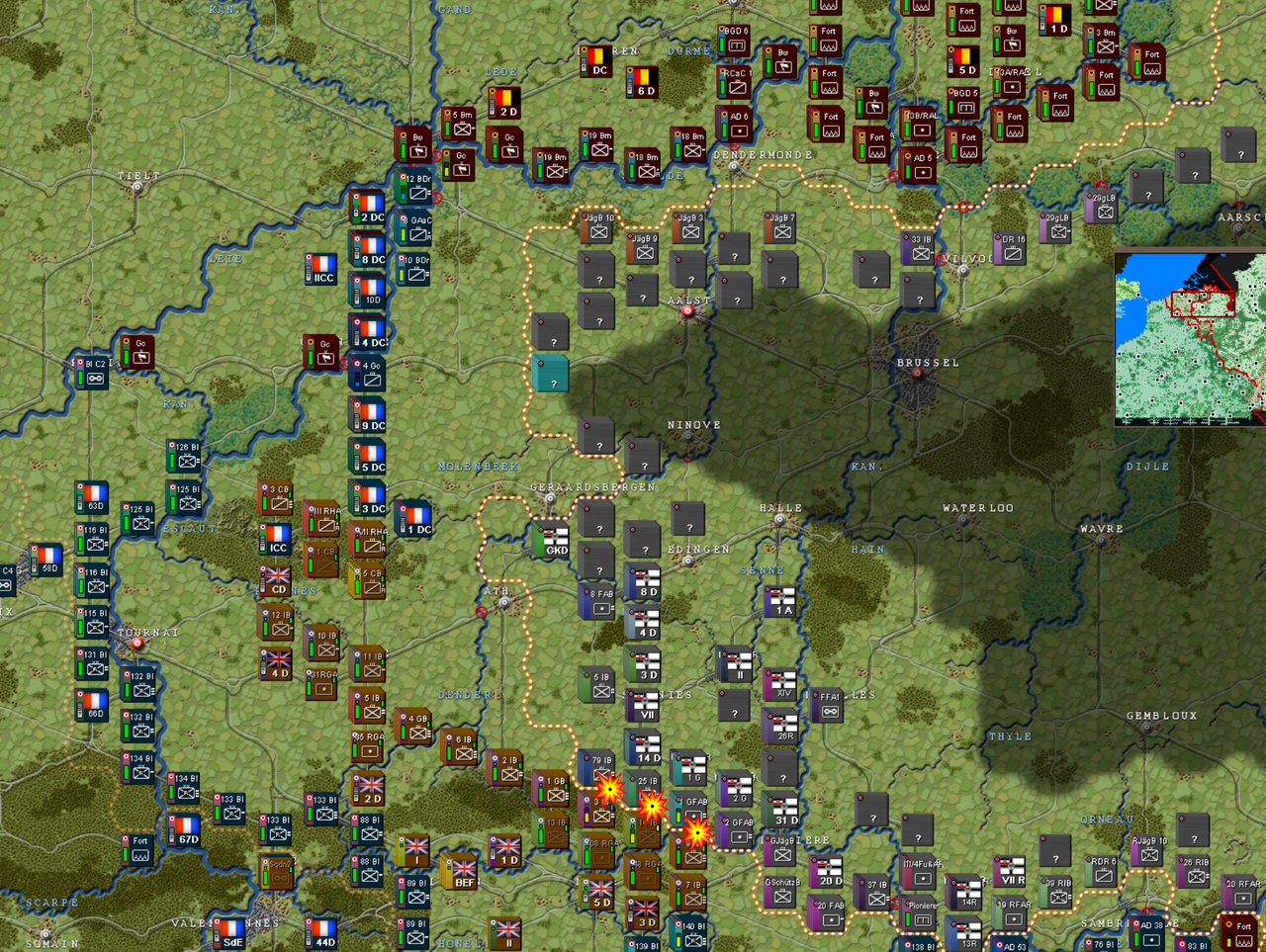
Further west the BEF sees it's first contact with the 1. German Guard Division which is stopped by 14. Infantry Brigade of 5. Division. Sir Horrace Smith-Dorrien moves up his artillery that shells the German spearhead.

The British 5. Cavalry Brigade blows the bridge over the Dender at Ath to slow down the German spearhead.

Meuse area:
Image

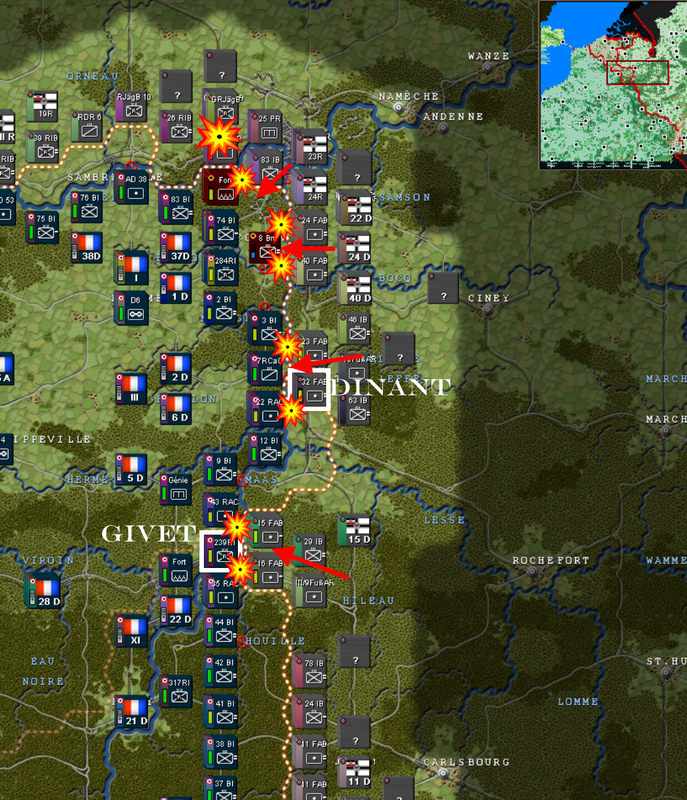
Fort de Suarlée falls and with it the left bank of the Sambre, leaving only fort de Malonne resisting the German onslaught. I. Corps d'armée is holding the heights over the Meuse and trades artillery fire with German division starting to move up to the river. The same is happening at Dinant and Givet. 28. Division d'infanterie arrives from the Vosges as local reserve to counter any attempt by German 3. Army to cross the Meuse in force.

Center:
Chiers area:
Image

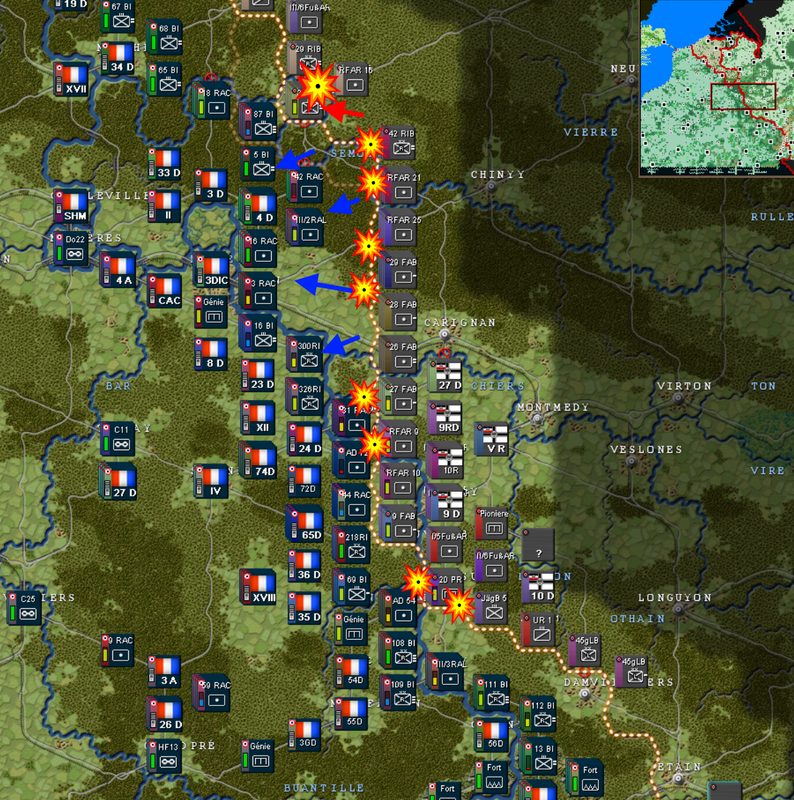
The Boches cross the Meuse at Laneuville but the newly arrived French divisions hold the forested high ground and are starting to concentrate artillery in an attempt to hold this line.

4. Armée falls back to Sedan. Bouillon is lost on the Chiers, with reserve German infantry suffering heavy losses crossing the river but forcing the extenuated 3. Division d'infanterie to shorten it's line to face the threat.

Woëvre area:
Image

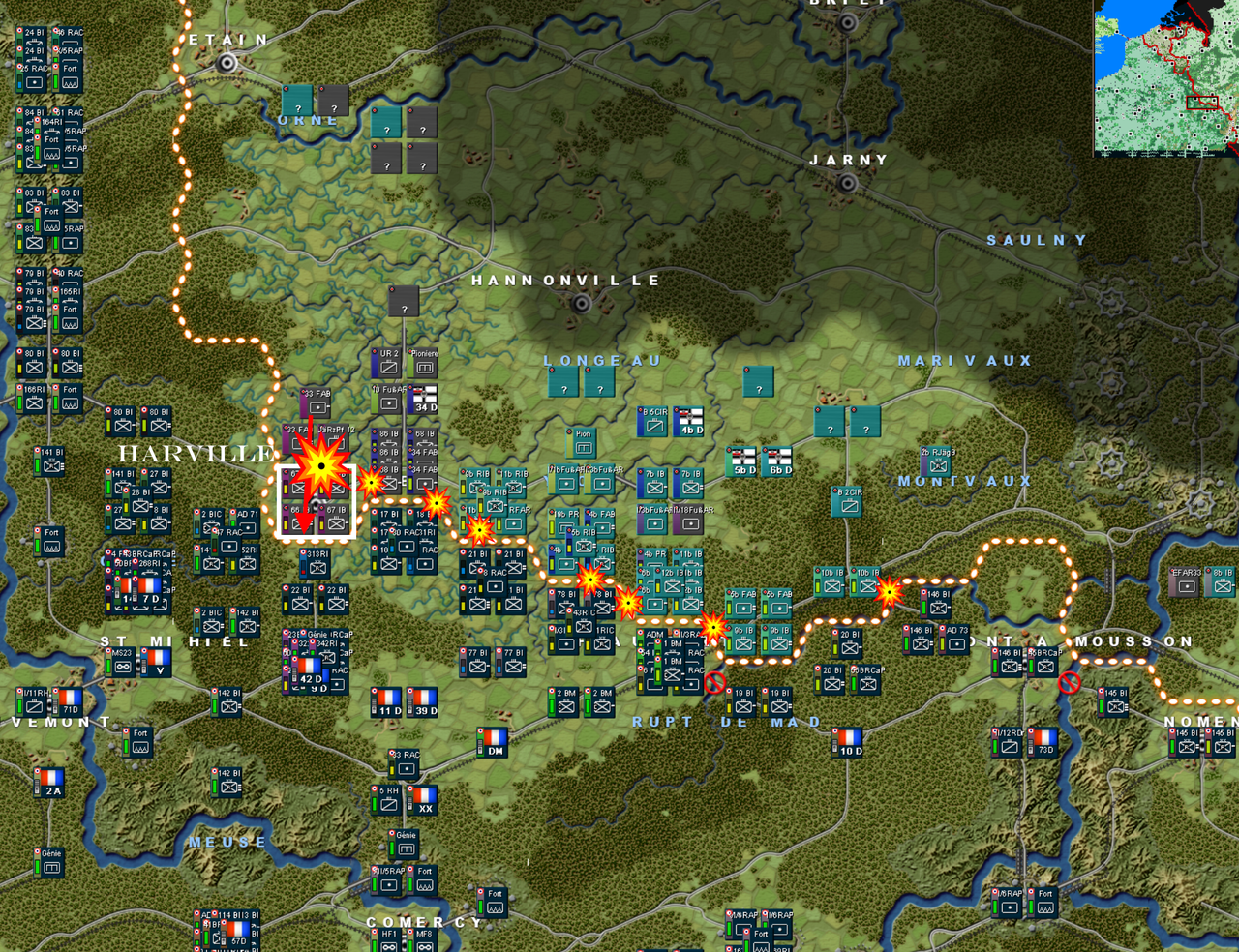
Harville falls to a German concentrated attack while the rest of the line is dominated by artillery fire. XIII. Corps d'armée moves up to shore up the defense and maybe retake Harville. At the same time 57. Division de réserve is unloading behind the Meuse to serve as local reserve.

In other news:
88. Division territoriale arrives from southern France and is assembling in general reserve around Hirson.

Conclusion:

The battle of Mons begins and the BEF is anticipating a lot more German Divisions arriving in front of them after the end of the battle of the Dender. Charleroi is holding admirably but the pressure on the Meuse from the Woëvre to Dinant is starting to mount, can the French center and center left between Verdun and Charleroi hold ? If not the battle of the left flank might not be as decisive as one thought.

Re: Westfront 1914

Posted: Sun Aug 09, 2026 5:55 pm
by Metatron
23aoutjourn.png
23aoutjourn.png (1.92 MiB) Viewed 218 times
Source of the journals: https://gallica.bnf.fr/accueil/fr/html/accueil-fr

23 August 1914

The BEF and the German Guard clashes near Mons, the French Meuse line from Verdun to Namur is under pressure, and the Bavarians continue their big offensive aided by heavy artillery.

Left flank:
Mons area:
Image

The French cavalry falls back behind the Escaut linking the Belgians and the BEF.

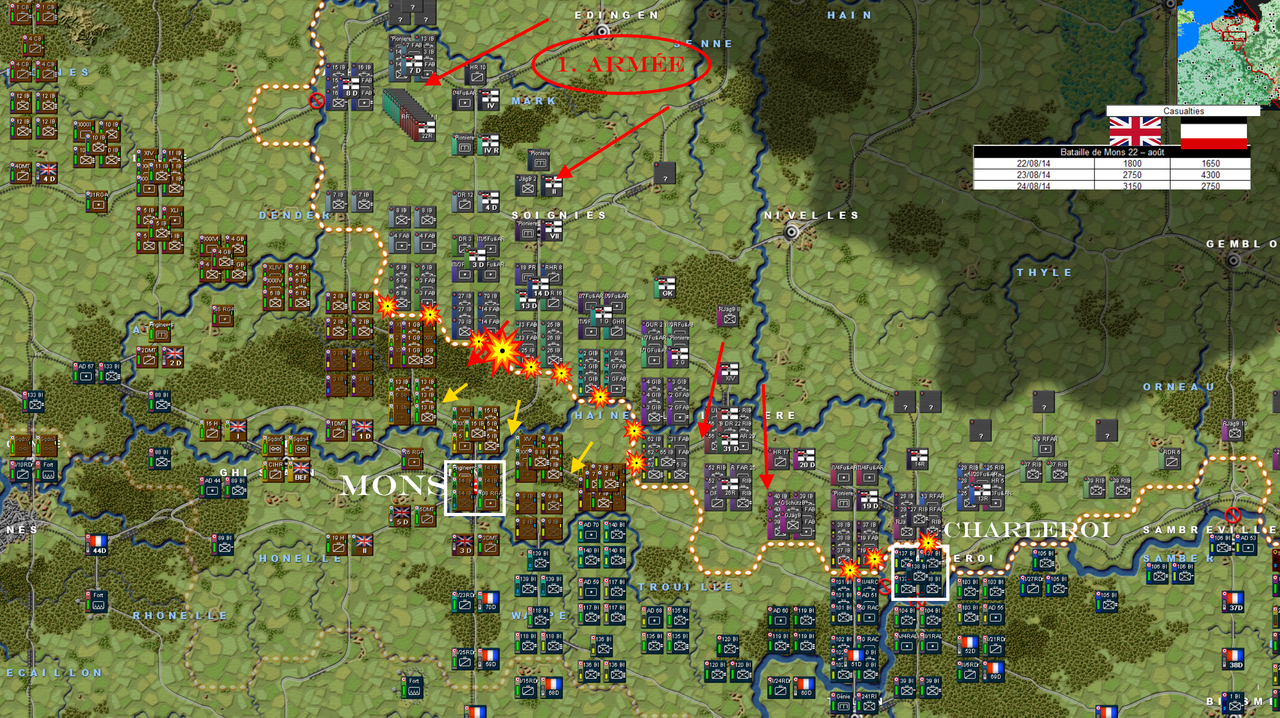
1. German Guard and 14. Infantry Division attack the BEF in force. British II. Corps concentrating it's artillery inflicts heavy casualties on the Guard but the German numerical superiority in artillery is already being felt in the counter battery fire.

2. Groupe de divisions de réserve links the Charleroi area to the BEF right flank on the Trouille river.

Charleroi area:
Image

The suburbs of Charleroi fall to German attacks and the French defenses fall back on the forests south of town using the central position of the artillery to harass the Germans on both sides of the Haine river.

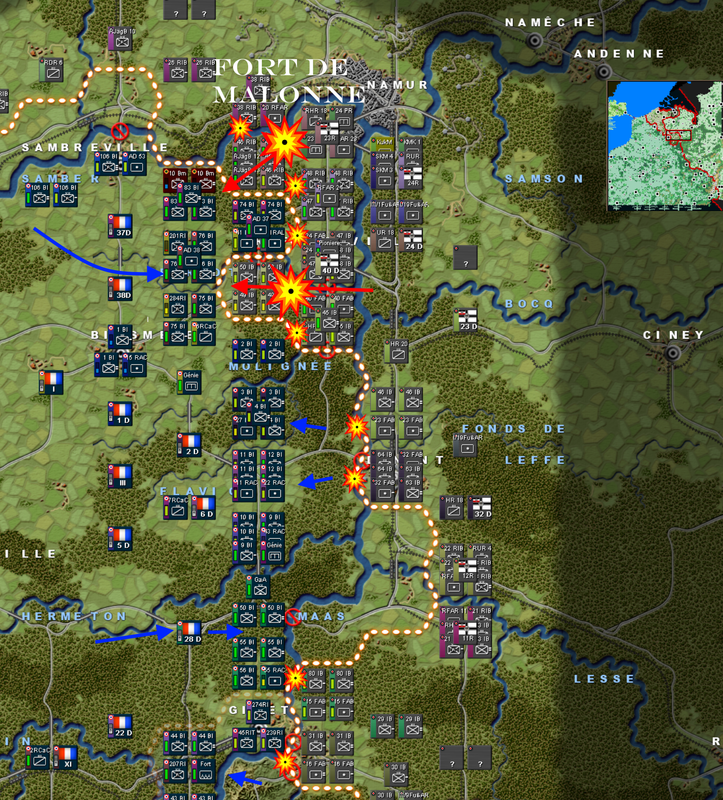
Fort de Malonne is being hammered by the German super heavy artillery but still holds.

Two Saxon active and two Saxon reserve divisions cross the Meuse around Profondeville to put pressure on I. Corps d'armée (I. CA). Together with the attacks around Dinant and Givet this puts heavy stress on 5. Armée's right flank. Because of that 28. Division d'infanterie and 88. Division territoriale are moving up to support I. and III. CA.

Center:
Sedan area:
Image

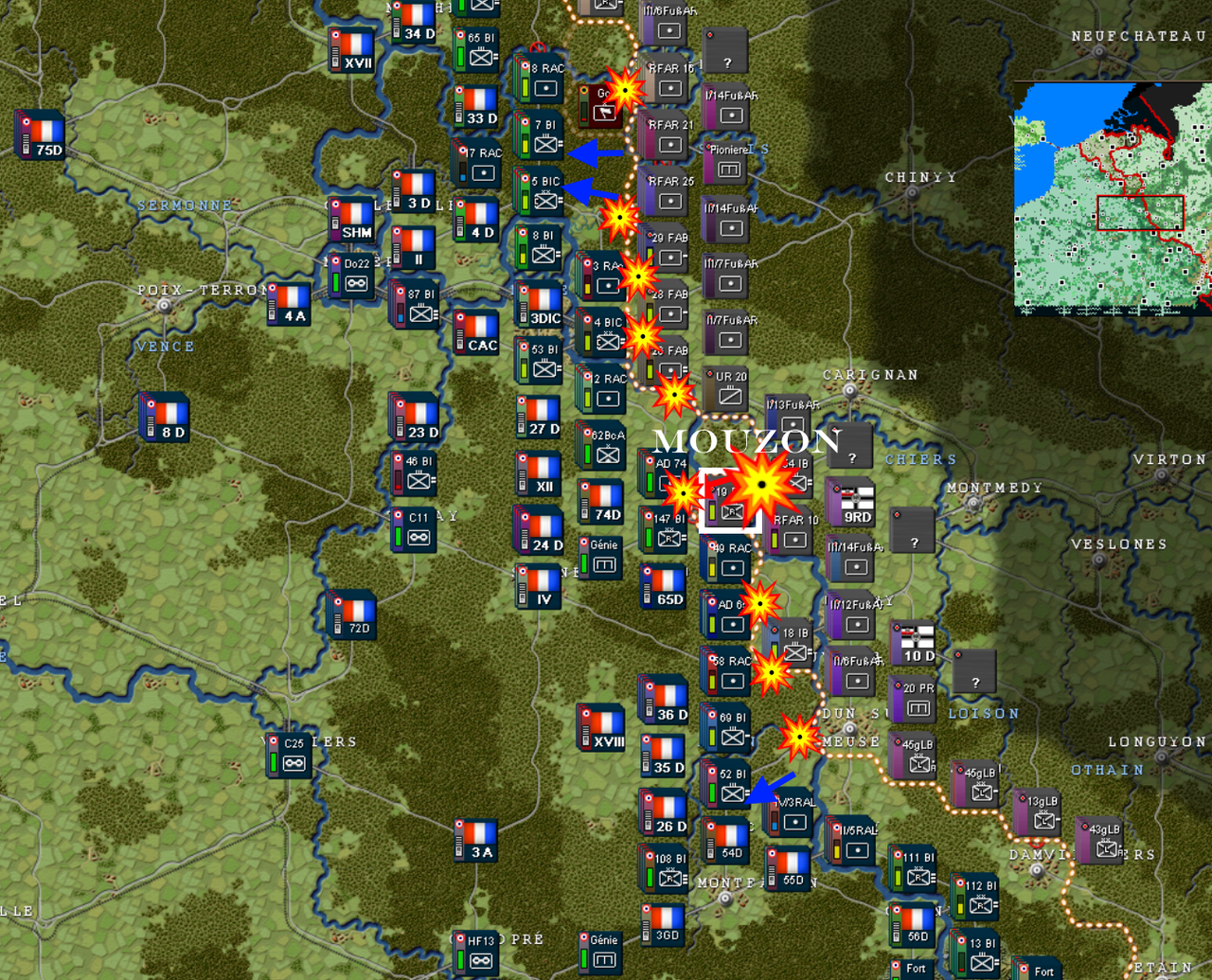
General Foch seems to be stabilizing the line well with it's reinforcement, the German spearhead seemingly stuck in front of Mouzon and Laneuville. The main German attack seem to target Sedan instead but it looks like several German divisions have left the frontline for a destination unknown.

8. Division d'infanterie and 72. Division de réserve being mostly destroyed are pulled out the line to be sent south to relieve some brigades in Lorraine or Alsace.

Woëvre area:
Image

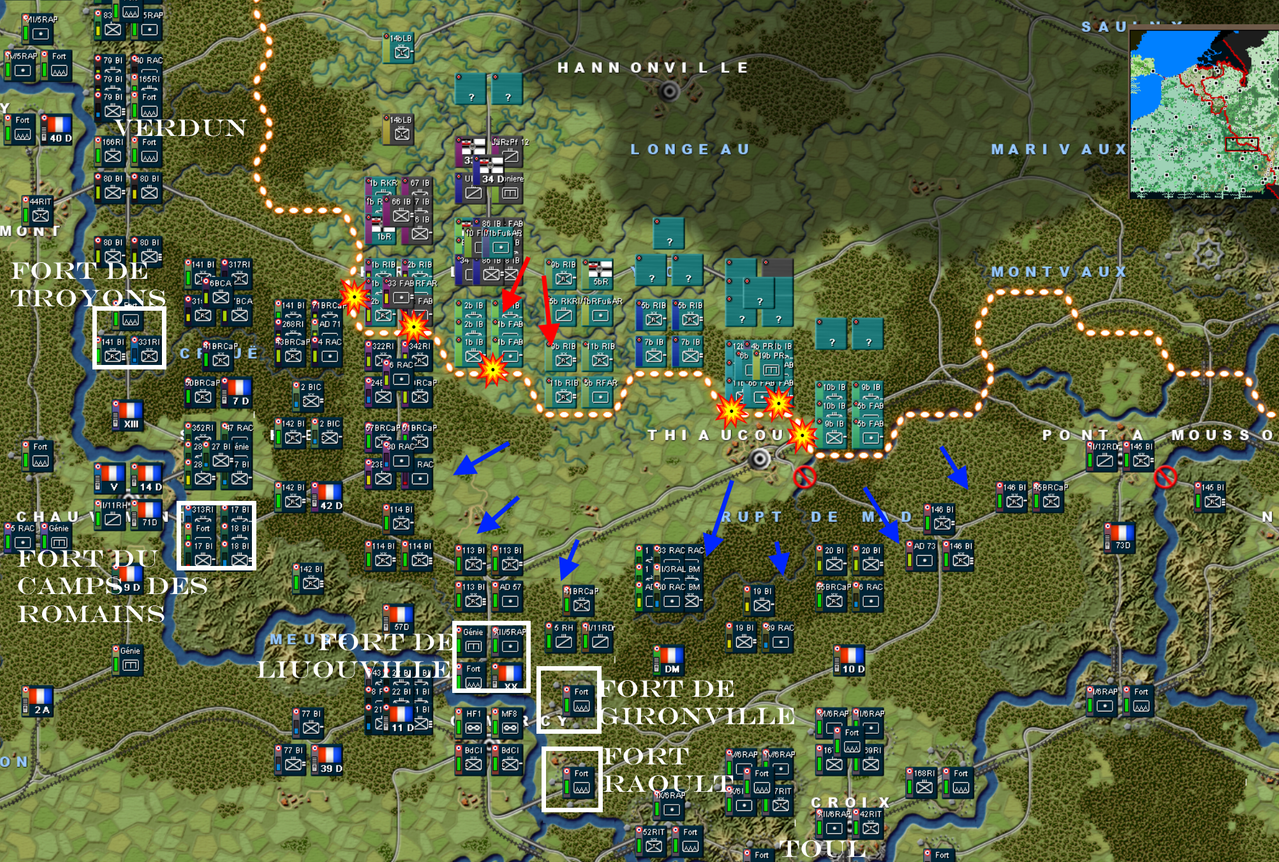
The Bavarian assault intensifies with more heavy artillery being committed to aid the attacks. Despite heavy losses and only skeletons of regiments left, 9. and 11. Division d'infanterie manage to stop the Bavarians but 39. Division d'infanterie is almost completely destroyed north of Thiaucourt. The 6. Bavarian Division is counter attacked though by the Division marocaine (DM) and retreats under artillery fire. For this the DM is mentioned in the Citation à l'ordre de l'armée of the day.

The weak French divisions are pulled out of the line as XIII. Corps d'armée takes up position in the forests northeast of St. Mihiel. 52. Division de réserve also arrives from Commercy but at this attrition rate de Castelnau is starting to prepare a fall back towards the Meuse forts to use the guns of Verdun and Toul as flanking defenses.

In other news:
The Russian invasion of East Prussia seems to be going well and putting the Germans in difficulty. 2ème Bureau operatives are reporting movements by rail over the Meuse around Liège of several division going east: estimating two army corps moving to East Prussia.

Conclusion:

Two German Corps moving east would be good news if true. The line of the Meuse and the Sambre are holding so far but the renewed attacks by 3. and 4. German Armies combined with the offensive against the BEF could threaten the entire front.

Re: Westfront 1914

Posted: Mon Aug 10, 2026 5:50 pm
by Metatron
24aoutjourn.png
24aoutjourn.png (1.81 MiB) Viewed 149 times
Source of the journals: https://gallica.bnf.fr/accueil/fr/html/accueil-fr

24 August 1914

The last fort of Namur falls to the Germans while Mechelen sees the first German shell fired near Antwerpen. The battle of the Sambre and Mons are underway and for now the Boches are taking heavy losses from having to storm well emplaced allied troops. But now 1. German Army is arriving in full force on the left of the frontline and together with the pressure on the Meuse this might spell disaster for the allied armies in Belgium.

Left flank:
Escaut area:
Image

The French cavalry regroups behind the Escaut river and observes the German 1. Army starting to move south towards the BEF's left flank.

Mons and Charleroi area:
Image

Around Charleroi the German attack falters against the concentrated French artillery fire but 53. Division de réserve has to move east along the Sambre, thinning thus the line, to replace 38. Division d'infanterie called east by I. Corps d'armée (I. CA) towards the battle of the Meuse crossings near Namur.

The 3. British Brigade manages to stop a second German assault but Sir Horace Smith-Dorian is worried of mounting casualties especially to his artillery and has 1. and 5. British Divisions abandon their forward line. Allenby's cavalry signals the arrival of the main force of German 1. Army on the BEF's left and while the French are demanding the BEF holds the line at all cost, Sir John French might not want his entire army destroyed in front of Mons when there is little reinforcement to be expected for the next few months with the exception of the rest of III. Corps still waiting to cross the channel.

Overall the BEF is trading well with some elite German divisions but unlike the German spearhead the British cannot afford to loose that many men every day.

Meuse area:
Image

The Saxons storm the last fort of Namur: fort de Malonne as well as the forested heights overlooking Profondeville to the south-west. This only leaves the zouaves and tirailleurs indigènes of 37. Division d'infanterie (37. DI) holding the forest before the plain of Biesmeret opens up. I. CA calls for 38. DI to close the gap.

Meanwhile the rest of the defenses on the Meuse suffer German artillery fire III. and XI. CA reform their line abandoning some exposed terrain and inserting 28. DI into the line.

Center:
Sedan area:
Image

A German Division takes heavy casualties but manages to enter Mouzon, this marks the end of the battle of the Chiers, the fighting now being concentrated around Sedan and the Argonne. It looks like the Argonne is holding so far but if Sedan falls this would leave the strategic railroad junction of the twin cities Charleville and Mezières in danger, opening the way for a German offensive towards Reims.

Woëvre area:
Image

The fighting stalls a bit as the Bavarians regroup and hammer Thiaucourt with a large amount of artillery. De Castelnau allows the fall back planned yesterday to occur and the weakest divisions in the area regroup around the forts on the Meuse while XIII. Corps d'armée and the Division marocaine set up a new line along the forests overlooking the Meuse.

Using the forts should allow the line to hold and keep the Germans from crossing the river and cutting one of the railroad lines going to Verdun.

In other news:
- two more reserve divisions from the Armée des Alpes arrive and are placed in reserve behind 4. and 5. Armée.
- a brigade of tirailleurs indigènes from North-Africa arrives and will be reinforcing the Division marocaine.
- the first British plane is shoot down during a reconnaissance flight by ground MG-fire near Mons.

Conclusion:

If the BEF has to fall back under the pressure of 1. German Army this will mean most likely that 5. Armée of Charles Lanzerac will have to fall back as well. Altough at this speed the crossings over the Meuse might force Lanzerac to fall back before the BEF. Surely French and Lanzerac would not blame each other for this kind of situation.

Re: Westfront 1914

Posted: Tue Aug 11, 2026 5:48 pm
by Metatron
25 aout journ.png
25 aout journ.png (1.79 MiB) Viewed 77 times
Source of the journals: https://gallica.bnf.fr/accueil/fr/html/accueil-fr

25 August 1914

The Entente cordiale between the French and British is not that cordial despite a solid performance by the British infantry north of Mons. Brutal fighting continues along the Meuse.

Left flank:
Mons and Charleroi area:
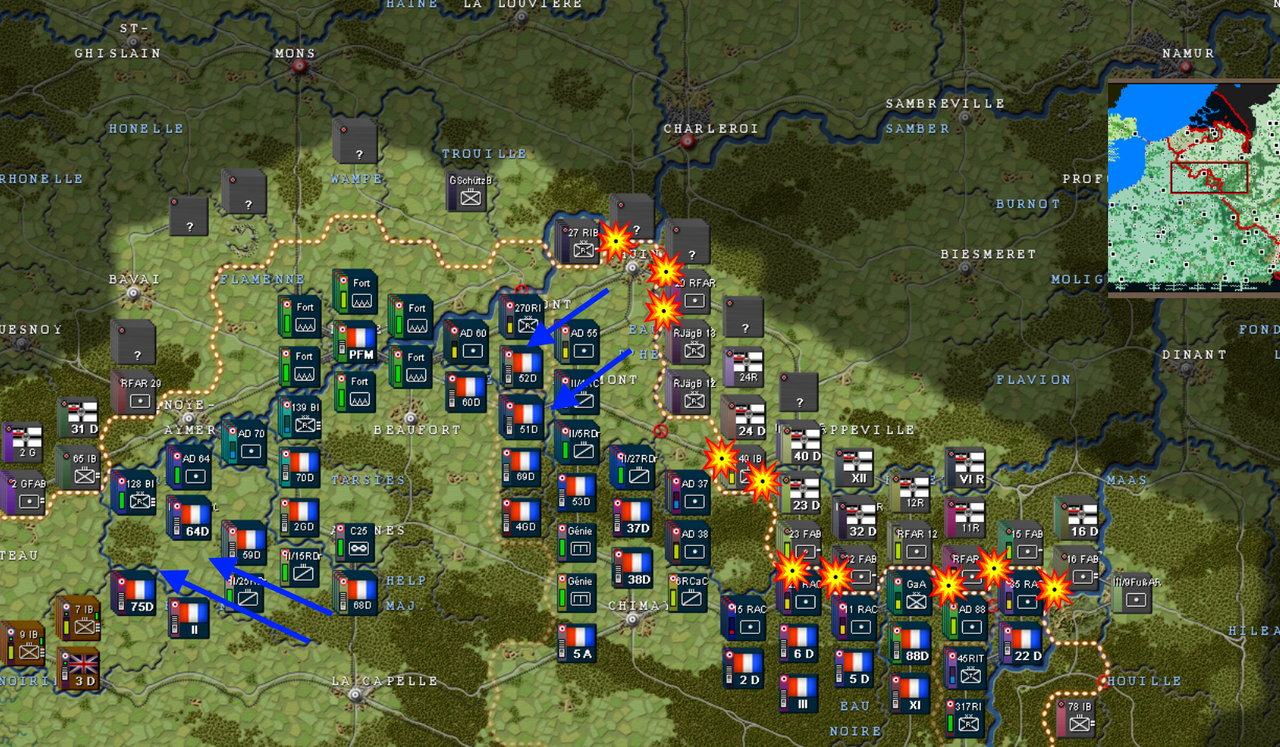
Image

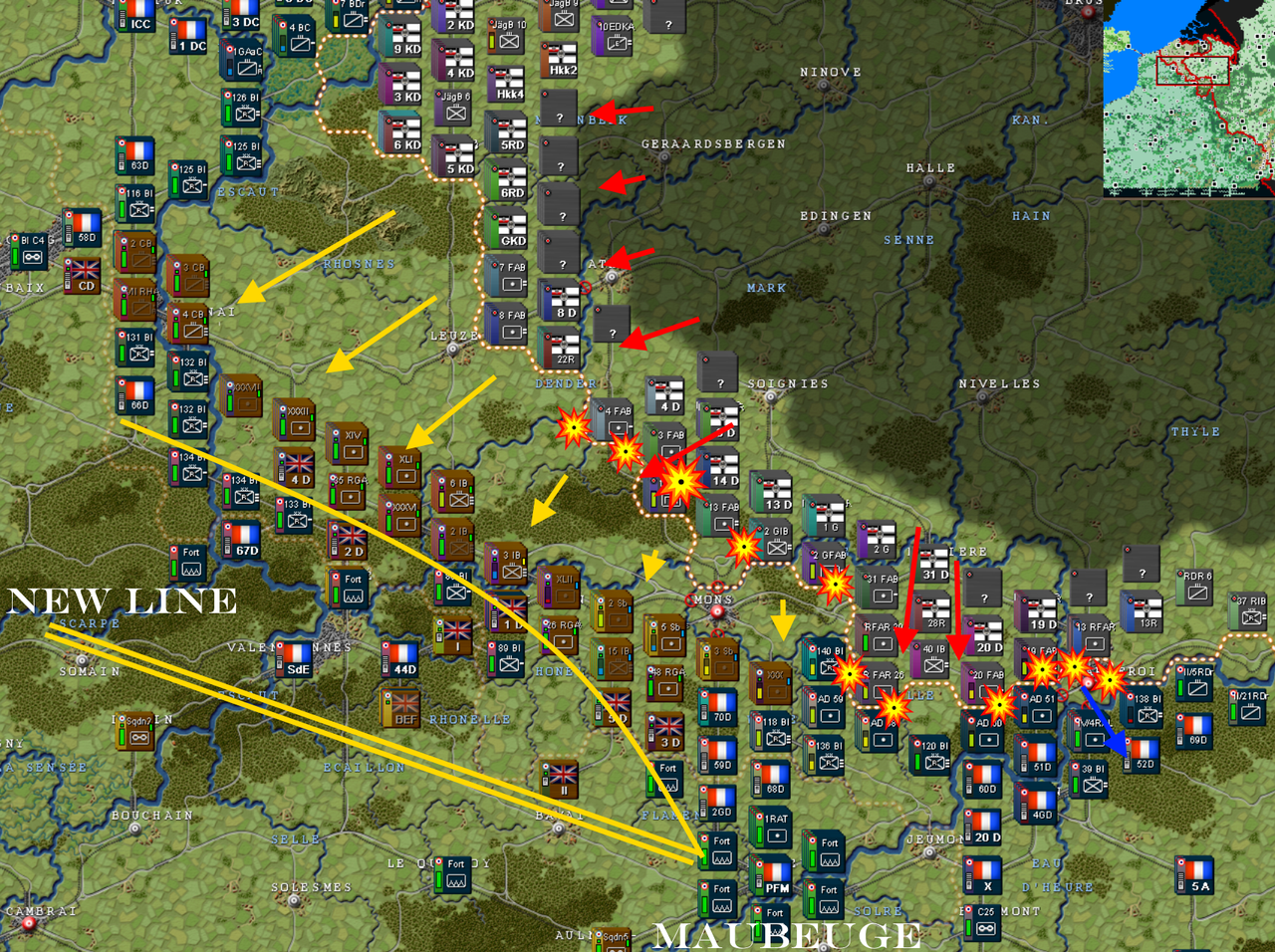
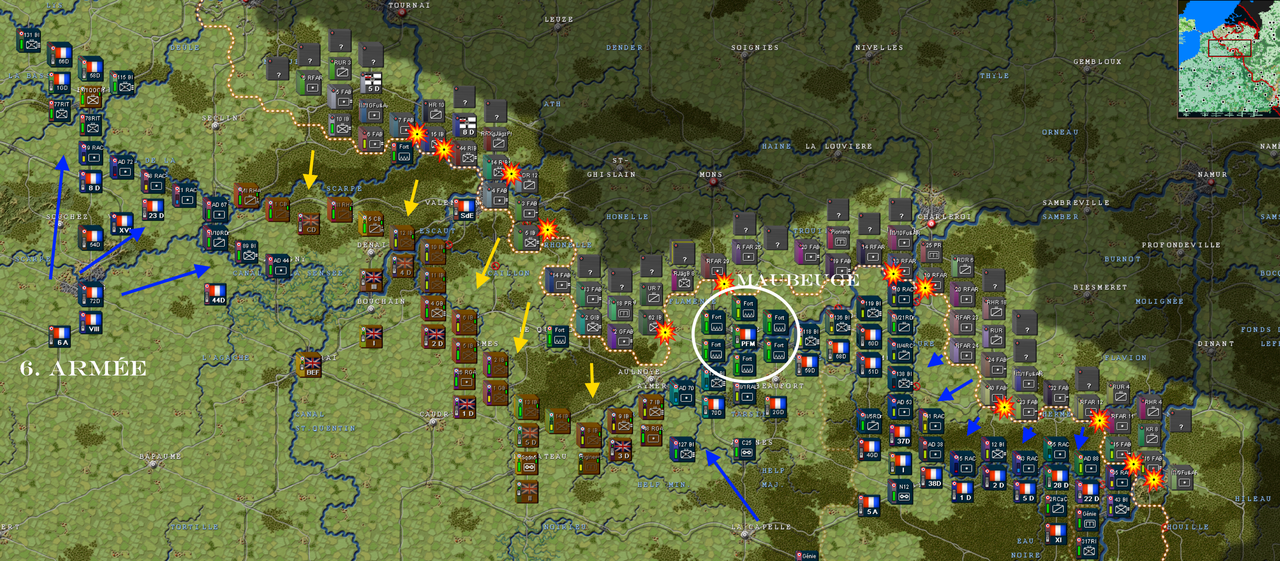
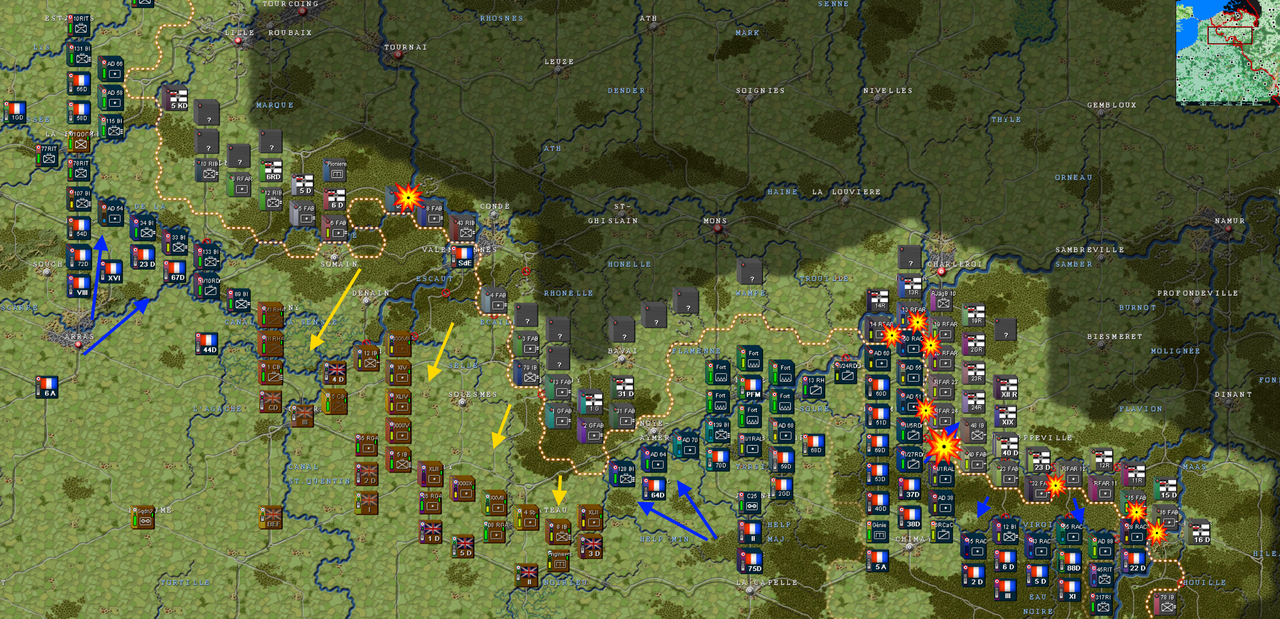
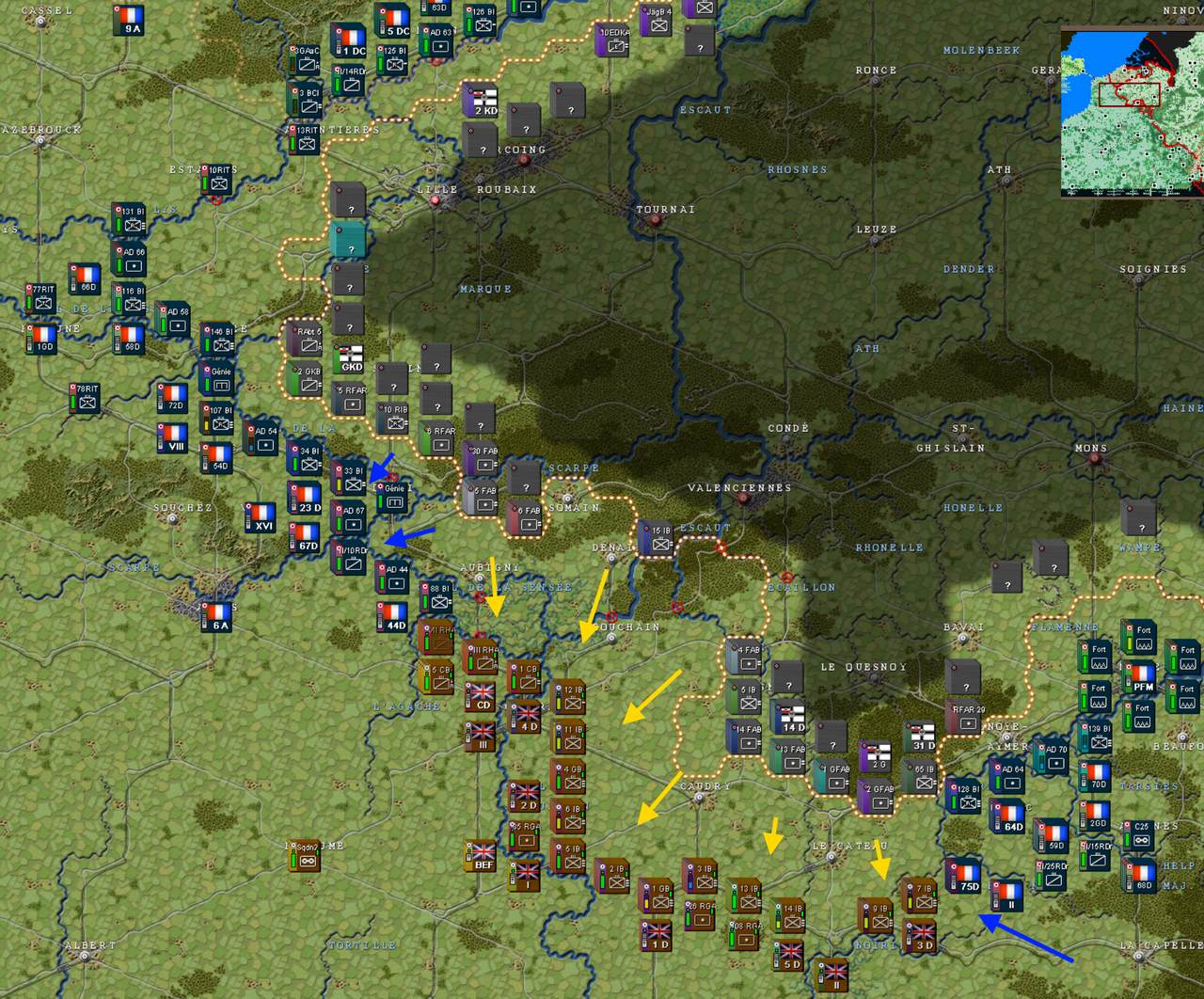
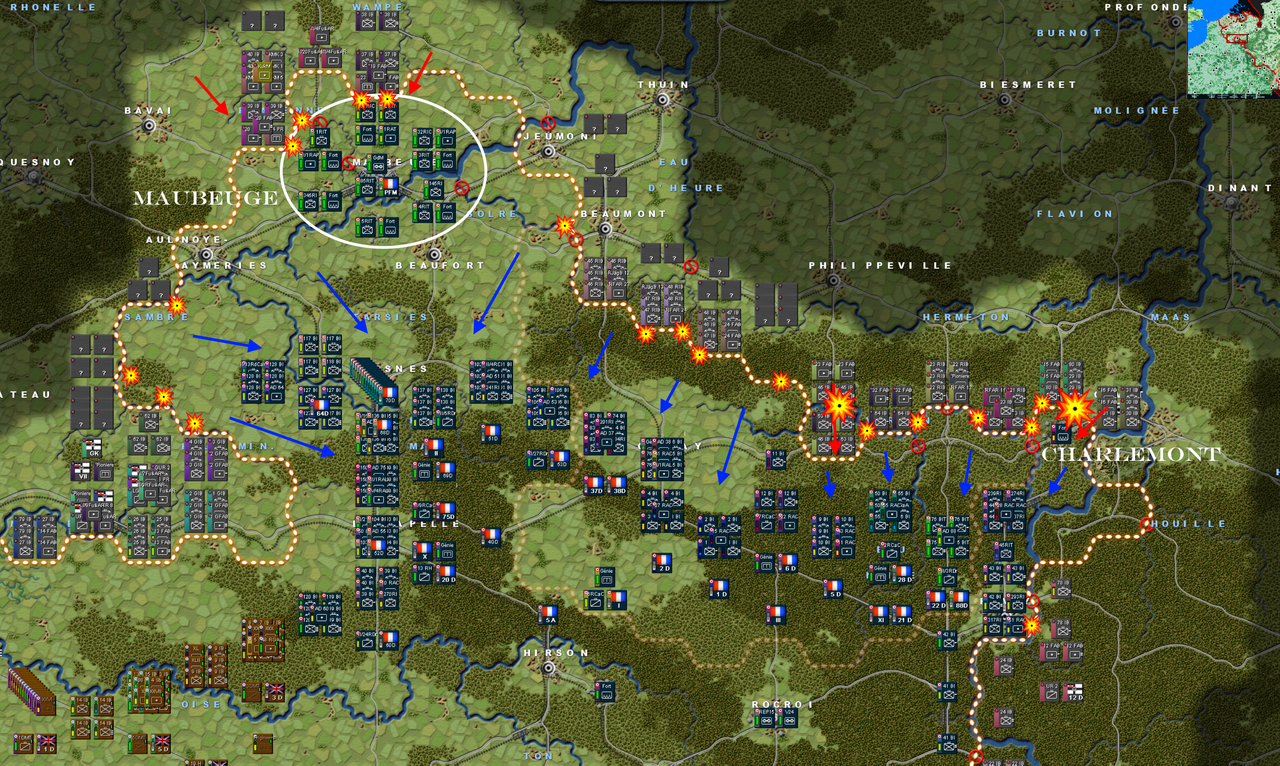
The right wing of the BEF is hit hard by additional German divisions arriving to support the German Guard. British 1. Guards Brigade inflicts heavy casualties on German VII. Corps but has to fall back under the pressure. Sir John French seeing his right in increasing danger orders a withdrawal of the entire BEF. Most of the bridges of Mons are blown up after the British artillery crosses the Haine to safety. French informs Lanzerac that he intends to use the Place forte de Maubeuge to anchor his line all the way to Valenciennes and/or Cambrais.

Lanzerac is furious considering how well his reserve divisions have been fighting at Charleroi and that such a move would leave Lille wide open to the enemy. But having no choice but to acknowledge the British decision he pulls back 137. Brigade d'infanterie out of Charleroi proper to hold the forests on the south bank of the Sambre river. 1. and 2. Groupe de divisions now form the flanks of the BEF and Lanzerac is not all to happy to be used as canon fodder to secure the British line.

Meuse area:
Image

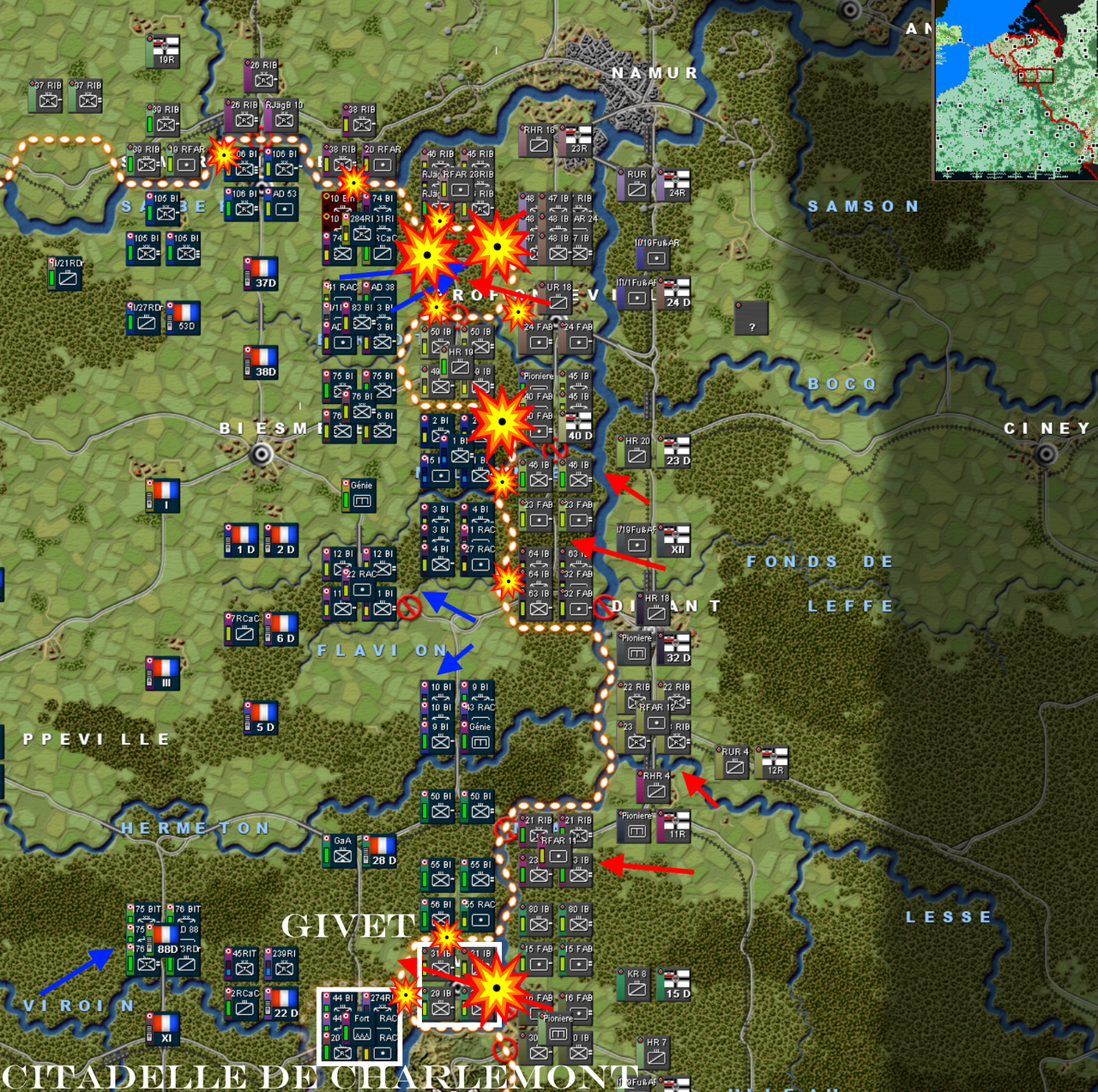
On the Meuse meanwhile horrendous losses occur on both sides, almost 10 000 casualties per side during the day, as the Saxons try to force their way out of the forests along the Burnot river. Attack and counter attack follow one after another leaving Saxons, French, and North-Africans alike dead among the trees and ravines. Tragically an artillery shell hit the Château d'Annevoie (where 40. German Division had it's headquarters) which burns to the ground.

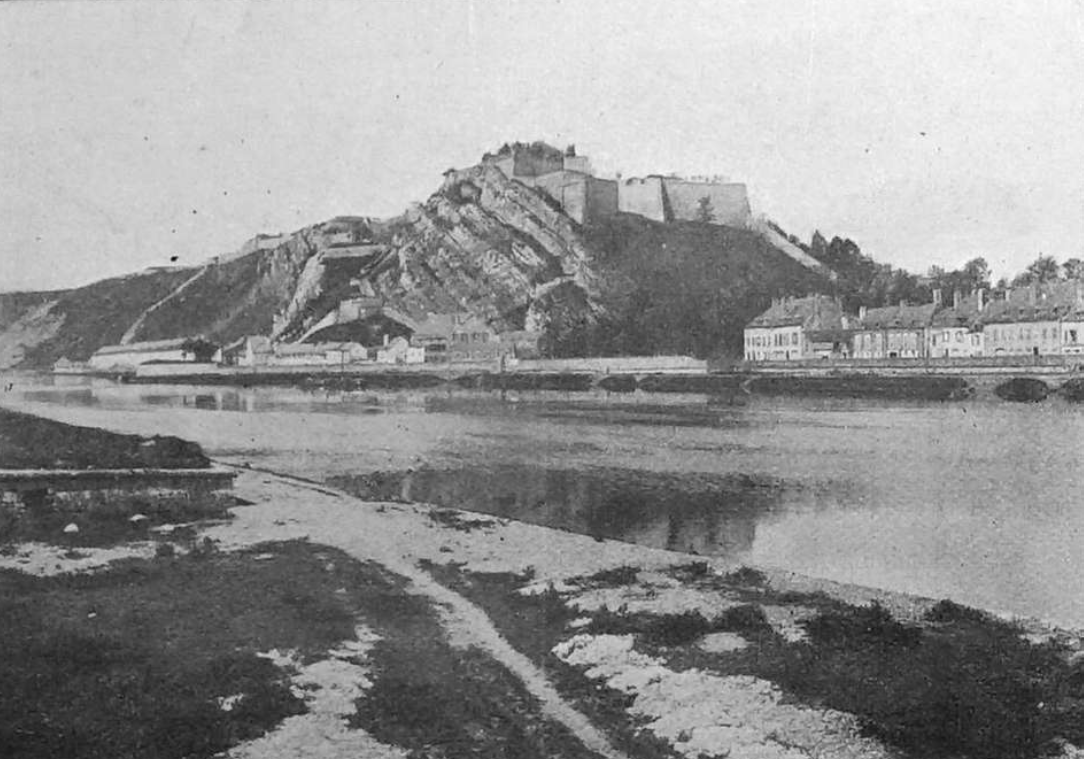
Further south the town of Givet falls to VIII. German Corps which crosses the Meuse. But the Citadelle de Charlemont is still firmly in the hand of 22. Division d'infanterie which is concentrating it's artillery there since it dominates the valley, town and railroad line beneath: as long as the citadel holds the loss of Givet itself is inconsequential.

Image
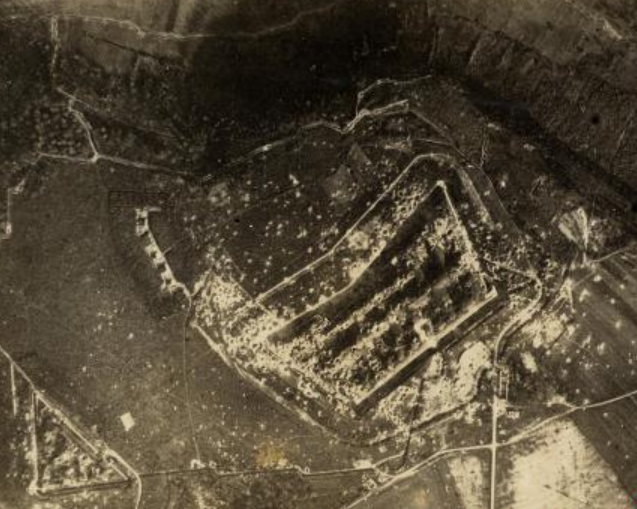
The citadel of Charlemont overlooking the Meuse.

More reinforcement is on the way to feed the slaughter: 88. Division territoriale is setting up to protect the northern flank of the Citadelle de Charlemont; the Boches on the other hand seem to have brought a Reserve Corps between Dinant and Givet from the Verdun area.

Center:
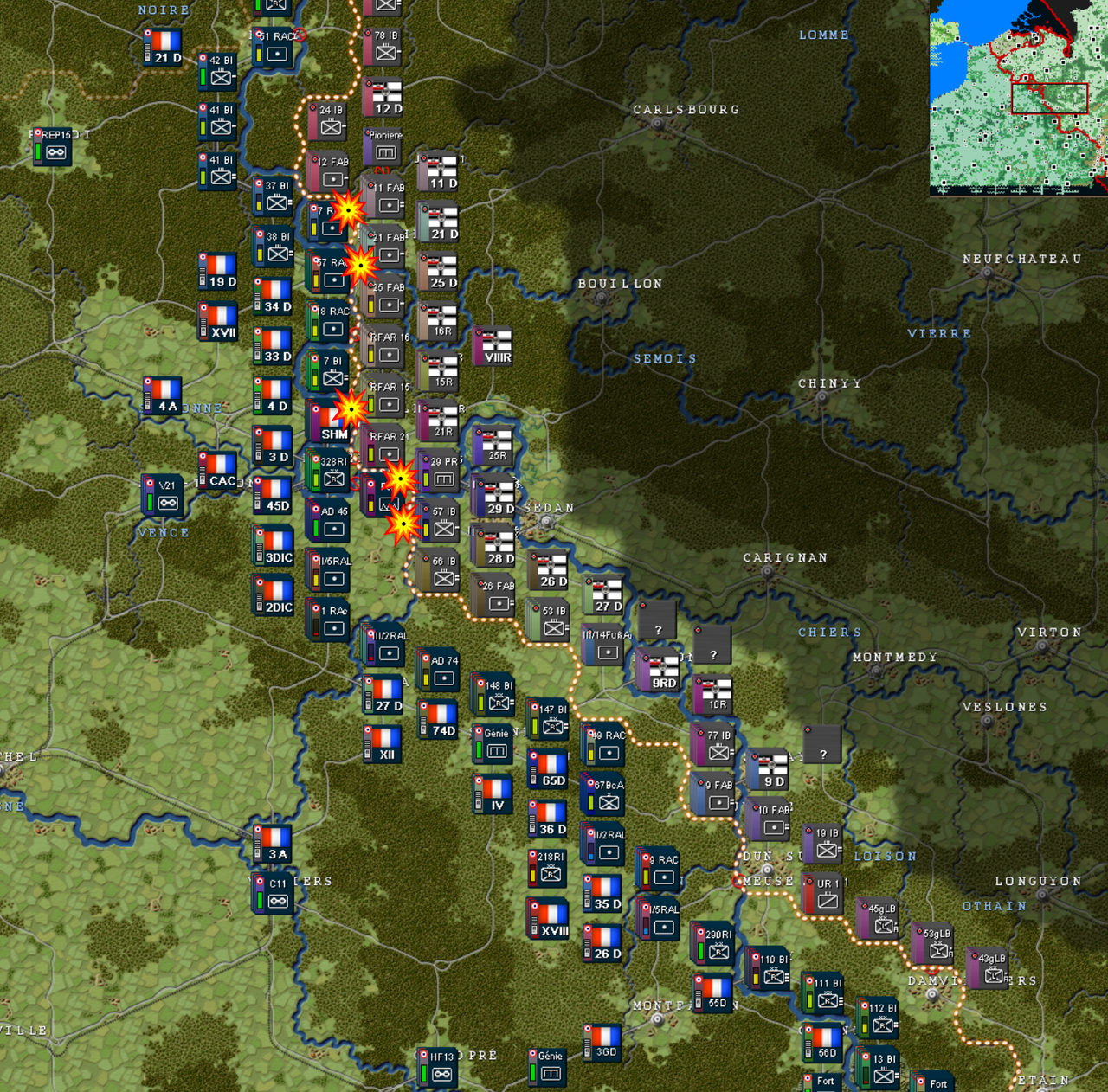
Image

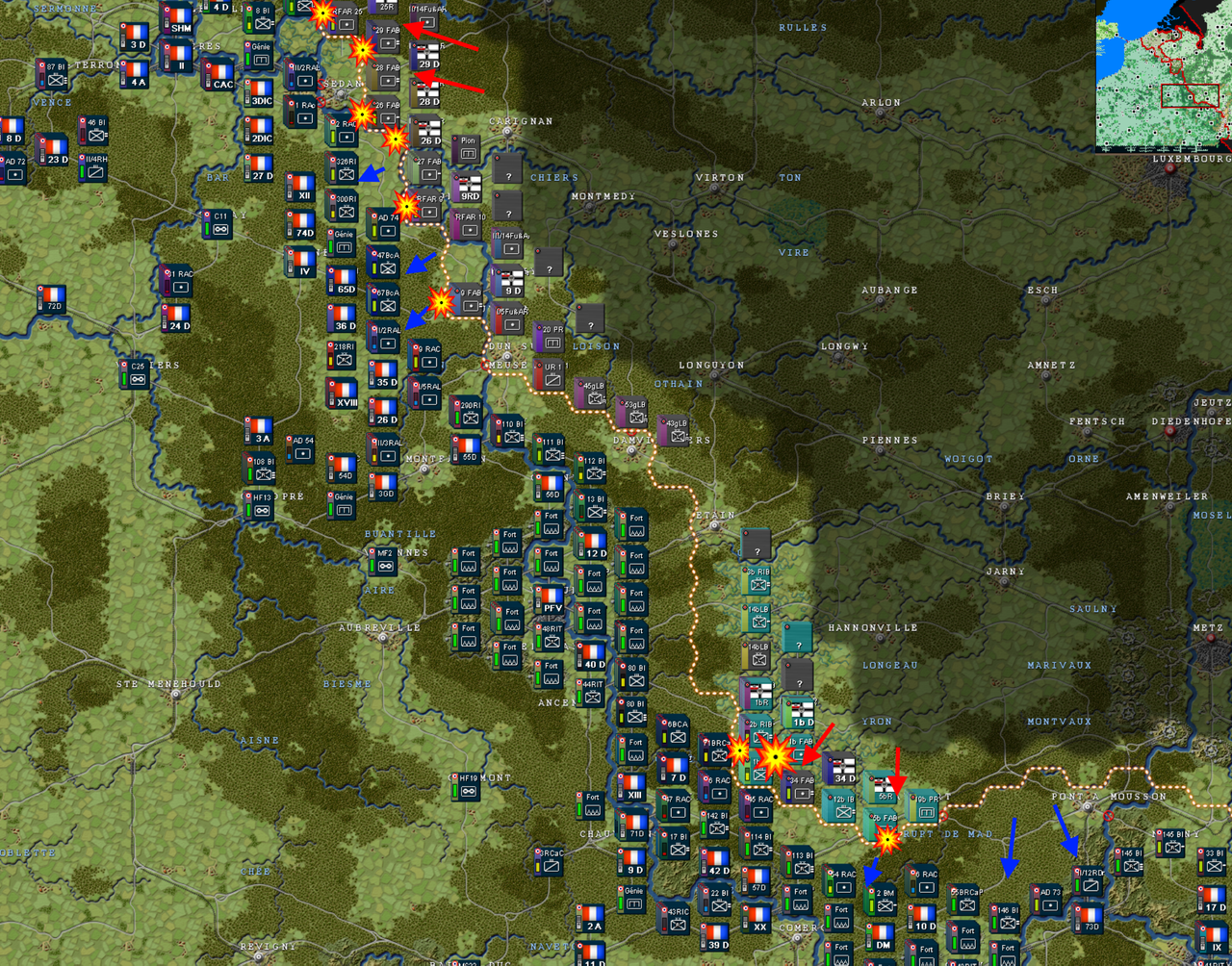
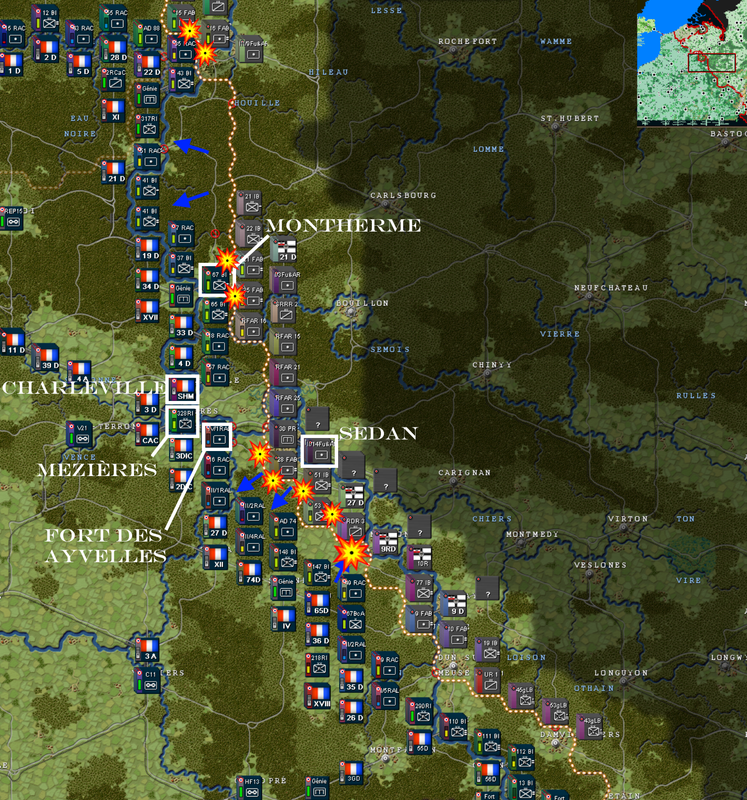
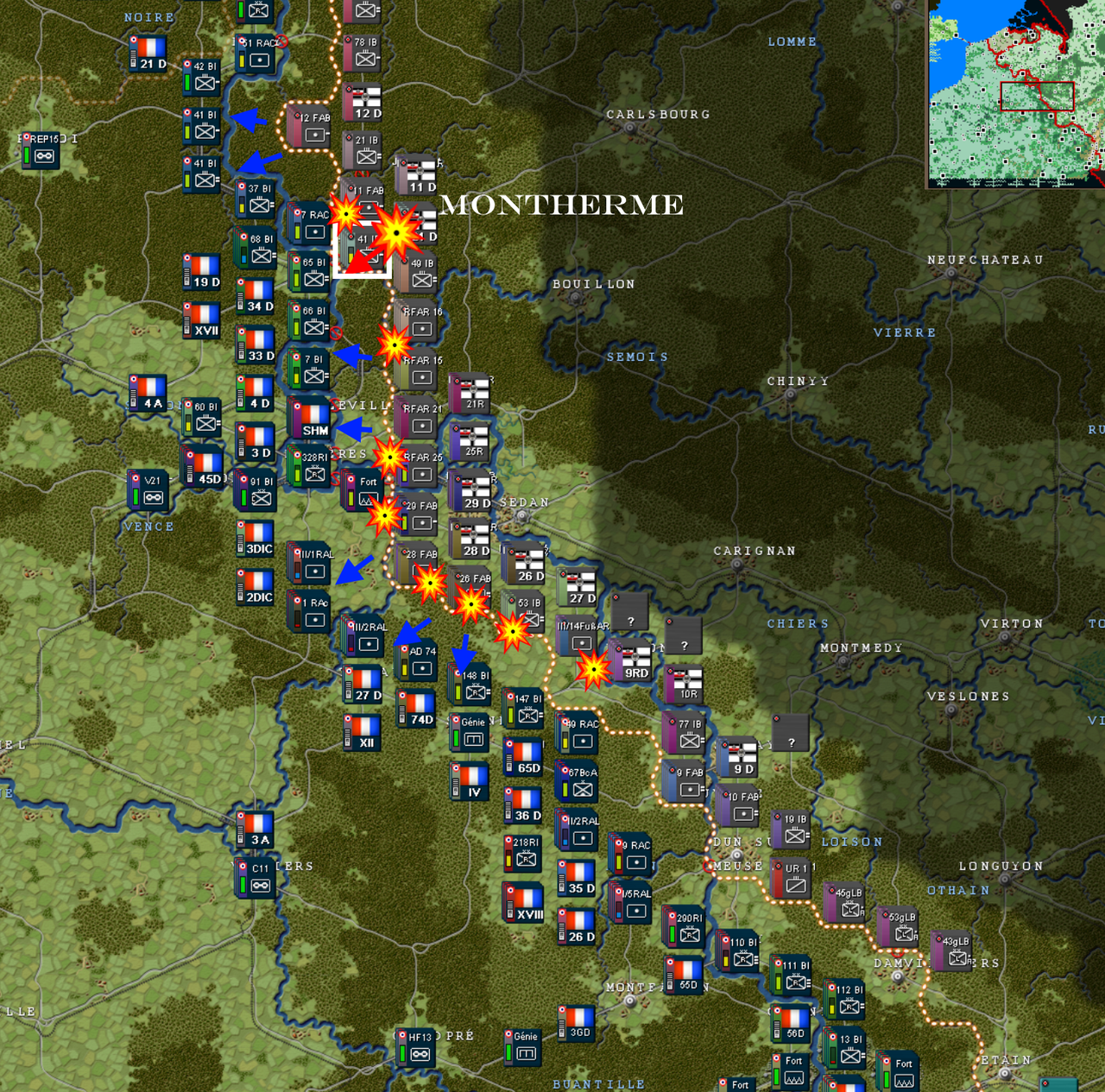
Things are a bit more quite in the center of the line. Sedan is abandoned by the Corps colonial to focus on the defense of the Meuse itself. Especially since 4. Armée is noticing a built up of German troops in front of Montherme further north.

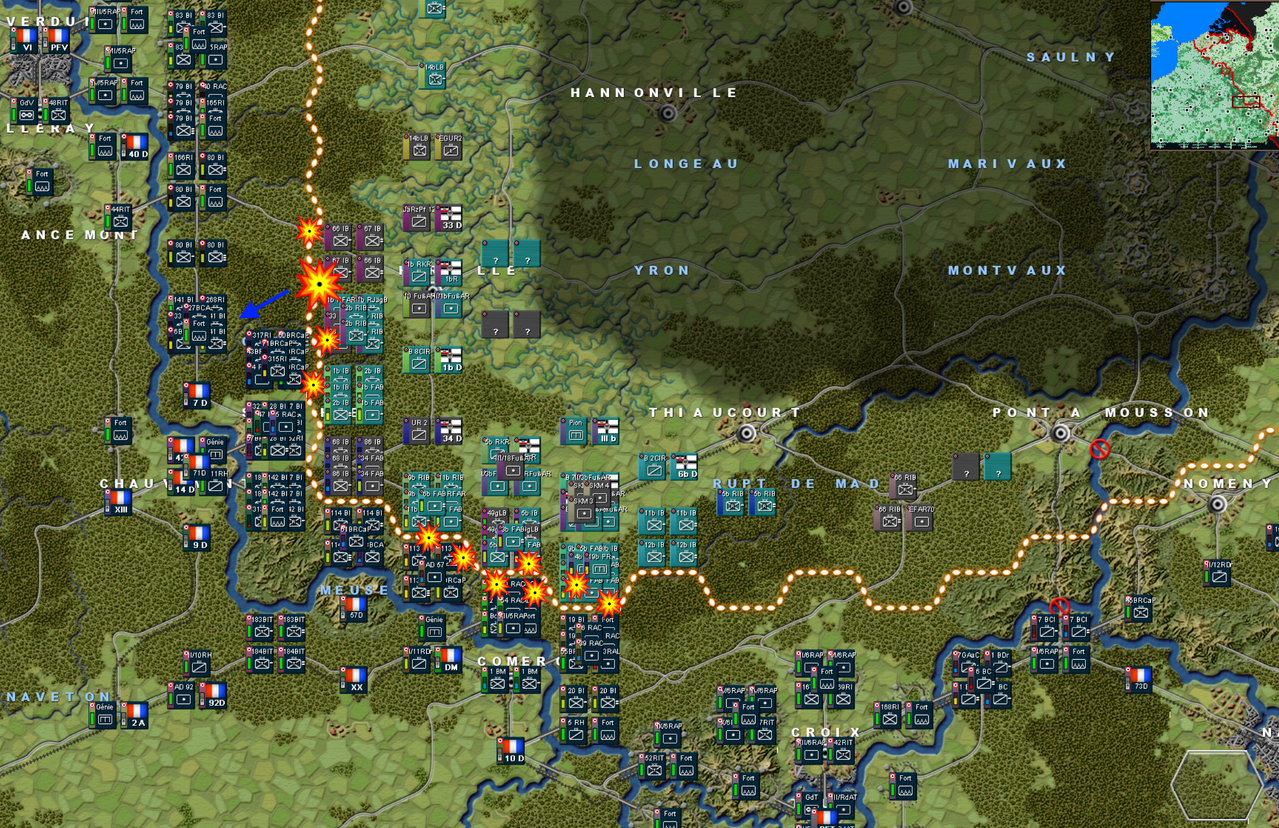
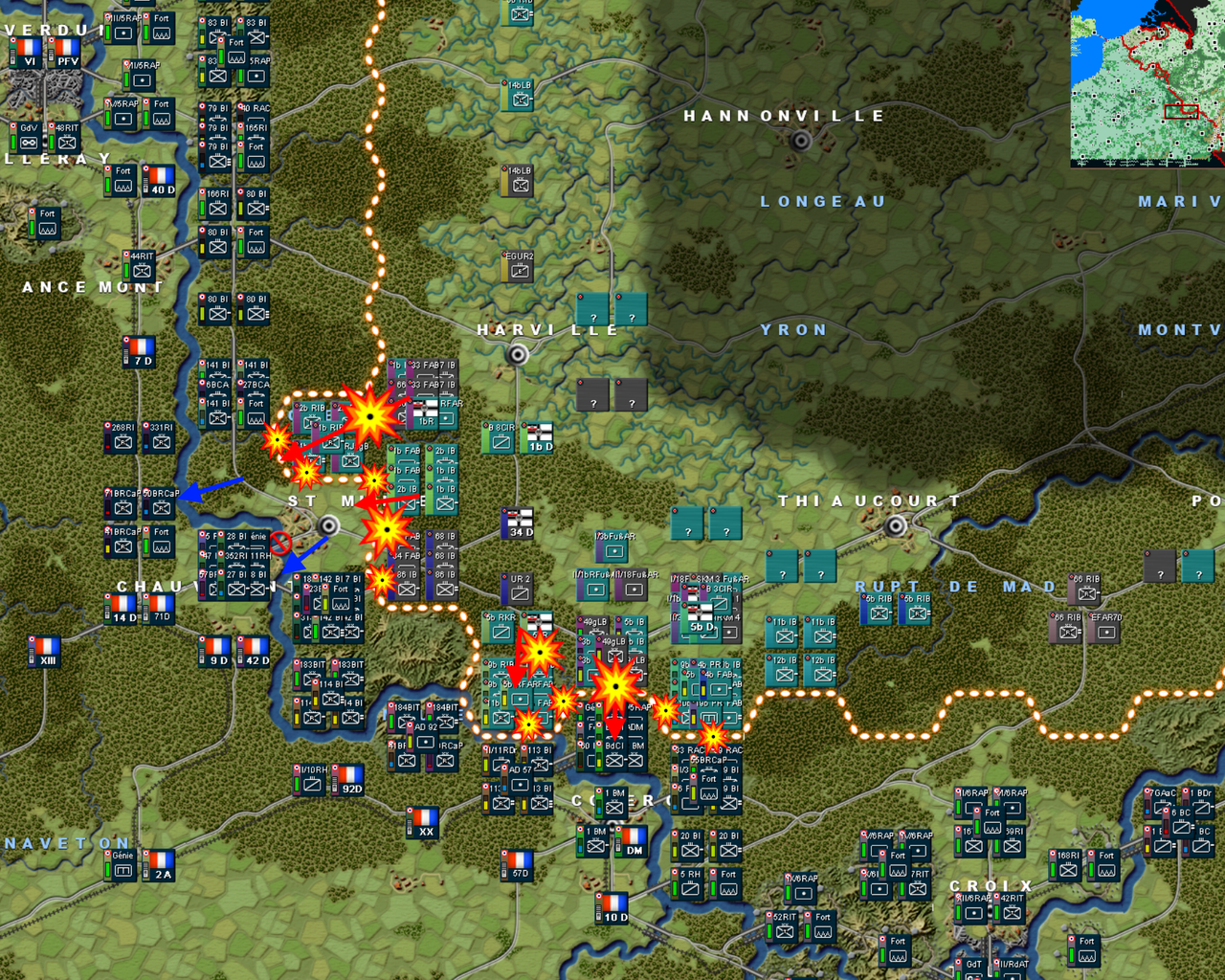
The Bavarian 1. Division leads the attack south of Verdun and de Castelnau continues to slowly pull back towards the forts of the Meuse.

In other news:
- Théophile Jouannic is sent to Limoges and is replaced as head of 36. Division d'infanterie by Alexis Hély d'Oissel.
- 8. Division d'infanterie is being reconstituted with reserves from Lorraine behind 3. Armée.
- Rumors say that Charles Lanzerac told a British liaison officer that Sir John French was a coward. Things are going great.
- A new French army is about to be set up around Paris, using the seven reserve and territorial divisions serving as garrison of the Paris defensive perimeter.

Conclusion:

Things heat up in Belgium and the daily casualty rates of the earlier battles like Lorraine are being surpassed. But this time both Germans and allied troops suffer heavily, enough to stop the German 1. Army crashing down onto the BEF?