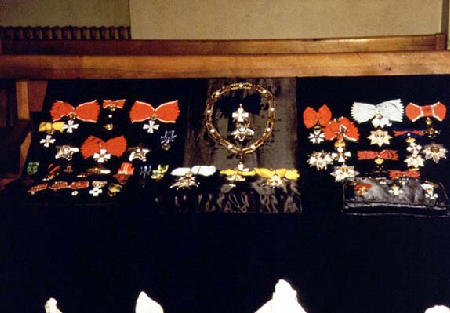
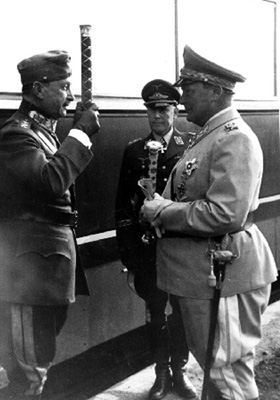
C.G.E Mannerheim
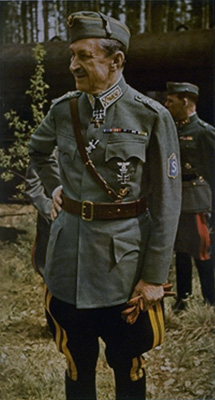 C.G.E Mannerheim.
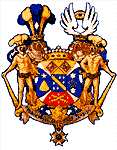 Coat-of-arms of the Mannerheim family of barons.
*Spoke six languages: Swedish, Finnish, Russian, French, German and English.
*Served 30 years in the Imperial Russian army.
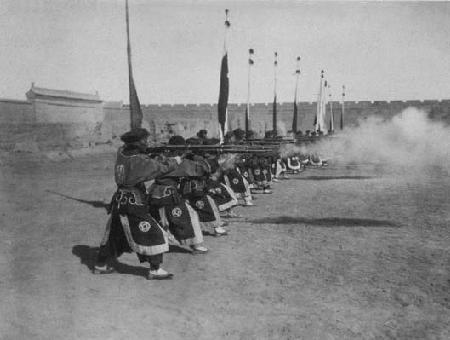
*Fought in the Russo-Japanese war as a junior officer of a dragoon regiment 1904-1905.
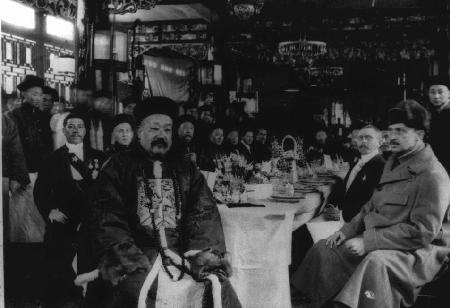
*Lead a "scientific expedition" to china and asia in 1906.
*Appointed commander of the Uhlan Regiment of the Life Guard of his Majesty the Emperor.
*Nominated "a general in the imperial entourage".
*Fought in ww1.
*Serving in the ranks of the 4th Army in 1914, his actions in the defence battle of Krasnik earned him the Sword of St George.
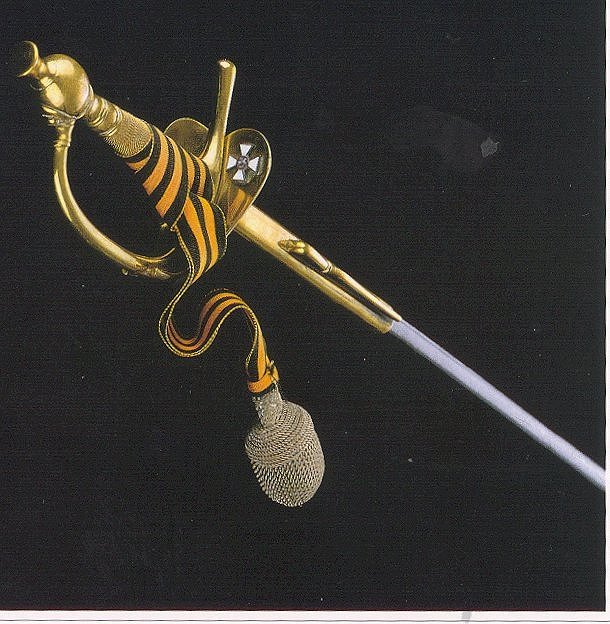
*Awarded the 4th class decoration of the Order of St George on the 18th of December, 1914, for his merits of commanding his brigade with excellent skill and bravery when guarding the flank of the sniper brigade of the Guard.
*In October and November 1914, Mannerheim’s brigade participated, in the ranks of the 9th Army, in the battles of Ivangorod, Tsharnyjlas-Zvolja, Politshna, Zvolen, Kutshk, Gezin, Leshtshiny, Komork, Piotrkovits, Pintshov, Hraberzh, Pomovits, Vavrzhentshits and Krakov.
*From 18 February, 1915, Mannerheim commanded the 12th Cavalry Division, consisting of Ahtyr Hussar Regiment, Belgorod Uhlan Regiment, Starodubov Dragoon Regiment, Orenburg Cossack Regiment, and some Don and Turkestan mountain batteries. He distinguished in the battle of Opolje in August and September 1915, and served as the acting commander of the second Cavalry Corps on several occasions in 1915. During the defensive battle the division was stationed in Fundul-Moldav in May and June 1917.
*Commanded a large Russo-Rumanian group Wrancza on the Rumanian front in the Carpathian Mountains from 11 December, 1916, till 7 January, 1917 and participated in six battles.
*Appointed commander of the 6th Cavalry Corps on the 12th of June 1917, and participated in its ranks, in the battles on the Rumanian front in July and August, 1917.
*Fought and won in the independence war as a white general.
*Internationally respected military leader. Even in Russia today there is a growing interest toward him.
*Had his own flag day.
*Succeeded in uniting the nation in a courageous battle against the enemy far superior in force.
*Received thank-you letters from the russian prisoners of war.
*Refused to actively participate in the siege of Leningrad.
*Was able to fight a truce and armistice from the allies.
Military Ranks
Non-commissioned officer, July 7, 1888
Cornet, August 8, 1889
Cornet of the Guard, July 27, 1891
Lieutenant of the Guard, August 30, 1893
Subaltern Cavalry Captain of the Guard, July 22, 1899
Cavalry Captain of the Guard, December 6, 1902
Lieutenant Colonel, October 7, 1904
Colonel, November 29, 1905
Major General, February 13, 1911 (returned to the rank of officer of
the Guard, December 24, 1913)
Lieutenant General, April 25, 1917
General of Cavalry, March 7, 1918
Field Marshal, May 19, 1933 (in connection with the 15th
anniversary of the end of the War of Independence)
The title of Marshal of Finland on his 75th birthday, June 4, 1942
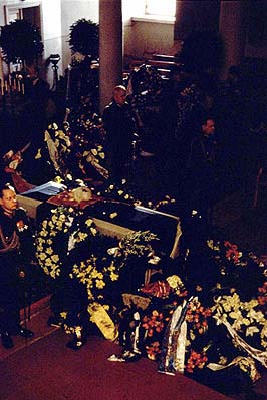
*Laid to rest with military honors 1951.