RE: OT: Corona virus
Posted: Wed Apr 08, 2020 10:06 pm
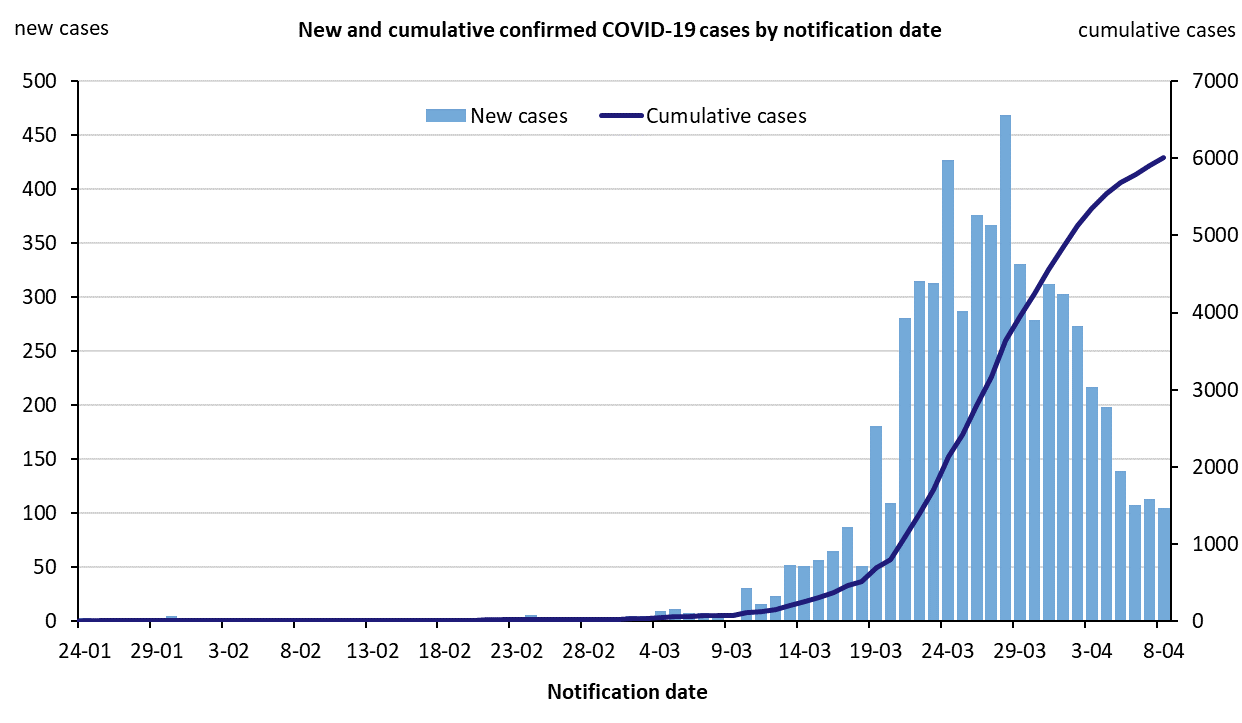
Oz graph
It has been less than two weeks since New Zealand imposed a coronavirus lockdown so strict that swimming at the beach and hunting in bushland were banned. They’re not essential activities, plus we have been told not to do anything that could divert emergency services’ resources.
.
.
.
It took only 10 days for signs that the approach here — “elimination” rather than the “containment” goal of the United States and other Western countries — is working.
The number of new cases has fallen for two consecutive days, despite a huge increase in testing, with 54 confirmed or probable cases reported Tuesday. That means the number of people who have recovered, 65, exceeds the number of daily infections.
.
.
.
After peaking at 89 on April 2, the daily number of new cases ticked down to 67 on Monday and 54 on Tuesday. The vast majority of cases can be linked to international travel, making contact tracing relatively easy, and many are consolidated into identifiable clusters.
Because there is little evidence of community transmission, New Zealand does not have huge numbers of people overwhelming hospitals. Only one person, an elderly woman with existing health problems, has died.
Far from the big coastal hubs of Seattle, Los Angeles and New York, this hospital in the remote southwest Georgia city of Albany — more than 35 miles from an interstate highway and 180 miles from a major international airport — is struggling to treat a community afflicted with one of the most intense coronavirus rates in the nation.
With 973 cases in Dougherty County, about one in 90 residents of this poor, predominantly black community has tested positive for COVID-19 — significantly more than the one in 1,450 residents Los Angeles County. Already, 56 people have died, about 75% of whom are African American, according to Michael Fowler, the county coroner.
.
.
.
No one suspected COVID-19 when a man from the Atlanta area arrived at Phoebe Putney’s emergency room Feb. 29 complaining of shortness of breath.
The man, who was 67 years old, had chronic lung disease and had not traveled to China or the West Coast.
He had come to Albany to attend a funeral for Andrew Jerome Mitchell, a retired janitor. After more than 100 people gathered at Albany’s Martin Luther King Memorial Chapel for the service, many then crammed into Mitchell’s small three-bedroom home for a potluck meal of fried chicken, greens and cornbread.
We hugged, we talked, we cried together,” said Alice Wise Bell, the daughter of Mitchell’s longtime partner, Emell Murray. “We didn’t think anything of it.”
Before she went to bed, Murray started feeling chills. The next day, Bell rushed her mother, who is diabetic and has high blood pressure, to the hospital with a fever of 103. Staff told her they suspected a urinary tract infection.
Before long, a cascade of sick people — including Bell’s aunt and cousin — trickled in to the emergency room.
By the time hospital and local officials realized the deadly virus was in the community, it had already spread from the funeral home to churches, the county courthouse and the hospital.
Sheriff’s deputies, teachers and caregivers to the elderly were among those who tested positive for the virus, along with more than 60 hospital employees.
ORIGINAL: RangerJoe
New Zealand isn’t just flattening the curve. It’s squashing it.
SEOUL, April 9 (Yonhap) -- South Korea on Thursday reported its fewest additional cases of the new coronavirus since late February, as the country is implementing an extended social distancing drive to fight against the virus pandemic.
The 39 new cases, detected Wednesday and down from 53 a day ago, brought the nation's total infections to 10,423, according to the Korea Centers for Disease Control and Prevention (KCDC).
South Korea recorded around 50 or fewer daily new cases for a fourth day in a row, a sharp drop from the Feb. 29 peak of 909 new cases. But health authorities remain on high alert over cluster infections at churches and hospitals, as well as new cases coming from overseas.
The nation's death toll from the coronavirus, which emerged in China late last year, rose by four to 204, according to the KCDC. In total, 6,973 people in South Korea have recovered from the virus.
ORIGINAL: Wuffer
ORIGINAL: obvert
Everyone continues to ask what Germany is doing well to keep deaths down.
While many of the overarching strategies have been discussed, like extensive testing, case tracking and isolation early, early-on lower age case rates, keeping the vulnerable as safe as possible, and their high numbers of ICU beds (although those will likely come more into play at a later stage).
The more I think about the more I believe it's a cultural thing and a lot of luck.
First, there is the habit of annoying everyone with absurdly high standards, which in the end you can't meet yourself. /s
Germans distance themselves socially far more than francone or Romanic cultures, the normal distance between conversations is at least an arm's length, rather two. When talking to southern Italians, we like to take a step back, whereupon the other one takes another step forward - I have often observed how people wandered across the room during a heated dialogue.
You don't find hugs or kisses in the > 50 years old generation, we were just about to introduce this into our behaviour.
Compare this with Switzerland: the number of cases in the Italian-speaking Kanton (Tessin) is significant higher than in the German-speaking world, the French part is in between.
https://de.m.wikipedia.org/wiki/Datei:C ... canton.svg
Regarding the numbers of tests, they were not that much available in the beginning, so the more important work was tracking down e.v.e.r.y. single case and isolating all contact persons - at some point they were 3-5 or more people quarantined for every confirmed case.
ORIGINAL: RangerJoe
The hospital went through 6 months of supplies in one week:
A small Georgia hospital battles one of the nation’s most intense coronavirus outbreaks
Far from the big coastal hubs of Seattle, Los Angeles and New York, this hospital in the remote southwest Georgia city of Albany — more than 35 miles from an interstate highway and 180 miles from a major international airport — is struggling to treat a community afflicted with one of the most intense coronavirus rates in the nation.
With 973 cases in Dougherty County, about one in 90 residents of this poor, predominantly black community has tested positive for COVID-19 — significantly more than the one in 1,450 residents Los Angeles County. Already, 56 people have died, about 75% of whom are African American, according to Michael Fowler, the county coroner.
.
.
.
No one suspected COVID-19 when a man from the Atlanta area arrived at Phoebe Putney’s emergency room Feb. 29 complaining of shortness of breath.
The man, who was 67 years old, had chronic lung disease and had not traveled to China or the West Coast.
He had come to Albany to attend a funeral for Andrew Jerome Mitchell, a retired janitor. After more than 100 people gathered at Albany’s Martin Luther King Memorial Chapel for the service, many then crammed into Mitchell’s small three-bedroom home for a potluck meal of fried chicken, greens and cornbread.
We hugged, we talked, we cried together,” said Alice Wise Bell, the daughter of Mitchell’s longtime partner, Emell Murray. “We didn’t think anything of it.”
Before she went to bed, Murray started feeling chills. The next day, Bell rushed her mother, who is diabetic and has high blood pressure, to the hospital with a fever of 103. Staff told her they suspected a urinary tract infection.
Before long, a cascade of sick people — including Bell’s aunt and cousin — trickled in to the emergency room.
By the time hospital and local officials realized the deadly virus was in the community, it had already spread from the funeral home to churches, the county courthouse and the hospital.
Sheriff’s deputies, teachers and caregivers to the elderly were among those who tested positive for the virus, along with more than 60 hospital employees.
https://www.latimes.com/world-nation/st ... -outbreaks

ORIGINAL: Sammy5IsAlive
The situation in the UK is a bit odd. Just going off the numbers today's reported deaths are higher than all but the worst single days in Italy and Spain. But we have not seen the kind of scary reports of hospitals being overwhelmed that came from Lombardy/Madrid. There is of course the possibility that the coverage is being managed to an extent by the government. But in these times of Twitter etc I'd suggest it is pretty difficult to 'gag' those on the front line. If we'd been overwhelmed I think we'd know about it.
More likely, my speculation would be two possible (not mutually exclusive) explanations. One would be that our classification of deaths is less stringent than Italy/Spain. So a similar number of 'Coronavirus deaths' would not be representing an equivalent stress on health services on the ground. The other possibility is that Italy and Spain had their cases confined to much more localised regions (Lombardy/Madrid/Barcalona) whereas the UK - which is even more densely populated than the European average (England is twice as densely populated as Italy and 4 times more densely populated than Spain and indeed the USA) has had cases and deaths - and the strain on health services these represent - spread across the country. That would tally with the FT graphs which suggest that whilst things are bad in London they are not anywhere near as bad as they were in equivalent regions in Spain/Italy.
ORIGINAL: Encircled
ORIGINAL: Sammy5IsAlive
The situation in the UK is a bit odd. Just going off the numbers today's reported deaths are higher than all but the worst single days in Italy and Spain. But we have not seen the kind of scary reports of hospitals being overwhelmed that came from Lombardy/Madrid. There is of course the possibility that the coverage is being managed to an extent by the government. But in these times of Twitter etc I'd suggest it is pretty difficult to 'gag' those on the front line. If we'd been overwhelmed I think we'd know about it.
More likely, my speculation would be two possible (not mutually exclusive) explanations. One would be that our classification of deaths is less stringent than Italy/Spain. So a similar number of 'Coronavirus deaths' would not be representing an equivalent stress on health services on the ground. The other possibility is that Italy and Spain had their cases confined to much more localised regions (Lombardy/Madrid/Barcalona) whereas the UK - which is even more densely populated than the European average (England is twice as densely populated as Italy and 4 times more densely populated than Spain and indeed the USA) has had cases and deaths - and the strain on health services these represent - spread across the country. That would tally with the FT graphs which suggest that whilst things are bad in London they are not anywhere near as bad as they were in equivalent regions in Spain/Italy.
They are plenty of questions for the government to answer on what it did to close down the country and whether it was fast enough, but the NHS effectively doubled its ICU capacity in that period.
Thats something that is pretty impressive, and is probably the only reason we haven't been overwhelmed.

ORIGINAL: CaptBeefheart
OK, gents, I've got your feel good story of the day: S. Korea reports fewest virus cases since late Feb.
SEOUL, April 9 (Yonhap) -- South Korea on Thursday reported its fewest additional cases of the new coronavirus since late February, as the country is implementing an extended social distancing drive to fight against the virus pandemic.
The 39 new cases, detected Wednesday and down from 53 a day ago, brought the nation's total infections to 10,423, according to the Korea Centers for Disease Control and Prevention (KCDC).
South Korea recorded around 50 or fewer daily new cases for a fourth day in a row, a sharp drop from the Feb. 29 peak of 909 new cases. But health authorities remain on high alert over cluster infections at churches and hospitals, as well as new cases coming from overseas.
The nation's death toll from the coronavirus, which emerged in China late last year, rose by four to 204, according to the KCDC. In total, 6,973 people in South Korea have recovered from the virus.
We still have zero deaths from this in Seoul, a city of 11 million people.
Anyway, all this without government-mandated shutdowns, except schools and the Seoul mayor recently shutting down large clubs and room salons for 10 days. [What's a "room salon?" A friend told me it's a place where you pay a gal to sing with you, whisper sweet-nothings in your ear and pour you watered-down whiskey, all in a room fitting 6-30 people.] Clearly the Korean Room Salon Association hasn't been on the ball in offering freebies to government officials.
Back to your regularly scheduled programming.
Cheers,
CB
warspite1ORIGINAL: obvert
Midlevel bureaucrats in the city of Wuhan, where the virus originated, and elsewhere in China have been lying about infection rates, testing and death counts, fearful that if they report numbers that are too high they will be punished, lose their position or worse, current and former intelligence officials said.

ORIGINAL: warspite1
warspite1ORIGINAL: obvert
Midlevel bureaucrats in the city of Wuhan, where the virus originated, and elsewhere in China have been lying about infection rates, testing and death counts, fearful that if they report numbers that are too high they will be punished, lose their position or worse, current and former intelligence officials said.
Echoes of Chernobyl.....[:(]
ORIGINAL: JohnDillworth
It's starting to look like Sars-Covid-19 got to NYC from Europe, not China, and was circulating for weeks before anyone knew about it. Apparently it's genetics change over time and are trackable. The paper is awaiting peer review but come form a geneticists at Mt Sinai Hospital.
https://www.nytimes.com/2020/04/08/science/new-york-coronavirus-cases-europe-genomes.html
We made mistakes for sure, but we thought we had 2 weeks only to find it has been here for a month.
warspite1ORIGINAL: Wuffer
ORIGINAL: warspite1
warspite1ORIGINAL: obvert
Midlevel bureaucrats in the city of Wuhan, where the virus originated, and elsewhere in China have been lying about infection rates, testing and death counts, fearful that if they report numbers that are too high they will be punished, lose their position or worse, current and former intelligence officials said.
Echoes of Chernobyl.....[:(]
It's the same everywhere.
