Page 4 of 7
Posted: Fri Jul 20, 2001 12:50 am
by Josans
Originally posted by Don Shafer:
I'm with you on this issue Ed. I also don't like to win by a bug. But I also think that this particular strategy in discussion is not necessarily a bug issue. I reinterate, if the Luftwaffe can be used in sufficient strength to keep a unit in SL 0 with a high enough readiness not to incure equipment losses, and with no combat, then I think it's a valid strategy. If the unit is incurring losses due to combat or low readiness and airlift replaces lost equipment, then it is a definite bug.
Ok I will say again "nobody likes win with the help of a bug".
Many people in this forum makes an effort to expose things in english. I try it but sometimes I mistake. How many times I must to say Im sorry?

Posted: Fri Jul 20, 2001 1:49 am
by RickyB
Originally posted by Josan:
Ok I will say again "nobody likes win with the help of a bug".
Many people in this forum makes an effort to expose things in english. I try it but sometimes I mistake. How many times I must to say Im sorry?
You don't need to say anything further about it, as we understand and agree I believe (at least speaking for myself). These posts are discussing what should be considered a bug rather than a feature. In this specific case Don is saying that the only part he considers a bug is if equipment is delivered to isolated units by air - if the unit exists forever with just air supply but no combat, he feels that is okay, and is okay to use in a game. This was not directed at you, period.
Posted: Fri Jul 20, 2001 11:53 am
by Ed Cogburn
Originally posted by Don Shafer:
Isn't that the point? It can be done in WIR. If everything in the game is tied directly to what happened historically, then why bother turning on the computer? I'll just go down to the local library and pick up a book on the Russo-German War and read about it. Or slap in Cross of Iron in the DVD player and watch it again. 
There's a difference. You can play the game making different decisions about force deployment and changing priorities that leads to a game which is very different from history. In this case though, we have an exploit in the game, something that allows an event that simply never could have happened historically, and arguably never could have happened period, then or now. Big Difference.
Posted: Fri Jul 20, 2001 12:03 pm
by Ed Cogburn
Originally posted by Don Shafer:
I'm with you on this issue Ed. I also don't like to win by a bug. But I also think that this particular strategy in discussion is not necessarily a bug issue. I reinterate, if the Luftwaffe can be used in sufficient strength to keep a unit in SL 0 with a high enough readiness not to incure equipment losses, and with no combat, then I think it's a valid strategy.
If you are saying a mechanized unit which is not fighting, AND NOT MOVING, should be allowed to survive indefinitely, then I might go along, but only to a point. We have examples of air supply attempts to keep infantry pockets in supply, and these largely failed. We don't have an example of a mechanized corps moving and fighting behind enemy lines indefinitely. I believe the reason for that is because it could not work, and therefore was never tried.
If the unit is incurring losses due to combat or low readiness and airlift replaces lost equipment, then it is a definite bug.
Yes, air supply adding large equipment to an out-of-suppy unit should be illegal no matter what the other circumstances are.
Posted: Fri Jul 20, 2001 12:50 pm
by Ed Cogburn
Originally posted by Don Shafer:
Guess you've never seen what a squadron of C-130's can do in lift capabilities. The whole purpose of there design was to takeoff/land on any surface and if they can't land, the old back door opens up and you roll the stuff out as you go by. They kept Khe Sahn alive for a few months. Not the same as an armored army, but it is feasible.
Yes, I've seen that. Its really impressive, but do the numbers add up? About Khe Sanh:
"As the NVA battered the base supply problems became evident. Three C-ration meals per day were reduced to two. With only twelve different meals to chose from, meal time turned from a pleasant break in the daily routine into just another ordeal."
They had only 5000-6000 Marines there, about a third the size of a WWII infantry division. They were not mechanized, they weren't moving, they needed fuel only for electric generators, the rest of the supply capacity brought in food, weapons, and ammunition. And still they couldn't get the supplies in fast enough to avoid rationing the food.
The reality is that what couldn't happen in 1941, definitely can't happen now. A mechanized corps deep in enemy territory can not be fully supported by air, plain and simple. A modern mech corps requires a level of supply higher than a WWII equivalent, and I don't think we even have enough C130s in existence to try to supply such a unit. Remember what I pointed out earlier, in Desert Storm the ground supply system couldn't bring up enough fuel to sustain the mechanized forces. Fortunatey, the ground war ended before this problem could become noticable. If ground supply can't get enough fuel to the units (who are not behind enemy lines), how can air supply accomplish what even ground supply couldn't do?
[ July 20, 2001: Message edited by: Ed Cogburn ]
Posted: Fri Jul 20, 2001 1:13 pm
by Ed Cogburn
Originally posted by Josan:
Ok I will say again "nobody likes win with the help of a bug". Many people in this forum makes an effort to expose things in english. I try it but sometimes I mistake. How many times I must to say Im sorry?
There is absolutely no reason for you to apologize to anyone here for any reason. Its obvious you are struggling with English, and you're not the only one, so misunderstandings are inevitable. You did what you're suppose to do, you corrected my mistake in understanding, and now we move on to the next topic.
Posted: Fri Jul 20, 2001 3:22 pm
by JustAGame
The questions that I am seeing here are as follows:
1. Is it an exploit or tactic for the German player to supply a mobile korps behind enemy lines with air power?
2. Is it even possible for such a method of supply to be accomplished with success?
3. If granted that it isn't an exploit, should the game be altered such that this tactic is mechanically impossible?
1. Is it an exploit or tactic for the German player to supply a mobile korps behind enemy lines with air power?
The player is using a game feature specifically for it's intended purpose. The game feature being the ability to provide air supply to field units and the intended purpose is indeed to increase readiness. One might still argue that it isn't historically how air supply was used, but I believe we all deviate from doing what Germany did historically.
2. Is it even possible for such a method of supply to be accomplished with success?
I must admit that I'm not a logistics expert and my job in the army was in no way related to logistics. Disclaimer posted, I will take a stab at this anyway.
First, one has to consider the philosophy of the nation's military structure. Unquestionably, the US has embraced a philosophy that uses strong logistical support as a significant force multiplier and invests resources accordingly. Other major powers opt to invest their resources elsewhere and do not enjoy the same deployment options and logistical supply capabilities.
Second, the quantity of supply required by a mechanized unit differs significantly from one nation to another. I think the reasons are obvious enough to not further explain this one.
Third, the conditions of the battlefield in the air above and between the unit and the source of supply can make it "impossible" even if all other factors are favorable. To even consider this effort as possible, we would have to assume air suprememcy or at least air superiority.
Fourth, the technology would have to be ample for the desired purpose. I am probably not in the minority in my confidence that a Roman legion couldn't have been supplied by an armada of homing pigeons.
Fifth, the type and quantity of supply required would be dependent on the mission specific needs of the mechanized unit. Maintaining the mobility of a unit would have different needs than supporting that unit for drawn out battles against equal foes. This factor is really a multiplier for the scale of the capability.
Finally, the nation must have the resources
or else their plans would remain on paper.
As evidenced during WWII, nations can develop entire industries and produce massive military forces where none existed. It is and has been possible for a nation with the will to develop such a capability, the technology and the resources to supply a mobile mechanized unit behind enemy lines.
3. If granted that it isn't an exploit, should the game be altered such that this tactic is mechanically impossible?
While Germany did enjoy substantial air superiority in 1941, I haven't yet seen anyone present evidence for the arguement that they had the capability to supply a mechanized unit behind enemy lines at the outset of Barbarosa. However, the game was designed to allow production freedom and players should be able to produce this capability. The player is infinitely more powerful and dutifully obeyed than Hitler and our ability to alter our production towards logistical support should not be hampered by it being historically different than what happened. Historically accurate stops for us on June 22, 1941.
My feeling is that if the air supply is changed at all, it should only be with regard to the accuracy of the payload of the transports. If someone can show cause that all the German transports and bombers capable of transport were not sufficient for the quantity of supply needed for a mobile mech unit in the enemy's backyard, then adjust the amount of readiness gained per aircraft load value.
It may even be possible to modify the combat value formulae for out of supply units independent of their readiness. This is assuming the research isn't done to accurately determine the airlift capability required to supply a mobile 1941 German mechanized unit that is out of supply from ground sources.
Posted: Fri Jul 20, 2001 3:40 pm
by Lorenzo from Spain
Originally posted by Ed Cogburn:
[ July 17, 2001: Message edited by: Ed Cogburn ]
Tactic: Deep advance with unit, only some infantry elite divisions, supplied by air. The ground unit dońt fight heavily, are the air bombers who destroy the enemies.
Counter tactic: Maintain in all fronts a reserve of one (or two) infantry armies, with tanks, and one tank army, at 3-4 hexes in the rearguard. Any deep penetration will be isolated and destroyed.
If yoúve not reserves (it́s not good) and you suffer a deep advance, dońt send reinforcements by train near the advancing enemy unit: they will arrive tired, and without any entrenchment. The enemy bombers will destroy them, and the enemies still will advance easily. Send your reinforcements 5 hexes in the rearguard. Another ones, at 6 hexes. One Tank army too. This way, your units will have time to rest and to entrench. Dispose a good HQ and good general, with good fighters and bombers, to back your defenders (the enemies HQ will be too far to send fighters, only bombers). When the enemy unit arrives and is rejected, surround, counterattack and destroy it.
This tactic can be done in any place and date, if the enemy defense is not deep. It́s not necessary change rules, only defend deeply.
Strategy: Caucasus attack in 1942.
When the German cross the south Don, can destroy any soviet army, until the Terek river. Can advance and manouevre easily. When conquered the railroad cross, the south way to Stalingrad will open. And more, Maikop is out of supply then. And it́s not necessary a deep advance (only is a posible tactic, you can use it or not). When Germans reach Grodzny, the others soviet oil centers are in range of German fighters: the soviet can do nothing to avoid their destruction by escorted bombers.
Counter strategy:
Really I dońt know, Ím studding it (and Ím suffering it in a PEBM). Defend heavily the south Don line, even sacrificing Rostov. If this line is penetrate, general retreat and defend the Terek line. There is not defense of railroad cross and Maikop, if the Germans attack heavily. I though in flank attack from railroad from south Stalingrad, but if the Germans advance too trough the east railroad to Stalingrad (and they will do, no doubt), they can cut the rearguard railroad of flanking armies, and destroy them.
Posted: Fri Jul 20, 2001 10:14 pm
by Micha
In my opinion, supplying an isolated, advancing unit is not only about having enough aircraft to transport the necessary amount of supplies. I don't know about it, but I can imagine that it might be possible to scratch together enough Ju52 and bombers to have a sufficient total payload.
But how to deliver that load? Maybe in the steppes you can build field airports wherever you go(you certainly cannot do this in the Caucasus Mountains), but those will hardly be able to handle such vast amounts as are needed by a corps. And how to distribute the supplies? Since the unit is constantly moving, you cannot build a regular organization, you will have to improvize, and there is no way that this might work on such a great scale.
I am not a logistics expert, but I just do not believe that is is possible to properly supply a unit moving behind enemy lines, certainly not a corps-sized one. And if something is not possible, then it should not be in the game.
On the other hand, as long as the current rules are in effect I do not consider it as cheating if somebody makes use of them. Maybe this is a weakness in the game, but it is not a bug because those rules have been set intentionally.
Posted: Sat Jul 21, 2001 4:11 am
by Nikademus
I've been following this thread with interest. To be honest i'm stunned that this topic is as controversial as it is.
Is the tactic of supplying an advancing army(s) or corps soley by air a game tactic or historically possible?
OF COURSE its a game tactic. No army in WWII was capable of conducting *sustained offensive operations* supplied soley by air at the level portrayed in War in Russia.
Even today such a tactic would be highly difficult to pull off and then only with ligh combat troops ala the helicopter/cavalry tactics developed by the US army during the Vietnam conflict.
Think about it. Its one thing to supply a combat formation that is holding a static position, with it's location and entrenchments firmly in place. But supplying a static formation is a far cry from a unit that is not only advancing but fighting as well!
This is not a case of alternate strategy vs historical. An example of 'doing it differently' would be advancing on Leningrad and Moscow as opposed to halting and/or driving south to encircle Kiev.
If such tactics were realistically possible then why did'nt any nation do it during the war?
What about Market Garden? Why the emphasis on the ground advance? why did'nt the airforce simply supply the defending paratroopers with all they needed?
How about Italy? why did'nt the US/British just land in several different locations at the same time and advance through the Italian countryside supplied soley by air?
Why did the Germans bother to encircle their enemy? why not just keep driving East towards the industrial objectives? they can be supplied by air right?
Why did we bother with the struggle at Normandy? just land the paratroopers, bring in some heavy equipment with some exotic new airframe and head straight for Germany?
Sorry, not intending to sound mocking or ridiculous, but to me its just common sense. No amount of WWII airpower can fully replace the need for ground based supply and transport. Airpower can enhance or in certain cases support isolated units and keep them from being destoryed. But to keep them going on a *sustained offensive* in the enemy's rear? No way, and certainly not the Luftwaffe, which was at it's heart, a ground attack oriented organization. Further, if the supplied units is advancing, how does the airforce in question manage to firmly locate and drop and/or land it's supplies in the proper location each time? From what i've read, even supplying a static unit was difficult, more so if there were enemy troops nearby. More often than not half the supplies designated for your troops will end up falling into enemy hands
And here we're talking tanks too?? How much fuel would it take to sustain a single Panzer corps?
Not even the USAAF, using B-24's and B-17's would be able to realistically pull this trick off. Were such things possible the 6th Army should'nt have had anything to worry about once they got encircled. But it did'nt happen that way did it? Confident assurances that the Luftwaffe was up to the job of them fell to naught.
Granted, the 6th was a far larger organization but they were *static* too. A smaller panzer corp, advancing and fighting is going to require a huge amount of logistical support. Rations, spare parts, ammunition, and of course fuel.
I've only just rediscovered War in Russia and hav'nt been playing so i was amazed to discover that this was a valid (game-wise) tactic.
I think one thing that has'nt been addressed too is that part of the problem of this inflated capability of the airforces is how the game factors in the control of hexes. To isolate an army all a Panzer corp has to do is track across it's rear side and "convert" the traversed hexes into their army's control. Unless the rules have changed and assuming i'm remembering correctly this means that no supply will be able to cross this invisible line even if technically there are no enemy troops there to interdict them.
This does'nt strike me as totally realistic. If this was 'real life' the vastness of Russia would be playing towards the defenders benefit. Sure the Panzers can romp around the country-side but they cant be everywhere at once. This is a reallife "check" on the conduct of armored forces. They can only trek so far beyond the main line of advance because the more they do the larger the "holes" will be from which enemy troop and logistical forces can take advantage of.
Rail hubs and lines are an exception of course. The this "all or nothing" effect can be devastating. A single panzer corp of two divisions and a battalion could all by itself cut off an entire army group from it's supply by taking advantage of these rules and simply 'converting hexes'
I'm not berating anyone who's used this tactic (unless there was a pre-agreed to "house rule" between the players) but if it comes to a vote i'll side with Ed and say that the rules need a serious revision in a future version.
[ July 20, 2001: Message edited by: Nikademus ]
Posted: Sat Jul 21, 2001 8:09 am
by jager506
As Nikademus pointed out, just cutting off or isolating armies rarely leads to wholesale surrender. Even in the earliest cauldron battles at Minsk, Bialystok and Smolensk large numbers of Soviet troops fought their way of the encirclements - perhaps that's where shattering (as opposed to surrendering) is a fairly realistic way of portraying this fact in the game. The weakened units that reappear the next week represent the cadres who got away to fight another day.
Posted: Sat Jul 21, 2001 10:05 am
by JustAGame
The world would be a very different place if noone tried anything because it hadn't been done before or because others felt it was impossible.
In an effort to bring this discussion closer to being based on facts rather than opinions, I decided to actually dig up some empirical data. This data and information is only a beginning, but it does have value in answering the question of whether it is possible to supply a German mechanized korps in 1941-42.
Berlin required 4500 tons of food daily to not be starved by the Soviet blockade. In a matter of a few months, 400 transport aircraft were supplying Berlin with 8000 tons per day of food, coal, deisel fuel, etc.. The C-47, Dakota and Skymasters actually flew in 13000 tons by noon on Easter Sunday.
It was largely believed to be impossible to feed a major metropolis for a sustained period by air alone. The alternative would have been a war for which the western powers were ill prepared to undertake. Although contingency plans were drawn that would have dropped 133 atomic bombs on 70 Soviet cities and industrial sites.
The planes used in the airlift had carrying capacities of 1.5 tons, 3.5 tons and 10 tons. The two most successful German transport aircraft were the JU-52 and the HE-177, which had carrying capacities of 5 and 15 tons respectively. It can be logically argued that less than 400 German transports could have achieved the same 8000 tons daily under the same circumstances and given the same parameters.
Summary of Facts:
1. General Tunner was hardly questioned when he later claimed that the US airlift capability is such that we can fly anything, anywhere, and at any time. It was fortunate that he thought outside of the box.
2. JU-52 carrying capacity is 5 tons.
3. HE-177 carrying capacity is 15 tons.
4. 400 aircraft of less carrying capacity than the German transports supplied 8000 tons per day to a city with 3 airfields.
Questions:
1. What is the effective carrying capacity loss for parachuting supplies?
2. What was the supply need per day for a German mechanized soldier, motor vehicle and armored vehicle? I'm guessing the game already increases readiness with the number of squads and vehicles as a factor. Whether it does or doesn't, the tonnage of supplies needed for a given unit of any size can be determined mathematically. The answer to this question should also consider the unit as mobile rather than static or thoroughly engaged.
3. While Germany's fuel was not as combustible as others, was the technology available to air drop it with relatively light loss?
4. Does the 40% movement rate accomodate a penalty for being resupplied by air?
5. Is everyone entrenched in their opinions such that empirical data is not relevant to this discussion?
Posted: Sat Jul 21, 2001 12:24 pm
by Ed Cogburn
Originally posted by JustAGame:
The player is using a game feature specifically for it's intended purpose.
It is not the "intended purpose" of the game to allow the player to do something that was never possible. If it were possible, then it would have happened in real life. Certainly parts of AGC would have gotten this help to let it continue towards Moscow without a need to stop when they overran ground supply's ability to keep up with them.
I'm sure Gary didn't have the idea of a lone panzer corps deep in enemy territory, moving and fighting indefinitely supplied only by air. Of course, I haven't talked with my buddy Gary recently, so I can't say for sure what he intended, but then again neither can you. Just because the exploit, or "feature", is there does not imply Gary meant for it to be there.
This argument won't end until Gary releases WiRIII it looks like.
Posted: Sat Jul 21, 2001 12:54 pm
by Ed Cogburn
Originally posted by JustAGame:
The world would be a very different place if noone tried anything because it hadn't been done before or because others felt it was impossible.
No one has climbed Mt. Everest naked either. Since it hasn't been tried, does that mean its possible?
Berlin required 4500 tons of food daily to not be starved by the Soviet blockade.
I don't see the analogy to a panzer corps here. We were not at war, no one was shooting at those planes, no one was fighting on the ground to control the airfields, and we WERE NOT MOVING. We had planes coming in every couple of minutes. They had a sophisticated flight plan, stacking planes vertically and nearly wing tip to wing tip in the air corridor. Its simply not possible for a system like that to happen during war due to risk of heavy losses, and it only works when you have the luxury of major airfields that were massively beefed up with comm gear and radar in the beginning of the blockade, allowing the use of larger cargo planes than a C47 or JU52 (Douglas C-54s and Boeing C-97s), the typical cargo planes of WWII. The moving part is the most important. West Berlin relied on existing high quality airfields to bring this in. Every turn a panzer corps moves means he would have to build new airfields (how long does it take to build a paved airfield for medium sized cargo aircraft?), or rely on tougher, but smaller, planes that could operate on lesser air fields or just open terrain. The smaller planes could probably use a dirt airstrip, but now you're restricted to the smallest cargo planes in your inventory. This means you can forget about these large numbers of tons being transferred ever happening because you're on the move and your ability to bring in supplies depends on what airfields, if any, you control at your current location.
We also know from someone's posting earlier that Germany didn't have the means to airlift a Tiger or any heavy tank.
5. Is everyone entrenched in their opinions such that empirical data is not relevant to this discussion?
If your empirical data is based on the Berlin Airlift, I've already explained above why that doesn't help any.
We need to know how much supplies are consumed in a week by an ACTIVE panzer corps (2 Pz Div, 1 Mot Div, 2 or 3 independent battalions) involved in movement and combat during that week. If we could find that out we might be able to put this thread to rest.
[ July 21, 2001: Message edited by: Ed Cogburn ]
Posted: Sat Jul 21, 2001 8:41 pm
by Picohertz
For those interested in the various transport capabilities that the Germans had during the war I found a link that has some pretty good information.
http://www.warbirdsresourcegroup.org/LRG/transprt.html
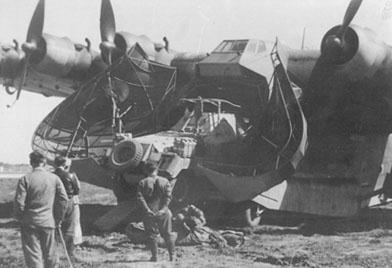
In particular the Me 323 is huge. As is the Ar 232.
Here is a picture of the Me 323 unloading an armored car. Told ya it was huge.
http://www.warbirdsresourcegroup.org/LRG/images/lrg1729.jpg
Posted: Sat Jul 21, 2001 10:46 pm
by g00dd0ggy
I am not entirely convinced either way on this one. Some of the examples seem inappropriate to me - Demyansk, Stalingrad, Market garden, Vietnam - these are all examples of pockets supplied when encircled, and small pockets too. This means flak,and difficult landing conditions. At Demyansk and Stalingrad you have to throw in quite appalling weather too.
To my knowledge the Germans did not commit large sections of the Luftwaffe to transporting supply - even at Stalingrad I think they just used JU 52s (I could be wrong). If Ju88's and He111's could carry as much stuff, why not use them? They at least had some defences and better speed. Perhaps the major problem here is that bombers are allowed to carry supply at all. If they were not, then I doubt that the 4 Ju52 Geschwaders could bring off the supply of a significant force. In addition, they would be completely defenceless against any sort of CAP.
To do this, you would need to divert production to Ju52's (very unattractive) and to get long range fighter cover (ie ME110's - also very unattractive). So I don't think anyone would try!
If you accept that bombers can carry supply (and presumably they could easily enough) then if you divert 1,000 odd aircraft to supply a corps, in good weather and assuming they could land, then I would have thought that it was perfectly possible to achieve.
It was never really done though...why? Well I would guess because a deep penetration like this could not in reality achieve much other than at a local level. Once the corps had moved the land behind would not be controlled - it would only control its immediate area, and eventually would find itself bogged down and easily destroyed.
If the air supply does not increase the SL of the land, presumably all land covered reverts back to Soviet control immediately? This seems realistic. If the Corps only controls its hex that seems to me not unreasonable.
I guess the real problem here is allowing bombers to be such effective carriers of supply.
Posted: Sun Jul 22, 2001 4:17 am
by SoleSurvivor
well at Stalingrad Luftwaffe used all it had. He 111 was cabable to transport excess fuel early on (as front distance wasn't too long then) as well as drop supply bombs later on. Luftwaffe also drew FW200 and He 177 (a field-testing group) as well as a really big junkers plane (they only had 2 of them, don't know the exact type) so air supply of significant forces larger than korps-size is more or less unachievable. It might be possible in special conditions such as undisputed air superiority, near front and good airfields in the enemy's back but when would these factors ever exist?
You shouldn't forget Luftwaffe was a tactical strike force, it was never intended to be anything else. Thus Luftwaffe needed to take Ju52 from everywhere: The Med, the civil transports and the flight schools which was a critical drain on the number of well-trained pilots later in the war.
Posted: Sun Jul 22, 2001 4:24 am
by g00dd0ggy
Of course at Stalingrad the airfields were pretty pitiful - though probably better than a rampaging Pz corps could rustle up! I'm amazed they landed He 177s at Stalingrad - seems incredible.
Posted: Sun Jul 22, 2001 6:23 am
by JustAGame
I guess the real problem here is allowing bombers to be such effective carriers of supply.
The only bomber that I have found to have been used regularly for tactical mobility was the HE 111. Although, my findings are hardly complete.
Add to this list the HE-177s. While the JU-52s and HE-111s were actually designed as transports, the HE-177 was reliably used for airlift operations (notably at Stalingrad).
[ July 21, 2001: Message edited by: JustAGame ]
Posted: Sun Jul 22, 2001 6:55 am
by JustAGame
Originally posted by Ed Cogburn:
No one has climbed Mt. Everest naked either. Since it hasn't been tried, does that mean its possible?
From an objective standpoint, I don't know the answer to that. I can assume that it isn't possible, but that is with admitting little to no knowledge of mountain climbing, human endurance, the climate of the region and the specifics of climbing that particular mountain.
I don't see the analogy to a panzer corps here. We were not at war, no one was shooting at those planes, no one was fighting on the ground to control the airfields, and we WERE NOT MOVING. We had planes coming in every couple of minutes. They had a sophisticated flight plan, stacking planes vertically and nearly wing tip to wing tip in the air corridor. Its simply not possible for a system like that to happen during war due to risk of heavy losses, and it only works when you have the luxury of major airfields that were massively beefed up with comm gear and radar in the beginning of the blockade, allowing the use of larger cargo planes than a C47 or JU52 (Douglas C-54s and Boeing C-97s), the typical cargo planes of WWII. The moving part is the most important. West Berlin relied on existing high quality airfields to bring this in. Every turn a panzer corps moves means he would have to build new airfields (how long does it take to build a paved airfield for medium sized cargo aircraft?), or rely on tougher, but smaller, planes that could operate on lesser air fields or just open terrain. The smaller planes could probably use a dirt airstrip, but now you're restricted to the smallest cargo planes in your inventory. This means you can forget about these large numbers of tons being transferred ever happening because you're on the move and your ability to bring in supplies depends on what airfields, if any, you control at your current location.
The only analogy was clearly stated that if the Germans possessed something less than 400 Ju-52s and HE-111s, then they could have achieved the same results as the smaller payload American and British planes used for the Berlin airlift. I didn't attempt to state anything more than that.
My point and the reason the Berlin airlift is relevant to this discussion is that much of this discussion hinges on many people's feeling that it is "impossible" to do something and support their belief with the argument that it hadn't been done before. Additionally, the Berlin airlift provides a case study of tactical and strategic mobility capabilities.
We need to know how much supplies are consumed in a week by an ACTIVE panzer corps (2 Pz Div, 1 Mot Div, 2 or 3 independent battalions) involved in movement and combat during that week. If we could find that out we might be able to put this thread to rest.
I agree to an extent. As we all know, an independent division or brigade can be represented by a korps unit in WIR. That is why I am trying to learn the supply needs of more basic units than an entire korps. With the needs of the more basic units, one can extrapolate for the needs of larger units.