Page 1 of 4
Tip thread
Posted: Sun Dec 19, 2010 11:04 pm
by bairdlander2
Im not sure if one exists so Im starting this one.A good tip when advancing is try to take eneamy HQ's to capture fuel and supplies.
RE: Tip thread
Posted: Tue Dec 21, 2010 1:34 am
by bcgames
German First Turn Airfield Attacks. Fly air recon missions over the airfields you want to attack until you achieve a detection (det) level of 10. It appears that the higher the det level, the higher the chances of causing destruction of Soviet aircraft on the ground.
RE: Tip thread
Posted: Tue Dec 21, 2010 11:52 pm
by Zovs
Globally Setting Support Levels for HQs in CR
Open the CR
Click on the HQs tab
Set filters as:
Nation: GE
HQ Type: Here deselect all the HQ you don't want to set, for example you may only want to set the HiCom, or ArmyGrp, or Army or the Corps, that way you set for example the O.K.H. to 0, AGN, AGC, AGS to 1, and 18, 16, 4th PzG, 1st PzG, etc. to 2 and all the Corps to say 3. In just a few clicks.
2 attachments to follow.
RE: Tip thread
Posted: Tue Dec 21, 2010 11:53 pm
by Zovs
Second file here
RE: Tip thread
Posted: Wed Dec 22, 2010 12:01 am
by randallw
Be sure to check HQs so they are not overloaded with units beyond their 'command points' maximum. Beyond maximum the unit suffers penalties.
In the info box there will be a tank icon with two numbers: the first is the command points being used, then the number behind the colon is the maximum
RE: Tip thread
Posted: Wed Dec 22, 2010 2:23 am
by bcgames
Reading the Air Losses Screen. At first, I thought there was an addition bug on this screen. Then I figured out how to read it.
Flak Losses and Operational Losses are two of three
causes for the 45 TOTAL LOSSES of aircraft shown in the screen shot below. The third number required to get a total of 45 losses is the training losses; this yields 2 more aircraft. So flak losses (21) plus Operational Losses (22) plus Training Losses (2) = 45 aircraft lost.
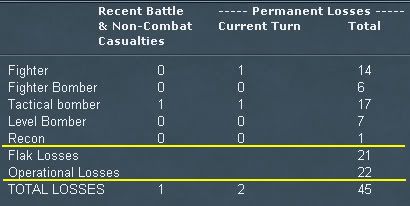
Note: I added the two yellow lines; they do not appear in the game.
RE: Tip thread
Posted: Sat Jan 01, 2011 8:29 pm
by heliodorus04
Newb bumping this thread in hopes veterans build on it!
RE: Tip thread
Posted: Mon Jan 03, 2011 12:30 am
by JSBoomer
bump again
RE: Tip thread
Posted: Mon Jan 03, 2011 1:43 am
by Schmart
Wait one (enemy) turn before reducing pockets, otherwise units can escape by routing. This relates to the difference between pending and actual ZOCs.
RE: Tip thread
Posted: Mon Jan 03, 2011 5:30 am
by randallw
The rule also applies when it's your units in trouble; don't end a turn with your guys unable to trace supply. You may have to move them out of good terrain, into the open, to get them supplied again. They'll probably run if attacked, but at least they can survive, rather stay where they are and be forced to surrender.
RE: Tip thread
Posted: Tue Jan 04, 2011 3:45 pm
by Davekhps
Beware Soviet ports supplying pockets. Whether on the Baltic or Black Sea coastlines, pockets around Soviet forces pressed against the sea can still supply themselves from ports in small cities, a.k.a. those black dots. Even after forming a proper 2-turn pocket, those Soviet units will still supply, retreat, and rout out of those ports.
RE: Tip thread
Posted: Tue Jan 04, 2011 3:47 pm
by Davekhps
Pressing F1 (or selecting regular movement) acts as a hotkey to "de-train" all selected rail embarked forces. This is a shortcut to de-train an entire selected stack versus manually selecting each unit on the unit bar.
RE: Tip thread
Posted: Tue Jan 04, 2011 3:51 pm
by Davekhps
When reducing pockets, enemy units will retreat to enemy-controlled hexes, but will likely surrender if no enemy-controlled hexes are available. After you have formed a proper 2-turn pocket, enemy units that don't surrender from your hasty or deliberate attacks will retreat within the pocket to other free and open enemy-controlled hexes. If you wish to avoid chasing after enemy units retreating across multiple empty hexes, use a free friendly unit to claim those empty enemy-controlled hexes *before* launching your attacks against the enemy stack. With rare exceptions, those units will always surrender if forced to retreat.
RE: Tip thread
Posted: Tue Jan 04, 2011 3:56 pm
by Davekhps
When possible, choose to reduce enemy pockets either at the beginning of the turn or the end of the turn. Don't split up your attacks throughout the turn. If done in the beginning, go into your air doctrine screen and set the air attack minimum above 100% to prevent your air support from aiding in any attacks launched against the pocket. When done reducing the pocket(s), reset your air doctrine and then launch your front attacks. This will save your airpower for the attacks that require it the most. If you so choose, you can also reduce pockets at the end of a turn, after you have used your airpower for your main attacks-- any remaining air units will help in reducing the pockets.
RE: Tip thread
Posted: Wed Jan 05, 2011 12:10 am
by heliodorus04
What is a "proper 2-turn pocket?"
RE: Tip thread
Posted: Wed Jan 05, 2011 5:56 am
by randallw
You surround enemy units, but wait to attack them on your next turn.
RE: Tip thread
Posted: Wed Jan 05, 2011 12:43 pm
by Davekhps
ORIGINAL: randallw
You surround enemy units, but wait to attack them on your next turn.
This. Perhaps the most confusing basic game mechanic for new players of WITE. Enemy units are not isolated during the first turn of combat.
The two-turn "proper pocket" dynamic is a compromise in an IGUGO game system, representing that the enemy (and you, on the flip side!) should always have a chance to relieve (or air supply) isolated units.
Which in game terms means, on Turn 1 use your forces to isolate the enemy hexes, either via an unbroken chain of friendly units (less risky) or via units spaced one hex apart for ZOC (more risky). Then do NOT attack the now-isolated pocket on Turn 1.**
If you do so, the enemy fights at full strength, and they can retreat/rout out of the pocket. If you wait until Turn 2, those isolated enemy units will surrender (you still must attack them, and risk casualties and being HELD, but unless they still have an open enemy-controlled hex to retreat to, they will surrender).
** There are exceptions to every rule. If you don't think you can form a proper pocket-- not enough mobile units, you're out of MPs on your flanks, your line of isolating units isn't very strong and won't hold the pocket during a counterattack, etc.-- you can still attack enemy units that are isolated on Turn 1, forcing them to retreat/rout out of the Turn 1 isolated hexes. The enemy still takes damage, routed units take time to recover, etc.
RE: Tip thread
Posted: Thu Jan 06, 2011 2:53 pm
by mavraamides
Tip:
When you break through the enemy lines and see some unguarded HQ's and air, you can disrupt even more by first splitting a div into 3 and so you can spread out and cover more ground. Even the weakest SEC unit will still scatter unguarded non combat units.
Also, Splitting units is a great way to create a garrison for a remote VP that you don't want to stick around and guard with a lot of force. Just drop one off in the city with a fortification and send the other 2 ahead with the rest of the Corp. Later, if you don't need it to guard that VP any more, you can temporarily motorize it to catch up with its buddies.
RE: Tip thread
Posted: Thu Jan 06, 2011 5:45 pm
by heliodorus04
Gordion, how do you handle out of supply/command range issues (more likely the latter will be present than the former)?
I'm so terrified of leaving units out of command range that I switch unit superior HQs to the Army Groups just to avoid that.
RE: Tip thread
Posted: Thu Jan 06, 2011 5:51 pm
by GBS
Will a fortified zone serve as a garrison?