1st - 3rd September 1939 (Poland and the Baltic)
The Polish Navy 1st September 1939
The Polish nation that emerged from the Versailles treaty after World War I had to efectively build its navy from scratch. The Polish navy that found itself at war with Germany in September 1939 was smaller than had been envisioned in the 1920's, reflecting the economic reality that Poland - like all nations - was faced with during the inter-war years.
The main naval base was located at Gydnia, north of Danzig.
DD - Destroyer
SS - Submarine
4 x DD (Wicher, Burza, Grom, Blyskawica)
5 x SS (Rys, Wilk, Zbik, Orzel, Sep)
1 x Minelayer (Gryf)
6 x Minesweepers (Czajka, Jaskolka, Mewa, Rybitwa, Czapla, Zuraw)
2 x Gunboats (General Haller, Komandant Pilsudski)
There was also a small river flotilla.
1st September 1939
The conflict that was to become World War II began with the German invasion of Poland in the early hours of 1st September.
Only a few days prior to the attack, the British and Polish had agreed a plan – Operation Peking - that would see three of Poland’s four destroyers sail for the United Kingdom to serve alongside the Royal Navy. It was realised that these ships would be unlikely to survive any German attack for very long – either falling victim to the much larger Kriegsmarine or the Luftwaffe. All three chosen destroyers (Burza, Grom and Blyskawica) safely made the journey through the Baltic – indeed German sailors aboard the light cruiser force sent to intercept them had the ships in their sights at one point but had to frustratingly watch them sail into the distance as the war had not then begun. Many Polish merchant vessels made it to the United Kingdom too. In addition, two of the five Polish submarines – Wilk and Orzel – also made it to there eventually, the latter via brief internment - and escape - from Estonia.
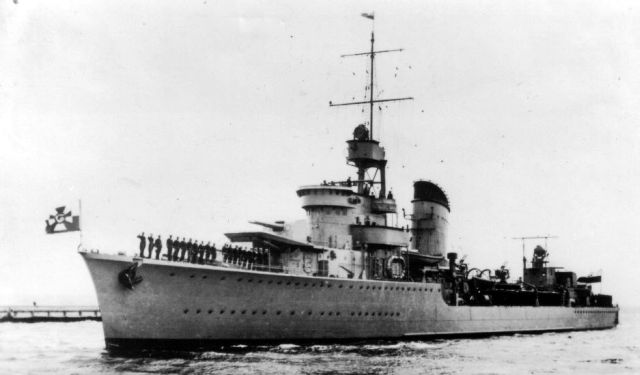
- [i]The modern destroyer Grom successfully reached the UK with two other destroyers as part of Operation Peking.[/i]
- ORP_Grom.jpg (26.33 KiB) Viewed 4484 times
The Kriegsmarine can claim to have fired the first shots of the war when, at around 0400hrs the old pre-dreadnought battleship Schleswig-Holstein opened fire on the Polish garrison at Westerplatte, near Danzig. She had sailed into Danzig a few days earlier under the cover of a ceremonial visit, but then slipped her moorings to begin the bombardment as a prelude to the invasion proper at 04:45hrs. The pre-WWI vintage battleship would remain on bombardment duty for much of the Polish Campaign, until the Polish resistance in the corridor was finally put to an end.

- [i]The Schleswig-Holstein bombards the defenders of the Westerplatte on the opening day of the war.[/i]
- 8SchleswigHolstein.jpg (39.89 KiB) Viewed 4484 times
To defend against the attack the Polish Navy, commanded by Rear-Admiral Josef Unrug, could call upon the destroyer Wicher, the minelayer Gryf and a handful of smaller craft in addition to the five submarines. These vessels were ordered to sea as part of a minelaying operation to protect the coastline from possible German landings.
Luftwaffe aircraft cause serious damage to much of the Polish flotilla on that first day; Gryf returned to Hel where she was sunk in shallow water and used as an artillery battery.
2nd September 1939
The submarine Wilk was damaged in a depth charge attack by German minesweepers but she laid her mines as per the plan and safely arrived in the UK on the 20th September. As mentioned above, she would be joined by Orzel, but the remaining three Polish boats – Sep, Zbik and Rys - sailed for Sweden and were interned for the rest of the war.
3rd September 1939
The first signs of problems to come… The U-14 attacks the Polish submarine Zbik in the Baltic. The Germans believed the enemy boat sunk – but instead the magnetic pistol failed to work. This failure would prove a major problem for Admiral Donitz and his U-boat fleet in the months and years to come.
Two German destroyers – Lebrecht Maass and Wolfgang Zenker – were ordered to the Hel Peninsula to attack the Wicher and the Gryf which were sheltering under the protection of the Polish shore batteries there. The four ships traded blows and the Lebrecht Maass was damaged. Both Germans ships withdrew and it was left to the Luftwaffe to finish off the Polish ships later that day.

- [i]The Wicher was chosen to stay and fight. She didn't last long......[/i]
- ORP_Wicher.jpg (40.01 KiB) Viewed 4484 times


