Page 1 of 1
[Q] Why is the layer floor so shallow?
Posted: Thu Nov 04, 2021 6:53 am
by LucasLB
Hello, is the in-game "layer" the IRL "seasonal thermocline" (as opposed to the "main thermocline" that runs much deeper - minus 1000 to 1500m - than what the in game "layer" does)? If so, why stopping the layer at its seasonal floor instead of pushing it to the bottom of the main thermocline as the temperature keeps going down until depth reaches the floor of the main thermocline (and the deep isothermal layer starts)? Especially considering that the game manual identifies the "layer" to the "thermocline", therefore including seasonal + main thermocline. Thanks a lot.
RE: Why is the layer floor so shallow?
Posted: Sun Nov 07, 2021 1:45 pm
by Dimitris
Hi,
Our current model assumes a year-round thermocline, whose properties vary with the season (temps), latitude, local bottom etc. We do not currently discriminate between permanent and seasonal thermoclines.
Thanks.
RE: Why is the layer floor so shallow?
Posted: Sun Nov 07, 2021 3:16 pm
by LucasLB
Hello Dimitris,
Thank you for your answer that clarifies a bit. However, if the layer is the whole thermocline, why does its floor run so shallow in the game. Indeed, the deepest layer floor I have encountered in game was in the -800 feet levels, which is much shallower than the typical - 3 300 feet thermocline floor level I read about in many sources (i'm not allowed to post links unfortunately but if you google it, you'll find plenty evidence of it). Are my sources wrong or perhaps is it a development choice for whatever reason?
Cheers,
RE: Why is the layer floor so shallow?
Posted: Sat Nov 13, 2021 5:10 am
by Dimitris
Please share your sources and clarify your interest (hobby / professional). Thanks.
RE: Why is the layer floor so shallow?
Posted: Tue Nov 16, 2021 4:24 pm
by RoryAndersonCDT
The reason the layer reflects/refracts sonar is because of the change in speed of sound.
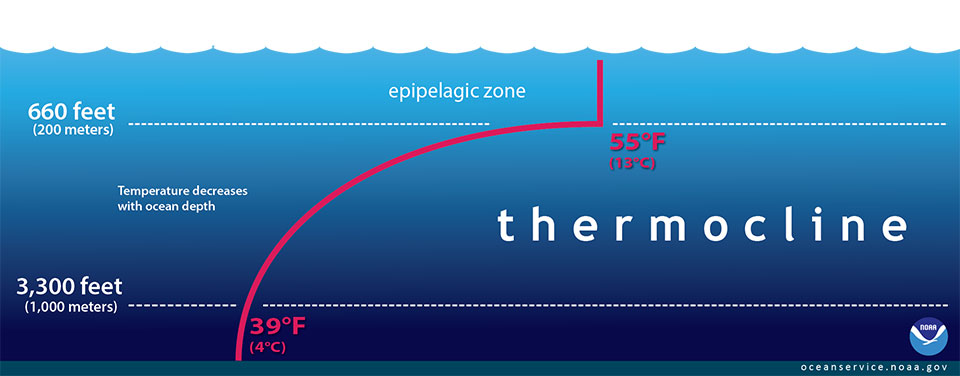
The best way to think about this is to consider the derivative of this temperature profile, and you would note its mostly close to zero throughout.
The change in temperature at the bottom is very slight compared to the change in temperature near to the surface.
Our sonar model is focused on tactical use of the layer, and you can see the layer temperature rapidly changes near the top, and barely changes at all near the bottom. In this abstraction the "effects-heavy" slice of the layer is thin and concentrated at the top, and our floor/ceiling values reflect that.