Page 1 of 2
AAM & SAMs Picked Up Too Early By Targets Radar
Posted: Thu Feb 09, 2023 6:14 pm
by bsq
Wasn't even certain what to put as a subject here, so hopefully the one I have used will pique enough interest. Not in a position to conduct a sandbox series of events to prove this either right now, which is why I have posted it here to see what others think. Of course it may be explained by limitations within the sim, but no one in the discussions about A2A and WRA has mentioned this at all (wrt to Radar).
Here we go:
Much of the AAW discussion right now on the boards is focussing on how good/bad various missiles may or may not be in the game. Running a scenario out there for testing with a lot of AAW in it, I have noticed several things, most critically how early and easily most 'targets' pick up the inbound objects and classify them as a threat to them.
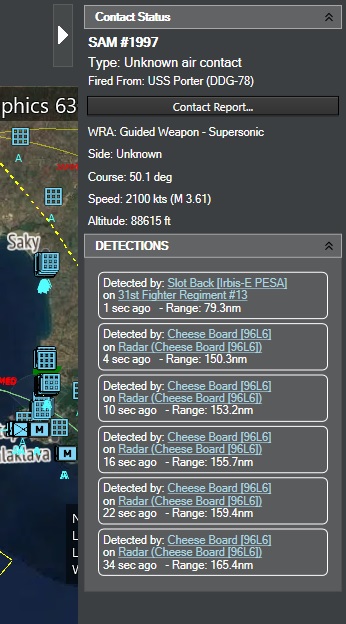
Take the image below. An SM6 is picked up by various radars as it climbs away from the DDG. Personally I think the Cheeseboard pickups of a target with an RCS of 0.078m2 at more than 160nm is a bit optomistic, but no way I am I having an AI radar picking this up at nearly 80nm whilst at 88kft. This is so out of the physics of what even a small AESA can do. Why is looking up like that? What cued it? How, in less than a second does the pilot know that it is fired at him and he begins a notch or drag manoeuvre?
- Just No.jpg (85.49 KiB) Viewed 2538 times
Let me explain why I dont buy this. AI radars scan the sky looking for targets, not threats. They are optomised to search and detect (within the realms of their ability) air targets (if they are in that mode). In the same sweep, this Su-35 also picks up an F-16C at 20kft for the first time at 106nm. He also, in the same scan sees, for the first time, the P-8A at 135nm, who is at 6kft.
P-8A @ 6kft
F-16C @ 20kft
SM6 @88kft
So to all intents and purposes, we now have a radar, that in the game, scans a wedge from surface to space (near enough). The realitiy is that it not only has azimuth limits (which are extremely well modelled in the game) but it also has elevation limits (which seem to be an issue) and also mode limits (can't do all modes at once, but I am aware this is known limitation of the game). So even with Agile Beam radars there limits to where it can scan in elevation. Cheesboard has a mode that can do that - Irbis and for that matter Slot Back, BARS, APG-68, 70, 77, 79, 83, Captor etc do not.
If this is replicated across all radar models that can track air targets then we have a big issue whilst trying to resolve the other issues surrounding AAW. IMO, from what I have seen over the month or so I have been testing this scenario, there is a disturbing, omniscient feel to anti air radars. They just wont see things like that and, whilst they continue to do so, the fighters will keep evading the missiles fired at them at anything less than point blank, which helps in part to explain what lots of forum members have been head scratching about.
All the advantages of a lofted shot, in respect of counter detection, are lost in this situation.
Bottom line, IMO, the A2A issues are not just about the weapons, it has a lot to do with the detection of them that is occuring too soon, with a probability that is too certain and an accuracy that is too precise.
I haven't even touched on other sensors yet, including Mk1 eyeball which seem to spot things they probably shouldn't or at least the spotting of them should be the subject of a 'die roll' with odds in favour (for small targets) of them NOT being seen.
If you want to see how hard this type of visual pickup is, do a search on YouTube for the Black Monday Red Flag videos. Lots of instances in there where things arent seen till it's too late - they are the best of our best and they dont see stuff all the time...
This issue may be insurmountable, but no one yets seems to have mentioned how early some of these platforms pick up inbound missiles (without the use of MAWS/DASS).
Re: AAM & SAMs Picked Up Too Early By Targets Radar
Posted: Thu Feb 09, 2023 8:35 pm
by scott1393
Following along. Great topic.
Re: AAM & SAMs Picked Up Too Early By Targets Radar
Posted: Thu Feb 09, 2023 8:44 pm
by c3k
Thanks. Following...
Re: AAM & SAMs Picked Up Too Early By Targets Radar
Posted: Thu Feb 09, 2023 8:56 pm
by Blast33
Hear hear!
Re: AAM & SAMs Picked Up Too Early By Targets Radar
Posted: Fri Feb 10, 2023 5:57 am
by Dimitris
Noted; we have a few ideas about why that is happening but we'll need to examine this in detail when we have more time (cue laugh track).
Re: AAM & SAMs Picked Up Too Early By Targets Radar
Posted: Fri Feb 10, 2023 11:25 am
by Kobu
To add, many times the air to air missiles are detected via mk1 eyeball wich in my opinion is impossible, no way to detect such a small object travelling at more than mach 1 in the sky.
The only way to achieve this detection is in the first seconds of the launch with missiles that create a trail (most modern missiles now are smokeless) or with launch at very high altitude where appear contrails, however in all the cases it is only a few seconds when the motor is running.
With regards the radars detecting missiles i think that moders AESA radars can detect missiles (always within their scan limits) but at much shorter distance that we have now and other older radars should not be able to detect this small missiles.
Regards
Re: AAM & SAMs Picked Up Too Early By Targets Radar
Posted: Fri Feb 10, 2023 11:18 pm
by thewood1
Since people like to just conjecture, I thought I would drop this from the BVR thread.
Just ran a bunch tests on various targets and their ability to detect missile launches against them. I used an F-15 with an AIM-7M. I used the sparrow because a fighter target gets a tight bearing detection at 7-8 nm when the 120 lights up its radar. After that, with IR it gets a detection at 3nm and by eyeball at less than 1 nm.
A mig-29 RWR gets "guidance radar detected" contact on the missile at at 32 nm with only rough bearing. I think the rationalization here is that the F-15s radar is lit up so the 29 knows its there and has some bearing information at a minimum. If the IR is already slewed to the F-15, it sees a missile launch and has a rough track on it. Its about 3 nm before the track is ranged, but no altitude. Eyeball detection is 0.4 nm and it knows altitude. No defensive maneuvering happens until that eyeball detection. The pilot has 1-2 sec at best to evade. The first sparrow usually missed btw. As I tested before, with the Mig radar on, it detects the missile inbound around 12 nm.
A mig-23M with an older radar and no IR fairs no better. At 32 nm, the RWR picks up that a missile has been launched with a very rough missile uncertainty box. The sparrow missed and the Mig-23 never saw it go by. A second run through and the Mig saw the sparrow at 0.3 nm. With radar on, it detects it at 6 nm. Interestingly, as the Mig starts evasion through a notch, it lost sight of the sparrow and never regained. The other thing I noticed is the second missile is still only detected by seeing the F-15's guidance radar spike, but the track is a lot more accurate and the Mig-23 starts evasion immediately by running away. So it kind of remembers or maybe sees the smoke from the motor since the two planes are closer at that point. It easily out runs the missile based on that.
The short of it is that there's a lot more intricacy in detection, tracking, and evading missiles than I thought. Some of this can be altered through ROEs and such, but visual detection doesn't seem that bad (.3 to .4 nm). Maybe the only questions are how easily the IR sensor can be skewed through the RWR and a fighter's radar ability to detect a sparrow-sized object.
I did some less stringent testing of bombers and cargo aircraft. They rarely saw the missile. If they did, it was so close as not mean much. I also test different engagement angles. It looks like anything but a 90-120 FOV to the front means they will not even see the missile coming.
Re: AAM & SAMs Picked Up Too Early By Targets Radar
Posted: Sat Feb 11, 2023 7:33 am
by bsq
thewood1 wrote: Fri Feb 10, 2023 11:18 pm
Since people like to just conjecture, I thought I would drop this from the BVR thread.
Sorry to pick on one part of your comment and perhaps take it out of context, but my assertions about 'Vertical Scan Limits' are not conjecture, they are fact.
Broad brush detail then.
A radar, no matter what type has a beamwidth, calculated simply at the point at which there is a 3dB drop in the energy (half power point). This applies equaly in azimuth and elevation. The so what of this is that a single beam (mech scan and PESA) can only cover so much sky in the scheduled scan. It's a bit more convoluted for an AESA but it points the beam, dwells, moves on - so again it can only point to so many bits of sky within its scheduling.
It cannot scan surface to space in the same instance, it will, if an AESA squint off the beam in the vertical axis as well as the (well modelled) horizontal axis. It needs to dwell sufficiently to allow for the return of all echoes out to its maximum range. So if it utlises a 1km PRI and has a range of 200km, it must dwell whilst it waits for the maximum range return echo. If it does not (for an AESA) then it is not 'beam formed' to optimise any long range returns.
Again, so what? Well it then has to dwell for about a few thousandths of a second, which means if you have a modelled 2 to 4 second scan, there are only so many hundred pointing angles available in which you may see a target. These are not going to be looking everywhere, so the probability of detection comes right down for targets on the edges of the scan (vertical ones especially). Its called look down/shoot down for a reason, it isnt always looking up.
A mech scan radar has to perform a raster scan - bar width is your (well modelled) azimuth FOV you can all see in the DB descriptions, but it has limits as to how many bars it can scan (given it still has to recieve those rangy returns whilst the scanner is still pointing roughly in the same direction as the target). 2 x 1 second bars or 4 x 1 second bars seems reasonable. Now beamwidth comes into play, big time. 5 deg beamwidth, your vertical coverage is either 10 degrees in example 1 or 20 degrees in example 2. So vast portions of the sky not beeing looked at IRL but that seem to be in the game.
Radar physics have so many 'moving parts' elements to them, this is not going to be an easy fix. More likely it will be fixed using probability maths rather than convoluted 3D modelling of the radar scan coverage.
Re: AAM & SAMs Picked Up Too Early By Targets Radar
Posted: Sat Feb 11, 2023 10:25 am
by thewood1
Sorry, I should have specified I was pointing tot comment above mine on AAM detection.
Re: AAM & SAMs Picked Up Too Early By Targets Radar
Posted: Sat Feb 11, 2023 2:12 pm
by SeaQueen
You could answer this question for yourself using the radar equation and doing a little math:
For the CHEESEBOARD radar you specified:
F-16 RCS: 2.6-4.5 m^2
Missile RCS: 0.078-0.155 m^2
RCS[F-16]^(1/4) * constant = 215.2 NM
RCS[missile]^(1/4) * constant = unknown
( RCS[missile]^(1/4) / RCS[F-16]^(1/4) ) * (215.2 NM)
So that suggests, based on rcs alone, that a missile should have a detection range between ~89.6 - 106.3 NM, which is a pretty substantial range, but not the range you observed. So... the question then becomes, what's going on there?
Re: AAM & SAMs Picked Up Too Early By Targets Radar
Posted: Sat Feb 11, 2023 3:19 pm
by thewood1
Didn't even know that equation existed. Not my specialty. Just looking at it from a game empirical perspective.
Re: AAM & SAMs Picked Up Too Early By Targets Radar
Posted: Sat Feb 11, 2023 4:33 pm
by SeaQueen
The radar equation is really handy. The nice thing is, you don't even really need to know the system parameters for a given system to make use of it. You just need to know the radar cross section and detection range of one thing, and the radar cross section of the thing you're interested in. For a given system:
(sigma1 / sigma2)^(1/4) = R1 / R2
The rest of the system parameters cancel out. This is nice because it means you don't have to dork around in the CMO database to get the systems numbers, but if you know the RCS and detection range of one thing on one system, you know the rcs and detection range for everything on that system.
thewood1 wrote: Sat Feb 11, 2023 3:19 pm
Didn't even know that equation existed. Not my specialty. Just looking at it from a game empirical perspective.
Re: AAM & SAMs Picked Up Too Early By Targets Radar
Posted: Sat Feb 11, 2023 6:35 pm
by thewood1
So its basically dimensional analysis. In my engineering jobs, we never knew the coefficients for various engineering equations in the field. You actually had to have the books. We used DA all the time. You just needed to know the basic equation.
Re: AAM & SAMs Picked Up Too Early By Targets Radar
Posted: Sat Feb 11, 2023 8:51 pm
by SeaQueen
thewood1 wrote: Sat Feb 11, 2023 6:35 pm
So its basically dimensional analysis. In my engineering jobs, we never knew the coefficients for various engineering equations in the field. You actually had to have the books. We used DA all the time. You just needed to know the basic equation.
There actually is a radar equation, and understanding it will give you a sense of how important other factors like gain, power, etc. are in radar performance. The radar equation isn't that hard to understand by itself. It's really just understanding what "power" means and how spheres work. The above technique also won't take into account things like standoff jamming, where I can raise the noise level and what not.
Re: AAM & SAMs Picked Up Too Early By Targets Radar
Posted: Sun Feb 12, 2023 12:05 pm
by bsq
SeaQueen wrote: Sat Feb 11, 2023 8:51 pm
There actually is a radar equation, and understanding it will give you a sense of how important other factors like gain, power, etc. are in radar performance. The radar equation isn't that hard to understand by itself. It's really just understanding what "power" means and how spheres work. The above technique also won't take into account things like standoff jamming, where I can raise the noise level and what not.
There are 2 good books out there which we use that covers much of this, both by David L. Adamy - EW101 and EW102 (EW103 is more communications based).
Of course to make the equations work effectively you need also to know stuff that is not (in the main) in the public domain.
There are quite a few things that happen in radar receivers that should slow the detection process down too. Just because the radar can detect something at x km, doesn't mean it will declare it as a missile or what ever until much later. It needs to process the returns and make comparisons and this may take a few scans (or dwells in the case of an AESA) before a valid track is returned. If this is modelled (with OODA) loops, then some of these 'initial' detection ranges may be even further out than this.
So compare these two statements:
Can detect a fighter sized target at 350km
Can classify a fighter sized target at 350km
Which radar is better?
Which statement is modelled in the game?
I know the answer to the first question, but I am not sure I know the answer to the second.
Do we know, when we read what Rosenboronexport state in the catalogue, what they are actually claiming? Is there a contested/degraded element to this or is it theory maths or clean weapons range data?
Lots we dont know here and cannot know here, but some of the geometry of detection as I originally observed in the first post is way off the mark (still standing by the reasons I gave as to why this might be).
Re: AAM & SAMs Picked Up Too Early By Targets Radar
Posted: Tue Feb 14, 2023 5:14 pm
by BDukes
So basically what you're saying Tolstoy is there is no free will

Excellent points. How about applying generational stats to RWR, radars, etc., and applying them to reaction times? You don't have to dig up data we'll likely never find, and it better addresses the timing difference between see and know.
Mike
Re: AAM & SAMs Picked Up Too Early By Targets Radar
Posted: Tue Feb 14, 2023 8:18 pm
by bsq
BDukes wrote: Tue Feb 14, 2023 5:14 pm
So basically what you're saying Tolstoy is there is no free will
Excellent points. How about applying generational stats to RWR, radars, etc., and applying them to reaction times? You don't have to dig up data we'll likely never find, and it better addresses the timing difference between see and know.
Mike
Sorry Mike for the War and Peace explanation - but it just sat wrong.
We were, in the defence of the Devs, warned by Dimitris that all this tinkering might lead us somewhere we wish we had not got to.
I am currently testing a scenario posted here that pits F-22's against SU-35's. The SU-35s have a load out of 10 x AA-12B & 2 Archers and the F-22's a load out of 6+2. When (not if) the first shots miss, the 22's either run or are toast. This cannot be correct, or what was intended.
(Aside I do feel that I should not be facing 'brochure loads' but again that's what people have asked for)
Re: AAM & SAMs Picked Up Too Early By Targets Radar
Posted: Thu Feb 16, 2023 9:39 am
by blu3s
SeaQueen wrote: Sat Feb 11, 2023 4:33 pm
The radar equation is really handy. The nice thing is, you don't even really need to know the system parameters for a given system to make use of it. You just need to know the radar cross section and detection range of one thing, and the radar cross section of the thing you're interested in. For a given system:
(sigma1 / sigma2)^(1/4) = R1 / R2
The rest of the system parameters cancel out. This is nice because it means you don't have to dork around in the CMO database to get the systems numbers, but if you know the RCS and detection range of one thing on one system, you know the rcs and detection range for everything on that system.
thewood1 wrote: Sat Feb 11, 2023 3:19 pm
Didn't even know that equation existed. Not my specialty. Just looking at it from a game empirical perspective.
Hi, I have been curious about this formula and wanted to do a little test to see if it was somehow fulfilled. It should be said that my knowledge of radar technology is very limited so I don't know if I'm missing something. My test has been the following.
The scenario has two sides, Aircraft and Radar. In the Radar side I create in the position latitude=30.5, longitude=8 a CheeseBoard 96L6E type radar.
Using the method World_GetPointFromBearing() I obtain a position with respect to the radar at 90º and 450NM distance. In this position I create an airplane that I read from a table of airplanes, I place them at an altitude of 10000m (C-130H its at 9753.59m max altitude) and I mark the same route latitude=30.5, longitude=5, that is to say that they fly over the radar.
There are two events, the first one is unit detected. It is configured for any detection on the "Aircraft" side. When this event is activated, I write in the LuaHistory the data that I consider as distance at which it is detected, type of aircraft, type of sensor that detects, etc. I delete both units and start over as long as there are still planes in the list to go through.
The second event is of the type unit enters in area, this area is located to the left of the radar, so if the unit enters in this area, it has already flown over the radar and has not been detected, so I write in this case a Unit Not Detected.
I attach the scenario with which I have made the tests, I have always played it at a speed flame and it performs 5 iteractions, that is, it goes through the list of aircraft 5 times before finishing. When the scenario ends a special message appears.
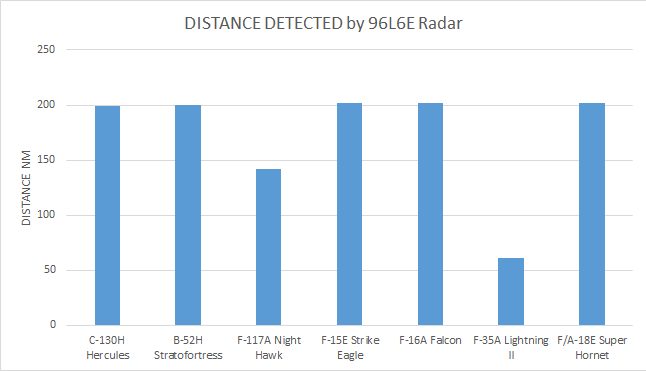
I attach as an image the tests I have obtained, it is interesting that all aircraft regardless of their RCS are detected at the same distance, excluding the stealth aircraft. As I mentioned before, I am not sure that it is a bug, or anything else since I imagine that there will be things that I am missing for sure and for sharing it here that surely you can better understand this type of tests and behaviors.
- Distance Cheeseboard.png (8.01 KiB) Viewed 1933 times
My intention is none other than to better understand both the reality, as well as in CMO, how the different types of radars work and their operation. I hope this is not taken as a criticism, since I am very happy with the game and its new mechanics and I was simply curious to do some tests to understand it better.
Re: AAM & SAMs Picked Up Too Early By Targets Radar
Posted: Thu Feb 16, 2023 11:36 am
by bsq
blu3s wrote: Thu Feb 16, 2023 9:39 am
I attach as an image the tests I have obtained, it is interesting that all aircraft regardless of their RCS are detected at the same distance, excluding the stealth aircraft. As I mentioned before, I am not sure that it is a bug, or anything else since I imagine that there will be things that I am missing for sure and for sharing it here that surely you can better understand this type of tests and behaviors.
For the non-stealth aircraft you have just described the in game performance limts of Cheeseboard.
Screen Range = 215nm, with OODA, that is exactly what your chart is saying...
You may also get different results when DB 499 is released as 497/498 contained an error on Cheeseboard RF, so then it will sit in the D to M bracket
Re: AAM & SAMs Picked Up Too Early By Targets Radar
Posted: Thu Feb 16, 2023 1:16 pm
by blu3s
bsq wrote: Thu Feb 16, 2023 11:36 am
For the non-stealth aircraft you have just described the in game performance limts of Cheeseboard.
Mmm I have tried a few more radars and the results are very similar (the difference between a B-52 and a SuperHornet are minimal). Can you think of any radar that can meet the above relationship (RCS and distance detection)?
Thank you