Page 1 of 1
Sub attack speed and Towed array
Posted: Thu Dec 19, 2024 2:41 am
by Tcao
The current ASW Patrol mission's Sub default setting is attack at cruise speed. For many fast nuke attack submarine like LA, Virginia, Akula the cruise speed is 20kts, above of the TA deployment speed threshold 15kts. That would make them blind in the dangerous approach process.
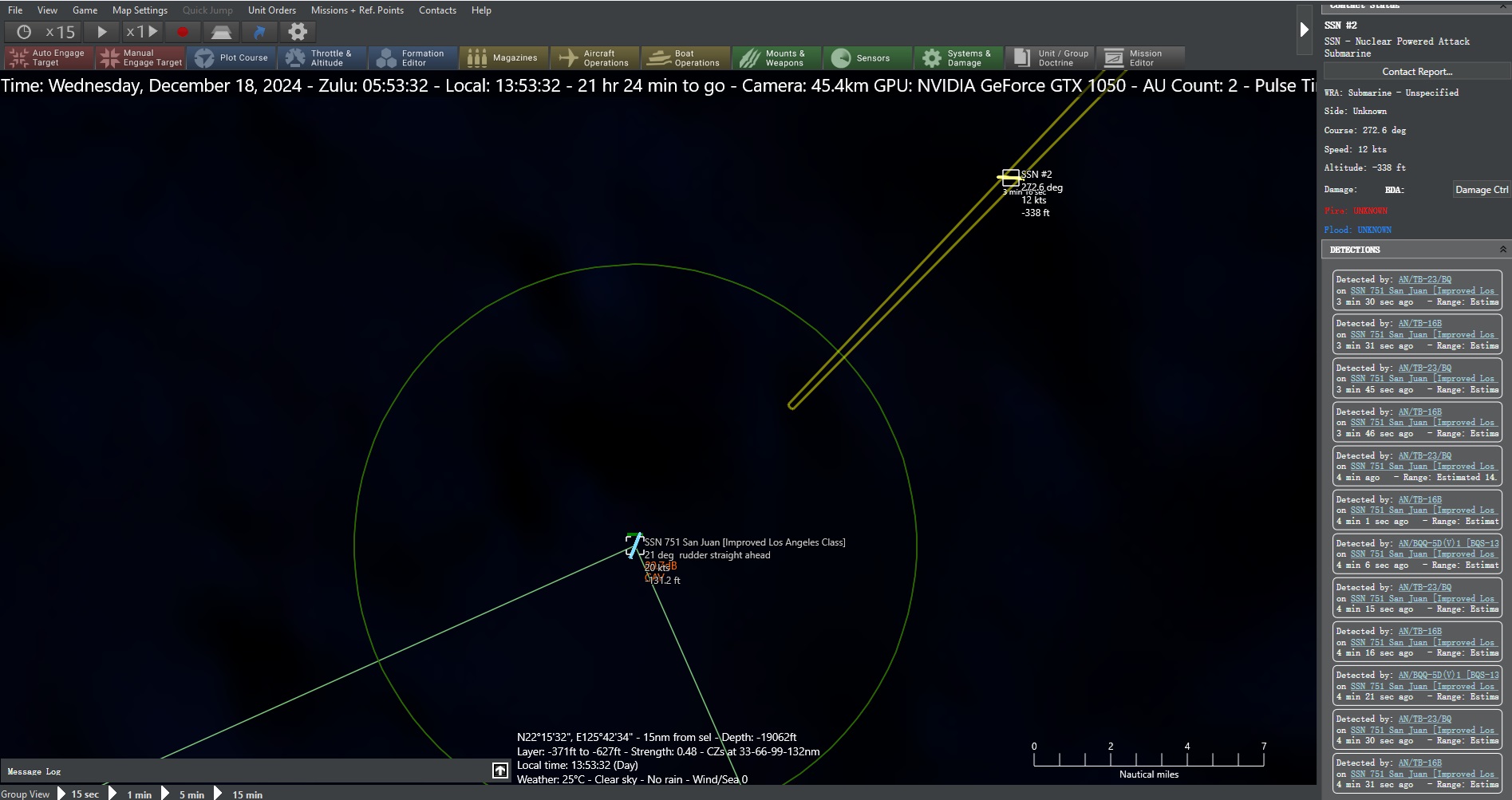
- TA washout speed.jpg (293.1 KiB) Viewed 1349 times
to avoid this then the player got to change the attack speed to creep, 5kts. However, it is too slow in some of the engagement
I am wondering if the game can add another speed option , nuke sub tactical speed at 8kts-12kts.
or add an option on Throttle page, "limit the speed to deploy TA" , an option similar to "Avoid cavitation".
Re: Sub attack speed and Towed array
Posted: Thu Dec 19, 2024 7:38 pm
by Fido81
That's an interesting idea.
IRL sonar performance, including towed array performance, decreases as speed increases (because the noise your powerplant makes increases with speed). A towed array will be less effective at the max possible speed than at something like 5 kts. CMO does model this.
The "best of both worlds" approach in CMO as I understand it is to select "sprint & drift" as your speed setting. It'll alternate creep speed (most often in CMO 5 kts) w/ flank speed and average out to whatever speed you select. That'll give you some access to the towed array, and more speed than you'd otherwise have.
The trick is to come out of sprint & drift mode within your tactical range of the enemy, in a position where they can't detect you.
If I have a speed advantage, I like to do this by approaching submarine targets from astern.
Re: Sub attack speed and Towed array
Posted: Thu Dec 19, 2024 9:32 pm
by thewood1
I was reading a sub book a few years ago...I think it was the Tom Clancy one, but I'm not sure. Standard procedure when hunting another sub was sprint and drift, combined with over and under layers. Not sure if that takes into account the forces exerted on the towed array for possible damage or not. If the goal is stalking surface ships, it was 5-10 knots in all cases.
Re: Sub attack speed and Towed array
Posted: Sat Jan 04, 2025 2:59 pm
by Tcao
Fido81 wrote: Thu Dec 19, 2024 7:38 pm
That's an interesting idea.
IRL sonar performance, including towed array performance, decreases as speed increases (because the noise your powerplant makes increases with speed). A towed array will be less effective at the max possible speed than at something like 5 kts. CMO does model this.
The "best of both worlds" approach in CMO as I understand it is to select "sprint & drift" as your speed setting. It'll alternate creep speed (most often in CMO 5 kts) w/ flank speed and average out to whatever speed you select. That'll give you some access to the towed array, and more speed than you'd otherwise have.
The trick is to come out of sprint & drift mode within your tactical range of the enemy, in a position where they can't detect you.
If I have a speed advantage, I like to do this by approaching submarine targets from astern.
Here is what I do in Dangerous waters. After I pick up a week, assuming distant contact on the Towed array, I will slightly increase speed to 8kt-12kt, spending next 20-30min to finish 1-2 sharp turns and try to Ekelund range the target. Other action might include going to the opposite layer to see if the signal will diminish. Then depending on my guess of the target, I will either approach from the opposite layer (if I think the target has a good passive sonar capabilities) or approaching from the same layer if my sub is outclassing the target.
At first, I will retract the TA and increase the speed to 22-25kts. When the distance is close to 12-15nmi, reduce the speed to 5kts for a very short time, redeploy the TA to see if the target is still on track. Then increase speed to 8-12kt with TA deployed to approach the target until I am getting close to torpedo's effective range. The key is to keep good situation awareness, I understand the high approaching speed decrease the TA performance, but it can still give me a warning if the target increase its speed or change its course, fired a torpedo toward me or something.
This is very hard to implement in CMO, I could be wrong on this but the current sprint&drift will sprint your sub like a blind noisy bat right into the enemy's Torp range. Also instead of waiting for collecting more data to update the target position on TMA, in CMO sub will initiate attack immediately. I understand writing code to optimizing sub attacking approach will be very complicate. To make this simple and easy, with some abstract here and there, putting a new throttle between creep and cruise is a good option here (if not the best). It is a compromise between the need for higher attacking speed and the need of good situation awareness.
Re: Sub attack speed and Towed array
Posted: Sat Jan 04, 2025 3:16 pm
by thewood1
Its actually easy to automate (more semi-automate). I never user the standard S&D on sub-hunting. I use the waypoints with different bearing and speed at each waypoint. There are ways to get it to work within the mission function, but with singleton subs, I just build a path.
Re: Sub attack speed and Towed array
Posted: Fri Jan 10, 2025 4:22 pm
by Tcao
Same here, when playing single sub, I micromanage everything. Do a lot of calculation, calculate interception point, ambush zone, make decision on if I should rush my sub into the ambush zone then wait for the target , or attack from the side (to avoid enemy's ASW A/C , which usually patrol in the surface TG's front), or conduct a high speed attack from behind.
I turn off the automatic evasion too. ahhh don't get me start on that stupid automatic evasion maneuver
https://www.matrixgames.com/forums/view ... n#p5130518
The problem is, I cannot micromanage everything in a large scenario. We are playing CMO here, not SP ,

Implement a new attack option will also help the computer side, make the AI's sub attack more deadly.
Re: Sub attack speed and Towed array
Posted: Sat Jan 11, 2025 9:45 am
by I1066
To enhance our understanding of the AI settings for submarines in Command Modern Operations, it is crucial to define and comprehend the intentions behind these settings. Given that this is a simulation, we should assume that the submarine captain is competent and not acting recklessly.
When the “Avoid Cavitation” checkbox is selected, we expect the captain to avoid cavitation. However, this should not be to the extent that the submarine is compromised by a torpedo while attempting to avoid cavitation, instead of prioritizing maximum speed to evade the threat, regardless of cavitation.
All settings influencing submarine behavior should be viewed as guidelines for the captain to follow, rather than rigid rules. Therefore, it is important to clarify the definitions and implications of these settings.
For instance, the terms “Attack Throttle” and “Attack Depth” initially seem context-dependent and ambiguous. It raises the question of when an “attack” actually begins. It appears that these settings are intended to represent the level of risk acceptable during an engagement. For example, setting “Attack Throttle” to creep implies a conservative approach, engaging only targets directly approaching the submarine. Conversely, setting it to cruise allows for a more aggressive pursuit of targets.
In light of this, a “Risk” setting might be more appropriate than specifying throttle and depth, as it would better capture the intended behavior during engagements.
Additionally, the “sprint and drift” feature, which alternates between rapid movement and creeping to achieve a specified average speed, is particularly important. There are various reasons for employing this tactic, such as traveling quickly from point A to point B, hunting down a target, or avoiding detection, etc.. Regardless of the reason, one key concept must always be maintained: the sprint distance should never exceed the distance at which a “normal” contact would be detected, to prevent the submarine from blindly entering unknown waters.
Specifying only an average speed is quite limiting. More sophisticated settings could allow for separate definitions of the sprint and creep phases. For example, one could specify sprinting at maximum depth and then transitioning to just above the layer for the creep phase. Options for creep speed, sprint speed, creep duration, and sprint duration could be provided, with the average speed being calculated based on these inputs. Additionally, the ability to lock specific properties to prevent them from changing during automatic recalculations would be beneficial. This way, one could ensure that the creep speed is always 5 knots and maintained for 5 minutes.
Even more advanced settings could include specifying maximum and minimum values for the various properties.