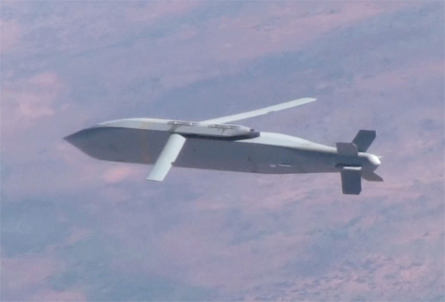
The Kill chain of a MANPADS begins at knowing that a target (in this case bombs) are incoming.
This trigger starts a reaction time to put the launcher on the shoulder and to begin to look for targets in the desired direction.
Secondly the shooter should acquire the target, seeing the target with his Mk1 eyes, aligning the weapon and putting it in the crosshairs, acquire a lock with the seeker and fire.
CMO uses a base PH for a SA-18 sensor (which came into service in 1983...) at a base PH of 50%! for a GBU-10! So almost every second MANPADS shooter can hit a incoming bomb...
CMO's reaction from Dimitis chooses the scientific approach by saying "
Any object warmer than absolute zero Kelvin (ie. -273 C) radiates some heat, and at short range this can be detected by normal IR seekers" Fine to start of with. But then we need some theory checks which can be useful to come to a more deeper conclusion than only one sentence. But remember the term "
short range".
The boms have no engine, were flying in temperatures of minus 34.5 deg C/ -30F which is standare temperature @25.00 feet according to AI.
This is supported by:
One of the critical problems Ukrainian forces face with the Russian D-30 glide bombs is their lack of a thermal signature. Unlike other types of munitions that emit detectable infrared heat, these glide bombs do not provide the thermal energy needed for Ukraine’s Man-Portable Air Defense Systems [MPADS] to lock on. Source:
https://bulgarianmilitary.com/2024/12/3 ... heres-why/
In the attached scenario, a GBU-10 (4.3m long and a width of 0.46m, span of 1.68m is detected flying at 8.000 feet by people on the ground: (CMO seeker generation '80's-'90's)
- with an IR sensor of a ATGM at 3.4 Nm/6.3km;

- Clipboard02.jpg (3.27 KiB) Viewed 825 times
( (Note a T-80 thermal camera can only see another armoured vehicels @ 1350 meters, but in CMO it finds a bomb at 6.3 km. That is a big difference!
- and guys with a binocular even at 6.7 Nm/12.4 Km flying at 8.000 feet!

- Clipboard01.jpg (3.42 KiB) Viewed 825 times
- with only their eyes... even more. From an average of 5Nm but some even at 19.6Nm/36 km! :

- Clipboard03.jpg (5.9 KiB) Viewed 825 times
That is too good to be true eyesight. This is too much to say they can be detected at short range.
Please take a look at this video
https://www.youtube.com/watch?v=MzGGbG8cf_I from 1:21 to 1:25 and try to locate the bombs in IR with a sensor from 2025 instead of the very small Field of View SA-18 MANPADS seeker of the 1980's. I don't see the incoming bombs, do you?
Not yet convinced?
Watch these:
https://www.youtube.com/shorts/FswKQQkH ... ture=share or
https://www.youtube.com/watch?v=kLc0P_EMn_w or
https://www.youtube.com/watch?v=Q1cyBeZmC60 or
https://www.youtube.com/watch?v=aaC1t8hQBRo
I changed the scenario to night and changed the settings to weather and day/night affect aircraft sorties (I hoped it also would affect others..) But even at night, personell with binoculars spot an incoming GBU-10 at 2Nm/3.7 Km at 7.000 feet! Three SA-18s engage incoming LGB's In darkness!

- Clipboard04.jpg (26.59 KiB) Viewed 825 times
Conclusion #1 There must be a significant difference between night and day for a MANPADS shooter. Because if you can't aquire the bomb with your eyes you cannot aim with a sensor with only a FOV Of les than 1.9 degrees to scan the skies.
Conclustion #2 The assumption that a MANPAD can shoot down incoming bombs is highly debatable. The plus side? You don't have to model post impact damage

Conclusion #3 What I do, is turn in the doctrine & ROE/ Weapon Release Authorisation/MANPAD TYPE SA-18/Guided Weapon - Subsonic to:
do not use this weapon. Yes on a very good day it is possible to shoot down a cruismissile and I will miss that opportunity , but I rather take that loss of videlity than frustratenly see bombs being shot down by these old weapons.
@CMO: Is there a possibility to turn down the PH probability of the MANPADS, the extended ranges personell can see small object on the battlefield, and decrease the visibility of bombs in the IR and visible spectrum?