Page 1 of 1
[LOGGED] Cranking to gimbals
Posted: Sun Jun 28, 2026 11:23 pm
by Knightpawn
I was doing some tests to understand crank behavior and radar illumination
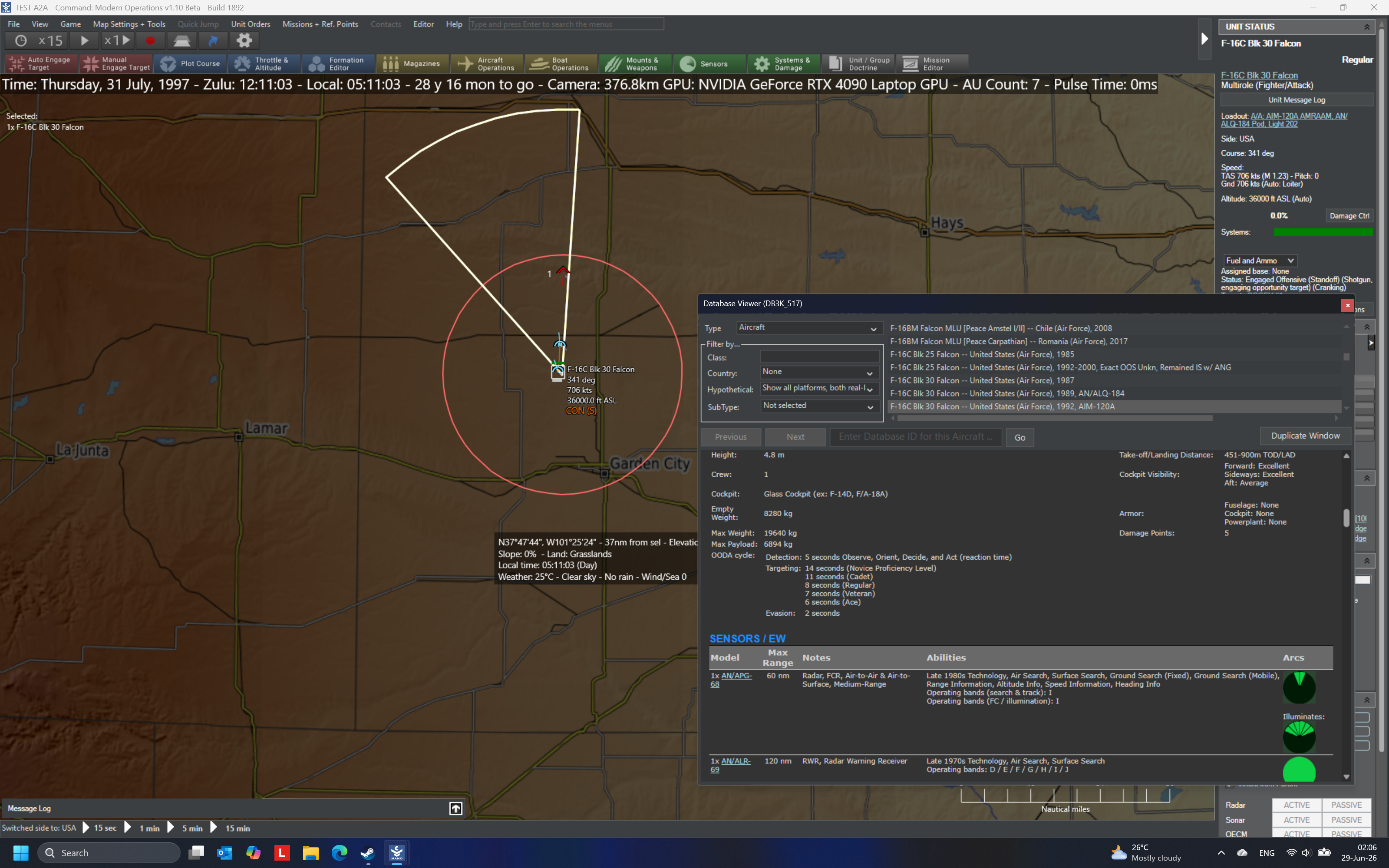
In the pic below an F16 has fired a AIM120A and is cranking.
Is this WAD or should the illumination cone be wider and cranking more "safe"
- Screenshot 2026-06-29 020613.png (3.22 MiB) Viewed 754 times
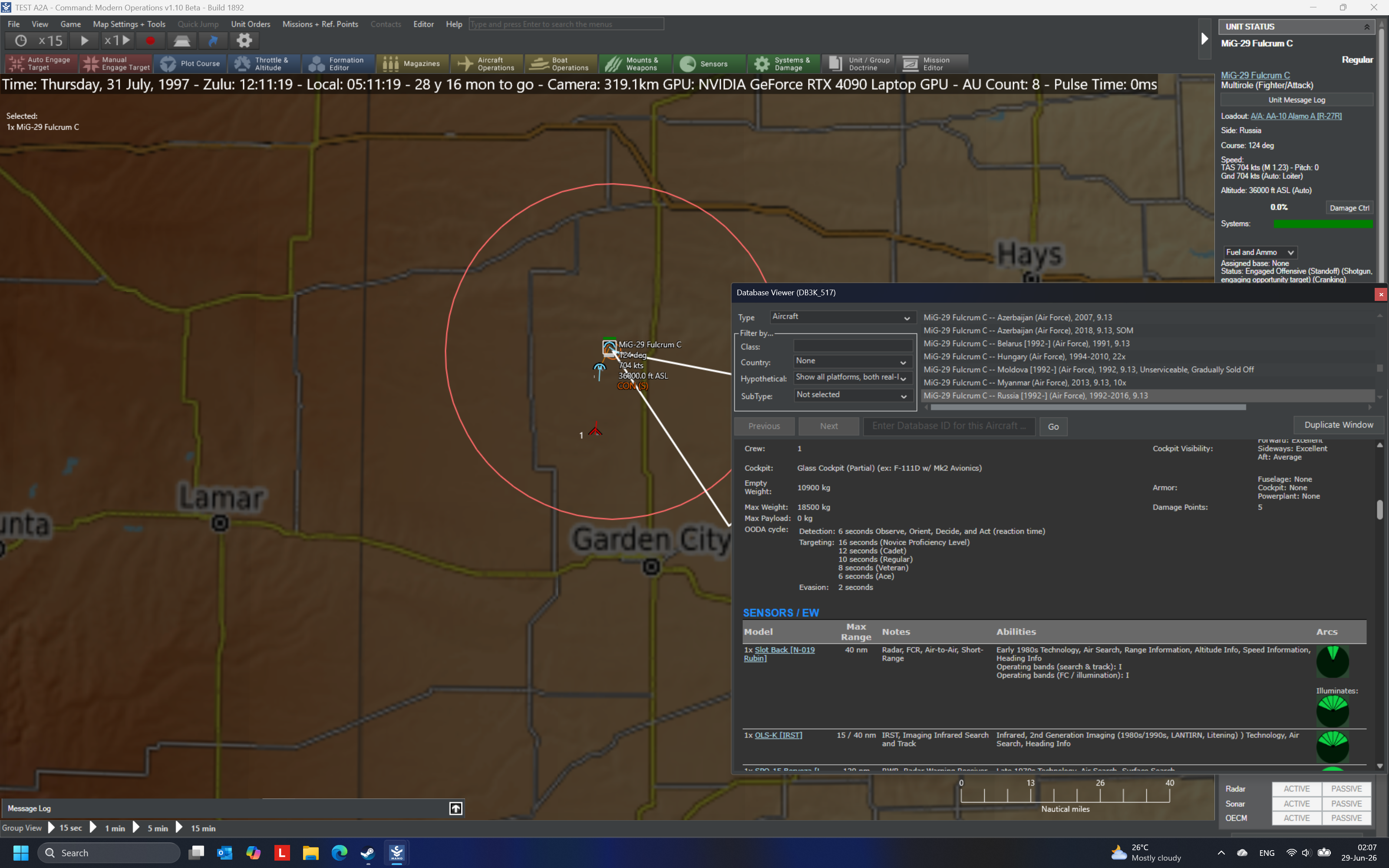
In the same dogfight, the Mig-29 seems to crank "better" (see below). But the Alamo appears out of illumination
1) Should the cone appear wider, or
2) the Alamo to loose track, or
3) is it WAD?
- Screenshot 2026-06-29 020747.png (2.44 MiB) Viewed 754 times
Test file here
Re: [Q] Cranking to gimbals
Posted: Tue Jun 30, 2026 7:13 am
by Dimitris
In the first example, the F-16C is performing track-while-scan (TWS); it is tracking the engaged target and providing datalink updates to the missile, while concurrently scanning for other targets. It is not performing single-target track and illumination, so it has to keep the target within the narrower volume-search arc, hence the limited degree of crank. This is certainly WAD.
In the second example, the MiG-29 is cranking to a much wider degree while providing datalink update to the R-27 and preparing to provide terminal SARH illumination. (The R-27R/AA-10A is unusual in that it combines mid-course datalink updates and terminal SARH illumination, similar to the early SM-2). Whether the MiG-29 should crank lightly or heavily depends on whether the sensor tracking the target is the Slot Back radar or the IRST.
Re: [Q] Cranking to gimbals
Posted: Tue Jun 30, 2026 7:47 am
by Knightpawn
Dimitris wrote: Tue Jun 30, 2026 7:13 am
In the first example, the F-16C is performing track-while-scan (TWS); it is tracking the engaged target and providing datalink updates to the missile, while concurrently scanning for other targets. It is not performing single-target track and illumination, so it has to keep the target within the narrower volume-search arc, hence the limited degree of crank. This is certainly WAD.
Thanks for the above
The way I see it is the following:
The doctrine BVR logic for the F-16 is 'crank'. This means putting the target at 45-50 deg abreast while maintaining radar illumination. If the radar is TWS capable and may remain so while the maneuver is executed - the better. But the execution of the maneuver should be given priority because it is about survival of the plane and the pilot not optimising radar behaviour.
Put it differently: if (assuming for argument's purposes) TWS mode does not work when the radar is turned to gimbal limit, then a sane pilot would prefer to keep the radar locked on target and crank as much as possible rather than risking closing the distance to an incoming missile threat in exchange for TWS functionality. In CMO, the player controls pilot's level of sanity by choosing Crank - Crank and Drag - or Straight in (the less sane option). When I choose crank I expect a certain non suicidal behaviour
Hence I respectfully disagree that the behaviour should be so designed.
Re: Cranking to gimbals
Posted: Thu Aug 13, 2026 12:01 pm
by Dimitris
Logged #17527