Page 1 of 1
Questions about the stock scenarios
Posted: Mon Jun 12, 2006 6:18 am
by Crimguy
I don't want this to sound like an NPR interview, but I'm curious as to whether the scenario designers strove first and foremost for historical accuracy, or play balance? I know practically nothing about this campaign, and have wondered how evenly matched the two sides were in the conflict.
Gobs have been written about Market Garde, so HTTR comes a bit more naturally to me (and I always felt I was fighting a bit of a lost cause in spots as the Allies).
RE: Questions about the stock scenarios
Posted: Mon Jun 12, 2006 6:40 am
by sterckxe
ORIGINAL: Crimguy
I don't want this to sound like an NPR interview, but I'm curious as to whether the scenario designers strove first and foremost for historical accuracy, or play balance?
I think the first thing on their mind was "make it challenging". It's historically accurate and play balance is achieved through having asynchronous victory conditions.
ORIGINAL: Crimguy
I know practically nothing about this campaign, and have wondered how evenly matched the two sides were in the conflict.
Crete was a close run thing that could have gone either way and even the Greek campaign might have gone a bit differently given other choices by the Allied High Command. This is reflected in a few what-if scenarios. Malta is - of course - totally what-if.
Greetz,
Eddy Sterckx
RE: Questions about the stock scenarios
Posted: Mon Jun 12, 2006 6:51 am
by GoodGuy
ORIGINAL: sterckxe
Crete was a close run thing that could have gone either way
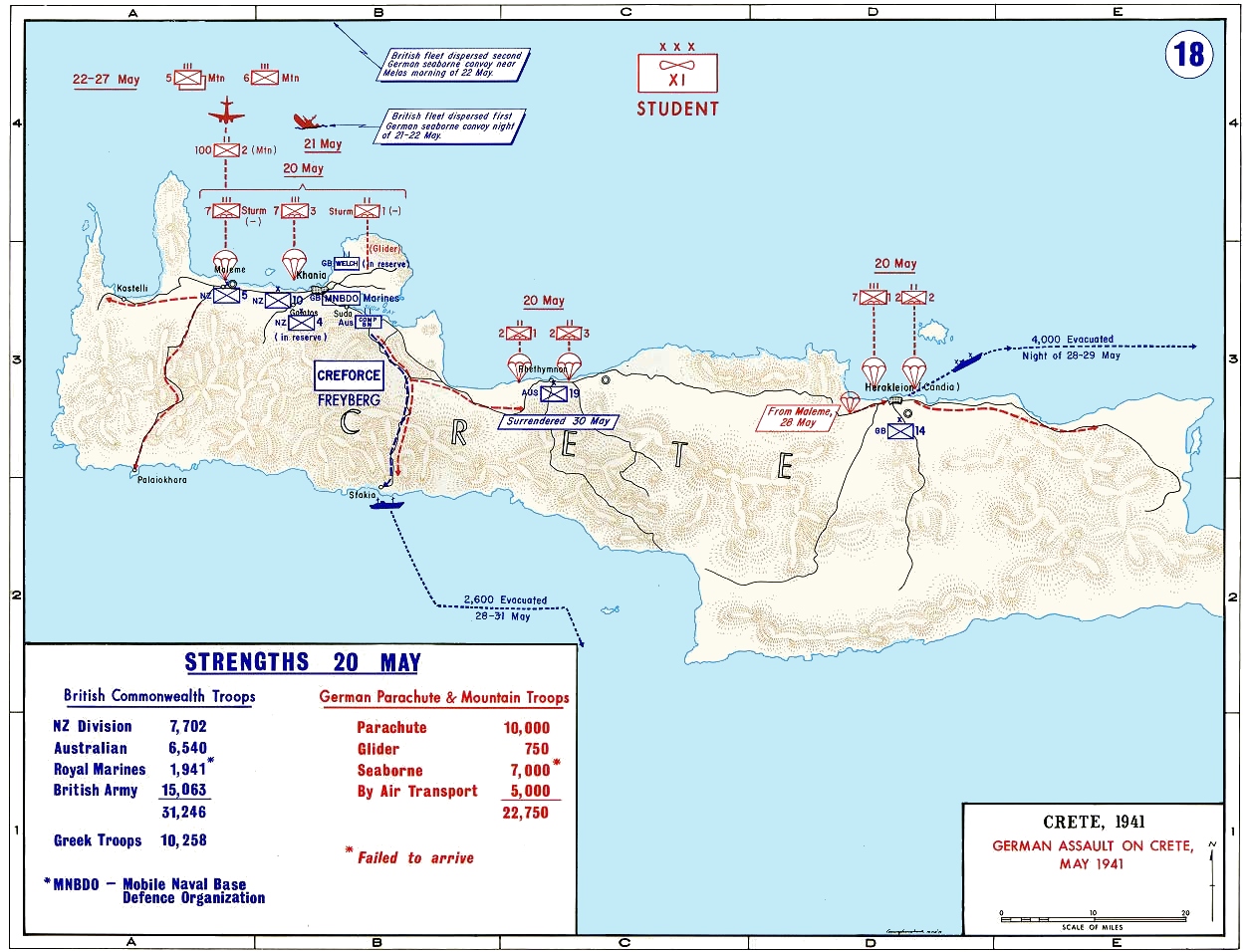
Indeed. Bad recon (AUS/UK positions were camouflaged, tho) and very optimistic assessment regarding enemy strength, plus, several thousand (this map linked below states 7000 troops, not sure) troops couldn't be shipped to Crete, because the Royal Navy managed to drive off and/or destroy their convoy.
An initial amount of around 16000 german paras, facing around 41000 enemies on the ground (20th of May). Pretty risky plan (especially with the fact that the convoy had to pass some serious Royal Navy gems, on their playground). One reason, for the Germans being successful on Crete, might be the fact that, while the Allied forces had a superior amount of troops, the german paras' firepower was overwhelming. They got special para AT guns (very light - but still powerful), AT rifles, 25% of the troops were equipped with MP40 submachine guns, and every 8th - 12th soldier carried a MG34 (machine gun), while the Allied troops suffered of many missing parts for field guns and mortars, and the overall firepower of their infantry units weren't a real match for the german paras.
Btw....I just read that the greek troops on Crete mostly carried german and austrian rifles (confiscated after the treaty of Versailles), rendering impossible receiving resupplies from Allied troops.
German Luftwaffe raids ensured that the Royal Navy wasn't able to give support fire, afaik, they "only" covered the exctraction at the harbour in the south and the one in the north-east, later on. The extraction took 3 days (nights?).
Check this:
http://upload.wikimedia.org/wikipedia/c ... _Crete.jpg
Bad planning, but most decisions/reactions, made by the german para commanders on the ground, seem to be correct.
RE: Questions about the stock scenarios
Posted: Mon Jun 12, 2006 7:24 am
by sterckxe
ORIGINAL: GoodGuy
Bad planning, but most decisions/reactions, made by the german para commanders on the ground, seem to be correct.
So performing better than the Allied Command should be easy for you guys, right ? [:D]
Greetz,
Eddy Sterckx
RE: Questions about the stock scenarios
Posted: Mon Jun 12, 2006 7:32 am
by GoodGuy
lol, good one [:)]
I dunno.....I'm not sure whether the superior german firepower is taken 100% into account in this installment, I mean in the Crete scenario. I'm still trying to figure it out.
Btw.....There might be 2 major reasons for the heavy losses among the paras on Crete (IMHO):
1) They used to drop off weapons in small para cargo-boxes. So, they had to collect their heavy weapons first, b4 being able to put up 100% of their firepower. Some units literally landed right on enemy strongpoints.
2) It seems that a good amount of paras landed on Agave fields, receiving wounds even before facing any enemy. I've seen vets reporting that in interviews.
So, looks like the germans suffered some more from bad planning and from a lil bit unfriendly environment, no?

RE: Questions about the stock scenarios
Posted: Mon Jun 12, 2006 7:55 am
by sterckxe
ORIGINAL: GoodGuy
lol, good one [:)]
I dunno.....I'm not sure whether the superior german firepower is taken 100% into account in this installment, I mean in the Crete scenario. I'm still trying to figure it out.
Btw.....There might be 2 major reasons for the heavy losses among the paras on Crete (IMHO):
1) They used to drop off weapons in small para cargo-boxes. So, they had to collect their heavy weapons first, b4 being able to put up 100% of their firepower. Some units literally landed right on enemy strongpoints.
2) It seems that a good amount of paras landed on Agave fields, receiving wounds even before facing any enemy. I've seen vets reporting that in interviews.
So, looks like the germans suffered some more from bad planning and from a lil bit unfriendly environment, no?
Yup, add to this that their 'chutes and jump technique were not as good as the Allies too - causing more injuries irrespective of terrain. But there's a psychological angle as well : A lot of the Allied troops that were in Crete had just been kicked out of Greece. German HQ moral was very Gung-Ho at the time while the Allied commanders were very on edge/defeatist. But as I said, this time it's *you* commanding the Allies and surely you aren't afraid of those Falschirmjaeger sissies, are you ?
Greetz,
Eddy Sterckx
RE: Questions about the stock scenarios
Posted: Mon Jun 12, 2006 4:06 pm
by Agema
Allied commanders made lots of errors. Wavell saw it as a backwater and was not very forthcoming with equipment, hence the poor state of the allies when the Germans arrived, a major part of which was poor communications. The commander in charge of the island was also obsessed with a seaborne invasion, despite the fact that it had been made pretty clear that he was facing an airborne invasion, and holding the three airfields was an absolute must. So he had lots of his troops uselessly facing the sea.
The Germans got massacred on two airfields. Well, they got massacred at the third, Maleme, too, but the battalion commander ended up unable to contact his forward companies or his superiors. Feeling isolated and - fairly reasonably albeit erroneously - that he was being overrun, he withdrew. Still not appreciating the importance of the airfield, the British/Anzacs then failed to make anything like a suitable effort to recover it. German reinforcements flooded in, island lost.