Battlefront Designer Notes Part 1 thur 7
Posted: Fri Jul 07, 2006 12:46 am
Battlefront Designer Notes Part 1
This is the first in a series of designer notes about the new Battlefront game. It gives an overview of the changes and new features in the Battlefront engine. Future articles will explore these changes in detail and will also include info about the four exciting battles that make up the Battlefront game.
Battlefront - Designer Notes
Now that our new Battlefront game has been announced, it's time to let you know something about it. Let's start by answering a few questions. One question, is Battlefront a new game? Well, if it wasn't a new game, it would have been out a long, long time ago! In addition to the ton of new features in the game, Battlefront embodies some important philosophical changes in how we simulate warfare. We'll go through them all, so you'll have a good idea of what to expect when Battlefront is released.
Game Overview
Battlefront will ship with four complete battles: Saipan, Market Garden, Gazala and Novorossik. These battles, which take place in wildly different environments illustrate the inherent flexibility of the Battlefront system. The ground scale is 1 km per hex and there are 2 turns per day. Most combat units are battalions, with some more specialized units being companies. At this scale there are literally hundreds of battles that can be simulated, and this, along with the fact that all major WWII combatants are represented in the first game will help the scenario making community whose free scenarios do so much to help create and extend interest in our games.
There are a number of issues that we wanted to address in making this new game. One was to give more emphasis to issues of command and control. It’s easy, from the godlike perspective that games to give, to overlook just how important hierarchies and procedures are to all armies, although the incessant saluting and continual references to orders are a bit of a giveaway. We also wanted to recreate a more realistic tempo for the battles. Although Spike Milligan famously offered ‘to fight nights as well’ to make up for his late arrival after being conscripted, no formation could fight all day, every day, for extended periods of time, and new structures in the game will make this obvious.
We’ve also introduced structures to increase the decision making options available to players and decrease the certainty with which you can contemplate your opponent’s options. This, coupled with a significantly improved AI system will guarantee a great game no matter who you play.
There are now three deliciously different ways to deal damage to your opponents: Close Combat, Direct Fire and Indirect Fire. Close Combat involves an attack by units adjacent to an enemy unit. Direct Fire is an attack by armored units against other armored units or suitable targets, from a distance of one hex. Indirect Fire is a ranged attack by artillery, naval or air units, any of which can cause losses to enemy units.
An important innovation with Battlefront is the introduction of the Off Map Areas, or OMAs. Each side can have up to twelve of these special holding areas, which are connected to map hexes and/or other holding areas. The scenario creator can designate units to arrive in an OMA, from which the player can choose whether to move those units to up to three on-map hexes, or another OMA. This creates more control for the player and less certainty for their opponent. For example, in Saipan, the US player must make his initial invasion on the historical beaches, but all units after that arrive in the OMAs, and from there the US player can land them at three separate locations, including some on the other side of the island from the initial landings. This means that the Japanese player can never be sure of which beaches he has to defend, and must dispose his forces accordingly. Sooner or later, a Japanese player who doesn’t maintain a reserve will come spectacularly unstuck.
Combat has some important changes from the Decisive Battles system, and will be treated in more detail in later articles. Retreat is decided by a separate dice roll from casualties instead of being part of a single combat result. A unit which has taken casualties from artillery fire is more likely to retreat. Units flushed out of their entrenchments and retreating to unprepared positions are very vulnerable to artillery fire. On the other hand, advancing into an enemy controlled hex that has just been vacated makes you equally vulnerable, so each side has opportunities in attack and counter attack.
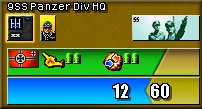
Headquarters now appear on the map as real units. HQs provide major combat bonuses, and supply for attacks, so the long suffering staff wallahs will now feel appreciated. Any unit not in command range will suffer a noticeable loss in combat efficiency. Even if a unit is in command range, there’s no guarantee that it will be able to attack. The supply system has been changed so as to recreate a more realistic tempo for battles. Supply units provide defensive supply, but only HQs can hand out attack supply. For some units, an attack will use more supply in a turn than their HQ can resupply, meaning that these units simply cannot attack every turn. It’s most likely that artillery units will be restricted in this fashion, making it imperative that players build up supplies and conduct planned offensives if they wish to avoid operations grinding to a premature halt.
Our next article will give a quick overview of the Market Garden scenario, as seen from the Allied viewpoint.
By Gregor Whiley
This is the first in a series of designer notes about the new Battlefront game. It gives an overview of the changes and new features in the Battlefront engine. Future articles will explore these changes in detail and will also include info about the four exciting battles that make up the Battlefront game.
Battlefront - Designer Notes
Now that our new Battlefront game has been announced, it's time to let you know something about it. Let's start by answering a few questions. One question, is Battlefront a new game? Well, if it wasn't a new game, it would have been out a long, long time ago! In addition to the ton of new features in the game, Battlefront embodies some important philosophical changes in how we simulate warfare. We'll go through them all, so you'll have a good idea of what to expect when Battlefront is released.
Game Overview
Battlefront will ship with four complete battles: Saipan, Market Garden, Gazala and Novorossik. These battles, which take place in wildly different environments illustrate the inherent flexibility of the Battlefront system. The ground scale is 1 km per hex and there are 2 turns per day. Most combat units are battalions, with some more specialized units being companies. At this scale there are literally hundreds of battles that can be simulated, and this, along with the fact that all major WWII combatants are represented in the first game will help the scenario making community whose free scenarios do so much to help create and extend interest in our games.
There are a number of issues that we wanted to address in making this new game. One was to give more emphasis to issues of command and control. It’s easy, from the godlike perspective that games to give, to overlook just how important hierarchies and procedures are to all armies, although the incessant saluting and continual references to orders are a bit of a giveaway. We also wanted to recreate a more realistic tempo for the battles. Although Spike Milligan famously offered ‘to fight nights as well’ to make up for his late arrival after being conscripted, no formation could fight all day, every day, for extended periods of time, and new structures in the game will make this obvious.
We’ve also introduced structures to increase the decision making options available to players and decrease the certainty with which you can contemplate your opponent’s options. This, coupled with a significantly improved AI system will guarantee a great game no matter who you play.
There are now three deliciously different ways to deal damage to your opponents: Close Combat, Direct Fire and Indirect Fire. Close Combat involves an attack by units adjacent to an enemy unit. Direct Fire is an attack by armored units against other armored units or suitable targets, from a distance of one hex. Indirect Fire is a ranged attack by artillery, naval or air units, any of which can cause losses to enemy units.
An important innovation with Battlefront is the introduction of the Off Map Areas, or OMAs. Each side can have up to twelve of these special holding areas, which are connected to map hexes and/or other holding areas. The scenario creator can designate units to arrive in an OMA, from which the player can choose whether to move those units to up to three on-map hexes, or another OMA. This creates more control for the player and less certainty for their opponent. For example, in Saipan, the US player must make his initial invasion on the historical beaches, but all units after that arrive in the OMAs, and from there the US player can land them at three separate locations, including some on the other side of the island from the initial landings. This means that the Japanese player can never be sure of which beaches he has to defend, and must dispose his forces accordingly. Sooner or later, a Japanese player who doesn’t maintain a reserve will come spectacularly unstuck.
Combat has some important changes from the Decisive Battles system, and will be treated in more detail in later articles. Retreat is decided by a separate dice roll from casualties instead of being part of a single combat result. A unit which has taken casualties from artillery fire is more likely to retreat. Units flushed out of their entrenchments and retreating to unprepared positions are very vulnerable to artillery fire. On the other hand, advancing into an enemy controlled hex that has just been vacated makes you equally vulnerable, so each side has opportunities in attack and counter attack.
Headquarters now appear on the map as real units. HQs provide major combat bonuses, and supply for attacks, so the long suffering staff wallahs will now feel appreciated. Any unit not in command range will suffer a noticeable loss in combat efficiency. Even if a unit is in command range, there’s no guarantee that it will be able to attack. The supply system has been changed so as to recreate a more realistic tempo for battles. Supply units provide defensive supply, but only HQs can hand out attack supply. For some units, an attack will use more supply in a turn than their HQ can resupply, meaning that these units simply cannot attack every turn. It’s most likely that artillery units will be restricted in this fashion, making it imperative that players build up supplies and conduct planned offensives if they wish to avoid operations grinding to a premature halt.
Our next article will give a quick overview of the Market Garden scenario, as seen from the Allied viewpoint.
By Gregor Whiley