

Looks great and is not a direct copy of Wikipedia which I was guilty of.
Thanks for all your efforts.[:)]
Unit Descriptions: Air, Naval, Land
Moderator: Shannon V. OKeets
-
paulderynck

- Posts: 8529
- Joined: Sat Mar 24, 2007 5:27 pm
- Location: Canada
-
Shannon V. OKeets
- Posts: 22165
- Joined: Wed May 18, 2005 11:51 pm
- Location: Honolulu, Hawaii
- Contact:
RE: Unit Descriptions: Air, Naval, Land
Caquineur is editing the Land Unit writeups.[&o][&o] You should PM him with suggested changes.ORIGINAL: Froonp
I found a spelling error in the Copenhagen MIL.
Is it OK to report here ?
You should replace :
"IOn the 9th of April, 1940 the Germans attacked without warning."
With :
"On the 9th of April, 1940 the Germans attacked without warning."
Steve
Perfection is an elusive goal.
Perfection is an elusive goal.

RE: Unit Descriptions: Air, Naval, Land
Please see attached a unit unique to the US - the Naval Supply Unit. Below is my interpretation of what ADG based the two counters on but would be grateful for any comment on this - particularly where I have referred to the optional rule.
Many thanks as ever.
[4255 Naval Supply - by Robert Jenkins]
.P This unit does not represent an individual ship, but rather a group of
ships, the composition of which could change from time to time.
.P Naval warfare in the pacific and the island hopping strategy employed by the
US forces, contained a number of obstacles to be overcome if victory over the
Japanese was to be achieved. Between the USA in the east, Australia in the
south, the Dutch East Indies in the west and Japan in the north were numerous
islands, big and small spread over the huge expanse of the great Pacific Ocean.
These islands and island chains were mostly primitive in terms of infrastructure
and resources. This meant that pretty much everything that the US forces needed
to prosecute the Pacific war had to be brought from their main bases.
.P Once the enemy were evicted, and the next target could be contemplated, the
US Navy needed to ensure that the ships of the fleet were adequately re-supplied
with all manner of equipment, foodstuffs and ammunition. In addition, the ships
damaged in the previous operations may have needed basic repair work before
being able to recommence operations. An alternative had to be found to avoid the
need for the fleet to have to return to the nearest naval base; which of course
could be many hundreds of miles away; if not more.
.P The US Navy`s answer to these problems was to form service squadrons and
later, two mobile service squadrons, the later numbered four and ten. The twenty
-four ship Mobile Service Squadron Four was commissioned in October 1943. It was
sent to Funafuti in the Ellice Islands at the time of Operation Galvanic; the
invasion of the Gilbert Islands. The much larger Mobile Squadron Ten was set up
in February 1944 and was sent to Majuro in the Marshall Islands during the
assault and conquest of those islands.
.P The original idea was that the two mobile squadrons would leapfrog each other
as new territories were conquered, so that as one squadron looked after the
fleet at the newly conquered territory, the second squadron would prepare to
move to the next target. In practice they did not operate like that and in March
1944, Mobile Squadron Four was incorporated within Mobile Squadron Ten.
.P Under this huge squadron, subsidiary Service Squadrons were employed; Service
Squadron Six operated close to the operational area of the fleet and then
replenished ships as and when required at sea. From time to time, this squadron
would then return to the Mobile Squadron Ten to replenish their own supplies
before returning to the operational area to begin the process again. Meanwhile,
Service Squadron Eight brought supplies from the US west coast and Caribbean to
the forward bases.
.P The Naval Supply Units (NSU) in World in Flames represents the two mobile
service squadrons and are available in 1941 and 1943 respectively. What these
NSU`s allow the US player to do is to increase the capacity of a minor port by
either ten (1941) or fifteen (1943) ships, greatly increasing US fleet
flexibility.
.P Note the use of NSU`s is optional.
Many thanks as ever.
[4255 Naval Supply - by Robert Jenkins]
.P This unit does not represent an individual ship, but rather a group of
ships, the composition of which could change from time to time.
.P Naval warfare in the pacific and the island hopping strategy employed by the
US forces, contained a number of obstacles to be overcome if victory over the
Japanese was to be achieved. Between the USA in the east, Australia in the
south, the Dutch East Indies in the west and Japan in the north were numerous
islands, big and small spread over the huge expanse of the great Pacific Ocean.
These islands and island chains were mostly primitive in terms of infrastructure
and resources. This meant that pretty much everything that the US forces needed
to prosecute the Pacific war had to be brought from their main bases.
.P Once the enemy were evicted, and the next target could be contemplated, the
US Navy needed to ensure that the ships of the fleet were adequately re-supplied
with all manner of equipment, foodstuffs and ammunition. In addition, the ships
damaged in the previous operations may have needed basic repair work before
being able to recommence operations. An alternative had to be found to avoid the
need for the fleet to have to return to the nearest naval base; which of course
could be many hundreds of miles away; if not more.
.P The US Navy`s answer to these problems was to form service squadrons and
later, two mobile service squadrons, the later numbered four and ten. The twenty
-four ship Mobile Service Squadron Four was commissioned in October 1943. It was
sent to Funafuti in the Ellice Islands at the time of Operation Galvanic; the
invasion of the Gilbert Islands. The much larger Mobile Squadron Ten was set up
in February 1944 and was sent to Majuro in the Marshall Islands during the
assault and conquest of those islands.
.P The original idea was that the two mobile squadrons would leapfrog each other
as new territories were conquered, so that as one squadron looked after the
fleet at the newly conquered territory, the second squadron would prepare to
move to the next target. In practice they did not operate like that and in March
1944, Mobile Squadron Four was incorporated within Mobile Squadron Ten.
.P Under this huge squadron, subsidiary Service Squadrons were employed; Service
Squadron Six operated close to the operational area of the fleet and then
replenished ships as and when required at sea. From time to time, this squadron
would then return to the Mobile Squadron Ten to replenish their own supplies
before returning to the operational area to begin the process again. Meanwhile,
Service Squadron Eight brought supplies from the US west coast and Caribbean to
the forward bases.
.P The Naval Supply Units (NSU) in World in Flames represents the two mobile
service squadrons and are available in 1941 and 1943 respectively. What these
NSU`s allow the US player to do is to increase the capacity of a minor port by
either ten (1941) or fifteen (1943) ships, greatly increasing US fleet
flexibility.
.P Note the use of NSU`s is optional.
Now Maitland, now's your time!
Duke of Wellington to 1st Guards Brigade - Waterloo 18 June 1815
Duke of Wellington to 1st Guards Brigade - Waterloo 18 June 1815
RE: Unit Descriptions: Air, Naval, Land
It looks good. I am not learned enough in the ADG design that lead to the NSU, nor into those Mobile Squadron that you describe, but this is very credible to me.ORIGINAL: warspite1
Please see attached a unit unique to the US - the Naval Supply Unit. Below is my interpretation of what ADG based the two counters on but would be grateful for any comment on this - particularly where I have referred to the optional rule.
Many thanks as ever.
[4255 Naval Supply - by Robert Jenkins]
.P This unit does not represent an individual ship, but rather a group of
ships, the composition of which could change from time to time.
.P Naval warfare in the pacific and the island hopping strategy employed by the
US forces, contained a number of obstacles to be overcome if victory over the
Japanese was to be achieved. Between the USA in the east, Australia in the
south, the Dutch East Indies in the west and Japan in the north were numerous
islands, big and small spread over the huge expanse of the great Pacific Ocean.
These islands and island chains were mostly primitive in terms of infrastructure
and resources. This meant that pretty much everything that the US forces needed
to prosecute the Pacific war had to be brought from their main bases.
.P Once the enemy were evicted, and the next target could be contemplated, the
US Navy needed to ensure that the ships of the fleet were adequately re-supplied
with all manner of equipment, foodstuffs and ammunition. In addition, the ships
damaged in the previous operations may have needed basic repair work before
being able to recommence operations. An alternative had to be found to avoid the
need for the fleet to have to return to the nearest naval base; which of course
could be many hundreds of miles away; if not more.
.P The US Navy`s answer to these problems was to form service squadrons and
later, two mobile service squadrons, the later numbered four and ten. The twenty
-four ship Mobile Service Squadron Four was commissioned in October 1943. It was
sent to Funafuti in the Ellice Islands at the time of Operation Galvanic; the
invasion of the Gilbert Islands. The much larger Mobile Squadron Ten was set up
in February 1944 and was sent to Majuro in the Marshall Islands during the
assault and conquest of those islands.
.P The original idea was that the two mobile squadrons would leapfrog each other
as new territories were conquered, so that as one squadron looked after the
fleet at the newly conquered territory, the second squadron would prepare to
move to the next target. In practice they did not operate like that and in March
1944, Mobile Squadron Four was incorporated within Mobile Squadron Ten.
.P Under this huge squadron, subsidiary Service Squadrons were employed; Service
Squadron Six operated close to the operational area of the fleet and then
replenished ships as and when required at sea. From time to time, this squadron
would then return to the Mobile Squadron Ten to replenish their own supplies
before returning to the operational area to begin the process again. Meanwhile,
Service Squadron Eight brought supplies from the US west coast and Caribbean to
the forward bases.
.P The Naval Supply Units (NSU) in World in Flames represents the two mobile
service squadrons and are available in 1941 and 1943 respectively. What these
NSU`s allow the US player to do is to increase the capacity of a minor port by
either ten (1941) or fifteen (1943) ships, greatly increasing US fleet
flexibility.
.P Note the use of NSU`s is optional.
Originaly, I had thought that the NSU also represented the mullbery ports that the US put up in Normandy, but maybe the Mullberry ports are better WiFZenned as simply the effects of HQs on the coast.
Your writeup looks good to me.
Thanks for all those researches you do the for game, they mean more enjoyment for the players.

- Attachments
-
- NSU (USA).gif (2.75 KiB) Viewed 457 times
RE: Unit Descriptions: Air, Naval, Land
Warspite 1ORIGINAL: Froonp
It looks good. I am not learned enough in the ADG design that lead to the NSU, nor into those Mobile Squadron that you describe, but this is very credible to me.ORIGINAL: warspite1
Please see attached a unit unique to the US - the Naval Supply Unit. Below is my interpretation of what ADG based the two counters on but would be grateful for any comment on this - particularly where I have referred to the optional rule.
Many thanks as ever.
[4255 Naval Supply - by Robert Jenkins]
.P This unit does not represent an individual ship, but rather a group of
ships, the composition of which could change from time to time.
.P Naval warfare in the pacific and the island hopping strategy employed by the
US forces, contained a number of obstacles to be overcome if victory over the
Japanese was to be achieved. Between the USA in the east, Australia in the
south, the Dutch East Indies in the west and Japan in the north were numerous
islands, big and small spread over the huge expanse of the great Pacific Ocean.
These islands and island chains were mostly primitive in terms of infrastructure
and resources. This meant that pretty much everything that the US forces needed
to prosecute the Pacific war had to be brought from their main bases.
.P Once the enemy were evicted, and the next target could be contemplated, the
US Navy needed to ensure that the ships of the fleet were adequately re-supplied
with all manner of equipment, foodstuffs and ammunition. In addition, the ships
damaged in the previous operations may have needed basic repair work before
being able to recommence operations. An alternative had to be found to avoid the
need for the fleet to have to return to the nearest naval base; which of course
could be many hundreds of miles away; if not more.
.P The US Navy`s answer to these problems was to form service squadrons and
later, two mobile service squadrons, the later numbered four and ten. The twenty
-four ship Mobile Service Squadron Four was commissioned in October 1943. It was
sent to Funafuti in the Ellice Islands at the time of Operation Galvanic; the
invasion of the Gilbert Islands. The much larger Mobile Squadron Ten was set up
in February 1944 and was sent to Majuro in the Marshall Islands during the
assault and conquest of those islands.
.P The original idea was that the two mobile squadrons would leapfrog each other
as new territories were conquered, so that as one squadron looked after the
fleet at the newly conquered territory, the second squadron would prepare to
move to the next target. In practice they did not operate like that and in March
1944, Mobile Squadron Four was incorporated within Mobile Squadron Ten.
.P Under this huge squadron, subsidiary Service Squadrons were employed; Service
Squadron Six operated close to the operational area of the fleet and then
replenished ships as and when required at sea. From time to time, this squadron
would then return to the Mobile Squadron Ten to replenish their own supplies
before returning to the operational area to begin the process again. Meanwhile,
Service Squadron Eight brought supplies from the US west coast and Caribbean to
the forward bases.
.P The Naval Supply Units (NSU) in World in Flames represents the two mobile
service squadrons and are available in 1941 and 1943 respectively. What these
NSU`s allow the US player to do is to increase the capacity of a minor port by
either ten (1941) or fifteen (1943) ships, greatly increasing US fleet
flexibility.
.P Note the use of NSU`s is optional.
Originaly, I had thought that the NSU also represented the mullbery ports that the US put up in Normandy, but maybe the Mullberry ports are better WiFZenned as simply the effects of HQs on the coast.
Your writeup looks good to me.
Thanks for all those researches you do the for game, they mean more enjoyment for the players.
Thanks Patrice - two things 1. Where did that cool counter come from? Going through my 2007 WiF/SiF/CoiF/CinF etc counter sheets, I could not find these counters for ages - until I realised the only way you could tell them apart was the little port symbol on the back of the counter. Is the design above a special MWIF version only? If so - I like it and ADG should amend theirs to this.
2. Good point re the Mulberries and to be honest I did not think of that, however, now you mention it, I would like to think that if thats what ADG intended, they would have given the British one of the Naval Supply Counters - at least our Mulberry didn`t fall apart in a storm! [:D] More importantly, I think the Mulberries are too limited in their use. E.g. these NSU counters can be used anywhere, but towing the great concrete Mulberry structures any further than the few miles from England to France would surely have been impractical/impossible?
I must admit that doing these write-ups is proving a real learning experience. I did not know about the Mobile Squadrons either before I started researching for those counters. I began just assuming the US used a massive and well organised Fleet Train.
When you look at the distances involved in the Pacific, the sheer scale of the US operation, the number of ships, the fact the everything had to be brought to the front line; the whole logistics effort is just staggering. The Japanese just never had a hope........
Now Maitland, now's your time!
Duke of Wellington to 1st Guards Brigade - Waterloo 18 June 1815
Duke of Wellington to 1st Guards Brigade - Waterloo 18 June 1815
-
kirk23_MatrixForum

- Posts: 1052
- Joined: Tue Dec 16, 2008 4:53 pm
- Location: Scotland
RE: Unit Descriptions: Air, Naval, Land
Hi,
I noticed in this write up that Gneisenau & Scharnhorst have been classified as Pocket Battleships,this is wrong both were BATTLECRUISERS,will this be corrected before release of game.
Germany had 3 Pocket battleships Admiral Graf Spee,Admiral Scheer & Deutschland renamed Lutzow because Hitler did not want a ship named after Germany sunk.
Germanys 2 Battleships were Bismarck & Tirpitz.
I noticed in this write up that Gneisenau & Scharnhorst have been classified as Pocket Battleships,this is wrong both were BATTLECRUISERS,will this be corrected before release of game.
Germany had 3 Pocket battleships Admiral Graf Spee,Admiral Scheer & Deutschland renamed Lutzow because Hitler did not want a ship named after Germany sunk.
Germanys 2 Battleships were Bismarck & Tirpitz.
Regards,
Graham.
I'm not retreating, I'm attacking in a different direction! Lewis B. "Chesty" Puller
Graham.
I'm not retreating, I'm attacking in a different direction! Lewis B. "Chesty" Puller
-
Shannon V. OKeets
- Posts: 22165
- Joined: Wed May 18, 2005 11:51 pm
- Location: Honolulu, Hawaii
- Contact:
RE: Unit Descriptions: Air, Naval, Land
The design of the NSU counters is mine.[:)]
One problem with computers is that when you look at the back of a counter, you just see the cables hanging down from the back of your monitor.[:D]
One problem with computers is that when you look at the back of a counter, you just see the cables hanging down from the back of your monitor.[:D]
Steve
Perfection is an elusive goal.
Perfection is an elusive goal.
RE: Unit Descriptions: Air, Naval, Land
Thank you. This one I corrected [8D] (but I certainly missed others [&:])ORIGINAL: Shannon V. OKeetsCaquineur is editing the Land Unit writeups. You should PM him with suggested changes.ORIGINAL: Froonp
I found a spelling error in the Copenhagen MIL.
Is it OK to report here ?
You should replace :
"IOn the 9th of April, 1940 the Germans attacked without warning."
With :
"On the 9th of April, 1940 the Germans attacked without warning."
RE: Unit Descriptions: Air, Naval, Land
Warspite1ORIGINAL: hellfirejet
Hi,
I noticed in this write up that Gneisenau & Scharnhorst have been classified as Pocket Battleships,this is wrong both were BATTLECRUISERS,will this be corrected before release of game.
Germany had 3 Pocket battleships Admiral Graf Spee,Admiral Scheer & Deutschland renamed Lutzow because Hitler did not want a ship named after Germany sunk.
Germanys 2 Battleships were Bismarck & Tirpitz.
Which write-up are you referring to?
Now Maitland, now's your time!
Duke of Wellington to 1st Guards Brigade - Waterloo 18 June 1815
Duke of Wellington to 1st Guards Brigade - Waterloo 18 June 1815
RE: Unit Descriptions: Air, Naval, Land
This should be corrected. Gneisenau & Scharnhorst are definitely not Pocket Battleships.ORIGINAL: hellfirejet
I noticed in this write up that Gneisenau & Scharnhorst have been classified as Pocket Battleships,this is wrong both were BATTLECRUISERS,will this be corrected before release of game.
Germany had 3 Pocket battleships Admiral Graf Spee,Admiral Scheer & Deutschland renamed Lutzow because Hitler did not want a ship named after Germany sunk.
Germanys 2 Battleships were Bismarck & Tirpitz.
In WiF FE sense, they are Battleships, but reality they are Battlecruisers as hellfirejet says.
RE: Unit Descriptions: Air, Naval, Land
Warspite 1ORIGINAL: Froonp
This should be corrected. Gneisenau & Scharnhorst are definitely not Pocket Battleships.ORIGINAL: hellfirejet
I noticed in this write up that Gneisenau & Scharnhorst have been classified as Pocket Battleships,this is wrong both were BATTLECRUISERS,will this be corrected before release of game.
Germany had 3 Pocket battleships Admiral Graf Spee,Admiral Scheer & Deutschland renamed Lutzow because Hitler did not want a ship named after Germany sunk.
Germanys 2 Battleships were Bismarck & Tirpitz.
In WiF FE sense, they are Battleships, but reality they are Battlecruisers as hellfirejet says.
But my question was what write-up? - I have the master list and neither Scharnhorst nor Gneisenau are referred to as pocket-battleships. Unless Hellfirejet is reading post 1058 on this thread - in which case he`s wrong.......although he has spotted a spelling error in battlescruisers!!
Now Maitland, now's your time!
Duke of Wellington to 1st Guards Brigade - Waterloo 18 June 1815
Duke of Wellington to 1st Guards Brigade - Waterloo 18 June 1815
RE: Unit Descriptions: Air, Naval, Land
As Warspite1, I do not see which writeup referres the Scharnhorst & Gneisenau as pocket-battleships.ORIGINAL: warspite1
But my question was what write-up? - I have the master list and neither Scharnhorst nor Gneisenau are referred to as pocket-battleships. Unless Hellfirejet is reading post 1058 on this thread - in which case he`s wrong.......although he has spotted a spelling error in battlescruisers!!
RE: Unit Descriptions: Air, Naval, Land
Warspite 1ORIGINAL: Froonp
As Warspite1, I do not see which writeup referres the Scharnhorst & Gneisenau as pocket-battleships.ORIGINAL: warspite1
But my question was what write-up? - I have the master list and neither Scharnhorst nor Gneisenau are referred to as pocket-battleships. Unless Hellfirejet is reading post 1058 on this thread - in which case he`s wrong.......although he has spotted a spelling error in battlescruisers!!
To be fair, if it is post 1058 that Hellfirejet is mis-reading, on reflection I think I have not made it clear why the ships - that were originally envisaged as heavier armoured versions of the Deutschland`s became battlecruisers. I have amended as follows:
[5106 Scharnhorst - by Robert Jenkins]
.B Engine(s) output: 165,000 hp
.B Top Speed: 32 knots
.B Main armament: 9 x 11-inch (280mm), 12 x 5.9-inch (150mm) guns
.B Displacement (full load): 38,900 tons
.B Thickest armor: 13.75-inches (belt)
.P This is a World In Flames "what if" counter that allows the German player
to upgrade the battlecruiser Scharnhorst`s 11-inch main armament to a 15-inch
gun.
.P The Scharnhorst and her sister Gneisenau were originally intended to be
better armoured versions of the Deutschland-class pocket-battleships. However,
to avoid the ships becoming un-balanced (too heavy armour protection for too
little hitting power) a third 11-inch turret was added. As such, the revised
specification of these ships made them less like pocket-battleships and more
like battlecruisers.
.P Then, after the signing of the Anglo-German Naval Agreement in June 1935,
Adolf Hitler wanted to increase the main armament to a 15-inch (381mm) gun in
order that the battlecruisers main armament would compare with that of British
capital ships. This would mean their introduction would be delayed by up to two
years and this was not something Hitler could afford to do, given his
territorial ambitions.
.P The two ships were therefore completed as heavily armoured battlecruisers
with a plan to upgrade their main armament at the first opportunity. As it
turned out, the upgrade never happened and the two ships remained with their
original main armament throughout their life.
.P Please see Counter 4771 for brief details of the Scharnhorst`s service record
in World War II.
Thanks Hellfirejet!! [:)]
Now Maitland, now's your time!
Duke of Wellington to 1st Guards Brigade - Waterloo 18 June 1815
Duke of Wellington to 1st Guards Brigade - Waterloo 18 June 1815
-
Shannon V. OKeets
- Posts: 22165
- Joined: Wed May 18, 2005 11:51 pm
- Location: Honolulu, Hawaii
- Contact:
RE: Unit Descriptions: Air, Naval, Land
Rob,
There are a dozen or more references to pocket-battleships in the naval unit writeups, starting with the very first one (#4001)! You might want to do a global search for the letters 'pocket' in all the naval unit writeups to see if the use of the term is correct in each case.
There are a dozen or more references to pocket-battleships in the naval unit writeups, starting with the very first one (#4001)! You might want to do a global search for the letters 'pocket' in all the naval unit writeups to see if the use of the term is correct in each case.
Steve
Perfection is an elusive goal.
Perfection is an elusive goal.
RE: Unit Descriptions: Air, Naval, Land
Warspite 1ORIGINAL: Shannon V. OKeets
Rob,
There are a dozen or more references to pocket-battleships in the naval unit writeups, starting with the very first one (#4001)! You might want to do a global search for the letters 'pocket' in all the naval unit writeups to see if the use of the term is correct in each case.
I would ask Hellfirejet to clarify what post he was referring to before going through that amount of work - although I am sure it was 1058, in which case I most definitely did not refer to the "Ugly Sisters" as pocket-battleships [&:].
Now Maitland, now's your time!
Duke of Wellington to 1st Guards Brigade - Waterloo 18 June 1815
Duke of Wellington to 1st Guards Brigade - Waterloo 18 June 1815
-
Shannon V. OKeets
- Posts: 22165
- Joined: Wed May 18, 2005 11:51 pm
- Location: Honolulu, Hawaii
- Contact:
RE: Unit Descriptions: Air, Naval, Land
In a quick run through of references (more than 100[X(]) in the naval unit writeups to these 2 ships, I could see no instance where you referred to them as pocket-battleships, other than that that was the original intent for these ships before they were built as battlecruisers.ORIGINAL: warspite1
Warspite 1ORIGINAL: Shannon V. OKeets
Rob,
There are a dozen or more references to pocket-battleships in the naval unit writeups, starting with the very first one (#4001)! You might want to do a global search for the letters 'pocket' in all the naval unit writeups to see if the use of the term is correct in each case.
I would ask Hellfirejet to clarify what post he was referring to before going through that amount of work - although I am sure it was 1058, in which case I most definitely did not refer to the "Ugly Sisters" as pocket-battleships [&:].
I think I'll go look at the reported bugs in MWIF code, ...[8|]
Steve
Perfection is an elusive goal.
Perfection is an elusive goal.
RE: Unit Descriptions: Air, Naval, Land
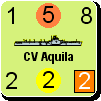
I don't understand because Italian ships of the same class have different values:
- (Attak-Defense-A/A-Bomb-Move-Range)
- BB Giulio Cesare and Cavour (5-5-1-2-5-3 I suggest)
- BB Andrea Doria and Caio Duilio (6-5-2-2-5-2), very similar to the Cavour class but with a better A/A and secondary guns (90/50 instead of obsolete 100/47, 135/45 instead of obsolete 120/50), with a minor range
- BB Vittorio Veneto and Littorio (8-2-2-3-6-2)
- BB Roma and Impero (8-2-2 or 3-3-6-2), very similar to the V.V. class, may be with a little better A/A
- CA Trento and Trieste (4-6-1-2-6-2), heavy cruisers, very speed but with a powerfull armour (13.500 tons on 196,9 m)
- CA Zara, Fiume, Pola and Gorizia (4-5-1-2-6-3), heavy cruisers, more strong that the Trento class (14.800 tons on 182,8 m) with better primary guns (203/53 instead of 203/50), with a range of 5.400/16 kn instead of 4160/16
- CA Bolzano (4-6-1-2-6-2) a "beatifull mistake", very similar to the Trento class, using the same guns of the Zara class
- CA Duca d'Aosta and Eugenio di Savoia (2 or 3-6-1-1-6-2)
- CA Garibaldi and Duca d'Abruzzi (3-5-1-1 or 2-6-2 or 3), a big light cruiser class, with 10x152/55 instead of 8x152/53 of all the other Italian LC and a range of 5360/14 kn instead of 3900/14 of the Aosta class.
The name of italian Cavalry is NIZZA (Nice in French, an Italian-Ligurian city, that today is part of France, Garibaldi was born in Nizza) not MIZZA [&:].
Sorry for my terrific English.
Giacomo Bellucci
[&:]
- (Attak-Defense-A/A-Bomb-Move-Range)
- BB Giulio Cesare and Cavour (5-5-1-2-5-3 I suggest)
- BB Andrea Doria and Caio Duilio (6-5-2-2-5-2), very similar to the Cavour class but with a better A/A and secondary guns (90/50 instead of obsolete 100/47, 135/45 instead of obsolete 120/50), with a minor range
- BB Vittorio Veneto and Littorio (8-2-2-3-6-2)
- BB Roma and Impero (8-2-2 or 3-3-6-2), very similar to the V.V. class, may be with a little better A/A
- CA Trento and Trieste (4-6-1-2-6-2), heavy cruisers, very speed but with a powerfull armour (13.500 tons on 196,9 m)
- CA Zara, Fiume, Pola and Gorizia (4-5-1-2-6-3), heavy cruisers, more strong that the Trento class (14.800 tons on 182,8 m) with better primary guns (203/53 instead of 203/50), with a range of 5.400/16 kn instead of 4160/16
- CA Bolzano (4-6-1-2-6-2) a "beatifull mistake", very similar to the Trento class, using the same guns of the Zara class
- CA Duca d'Aosta and Eugenio di Savoia (2 or 3-6-1-1-6-2)
- CA Garibaldi and Duca d'Abruzzi (3-5-1-1 or 2-6-2 or 3), a big light cruiser class, with 10x152/55 instead of 8x152/53 of all the other Italian LC and a range of 5360/14 kn instead of 3900/14 of the Aosta class.
The name of italian Cavalry is NIZZA (Nice in French, an Italian-Ligurian city, that today is part of France, Garibaldi was born in Nizza) not MIZZA [&:].
Sorry for my terrific English.
Giacomo Bellucci
[&:]
ciao
-
Joseignacio
- Posts: 3184
- Joined: Fri May 08, 2009 11:25 am
- Location: Madrid, Spain
RE: Unit Descriptions: Air, Naval, Land
Just to point out that, if I am not wrong, Nice, Nicea, Nicaea, Niza, Nizza originally was a greek city for about 1400 years, until it joined Liguria (the name itself comes after the greek godddess of Victory, Niké) in the VII century.
It was a part of the roman empire the same as Carthago after the conquer, Egypt or Illyria, but I think it was not part of Italy most of the time politically (although it belonged for some years to the county of Saboya) , although it was in the very border and took part in the italian politics and wars, like other powers such as Austria. Besides, it was never part of Italy geographically or politically since Italy exists as a country.
It was a part of the roman empire the same as Carthago after the conquer, Egypt or Illyria, but I think it was not part of Italy most of the time politically (although it belonged for some years to the county of Saboya) , although it was in the very border and took part in the italian politics and wars, like other powers such as Austria. Besides, it was never part of Italy geographically or politically since Italy exists as a country.
RE: Unit Descriptions: Air, Naval, Land
Niké was a Greek city fonded by Massilian (Marseille) on 100 b.C, when Augustus made the Italian Province (14 a.C), Nizza make part of Italy (Liguria), after made part of Ostrogotian Kingdom (483) and East Roman Empire (536, as Italy prefecture) but contested by Burgund, after made part of Longobard Italian kingdom (580-90 circa), after made part of a league with Genoa (650 circa), after as an Italian Free Commune, was an ally of Pisa against Genoa, after made part of Savoy as County of Nizza (1388-1861) and now is part of France; on 2100 ears of his history, Nice was 100-150 years Greek, 1750-1800 Italian and 150 French.
Today the nissard speake French but on 1861, in the city, 90% spoke Italian or Ligurian (Italian dialect) and 10% Occitan (no one spoke French), in the county 80% spoke occitan, 15% Italian or Ligurian and 5% French.
Giacomo Bellucci
P.S.: I don't wont make revanchisme but it's correct to know the history (like Strasbourg is a historical German city that make part of France or Perpignan is a Catalan ispanic city in France).
Today the nissard speake French but on 1861, in the city, 90% spoke Italian or Ligurian (Italian dialect) and 10% Occitan (no one spoke French), in the county 80% spoke occitan, 15% Italian or Ligurian and 5% French.
Giacomo Bellucci
P.S.: I don't wont make revanchisme but it's correct to know the history (like Strasbourg is a historical German city that make part of France or Perpignan is a Catalan ispanic city in France).
ciao
-
Joseignacio
- Posts: 3184
- Joined: Fri May 08, 2009 11:25 am
- Location: Madrid, Spain
RE: Unit Descriptions: Air, Naval, Land
Not intending to itch or start a political discussion, just tried to correct what I thought was a mistake on your side. I still think you are wrong, but I accept your point of view. To support mine, I can quote the wikipedia (in your own language)
Anyway, I don't want to polemize or hurt any feeling. If you don't agree with wikipedia, it's ok, Wiki is not God and anybody can disagree. [;)]
Anche se alcuni scavi archeologici fanno risalire i primi insediamenti di progenitori umani addirittura a 400.000 anni fa, Nizza (Nicaea) fu fondata circa 2.000 anni fa dagli abitanti di Marsiglia e ricevette il nome di Nikaïa in onore alla vittoria sui liguri (Nike è il nome in greco della dea della vittoria).
Anyway, I don't want to polemize or hurt any feeling. If you don't agree with wikipedia, it's ok, Wiki is not God and anybody can disagree. [;)]