House Rules

World in Flames is the computer version of Australian Design Group classic board game. World In Flames is a highly detailed game covering the both Europe and Pacific Theaters of Operations during World War II. If you want grand strategy this game is for you.

Moderator: Shannon V. OKeets

Extraneous
Posts: 1810
Joined: Sat Jun 14, 2008 1:58 am

RE: House Rules

Post by Extraneous »

ORIGINAL: dhucul

MWIF definately needs house rules for historical realism. There are too many ridiculous possibilities.

We have revised ours for simplicity:

1. If Narvik is Allied controlled then Germany loses the Swedish resources in Nov-Dec and Jan-Feb.
2. If Germany DOWs Denmark and not Norway then Germany loses one Swedish resource in Nov-Dec and Jan-Feb from Norwegian economic sanctions.
3. Germany must DOW Belgium the same impulse that it DOWs the Netherlands. (but not vice versa) Belgium would not have sat passively by if Germany only DOWd the Netherlands.
4. The land and air units of all neutral minors can only operate in their own or adjacent countries. For example, Bulgarian units can only operate in Bulgaria, Turkey, Greece, Yugoslavia and Romania. Finnish units can only operate in Finland, USSR and Sweden etc. The only exemption is that Hungarian and Spanish units can also operate in the USSR.
5. Vichy cannot DOW the Western Allies even if they are hostile.
6. All minor country (non-territorial) land and air units must start in their home country.
7. USSR must claim the Borderlands by end of 1939 and must claim Bessarabia by end of 1940.
8. No peacekeepers. Stupid rule as it is set out now.
9. All minor country air units must fight to defend their country until the capital is taken before they can flee and be interned.


Would you care to rethink your house rules?

ORIGINAL: WiFFE-RAW-7.0.pdf
1) If the last impulse of the turn was blizzard or snow in the Arctic weather zone, Germany can only ship the Swedish resources through the Baltic Sea area if Narvik is not controlled by an Allied major power [Designer’s Note: this represents the fact that the resources were transported through neutral Norwegian coastal waters during Winter].

2) 01/09/1939 Norway's King Haakon VI proclaims the neutrality of his country. Finland declares strict neutrality. Denmark issues a declaration of neutrality. 02/09/1939 Sweden issues a declaration of neutrality. German Ministers at Stockholm, Sweden, and Oslo, Norway, give a declaration that Germany would respect the integrity of Sweden and Norway.
07/12/1939 Norway, Denmark and Sweden declare their neutrality. The Soviet Ninth Army launches an offensive in central Karelia. Britain and France agree to send troops and material to help Finland fight against the Soviet Union. However, there is virtually no way to get these forces to Finland and so the promises mean little.

3) In October 1936, King Leopold III announced that Belgium would remain neutral in the event of another war in Europe as part of what he termed an Independent Policy (Politique d'Indépendance). To this end, the Belgian government tried to steer a path away from alliances: leaving the Locarno Treaty, repudiating a defense pact with France signed in 1920 and receiving a guarantee of neutrality from Nazi Germany in 1937.

4) If a minor country aligns with a major power, it is controlled by that major power.

5) Alternatively, an Allied major power can destroy every French controlled unit in its territory. If it does so, Vichy France is hostile to that major power (see 17.5).
if an Allied unit enters Metropolitan Vichy France, Vichy France becomes hostile to that unit’s controlling major power.

6) In any scenario or just Global War? If you mean any scenario this is not historical.

7) Then why have USSR options at all?

8) I disagree.

9) Your view is not historical.
University of Science Music and Culture (USMC) class of 71 and 72 ~ Extraneous (AKA Mziln)
User avatar
Orm
Posts: 33193
Joined: Sat May 03, 2008 7:53 pm
Location: Sweden

RE: House Rules

Post by Orm »

1. If Narvik is Allied controlled then Germany loses the Swedish resources in Nov-Dec and Jan-Feb.
This rule simplifies things but do not add any historical realism.

After the battle of Narvik the port was of little use for the ore export from Sweden to Germany. The port was to damaged to be of any use. This rule is more of what importance that Germany and the Western Allies thought Narvik had rather than historical realism.
Have a bit more patience with newbies. Of course some of them act dumb -- they're often students, for heaven's sake. - Terry Pratchett

A government is a body of people; usually, notably, ungoverned. - Quote from Firefly
User avatar
warspite1
Posts: 42130
Joined: Sat Feb 02, 2008 1:06 pm
Location: England

RE: House Rules

Post by warspite1 »

ORIGINAL: Centuur

3 is really stupid. In the 1920's the Netherlands and Belgium almost got into an armed conflict. The Dutch and the Belgians didn't like eachother at all in the interbellum. The Belgians were of the opinion that the Dutch did support the Huns in WW I too much with the trade continuing. Personally, I would think that if Hitler had been really smart, he could have promised the Belgians a nice part of the Netherlands and the Belgians than could be persuaded to join the Axis, even with the WW I history between Germany and Belgium...

They hated the Dutch in those years. The Germans were not liked also, but the hatred against the neutral and cowardice Dutch was far, far greater in Belgium during the interbellum.

warspite1

These are your house rules and if you are happy with them then fine dhucul. I would have to agree though that, from a historical perspective, 3 is perhaps a little hard to imagine.

Aside from the point above re Belgian / Dutch relations (which I am sure Centuur knows more about than I) regardless of this, there is simply no way the Belgians are going to do anything unilaterally about Nazi aggression toward the Netherlands. What could they practically do for one thing? - other than invite the Germans to invade them next. And why would they do that when it served no purpose?

A scenario that could, at a stretch, gain traction would be the British and French agreeing to go Holland's aid, provided Belgium join forces with them. I say at a stretch, but what I really mean is... even this is scarcely believable. One of the frustrations of the British and the French was that the Belgians would not discuss detailed plans for what to do in the event of a German invasion of Belgium. Why? Because the Belgians were scared that even the existence of such military plans would help persuade the Germans to invade them!

No, neutrality was a precious commodity, guarded well by the minor powers with fingers crossed at all times they were not going to be the next pawn in the major powers game.

After all, did Norway and Sweden declare war on the USSR over Finland? Did Sweden and Finland declare war on Germany over Norway? No, and in similar vein Belgium would not voluntarily make themselves the Nazi's next victims by aligning with Holland.
Now Maitland, now's your time!

Duke of Wellington to 1st Guards Brigade - Waterloo 18 June 1815
User avatar
paulderynck
Posts: 8523
Joined: Sat Mar 24, 2007 5:27 pm
Location: Canada

RE: House Rules

Post by paulderynck »

One thing that could be considered on #3 is that if Belgium and Netherlands aren't attacked on the same impulse, then once Netherlands is attacked, Belgium can't be subject to Surprise.

But that is unenforcable in MWiF.

OTOH it helps simulate Allied surprise that the Germans were going around the Maginot Line (go figure).
Paul
User avatar
warspite1
Posts: 42130
Joined: Sat Feb 02, 2008 1:06 pm
Location: England

RE: House Rules

Post by warspite1 »

ORIGINAL: paulderynck

One thing that could be considered on #3 is that if Belgium and Netherlands aren't attacked on the same impulse, then once Netherlands is attacked, Belgium can't be subject to Surprise.

But that is unenforcable in MWiF.
warspite1

Given their experience in WWI, and given the recent invasion of Denmark and Norway, it would have been criminal if the Belgians were surprised [:)]
Now Maitland, now's your time!

Duke of Wellington to 1st Guards Brigade - Waterloo 18 June 1815
AlbertN
Posts: 4280
Joined: Tue Oct 05, 2010 3:44 pm
Location: Italy

RE: House Rules

Post by AlbertN »

No, neutrality was a precious commodity, guarded well by the minor powers with fingers crossed at all times they were not going to be the next pawn in the major powers game.

After all, did Norway and Sweden declare war on the USSR over Finland? Did Sweden and Finland declare war on Germany over Norway? No, and in similar vein Belgium would not voluntarily make themselves the Nazi's next victims by aligning with Holland.

Warspite is very correct here.
No matter how the Major Powers could help a minor, none wants war in their own homeland and soil - and would try to avoid it at all costs.
Heck, even Stalin from his thronw of soviet power was gripping on neutrality til his nation got attacked at Barbarossa.

Of these House Rules posted above the only one I'd agree with - and actually play - is that in the Global War campaign non colonial minor country units are to be setup in their homeland. (Western Poland for Poles).
It's just silly that the cream of the national forces or the bulk of the airforce is deployed in remote and distant colonies in times of peace.

User avatar
rkr1958
Posts: 31701
Joined: Thu May 21, 2009 10:23 am

RE: House Rules

Post by rkr1958 »

ORIGINAL: Cohen

Of these House Rules posted above the only one I'd agree with - and actually play - is that in the Global War campaign non colonial minor country units are to be setup in their homeland. (Western Poland for Poles).
It's just silly that the cream of the national forces or the bulk of the airforce is deployed in remote and distant colonies in times of peace.

Wasn't colonization a big deal for the major European powers in the 1930's? So, for me, it isn't that hard to believe that European powers would invest a significant portion of their military might to that end. That is, half their military deployed a half a world away "protecting" their colonies.
Ronnie
brian brian
Posts: 3191
Joined: Wed Nov 16, 2005 6:39 pm

RE: House Rules

Post by brian brian »

The minor countries with overseas possessions had forces overseas and those are in the game - 2 TERR units, a MIL, and notional defending units in Portugal's colonial cities (only).

I'm OK with the occasional minor aircraft unit just generating Pilots for the controlling Major Power. It's easy to WiF-Zen - most of the aircraft were destroyed on the ground in the first 2 hours of daylight that they were part of the war....but that does leave pilots and aircrew that could still contribute to the war. It's gamey to put the Belgian FTR in Africa, but it is also gamey to rule that it gets Ground Struck upon DOW and then the pilots just stand around waiting to be captured.


I think with House Rule deviations from the rules on the lines of a Major Power MUST do this or can NEVER do that are better handled by just not playing that way for several games. Eventually you will want to try alternative decisions from history, but if you have already prevented such explorations via House Rules, you are now painted into a corner. Whichever player brings up the idea of playing a new game without such a House Rule makes it obvious that they will NOT be doing this and will DEFINITELY want to do that and you are right back where you started with everyone knowing what is coming in a game.

It it is quite interesting to play a full game of World in Flames sticking to the same major decisions as in history. But that doesn't remain true forever.
User avatar
warspite1
Posts: 42130
Joined: Sat Feb 02, 2008 1:06 pm
Location: England

RE: House Rules

Post by warspite1 »

ORIGINAL: rkr1958
ORIGINAL: Cohen

Of these House Rules posted above the only one I'd agree with - and actually play - is that in the Global War campaign non colonial minor country units are to be setup in their homeland. (Western Poland for Poles).
It's just silly that the cream of the national forces or the bulk of the airforce is deployed in remote and distant colonies in times of peace.

Wasn't colonization a big deal for the major European powers in the 1930's? So, for me, it isn't that hard to believe that European powers would invest a significant portion of their military might to that end. That is, half their military deployed a half a world away "protecting" their colonies.
warspite1

Although many countries had colonial possessions the military forces set aside to protect them were nothing like the size of the forces at home - for obvious reasons. What is the point of having a well defended colony if the mother country is defeated - and probably loses the colony to the conqueror anyway? [:)]

Thus the Dutch, Belgian, Portugese, Spanish, Italian, French and British troop levels would be higher in the home country than in any individual colony.

I am not aware of any exceptions to this rule - although the Dutch navy (which reserved its most modern ships for the NEI) is probably as close as you are going to get. But in terms of troop numbers, there were very few Dutch within the NEI army.

Personally I have no big issues with the rules as they currently exist - there are choices to be made with aircraft, pilots and ships. However I do not like the idea that all land forces can be placed in a colony. E.g. in our AAR, Portugal was left undefended while all troops were sent to Mozambique.... A 50% maximum (in troop counters alone) would not be unreasonable to have based at home.
Now Maitland, now's your time!

Duke of Wellington to 1st Guards Brigade - Waterloo 18 June 1815
User avatar
Centuur
Posts: 9089
Joined: Fri Jun 03, 2011 12:03 pm
Location: Hoorn (NED).

RE: House Rules

Post by Centuur »

According to Dutch politics, the Dutch East Indies could only remain under Dutch control, if they had a large naval presence in the area, together with a small army which depended on the navy to be transported into those area's of the colony which were in a state of unrest. The Dutch weren't nice at all, where the local population were concerned. Uprisings did not happen a lot, but they happened...

The KNIL consisted of almost 100.000 men in may 1940 and became even larger before the war with Japan started. So the Batavia MIL and the NEI TERR really simulates this.

But I agree on the fact that for a neutral minor to not have at least one land unit defending the home country is over the top. I believe the rules should be that at least one land and one air unit need to be present in the home country (if available, of course)...

Now: for setting up all Poles in the West? I don't agree on that rule. There were a lot of Polish soldiers taken prisoner by the USSR during the occupation of Eastern Poland, which were later transported to the CW or included in the Red Army after Barbarossa started...
Peter
User avatar
warspite1
Posts: 42130
Joined: Sat Feb 02, 2008 1:06 pm
Location: England

RE: House Rules

Post by warspite1 »

ORIGINAL: Centuur

According to Dutch politics, the Dutch East Indies could only remain under Dutch control, if they had a large naval presence in the area, together with a small army which depended on the navy to be transported into those area's of the colony which were in a state of unrest. The Dutch weren't nice at all, where the local population were concerned. Uprisings did not happen a lot, but they happened...

The KNIL consisted of almost 100.000 men in may 1940 and became even larger before the war with Japan started. So the Batavia MIL and the NEI TERR really simulates this.

But I agree on the fact that for a neutral minor to not have at least one land unit defending the home country is over the top. I believe the rules should be that at least one land and one air unit need to be present in the home country (if available, of course)...

Now: for setting up all Poles in the West? I don't agree on that rule. There were a lot of Polish soldiers taken prisoner by the USSR during the occupation of Eastern Poland, which were later transported to the CW or included in the Red Army after Barbarossa started...
warspite1

I am not sure I agree on one thing from an historical perspective:

The Polish forces in the east, set up to man the Soviet, Lithuanian and Romanian border were Border Guards (Korpus Ochrony Pogranicza) or KOP.

The Kop was made up of a number of regiments - all told I suspect you would struggle to form two full infantry divisions from these men - and they were widely distributed across the eastern borders. So in WIF terms I think forcing a full corps to be located east would be wrong.

I think the men that made up the forces that fought with the Soviets were a mix of these border guards, retreating units from the fighting in the west, and civilians.
Now Maitland, now's your time!

Duke of Wellington to 1st Guards Brigade - Waterloo 18 June 1815
brian brian
Posts: 3191
Joined: Wed Nov 16, 2005 6:39 pm

RE: House Rules

Post by brian brian »

the eastern Poland question opens up a deeper can of worms - the historical Russians invaded with hundreds of thousands of soldiers (a million? I forget though I have read excerpts from the STAVKA notes on the operation). No one saw the historical results coming. If you prohibit setting up a few Poles in the east for eventual internment, do you allow the Russians to claim the area with a single division? That division would have been wiped out, even with the Germans rapidly conquering western Poland. And how much does the Polish counter mix represent what they realistically deployed on the German frontier vs what remained in the east?

In some games, Germany stays historical and sets up everything against Poland. The west has basically zero chance to do anything about it, as in history. It is gamey to leave the Polish HQ and the Infantry division in east Poland, sure. Ultimately in such a case, Poland is still conquered easily and much later in the game the CW gets a few additions to it's capabilities. But in a game where the Germans attempt other operations on the first turn, the Allied side would have to pay a price for setting up the Poles like that by making it easier for the Germans to conquer Poland.

And it all comes back around to how many special rules do you want in the game, how much do you want it to be a forced re-creation of history, and how much do you want some things to be handled as simply as possible so everyone can get on with playing an already complicated game and possibly opening the "What IF?" questions that are a part of all wargaming.
User avatar
warspite1
Posts: 42130
Joined: Sat Feb 02, 2008 1:06 pm
Location: England

RE: House Rules

Post by warspite1 »

Have to say this is a most interesting thread.

Of the ideas posted so far - and other threads - I have three house rules I would not mind adopting if my opponent was happy:

1. Treatment of minor warships and CP. Sadly not available as a house rule as the code prohibits it [:(]
2. Naval attacks in the Baltic.To expand on Orm's rule I would suggest if the Allies want to do this they can only use RN units - not French.
3. 50% of land units (minimum one) must be placed in the minor home country on set-up (and where there is a choice e.g. Portugal, the best unit must be placed in the Home Country). This does not apply to aircraft or ships, which may be placed anywhere permitted.
Now Maitland, now's your time!

Duke of Wellington to 1st Guards Brigade - Waterloo 18 June 1815
User avatar
Centuur
Posts: 9089
Joined: Fri Jun 03, 2011 12:03 pm
Location: Hoorn (NED).

RE: House Rules

Post by Centuur »

The USSR did take 230.000 Polish soldiers prisoner of war during the occupation of the area. That's far more than two divisions. Two corps is more likely. Furthermore, the Poles did fight the Soviets. Somewhere around 7.000 soldiers were killed by the Soviet forces during the occupation of Eastern Poland. There was some heavy fighting around the area too. Soviet losses are not given, but they attacked with an overwhelming force, not just the one division or corps which is often used to claim the area in WiF.

Such an attack is of course very difficult to recreate in WiF. I've always wondered why the Poles don't have the forces available on the board as they had if you investigate the number of soldiers the Poles really had and place it next to the counters they have in WiF. They are at least two corps sized units short... That was because of the defenses in the East. The Poles knew that they would not only had to fight the Germans, but that the Russians were going to attack too...

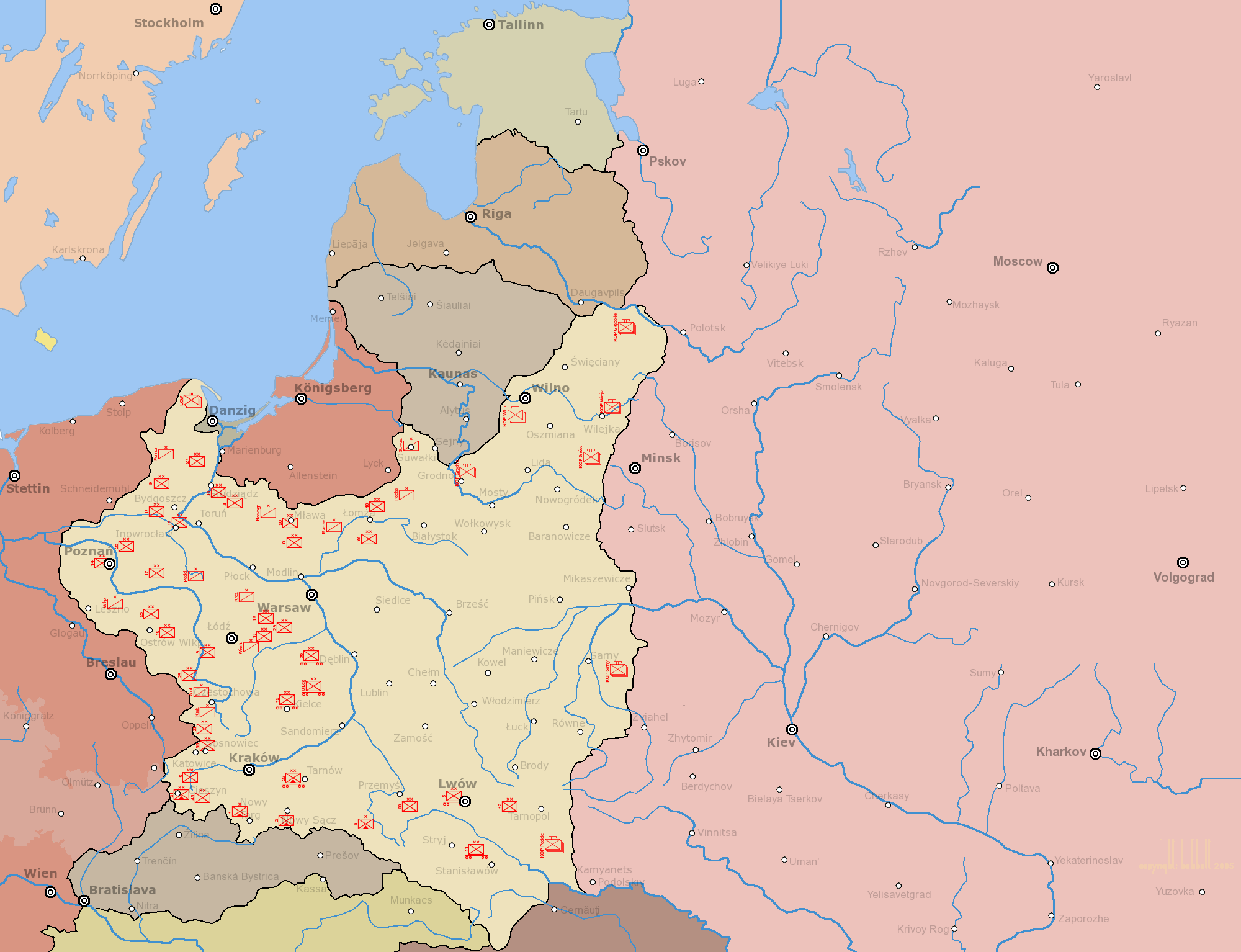
On this map, you will see that at least 10 Polish division were deployed in Eastern Poland

http://upload.wikimedia.org/wikipedia/c ... isions.png
Peter
User avatar
warspite1
Posts: 42130
Joined: Sat Feb 02, 2008 1:06 pm
Location: England

RE: House Rules

Post by warspite1 »

ORIGINAL: warspite1

ORIGINAL: Centuur

According to Dutch politics, the Dutch East Indies could only remain under Dutch control, if they had a large naval presence in the area, together with a small army which depended on the navy to be transported into those area's of the colony which were in a state of unrest. The Dutch weren't nice at all, where the local population were concerned. Uprisings did not happen a lot, but they happened...

The KNIL consisted of almost 100.000 men in may 1940 and became even larger before the war with Japan started. So the Batavia MIL and the NEI TERR really simulates this.

But I agree on the fact that for a neutral minor to not have at least one land unit defending the home country is over the top. I believe the rules should be that at least one land and one air unit need to be present in the home country (if available, of course)...

Now: for setting up all Poles in the West? I don't agree on that rule. There were a lot of Polish soldiers taken prisoner by the USSR during the occupation of Eastern Poland, which were later transported to the CW or included in the Red Army after Barbarossa started...
warspite1

I am not sure I agree on one thing from an historical perspective:

The Polish forces in the east, set up to man the Soviet, Lithuanian and Romanian border were Border Guards (Korpus Ochrony Pogranicza) or KOP.

The Kop was made up of a number of regiments - all told I suspect you would struggle to form two full infantry divisions from these men - and they were widely distributed across the eastern borders. So in WIF terms I think forcing a full corps to be located east would be wrong.

I think the men that made up the forces that fought with the Soviets were a mix of these border guards, retreating units from the fighting in the west, and civilians.
warspite1

That is a good additional point brian brian raises. If you do say the Poles must place a corps counter east of (a to be determined line) then it is only fair that you handicap the Soviets too by setting aside the forces they put into the field to capture their half of Poland - and then you have to make the Germans deploy their troops historically and.....[;)]
Now Maitland, now's your time!

Duke of Wellington to 1st Guards Brigade - Waterloo 18 June 1815
User avatar
warspite1
Posts: 42130
Joined: Sat Feb 02, 2008 1:06 pm
Location: England

RE: House Rules

Post by warspite1 »

ORIGINAL: Centuur

The USSR did take 230.000 Polish soldiers prisoner of war during the occupation of the area. That's far more than two divisions. Two corps is more likely. Furthermore, the Poles did fight the Soviets. Somewhere around 7.000 soldiers were killed by the Soviet forces during the occupation of Eastern Poland. There was some heavy fighting around the area too. Soviet losses are not given, but they attacked with an overwhelming force, not just the one division or corps which is often used to claim the area in WiF.

Such an attack is of course very difficult to recreate in WiF. I've always wondered why the Poles don't have the forces available on the board as they had if you investigate the number of soldiers the Poles really had and place it next to the counters they have in WiF. They are at least two corps sized units short... That was because of the defenses in the East. The Poles knew that they would not only had to fight the Germans, but that the Russians were going to attack too...

On this map, you will see that at least 10 Polish division were deployed in Eastern Poland

http://upload.wikimedia.org/wikipedia/c ... isions.png
warspite1

That is not correct. Look more closely at the units - they are KOP and they were NOT division strength. Happy to give details of these units if interested.

Just as one example the map shows in the east the 39th Division. This was not a fully formed division.
Now Maitland, now's your time!

Duke of Wellington to 1st Guards Brigade - Waterloo 18 June 1815
brian brian
Posts: 3191
Joined: Wed Nov 16, 2005 6:39 pm

RE: House Rules

Post by brian brian »

We've messed with a House Rule allowing Partisans to appear in eastern Poland during the Russian occupation for those games where the Russian Engineer division just sits there while the Russians campaign elsewhere. Which I think would be a historical result (I mean the appearance of Partisan bands) ... but we ultimately gave up on it as the Partisans couldn't actually accomplish anything, and then you have a question of what to do with them when the war with Germany starts, and others, iirc. And that kind of showed us that leaving the Russian occupation of East Poland as a background fact in the game is a better way to go.

Maybe someday in a division level game, all this would be worth modeling.
User avatar
Centuur
Posts: 9089
Joined: Fri Jun 03, 2011 12:03 pm
Location: Hoorn (NED).

RE: House Rules

Post by Centuur »

ORIGINAL: warspite1
ORIGINAL: Centuur

The USSR did take 230.000 Polish soldiers prisoner of war during the occupation of the area. That's far more than two divisions. Two corps is more likely. Furthermore, the Poles did fight the Soviets. Somewhere around 7.000 soldiers were killed by the Soviet forces during the occupation of Eastern Poland. There was some heavy fighting around the area too. Soviet losses are not given, but they attacked with an overwhelming force, not just the one division or corps which is often used to claim the area in WiF.

Such an attack is of course very difficult to recreate in WiF. I've always wondered why the Poles don't have the forces available on the board as they had if you investigate the number of soldiers the Poles really had and place it next to the counters they have in WiF. They are at least two corps sized units short... That was because of the defenses in the East. The Poles knew that they would not only had to fight the Germans, but that the Russians were going to attack too...

On this map, you will see that at least 10 Polish division were deployed in Eastern Poland

http://upload.wikimedia.org/wikipedia/c ... isions.png
warspite1

That is not correct. Look more closely at the units - they are KOP and they were NOT division strength. Happy to give details of these units if interested.

Just as one example the map shows in the east the 39th Division. This was not a fully formed division.

Than explain to me why the Soviets killed 7.000 Polish soldiers and took 230.000 PoW's while overrunning Eastern Poland? How can 20.000 men kill almost 1.000 Soviet soldiers out of an attacking force of over a million man? That's impossible too. 7.000 Polish soldiers killed out of 20.000? Strange number, isn't it?

I know the KOP were the border guards and were numbered only 20.000. But I simply don't believe that those were the only forces the USSR encountered. You can't take 230.000 PoW's during the campaign if you have only 20.000 enemy soldiers opposing you...

On the Soviet attack on Eastern Poland there is so few information available (it is probably buried somewhere in closed archives in Moscow, due to the war crimes committed by the Soviets during this campaign, I believe).

Fact is that if you simply total the number of Polish troops available and you put that back into the number of corps you should get in Poland at the moment of the DoW in WiF, you still are a couple of corps short. That is even when you take into account the MIL arriving in the next turn if Poland survives the first turn...

Peter
brian brian
Posts: 3191
Joined: Wed Nov 16, 2005 6:39 pm

RE: House Rules

Post by brian brian »

It was a serious operation from the Soviet view. They basically lost a war with Poland in 1920. I think I have read one historical account where the appearance of the Germans somewhat rescued a Soviet unit in the Brest or Lvov area (from a Guderian interview perhaps?). It was quite a chaotic situation on the ground, a ground occupied by mixed nationalities and centuries of border adjustments - in places the Soviets were welcomed I believe.

The game though, has to keep moving. The chaos stabilized by the end of the first month of the war, and I think the game gets it right. The manpower of the NKVD, for example, isn't explicitly part of the game either. A lot of things are handled at the macro level to create a feel for the high level decision making. If there are too many micro items...

As I said, on a lower scale some of these questions would be more worthwhile to explore. Also in a game of Days of Decision, where you can take a look at World War Two without the existence of the Nazi-Soviet Pact at all.
User avatar
warspite1
Posts: 42130
Joined: Sat Feb 02, 2008 1:06 pm
Location: England

RE: House Rules

Post by warspite1 »

ORIGINAL: Centuur
ORIGINAL: warspite1
ORIGINAL: Centuur

The USSR did take 230.000 Polish soldiers prisoner of war during the occupation of the area. That's far more than two divisions. Two corps is more likely. Furthermore, the Poles did fight the Soviets. Somewhere around 7.000 soldiers were killed by the Soviet forces during the occupation of Eastern Poland. There was some heavy fighting around the area too. Soviet losses are not given, but they attacked with an overwhelming force, not just the one division or corps which is often used to claim the area in WiF.

Such an attack is of course very difficult to recreate in WiF. I've always wondered why the Poles don't have the forces available on the board as they had if you investigate the number of soldiers the Poles really had and place it next to the counters they have in WiF. They are at least two corps sized units short... That was because of the defenses in the East. The Poles knew that they would not only had to fight the Germans, but that the Russians were going to attack too...

On this map, you will see that at least 10 Polish division were deployed in Eastern Poland

http://upload.wikimedia.org/wikipedia/c ... isions.png
warspite1

That is not correct. Look more closely at the units - they are KOP and they were NOT division strength. Happy to give details of these units if interested.

Just as one example the map shows in the east the 39th Division. This was not a fully formed division.

Than explain to me why the Soviets killed 7.000 Polish soldiers and took 230.000 PoW's while overrunning Eastern Poland? How can 20.000 men kill almost 1.000 Soviet soldiers out of an attacking force of over a million man? That's impossible too. 7.000 Polish soldiers killed out of 20.000? Strange number, isn't it?

I know the KOP were the border guards and were numbered only 20.000. But I simply don't believe that those were the only forces the USSR encountered. You can't take 230.000 PoW's during the campaign if you have only 20.000 enemy soldiers opposing you...

On the Soviet attack on Eastern Poland there is so few information available (it is probably buried somewhere in closed archives in Moscow, due to the war crimes committed by the Soviets during this campaign, I believe).

Fact is that if you simply total the number of Polish troops available and you put that back into the number of corps you should get in Poland at the moment of the DoW in WiF, you still are a couple of corps short. That is even when you take into account the MIL arriving in the next turn if Poland survives the first turn...

warspite1

1. Remember we are only interested in September 1st 1939. How do the Polish set-up? Your House Rule suggested some Polish units need to be placed in the east to mirror historical set up. Everything that happens thereafter – and certainly from the 17th - is totally irrelevant to this. i.e. how the Poles react to the Soviet stab in the back, how the war progresses etc.

2. The Polish historical set-up was designed to hold the Germans - where they knew the attack was coming from. That is where the Polish army was placed - in the west.

3. I do not know where that map comes from but according to the OOB’s I have seen, the 39th and 11th Division were forming on the 1st September, the only 5th Division I can find was far to the west, in Wloclawek (near Lodz) while the 12th was between Warsaw and Krakow.

4. The Polish defences in the east were the responsibility of the KOP. These were regiment size and even if added together, they still would not make a proper division / corps as the AA, AT and other specialist units that divisions and corps contain were not available. I think 20,000 seems a high number but may be right day 1. Certainly some of these forces were stripped to the west to shore up positions.

5. As to the question of how 7,000 out of circa.20,000 troops could have been killed. It's not strange at all. You were right - the KOP were not the only Polish forces encountered, but then miss the point - it is not 7,000 out of 20,000. The Polish units in the west were pushed back to the east by the Germans between September the 1st and the 17th. There was much fighting in the south-east between the Poles and the Soviets particularly around Lvov where there was a “plan” to try and hold out in the extreme south-east on the Romanian border, and where Polish units were being pushed back anyway by German units from Slovakia. This is in addition to fighting by the KOP who, in many cases disobeyed orders not to fight the Soviets!

6. The total number killed and taken prisoner has nothing to do with day one strength of the eastern defences, and is more to do with what happened during the campaign and particularly post the 17th and the heavy fighting in the southeast.

7. Finally as to how accurate the OOB’s are – well this is World In Flames and not WITE! How the hell does Belgium have a naval counter? [;)]


Now Maitland, now's your time!

Duke of Wellington to 1st Guards Brigade - Waterloo 18 June 1815
Post Reply

Return to “World in Flames”