If your ConSim was only for constructing battles where the computer played both sides that may work but it falls apart when using two humans to enter their own orders.
No, it doesn't. The point is that a Consim allows player to choose alternative ways to do things. You don't have to try to invade Midway. You don't have to fight an attritional war in the southern Solomons. You don't *have* to do anything in particular, save try to meet the victory conditions.
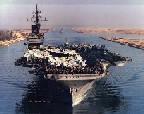
But a good consim is designed around the premise that if you did the same thing as historically or even a similar thing (let us suppose, for example, a Japanese 4 CV TF plus supporting bombardment and transport TFs attempting to invade Johnston Island in June 1942 against a well prepared base with an airfield that operates fighters, tatical and strategic bombers, and recon, backed up by two or three USN CVs) then you'd expect similar results.
Why? Because that was the nature of air-naval combat in the PTO in 1942. The USN and IJN understood very well, at the time, that assailing a major enemy land base located outside of the range of your own land based air assets and in the face of potential enemy CV intervention was a formula for disaster. That is why, at Coral Sea, once the Japanese knew the USN CVs were there, the objective was to eliminate all the USN CVs. That is why at Santa Cruz and Eastern Solomons, the objective was to get the enemy CVs. None of these invasions could be carried off in the face of enemy CV intervention, and they were deemed AT THE TIME unlikely to succeed in the face of both enemy CVs and a substantial enemy forward base with lots of land-based a.c.
Why? Because humans know they are entering the data into a ConSim. A reasonably intuitive person will be able to quickly decipher certain constants within the engine. All systems have limits. True you could make an incredibly complex system that could even run on a PC.
Sure. But that's true of any game as well as any Consim. Frankly, really good GAMES don't necessarily require a whole lot of complexity. Totaler Krieg being a very good example. And some really complex games really stink because in adding all that detail, they not only got the model wrong, but the errors screw up the overall strategic and economic realities. A World at War is a good example of that.
Problem is would players want to play a game that took twleve hours or more to resolve a single turn?
I don't think they would. I don't think I'd design a game that required that. But considering that people seem to enjoy playing a game that takes longer to resolve the entire war than the actual war, it wouldn't surprise me if someone would want a game like that.
At some point you have to accept that not every variable can be accounted for and insert constants.
I agree. I think somewhere you missed my point then. IMO, WitP would likely be both a better game and a better Consim if they took the EXP values and the altitude settings right out of the game entirely. But that'd be a different game. I say that because there is no rational basis to the EXP values. I don't want to get into a long talk about that but consider that BB Mutsu, a ship that never in its entire career fought in any surface action, is initially rated better than HMS Warspite, a ship that had successfully and brilliantly fought more night surface engagements prior to 7 Dec 1941 than ANY ship in the Japanese fleet; the EXP ratings are objectively nonsensical. This is an example of how adding all manner of fiddley details actually makes a game worse, becuase the details have been poorly researched and poorly indexed to anything real.
Problem is that it is unlikely. The biggest reason for this boils down to one simple fact: unlike real life the Japan player knows the Allied player is "reading his mail". Ergo, an astute Japan player would be unlikely to stumble into a "Midway" because he would always consider the fact that the Allied player knows at least a portion of his plans. That is why a Midway scenario for AE is likely a non-starter at least for PBEM. The Japan player's first order of business would always be to find the Allied CVTF not reducing Midway's AB.
Exactly. No problem with that. My point is that if the Japanese player sends 4 CVs against a US level 4 airfield in 1942 with 3 USN CVs working in the area, the reasonable presumption is that the game OUGHT to produce Midway like results. Clearly, as a Consim, since the Japanese player can choose to do something else (use many more CVs, attack an island under the cover of Japanese land-based air, don't attack there but instead go on a joyraid in the Indian Ocean) you can't legislate that the players MUST attempt to do Midway, or to use the historical orders of battle.
To expand on a point I made above, a very interesting game might be one where the two players have nothing more than the database and map on their computers. Instead of plotting Japan then Allied and then back to Japan where the turn is resolved, both players plot their orders and send it to a game server. The game server would have more power than the average Joe could ever afford to have on a PC. This powerful engine would resolve the turn and send both players back the combat replay. Now how cool would that be?
Don't need a powerful computer. All you need is well researched, rational assumptions. SPI/TSR's old WW2:PTO (the pre-DecisionGames APTO) comes very close to that. SPI/TSR never did really work out a decent carrier combat routine though.
I hope all that clarifies things a bit.
Show me a fellow who rejects statistical analysis a priori and I'll show you a fellow who has no knowledge of statistics.
Didn't we have this conversation already?




 Then when I read it, I was sooooooo disappointed.