

I'm reading a book on the Franco-Prussian war and the author (British) inserts both French and German text rather liberally throughout. My French is what I think of as "funny French" - whenever Frenchmen hear me speak it, they laugh. My German is less than 6 words. But I can persevere in reading this book. Using the native language of the communications between the commanders in the field adds flavor to the narrative and isn't totally opaque.ORIGINAL: brian brian
Amiral Gensoul is introduced to the reader without his rank or his command ... is he in charge of the Dunkerque/Strasbourg 1st Line Division (?), or something else?
Use of the French is nice, but it gets a tad heavy at times for us lazy Americans who rarely bother to learn foreign languages. contre-torpilleurs = anti-torpedo? ships = destroyers ?
and there is one "amiral" rather than "Amiral"
but outstanding work as usual
Unit Descriptions: Air, Naval, Land
Moderator: Shannon V. OKeets
-
Shannon V. OKeets
- Posts: 22165
- Joined: Wed May 18, 2005 11:51 pm
- Location: Honolulu, Hawaii
- Contact:
RE: Unit Descriptions: Air, Naval, Land
Steve
Perfection is an elusive goal.
Perfection is an elusive goal.
-
brian brian
- Posts: 3191
- Joined: Wed Nov 16, 2005 6:39 pm
RE: Unit Descriptions: Air, Naval, Land
It is good to be exposed to foreign languages, I enjoy learning them in tiny portions. I guess what I would suggest is giving the reader a little helping hand once in a while (not combing through every entry, having some definitive system across them all, translating every word, etc.). Just a simple (destroyers) or other translation thrown in here and there could strengthen any piece using non-English words.

RE: Unit Descriptions: Air, Naval, Land
Thanks Extraneous - I have incorporated a few of these suggestions too.
Now Maitland, now's your time!
Duke of Wellington to 1st Guards Brigade - Waterloo 18 June 1815
Duke of Wellington to 1st Guards Brigade - Waterloo 18 June 1815
-
Extraneous
- Posts: 1810
- Joined: Sat Jun 14, 2008 1:58 am
RE: Unit Descriptions: Air, Naval, Land
ORIGINAL: brian brian
It is good to be exposed to foreign languages, I enjoy learning them in tiny portions. I guess what I would suggest is giving the reader a little helping hand once in a while (not combing through every entry, having some definitive system across them all, translating every word, etc.). Just a simple (destroyers) or other translation thrown in here and there could strengthen any piece using non-English words.
Without going into detail:
Cuirassé = Battleship
Croiseur de bataille = Battlecruiser
Croiseur Lourd = Heavy Cruiser
Croiseur Léger = Light Cruiser
contre-torpilleurs = Large Destroyer
Torpilleur = Destroyer, Torpedo boat destroyer, or Torpedo boat
University of Science Music and Culture (USMC) class of 71 and 72 ~ Extraneous (AKA Mziln)
-
Extraneous
- Posts: 1810
- Joined: Sat Jun 14, 2008 1:58 am
RE: Unit Descriptions: Air, Naval, Land
Would it be possible to see the write ups for Timoshenko and Zhukov [&:]
I was just wondering about them from a historical aspect.
I was just wondering about them from a historical aspect.
University of Science Music and Culture (USMC) class of 71 and 72 ~ Extraneous (AKA Mziln)
RE: Unit Descriptions: Air, Naval, Land
Historical description of Zhukov.
Aged 52 in 1939, Marshal Georgi Konstantinovich Zhukov was born to impoverished parents and by the age
of ten was working twelve hours a day in a factory. He was conscripted in 1915 and within a year had been
selected for NCO (non-commissioned officer) training. After being wounded in battle and receiving decorations
for bravery, he joined the Communist Party and fought for the Red Army during the Revolution.
By 1923 he was the commander of a horse cavalry regiment and gained an enviable reputation for his
military skills. During the 1930s he experimented with tanks and in July 1939 he was appointed commander of
the First Soviet Mongolian Army Group and defeated the Japanese incursions into Mongolia at the battle of
Khalkin Gol. This encounter gave Zhukov valuable experience in combined arms warfare. The 40% casualties
suffered by the Russians were accepted by Zhukov as an unavoidable cost of making war.
Stalin summoned Zhukov to Moscow to prepare war games representing a German attack on Russia and
Zhukov, as the "Germans", won convincingly. Stalin promoted Zhukov to chief of general staff (CGS) and in
that role he tried to shape the Russian army to defeat the expected real-life invasion. When the Germans did
invade Russia on June 22nd 1941, Zhukov fell out of favor with Stalin for suggesting the abandonment of Kiev
(where over 600,000 Russian soldiers would eventually be captured) and in September was ordered north to
command the Leningrad front.
The threat to Moscow caused Stalin to recall him to defend that city and Zhukov's successful defense of
the capital bought him back into favor with the Russian dictator. Zhukov's December counter-offensive with 88
infantry divisions, 15 cavalry divisions and 1,500 tanks on a 200 mile front stabilized the line and forced Hitler
to consider other options. Promoted to deputy commander in chief under Stalin (the only person to ever hold
that position), he went to Stalingrad in August 1942 and masterminded the pincer movement that cut off
General von Paulus and the German Sixth Army.
Further successes followed in the 1943 battles for Kursk and the Western Ukraine and by January 1945
Zhukov was commanding the First Byelorussia Front in a successful maneuver to bypass Warsaw and force the
defending Germans to retreat from that city. Stalin's political maneuvering halted Zhukov's preparations for
taking Berlin since the Soviet dictator was trying to sabotage the Western Allies plans to drive on the German
capital by persuading them that Berlin was not an important military target. The maneuver worked, but at the
cost of allowing the Germans time to rebuild their defenses.
In March 1945 Stalin summoned Zhukov to Moscow and instructed him to take Berlin by the First of May
Labor Day holiday. Zhukov prepared well for the attack but insisted on traveling to Berlin by the most direct
route. The initial artillery and aerial bombardment failed since the Germans had anticipated the attack and had
evacuated their frontline fortifications. Zhukov's subsequent night attack supported by 140 searchlights bogged
down in the teeth of the resolute German defense and the Russians lost 700 tanks in four days. While Zhukov
was battering down the front door, his rival, General Koniev, was pushing around Berlin from the south and
Stalin deliberately set his generals in a race for the prestige of taking the city.
The Soviet flag was raised over the German Reichstag at 10.50pm on the night of 30 April, just before the
deadline set by Stalin. The Berlin garrison surrendered on 2 May 1945 and within a week the Germans had
signed the document of surrender. After the war Zhukov was sidelined to minor military posts to keep him from
converting his immense personal popularity into a possible threat to Stalin's political control.
The death of Stalin in 1954 allowed Zhukov to serve as deputy minister of defense until 1957 when he
retired. He died in 1974 and was buried in Red Square at the Kremlin Wall. Recent articles have suggested
that Zhukov’s genius lay primarily in his ability to take the credit for the work of other generals.
Have a bit more patience with newbies. Of course some of them act dumb -- they're often students, for heaven's sake. - Terry Pratchett
A government is a body of people; usually, notably, ungoverned. - Quote from Firefly
A government is a body of people; usually, notably, ungoverned. - Quote from Firefly
RE: Unit Descriptions: Air, Naval, Land
And the historical description of Timoshenko.
Aged 44 in 1939, Marshal of the Soviet Union Semyon Konstantinovich Timoshenko was drafted into the
Russian Army in 1915 and served as a cavalryman before joining the side of the revolutionaries in the 1917
Russian revolution. During the ensuing civil war Timoshenko fought at Tsaritsyn (Stalingrad) where he met and
befriended Joseph Stalin.
After the Civil War and the Russo-Polish war, Timoshenko was appointed as commander of the Red Army
cavalry forces and occupied a number of regional military commands before becoming commander of the whole
western border region in 1939. In this role he oversaw the Russian occupation of eastern Poland in accordance
with the terms of the Nazi-Soviet Pact. In the period leading up to the war Stalin had ruthlessly purged his
officer corps including three of the five Marshals of the Soviet Union. Only Marshals Budyonny and Voroshilov
survived and their lack of combat ability left Timoshenko as the senior professional military officer commanding
Russian forces.
From November 1939, Voroshilov had commanded Russian forces fighting the Russo-Finnish war and his
failure to conquer the smaller country led to his replacement by Timoshenko in January 1940. Within two
months, Timoshenko had beaten the Finns and Stalin rewarded the victorious general by naming him People's
commissar for defense and a Marshal of the Soviet Union. In his new role Timoshenko pushed for
mechanization of the army and moved to impose a stricter discipline on the troops. These initiatives were put
to the test eighteen months later when the Germans invaded Russia.
Stalin took over the post of defense commissar, which freed Timoshenko to conduct the fighting withdrawal
from the borderlands back to Smolensk. In September 1941, Timoshenko turned over the defense of Moscow
to Koniev and Zhukov and went south to stabilize the Ukraine front after disastrous losses at Kiev. By May
1942, Timoshenko was confident of launching a counterattack and threw 640,000 men at Kharkov. Although
Timoshenko's actions upset the timetable of Germany's drive on Stalingrad, his troops suffered over 200,000
casualties.
Thereafter, Stalin viewed Timoshenko as a second rank commander behind Zhukov and Koniev. He was
removed from front line command and posted to a variety of strategic coordination roles for the remainder of
the war. After WWII, Timoshenko occupied a series of Army commands and was appointed to the honorary
posts of inspector- general of the Defense Ministry (1960) and chairman of the State Committee for War
Veterans (1961). He died in Moscow in 1970.
Have a bit more patience with newbies. Of course some of them act dumb -- they're often students, for heaven's sake. - Terry Pratchett
A government is a body of people; usually, notably, ungoverned. - Quote from Firefly
A government is a body of people; usually, notably, ungoverned. - Quote from Firefly
-
Extraneous
- Posts: 1810
- Joined: Sat Jun 14, 2008 1:58 am
RE: Unit Descriptions: Air, Naval, Land
Thanks Orm.
I was just wondering if there was any mention of Stavka.
Stavka or the headquarters of the "Main Command of the Armed Forces of the USSR" was established on June 23, 1941 by the top secret decree signed by Joseph Stalin in his capacities both as the head of government and as the leader of the Communist Party of the Soviet Union. According to this decree Stavka was composed of the Chairman of the Supreme Military Council of the Red Army Marshal Semyon Timoshenko, Deputy Supreme Commander in Chief of the Red Army Georgy Konstantinovich Zhukov, Stalin, Vyacheslav Molotov, Marshal Kliment Voroshilov, Marshal Semyon Budyonny and the People's Commissar (Narkom) of the Navy Admiral Nikolai Gerasimovich Kuznetsov.
Note: Stavka is the correct spelling no capatial letters other than the "S".
I was just wondering if there was any mention of Stavka.
Stavka or the headquarters of the "Main Command of the Armed Forces of the USSR" was established on June 23, 1941 by the top secret decree signed by Joseph Stalin in his capacities both as the head of government and as the leader of the Communist Party of the Soviet Union. According to this decree Stavka was composed of the Chairman of the Supreme Military Council of the Red Army Marshal Semyon Timoshenko, Deputy Supreme Commander in Chief of the Red Army Georgy Konstantinovich Zhukov, Stalin, Vyacheslav Molotov, Marshal Kliment Voroshilov, Marshal Semyon Budyonny and the People's Commissar (Narkom) of the Navy Admiral Nikolai Gerasimovich Kuznetsov.
Note: Stavka is the correct spelling no capatial letters other than the "S".
University of Science Music and Culture (USMC) class of 71 and 72 ~ Extraneous (AKA Mziln)
RE: Unit Descriptions: Air, Naval, Land
Here is the Corps counter for the Japanese SNLF unit
[2175] [Japanese Special Naval Landing Force Marine]
.P Due to the scale of World in Flames and the unit sizes in play, the depiction of units of the Japanese Special Naval Landing Force (SNLF) – which were generally deployed in numbers smaller than a brigade - has to be necessarily ahistorical. It is right that these units are included within the game however. World in Flames allows the Japanese player to build one SNLF corps and two divisions.
.P During World War II the Japanese did not operate an autonomous marine branch in the way that their US counterparts did. However they did make use of naval troops. Such troops were used to land at key points – often ahead of a larger force – to seize key objectives.
.P The forerunners of the SNLF (Tokubetsu Rikusentai) were used for the first time during the fighting against Russia at the start of the 20th Century. Having proved their worth there and later in Manchuria, the Japanese began raising SNLF units at each of their four main naval bases.
.P The following units fought during World War II:
.P Kure naval base: 1st Kure SNLF, 2nd Kure, 3rd Kure, 5th Kure, 6th Kure and 7th Kure
.P Maizuru naval base: 1st Maizuru SNLF, 2nd Maizuru, 4th Maizuru and 5th Maizuru
.P Sasebo naval base: 1st Sasebo SNLF, 2nd Sasebo, 5th Sasebo, 6th Sasebo, 7th Sasebo and 8th Sasebo
.P Yokosuka naval base: 1st Yokosuka SNLF, 2nd Yokosuka, 3rd Yokosuka, 4th Yokosuka, 5th Yokosuka, 6th Yokosuka and 7th Yokosuka
.P In addition to the above, there were small Guard detachments that were based at other key ports and rivers such as Ryojun, Shanghai, Yangtse, Hankow and Canton.
.P The SNLF units varied in size. At most, a single unit was likely to contain no more than 1,600 men – roughly two battalions in size. The smallest units contained around 750 men. For some operations, two units could combine to form a brigade sized outfit. The 1st and 3rd Yokosuka SNLF’s were both airborne trained.
.P The division counters 2171 and 2172 provide details of some of the individual operations of the SNLF and these show at high level, how important these elite units were in the early stages of the war as the Japanese sought to expand their empire.
.P By June 1942, once the Japanese advance had been checked, the need for these troops was no longer as important. From elite, special purpose troops, they became nothing more than garrison troops that were, in many cases, annihilated as they sought to defend outposts in the Pacific; outposts that were taken one by one by the US juggernaut.
[2175] [Japanese Special Naval Landing Force Marine]
.P Due to the scale of World in Flames and the unit sizes in play, the depiction of units of the Japanese Special Naval Landing Force (SNLF) – which were generally deployed in numbers smaller than a brigade - has to be necessarily ahistorical. It is right that these units are included within the game however. World in Flames allows the Japanese player to build one SNLF corps and two divisions.
.P During World War II the Japanese did not operate an autonomous marine branch in the way that their US counterparts did. However they did make use of naval troops. Such troops were used to land at key points – often ahead of a larger force – to seize key objectives.
.P The forerunners of the SNLF (Tokubetsu Rikusentai) were used for the first time during the fighting against Russia at the start of the 20th Century. Having proved their worth there and later in Manchuria, the Japanese began raising SNLF units at each of their four main naval bases.
.P The following units fought during World War II:
.P Kure naval base: 1st Kure SNLF, 2nd Kure, 3rd Kure, 5th Kure, 6th Kure and 7th Kure
.P Maizuru naval base: 1st Maizuru SNLF, 2nd Maizuru, 4th Maizuru and 5th Maizuru
.P Sasebo naval base: 1st Sasebo SNLF, 2nd Sasebo, 5th Sasebo, 6th Sasebo, 7th Sasebo and 8th Sasebo
.P Yokosuka naval base: 1st Yokosuka SNLF, 2nd Yokosuka, 3rd Yokosuka, 4th Yokosuka, 5th Yokosuka, 6th Yokosuka and 7th Yokosuka
.P In addition to the above, there were small Guard detachments that were based at other key ports and rivers such as Ryojun, Shanghai, Yangtse, Hankow and Canton.
.P The SNLF units varied in size. At most, a single unit was likely to contain no more than 1,600 men – roughly two battalions in size. The smallest units contained around 750 men. For some operations, two units could combine to form a brigade sized outfit. The 1st and 3rd Yokosuka SNLF’s were both airborne trained.
.P The division counters 2171 and 2172 provide details of some of the individual operations of the SNLF and these show at high level, how important these elite units were in the early stages of the war as the Japanese sought to expand their empire.
.P By June 1942, once the Japanese advance had been checked, the need for these troops was no longer as important. From elite, special purpose troops, they became nothing more than garrison troops that were, in many cases, annihilated as they sought to defend outposts in the Pacific; outposts that were taken one by one by the US juggernaut.
Now Maitland, now's your time!
Duke of Wellington to 1st Guards Brigade - Waterloo 18 June 1815
Duke of Wellington to 1st Guards Brigade - Waterloo 18 June 1815
-
Extraneous
- Posts: 1810
- Joined: Sat Jun 14, 2008 1:58 am
RE: Unit Descriptions: Air, Naval, Land
Change "Soviet Mongolian Army Group" to "Soviet Mongolian Army" or "Soviet Mongolian Army Group of Forces".
The USSR did not use Army Groups.
Change "Japanese Special Naval Landing Force Marine" To "Japanese Special Naval Landing Forces".
This was a common misconception but there were no Japanese Marines in World War II.
I can give you details if you would like them.
The USSR did not use Army Groups.
Change "Japanese Special Naval Landing Force Marine" To "Japanese Special Naval Landing Forces".
This was a common misconception but there were no Japanese Marines in World War II.
I can give you details if you would like them.
University of Science Music and Culture (USMC) class of 71 and 72 ~ Extraneous (AKA Mziln)
RE: Unit Descriptions: Air, Naval, Land
warspite1ORIGINAL: Extraneous
Change "Japanese Special Naval Landing Force Marine" To "Japanese Special Naval Landing Forces".
This was a common misconception but there were no Japanese Marines in World War II.
I can give you details if you would like them.
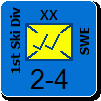
Thanks, but the word Marine is not used on the counter. They appear as 1st SNLF Div, 2nd SNLF Div and SNLF.
The three SNLF units have the marine anchor symbol and are thus termed Marines for game purposes i.e. there are special rules that Marine units benefit from, and these, naturally apply to the SNLF.
Re your offer of details - do you have anything on the Japanese Army Landing Forces? There are two Japanese corps counters - one called Imperial Guard and the other LG Marine. These two appear to be "What if" counters but would be useful to know if there is any basis in fact for their appearance in the game?
Now Maitland, now's your time!
Duke of Wellington to 1st Guards Brigade - Waterloo 18 June 1815
Duke of Wellington to 1st Guards Brigade - Waterloo 18 June 1815
RE: Unit Descriptions: Air, Naval, Land
I remember reading somewhere that the Imperial Guard recruited heavily from Hokkaido because many men there were taller: nearly 6 feet tall wasn't uncommon.
Also, obviously there's this...
http://en.wikipedia.org/wiki/Imperial_Guard_(Japan)
Cheers, Neilster
Also, obviously there's this...
http://en.wikipedia.org/wiki/Imperial_Guard_(Japan)
Cheers, Neilster
Cheers, Neilster
RE: Unit Descriptions: Air, Naval, Land
warspite1ORIGINAL: Neilster
I remember reading somewhere that the Imperial Guard recruited heavily from Hokkaido because many men there were taller: nearly 6 feet tall wasn't uncommon.
Also, obviously there's this...
http://en.wikipedia.org/wiki/Imperial_Guard_(Japan)
Cheers, Neilster
Unfortunately nothing in that indicates a marine or naval specialism.
Now Maitland, now's your time!
Duke of Wellington to 1st Guards Brigade - Waterloo 18 June 1815
Duke of Wellington to 1st Guards Brigade - Waterloo 18 June 1815
-
Extraneous
- Posts: 1810
- Joined: Sat Jun 14, 2008 1:58 am
RE: Unit Descriptions: Air, Naval, Land
ORIGINAL: warspite1
Here is the Corps counter for the Japanese SNLF unit
[2175] [Japanese Special Naval Landing Force Marine]
.P Due to the scale of World in Flames and the unit sizes in play, the depiction of units of the Japanese Special Naval Landing Force (SNLF) – which were generally deployed in numbers smaller than a brigade - has to be necessarily ahistorical. It is right that these units are included within the game however. World in Flames allows the Japanese player to build one SNLF corps and two divisions.
.P During World War II the Japanese did not operate an autonomous marine branch in the way that their US counterparts did. However they did make use of naval troops. Such troops were used to land at key points – often ahead of a larger force – to seize key objectives.
.P The forerunners of the SNLF (Tokubetsu Rikusentai) were used for the first time during the fighting against Russia at the start of the 20th Century. Having proved their worth there and later in Manchuria, the Japanese began raising SNLF units at each of their four main naval bases.
.P The following units fought during World War II:
.P Kure naval base: 1st Kure SNLF, 2nd Kure, 3rd Kure, 5th Kure, 6th Kure and 7th Kure
.P Maizuru naval base: 1st Maizuru SNLF, 2nd Maizuru, 4th Maizuru and 5th Maizuru
.P Sasebo naval base: 1st Sasebo SNLF, 2nd Sasebo, 5th Sasebo, 6th Sasebo, 7th Sasebo and 8th Sasebo
.P Yokosuka naval base: 1st Yokosuka SNLF, 2nd Yokosuka, 3rd Yokosuka, 4th Yokosuka, 5th Yokosuka, 6th Yokosuka and 7th Yokosuka
.P In addition to the above, there were small Guard detachments that were based at other key ports and rivers such as Ryojun, Shanghai, Yangtse, Hankow and Canton.
.P The SNLF units varied in size. At most, a single unit was likely to contain no more than 1,600 men – roughly two battalions in size. The smallest units contained around 750 men. For some operations, two units could combine to form a brigade sized outfit. The 1st and 3rd Yokosuka SNLF’s were both airborne trained.
.P The division counters 2171 and 2172 provide details of some of the individual operations of the SNLF and these show at high level, how important these elite units were in the early stages of the war as the Japanese sought to expand their empire.
.P By June 1942, once the Japanese advance had been checked, the need for these troops was no longer as important. From elite, special purpose troops, they became nothing more than garrison troops that were, in many cases, annihilated as they sought to defend outposts in the Pacific; outposts that were taken one by one by the US juggernaut.
Special Naval Landing Forces not Special Naval Landing Force.
University of Science Music and Culture (USMC) class of 71 and 72 ~ Extraneous (AKA Mziln)
RE: Unit Descriptions: Air, Naval, Land
warspite1ORIGINAL: Extraneous
ORIGINAL: warspite1
Here is the Corps counter for the Japanese SNLF unit
[2175] [Japanese Special Naval Landing Force Marine]
.P Due to the scale of World in Flames and the unit sizes in play, the depiction of units of the Japanese Special Naval Landing Force (SNLF) – which were generally deployed in numbers smaller than a brigade - has to be necessarily ahistorical. It is right that these units are included within the game however. World in Flames allows the Japanese player to build one SNLF corps and two divisions.
.P During World War II the Japanese did not operate an autonomous marine branch in the way that their US counterparts did. However they did make use of naval troops. Such troops were used to land at key points – often ahead of a larger force – to seize key objectives.
.P The forerunners of the SNLF (Tokubetsu Rikusentai) were used for the first time during the fighting against Russia at the start of the 20th Century. Having proved their worth there and later in Manchuria, the Japanese began raising SNLF units at each of their four main naval bases.
.P The following units fought during World War II:
.P Kure naval base: 1st Kure SNLF, 2nd Kure, 3rd Kure, 5th Kure, 6th Kure and 7th Kure
.P Maizuru naval base: 1st Maizuru SNLF, 2nd Maizuru, 4th Maizuru and 5th Maizuru
.P Sasebo naval base: 1st Sasebo SNLF, 2nd Sasebo, 5th Sasebo, 6th Sasebo, 7th Sasebo and 8th Sasebo
.P Yokosuka naval base: 1st Yokosuka SNLF, 2nd Yokosuka, 3rd Yokosuka, 4th Yokosuka, 5th Yokosuka, 6th Yokosuka and 7th Yokosuka
.P In addition to the above, there were small Guard detachments that were based at other key ports and rivers such as Ryojun, Shanghai, Yangtse, Hankow and Canton.
.P The SNLF units varied in size. At most, a single unit was likely to contain no more than 1,600 men – roughly two battalions in size. The smallest units contained around 750 men. For some operations, two units could combine to form a brigade sized outfit. The 1st and 3rd Yokosuka SNLF’s were both airborne trained.
.P The division counters 2171 and 2172 provide details of some of the individual operations of the SNLF and these show at high level, how important these elite units were in the early stages of the war as the Japanese sought to expand their empire.
.P By June 1942, once the Japanese advance had been checked, the need for these troops was no longer as important. From elite, special purpose troops, they became nothing more than garrison troops that were, in many cases, annihilated as they sought to defend outposts in the Pacific; outposts that were taken one by one by the US juggernaut.
Special Naval Landing Forces not Special Naval Landing Force.
Why highlight Marine? As I said, it does not appear on the counter.
Re the name change, using Units plural and Forces plural in the same sentence does not sound right to me? Osprey Men-at-Arms series refers to both Force and Forces so not sure that my sentence was incorrect.
Now Maitland, now's your time!
Duke of Wellington to 1st Guards Brigade - Waterloo 18 June 1815
Duke of Wellington to 1st Guards Brigade - Waterloo 18 June 1815
RE: Unit Descriptions: Air, Naval, Land
Yep. Sounds hypothetical.ORIGINAL: warspite1
warspite1ORIGINAL: Neilster
I remember reading somewhere that the Imperial Guard recruited heavily from Hokkaido because many men there were taller: nearly 6 feet tall wasn't uncommon.
Also, obviously there's this...
http://en.wikipedia.org/wiki/Imperial_Guard_(Japan)
Cheers, Neilster
Unfortunately nothing in that indicates a marine or naval specialism.
Cheers, Neilster
Cheers, Neilster
-
brian brian
- Posts: 3191
- Joined: Wed Nov 16, 2005 6:39 pm
RE: Unit Descriptions: Air, Naval, Land
but oh so useful when commanding the red counters. World in Flames only looks complicated. Really it's just another sake-and-rice cakes affair.
RE: Unit Descriptions: Air, Naval, Land
Re your offer of details - do you have anything on the Japanese Army Landing Forces? There are two Japanese corps counters - one called Imperial Guard and the other LG Marine. These two appear to be "What if" counters but would be useful to know if there is any basis in fact for their appearance in the game?
Try looking up "Japanese Monograph No. 156" "Historical review of Landing Operations of the Japanese Forces"
It really only applies up to 1942.
-
Extraneous
- Posts: 1810
- Joined: Sat Jun 14, 2008 1:58 am
RE: Unit Descriptions: Air, Naval, Land
ORIGINAL: warspite1
Why highlight Marine? As I said, it does not appear on the counter.
Re the name change, using Units plural and Forces plural in the same sentence does not sound right to me? Osprey Men-at-Arms series refers to both Force and Forces so not sure that my sentence was incorrect.
Doesn't MWiF use the NATO unit symbols? NATO unit symbols show a marine capable unit.
Are you doing a unit description or forcing the players to read the descriptions to find out what the units can do?
It doesn't matter if you think "Special Naval Landing Forces" sounds right it is what they were called.
Example: What you suggest is the British "Commandos" change their name to the British "Commando".
University of Science Music and Culture (USMC) class of 71 and 72 ~ Extraneous (AKA Mziln)
RE: Unit Descriptions: Air, Naval, Land
warspite1ORIGINAL: Extraneous
ORIGINAL: warspite1
Why highlight Marine? As I said, it does not appear on the counter.
Re the name change, using Units plural and Forces plural in the same sentence does not sound right to me? Osprey Men-at-Arms series refers to both Force and Forces so not sure that my sentence was incorrect.
Doesn't MWiF use the NATO unit symbols? NATO unit symbols show a marine capable unit.
Are you doing a unit description or forcing the players to read the descriptions to find out what the units can do?
It doesn't matter if you think "Special Naval Landing Forces" sounds right it is what they were called.
Example: What you suggest is the British "Commandos" change their name to the British "Commando".
I didn't design the game - ADG did. Some counters state Inf or Arm or Mot etc and some don't. The SNLF - both corps and divisions are in the latter camp.
As I said, the word Marine does not appear on the counter.
Am I doing a unit description? Yes and I am explaining at high level what these counters represent in a historical sense.
Am I forcing players to read descriptions to know what they can do? No I am not forcing anyone to do anything. The write-ups are not designed to further a players rule understanding - they are just a bit of "chrome" to be read or ignored as required. The symbol on the counter tells a player what type it is and what it can do in consultation with the unit description chart (if they do not know already).
So when a respected publication like Osprey use force and forces interchangeably they are wrong?
Re Commandos - yes, the individual units currently in operation are 40, 42, 43 and 45 commando.
So by that reckoning I suspect its, for example, the 1st Kure Special Naval Landing Force
http://www.royalnavy.mod.uk/The-Fleet/T ... 5-Commando
Now Maitland, now's your time!
Duke of Wellington to 1st Guards Brigade - Waterloo 18 June 1815
Duke of Wellington to 1st Guards Brigade - Waterloo 18 June 1815