ORIGINAL: Bigfish
@GordianKnot: Where do you from? I have to reread some books but i think you are talking about typical US Task Forces. British warships often sailing alone or with only a few destroyer escorts. Examples:
- hunting the Graf Spee: german side: BC Graf Spee; british side: CA Exeter, CL Ajax, CL Achilles no escorts
- sinking HMS Hood: german side: BB Bismarck, CA Prinz Eugen; british side: BB Hood, BB Prince of Wales no escorts
- right before that: The observation Force of Bismarck TG includes only two heavy cruisers the HMS Norfolk and HMS Suffolk no escorts
- sinking HMS Glorius: german side: BC Scharnhorst, BC Gneisenau; british side: CV Glorius, two destroyer escorts
- meeting 9th April 1940 near by the lofots: german side: BC Scharnhorst, BC Gneisenau; british side: BC Renown no escorts (i think)
- sinking HMS Ark Royal: german side: SS U-81; british side: CV Ark Royal, two destroyer escorts
- there are more exxamples
Those are all good points. Both the British and Germans did use BB's alone (and possibly the French and Italians as well?). I think possibly the Russians as well. I think there was also a case where the Brits tried to send some unescorted BB's to the Pacific region for support only to have them ravaged by Japanese air.
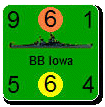
The US and Japan OTOH frequently used "death star" TF's like the ones I described. I believe even the massive Iowa class BB's for example were sometimes used as massive AA platforms to help protect CV's.
I must confess that most of my knowledge of WWII naval tactics comes from WITP and CAW which of course both cover only the Pacific Theater. I'm certainly no expert.
So I think you make a good point. I just ASSUMED that these units were TF's. I don't really know for sure. But if they are individual ships, then:
A) There should be WAY more of them.
B) You should be able to stack naval units so you can potect your cap's with DD's.