How to combat the B-17

This new stand alone release based on the legendary War in the Pacific from 2 by 3 Games adds significant improvements and changes to enhance game play, improve realism, and increase historical accuracy. With dozens of new features, new art, and engine improvements, War in the Pacific: Admiral's Edition brings you the most realistic and immersive WWII Pacific Theater wargame ever!

Moderators: wdolson, MOD_War-in-the-Pacific-Admirals-Edition

User avatar
Shark7
Posts: 7936
Joined: Tue Jul 24, 2007 4:11 pm
Location: The Big Nowhere

RE: How to combat the B-17

Post by Shark7 »

ORIGINAL: Numdydar

You sound like you may be familar with that event [:)]

Not at all, I'm smarter than the average bear. [;)]
Distant Worlds Fan

'When in doubt...attack!'
paulkenny
Posts: 178
Joined: Wed May 07, 2003 6:38 pm

RE: How to combat the B-17

Post by paulkenny »

Getting pounded at Suva, nearly a month of daily bombings, B17Es with sweeping P38s are decimating my Zero force, the Zeros get annihilated by the P38s then the 17s come in and take out a few more zeros and crater the airfields (nadi too).  now he has supplemented his attacks with B24s from Pago Pago.  IIRC IRL the heavies werent very effective around guadalcanal (essentially what we are refighting given it is early Aug 42), just a few hundred miles SE.  I have sent in a few bombardment forces to Vavavu (sp?) to destroy a few planes but got stupid and ran a cruiser force to Pago Pago and got nailed.  Finally got some Nicks there but they were torn apart the first day.
 
Suppose it is reminiscent of RL, just wish I could convince my bombers to actually take off and attack.
mdiehl
Posts: 3969
Joined: Sat Oct 21, 2000 8:00 am

RE: How to combat the B-17

Post by mdiehl »

As for turret-mounted MGs in bombers being as good firing platforms as fighters.... Not really, the fighters had simpler deflection calculations to make when deciding on a firing point - except in direct frontal and direct stern attacks

No, they didn't. When approaching from any direction other then in front or astern the fighters also had to correct for lateral motion both of the bomber and of the fighter, in addition to correcting for lateral roll and pitch of the fighter and, as applicable, convergence of wing mounted armaments. Owing to their general size, bomber gunners did not have to correct for much of their own pitch and roll.
WW2 gunnery manuals for bomber gunners clearly demonstrate the fact that given that their shooting platform was in lateral motion relative to any plane attacking from the side they had a rather complex firing solution to calculate in order to generate a hit. This was even more complex when fighters didn't come in from level on one side or the other but were else either diving or climbing from the side.

That is correct. The B-29 targeting system had a gyroscopic gunsight and a stadial rangefinder (something that B-17, B-24 etc turrets did not have) slaved to an electrically driven analog computer (also only on B-29s) that controlled the turret. It was a far more accurate firing platform than the manual sighting systems on the preceding Allied heavies and in fact far more accurate than any sighting system on any Japanese interceptor (who lacked even the gyroscopic gunsights of Allied fighters that became ubiquitous in 1943).

I've had the pleasure of speaking to two WW2 B-29 FCOs. Both of them said they were confident in the system's ability to shoot down Japanese fighters before they got into firing range with their guns, provided that there weren't too many targets overwhelming the defense. The confidence came both from the excellent targeting system and the ability to put at least 8x.50cal on the target fighter at any range at which they could see the fighter by slaving multiple turrets to one shooter's position. (The B-29 turrets could all be slaved to a single position or freed to be operated independently by each gunner. When slaved together, most gunners' basic function was to keep their gun fed with ammo).
Show me a fellow who rejects statistical analysis a priori and I'll show you a fellow who has no knowledge of statistics.

Didn't we have this conversation already?
User avatar
LoBaron
Posts: 4775
Joined: Sun Jan 26, 2003 8:23 pm
Location: Vienna, Austria

RE: How to combat the B-17

Post by LoBaron »

ORIGINAL: mdiehl
As for turret-mounted MGs in bombers being as good firing platforms as fighters.... Not really, the fighters had simpler deflection calculations to make when deciding on a firing point - except in direct frontal and direct stern attacks

No, they didn't. When approaching from any direction other then in front or astern the fighters also had to correct for lateral motion both of the bomber and of the fighter, in addition to correcting for lateral roll and pitch of the fighter and, as applicable, convergence of wing mounted armaments. Owing to their general size, bomber gunners did not have to correct for much of their own pitch and roll.

Fighters´ guns are always oriented along the axis of movement (no need to nitpick about conversion zones) so the deflection calculations depend on the movement
of the enemy plane, except when using rudder/elevator inputs while shooting (which in most instances is a bad idea anyway). Even then the deflection calculations
were easier because both inputs were usually made by the guy on the trigger.

A gun orientation on a bomber can be everything up to 90° from the axis of movement. The bullets get an initial additional momentum in the direction the bomber flies,
and this has to be calculated in.

Ergo, except for direct frontal or rear attacks, where deflection is no issue obviousely, the task is more difficult for a bomber than for a fighter.

Nemo explained it exactly the way it is...
Image
User avatar
PaxMondo
Posts: 11125
Joined: Fri Jun 06, 2008 3:23 pm

RE: How to combat the B-17

Post by PaxMondo »

In addition, bomber frames flexed and whipped quite a bit even in what would be considered level flight. Multiple 50's firing created their own whipping effect. Waist gunners really struggled with this, trying to brace themselves effectively and then aim.

The group formation helped a lot here. gunners actual shooting arc was very small. not like the movies at all. none of the see-sawing back and forth that you see. none of these long tracking arcs with the guns. Ex tail gunner. He had this small arc to shoot within (think of it like a pie slice based upon where the plane is in the formation). They used to use tape to mark it out on his wind screen. If the target was within the screen, shoot, otherwise it is someone else's target. Remember, the planes were in a tight formation planned to have maximum overlap of weapons coverage, but that also means you have your planes within your firing arcs. Particularly early in the war, there was a lot of 50 cal damage on B-17's.

I was told as an anecdote that one gunner gained an undesirable reputation for shooting outside of his box and hitting group planes. Other members of his unit taped his windscreen completely leaving only the small target box un-taped. Supposedly, he left it that way for his tour. Not sure I believe that portion, but it still makes for a good story.
Pax
User avatar
Erkki
Posts: 1460
Joined: Wed Feb 17, 2010 5:03 am

RE: How to combat the B-17

Post by Erkki »

ORIGINAL: PaxMondo

In addition, bomber frames flexed and whipped quite a bit even in what would be considered level flight. Multiple 50's firing created their own whipping effect. Waist gunners really struggled with this, trying to brace themselves effectively and then aim.

The group formation helped a lot here. gunners actual shooting arc was very small. not like the movies at all. none of the see-sawing back and forth that you see. none of these long tracking arcs with the guns. Ex tail gunner. He had this small arc to shoot within (think of it like a pie slice based upon where the plane is in the formation). They used to use tape to mark it out on his wind screen. If the target was within the screen, shoot, otherwise it is someone else's target. Remember, the planes were in a tight formation planned to have maximum overlap of weapons coverage, but that also means you have your planes within your firing arcs. Particularly early in the war, there was a lot of 50 cal damage on B-17's.

I was told as an anecdote that one gunner gained an undesirable reputation for shooting outside of his box and hitting group planes. Other members of his unit taped his windscreen completely leaving only the small target box un-taped. Supposedly, he left it that way for his tour. Not sure I believe that portion, but it still makes for a good story.

...or he was given 2 options: leave it taped or grab a rifle. [:'(]
mdiehl
Posts: 3969
Joined: Sat Oct 21, 2000 8:00 am

RE: How to combat the B-17

Post by mdiehl »

A gun orientation on a bomber can be everything up to 90° from the axis of movement. The bullets get an initial additional momentum in the direction the bomber flies, and this has to be calculated in.


Yes they do. And yes, you correctly note that the aircraft adds no additional velocity to the bullet unless applying rudder or elevators while shooting, which pretty much happened all the time. Wings level no rudder firing passes were not so common because they made it relatively easy for a human directed MG to predict the path of an attacking fighter and apply proper lead. If you watch Ltfwf gun camera footage of attacks on B-17s you'll notice that straight and level only tends to occur on isolated B-17s. When they're hitting a bomber box there's ALOT of weaving and rolling. By weaving I mean the interceptor pilots tended to use the elvator to weave a serpentine path to throw off defensive gunners' aim while trying to place their fire on target.

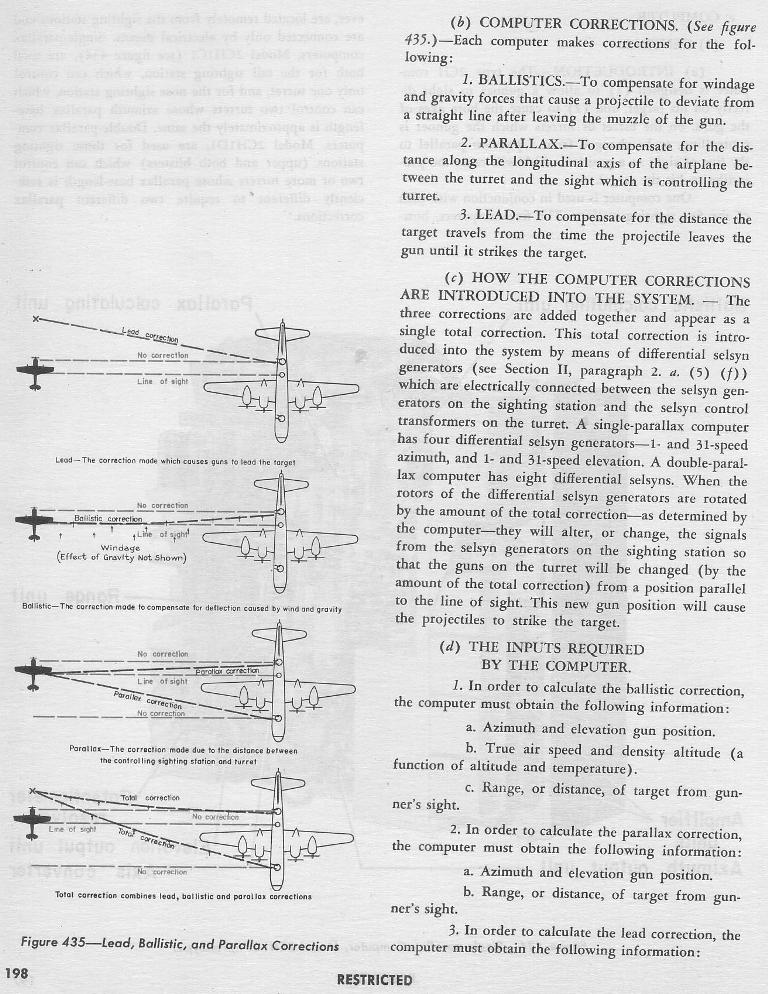
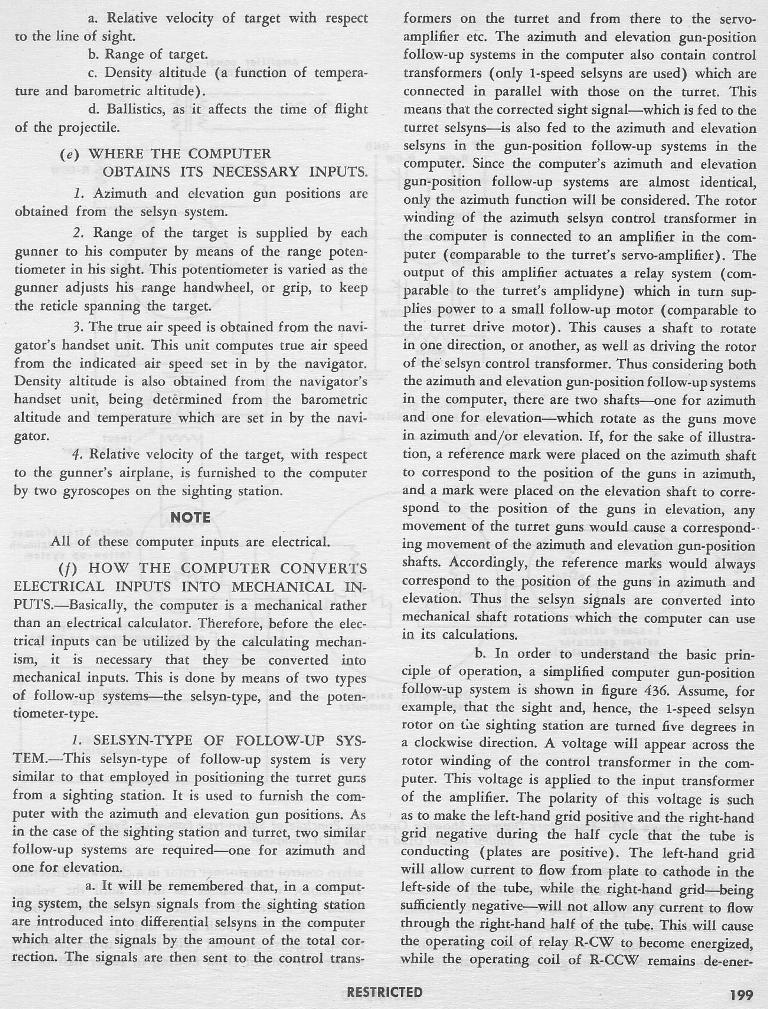
Moving on to the B-29, the computer actually corrected for all of that. All the FCO had to do was apply the optical sight to the target and decide how many guns he wanted to shoot. The computer corrected for the movement of the bomber gyroscopically and for the range (from the stadia) automatically, and for the differences in deflection (from the fact that the turrets were in different places on the bomber) and put all the slaved guns on target. It even calculated leed based on an estimate of the relative airspeed of the interceptor and the bomber.

It was a remarkable system that was ultimately obviated by the conversion to A2A missiles after the war. Defensive armament became a thing of the past. The B-29s defensive armament was as state of the art as any kind of projectile weapon could be during WW2 and simply better than the Japanese could field on any a.c. of any kind.
Show me a fellow who rejects statistical analysis a priori and I'll show you a fellow who has no knowledge of statistics.

Didn't we have this conversation already?
mdiehl
Posts: 3969
Joined: Sat Oct 21, 2000 8:00 am

RE: How to combat the B-17

Post by mdiehl »

no need to nitpick about conversion zones

It's no more nitpicky than worrying about the added lateral velocity imparted to a bullet by a B-17. Human brains are quite good at that sort of thing. If you're outside of the convergence sweet spot, some of your guns are going to miss unless you're at collision distance from the target.
Show me a fellow who rejects statistical analysis a priori and I'll show you a fellow who has no knowledge of statistics.

Didn't we have this conversation already?
User avatar
PaxMondo
Posts: 11125
Joined: Fri Jun 06, 2008 3:23 pm

RE: How to combat the B-17

Post by PaxMondo »

ORIGINAL: Erkki


...or he was given 2 options: leave it taped or grab a rifle. [:'(]
I know what I would have done if he had been shooting at me in another plane ... taping his window would not have been the end of it. [:D]
Pax
User avatar
PaxMondo
Posts: 11125
Joined: Fri Jun 06, 2008 3:23 pm

RE: How to combat the B-17

Post by PaxMondo »

ORIGINAL: mdiehl

Moving on to the B-29, the computer actually corrected for all of that.

You do understand that these are analog computers? It seems to me that you are ascribing capabilities to them by using the word "computer" that overstates their actual capabilities. Were these state of the art for '45? Yes. Were they far beyond what most other aircraft had? Yes. Were they even close to an Intel 4004 chip from 1971? No.

I'm not sure what your background is. You may in fact actually have used analog computers if you are old enough. But, most people now have no idea what they were nor their capabilities/limitations. <Yeah, I actually used to program analog computers. I'm old enough. [;)] I also programmed 4004's as well. >
Pax
mdiehl
Posts: 3969
Joined: Sat Oct 21, 2000 8:00 am

RE: How to combat the B-17

Post by mdiehl »

I am not "ascribing" any capabilities to them. They were analog and electronically driven (not mechanical) and quite capable of providing accurate targeting for a.c. moving at less than 500 mph. The mathematics involved wasn't all that complicated. The system was designed to, and in combat found to be successful at, providing accurate gunfire while compensating for all of the following. Parallax (between observer and firing turret), convergence (when using multiple turrets), windspeed, bomber airspeed, apparent motion of target relative to bomber, range (lead and bullet drop), and jolts and bounces (gyroscopic compensation) of the bomber.

They were designed to allow a gunner to put a pipper on a target and have an immediate and accurate targeting solution and that is what they did in fact do.

It wasn't ANYTHING at all like being a gunner on a B-17.

The B-29 was a revolutionary aircraft in every way from the skin to the engines (at times quirky especially at higher altitude), the cabin interior, the gun positions, the targeting systems, EVERYTHING. Step inside one and any other bomber made during WW2 by anyone and the differences are apparent and immediate.

We had a couple of B-29 fire control officers as volunteers at PASM (where we have a fully functional B-29 on static display). Between what they've told me, and what I've gleaned from the manuals and the combat records, it's pretty clear that the fire control computer worked as advertised.
Show me a fellow who rejects statistical analysis a priori and I'll show you a fellow who has no knowledge of statistics.

Didn't we have this conversation already?
mdiehl
Posts: 3969
Joined: Sat Oct 21, 2000 8:00 am

RE: How to combat the B-17

Post by mdiehl »

For your amusement you can see pix and some sample diagrams of one at the following link:

http://www.glennsmuseum.com/bombsights/bombsights.html

It's kind of a fun web page. Got bombsights too. "The original killer app." [:D]
Show me a fellow who rejects statistical analysis a priori and I'll show you a fellow who has no knowledge of statistics.

Didn't we have this conversation already?
User avatar
Nemo121
Posts: 5838
Joined: Fri Feb 06, 2004 11:15 am
Contact:

RE: How to combat the B-17

Post by Nemo121 »

LoBaron, Pax, mdiehl,


For those interested in the B29 gunnery system though I think some additional points are useful.


1. That fighters had to correct for the bomber's motion... Yes, but the fighter pilot didn't have to do so while, potentially, moving laterally relative to the target adding a whole other level to his deflection calculation. The two situations just aren't the same.

Here's a simple example. Imagine yourself setting 500 metres from a train track. You are driving towards it in a care and the train is moving past in front of you. Your job is to fire a sniper rifle and hit a specific carriage. Since the train is moving pretty predictably ( straight and level, as though in a formation ) once you give enough lead you should have very little difficulty hitting the carriage so long as you don't hit a bump and have the right distance to target etc.

NOW imagine yourself INSIDE that train carriage and imagine yourself moving laterally along the track and having to hit that truck driving towards the tracks at 500 metres. Note: That truck is presenting a head-on target which is MUCH smaller than your profile target ( the side of the train carriage ) and has the freedom to manoeuvre evasively until such time as the sniper wishes to straighten out and take the shot.

I think sheer common sense will tell everyone that the sniper in the truck has a simpler shot than the guy moving laterally in the train.


2.
Both of them said they were confident in the system's ability to shoot down Japanese fighters before they got into firing range with their guns,
Well, I've known people who were confident of a lot of things which, when push came to shove, didn't turn out to be right. I've seen many reports by B29 gunners who found that fighters which flew "through" the various engagement zones of the turrets could actually transition through the zones so quickly ( if close-in ) that the turrets had difficulty engaging them. I've also seen many B29 gunners talk about electrical problems which rendered the computerised gunnery system less than effective, I've heard of the radars for range-finding getting spooked by B29s in the formation and giving the wrong information to the guns and I've read other reports in which they talked about the convergence problems arising from parallax and misidentification of the enemy plane, leading to incorrect wingspan estimation leading to incorrect range estimation and the fire from the guns converging at entirely the wrong distance ( when the radars didn't work, as was often the case ).

Image
Image

I think this image from the B29 gunnery manual issued during the war shows the complexity of the system and shows that there were significant problems in accounting for parallax distance between the sighting position and the gun position which were NOT co-located.

Also I'd point out that the whole gun solution is reliant on one thing which gunners frequently got wrong, a correct identification of the attacking fighter type. They had to identify the fighter properly in order to enter its wingspan into the gunnery computer. This wingspan was then utilised to calculate the distance to target. Get the wingspan wrong even slightly and the distance to the target would be wrong. Since the distance to the target would be wrong AND since the gun positions were NOT co-located with the sighting station the zone of convergence would be wrong --- and the bullets would all miss.

E.g. A plane with a 10 metre wingspan at 200 metres would APPEAR to be the same size to the B29 gunner as a plane with a 15 metre wingspan at 300 metres. Mistake the fighter and you'd find yourself shooting either 100 metres in front or 100 metres behind the target. That's hardly effective. Now, if you say that the gunners could ID the planes involved... I'd point you to the huge number of issues pilots have had in plane identification. Hell, in one case I studied when assessing kamikaze action a few Ki-45s were actually identified as either P1Ys or G4Ms or, possibly, Ki-46 Dinahs. Each of those planes has quite a different wingspan than the Ki-45. So, I really amn't convinced that in the heat of battle with targets transitioning rapidly through the various turret zones the gunners would have gotten their plane identification correct a lot of the time and neither am I convinced that the parallax issue and convergence zone issue wasn't a fatal flaw. It is different nowadays with radar etc which gives perfect range data. Then though the Mk1 eyeball operating on a glimpse of an enemy plane of a few seconds just wasn't IMO accurate enough to get the sorts of results you seem to think they would have.

At least with non-displaced gunnery positions ( in other words positions which were co-located with the sighting mechanism and/or manned and aimed by a person ) there would be no parallax issues and you'd just be shooting straight down the barrel of the gun, removing a great deal of the issues arising from this parallax issue.


I think the issue may come with your emphasis on the gunnery system mechanism as opposed to the gunnery weapons system. The machinery and suchlike was very advanced for its day and a triumph of design and building.

However add in the tasks it required of the organic component AND the issue with parallax requiring absolutely accurate range data in order to generate converging fire from all those turret at the point in space occupied by the target and I just don't see it working that well in practice.

Even if you take all of the above out of the equation and assume a 50 metre convergence zone at 300 metres or suchlike you still end up with a situation where a fighter making a firing pass from left to right side on the B-29 at 480 kph ( quite a reasonable speed to make such a pass and well within the capabilities of many of the planes of the time ) would cover 8,000 meters in a minute, over 130 metres in a second and thus would be through the convergence zone in less than 0.4 seconds. Once through the convergence zone, even with everything else working perfectly the guns wouldn't be able to hit him since the gunner and the guns wouldn't adjust the distance at which they were firing rapidly enough to maintain the convergence on the fighter.

So, great mechanics and theory but in practice it just isn't going to be as lethal as I think you believe it would have been.


Your other possibility is that the various radars in the B29 worked and were able to feed data into the computer without fault. In this case you have a situation in which the radar was able to deal with 1 target at a time but not any more than that without screwing up the firing data for all of the guns. In addition any attacks by multiple fighters flying in reasonably close formation would have resulted in an "averaging" problem for the computer which may have averaged the position of the two fighters and viewed them as one. End result, the fire misses.

So, a very good piece of kit but history is full of very good pieces of kit which simply weren't as lethal as the theory suggested.
John Dillworth: "I had GreyJoy check my spelling and he said it was fine."
Well, that's that settled then.
User avatar
PaxMondo
Posts: 11125
Joined: Fri Jun 06, 2008 3:23 pm

RE: How to combat the B-17

Post by PaxMondo »

ORIGINAL: Nemo121

So, a very good piece of kit but history is full of very good pieces of kit which simply weren't as lethal as the theory suggested.
+1

What I was attempting to say about analog computers...
Pax
User avatar
LoBaron
Posts: 4775
Joined: Sun Jan 26, 2003 8:23 pm
Location: Vienna, Austria

RE: How to combat the B-17

Post by LoBaron »

Thanks Nemo, interesting read.


ORIGINAL: mdiehl
no need to nitpick about conversion zones

It's no more nitpicky than worrying about the added lateral velocity imparted to a bullet by a B-17. Human brains are quite good at that sort of thing. If you're outside of the convergence sweet spot, some of your guns are going to miss unless you're at collision distance from the target.

Sorry mdiehl, considering that you habitually confuse topics I should have been more accurate. [:D]


What I meant was:

"no need to notpick about conversion zones because they have nothing to do with deflection shooting"

Is that clearer now? Probably not...
Image
mdiehl
Posts: 3969
Joined: Sat Oct 21, 2000 8:00 am

RE: How to combat the B-17

Post by mdiehl »

Well, I've known people who were confident of a lot of things which, when push came to shove, didn't turn out to be right.


Well, since both of them flew missions in B-29s and shot at Japanese interceptors from them, I think their anecdotal experience outweighs the general supposition that "such a gadgety thing could never work." It worked. No historical treatment of B-29 operations has ever claimed that the fire control system was a white elephant.

It was engineered by people who knew what they were doing for a specific purpose, tested for same, and properly implemented. It worked so well that B-29s retained them fro daylight operations into the Korean War. They only started to not be able to keep up when MiG 17s began operating against them. I think the whole "I must know better than the guys who built and operated them" routine is very strange.

As to your train analogy. The reason why it fails is because the truck is constantly turning to keep aligned with a particular part of the train (in relative terms). A bomber may look like a big ol target, but interceptor drivers knew you couldn't bring one down without shooting out the engines or setting the fuel tank alight. The good Luftwaffe pilots were good at that sort of thing.

The sniper in the truck has to deal with added velocity that is offset from the direction the truck is pointing. Even if you skew the truck you still impart a vector change on the bullet path. The only way to avoid that is to attack from directly in front or directly behind. The targeting problem for both the B-17 gunner and interceptor pilot was the same, except that the interceptor pilot was more likely also have to compensate for pitch, roll, and as needed, skid.
Show me a fellow who rejects statistical analysis a priori and I'll show you a fellow who has no knowledge of statistics.

Didn't we have this conversation already?
mdiehl
Posts: 3969
Joined: Sat Oct 21, 2000 8:00 am

RE: How to combat the B-17

Post by mdiehl »

Sorry mdiehl, considering that you habitually confuse topics I should have been more accurate.

If that's a bass ackwards way of admitting that you were imprecise and inaccurate, we agree. I don't easily confuse topics, but when someone with poor writing skills blunders about, ambiguity ensues.

What I meant was: "no need to notpick about conversion zones because they have nothing to do with deflection shooting"

Is that clearer now? Probably not...

Much clearer thanks. With your clarification, it's apparent that you were basically introducing a straw man argument. Conversion zones had to do with ALL shooting from any interceptor with wing-mounted guns, regardless of whether they were attempting deflection shots.
Show me a fellow who rejects statistical analysis a priori and I'll show you a fellow who has no knowledge of statistics.

Didn't we have this conversation already?
mdiehl
Posts: 3969
Joined: Sat Oct 21, 2000 8:00 am

RE: How to combat the B-17

Post by mdiehl »

That's hardly effective. Now, if you say that the gunners could ID the planes involved... I'd point you to the huge number of issues pilots have had in plane identification.

Actually, I'd say that a ten meter difference between interceptors is greater than the size range of most Japanese interceptors. The reason why these things had gunners, and, importantly, tracers, was to allow an operator to correct for any intrinsic errors that might come up.

The USAAF reckoned, after alot of testing, that the the system allowed accurate fire placement out to 1000 yards. The stuff you brought up, in particular parallax, is of course discussed in the manual. But the operator was not the one who had to correct for parallax. The computer did that automatically. The operator had to observe the target and lay on it with the rangefinder and observe shot fall. In most circumstances that rangefinder gave very accurate initial targeting, according to the people who used them. So while in theory a B-29 gunner might experience more misses if he used that fighter-proportioned stadial set to line up a shot at, say, another B-29, in practice that sort of thing wasn't a serious problem for its users.

By all accounts, the one thing the B-29s computer could not easily compensate for was very high closing speeds. A.C. capable of speeds in excess of 500 mph gave it problems. The Japanese fielded no such a.c. during WW2.

Show me a fellow who rejects statistical analysis a priori and I'll show you a fellow who has no knowledge of statistics.

Didn't we have this conversation already?
User avatar
Erkki
Posts: 1460
Joined: Wed Feb 17, 2010 5:03 am

RE: How to combat the B-17

Post by Erkki »

ORIGINAL: mdiehl
Well, I've known people who were confident of a lot of things which, when push came to shove, didn't turn out to be right.


Well, since both of them flew missions in B-29s and shot at Japanese interceptors from them, I think their anecdotal experience outweighs the general supposition that "such a gadgety thing could never work." It worked. No historical treatment of B-29 operations has ever claimed that the fire control system was a white elephant.

It was engineered by people who knew what they were doing for a specific purpose, tested for same, and properly implemented. It worked so well that B-29s retained them fro daylight operations into the Korean War. They only started to not be able to keep up when MiG 17s began operating against them. I think the whole "I must know better than the guys who built and operated them" routine is very strange.

As to your train analogy. The reason why it fails is because the truck is constantly turning to keep aligned with a particular part of the train (in relative terms). A bomber may look like a big ol target, but interceptor drivers knew you couldn't bring one down without shooting out the engines or setting the fuel tank alight. The good Luftwaffe pilots were good at that sort of thing.

The sniper in the truck has to deal with added velocity that is offset from the direction the truck is pointing. Even if you skew the truck you still impart a vector change on the bullet path. The only way to avoid that is to attack from directly in front or directly behind. The targeting problem for both the B-17 gunner and interceptor pilot was the same, except that the interceptor pilot was more likely also have to compensate for pitch, roll, and as needed, skid.


Unlike the fighter, the rounds shot by the bomber also get a nice 50m/s+ side wind to consider, making the fire extremely inaccurate any further than 100-200 meters or so pretty much regardless of weapon unless the target is within a small sector ahead or astern. Its called Magnus effect, but you probably knew about it, right? [;)] http://en.wikipedia.org/wiki/Magnus_effect

I've read many times how pilots and land crew would wonder about gunner fire hit aircraft having lots of the bullet holes look like the bullet landed sideways...

Aiming, ballistics and hitting isnt as simple as you're trying to make it sound. [:-]
If that's a bass ackwards way of admitting that you were imprecise and inaccurate, we agree. I don't easily confuse topics, but when someone with poor writing skills blunders about, ambiguity ensues.

[:-]
Actually, I'd say that a ten meter difference between interceptors is greater than the size range of most Japanese interceptors. The reason why these things had gunners, and, importantly, tracers, was to allow an operator to correct for any intrinsic errors that might come up.

Have you ever actually shot tracers?!? They cant be used to estimate distance, especially not if the barrel of the gun is right next to you (no parallax). Tracers were used in air warfare to mark targets (bombers) and to scare fighters who wouldnt even see muzzle flashes if it was daytime and in fighters to estimate lead, if the tracers fell behind the target. Every single guide and manual you will find tells to not fire by the tracers but to always use the sight and correct fire using sight only, tracers only tell you if you're missing by a mile and what targets the others are shooting, in case one didn't spot them early.
By all accounts, the one thing the B-29s computer could not easily compensate for was very high closing speeds. A.C. capable of speeds in excess of 500 mph gave it problems. The Japanese fielded no such a.c. during WW2.


Even a Ki-27 can achieve 500mph closure speed - when its coming head-on, which was the only way to get within firing range of a B-29 for most of the Japanese fighter force (excluding only Ki-84, J2M, N1K).
User avatar
oldman45
Posts: 2325
Joined: Sun May 01, 2005 4:15 am
Location: Jacksonville Fl

RE: How to combat the B-17

Post by oldman45 »

mdiehl - thanks for that link. When I was knee high to a grasshopper I was given a sight off a fighter. Too young to realize what it really was it was something to play around with.

The link shows a K10 which looked like what I remember.
Post Reply

Return to “War in the Pacific: Admiral's Edition”