ORIGINAL: bomccarthy
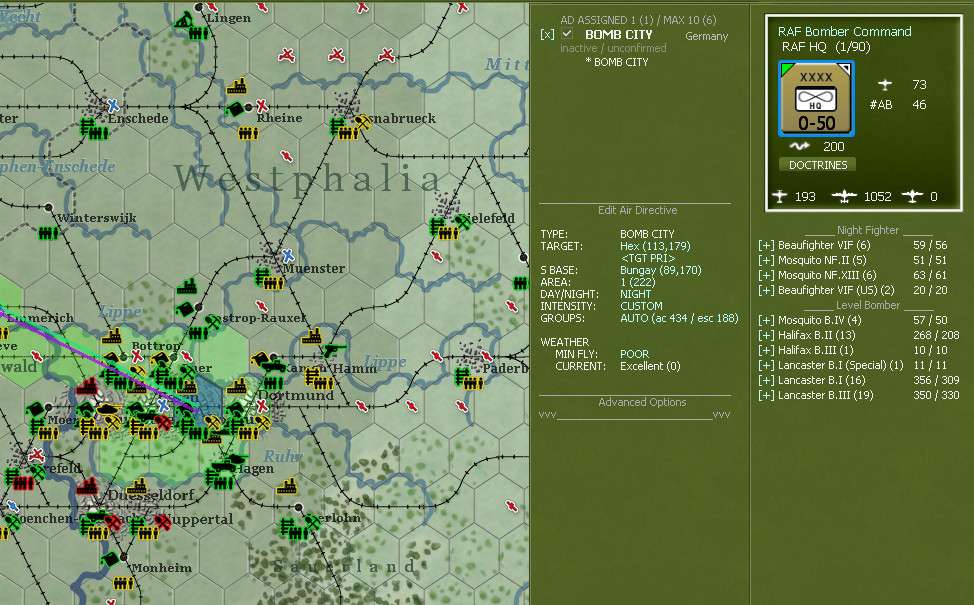
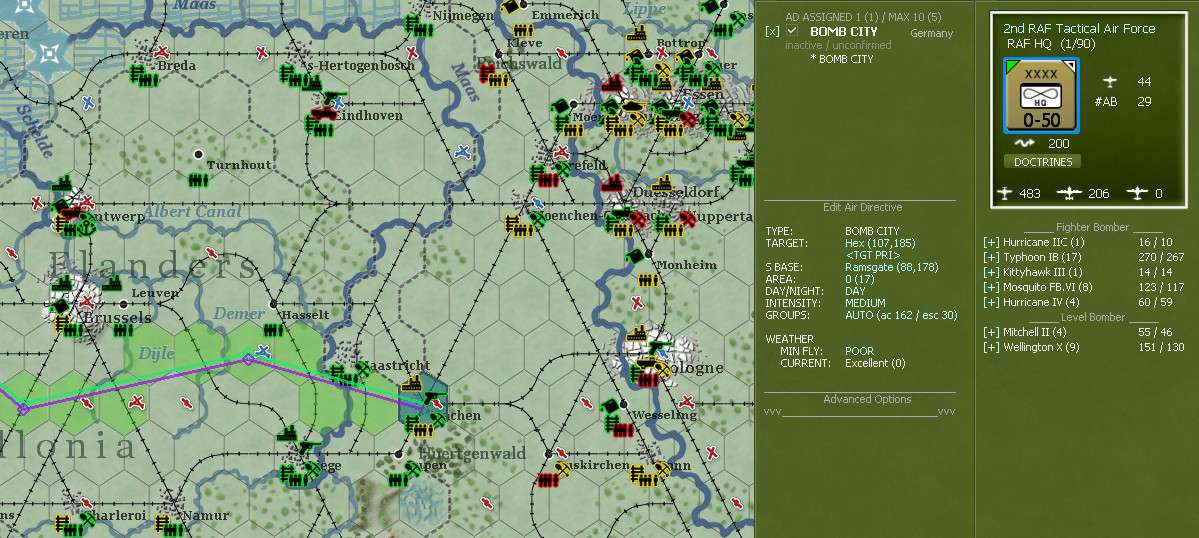
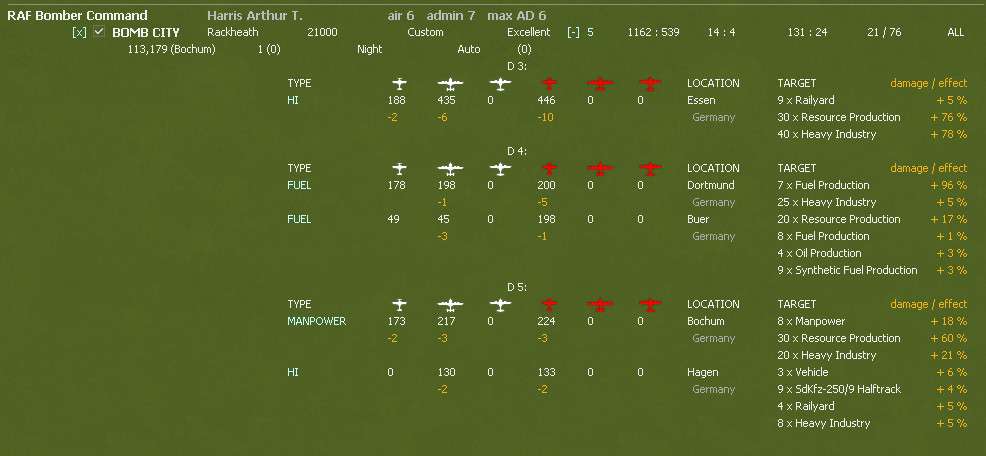
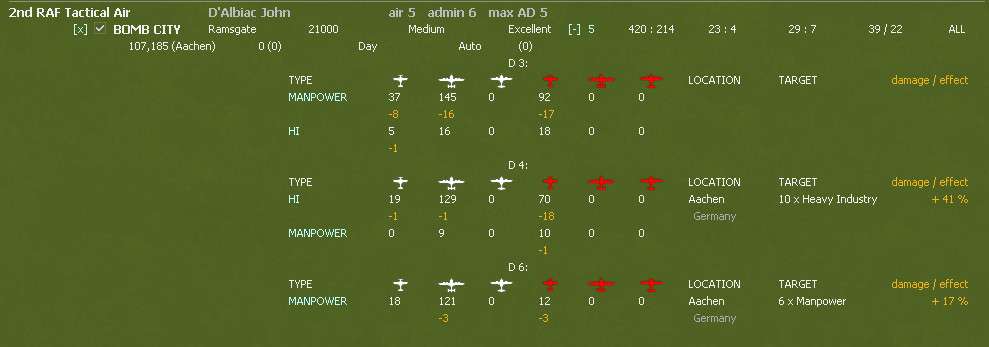
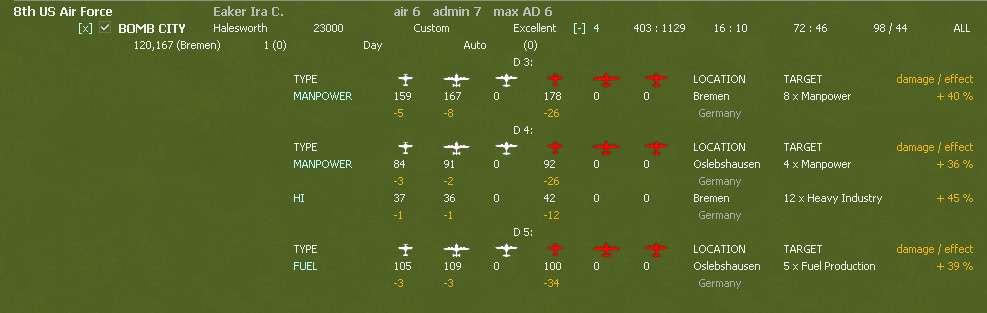
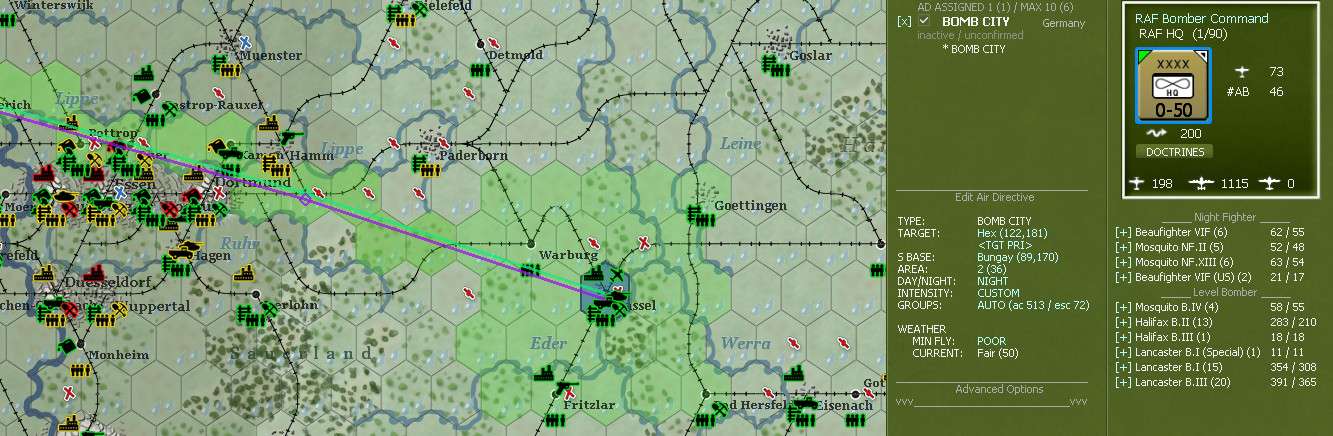
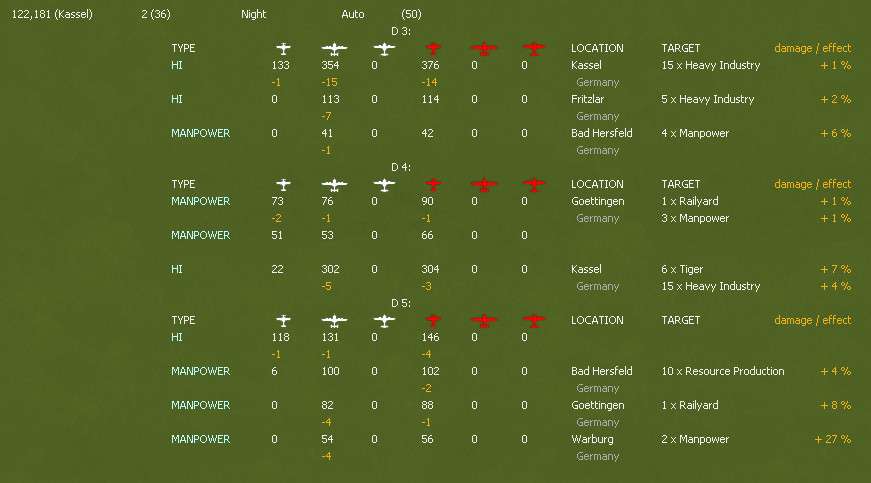
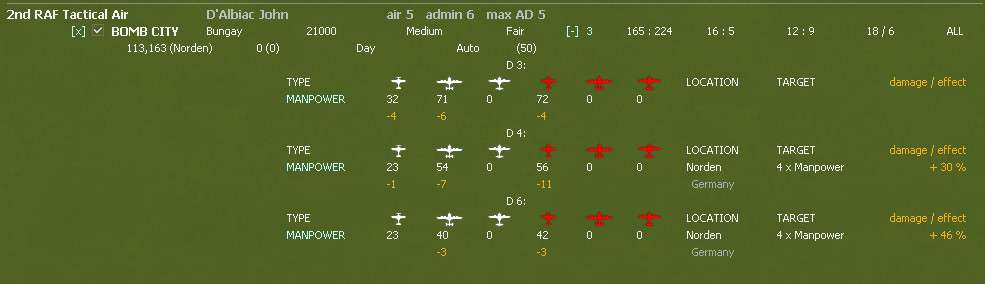
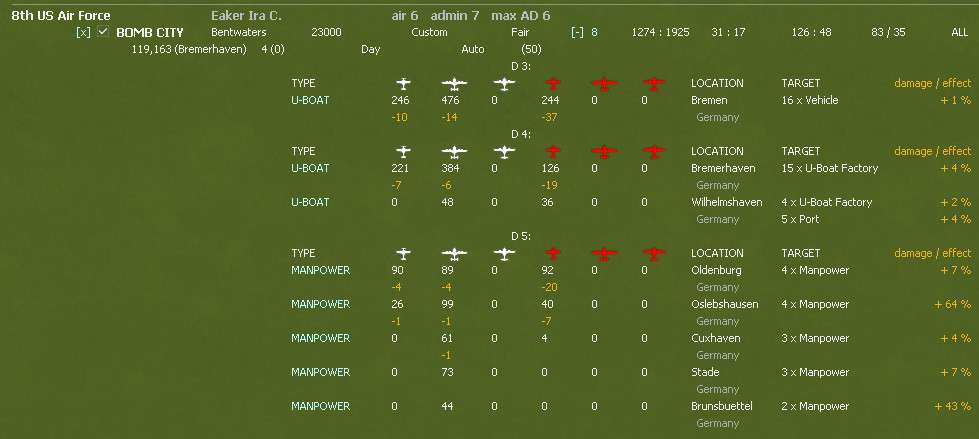
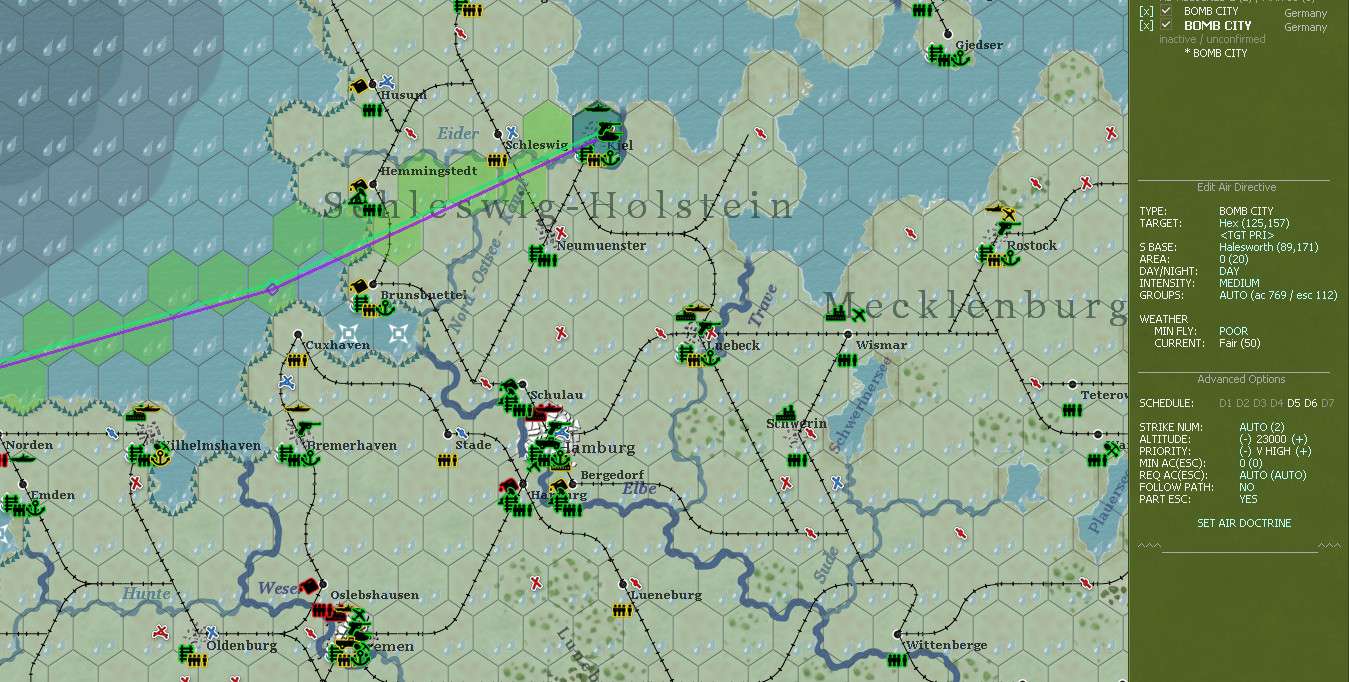
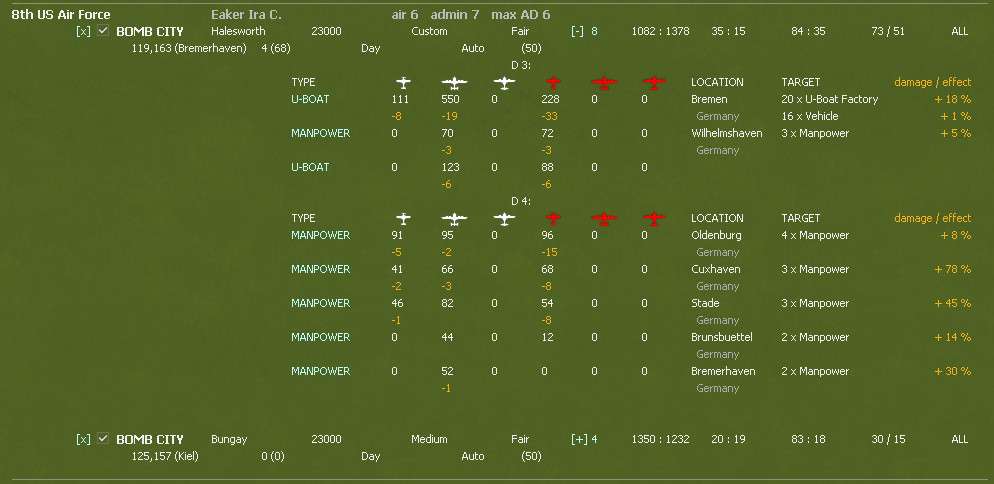
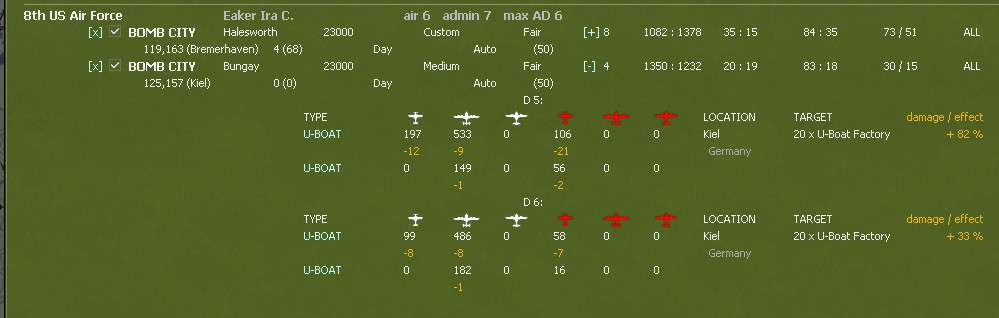
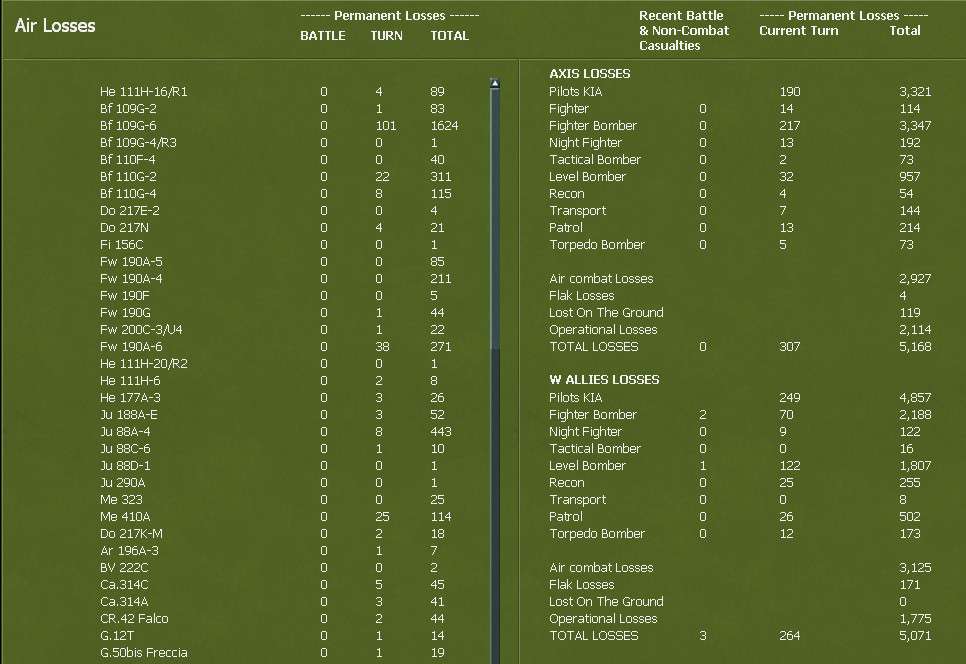
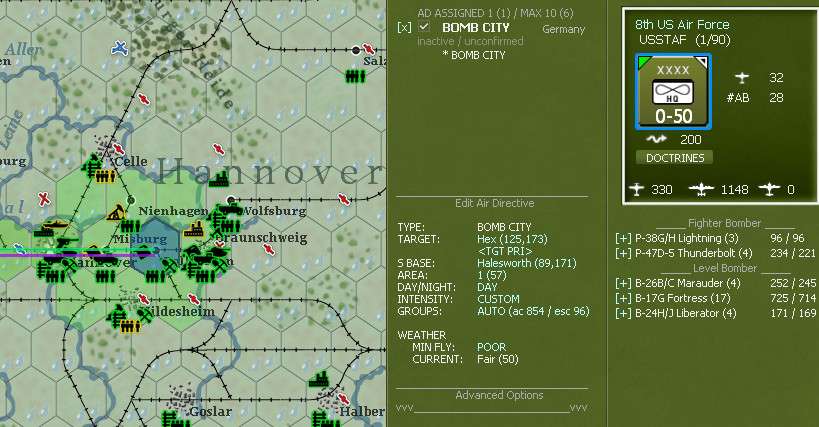
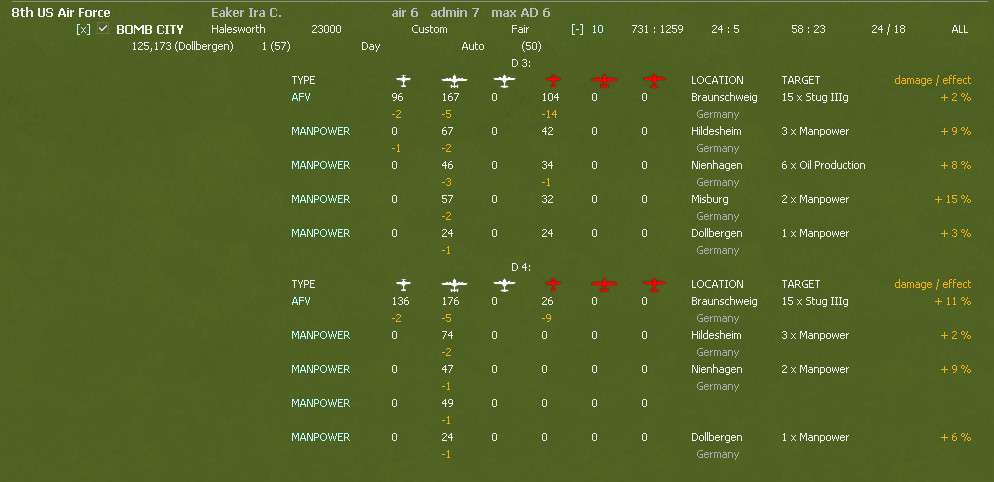
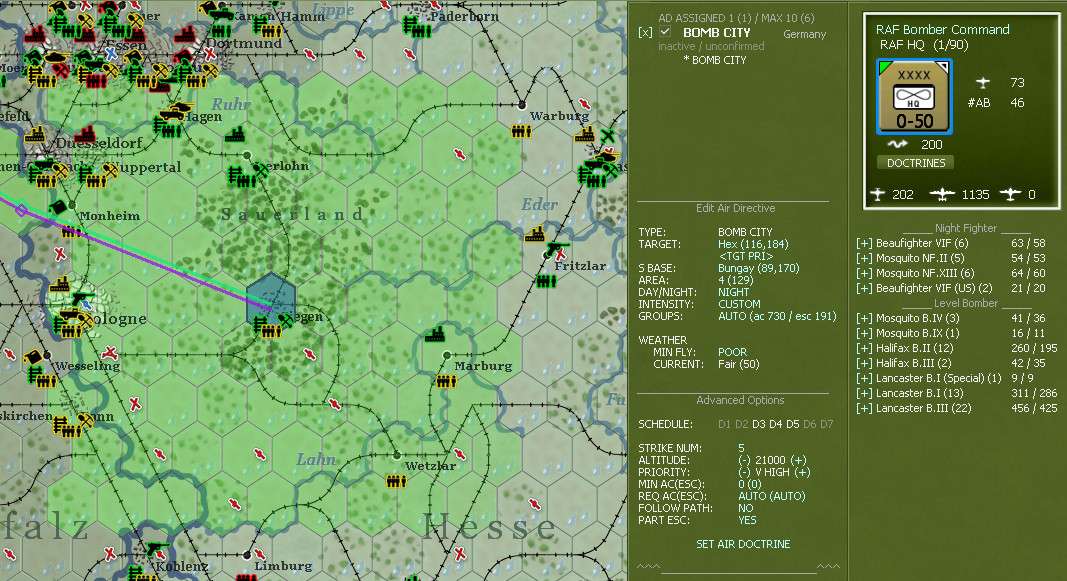
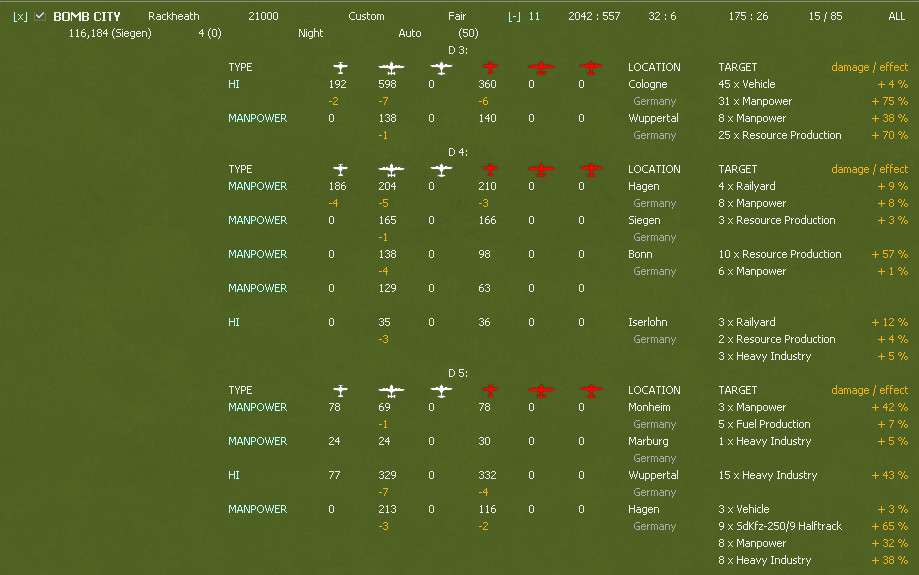
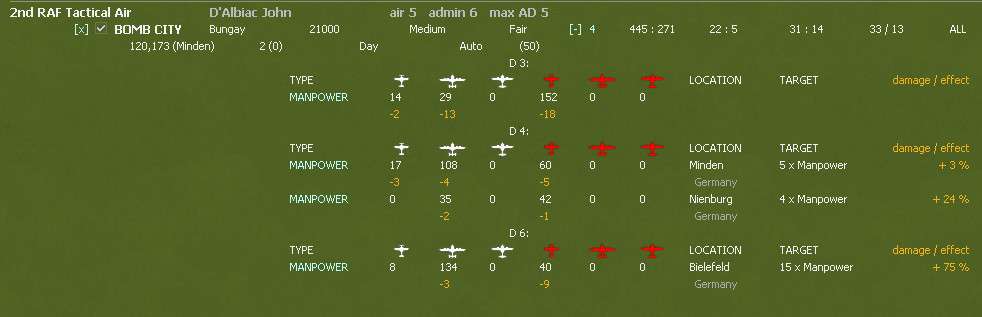
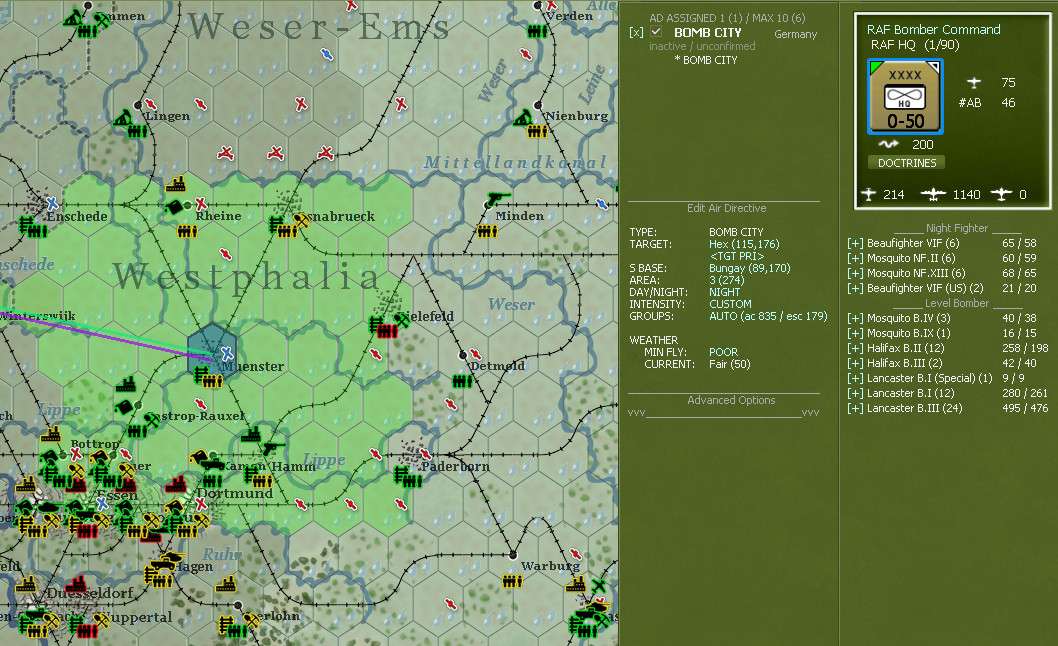
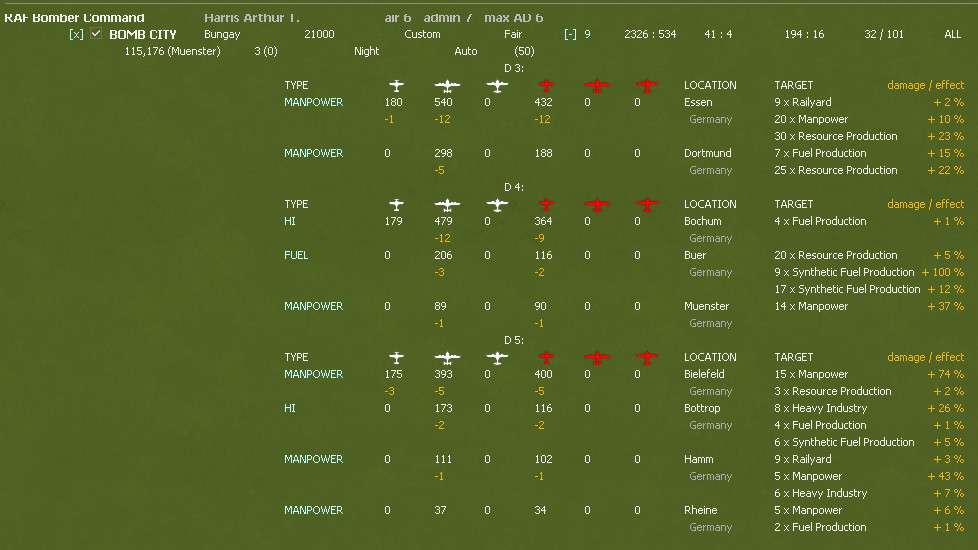
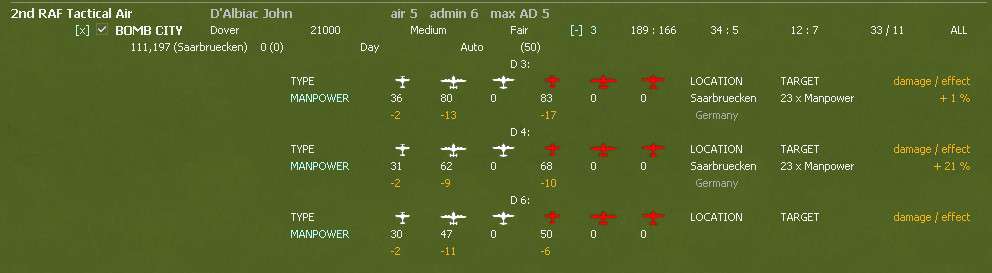
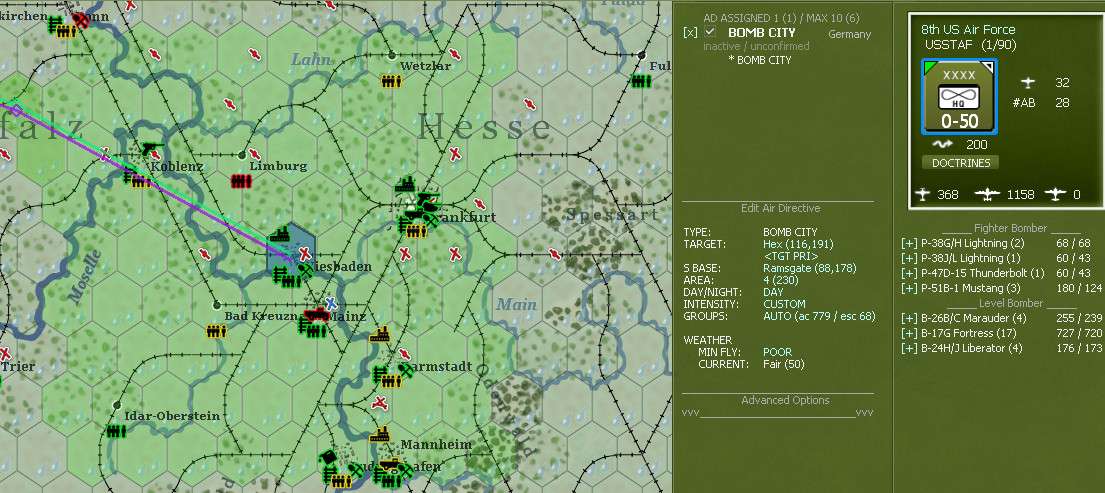
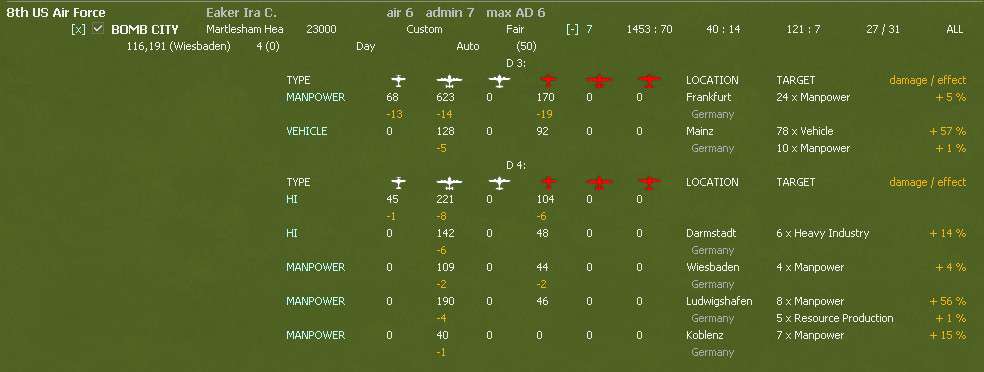
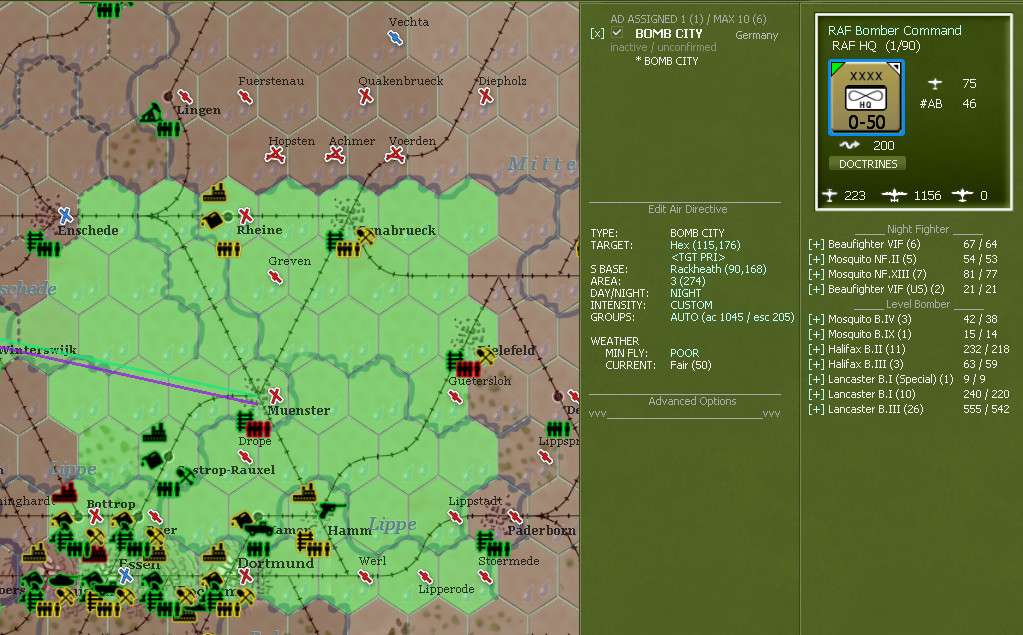
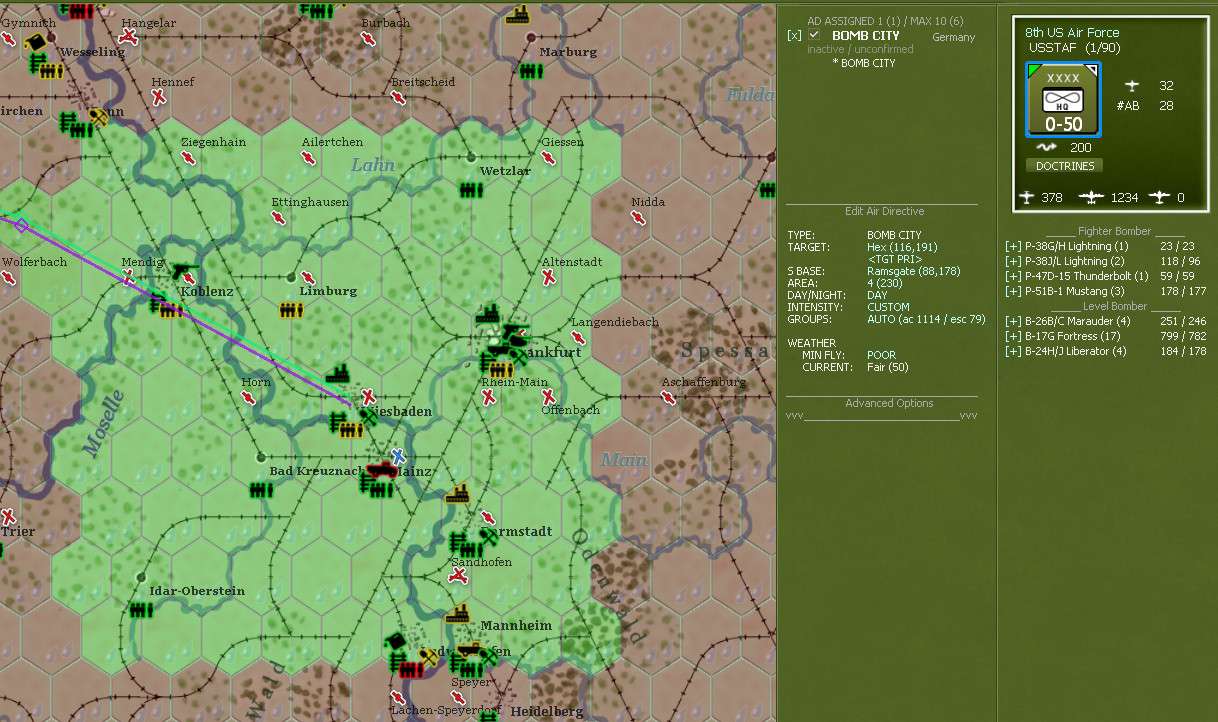
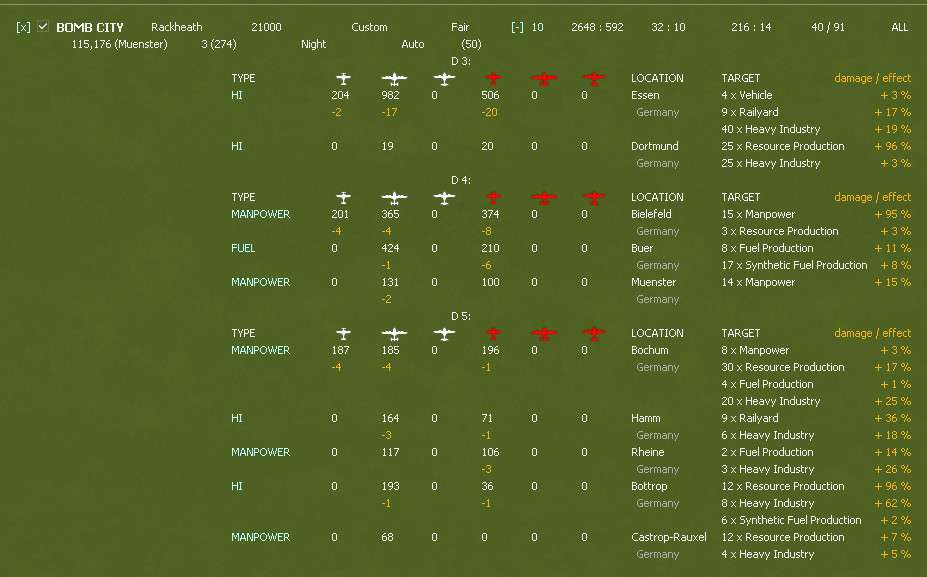
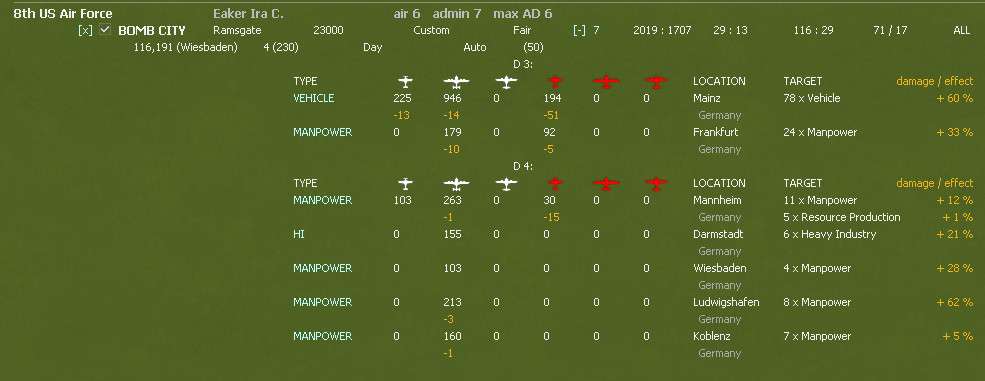
I noticed that your flew BC and 8th AF consecutive days in the past couple of turns - would your units get more rest if you alternated the days (D2, D4, D6 or D1, D3, D5, D7)?
Not really. I'd avoid D1 missions so that the recon has chance to operate. Beyond that it makes no real difference if you cluster or spread out. You might get a few more planes by spreading out as they shed a bit of damage but not sure about this and its very marginal.
In a PBEM I might mix things up more. The ideal for the Germans is to only fly defensive air on the days that the bombers appear (=less fatigue and operational losses), so if you keep to the same pattern your opponent might start to react. This is also why in a PBEM, I vary altitudes a bit to see if I can catch the enemy out. I don't think the AI reacts to your moves at this level of detail so I just keep to a similar pattern.
ORIGINAL: Chuske
ORIGINAL: bomccarthy
Naval patrols do seem more effective on auto than they used to be. In my previous games, I would regularly lose ships and their cargo immediately upon leaving Oran in early 1945, even though the closest Axis base was in Albania. I couldn't figure out what was attacking them, a Nazi-sympathizing Kraken?
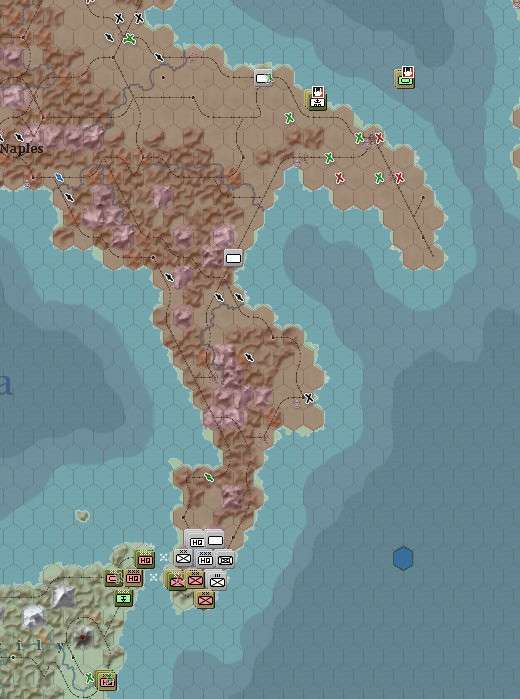
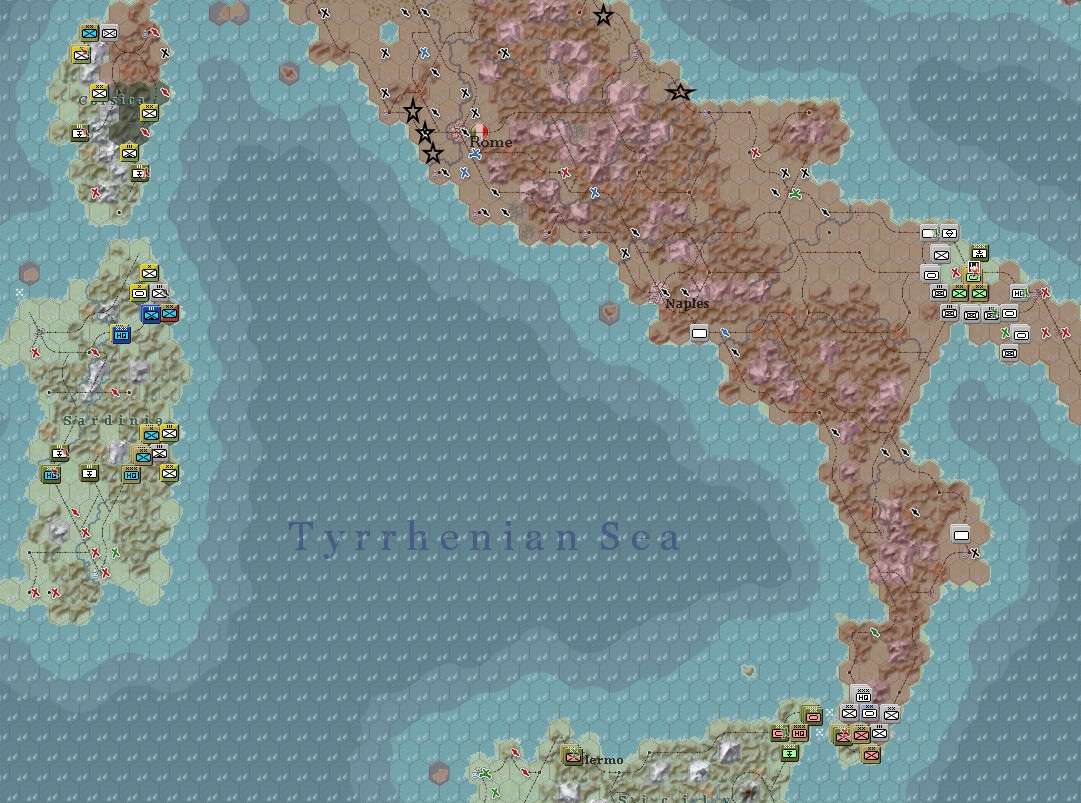
In my current game, I am only setting up Naval patrol directives to protect invasion sites. In Spring '44 good weather turns with no naval patrol directives, I usually control most of the Med ocean hexes to within 40 miles of the French coast, as well all around the Italian coastline that I control on land. I just make sure to spread the Coastal AF patrol planes and bombers along the coastlines I control.
Could be U-boats attacking as they remained a threat right to the end of the war, it was only the more effective allied technology and tactics that stopped them being the threat they were until mid 43. In fact the new models introduced in 1945 were v.difficult for the Allies to deal with as they had ability to stay submerged (first true submarines rather than submersibles) and very fast underwater speed. If they had been introduced a year earlier the Western Allies may have been knocked out of the war.
I've just installed the beta and I see what you guys mean. 1.01.68 the naval patrols were seriously under-powered and hard to get control of sea hexes at all, now its almost too easy.
I think this game is excellent except for the Naval model which never has felt that convincing, particularly in not having a requirement for Allies to keep anti-Uboat naval patrols over the Western approaches, bay of Biscay etc and U-boats war just reduced to a few factories.
Aye the naval model is functional rather than anything else. The odd dual nature of the TFs as both the transport assets and combat ships is a bit hard to grasp (intuitively) as is the ability of a TF to repair a level 1/2 port. I'd also have liked to see either a fair bit of the UK based coastal command out of the game to reflect the enduring U-boat campaign or some practical penalty if you just use it in support of land operations?
ORIGINAL: Chuske
Loki a few more questions for you which might benefit new players:-
1) What is your approach to Support Unit (SU) attachment? What do you attach to your Divisions, Corp HQ and Army HQ? I usually have engineers on most inf div and often an armoured SU and AT SU. Corps HQ I load with Artillery (can't remember though if there is a limit on how much artillery will actually take part in a battle), I attach AA to all HQs but rarely to units (at least as Allies).
2) Do you bother attaching Commando units to Amphib HQs or making sure the amphib HQs with commandos already attached are on a flank of an invasion? I've never yet seen the rule about these multi-role SUs taking an adjacent empty hex during an invasion, actually activate.
3) How do you judge when you have enough port capacity repaired after an invasion (particularly in Med) to redeploy Amphib HQs for a new invasion? As you say, keeping up the amphib threat in Italy is essential but needs to be balanced against keeping supplies flowing to the main front.
4) How do you manage land unit fatigue and TOE loss? Do you always have a div or two resting and refitting? Can be particularly tough in Italy in winter 43/44 to keep up CV values, also can be hard to mantain CV during a rapid advance in NW Europe.
5) Rail repair units. I seem to remember there is a need to give these the correct higher HQ as otherwise they can lose TOE and suddenly stop working, I can't seem to find the thread on this though, can you remember?
6) What is your general strategy on rail repair? Are there any tips on getting the HQs to use their engineers so you don't have to repair every rail hex manually with rail repair units? Do you keep a reapir unit in Italy after D-Day invasions?
Do my best:
1) For Italy I find you don't really have the SUs you need so its a case of making do. I change my mind on this a lot but at the moment I'm tending to keep the assets at the corps level rather than directly attached. By the time you land in France you have the SUs both to fill out the corps and for direct attachments.
In testing WiTE2, I think a few people have come to a better appreciation of just how useful AA is in a ground combat role. So I have started directly attaching the light AA to allied divisions. It visibly adds a CV. Looking at the combat results in detail, it seems to contribute - need to see more instances since I have not really had that much ground combat so far. This may be over-powered (not least I'm pretty sure the W Allies did not tend to use AA in a ground role) but it seems as if the AA SUs actually have more value than it immediately appears.
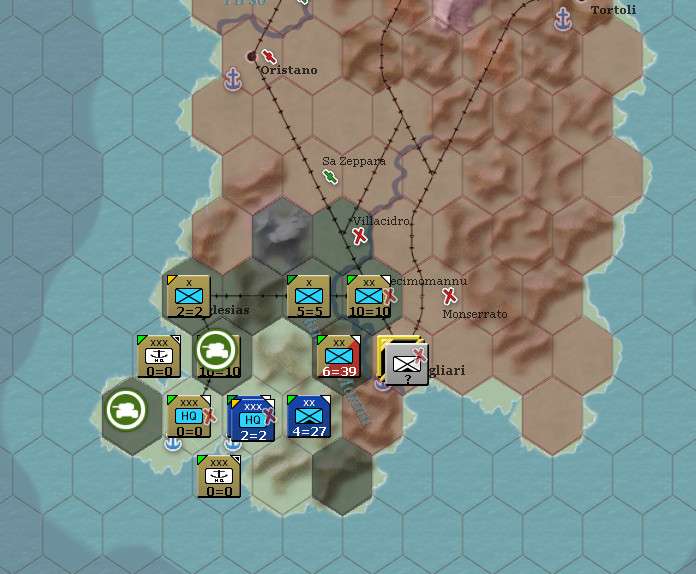
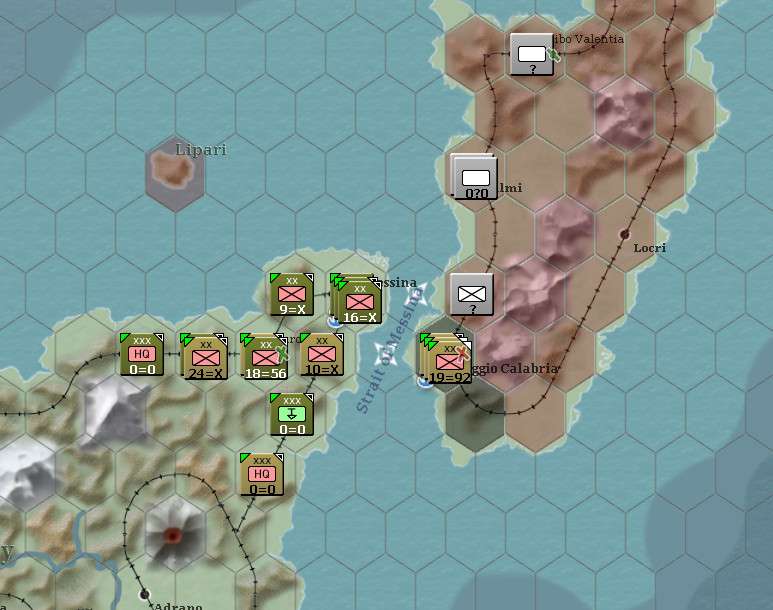
2) if I remember [;)]. Actually its more use in Italy, especially if you do one hex/one division landings in an attemtp to disrupt the Germans
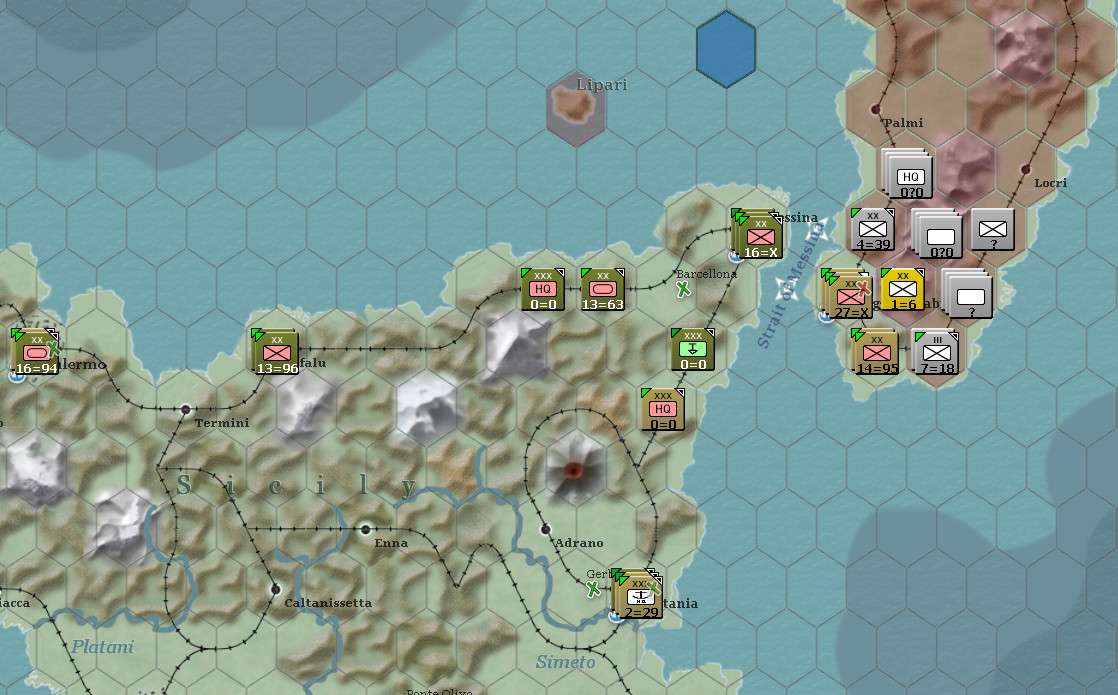
3) My logic is a typical T1 invasion will give you 6 temp port levels (feasibly 8 but most people will retarget one of those). I've never felt I had a global supply problem on Sicily so as a rough rule 6 port levels is enough.
You'll take Gela on T1 and it auto-repairs so that is one level back, Sciacca and Trapani are two more level 1 ports you should get easily and again auto-repair. Siracusa, Catania and Palermo are in combination 12 port levels but will be damaged to some extent. So I basically pull away TFs as I build up on the permanent ports. I reckon you can abandon one on T2 (Gela and a damaged Siracusa will replace this).
Its all a bit rough and ready as a model but its good enough for my purposes.
4) it definitely pays to see if you can pull units well back. In Italy you can often defend with a divisional front line, and really everything else should be pulled back. The end-game tends to be a war of ants as the Germans weaken and the Allies are in poor supply. Here keeping a few divisions back as a reserve and rotating them can make a huge difference - the problem is you often need every combat unit to hold the front as it gets stretched into some odd shapes.
5) yes, I've had that especially with the British ones. I tend to link them to a suitable army group as Army CP can be overloaded, but someone did indeed do a good analysis of the problem [8D]
6) I'm pragmatic about this. In the current game, all the Sicily rails are repaired and I'd guess I did about 40% by controlling the rail repair unit. I don't find rail repair to have the importance it has in WiTE. In the main port capacity/shipping are the real constraints for the allies both in Italy and France. Repaired rail lines are nice but not so critical?