With the big offensives and grand encirclements a time of the past, one has to find satisfaction in the smaller things in life. For example, the completion of a strech of railway behind the front.
I also find this to be quite addictive - like pistachio nuts.
The Soviet winter offensive is crashing in over the ramparts of our Ostwall in force! Several attacks of which most are successful. No breakthroughs of consequence though. German forces in protrusions are generally pulled back. Map after German moves.
Comment: I note that most Soviet attacks are supported by hordes of sapper regiments. That is sound from the Soviet prespective. It does however raise the point (again) that the Soviets are free to build whatever support units are proven most effective in the game engine, while the Germans have to make do with what they have.
Losses turn 75. Shown are losses in my turn caused by counterattacks. Not nearly good enough ratio... I am generally starting to refrain from counterattacks except where a hex is really necessary to kepp. The loss ratio wont go much above 2-1 even for successful German counterattacks and that simply isn't good enough.
I wonder how much of the losses are due to attrition rather than actual attacks; it would be nice if the report differentiated active from attrition losses; the Soviet can almost attrit the Axis to death.
With the big offensives and grand encirclements a time of the past, one has to find satisfaction in the smaller things in life. For example, the completion of a strech of railway behind the front.
I also find this to be quite addictive - like pistachio nuts.
Marquo
It's called displacement activity. Well known phenomenon. When you don't want to face up to or do anything about the major issue, fiddle around with a bit of trivia to which you attach an unrealistic importance. I am not immune which is why I'm writing this instead of going back to my homework.
web exchange
Post: I am always fearful that when I put this game down on the table and people see the box-art they will think I am some kind of neo-Nazi
Reply: They already know you're a gamer. What other shame can possibly compare?
If those AFV losses remain at that level, his mobile unit strength will deplete itself over time, but it depends mostly on what kind of tanks he's losing. If he's losing mostly T-34's: good. If he's losing primarily light tanks: you won't really notice the effect.
SSG tester
WitE Alpha tester
Panzer Corps Beta tester
Unity of Command scenario designer
If those AFV losses remain at that level, his mobile unit strength will deplete itself over time, but it depends mostly on what kind of tanks he's losing. If he's losing mostly T-34's: good. If he's losing primarily light tanks: you won't really notice the effect.
In my experience, AFVs don't really seem to have all that much effect. Their main effect is to generate impressive loss numbers.
They won't have an effect for Rifle units, but if Soviet mobile unit strength decreases, the chance of dangerous breakthroughs and the chance of units being attacked twice during a turn decreases.
SSG tester
WitE Alpha tester
Panzer Corps Beta tester
Unity of Command scenario designer
They won't have an effect for Rifle units, but if Soviet mobile unit strength decreases, the chance of dangerous breakthroughs and the chance of units being attacked twice during a turn decreases.
IMHO tanks feel underrated in WITE. A Soviet tank corps is easily brushed aside, but rifle corps are much tougher. Similarly, low tank strength is not really a big problem for the Germans as long as there are motorized infantry.
OTOH a Panther battalion seems to add a lot to the strength of a unit if it is attached, so I have a feeling thet late war AFVs contribute maybe too much to the CV. I mean, I think a Pz38 in 1941 had probably just as much influence, if not more, on the enemy as a Panther in 1943.
They won't have an effect for Rifle units, but if Soviet mobile unit strength decreases, the chance of dangerous breakthroughs and the chance of units being attacked twice during a turn decreases.
IMHO tanks feel underrated in WITE. A Soviet tank corps is easily brushed aside, but rifle corps are much tougher. Similarly, low tank strength is not really a big problem for the Germans as long as there are motorized infantry.
OTOH a Panther battalion seems to add a lot to the strength of a unit if it is attached, so I have a feeling thet late war AFVs contribute maybe too much to the CV. I mean, I think a Pz38 in 1941 had probably just as much influence, if not more, on the enemy as a Panther in 1943.
I just read the diary written by one of Wittmann's tank crew... - 1 Tiger could win the day... - (I have never reached the time of Tigers in this game - but I am just saying... when these new German tanks appeared they made one hell of a difference on the battlefiedl!)
Infantry has a low on-counter CV compared to mobile units, but it often has more of an effect on a battle than AFV's, so AFV's are often more of a CV increaser than an actual cause of more losses, although they perform well in battle. They don't necessarily cause more casualties than an infantry division, though.
A medium tank in 1941 has the same CV weight factor as a medium tank in 1945, but a Panzer 38(t) generally can't handle T-34's or KV-1's in a face to face battle at normal combat ranges, whilst it can be destroyed by most tanks in the Soviet arsenal. On the other hand, a Panther is capable of destroying the vast majority of the Soviet AFV's, whilst it has better protection, so in battle a Panther should perform better than a Panzer 38(t). If you fill a Panzer Battalion with any other medium or heavy tank than a Panther, its CV won't decrease or increase.
SSG tester
WitE Alpha tester
Panzer Corps Beta tester
Unity of Command scenario designer
@ ComradeP: Interesting. Thanks for the explanation. Though I still feel that tanks are somewhat underwhelming in WITE. Perhaps just as well for me as the Axis, as the Soviets have plenty of them...[;)]. But still, one would think that the German should be more afraid of a tank corps than a rifle corps, but that is not the case.
Mechanized corps are scary because they're essentially a reinforced motorized Rifle division with ~200 tanks. A Tank corps is ~200 tanks with, roughly, a reinforced Rifle brigade attached to it. Tank corps have little staying power. Mobile units become a threat when they're mobile, when they can't move anywhere they're not more of a problem than an infantry division, maybe even a lesser problem as there will be fewer men manning the frontline compared to an infantry division. Rifle corps and the artillery backing them caused far more casualties than Soviet mobile formations, and that's the case in the game as well, just like Axis mobile units are, at least after 1941, not likely to cause as many casualties as the infantry formations. For a Panzer/motorized division or a Tank/cavalry corps, mobility is a greater strength than actual combat effectiveness. Mid-war SS PzG/Panzer divisions and Mechanized corps are mobile and strong at the same time. This is represented by the latter units generally losing combat effectiveness at a lower rate than the former units, because they have infantry strength to soak up some losses and still be combat effective.
The extremes the lack of infantry strength of mobile units can cause will probably become even more visible in War in the West, because Commonwealth armoured divisions in particular lacked infantry support considering the (on paper) huge amount of AFV's the divisions had.
SSG tester
WitE Alpha tester
Panzer Corps Beta tester
Unity of Command scenario designer
Hence the disaster that was Operation Goodwood - Monty could have accomplished more with a well-thought out tactical plan & a a few infantry divisions then sending 800 tanks directly into the thickest German AT defenses (of course, given the issues with infantry replacements, whether or not he would have done that is a big question.
Never Underestimate the Power of a Small Tactical Nuclear Weapon...
Yes, all very true, but one would expect some kind of bonus for a well balanced combined arms force, but it just seems that the infantry is just as well off without the tanks. Basically, motorized infantry does the job as good as or better than a balanced mechanized formation.
Hence the disaster that was Operation Goodwood - Monty could have accomplished more with a well-thought out tactical plan & a a few infantry divisions then sending 800 tanks directly into the thickest German AT defenses (of course, given the issues with infantry replacements, whether or not he would have done that is a big question.
I think Monty understood this perfectly well, but was driven to use tanks precisely because they were cheap and infantry was dear. The replacement situation had reached critical proportions by that point. The British went into the battle willing to lose a lot of tanks and knew from the getgo that any advance would cost them greatly in AFVs. They didn't think they'd get stopped cold, however.
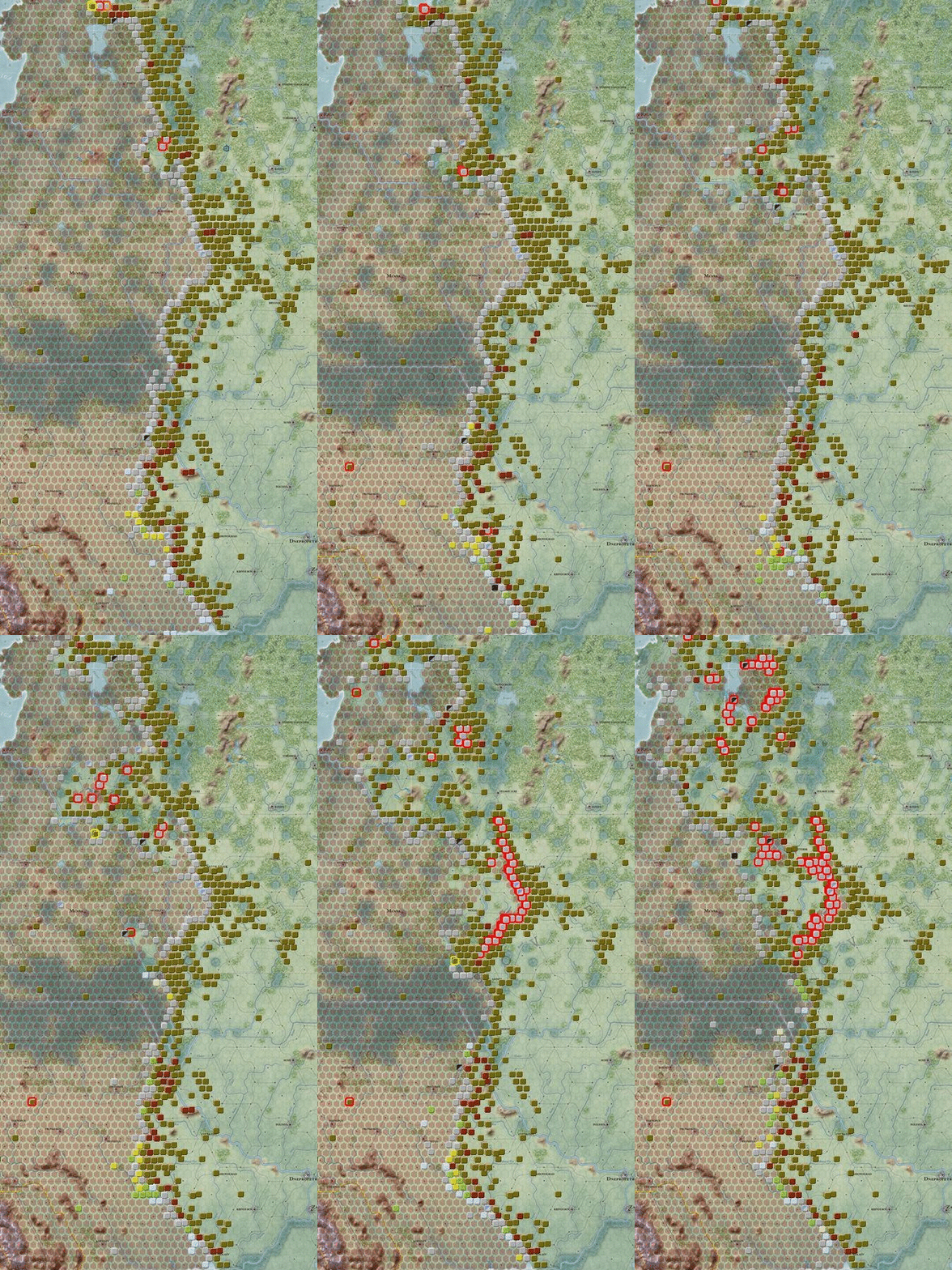
Here's a picture of what a few Russian tank corps can accomplish on German lines pulled tight as a drum. This is from mid-August '42 and covers about 7 turns:
"War is never a technical problem only, and if in pursuing technical solutions you neglect the psychological and the political, then the best technical solutions will be worthless." - Hermann Balck
Here's a picture of what a few Russian tank corps can accomplish on German lines pulled tight as a drum. This is from mid-August '42 and covers about 7 turns:
Aaaaargh! A horror movie! [X(]
You should have posted a warning! "Might be upsetting to sensitive persons". [;)]
Here's a picture of what a few Russian tank corps can accomplish on German lines pulled tight as a drum. This is from mid-August '42 and covers about 7 turns:
Is this against German AI (and you playing Soviets)?
Is this against German AI (and you playing Soviets)?
Yes, I'll put together an AAR at some point (don't won't to hijack this one), but this is a '41 GC as the Soviets against German AI, normal difficulty.
My point was the tanks show their worth when you can get them past the line, and let them run wild (like Patton after Cobra, or Guderian lunging for the Channel). If the enemy doesn't have the reserves on hand to quickly corral them, they'll be in trouble in a hurry.
"War is never a technical problem only, and if in pursuing technical solutions you neglect the psychological and the political, then the best technical solutions will be worthless." - Hermann Balck