Playing with the Big Boys

Panzer Command: Ostfront is the latest in a new series of 3D turn-based tactical wargames which include single battles, multi-battle operations and full war campaigns with realistic units, tactics and terrain and an informative and practical interface. Including a full Map Editor, 60+ Scenarios, 10 Campaigns and a very long list of improvements, this is the ultimate Panzer Command release for the Eastern Front!

Moderator: rickier65

Ratzki
Posts: 580
Joined: Sun Aug 17, 2008 9:32 pm
Location: Chilliwack, British Columbia

RE: Playing with the Big Boys

Post by Ratzki »

ORIGINAL: Mobius
ORIGINAL: Ratzki
if the Germans had come up with some HC ammunition for the KV2, I would not want to be trading shots with it. And I do agree that to say that US tanks would be dancing around the KV2 shooting it up is unrealistic in the setting that MR has said that the encounter occured.

In the TM listing German Ordinance 2 HE shells manufactured for Russian 152mm guns and one Anti-concrete type are described. No AP or HC.

The US 76mm gun is pretty accurate. They would have a 40% chance for first round hit on a 6.6' target at 1000 yds assuming a 25% error in ranging.
At 1000 yds the 152mm/L12 has a 7% chance of a first round hit against a similar size target.

Why would there be such a discrepancy in the to hit chances between these two rounds? I have never fired a76mm gun, but do reload and shoot a rather large range of rifle calibres. I am gonna compare my 338win and my 45-70gov't. with the 338 I was able to get somewhere north of 2600 feet per second from the muzzle, my 45-70 with a bullet weight almost twice that of the 338 I am starting to aproach 1825 feet per second. Now when at the range vs a stationary target there is absolutely no difference in my chances of putting both these rounds into a 6 inch circle at 200m. And in reality, the 45-70 with 6.5 inches of shorter barrel is more consistant and produces tighter groups. So within the effective range of my 3-9x scope, niether would seem to be at a disadvantage. I can snip the head off a grouse at around 30m with the 45-70 just as easily as the 338. Now at extreme ranges the data is the same, once you dial in your range the 45-70 is again equal to the 338, and I would say better as the big heavy bullet is not as affected by weather as is the smaller round. If you question the accuracy of the 45-70 you might want to ask the several million buffalo that were taken at ranges upwards of 1500m over open sights.
All this being said, I will give a little ground on a moving target, the 338 shoots flatter and faster making the initial targeting calculations easier. The 45-70 requires alot more lead time, there is more to consider with where the bullet crosses the optics' sights on the way up and on the way down and a more carefule choice of trigger pull oportunity, but again within the range of the optics, I would not hesitate to use either.
Are we talking that the 152mm is a poorer performer with reguards to accuracy because of the calibre and it's low velocity, and/or higher arcing trajectory, or is it more limited by the sights/optics being used compared to the US 76mm?
User avatar
Mad Russian
Posts: 13255
Joined: Sat Mar 15, 2008 9:29 pm
Location: Texas

RE: Playing with the Big Boys

Post by Mad Russian »

ORIGINAL: Mobius
ORIGINAL: Ratzki
if the Germans had come up with some HC ammunition for the KV2, I would not want to be trading shots with it. And I do agree that to say that US tanks would be dancing around the KV2 shooting it up is unrealistic in the setting that MR has said that the encounter occured.

In the TM listing German Ordinance 2 HE shells manufactured for Russian 152mm guns and one Anti-concrete type are described. No AP or HC.

The US 76mm gun is pretty accurate. They would have a 40% chance for first round hit on a 6.6' target at 1000 yds assuming a 25% error in ranging.
At 1000 yds the 152mm/L12 has a 7% chance of a first round hit against a similar size target.

Yes, but what about a hit close enough to damage the tank or crew?

The 152mm wouldn't have to get a direct hit to be effective.

Good Hunting.

MR
The most expensive thing in the world is free time.

Founder of HSG scenario design group for Combat Mission.
Panzer Command Ostfront Development Team.
Flashpoint Campaigns: Red Storm Development Team.
User avatar
Mad Russian
Posts: 13255
Joined: Sat Mar 15, 2008 9:29 pm
Location: Texas

RE: Playing with the Big Boys

Post by Mad Russian »

ORIGINAL: Yoozername

http://upload.wikimedia.org/wikipedia/commons/9/9f/Bundesarchiv_Bild_146-941%2C_Essen%2C_zerst%C3%B6rte_Krupp-Werke%2C_Luftaufnahme.jpg

Krupp works in Essen.

Original historic description: 
Bippa
Devastated Krupp Works in Essen
This aerial photo, taken from an artillery observation plane of Ninth U.S. Army's 79th Division, shows to the damage wrought to the Krupp tool plant at Essen, Germany, which was ponded by Allied air attacks and artillery of the Ninth Army before the city fell April 10, 1945, to troops of the 17th U.S. Airborne Division. Krupp was especially important to the enemy because so many other German armamonts factories were dependent on it for parts, such as armored platos and crankshafts. U.S. soldiers met little enemy resistence in the city, which had a peacetime population of 670,000. Essen is situated in the midst of one of the world's richest hard coal deposits and has been called the arsenal of Germany. U.S. Signal Corps Photo ETO-HQ-45-31874. Serviced by London OWI to list B certified as passed by shaef censor

Well, there you have it. Just because they had a KV-2 doesn't mean they used it.

Good Hunting.

MR
The most expensive thing in the world is free time.

Founder of HSG scenario design group for Combat Mission.
Panzer Command Ostfront Development Team.
Flashpoint Campaigns: Red Storm Development Team.
Yoozername
Posts: 1121
Joined: Fri Mar 03, 2006 10:42 pm

RE: Playing with the Big Boys

Post by Yoozername »

ORIGINAL: Mad Russian

ORIGINAL: Mobius
ORIGINAL: Ratzki
if the Germans had come up with some HC ammunition for the KV2, I would not want to be trading shots with it. And I do agree that to say that US tanks would be dancing around the KV2 shooting it up is unrealistic in the setting that MR has said that the encounter occured.

In the TM listing German Ordinance 2 HE shells manufactured for Russian 152mm guns and one Anti-concrete type are described. No AP or HC.

The US 76mm gun is pretty accurate. They would have a 40% chance for first round hit on a 6.6' target at 1000 yds assuming a 25% error in ranging.
At 1000 yds the 152mm/L12 has a 7% chance of a first round hit against a similar size target.

Yes, but what about a hit close enough to damage the tank or crew?

The 152mm wouldn't have to get a direct hit to be effective.

Good Hunting.

MR

The technical issue with this is that you are saying the gun is being aimed at the ground the target AFV is sitting on. Since its a direct fire weapon, it generally is aimed at the center of the target vehicle. In that case, misses left or right of the vehicle would travel quite far past the vehicle before impacting the ground. Misses that fly over the vehicle impact very far beyond the vehicle and those short rounds, unless landing right under the bow armor, would be mostly harmless.
User avatar
Mobius
Posts: 10339
Joined: Thu Jun 29, 2006 10:13 pm
Location: California
Contact:

RE: Playing with the Big Boys

Post by Mobius »

ORIGINAL: Ratzki
Why would there be such a discrepancy in the to hit chances between these two rounds? I have never fired a76mm gun, but do reload and shoot a rather large range of rifle calibres. I am gonna compare my 338win and my 45-70gov't. with the 338 I was able to get somewhere north of 2600 feet per second from the muzzle, my 45-70 with a bullet weight almost twice that of the 338 I am starting to aproach 1825 feet per second.
The 152mm has 918fps muzzle velocity and loses it fast. The US 90mm has a ballitistic cap which keeps its velocity high for a longer range. But the large shells have more chance of dispersion than your well shaped bullets. Look at the Lone Sentry page on the 90mm M82. It's maximum dispersion at 1000 yds is 5'. That's not inches thats feet. And that's very good for large rounds.
The classical BC should not change over the range. What does change is the drag. All projectile shapes have their own unique drag function. That is found by test firing the projectile or a model. BC just scales that up or down a projectile based on its size. (More modern tests using radar speed measurements have found that this is not entirely true but for WWII purposes it is close enough.)
All your Tanks are Belong to us!
panzer
User avatar
Mad Russian
Posts: 13255
Joined: Sat Mar 15, 2008 9:29 pm
Location: Texas

RE: Playing with the Big Boys

Post by Mad Russian »

ORIGINAL: Yoozername

Yes, but what about a hit close enough to damage the tank or crew?

The 152mm wouldn't have to get a direct hit to be effective.

Good Hunting.

MR
The technical issue with this is that you are saying the gun is being aimed at the ground the target AFV is sitting on. Since its a direct fire weapon, it generally is aimed at the center of the target vehicle. In that case, misses left or right of the vehicle would travel quite far past the vehicle before impacting the ground. Misses that fly over the vehicle impact very far beyond the vehicle and those short rounds, unless landing right under the bow armor, would be mostly harmless.

Nope, that's not what I'm saying at all. I'm saying the 152mm doesn't have to get a direct hit to be effective against smaller American vehicles to have an impact on them. Unlike the American guns which must penetrate the KV or hit the gun to have an impact on it.

Of course the KV would fire to hit the American vehicle but if it didn't the shell could cause collateral damage much easier than the US 75mm from return fire would if they missed.

Good Hunting.

MR
The most expensive thing in the world is free time.

Founder of HSG scenario design group for Combat Mission.
Panzer Command Ostfront Development Team.
Flashpoint Campaigns: Red Storm Development Team.
User avatar
Mad Russian
Posts: 13255
Joined: Sat Mar 15, 2008 9:29 pm
Location: Texas

RE: Playing with the Big Boys

Post by Mad Russian »

IF an M-36 shows up then we have a 90mm gun. If we're in Koln we could even have a Pershing....[X(]

Most support was with the Sherman 75mm. So, we can either go to best possible answer with an M-36 or a much more likely answer with a Sherman 75.

It looks like we are going to have to create this fight when PC4 gets here just to see how it plays out. [8D]

Good Hunting.

MR
The most expensive thing in the world is free time.

Founder of HSG scenario design group for Combat Mission.
Panzer Command Ostfront Development Team.
Flashpoint Campaigns: Red Storm Development Team.
Yoozername
Posts: 1121
Joined: Fri Mar 03, 2006 10:42 pm

RE: Playing with the Big Boys

Post by Yoozername »

During the production, the tank's turret was slightly improved and additional DT Machine-Gun was mounted in it. The shortened M-10 Howitzer was able to fire a 52-kg high-explosive projectile with muzzle velocity of 436 m/s.

That's 1417 fps.

MR: I do not think you understand the technical aspect. For the 152mm HE rounds to land alongside a targeted afv, the range would had to have been grossly underestimated. As I said before, misses that fly over the top of the target will impact far to the rear of the targeted tank. Rounds that miss the sides will fly far to the rear and explode way behind and to the sides of the tank.

To try to actually target the ground that a afv is sitting on would require iterations so that an observed burst could be adjusted so that the rounds 'walk' in. Unfortunately, dispersion would upset this plan and a targeted vehicle just has to move. Combined with the slow rate of fire, the ability of a KV-2 to take on armor is questionable. HE rounds that fell between firer and target would greatly obscure the target and make adjustments difficult.
User avatar
Mobius
Posts: 10339
Joined: Thu Jun 29, 2006 10:13 pm
Location: California
Contact:

RE: Playing with the Big Boys

Post by Mobius »

ORIGINAL: Yoozername

During the production, the tank's turret was slightly improved and additional DT Machine-Gun was mounted in it. The shortened M-10 Howitzer was able to fire a 52-kg high-explosive projectile with muzzle velocity of 436 m/s.

That's 1417 fps.
I picked the wrong gun from the list. @ 1417 it would have about a 17% chance of first round hit a 1000 yds.
All your Tanks are Belong to us!
panzer
Yoozername
Posts: 1121
Joined: Fri Mar 03, 2006 10:42 pm

RE: Playing with the Big Boys

Post by Yoozername »

ORIGINAL: Mobius
ORIGINAL: Ratzki
Why would there be such a discrepancy in the to hit chances between these two rounds? I have never fired a76mm gun, but do reload and shoot a rather large range of rifle calibres. I am gonna compare my 338win and my 45-70gov't. with the 338 I was able to get somewhere north of 2600 feet per second from the muzzle, my 45-70 with a bullet weight almost twice that of the 338 I am starting to aproach 1825 feet per second.
The 152mm has 918fps muzzle velocity and loses it fast. The US 90mm has a ballitistic cap which keeps its velocity high for a longer range. But the large shells have more chance of dispersion than your well shaped bullets. Look at the Lone Sentry page on the 90mm M82. It's maximum dispersion at 1000 yds is 5'. That's not inches thats feet. And that's very good for large rounds.
The classical BC should not change over the range. What does change is the drag. All projectile shapes have their own unique drag function. That is found by test firing the projectile or a model. BC just scales that up or down a projectile based on its size. (More modern tests using radar speed measurements have found that this is not entirely true but for WWII purposes it is close enough.)

Where do you see the '5 feet' on that website?

ACCURACY. Accuracy firings from the M3 Gun with the rounds loaded for a MV of 3,400 f/s have been conducted with the T30 type shot at a vertical target over a range of 2,100 yards. The extreme horizontal dispersion was 17 inches and the extreme vertical dispersion 30 inches.

ACCURACY. Accuracy firings have been conducted with the T33 round loaded for a M.V. of 2800 f/s and fired from a standard 90-mm Gun over a range of 700 yards at a vertical target. An extreme horizontal dispersion of 16 inches and an extreme vertical dispersion of 19 inches was obtained.

ACCURACY. Firings for accuracy with the round loaded for a M.V. of 2,800 f/s from the M3 Gun over a range of 2,100 yards at a vertical target gave an extreme horizontal dispersion of 41 inches and 70 inches extreme vertical dispersion.


User avatar
Mobius
Posts: 10339
Joined: Thu Jun 29, 2006 10:13 pm
Location: California
Contact:

RE: Playing with the Big Boys

Post by Mobius »

ORIGINAL: Yoozername
ACCURACY. Firings for accuracy with the round loaded for a M.V. of 2,800 f/s from the M3 Gun over a range of 2,100 yards at a vertical target gave an extreme horizontal dispersion of 41 inches and 70 inches extreme vertical dispersion.
That would be about 33 inches of vertical dispersion at 1000 yds.
All your Tanks are Belong to us!
panzer
Ratzki
Posts: 580
Joined: Sun Aug 17, 2008 9:32 pm
Location: Chilliwack, British Columbia

RE: Playing with the Big Boys

Post by Ratzki »

ORIGINAL: Mobius
ORIGINAL: Ratzki
Why would there be such a discrepancy in the to hit chances between these two rounds? I have never fired a76mm gun, but do reload and shoot a rather large range of rifle calibres. I am gonna compare my 338win and my 45-70gov't. with the 338 I was able to get somewhere north of 2600 feet per second from the muzzle, my 45-70 with a bullet weight almost twice that of the 338 I am starting to aproach 1825 feet per second.
The 152mm has 918fps muzzle velocity and loses it fast. The US 90mm has a ballitistic cap which keeps its velocity high for a longer range. But the large shells have more chance of dispersion than your well shaped bullets. Look at the Lone Sentry page on the 90mm M82. It's maximum dispersion at 1000 yds is 5'. That's not inches thats feet. And that's very good for large rounds.
The classical BC should not change over the range. What does change is the drag. All projectile shapes have their own unique drag function. That is found by test firing the projectile or a model. BC just scales that up or down a projectile based on its size. (More modern tests using radar speed measurements have found that this is not entirely true but for WWII purposes it is close enough.)
Below is a selection of 45 cal. bullets, hardly a streamlined work of art. Now I am not trying to be difficult, I am just trying to understand why the 152mm would be so much more inaccurate vs a non-moving target. A more common factory load pushes the 405 grain bullet out the muzzle at about 1300 feet per second in my 45-70, this is rather slow by hunting standards. It's trajectory is +1.3" at 100m and falls off to -22.9" at 200m. Does this mean you can't hit anything at 200m or more, not at all. Adjust your elevation and take the shot, I would say your gonna be on target. So now back to the 152mm and trying to see this as a big deer rifle, would it be a combination of no rifling in the barrel, along with poor optics that account for the poor hit chances?
As for Yoozername's comment about landing a shell on the ground close to the target, as long as you know the trajectory of the projectile at a given range, I do not see the problem, just add or subtract elevation, I am pretty sure that I can hit a can sitting on the ground just as easy as one 6-8 feet off the ground. Now I do not think that a tank crew would purposely aim the 152mm at the ground, but if you were shooting at the tracks and you came up short by a couple yards, might not be a bad thing. Now if the crew did want to shoot and land the HE on the ground near the target, I do not see this as being a big deal.
http://i279.photobucket.com/albums/kk13 ... /45-70.jpg

Image
Attachments
4570.jpg
4570.jpg (50.89 KiB) Viewed 448 times
User avatar
Mobius
Posts: 10339
Joined: Thu Jun 29, 2006 10:13 pm
Location: California
Contact:

RE: Playing with the Big Boys

Post by Mobius »

ORIGINAL: Ratzki
Below is a selection of 45 cal. bullets, hardly a streamlined work of art. Now I am not trying to be difficult, I am just trying to understand why the 152mm would be so much more inaccurate vs a non-moving target. A more common factory load pushes the 405 grain bullet out the muzzle at about 1300 feet per second in my 45-70, this is rather slow by hunting standards. It's trajectory is +1.3" at 100m and falls off to -22.9" at 200m. Does this mean you can't hit anything at 200m or more, not at all. Adjust your elevation and take the shot,
http://www.gunsandammo.com/ballistics-t ... istics_tab
Though not ACL it looks like it falls 1.3" at 30yds.

Image
Attachments
45mmbal.jpg
45mmbal.jpg (75.78 KiB) Viewed 448 times
All your Tanks are Belong to us!
panzer
Yoozername
Posts: 1121
Joined: Fri Mar 03, 2006 10:42 pm

RE: Playing with the Big Boys

Post by Yoozername »

As for Yoozername's comment about landing a shell on the ground close to the target, as long as you know the trajectory of the projectile at a given range, I do not see the problem, just add or subtract elevation, I am pretty sure that I can hit a can sitting on the ground just as easy as one 6-8 feet off the ground. Now I do not think that a tank crew would purposely aim the 152mm at the ground, but if you were shooting at the tracks and you came up short by a couple yards, might not be a bad thing. Now if the crew did want to shoot and land the HE on the ground near the target, I do not see this as being a big deal.
http://i279.photobucket.com/albums/kk13 ... /45-70.jpg

But if you aimed at a can 6-8 feet off the ground, you would not likely hit the ground close to the target. That is the point. I would caution anyone using handgun ammo as examples. Its not a very good analogy. You are not even speaking of dispersion.

The 152mm HE round is not a low velocity howitzer round. At the ranges we are speaking of, using direct fire, its misses, while aiming at center of mass of a target would not likely strike near the ground of the target tank. The most likely 'near-miss' would be a shell landing in front of the target vehicle. Unfortunately, that would have to be very close. The area in front of an exploding HE shell is least likely to inflict damage to a afv (at the velocity we are speaking about, the shell is landing at an extreme angle). The best chance for collataral damage is a near miss to the direct flank of the target AFV. Any round landing there within 20 meters or so might have payoff. But as I have said already, that would be an uncommon result.

Yoozername
Posts: 1121
Joined: Fri Mar 03, 2006 10:42 pm

RE: Playing with the Big Boys

Post by Yoozername »

ORIGINAL: Mobius

ORIGINAL: Yoozername
ACCURACY. Firings for accuracy with the round loaded for a M.V. of 2,800 f/s from the M3 Gun over a range of 2,100 yards at a vertical target gave an extreme horizontal dispersion of 41 inches and 70 inches extreme vertical dispersion.
That would be about 33 inches of vertical dispersion at 1000 yds.

Given the extreme height and width of the KV-2, it would not be a gun fight at all. The KV-2 would be hit and penetrated.

Pershing tank accounts speak of shooting the chimneys off houses at this kind of range. I can provide an account. 3AD website.

Edit: reviewing the famous 'roadblock' story regarding the KV-2....does it ever mention the KV-2 knocking out a AFV??? It mentions it knocking out trucks, 50mm pak, a 88mm that hasn't been setup yet...but its tricked by a feint and another 88 gets it.

Are there any other KV-2 accounts?
User avatar
Mad Russian
Posts: 13255
Joined: Sat Mar 15, 2008 9:29 pm
Location: Texas

RE: Playing with the Big Boys

Post by Mad Russian »

ORIGINAL: Yoozername

Are there any other KV-2 accounts?

I haven't found anything on the effectiveness of the KV-2 tank vs German tanks. The accounts are all German and they fall in the, "OMG LOOK AT THAT!", category.

The action at Lipki had 2 German tanks knocked out but it doesn't say by what.

Good Hunting.

MR
The most expensive thing in the world is free time.

Founder of HSG scenario design group for Combat Mission.
Panzer Command Ostfront Development Team.
Flashpoint Campaigns: Red Storm Development Team.
Ratzki
Posts: 580
Joined: Sun Aug 17, 2008 9:32 pm
Location: Chilliwack, British Columbia

RE: Playing with the Big Boys

Post by Ratzki »

ORIGINAL: Yoozername
As for Yoozername's comment about landing a shell on the ground close to the target, as long as you know the trajectory of the projectile at a given range, I do not see the problem, just add or subtract elevation, I am pretty sure that I can hit a can sitting on the ground just as easy as one 6-8 feet off the ground. Now I do not think that a tank crew would purposely aim the 152mm at the ground, but if you were shooting at the tracks and you came up short by a couple yards, might not be a bad thing. Now if the crew did want to shoot and land the HE on the ground near the target, I do not see this as being a big deal.
http://i279.photobucket.com/albums/kk13 ... /45-70.jpg

But if you aimed at a can 6-8 feet off the ground, you would not likely hit the ground close to the target. That is the point. I would caution anyone using handgun ammo as examples. Its not a very good analogy. You are not even speaking of dispersion.

The 152mm HE round is not a low velocity howitzer round. At the ranges we are speaking of, using direct fire, its misses, while aiming at center of mass of a target would not likely strike near the ground of the target tank. The most likely 'near-miss' would be a shell landing in front of the target vehicle. Unfortunately, that would have to be very close. The area in front of an exploding HE shell is least likely to inflict damage to a afv (at the velocity we are speaking about, the shell is landing at an extreme angle). The best chance for collataral damage is a near miss to the direct flank of the target AFV. Any round landing there within 20 meters or so might have payoff. But as I have said already, that would be an uncommon result.

Of course I admit to shot dispersion from any calibre from my .45 all the way up to 152mm. I am not talking a handgun, but a rifle from a bench at a range. Is the dispersion proportionally increased as the calilbre of the round goes up? ... Haven't done the math but it would look like it might be. Still I can not place any shot in the same hole over and over, all day long. I even get the occaisional flyer that might be off several inches, this is not the norm but it does happen. As far as using small arms examples, I fail to see why it might be a bad idea. The same rules of physics apply to both, just the ranges and the trajectories are different.
Why would you say that using dierct fire, the shot misses? How is this a given, yet the Pershing is hitting chimneys without a problem. I would dare to say that if a guy had some good training with both guns and fully understood the limitaions of both rounds at the same range (as long as this range falls within the gun's and optic's ability to be sighted in and aimed point blank) that both rounds would have pretty much an equal chance of hitting a stationary target, reguardless of size or distance off the ground. Now a faster moving projectile lessens and increases the range where a point blank shot will be possible. A slower moving projectile will have a smaller window of ranges where a point blank shot will occur, but it will still have the chance to do so within a given range. The chances for scoring a first hit shot be almost identical with both, with only a small chance caused by SD and BC of each projectile missing the target. What this means to me is I would not be taking on a Pershing at 2500m because the calculation to hit the target with the 152mm gun will be extreme, and might not even be possble due to gun elevation limitations. The Pershig in this example would be at the advantage but he too would be making some targetting calculations due to the limits of the gun he is using. Solution, position the KV to take the pershing on at my 152mm's point blank range. Now it will come down to who has the best gunner as to who will hit who first and though the 152mm shell might not be able to penetrate the frontal armour at 500m, it might rip everything off the Pershing with the shrapnel and render the US tank out of service due to optics failure or what have you.
User avatar
Mobius
Posts: 10339
Joined: Thu Jun 29, 2006 10:13 pm
Location: California
Contact:

RE: Playing with the Big Boys

Post by Mobius »

ORIGINAL: Mad Russian
ORIGINAL: Yoozername

Are there any other KV-2 accounts?

I haven't found anything on the effectiveness of the KV-2 tank vs German tanks. The accounts are all German and they fall in the, "OMG LOOK AT THAT!", category.

The action at Lipki had 2 German tanks knocked out but it doesn't say by what.

Good Hunting.

MR
I just ordered the new book on the KV. Maybe that will shed some light on why some authors describe it having 110mm or more on the front turret at odds with some photos.
All your Tanks are Belong to us!
panzer
User avatar
Mobius
Posts: 10339
Joined: Thu Jun 29, 2006 10:13 pm
Location: California
Contact:

RE: Playing with the Big Boys

Post by Mobius »

ORIGINAL: Ratzki
Why would you say that using dierct fire, the shot misses? How is this a given, yet the Pershing is hitting chimneys without a problem. I would dare to say that if a guy had some good training with both guns and fully understood the limitaions of both rounds at the same range (as long as this range falls within the gun's and optic's ability to be sighted in and aimed point blank) that both rounds would have pretty much an equal chance of hitting a stationary target, reguardless of size or distance off the ground. Now a faster moving projectile lessens and increases the range where a point blank shot will be possible. A slower moving projectile will have a smaller window of ranges where a point blank shot will occur, but it will still have the chance to do so within a given range. The chances for scoring a first hit shot be almost identical with both, with only a small chance caused by SD and BC of each projectile missing the target. What this means to me is I would not be taking on a Pershing at 2500m because the calculation to hit the target with the 152mm gun will be extreme, and might not even be possble due to gun elevation limitations.
This is the idea of needing to correctly estimate ranges to get a hit. You can be off a bit and still hit. But as you can see if the trajectory is flatter your estimate can be off considerably and still hit. On the other hand with an arcing shot your range estimate has to be right on or your shell will fall short or fly over the trarget.
This illustration was from "World War II Ballistics: Armor and Gunnery' by Lorrin Bird and Robert Livingston.


Image
Attachments
75mmballistics2.jpg
75mmballistics2.jpg (147.07 KiB) Viewed 448 times
All your Tanks are Belong to us!
panzer
Ratzki
Posts: 580
Joined: Sun Aug 17, 2008 9:32 pm
Location: Chilliwack, British Columbia

RE: Playing with the Big Boys

Post by Ratzki »

ORIGINAL: Mobius

ORIGINAL: Ratzki
Why would you say that using dierct fire, the shot misses? How is this a given, yet the Pershing is hitting chimneys without a problem. I would dare to say that if a guy had some good training with both guns and fully understood the limitaions of both rounds at the same range (as long as this range falls within the gun's and optic's ability to be sighted in and aimed point blank) that both rounds would have pretty much an equal chance of hitting a stationary target, reguardless of size or distance off the ground. Now a faster moving projectile lessens and increases the range where a point blank shot will be possible. A slower moving projectile will have a smaller window of ranges where a point blank shot will occur, but it will still have the chance to do so within a given range. The chances for scoring a first hit shot be almost identical with both, with only a small chance caused by SD and BC of each projectile missing the target. What this means to me is I would not be taking on a Pershing at 2500m because the calculation to hit the target with the 152mm gun will be extreme, and might not even be possble due to gun elevation limitations.
This is the idea of needing to correctly estimate ranges to get a hit. You can be off a bit and still hit. But as you can see if the trajectory is flatter your estimate can be off considerably and still hit. On the other hand with an arcing shot your range estimate has to be right on or your shell will fall short or fly over the trarget.
This illustration was from "World War II Ballistics: Armor and Gunnery' by Lorrin Bird and Robert Livingston.


Image


Image
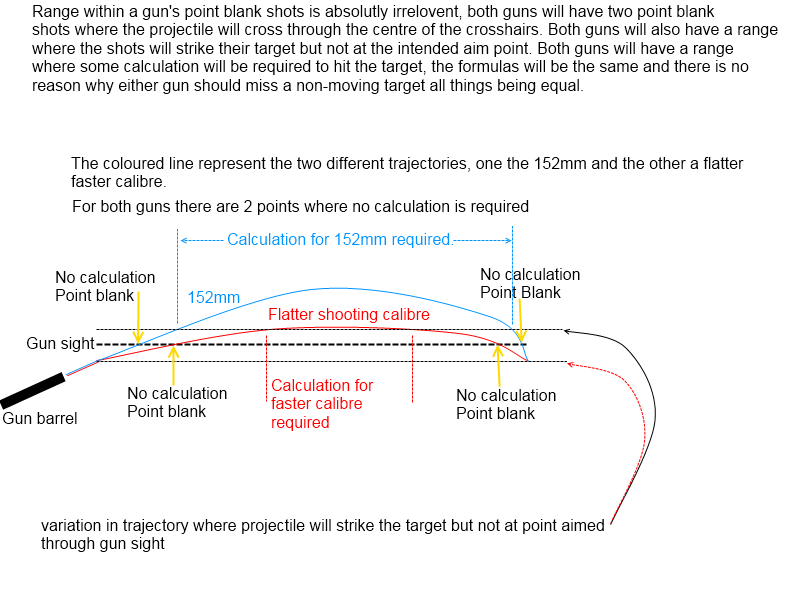
I think that we are on the same wavelength overall, my question comes back to first shot hit chances on a stationary target within each calibres effective ranges. Is the differences due to optics, or what? I just can't figure why a larger slower shooting calibre would have any less chances of striking it's target then would a faster shooting gun. I do understand the the chances for error increase with the higher arcing trajectory of the slower gun as range increases but without knowing the 152mm's characteristics I would say that out to 500m would there be any less chance of hitting it's target as the trajectory beteen the two point blank ranges would be reduced and the trajectory beteen these two ranges would not be that great.
Post Reply

Return to “Panzer Command: Ostfront”