

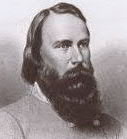
Maj. Gen. Patrick Ronayne Cleburne, CSA (b. 1828, d. 1864) was often called „Stonewall of the West“, and probably one of the best divisional commanders of the South. He was born in Ireland as third child of Joseph Cleburne, a doctor in Cork County. The Cleburne family was member of the protestant Church of Ireland, which distinguished them from most of their neighbours. When Patrick was fifteen years old, his father died and the second son had to take up a lot of responsibility. On 27 February 1846 Cleburne enlisted in the British Army and became a soldier in the 41st Regiment of Foot. But he was released from service in the rank of Corporal in 1849, when his family immigrated to the United States. While most of his siblings found jobs in the Midwest, Patrick Cleburne started his new life in Helena, Arkansas. He rose from managing a drugstore to lawyer. Influenced by Thomas C. Hindman, Cleburne became a Democrat soon after the Kansas-Nebraska Act. In the summer of 1860 the Irishman helped to organize a militia in Helena and was elected its captain. When most of the Arkansas troops were turned over to the Confederate army, Cleburne became commander of the 1st Arkansas regiment in William J. Hardee’s brigade. When Hardee was made divisional commander by Albert Sydney Johnston, Cleburne rose to brigade command and was promoted to Brig. Gen (March 4 1862). At Shiloh in his first major battle he led well but lost 38 Percent of his men (the 6th Mississippi even lost 300 of its 425 men, the fourth highest rate by any unit in any battle of the war). Cleburne afterward took part in the Kentucky invasion of 1862, being detached to Kirby Smith. He was wounded at the battle of Richmond (KY), saying afterwards he “caught the ball in his mouth and spat it out” and fought well at Perryville though the outnumbered Confederate army had to retreat. Later in the war Cleburne would recommend to free slaves with their families and let them fight for the South to increase the number of soldiers.
Cleburne was stubborn in battle, motivating his men and showed several times his personal courage. His performance in Kentucky brought him divisional command in the newly created Army of Tennessee under Gen. Braxton Bragg as part of Hardee’s corps. In December 1862 Pat was promoted to Maj. Gen. The first test of his new command was the battle of Murfreesboro, which resulted in yet another retreat though Cleburne fought brilliantly. At Chickamauga Cleburne’s division (now in Daniel H. Hill’s corps, who had replaced Hardee) fought on the Confederate right against George Thomas’ XIV. corps. At Missionary Ridge Cleburne’s men hold the Confederate right wing against the main Union attacking force more than seven times stronger in numbers. His division acted as rear guard after the Southern defeat and held Ringgold Gap against all odds. In the spring of 1864 the Army of Tennessee, now under Joseph E. Johnston, was hard pressed by William T. Sherman’s army and gave much ground in Georgia. At Pickett’s Mill Cleburne’s men repulsed a large scale Yankee attack and another at Kennesaw Mountain, this time well entrenched. The division played a key role in the Battle of Bald Hill, one of the four battles for Atlanta, attempts by John Bell Hood, who succeeded Johnston in army command, to throw back Sherman. At the battle of Jonesboro Cleburne commanded for the first and last time a whole corps. The Confederates lost and had to evacuate Atlanta. Hood blamed Hardee and Cleburne for it. While Hardee was transferred from the army, Cleburne served during Hood’s invasion of Tennessee. When Hood personally ordered a frontal assault on the Union line at Franklin in November 1864 Cleburne obeyed but was killed in the action. He was interred in Rose Hill cemetery but his body was removed twice until he could finally be buried in Helena in 1870, on the way to Arkansas there were public processions – in Memphis even Jefferson Davis attended.
Ldr: 7
Tact: 6
Init: 4
Cmd: 5
Cav: 0
Teaches: Sharpshooting, Entrenching, Charging, morale and discipline
Bio Patrick R. Cleburne
Moderator: Gil R.
-
jkBluesman
- Posts: 797
- Joined: Mon Feb 12, 2007 6:48 pm
Bio Patrick R. Cleburne
"War is the field of chance."
Carl von Clausewitz
Carl von Clausewitz
-
General Quarters
- Posts: 1059
- Joined: Sun Dec 03, 2006 1:08 pm
RE: Bio Patrick R. Cleburne
The last sentence in the first paragraph "Late in the war ..." doesn't quick track.
RE: Bio Patrick R. Cleburne
I had to read it twice, but I figured it out: "free" is a verb, not an adjective. I'll make it a bit more clear when I edit it.
Michael Jordan plays ball. Charles Manson kills people. I torment eager potential customers by not sharing screenshots of "Brother Against Brother." Everyone has a talent.
-
jkBluesman
- Posts: 797
- Joined: Mon Feb 12, 2007 6:48 pm
RE: Bio Patrick R. Cleburne
Cleburne did not want to abolish slavery as an institution but wanted to arm slaves. To motivate them to fight he wanted to give them and their families freedom. His plan came very close to what Lee proposed to the Confederate government in 1864 (or even 1865).
"War is the field of chance."
Carl von Clausewitz
Carl von Clausewitz
RE: Bio Patrick R. Cleburne
I've now edited Cleburne's bio. Since it came in over the maximum 3900 characters I had to shorten it, so I took out most of the details about his time in Ireland. Here's how it looks now:
Maj. Gen. Patrick Ronayne Cleburne (b. 1828, d. 1864). Cleburne, whose great personal courage, leadership skills, and tactical genius led him often to be called the “Stonewall of the West,” is widely considered one of the best divisional commanders of the South. Despite his considerable gifts, however, he never rose to corps command, since his controversial call in 1864 for freeing slaves who would take up arms for the Confederacy led him to be passed over for promotion. I reworked the information about Cleburne and the slaves, since in the original draft it didn’t really fit, and needed to be moved. I got the info about his career being stalled from Wikipedia – if this is inaccurate please let me know. He was born in Cork County, Ireland, but in 1849 ended up moving to the United States with his orphaned siblings in the aftermath of his father’s death, having served for three years in the British Army as a corporal. While most of his siblings found jobs in the Midwest, Cleburne started his new life in Helena, Arkansas, eventually becoming a lawyer. Influenced by future Confederate Gen. Thomas C. Hindman, at whose wedding Cleburne served as best man, Cleburne became a Democrat soon after the Kansas-Nebraska Act. In the summer of 1860, he helped to organize a militia in Helena and was elected its captain. When most Arkansas troops were turned over to the Confederate army, Cleburne became commander of the 1st Arkansas regiment in Gen. William J. Hardee’s brigade, and when Hardee was made divisional commander under Gen. Albert S. Johnston, Cleburne rose to brigade command, gaining his promotion to Brigadier General on March 4, 1862. At Shiloh, his first major battle, he performed well but lost 38% of his men nonetheless, in a battle so brutal that one regiment, the 6th Mississippi, lost 300 of its 425 men. Cleburne next took part in the Kentucky invasion of 1862, being detached to Gen. Kirby Smith’s command. He was wounded at the Battle of Richmond (Kentucky), saying afterwards he “caught the ball in his mouth and spat it out,” and fought well at Perryville until the outnumbered Confederate army was forced to retreat. Cleburne’s performance in Kentucky brought him a divisional command in the newly created Army of Tennessee under Gen. Braxton Bragg as part of Hardee’s corps, and that December he was promoted to Major General. The first test of his new command was the Battle of Murfreesboro, which resulted in yet another retreat, though Cleburne fought brilliantly. At Chickamauga, Cleburne’s division, serving under Hardee’s replacement Gen. D.H. Hill, fought on the Confederate right against Gen. George Thomas’ XIV Corps. At Missionary Ridge, Cleburne’s men held the Confederate right wing against a main Union attacking force outnumbering them more than sevenfold. His division acted as rear guard after the Southern defeat and held Ringgold Gap against all odds. In the spring of 1864, the Army of Tennessee, now under Gen. Joseph E. Johnston, was hard pressed by Gen. William T. Sherman’s army and gave much ground in Georgia. At Pickett’s Mill Cleburne’s men repulsed a large scale Yankee attack and another at Kennesaw Mountain, this time from a well-entrenched position. The division also played a key role in the Battle of Bald Hill, one of the four battles for Atlanta by which Gen. John B. Hood, Johnston’s successor, attempted to throw back Sherman. At the Battle of Jonesboro, Cleburne commanded a whole corps for the first and last time, but the battle ended in defeat and the Confederates had to evacuate Atlanta. Hood blamed Hardee and Cleburne for this result, but while Hardee was transferred from the army, Cleburne continued to serve under Hood during the invasion of Tennessee. When Hood personally ordered a frontal assault on the Union line at the Battle of Franklin in November 1864, Cleburne obeyed despite his opposition to the tactic, and was killed. He was interred in Rose Hill Cemetery, but his body was eventually brought back to Helena for burial in 1870, with Jefferson Davis among those attending the public processions along the way. (Bio by Joern Kaesebier)
Note: We already voted on Cleburne’s ratings, and he got 7-7-7-7-0. Your ratings strike me as more realistic, but the masses have voted. Do people think that they should be changed?
Ldr: 7
Tact: 6
Init: 4
Cmd: 5
Cav: 0
As for teachable abilities, I’ve already given him Shooters, Obedient, Wild, Steady and Disciplined. Are those okay? You recommended Sharpshooting (which isn’t a teachable ability), Entrenching (which is a good idea, though many other generals already have it), Charging (again, it’s quite common, but Wild lets units make opportunity charges), morale (no such ability, but Steady certainly helps) and discipline (great minds think alike).
Maj. Gen. Patrick Ronayne Cleburne (b. 1828, d. 1864). Cleburne, whose great personal courage, leadership skills, and tactical genius led him often to be called the “Stonewall of the West,” is widely considered one of the best divisional commanders of the South. Despite his considerable gifts, however, he never rose to corps command, since his controversial call in 1864 for freeing slaves who would take up arms for the Confederacy led him to be passed over for promotion. I reworked the information about Cleburne and the slaves, since in the original draft it didn’t really fit, and needed to be moved. I got the info about his career being stalled from Wikipedia – if this is inaccurate please let me know. He was born in Cork County, Ireland, but in 1849 ended up moving to the United States with his orphaned siblings in the aftermath of his father’s death, having served for three years in the British Army as a corporal. While most of his siblings found jobs in the Midwest, Cleburne started his new life in Helena, Arkansas, eventually becoming a lawyer. Influenced by future Confederate Gen. Thomas C. Hindman, at whose wedding Cleburne served as best man, Cleburne became a Democrat soon after the Kansas-Nebraska Act. In the summer of 1860, he helped to organize a militia in Helena and was elected its captain. When most Arkansas troops were turned over to the Confederate army, Cleburne became commander of the 1st Arkansas regiment in Gen. William J. Hardee’s brigade, and when Hardee was made divisional commander under Gen. Albert S. Johnston, Cleburne rose to brigade command, gaining his promotion to Brigadier General on March 4, 1862. At Shiloh, his first major battle, he performed well but lost 38% of his men nonetheless, in a battle so brutal that one regiment, the 6th Mississippi, lost 300 of its 425 men. Cleburne next took part in the Kentucky invasion of 1862, being detached to Gen. Kirby Smith’s command. He was wounded at the Battle of Richmond (Kentucky), saying afterwards he “caught the ball in his mouth and spat it out,” and fought well at Perryville until the outnumbered Confederate army was forced to retreat. Cleburne’s performance in Kentucky brought him a divisional command in the newly created Army of Tennessee under Gen. Braxton Bragg as part of Hardee’s corps, and that December he was promoted to Major General. The first test of his new command was the Battle of Murfreesboro, which resulted in yet another retreat, though Cleburne fought brilliantly. At Chickamauga, Cleburne’s division, serving under Hardee’s replacement Gen. D.H. Hill, fought on the Confederate right against Gen. George Thomas’ XIV Corps. At Missionary Ridge, Cleburne’s men held the Confederate right wing against a main Union attacking force outnumbering them more than sevenfold. His division acted as rear guard after the Southern defeat and held Ringgold Gap against all odds. In the spring of 1864, the Army of Tennessee, now under Gen. Joseph E. Johnston, was hard pressed by Gen. William T. Sherman’s army and gave much ground in Georgia. At Pickett’s Mill Cleburne’s men repulsed a large scale Yankee attack and another at Kennesaw Mountain, this time from a well-entrenched position. The division also played a key role in the Battle of Bald Hill, one of the four battles for Atlanta by which Gen. John B. Hood, Johnston’s successor, attempted to throw back Sherman. At the Battle of Jonesboro, Cleburne commanded a whole corps for the first and last time, but the battle ended in defeat and the Confederates had to evacuate Atlanta. Hood blamed Hardee and Cleburne for this result, but while Hardee was transferred from the army, Cleburne continued to serve under Hood during the invasion of Tennessee. When Hood personally ordered a frontal assault on the Union line at the Battle of Franklin in November 1864, Cleburne obeyed despite his opposition to the tactic, and was killed. He was interred in Rose Hill Cemetery, but his body was eventually brought back to Helena for burial in 1870, with Jefferson Davis among those attending the public processions along the way. (Bio by Joern Kaesebier)
Note: We already voted on Cleburne’s ratings, and he got 7-7-7-7-0. Your ratings strike me as more realistic, but the masses have voted. Do people think that they should be changed?
Ldr: 7
Tact: 6
Init: 4
Cmd: 5
Cav: 0
As for teachable abilities, I’ve already given him Shooters, Obedient, Wild, Steady and Disciplined. Are those okay? You recommended Sharpshooting (which isn’t a teachable ability), Entrenching (which is a good idea, though many other generals already have it), Charging (again, it’s quite common, but Wild lets units make opportunity charges), morale (no such ability, but Steady certainly helps) and discipline (great minds think alike).
Michael Jordan plays ball. Charles Manson kills people. I torment eager potential customers by not sharing screenshots of "Brother Against Brother." Everyone has a talent.
-
jkBluesman
- Posts: 797
- Joined: Mon Feb 12, 2007 6:48 pm
RE: Bio Patrick R. Cleburne
Sorry, I had been gone for a few days. I am sorry for making it too long but you have shortened the text at the right spots, thanks.
As for the information you got from Wikipedia. There has been a controversial debate on the question why Cleburne was never given corps command. I think that Craig L. Symonds summarises the debate best in his biography “Stonewall of the West. Patrick Cleburne & the Civil War”. His call for arming the slaves was kept a secret by the army and by President Davis. So it was probably not the reason for not promoting him. More important seems that Cleburne was foreign born, had not been to West Point and part of the Anti-Bragg party in the Army of Tennessee. However Symonds says that not even Hardee who had supported Cleburne from the beginning suggested Cleburne for corps command. This was due to Cleburne’s lack of initiative on the strategic level. Why he would grap it on the tactic level exploit any advantage, he never really made plans of how and where the army should strike the enemy. (That is why I would not have voted a 7 in Initiative and Command for him)
As for the teaching abilities, by including entrenching I wanted to include the great actions of Cleburne’s division as the army’s rear guard, wining skirmishes and minor battles against the odds.
As for the information you got from Wikipedia. There has been a controversial debate on the question why Cleburne was never given corps command. I think that Craig L. Symonds summarises the debate best in his biography “Stonewall of the West. Patrick Cleburne & the Civil War”. His call for arming the slaves was kept a secret by the army and by President Davis. So it was probably not the reason for not promoting him. More important seems that Cleburne was foreign born, had not been to West Point and part of the Anti-Bragg party in the Army of Tennessee. However Symonds says that not even Hardee who had supported Cleburne from the beginning suggested Cleburne for corps command. This was due to Cleburne’s lack of initiative on the strategic level. Why he would grap it on the tactic level exploit any advantage, he never really made plans of how and where the army should strike the enemy. (That is why I would not have voted a 7 in Initiative and Command for him)
As for the teaching abilities, by including entrenching I wanted to include the great actions of Cleburne’s division as the army’s rear guard, wining skirmishes and minor battles against the odds.
"War is the field of chance."
Carl von Clausewitz
Carl von Clausewitz
RE: Bio Patrick R. Cleburne
Thanks for the response. I changed that sentence to: "Despite his considerable gifts, however, he never rose to corps command: while some believe this was because of his controversial call in January 1864 for freeing slaves so that they could take up arms for the Confederacy, which was kept secret at the time, but it appears instead to have been due to his foreign birth, lack of a West Point pedigree, poor relations with Gen. Braxton Bragg, and lack of strategic initiative." Is that a good way of handling it?
That puts the bio over by 200 char., but for now I want to make sure that it is right. Then comes some shortening.
As for teachable abilities, plenty of other CSA generals have Diggers, so I think I'll not give it to Cleburne as well. Instead, I think I'll follow your idea of dropping his Initiative to "Fair," which will let me give him "Dreaded," since he'll be less likely to head an army. Also, instead of "Diggers" I'll give him "Independent," which reflects his use of sharpshooters and his rearguard actions. So, his new abilities are: "Shooters, Dreaded, Wild, Independent, Obedient."
That puts the bio over by 200 char., but for now I want to make sure that it is right. Then comes some shortening.
As for teachable abilities, plenty of other CSA generals have Diggers, so I think I'll not give it to Cleburne as well. Instead, I think I'll follow your idea of dropping his Initiative to "Fair," which will let me give him "Dreaded," since he'll be less likely to head an army. Also, instead of "Diggers" I'll give him "Independent," which reflects his use of sharpshooters and his rearguard actions. So, his new abilities are: "Shooters, Dreaded, Wild, Independent, Obedient."
Michael Jordan plays ball. Charles Manson kills people. I torment eager potential customers by not sharing screenshots of "Brother Against Brother." Everyone has a talent.
-
jkBluesman
- Posts: 797
- Joined: Mon Feb 12, 2007 6:48 pm
RE: Bio Patrick R. Cleburne
Sounds good to me. Maybe you can cut the part with the Mississippi regiment or the quote with bullet though it makes the bio more vivid.
"War is the field of chance."
Carl von Clausewitz
Carl von Clausewitz
RE: Bio Patrick R. Cleburne
Okay, I've gotten back to Cleburne, and reduced the bio to about 3870 characters. I was able to shorten it mainly be rephrasing things. The only facts dropped from the bio were the fate of that Miss. regiment at Shiloh and the fact that Cleburne's siblings ended up in the Midwest whereas he went to Helena. So, this bio is pretty much intact, and good to go.
Maj. Gen. Patrick Ronayne Cleburne (b. 1828, d. 1864). Cleburne, whose great personal courage, leadership skills, and tactical genius led him often to be called the “Stonewall of the West,” is widely considered one of the best divisional commanders of the South. Despite his considerable gifts, however, he never rose to corps command: while some believe this was because of his controversial call in January 1864 for freeing slaves so that they could take up arms for the Confederacy, which was kept secret at the time, but it appears instead to have been due to his foreign birth, lack of a West Point pedigree, poor relations with Gen. Braxton Bragg, and lack of strategic initiative. He was born in Ireland, but in 1849 moved to the United States with his orphaned siblings after his father’s death, having served for three years in the British Army as a corporal. Cleburne started his new life in Helena, Arkansas, eventually becoming a lawyer. Influenced by future Confederate Gen. Thomas C. Hindman, at whose wedding he served as best man, Cleburne became a Democrat soon after the Kansas-Nebraska Act. In the summer of 1860, he helped to organize and was elected captain of the Yell Rifles in Helena. When most Arkansas troops were turned over to the Confederate army, Cleburne became commander of the 1st Arkansas regiment in Gen. William J. Hardee’s brigade, and when Hardee was made divisional commander under Gen. Albert S. Johnston, Cleburne rose to brigade command, gaining his promotion to Brigadier General on March 4, 1862. At Shiloh, his first major battle, he performed well but lost 38% of his men nonetheless. Cleburne next took part in the Kentucky invasion of 1862, being detached to Gen. Kirby Smith’s command. He was wounded at the Battle of Richmond, saying afterwards he “caught the ball in his mouth and spat it out,” and fought well at Perryville until the outnumbered Confederate army was forced to retreat. Cleburne’s performance in Kentucky brought him a divisional command as part of Hardee’s corps in Bragg’s newly created Army of Tennessee, and that December he was promoted to Major General. The first test of his new command was the Battle of Murfreesboro, which resulted in yet another retreat, though Cleburne fought brilliantly. At Chickamauga, Cleburne’s division, serving under Hardee’s replacement Gen. D.H. Hill, fought on the Confederate right against Gen. George Thomas’ XIV Corps. At Missionary Ridge, Cleburne’s men held the Confederate right wing against a main Union attacking force outnumbering them more than sevenfold. His division acted as rear guard after the Southern defeat and held Ringgold Gap against all odds. In the spring of 1864, the Army of Tennessee, now under Gen. Joseph E. Johnston, was hard pressed by Gen. William T. Sherman’s army and gave much ground in Georgia. At Pickett’s Mill Cleburne’s men repulsed a large scale Yankee attack and another at Kennesaw Mountain, this time from a well-entrenched position. The division also played a key role in the Battle of Bald Hill, one of the four battles for Atlanta by which Gen. John B. Hood, Johnston’s successor, attempted to throw back Sherman. At the Battle of Jonesboro, Cleburne commanded a whole corps for the first and last time, but the battle ended in defeat and the Confederates had to evacuate Atlanta. Hood blamed Hardee and Cleburne for this result, but while Hardee was transferred from the army, Cleburne continued to serve under Hood during the invasion of Tennessee. When Hood ordered a frontal assault on the Union line at the Battle of Franklin on Nov. 30, 1864, Cleburne obeyed despite being opposed, and was killed. He was interred in Rose Hill Cemetery, but his body was eventually brought back to Helena for burial in 1870, with Jefferson Davis among those attending the public processions along the way. (Bio by Joern Kaesebier)
Maj. Gen. Patrick Ronayne Cleburne (b. 1828, d. 1864). Cleburne, whose great personal courage, leadership skills, and tactical genius led him often to be called the “Stonewall of the West,” is widely considered one of the best divisional commanders of the South. Despite his considerable gifts, however, he never rose to corps command: while some believe this was because of his controversial call in January 1864 for freeing slaves so that they could take up arms for the Confederacy, which was kept secret at the time, but it appears instead to have been due to his foreign birth, lack of a West Point pedigree, poor relations with Gen. Braxton Bragg, and lack of strategic initiative. He was born in Ireland, but in 1849 moved to the United States with his orphaned siblings after his father’s death, having served for three years in the British Army as a corporal. Cleburne started his new life in Helena, Arkansas, eventually becoming a lawyer. Influenced by future Confederate Gen. Thomas C. Hindman, at whose wedding he served as best man, Cleburne became a Democrat soon after the Kansas-Nebraska Act. In the summer of 1860, he helped to organize and was elected captain of the Yell Rifles in Helena. When most Arkansas troops were turned over to the Confederate army, Cleburne became commander of the 1st Arkansas regiment in Gen. William J. Hardee’s brigade, and when Hardee was made divisional commander under Gen. Albert S. Johnston, Cleburne rose to brigade command, gaining his promotion to Brigadier General on March 4, 1862. At Shiloh, his first major battle, he performed well but lost 38% of his men nonetheless. Cleburne next took part in the Kentucky invasion of 1862, being detached to Gen. Kirby Smith’s command. He was wounded at the Battle of Richmond, saying afterwards he “caught the ball in his mouth and spat it out,” and fought well at Perryville until the outnumbered Confederate army was forced to retreat. Cleburne’s performance in Kentucky brought him a divisional command as part of Hardee’s corps in Bragg’s newly created Army of Tennessee, and that December he was promoted to Major General. The first test of his new command was the Battle of Murfreesboro, which resulted in yet another retreat, though Cleburne fought brilliantly. At Chickamauga, Cleburne’s division, serving under Hardee’s replacement Gen. D.H. Hill, fought on the Confederate right against Gen. George Thomas’ XIV Corps. At Missionary Ridge, Cleburne’s men held the Confederate right wing against a main Union attacking force outnumbering them more than sevenfold. His division acted as rear guard after the Southern defeat and held Ringgold Gap against all odds. In the spring of 1864, the Army of Tennessee, now under Gen. Joseph E. Johnston, was hard pressed by Gen. William T. Sherman’s army and gave much ground in Georgia. At Pickett’s Mill Cleburne’s men repulsed a large scale Yankee attack and another at Kennesaw Mountain, this time from a well-entrenched position. The division also played a key role in the Battle of Bald Hill, one of the four battles for Atlanta by which Gen. John B. Hood, Johnston’s successor, attempted to throw back Sherman. At the Battle of Jonesboro, Cleburne commanded a whole corps for the first and last time, but the battle ended in defeat and the Confederates had to evacuate Atlanta. Hood blamed Hardee and Cleburne for this result, but while Hardee was transferred from the army, Cleburne continued to serve under Hood during the invasion of Tennessee. When Hood ordered a frontal assault on the Union line at the Battle of Franklin on Nov. 30, 1864, Cleburne obeyed despite being opposed, and was killed. He was interred in Rose Hill Cemetery, but his body was eventually brought back to Helena for burial in 1870, with Jefferson Davis among those attending the public processions along the way. (Bio by Joern Kaesebier)
Michael Jordan plays ball. Charles Manson kills people. I torment eager potential customers by not sharing screenshots of "Brother Against Brother." Everyone has a talent.
-
christof139

- Posts: 980
- Joined: Thu Dec 07, 2006 1:43 am
RE: Bio Patrick R. Cleburne
Cleburne is another tough one to assign attributes to. I just read a passage somewhere that told of him inspecting fieldworks that weren't constructed to his satisfaction, where upon he ordered the Infantry and Arty. there to improve them ASAP. He was a super trooper.
However, at Murfreesboro at least 3 of his 4 Brigades broke and routed after an initial successful advance when the lead Brigade hit Union resistance. The Yanks fired only 2 to 4 ragged volleys at this lead Brigade and it just took off to the rear, and routed through another Brigade which also then routed itself, while a Brigade en echelon to the right also split the scene. An example of mass hysteria occurring for not really any reason and it shows that this happens to all troops at one time or another. Just a tidbit of info.
Chris
However, at Murfreesboro at least 3 of his 4 Brigades broke and routed after an initial successful advance when the lead Brigade hit Union resistance. The Yanks fired only 2 to 4 ragged volleys at this lead Brigade and it just took off to the rear, and routed through another Brigade which also then routed itself, while a Brigade en echelon to the right also split the scene. An example of mass hysteria occurring for not really any reason and it shows that this happens to all troops at one time or another. Just a tidbit of info.
Chris
'What is more amazing, is that amongst all those approaching enemies there is not one named Gisgo.' Hannibal Barcid (or Barca) to Gisgo, a Greek staff officer, Cannae.
That's the CSS North Carolina BB-55
Boris Badanov, looking for Natasha Goodenov
That's the CSS North Carolina BB-55
Boris Badanov, looking for Natasha Goodenov
RE: Bio Patrick R. Cleburne
Interesting.
As for teachable abilities, sometimes it's hard to figure out even one obvious one, but sometimes there are guys like Cleburne for whom more than a dozen might apply. As I mentioned above, I've decided to go with Shooters, Dreaded, Wild, Independent, and Obedient. I've written elsewhere that I prefer not to give "Dreaded" to generals who might lead whole armies, but Cleburne doesn't become a general until early 1862, so there's less of a chance for him to teach it than someone who's a general from the very first turn.
As for teachable abilities, sometimes it's hard to figure out even one obvious one, but sometimes there are guys like Cleburne for whom more than a dozen might apply. As I mentioned above, I've decided to go with Shooters, Dreaded, Wild, Independent, and Obedient. I've written elsewhere that I prefer not to give "Dreaded" to generals who might lead whole armies, but Cleburne doesn't become a general until early 1862, so there's less of a chance for him to teach it than someone who's a general from the very first turn.
Michael Jordan plays ball. Charles Manson kills people. I torment eager potential customers by not sharing screenshots of "Brother Against Brother." Everyone has a talent.