

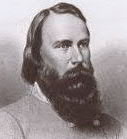
Gen. Robert Edward Lee (b. 1807, d. 1870). The son of revolutionary hero “Light Horse Harry” graduated from West Point in 1829 as second in his class and the only cadet without a single demerit. He was assigned to the Corps of Engineers. During the Mexican-American War he earned three brevet promotions. In 1852 he became superintendent of West Point for three years, served afterwards at the frontier and captured John Brown at Harper’s Ferry in 1859. At the beginning of the secession crisis Lee was offered to lead the Union army but declined because his loyalty rested with Virginia and though it meant that his property in Arlington, Virginia (today National Cemetery) would be confiscated. So Lee resigned his commission as colonel and was made general of the Virginia state forces and a full general of the Confederate army in August 1861. His first military operation in West Virginia in the fall of 1861 was a failure and earned him the nickname “Granny Lee”. His direction of Gen. Thomas “Stonewall” Jackson’s valley campaign that should threaten Washington, D.C. showed Lee’s talents as strategist. His chance as field commander came when Gen. Joseph E. Johnston was wounded in the battle of Seven Pines. Lee took over and fought the Federals back in the Battles of the Seven Days. Lee thought that the outnumbered Confederate armies had to take great risks in order to win the war. He always tried to hold the initiative. His strategy was either to get the Confederates local superiority in numbers or to separate his forces–thus one part would hold the enemy in place while the other would attack the enemy’s flank or rear. The latter worked very well with his corps commanders Gen. James Longstreet and Jackson. With them Lee achieved great victories at Second Manassas (August 29-30, 1862), Fredericksburg (December 13, 1862) and–without Longstreet–Chancellorsville (May 2-3, 1863). Lee’s audacity let him risk separating his forces in Maryland as well. When his lost orders fell in Union hands he stayed and gave battle at Antietam (September 17, 1862) nevertheless to win a battle on Northern soil. Officer and historian Edward Porter Alexander called this Lee’s “greatest military blunder” as the best possible outcome under the circumstances was a drawn battle. Thus it was and the Southerners had to retreat to Virginia. Lee was not at his best during the second invasion of the North either. At Gettysburg (July 1-3, 1863) he let Gen. A.P. Hill start a battle although Lee had given order not to bring on a major engagement. Without knowledge of the enemy position and force Lee stayed and fought what he believed at first was only the isolated vanguard of the Army of the Potomac. But after the repulse of Pickett’s Charge he had to retreat south. In the campaign of 1864 “Mars Bob” tried to strike the Army of the Potomac where he could and to seize the initiative. But Gen. Ulysses Grant kept advancing. Lee’s army inflicted high casualties on the enemy in the Wilderness (May 5-6, 1864), at Spotsylvania Court House (May 8-12, 1864) and Cold Harbor (June 3, 1864). However, it suffered significant losses as well and the South did not have the manpower to sustain them. The Army of Northern Virginia fell back into the entrenchments at Petersburg. Lee tried to relief the siege by threatening Washington once again, but the plan failed. Deserters, casualties and the stretching of his lines made it only a matter of time before Lee, appointed general-in-chief of all Confederate forces in January 1865, had to give up Petersburg and subsequently Richmond. After the lost Battle of Five Forks (April 1, 1865), Lee withdrew. He got caught by his pursuers and surrendered his army to Grant at Appomattox Court House on April 9, 1865. After the war he became president of Washington College (later renamed Washington and Lee University) in Lexington Virginia, where he was also buried.
Ldr: 8
Tact: 7
Init: 8
Cmd: 8
Cav: 0
suggested Teaches: Diggers, Brave, Obedient, Independent, Wild
Note: I had to cut my own draft several times to get finally 3900 characters. I did not want to shorten more. So if anyone would like to add things, please make a suggestion where to cut down. I concentrated of the Civil War life of Lee though I would have liked to include more of his prewar years and the way he is momorialized.
Gen. Robert Edward Lee
Moderator: Gil R.
-
jkBluesman
- Posts: 797
- Joined: Mon Feb 12, 2007 6:48 pm
Gen. Robert Edward Lee
"War is the field of chance."
Carl von Clausewitz
Carl von Clausewitz
RE: Gen. Robert Edward Lee
A bio for Lee! Now we're getting somewhere...
Michael Jordan plays ball. Charles Manson kills people. I torment eager potential customers by not sharing screenshots of "Brother Against Brother." Everyone has a talent.
RE: Gen. Robert Edward Lee
Here's the Lee bio, which does a great job hitting on the key points. It's a bit too long, mainly because I added stuff, but I figured I'd first run it by people before shortening it.
Gen. Robert Edward Lee (b. 1807, d. 1870). The son of Revolutionary War hero Henry “Light-Horse Harry” Lee graduated from West Point second in the class of 1829, the only cadet without a single demerit. He was assigned to the Corps of Engineers, and did not see battle until the Mexican-American War, in which he earned three brevet promotions. In 1852, Lee became superintendent of West Point for three years, served afterwards at the frontier and captured John Brown at Harper’s Ferry in 1859. At the beginning of the secession crisis Lee was offered to lead the Union army but declined because his loyalty rested with Virginia, even though it meant that his property in Arlington, Virginia would be confiscated (and, as later turned out, used for Arlington National Cemetery). Instead, Lee resigned his commission as colonel and was made general of the Virginia state forces and a full general of the Confederate army in August 1861. His first military operation in West Virginia that fall was a failure and earned him the nickname “Granny Lee,” for his age and perceived unwillingness to fight. His direction of Gen. “Stonewall” Jackson’s valley campaign that should threaten Washington, D.C. showed Lee’s talents as strategist. Lee’s chance as a field commander came when Gen. Joseph E. Johnston was wounded in the Battle of Seven Pines (May 31, 1862). Lee took command of the Army of Northern Virginia and fought the Federals back in the Seven Days’ Battles. Lee thought that the outnumbered Confederate armies had to take great risks in order to win the war; he always tried to hold the initiative. His strategy was either to reach local superiority in numbers or to separate his forces, with one part holding the enemy in place while the other would attack the enemy’s flank or rear. The latter approach worked very well partly because of his gifted corps commanders, Jackson and Gen. James Longstreet, with whom Lee achieved great victories at Second Manassas (August 29-30, 1862), Fredericksburg (December 13, 1862) and – without Longstreet – Chancellorsville (May 2-3, 1863). Lee’s audacity let him risk separating his forces during the Maryland Campaign as well. When his lost orders fell into Union hands he nevertheless stayed and gave battle at Antietam (September 17, 1862), hoping to win a battle on Northern soil. Officer and historian Edward P. Alexander called this Lee’s “greatest military blunder,” as the best possible outcome under the circumstances was a drawn battle. Thus it was, and the Southerners had to retreat to Virginia. Lee was not at his best during the second invasion of the North, either: at Gettysburg (July 1-3, 1863) he let Gen. A.P. Hill start a battle, although Lee had given orders not to bring on a major engagement. Without knowledge of the enemy position and force Lee stayed and fought what he believed at first was only the isolated vanguard of the Army of the Potomac – not the whole army. After the repulse of Pickett’s Charge he had to retreat back to Virginia. The following year, Lee repeatedly tried to strike the Army of the Potomac where he could and to seize the initiative. But Gen. Ulysses S. Grant, now in command of the army and intent on causing Lee’s forces maximum damage in a war of attrition, kept advancing. Lee’s army inflicted high casualties on the enemy in the Wilderness (May 5-6, 1864), at Spotsylvania Court House (May 8-12, 1864) and Cold Harbor (June 3, 1864). However, it suffered significant losses as well and the South did not have the manpower to sustain them. The Army of Northern Virginia fell back into the entrenchments at Petersburg. Lee tried to relieve the siege by threatening Washington once again, but his plan failed. Deserters, casualties and the stretching of his lines made it only a matter of time before Lee, appointed general-in-chief of all Confederate forces in January 1865, had to give up Petersburg and subsequently Richmond. After the lost Battle of Five Forks (April 1, 1865), Lee withdrew even farther, hoping to join up with Johnston’s forces in North Carolina, but his army was caught and cut off from retreat by his pursuers, and he was forced to surrender his army to Grant at Appomattox Court House on April 9, 1865. After the war he became president of Washington College (now Washington & Lee University) in Lexington Virginia, where he was also buried after his death from a stroke on October 12, 1870. (Bio by Joern Kaesebier)
Gen. Robert Edward Lee (b. 1807, d. 1870). The son of Revolutionary War hero Henry “Light-Horse Harry” Lee graduated from West Point second in the class of 1829, the only cadet without a single demerit. He was assigned to the Corps of Engineers, and did not see battle until the Mexican-American War, in which he earned three brevet promotions. In 1852, Lee became superintendent of West Point for three years, served afterwards at the frontier and captured John Brown at Harper’s Ferry in 1859. At the beginning of the secession crisis Lee was offered to lead the Union army but declined because his loyalty rested with Virginia, even though it meant that his property in Arlington, Virginia would be confiscated (and, as later turned out, used for Arlington National Cemetery). Instead, Lee resigned his commission as colonel and was made general of the Virginia state forces and a full general of the Confederate army in August 1861. His first military operation in West Virginia that fall was a failure and earned him the nickname “Granny Lee,” for his age and perceived unwillingness to fight. His direction of Gen. “Stonewall” Jackson’s valley campaign that should threaten Washington, D.C. showed Lee’s talents as strategist. Lee’s chance as a field commander came when Gen. Joseph E. Johnston was wounded in the Battle of Seven Pines (May 31, 1862). Lee took command of the Army of Northern Virginia and fought the Federals back in the Seven Days’ Battles. Lee thought that the outnumbered Confederate armies had to take great risks in order to win the war; he always tried to hold the initiative. His strategy was either to reach local superiority in numbers or to separate his forces, with one part holding the enemy in place while the other would attack the enemy’s flank or rear. The latter approach worked very well partly because of his gifted corps commanders, Jackson and Gen. James Longstreet, with whom Lee achieved great victories at Second Manassas (August 29-30, 1862), Fredericksburg (December 13, 1862) and – without Longstreet – Chancellorsville (May 2-3, 1863). Lee’s audacity let him risk separating his forces during the Maryland Campaign as well. When his lost orders fell into Union hands he nevertheless stayed and gave battle at Antietam (September 17, 1862), hoping to win a battle on Northern soil. Officer and historian Edward P. Alexander called this Lee’s “greatest military blunder,” as the best possible outcome under the circumstances was a drawn battle. Thus it was, and the Southerners had to retreat to Virginia. Lee was not at his best during the second invasion of the North, either: at Gettysburg (July 1-3, 1863) he let Gen. A.P. Hill start a battle, although Lee had given orders not to bring on a major engagement. Without knowledge of the enemy position and force Lee stayed and fought what he believed at first was only the isolated vanguard of the Army of the Potomac – not the whole army. After the repulse of Pickett’s Charge he had to retreat back to Virginia. The following year, Lee repeatedly tried to strike the Army of the Potomac where he could and to seize the initiative. But Gen. Ulysses S. Grant, now in command of the army and intent on causing Lee’s forces maximum damage in a war of attrition, kept advancing. Lee’s army inflicted high casualties on the enemy in the Wilderness (May 5-6, 1864), at Spotsylvania Court House (May 8-12, 1864) and Cold Harbor (June 3, 1864). However, it suffered significant losses as well and the South did not have the manpower to sustain them. The Army of Northern Virginia fell back into the entrenchments at Petersburg. Lee tried to relieve the siege by threatening Washington once again, but his plan failed. Deserters, casualties and the stretching of his lines made it only a matter of time before Lee, appointed general-in-chief of all Confederate forces in January 1865, had to give up Petersburg and subsequently Richmond. After the lost Battle of Five Forks (April 1, 1865), Lee withdrew even farther, hoping to join up with Johnston’s forces in North Carolina, but his army was caught and cut off from retreat by his pursuers, and he was forced to surrender his army to Grant at Appomattox Court House on April 9, 1865. After the war he became president of Washington College (now Washington & Lee University) in Lexington Virginia, where he was also buried after his death from a stroke on October 12, 1870. (Bio by Joern Kaesebier)
Michael Jordan plays ball. Charles Manson kills people. I torment eager potential customers by not sharing screenshots of "Brother Against Brother." Everyone has a talent.
-
jkBluesman
- Posts: 797
- Joined: Mon Feb 12, 2007 6:48 pm
RE: Gen. Robert Edward Lee
Funny, you readded some of the stuff I had deleted during my adjusting to get it down to the right length, like "retreat back to Virginia".
"War is the field of chance."
Carl von Clausewitz
Carl von Clausewitz
RE: Gen. Robert Edward Lee
Ironic.
It's right now about 500 characters over. I'm editing the Grant bio at the moment, but will shorten this one soon. I'll probably delete the sentence "His direction of Gen. “Stonewall” Jackson’s valley campaign that should threaten Washington, D.C. showed Lee’s talents as strategist," since though important it doesn't directly deal with Lee's own exploits. Not sure, though.
It's right now about 500 characters over. I'm editing the Grant bio at the moment, but will shorten this one soon. I'll probably delete the sentence "His direction of Gen. “Stonewall” Jackson’s valley campaign that should threaten Washington, D.C. showed Lee’s talents as strategist," since though important it doesn't directly deal with Lee's own exploits. Not sure, though.
Michael Jordan plays ball. Charles Manson kills people. I torment eager potential customers by not sharing screenshots of "Brother Against Brother." Everyone has a talent.
-
jkBluesman
- Posts: 797
- Joined: Mon Feb 12, 2007 6:48 pm
RE: Gen. Robert Edward Lee
If you delete it, you have to look to the part dealing with Petersburg: "Lee tried to relieve the siege by threatening Washington once again".
I included the strategist phrase to show how Lee prevented a Union concentration of forces and explore the Confederate advantage of interior lines.
But the information on the valley campaign might be included in Jackson's bio, so it could be deleted here.
I included the strategist phrase to show how Lee prevented a Union concentration of forces and explore the Confederate advantage of interior lines.
But the information on the valley campaign might be included in Jackson's bio, so it could be deleted here.
"War is the field of chance."
Carl von Clausewitz
Carl von Clausewitz
RE: Gen. Robert Edward Lee
Thanks. Here’s the shortened version. I did take out that sentence as well as the bit about his property in Arlington, plus I removed mention of Lee’s service in the Corps of Engineers, removed several specific dates for battles, and changed around some wording to get down to the proper size. Unless there are any objections, this is the version I’ll use.
Gen. Robert Edward Lee (b. 1807, d. 1870). The son of Revolutionary War hero Henry “Light-Horse Harry” Lee graduated second in West Point’s class of 1829, the only cadet without a single demerit. He first saw battle in the Mexican War, earning three brevet promotions. Between the wars, served in several posts, including superintendent of West Point, and in 1859 captured John Brown at Harper’s Ferry. At the beginning of the secession crisis, Lee was offered command of the U.S. Army but declined because his loyalty rested with Virginia, which was leaving the Union. Instead, Lee resigned his commission as colonel and was made general of the Virginia state forces and, in August, a full general of the Confederate army. His first military operation in western Virginia that September was a failure and earned him the nickname “Granny Lee,” for his age and seeming unwillingness to fight. Lee’s chance as a field commander came when Gen. Joseph E. Johnston was wounded in the Battle of Seven Pines on May 31, 1862. Lee took command of the Army of Northern Virginia and beat back the Union in the Seven Days’ Battles. Lee thought that the outnumbered Confederate armies had to take great risks in order to win the war; he always tried to hold the initiative. His strategy was either to reach local superiority in numbers or to separate his forces, with one part holding the enemy in place while the other would attack the enemy’s flank or rear. The latter approach worked very well partly because of his gifted corps commanders, Gen. “Stonewall” Jackson and Gen. James Longstreet, with whom in 1862 and 1863 Lee achieved great victories at Second Manassas, Fredericksburg and – without Longstreet – Chancellorsville. Lee’s audacity let him risk separating his forces during the Maryland Campaign as well. When his lost orders fell into Union hands he nevertheless stayed and gave battle at Antietam on September 17, 1862, hoping to win a battle on Northern soil. Officer and historian Edward P. Alexander called this Lee’s “greatest military blunder,” as the best possible outcome under the circumstances was a draw. Thus it was, and the Southerners had to retreat to Virginia. Lee was not at his best during the second invasion of the North, either: at Gettysburg on July 1-3, 1863, he let Gen. A.P. Hill start a battle, although Lee had given orders not to bring on a major engagement. Without knowledge of the enemy position and force Lee stayed and fought what he believed at first was only the isolated vanguard of the Army of the Potomac – not the whole army. After the repulse of Pickett’s Charge he had to retreat back to Virginia. The following year, Lee repeatedly tried to strike the Army of the Potomac where he could and to seize the initiative. But Gen. Ulysses S. Grant, now in command of the army and intent on causing Lee’s forces maximum damage in a war of attrition, kept advancing. Lee’s army inflicted high casualties on the enemy in the Wilderness, at Spotsylvania Court House and Cold Harbor in May-June 1864. However, it suffered significant losses as well, and the South did not have the manpower to replace these. Lee’s army fell back into the entrenchments at Petersburg, and after his attempt to relieve the siege by threatening Washington failed, it was only a matter of time before Lee, appointed general-in-chief of all Confederate forces in January 1865, had to give up Petersburg and subsequently Richmond. After the Battle of Five Forks on April 1, Lee withdrew even farther, hoping to join up with Johnston’s forces in North Carolina, but his army was cut off from retreat, forcing Lee to surrender to Grant at Appomattox Court House on April 9. After the war Lee became president of Washington College (now Washington & Lee University) in Lexington, where he was buried after his death from a stroke on October 12, 1870. (Bio by Joern Kaesebier)
Gen. Robert Edward Lee (b. 1807, d. 1870). The son of Revolutionary War hero Henry “Light-Horse Harry” Lee graduated second in West Point’s class of 1829, the only cadet without a single demerit. He first saw battle in the Mexican War, earning three brevet promotions. Between the wars, served in several posts, including superintendent of West Point, and in 1859 captured John Brown at Harper’s Ferry. At the beginning of the secession crisis, Lee was offered command of the U.S. Army but declined because his loyalty rested with Virginia, which was leaving the Union. Instead, Lee resigned his commission as colonel and was made general of the Virginia state forces and, in August, a full general of the Confederate army. His first military operation in western Virginia that September was a failure and earned him the nickname “Granny Lee,” for his age and seeming unwillingness to fight. Lee’s chance as a field commander came when Gen. Joseph E. Johnston was wounded in the Battle of Seven Pines on May 31, 1862. Lee took command of the Army of Northern Virginia and beat back the Union in the Seven Days’ Battles. Lee thought that the outnumbered Confederate armies had to take great risks in order to win the war; he always tried to hold the initiative. His strategy was either to reach local superiority in numbers or to separate his forces, with one part holding the enemy in place while the other would attack the enemy’s flank or rear. The latter approach worked very well partly because of his gifted corps commanders, Gen. “Stonewall” Jackson and Gen. James Longstreet, with whom in 1862 and 1863 Lee achieved great victories at Second Manassas, Fredericksburg and – without Longstreet – Chancellorsville. Lee’s audacity let him risk separating his forces during the Maryland Campaign as well. When his lost orders fell into Union hands he nevertheless stayed and gave battle at Antietam on September 17, 1862, hoping to win a battle on Northern soil. Officer and historian Edward P. Alexander called this Lee’s “greatest military blunder,” as the best possible outcome under the circumstances was a draw. Thus it was, and the Southerners had to retreat to Virginia. Lee was not at his best during the second invasion of the North, either: at Gettysburg on July 1-3, 1863, he let Gen. A.P. Hill start a battle, although Lee had given orders not to bring on a major engagement. Without knowledge of the enemy position and force Lee stayed and fought what he believed at first was only the isolated vanguard of the Army of the Potomac – not the whole army. After the repulse of Pickett’s Charge he had to retreat back to Virginia. The following year, Lee repeatedly tried to strike the Army of the Potomac where he could and to seize the initiative. But Gen. Ulysses S. Grant, now in command of the army and intent on causing Lee’s forces maximum damage in a war of attrition, kept advancing. Lee’s army inflicted high casualties on the enemy in the Wilderness, at Spotsylvania Court House and Cold Harbor in May-June 1864. However, it suffered significant losses as well, and the South did not have the manpower to replace these. Lee’s army fell back into the entrenchments at Petersburg, and after his attempt to relieve the siege by threatening Washington failed, it was only a matter of time before Lee, appointed general-in-chief of all Confederate forces in January 1865, had to give up Petersburg and subsequently Richmond. After the Battle of Five Forks on April 1, Lee withdrew even farther, hoping to join up with Johnston’s forces in North Carolina, but his army was cut off from retreat, forcing Lee to surrender to Grant at Appomattox Court House on April 9. After the war Lee became president of Washington College (now Washington & Lee University) in Lexington, where he was buried after his death from a stroke on October 12, 1870. (Bio by Joern Kaesebier)
Michael Jordan plays ball. Charles Manson kills people. I torment eager potential customers by not sharing screenshots of "Brother Against Brother." Everyone has a talent.
-
jkBluesman
- Posts: 797
- Joined: Mon Feb 12, 2007 6:48 pm