

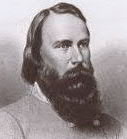
Lt. Gen. Ulysses Simpson Grant (b. 1822, d. 1885). Growing up in Ohio as Hiram Ulysses Grant he was registered at West Point by mistake as Ulysses Simpson Grant (Simpson being his mother’s maiden name) and kept that name: After graduating in 1843 Grant served in the infantry. His distinguished service during the Mexican-American War brought him promotion to captain but he resigned from the army in 1854 to live with his family. When Pres. Abraham Lincoln called for volunteers in 1861 to meet the secession crisis, Grant helped to raise troops in Illinois and got in command of a regiment. He quickly rose from colonel to Brig. Gen. (August 1861). Grant preferred offensive to defensive warfare and had a great grasp for strategic situations. Thus he developed a plan to capture Fort Henry and Fort Donelson in Tennessee. It was carried out successfully in February 1862, the Union army taking 15 000 prisoners, forcing the Confederates to retreat from Kentucky. Nicknamed “Unconditional Surrender” Grant for his reply when asked for terms at Fort Donelson, Grant was awarded promotion to Maj. Gen. of Volunteers (February 16, 1862). His first major battle was at Shiloh. His forces were pushed back on the first day, but he remained calm and determined to continue the struggle on the second day. Reinforced, Grant whipped the Confederates. Gen. Henry Halleck, his superior, reduced him to second-in-command nevertheless during the advancement on Corinth. But when Halleck went to Washington, D.C. as general-in-chief, Grant got in command of the Army of Tennessee and won the battles of Iuka and Corinth. His greatest challenge became the capture of Vicksburg on the Mississippi river. Various approaches failed, but in April 1863 he was successful by abandoning his supply lines and living from the country. Grant’s men defeated a Confederate rescue force at Jackson, pushed the defenders of Vicksburg back into their trenches and besieged the city. Gen. John Pemberton had to surrender the last important Confederate stronghold on the Mississippi July 4, 1863. Grants next task was to relief the besieged Union forces in Chattanooga. In several engagements culminating in the Battle of Missionary Ridge, he drove the enemy from Tennessee. As first American after George Washington, Grant was appointed Lt. Gen. (March 2, 1864) and commander-in-chief ten days later. For the campaigns of 1864, he ordered the Union armies to advance on all fronts, so that the pressured South could not reinforce one theatre with troops from others. Grant himself stayed with the Army of the Potomac, formally still under control of Gen. George Mead. As his direct opponent Gen. Robert E. Lee, Grant knew how to read his enemy. He was therefore determined to seize and keep the initiative. In the ensuing battles both sides were almost constantly entrenched making attacks very costly. The Virginian topography did not give much room for maneuvering, so when Grant tried to get around Lee’s right flank, the Confederates would get into his way as in the Wilderness, Spottsylvania Courthouse and Cold Harbour. The last being a costly frontal attack he later regretted. But U.S. Grant would “fight it out on this line if it takes all summer”, as he put it. So he once tried to get around Lee’s left flank – and succeeded. But the plan to seize Petersburg was thwarted by Gen. Benjamin Butler’s and W. F. Smith’s conduct. Lee could reinforce the defenders and a siege endured. Success on other fronts and at Five Forks enabled Grant to dislodge Lee in April, 1865 and to force him to surrender at Appomattox Court House on the 9th. After the war, Grant oversaw the reduction of the army. He was elected President twice (1868 and 1872) but his administration was well-known for its corruption. He himself stayed integer but lost later his money in bad investments. In order to support his family financially, Grant wrote his memoirs. He died from throat cancer a few days after finishing them.
Ldr: 8
Tact: 7
Init: 8
Cmd: 8
Cav: 0
suggested Teaches: Brave, Oblique_Fire, Steady, Resilient, Organized
The text is still 80 spaces too long. But the editor-in-chief will be able to shorten, I am sure. I just hope that there are not too many wishes for further information or stories related to Grant.
Lt. Gen. U.S. Grant
Moderator: Gil R.
-
jkBluesman
- Posts: 797
- Joined: Mon Feb 12, 2007 6:48 pm
Lt. Gen. U.S. Grant
"War is the field of chance."
Carl von Clausewitz
Carl von Clausewitz
RE: Lt. Gen. U.S. Grant
And here's the edited version. It's impossible to get in everything that needs to be there, but this gets across the basics. In editing it I did puff it up, but can always shorten it (somehow).
Lt. Gen. Ulysses Simpson Grant (b. 1822, d. 1885). Born on April 27, 1822 in Ohio as Hiram Ulysses Grant, he was registered at West Point by mistake as Ulysses Simpson Grant (Simpson being his mother’s maiden name) and kept that name. After graduating in 1843 Grant served in the infantry. His distinguished service during the Mexican-American War brought him promotion to captain, but he resigned from the army in 1854 to live with his family. When Pres. Abraham Lincoln called for volunteers in 1861 to meet the secession crisis, Grant helped to raise troops in Illinois and gained command of a regiment. He quickly rose from colonel to brigadier general by August. Grant preferred offensive warfare to defensive and had a great grasp for strategic situations: thus he developed a plan to capture Fort Henry and Fort Donelson in Tennessee, which he carried out successfully in February 1862, taking 15 000 prisoners and forcing the Confederates to retreat from Kentucky. Nicknamed “Unconditional Surrender” Grant for his reply when asked for terms at Fort Donelson, Grant was awarded promotion to Major General of Volunteers effective February 16, the date the fort fell. His first major battle was at Shiloh, where Grant turned near-defeat into victory: his forces having been pushed back on the first day, Grant remained calm and determined to continue the struggle on the second day when, with help from reinforcements, Grant whipped the Confederates. Despite this, Gen. Henry Halleck, his superior, reduced him to second-in-command during the advance on Corinth. But when Halleck went to Washington, D.C. as general-in-chief, Grant gained command of the Army of Tennessee and won the battles of Iuka and Corinth. Capturing Vicksburg, located on the Mississippi River, and effectively splitting the Confederacy was a much greater challenge. After various approaches failed, in April 1863 he was successful by abandoning his supply lines and operating in enemy territory, enabling Grant’s men to defeat a Confederate rescue force at Jackson and push the defenders of Vicksburg back into their fortified city for a six-week siege. On July 4, Gen. John C. Pemberton was forced to surrender this last important Confederate stronghold on the Mississippi, representing a major turning point in the war. Grant’s next task was to relieve the besieged Union forces in Chattanooga. In several engagements culminating in the Battle of Missionary Ridge, he drove the enemy from Tennessee. For his performance, Grant on March 2, 1864 became the first lieutenant general of the regular army, and was promoted to general-in-chief ten days later. Seeking a coordinated strategy for victory in 1864, Grant ordered the Union armies to advance on all fronts, so that the pressured South could not reinforce one theater with troops from others. Grant himself relocated to Virginia and oversaw the Army of the Potomac, over which Gen. George G. Meade formally remained in command. Like his new opponent Gen. Robert E. Lee, Grant knew how to read his enemy. He was therefore determined to seize and keep the initiative. In the ensuing battles both sides were almost constantly entrenched, making attacks very costly. Virginia’s topography did not give much room for maneuvering, so when Grant tried to flank Lee, the Confederates would get into his way (WHAT ARE YOU TRYING TO SAY HERE? PERHAPS WE SHOULD GO WITH “... Lee’s forces would nonetheless be able to take positions from which they inflicted great casualties”), as occurred in the Wilderness and at Spotsylvania Court House and Cold Harbor. But Grant’s approach was to fight doggedly, wearing down Lee’s forces by inflicting proportionally greater casualties, and no amount of maneuvering by Lee could prevent this ultimately. Grant also tried to cut off Richmond’s lifeline by taking Petersburg, but even though he out-maneuvered Lee his own subordinates moved too cautiously, enabling Lee to reinforce the defenders for a lengthy siege. Success on other fronts and in the Battle of Five Forks on April 1, 1865 enabled Grant to dislodge Lee from Petersburg’s defenses, and to force him to surrender at Appomattox Court House on April 9. After the war, Grant oversaw the reduction of the army and was promoted to the new rank of General of the Army. He was elected President twice, in 1868 and 1872, but his administration was known mainly for corruption among his subordinates. Having lost his savings when cheated by a business partner, Grant wrote his “Personal Memoirs” in order to put his family on a firm financial footing. He completed the work, which became an instant best-seller, just days before he died from throat cancer on July 23, 1885. (Bio by Joern Kaesebier)
Lt. Gen. Ulysses Simpson Grant (b. 1822, d. 1885). Born on April 27, 1822 in Ohio as Hiram Ulysses Grant, he was registered at West Point by mistake as Ulysses Simpson Grant (Simpson being his mother’s maiden name) and kept that name. After graduating in 1843 Grant served in the infantry. His distinguished service during the Mexican-American War brought him promotion to captain, but he resigned from the army in 1854 to live with his family. When Pres. Abraham Lincoln called for volunteers in 1861 to meet the secession crisis, Grant helped to raise troops in Illinois and gained command of a regiment. He quickly rose from colonel to brigadier general by August. Grant preferred offensive warfare to defensive and had a great grasp for strategic situations: thus he developed a plan to capture Fort Henry and Fort Donelson in Tennessee, which he carried out successfully in February 1862, taking 15 000 prisoners and forcing the Confederates to retreat from Kentucky. Nicknamed “Unconditional Surrender” Grant for his reply when asked for terms at Fort Donelson, Grant was awarded promotion to Major General of Volunteers effective February 16, the date the fort fell. His first major battle was at Shiloh, where Grant turned near-defeat into victory: his forces having been pushed back on the first day, Grant remained calm and determined to continue the struggle on the second day when, with help from reinforcements, Grant whipped the Confederates. Despite this, Gen. Henry Halleck, his superior, reduced him to second-in-command during the advance on Corinth. But when Halleck went to Washington, D.C. as general-in-chief, Grant gained command of the Army of Tennessee and won the battles of Iuka and Corinth. Capturing Vicksburg, located on the Mississippi River, and effectively splitting the Confederacy was a much greater challenge. After various approaches failed, in April 1863 he was successful by abandoning his supply lines and operating in enemy territory, enabling Grant’s men to defeat a Confederate rescue force at Jackson and push the defenders of Vicksburg back into their fortified city for a six-week siege. On July 4, Gen. John C. Pemberton was forced to surrender this last important Confederate stronghold on the Mississippi, representing a major turning point in the war. Grant’s next task was to relieve the besieged Union forces in Chattanooga. In several engagements culminating in the Battle of Missionary Ridge, he drove the enemy from Tennessee. For his performance, Grant on March 2, 1864 became the first lieutenant general of the regular army, and was promoted to general-in-chief ten days later. Seeking a coordinated strategy for victory in 1864, Grant ordered the Union armies to advance on all fronts, so that the pressured South could not reinforce one theater with troops from others. Grant himself relocated to Virginia and oversaw the Army of the Potomac, over which Gen. George G. Meade formally remained in command. Like his new opponent Gen. Robert E. Lee, Grant knew how to read his enemy. He was therefore determined to seize and keep the initiative. In the ensuing battles both sides were almost constantly entrenched, making attacks very costly. Virginia’s topography did not give much room for maneuvering, so when Grant tried to flank Lee, the Confederates would get into his way (WHAT ARE YOU TRYING TO SAY HERE? PERHAPS WE SHOULD GO WITH “... Lee’s forces would nonetheless be able to take positions from which they inflicted great casualties”), as occurred in the Wilderness and at Spotsylvania Court House and Cold Harbor. But Grant’s approach was to fight doggedly, wearing down Lee’s forces by inflicting proportionally greater casualties, and no amount of maneuvering by Lee could prevent this ultimately. Grant also tried to cut off Richmond’s lifeline by taking Petersburg, but even though he out-maneuvered Lee his own subordinates moved too cautiously, enabling Lee to reinforce the defenders for a lengthy siege. Success on other fronts and in the Battle of Five Forks on April 1, 1865 enabled Grant to dislodge Lee from Petersburg’s defenses, and to force him to surrender at Appomattox Court House on April 9. After the war, Grant oversaw the reduction of the army and was promoted to the new rank of General of the Army. He was elected President twice, in 1868 and 1872, but his administration was known mainly for corruption among his subordinates. Having lost his savings when cheated by a business partner, Grant wrote his “Personal Memoirs” in order to put his family on a firm financial footing. He completed the work, which became an instant best-seller, just days before he died from throat cancer on July 23, 1885. (Bio by Joern Kaesebier)
Michael Jordan plays ball. Charles Manson kills people. I torment eager potential customers by not sharing screenshots of "Brother Against Brother." Everyone has a talent.
-
jkBluesman
- Posts: 797
- Joined: Mon Feb 12, 2007 6:48 pm
RE: Lt. Gen. U.S. Grant
Virginia’s topography did not give much room for maneuvering, so when Grant tried to flank Lee, the Confederates would get into his way and block the move. But Grant’s approach was to fight doggedly, wearing down Lee’s forces by inflicting proportionally greater casualties, as occurred in the Wilderness and at Spotsylvania Court House.ORIGINAL: Gil R.
Virginia’s topography did not give much room for maneuvering, so when Grant tried to flank Lee, the Confederates would get into his way (WHAT ARE YOU TRYING TO SAY HERE? PERHAPS WE SHOULD GO WITH “... Lee’s forces would nonetheless be able to take positions from which they inflicted great casualties”), as occurred in the Wilderness and at Spotsylvania Court House and Cold Harbor. But Grant’s approach was to fight doggedly, wearing down Lee’s forces by inflicting proportionally greater casualties, and no amount of maneuvering by Lee could prevent this ultimately.
We might leave out the whole Halleck episode and just mention Iuka and Corinth. In Halleck's bio the relationship between the two can still be discribed.
"War is the field of chance."
Carl von Clausewitz
Carl von Clausewitz
RE: Lt. Gen. U.S. Grant
Thanks -- your rewritten sentences are perfect for this, and much shorter.
I, too, noticed that the Halleck episode could be chopped. I'll work on shortening this later, since Grant and Lee should both definitely go in together. (And then I'll get back to as many other bios as I can in the coming days, since the gold patch is to be released soon.)
I, too, noticed that the Halleck episode could be chopped. I'll work on shortening this later, since Grant and Lee should both definitely go in together. (And then I'll get back to as many other bios as I can in the coming days, since the gold patch is to be released soon.)
Michael Jordan plays ball. Charles Manson kills people. I torment eager potential customers by not sharing screenshots of "Brother Against Brother." Everyone has a talent.
RE: Lt. Gen. U.S. Grant
Here’s the shortened version (with just five characters to spare!). I saved a lot of space by rephrasing without actually losing info, though I did have to remove some facts. The bit about Halleck is gone. So, too, is the fact that Meade retained formal command over the AOP (I think the reader can figure out the situation). I took out reference to Grant’s service in the infantry after West Point. I also reworked the accounts of Vicksburg and the Overland Campaign somewhat. And, I took out the reference to Grant’s overseeing the reduction of the army post-ACW.
Lt. Gen. Ulysses Simpson Grant (b. 1822, d. 1885). Born on April 27, 1822 in Ohio as Hiram Ulysses Grant, he kept the name by which he was mistakenly registered at West Point (the “Simpson” coming from his mother’s maiden name). Having graduated in 1843, Grant served with distinction in the Mexican War and was promoted to captain, but resigned from the army in 1854 and entered private life. When Pres. Abraham Lincoln called for volunteers in April 1861, Grant helped to raise troops in Illinois and gained command of a regiment as its colonel, quickly rising to brigadier general on July 31. Grant preferred offensive warfare to defensive and had a great grasp for strategic situations: thus he developed a plan to capture Fort Henry and Fort Donelson in Tennessee and carried it out successfully in February 1862, taking 15,000 prisoners and forcing the Confederates out of Kentucky. Nicknamed “Unconditional Surrender” Grant for his reply when asked for terms at Fort Donelson, Grant was awarded promotion to Major General of Volunteers effective February 16, the date the fort fell. His first major battle was Shiloh, where he turned near-defeat into victory: having been pushed back on the first day, Grant remained calm and determined to continue the struggle on the second day when, with reinforcements, Grant whipped the Confederates. Given command of the Army of West Tennessee, Grant was victorious at Iuka and Corinth. But capturing the vital stronghold at Vicksburg and splitting the Confederacy along the Mississippi River was a much greater challenge. After various approaches failed, in April 1863 Grant abandoned his supply lines and operated in enemy territory, enabling him to defeat a Confederate rescue force at Jackson and push the defenders of Vicksburg back into their fortified city for a six-week siege that ultimately ended on July 4. Grant’s next task was to relieve the besieged Union forces in Chattanooga. In several engagements culminating in the Battle of Missionary Ridge, he drove the enemy from Tennessee. For his performance, Grant on March 2, 1864 became the first lieutenant general of the regular army, and was promoted to general-in-chief ten days later. Seeking a coordinated strategy for victory in 1864, Grant ordered the Union armies to advance on all fronts, preventing the South from reinforcing one theater with troops from others. Grant himself relocated to Virginia and oversaw Gen. George G. Meade’s Army of the Potomac in the Overland Campaign. Like his new opponent Gen. Robert E. Lee, Grant knew how to read his enemy. He was therefore determined to seize and keep the initiative. However, Virginia’s topography did not give much room for maneuvering, so when Grant tried to flank Lee, the Confederates would get in his way and block the move. Grant determined to fight doggedly, wearing down Lee’s forces by inflicting proportionally greater casualties, as occurred in the Wilderness and at Spotsylvania Court House – and since both sides used entrenchments, their casualties were very high. Grant also tried to cut off Richmond by taking Petersburg, but even though he out-maneuvered Lee his own subordinates moved too cautiously, enabling Lee to prepare for a lengthy siege. Success in the Battle of Five Forks on April 1, 1865 and elsewhere enabled Grant to dislodge Lee from Petersburg’s defenses, and to force his surrender at Appomattox Court House on April 9. After the war, Grant was promoted to the new rank of General of the Army. He was elected President twice, in 1868 and 1872, but his administration was known mainly for corruption among his subordinates. Having lost his savings when cheated by a business partner, Grant wrote his best-selling “Personal Memoirs” in order to ensure his family’s financial security. He completed this work just days before dying from throat cancer on July 23, 1885. (Bio by Joern Kaesebier)
Lt. Gen. Ulysses Simpson Grant (b. 1822, d. 1885). Born on April 27, 1822 in Ohio as Hiram Ulysses Grant, he kept the name by which he was mistakenly registered at West Point (the “Simpson” coming from his mother’s maiden name). Having graduated in 1843, Grant served with distinction in the Mexican War and was promoted to captain, but resigned from the army in 1854 and entered private life. When Pres. Abraham Lincoln called for volunteers in April 1861, Grant helped to raise troops in Illinois and gained command of a regiment as its colonel, quickly rising to brigadier general on July 31. Grant preferred offensive warfare to defensive and had a great grasp for strategic situations: thus he developed a plan to capture Fort Henry and Fort Donelson in Tennessee and carried it out successfully in February 1862, taking 15,000 prisoners and forcing the Confederates out of Kentucky. Nicknamed “Unconditional Surrender” Grant for his reply when asked for terms at Fort Donelson, Grant was awarded promotion to Major General of Volunteers effective February 16, the date the fort fell. His first major battle was Shiloh, where he turned near-defeat into victory: having been pushed back on the first day, Grant remained calm and determined to continue the struggle on the second day when, with reinforcements, Grant whipped the Confederates. Given command of the Army of West Tennessee, Grant was victorious at Iuka and Corinth. But capturing the vital stronghold at Vicksburg and splitting the Confederacy along the Mississippi River was a much greater challenge. After various approaches failed, in April 1863 Grant abandoned his supply lines and operated in enemy territory, enabling him to defeat a Confederate rescue force at Jackson and push the defenders of Vicksburg back into their fortified city for a six-week siege that ultimately ended on July 4. Grant’s next task was to relieve the besieged Union forces in Chattanooga. In several engagements culminating in the Battle of Missionary Ridge, he drove the enemy from Tennessee. For his performance, Grant on March 2, 1864 became the first lieutenant general of the regular army, and was promoted to general-in-chief ten days later. Seeking a coordinated strategy for victory in 1864, Grant ordered the Union armies to advance on all fronts, preventing the South from reinforcing one theater with troops from others. Grant himself relocated to Virginia and oversaw Gen. George G. Meade’s Army of the Potomac in the Overland Campaign. Like his new opponent Gen. Robert E. Lee, Grant knew how to read his enemy. He was therefore determined to seize and keep the initiative. However, Virginia’s topography did not give much room for maneuvering, so when Grant tried to flank Lee, the Confederates would get in his way and block the move. Grant determined to fight doggedly, wearing down Lee’s forces by inflicting proportionally greater casualties, as occurred in the Wilderness and at Spotsylvania Court House – and since both sides used entrenchments, their casualties were very high. Grant also tried to cut off Richmond by taking Petersburg, but even though he out-maneuvered Lee his own subordinates moved too cautiously, enabling Lee to prepare for a lengthy siege. Success in the Battle of Five Forks on April 1, 1865 and elsewhere enabled Grant to dislodge Lee from Petersburg’s defenses, and to force his surrender at Appomattox Court House on April 9. After the war, Grant was promoted to the new rank of General of the Army. He was elected President twice, in 1868 and 1872, but his administration was known mainly for corruption among his subordinates. Having lost his savings when cheated by a business partner, Grant wrote his best-selling “Personal Memoirs” in order to ensure his family’s financial security. He completed this work just days before dying from throat cancer on July 23, 1885. (Bio by Joern Kaesebier)
Michael Jordan plays ball. Charles Manson kills people. I torment eager potential customers by not sharing screenshots of "Brother Against Brother." Everyone has a talent.
-
jkBluesman
- Posts: 797
- Joined: Mon Feb 12, 2007 6:48 pm
RE: Lt. Gen. U.S. Grant
Great. Do we need the exact date of his death? That could provide the five characters needed.
"War is the field of chance."
Carl von Clausewitz
Carl von Clausewitz
RE: Lt. Gen. U.S. Grant
No, by "to spare" I meant that it's at 3895. I've put this in the master file, so Lee and Grant will both be in the patch. And now to try to get some others in before the patch goes gold...
Michael Jordan plays ball. Charles Manson kills people. I torment eager potential customers by not sharing screenshots of "Brother Against Brother." Everyone has a talent.
-
jkBluesman
- Posts: 797
- Joined: Mon Feb 12, 2007 6:48 pm
RE: Lt. Gen. U.S. Grant
Well, sometimes it would help to think before writing and publishing.ORIGINAL: Gil R.
No, by "to spare" I meant that it's at 3895. I've put this in the master file, so Lee and Grant will both be in the patch. And now to try to get some others in before the patch goes gold...
I could have spared the last and this one for sure.
"War is the field of chance."
Carl von Clausewitz
Carl von Clausewitz