

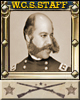
Maj Gen Abner Doubleday (b 1819 - d 1893) was born in Ballston Spa, New York.. Abner practiced as a surveyor and civil engineer for two years before entering West Point in 1838, from which he graduated in 1842, 24th in a class of 56 cadets, and was commissioned a 2nd lieutenant in the 3rd U.S. Artillery. Doubleday served in coastal garrisons and then in the Mexican (1846-1848) and Seminole (1856-1858) Wars. At the start of the civil war, he was a captain and second in command of the garrison at Fort Sumter, under Major Roger Anderson. He aimed the cannon that fired the first return shot in answer to the Rebel bombardment on April 12,1861, starting the war. He subsequently referred to himself as the "hero of Sumter" for this role. Doubleday was promoted to major in May, 1861, and commanded the Artillery Department in the Shenandoah Valley from June to August, and then the artillery for Banks’ division in the Army of the Potomac. He was appointed brigadier general in Feb, 1862, His first combat assignment was to lead a brigade in Pope’s Army. At 2nd Bull Run, his men were routed when they encountered Longstreet’s corps, but the following day he led them in rear guard action to cover the retreat of the Union Army. At Antietam, he led his men into the deadly fighting in the Cornfield and the West Woods, where he was wounded when an artillery shell exploded near his horse, throwing him to the ground in a violent fall. He received a promotion to major general for his actions at Antietam. At Gettysburg, Doubleday's division was first infantry on the field to reinforce the cavalry division of Buford. When his corps commander, Reynolds, was killed early in the fighting, Doubleday found himself in command of the corps. His men fought well in the morning, putting up a stout resistance, but as overwhelming Confederate forces massed against them, their line eventually broke and they retreated back to the relative safety of Cemetery Hill south of town. It was Doubleday's finest performance during the war, five hours leading 9,500 men against ten Confederate brigades that numbered more than 16,000. Seven of those brigades incurred casualties that ranged from 35 to 50 percent, indicating the ferocity of the Union defense. The next day, Meade replaced Doubleday with Newton, a more junior officer from another corps. The reason given was a report by Howard that Doubleday's corps broke first, causing the entire Union line to collapse, but Meade had a long history of disdain for Doubleday's combat effectiveness. Doubleday was humiliated by this snub and held a lasting grudge against Meade, but he returned to division command and fought well for the remainder of the battle. After the battle, Doubleday asked for the command of the 1st Corp but was denied it by Meade. He then left for Washington where he assumed mostly administrative duties for its defenses. While in Washington, Doubleday testified against Meade , criticizing him harshly over Meade’s conduct at Gettysburg. After the war, Doubleday was stationed in San Francisco (1869-1871) where he took out a patent for the cable car railway that still runs there today. He died of heart disease and is buried in Arlington National Cemetery. Although Doubleday was a competent combat general and had experience in many important Civil War battles, the lore of baseball credits Doubleday with inventing the game, supposedly in a cow pasture in Cooperstown, New York in 1839.However, there is considerable evidence to dispute this claim. At his death, Doubleday left many letters and papers, none of which describe baseball, or give any suggestion that he considered himself a prominent person in the evolution of the game. Also Doubleday was a cadet at West Point in the year of the alleged invention and his family had moved away from Cooperstown in 1838.
Maj Gen Abner Doubleday
Moderator: Gil R.
RE: Maj Gen Abner Doubleday
Nice job -- good to see that you included the baseball angle.
Michael Jordan plays ball. Charles Manson kills people. I torment eager potential customers by not sharing screenshots of "Brother Against Brother." Everyone has a talent.
-
General Quarters
- Posts: 1059
- Joined: Sun Dec 03, 2006 1:08 pm
RE: Maj Gen Abner Doubleday
Yes, very nice bio. Doubleday's current ratings in the game seem to high -- good, fair, great, great, IIRC. He had his moments but the current ratings make him one of the very best Union generals. Maybe Mikeejay can suggest some more realistic ratings.
RE: Maj Gen Abner Doubleday
Sure, I'm open to different stats. He currently has Great leadership, Fair tactics, Good initiative, and Great command.
Michael Jordan plays ball. Charles Manson kills people. I torment eager potential customers by not sharing screenshots of "Brother Against Brother." Everyone has a talent.
-
Erik Rutins

- Posts: 39787
- Joined: Tue Mar 28, 2000 4:00 pm
- Location: Vermont, USA
- Contact:
RE: Maj Gen Abner Doubleday
I think his performance at Gettysburg mandates pretty good ratings, honestly. I could see bumping his Initiative down one or two and perhaps Leadership down one, but I might bump Tactics up one to compensate.
Erik Rutins
CEO, Matrix Games LLC

For official support, please use our Help Desk: http://www.matrixgames.com/helpdesk/
Freedom is not Free.
CEO, Matrix Games LLC
For official support, please use our Help Desk: http://www.matrixgames.com/helpdesk/
Freedom is not Free.
RE: Maj Gen Abner Doubleday
I've edited Doubleday. It's a bit too long, but before I edit it down one or two issues need to be cleared up.
Maj. Gen. Abner Doubleday (b. 1819, d. 1893). Doubleday was born in Ballston Spa, New York. Having practiced as a surveyor and civil engineer for two years, he entered West Point in 1838, from which he graduated 24th in a class of 56 cadets in 1842. Doubleday was commissioned a 2nd lieutenant in the 3rd U.S. Artillery, and served in coastal garrisons and then in the Mexican War (1846-48) and Seminole War (1856-58). At the start of the Civil War, he was a captain and second in command of the garrison at Fort Sumter, under Maj. Roger Anderson: in fact, it was Doubleday who aimed the cannon that fired the first return shot in answer to the Rebel bombardment on April 12, 1861, starting the war. (He subsequently referred to himself as the "hero of Sumter" for this role.) Doubleday was promoted to major in May, 1861, and commanded the Artillery Department in the Shenandoah Valley from June to August, and then the artillery for Gen. Nathaniel P. Banks’ division in the Army of the Potomac. Doubleday was appointed brigadier general in February, 1862, and his first combat assignment was to lead a brigade in Gen. John Pope’s army. (My encyclopedia says that he first led a brigade at Groveton on Aug. 28, 1862 and later was promoted to brevet brigadier general of volunteers, and then commanded a brigade under McDowell at Second Bull Run. That seems to jar with your info about Feb. 1862 and Pope. How do we reconcile this?) At the Battle of Second Bull Run, Doubleday’s men were routed when they encountered Gen. James Longstreet’s corps, but the following day he led them in a rearguard action to cover the retreat of the Union Army. At the Battle of Antietam, he led his men into the deadly fighting in the Cornfield and the West Woods, where he was wounded when an artillery shell exploded near his horse, throwing him to the ground in a violent fall. He received a promotion to major general for his actions at Antietam. At Gettysburg, Doubleday's division was the first infantry on the field to reinforce the cavalry division of Gen. John Buford. When his corps commander, Gen. John F. Reynolds, was killed early in the fighting on the first day, Doubleday found himself in command of I Corps. His men fought well in the morning, putting up a stout resistance, but as overwhelming Confederate forces massed against them, their line eventually broke and they retreated back to the relative safety of Cemetery Hill south of town. It was Doubleday's finest performance during the war, five hours leading 9,500 men against ten Confederate brigades that numbered more than 16,000. Seven of those brigades incurred casualties that ranged from 35% to 50%, indicating the ferocity of the Union defense. The next day, Gen. George G. Meade, in overall command of the Union forces, replaced Doubleday with Brig. Gen. John Newton, a more junior officer from another corps. The reason given was an erroneous report by Gen. Oliver O. Howard that Doubleday's corps broke first, causing the entire Union line to collapse, but the explanation might lie in Meade’s long history of disdain for Doubleday's combat effectiveness. Doubleday was humiliated by this snub and held a lasting grudge against Meade, but he returned to division command and fought well for the remainder of the battle. After Gettysburg, Doubleday asked to be restored to command of I Corps but was denied it by Meade. He then left for Washington, where he assumed mostly administrative duties for its defenses, briefly seeing action for the last time during Gen. Jubal A. Early’s attempted raid on the capital in 1864. While in Washington, Doubleday testified against Meade, criticizing him harshly for his conduct at Gettysburg. After the war, Doubleday remained in the army until 1873, and died of heart disease twenty years later. Although Doubleday was a competent combat general and had experience in many important Civil War battles, he is more famous in baseball lore as the one credited with inventing the game, supposedly in a cow pasture in Cooperstown, New York in 1839. However, there is considerable evidence to dispute this claim: at his death, Doubleday left many letters and papers, none of which describe baseball or give any suggestion that he considered himself a prominent person in the evolution of the game, and Doubleday was a cadet at West Point in 1839 and his family had moved away from Cooperstown in 1838. He is more clearly linked to another invention: while stationed in San Francisco in 1869-71, he took out a patent for the cable car railway that still runs there today. Doubleday is buried in Arlington National Cemetery. (Bio by Scott Jennings)
Maj. Gen. Abner Doubleday (b. 1819, d. 1893). Doubleday was born in Ballston Spa, New York. Having practiced as a surveyor and civil engineer for two years, he entered West Point in 1838, from which he graduated 24th in a class of 56 cadets in 1842. Doubleday was commissioned a 2nd lieutenant in the 3rd U.S. Artillery, and served in coastal garrisons and then in the Mexican War (1846-48) and Seminole War (1856-58). At the start of the Civil War, he was a captain and second in command of the garrison at Fort Sumter, under Maj. Roger Anderson: in fact, it was Doubleday who aimed the cannon that fired the first return shot in answer to the Rebel bombardment on April 12, 1861, starting the war. (He subsequently referred to himself as the "hero of Sumter" for this role.) Doubleday was promoted to major in May, 1861, and commanded the Artillery Department in the Shenandoah Valley from June to August, and then the artillery for Gen. Nathaniel P. Banks’ division in the Army of the Potomac. Doubleday was appointed brigadier general in February, 1862, and his first combat assignment was to lead a brigade in Gen. John Pope’s army. (My encyclopedia says that he first led a brigade at Groveton on Aug. 28, 1862 and later was promoted to brevet brigadier general of volunteers, and then commanded a brigade under McDowell at Second Bull Run. That seems to jar with your info about Feb. 1862 and Pope. How do we reconcile this?) At the Battle of Second Bull Run, Doubleday’s men were routed when they encountered Gen. James Longstreet’s corps, but the following day he led them in a rearguard action to cover the retreat of the Union Army. At the Battle of Antietam, he led his men into the deadly fighting in the Cornfield and the West Woods, where he was wounded when an artillery shell exploded near his horse, throwing him to the ground in a violent fall. He received a promotion to major general for his actions at Antietam. At Gettysburg, Doubleday's division was the first infantry on the field to reinforce the cavalry division of Gen. John Buford. When his corps commander, Gen. John F. Reynolds, was killed early in the fighting on the first day, Doubleday found himself in command of I Corps. His men fought well in the morning, putting up a stout resistance, but as overwhelming Confederate forces massed against them, their line eventually broke and they retreated back to the relative safety of Cemetery Hill south of town. It was Doubleday's finest performance during the war, five hours leading 9,500 men against ten Confederate brigades that numbered more than 16,000. Seven of those brigades incurred casualties that ranged from 35% to 50%, indicating the ferocity of the Union defense. The next day, Gen. George G. Meade, in overall command of the Union forces, replaced Doubleday with Brig. Gen. John Newton, a more junior officer from another corps. The reason given was an erroneous report by Gen. Oliver O. Howard that Doubleday's corps broke first, causing the entire Union line to collapse, but the explanation might lie in Meade’s long history of disdain for Doubleday's combat effectiveness. Doubleday was humiliated by this snub and held a lasting grudge against Meade, but he returned to division command and fought well for the remainder of the battle. After Gettysburg, Doubleday asked to be restored to command of I Corps but was denied it by Meade. He then left for Washington, where he assumed mostly administrative duties for its defenses, briefly seeing action for the last time during Gen. Jubal A. Early’s attempted raid on the capital in 1864. While in Washington, Doubleday testified against Meade, criticizing him harshly for his conduct at Gettysburg. After the war, Doubleday remained in the army until 1873, and died of heart disease twenty years later. Although Doubleday was a competent combat general and had experience in many important Civil War battles, he is more famous in baseball lore as the one credited with inventing the game, supposedly in a cow pasture in Cooperstown, New York in 1839. However, there is considerable evidence to dispute this claim: at his death, Doubleday left many letters and papers, none of which describe baseball or give any suggestion that he considered himself a prominent person in the evolution of the game, and Doubleday was a cadet at West Point in 1839 and his family had moved away from Cooperstown in 1838. He is more clearly linked to another invention: while stationed in San Francisco in 1869-71, he took out a patent for the cable car railway that still runs there today. Doubleday is buried in Arlington National Cemetery. (Bio by Scott Jennings)
Michael Jordan plays ball. Charles Manson kills people. I torment eager potential customers by not sharing screenshots of "Brother Against Brother." Everyone has a talent.
RE: Maj Gen Abner Doubleday
Okay, I've got it down to 3897 characters, so it's ready to go:
Maj. Gen. Abner Doubleday (b. 1819, d. 1893). Doubleday was born in Ballston Spa, New York. Having practiced as a surveyor and civil engineer for two years, he entered West Point in 1838 and graduated in 1842 (24th out of 56). An artilleryman, he served in coastal garrisons and then in the Mexican War (1846-48) and Third Seminole War (1856-58). On April 12, 1861 he was serving as a captain and second in command of the Federal garrison at Fort Sumter when it was bombarded by the Confederates: in fact, it was Doubleday who aimed the cannon that fired the first shot returned in answer – for which he subsequently referred to himself as the “hero of Sumter.” Doubleday was promoted to major in May, and commanded the Artillery Department in the Shenandoah Valley from June to August, and then the artillery for Gen. Nathaniel P. Banks’ division in the Army of the Potomac. Doubleday was appointed brigadier general in February 1862, and his first combat assignment was to lead a brigade in Gen. John Pope’s Army of Virginia at the Battle of Second Bull Run, during which his men were routed by Gen. James Longstreet’s corps on the first day but effectively covered the army’s retreat on the second. At Antietam, he earned promotion to major general by leading his men into the deadly fighting in the Cornfield and the West Woods, where he was wounded when an artillery shell exploded near his horse and he was violently thrown. The following year, Doubleday’s division was the first infantry on the field to reinforce the cavalry division of Gen. John Buford at Gettysburg. When his corps commander, Gen. John F. Reynolds, was killed early in the fighting on the first day, Doubleday found himself in command of I Corps. His men fought well in the morning, putting up a stout resistance, but as overwhelming Confederate forces massed against them, their line eventually broke and they retreated back to the relative safety of Cemetery Hill. It was Doubleday’s finest performance during the war: five hours leading 9,500 men in a ferocious defense against 16,000 men in ten brigades, seven of which incurred casualties ranging from 35% to 50%. The next day, Gen. George G. Meade, the Union commander, replaced Doubleday with Gen. John Newton, a more junior officer from another corps. The reason given was an erroneous report by Gen. Oliver O. Howard that Doubleday’s corps broke first, causing the entire Union line to collapse, but the explanation might lie in Meade’s long history of disdain for Doubleday’s combat effectiveness. Doubleday was humiliated by the snub and held a lasting grudge against Meade, but he returned to division command and fought well for the remainder of the battle. After Gettysburg, Doubleday asked to be restored to command of I Corps but Meade refused. He then left for Washington, D.C., where he assumed mostly administrative duties for its defenses, briefly seeing action for the last time during Gen. Jubal A. Early’s attempted raid on the capital in 1864. While in Washington, Doubleday testified against Meade, criticizing him harshly for his conduct at Gettysburg. After the war, Doubleday remained in the army until 1873, dying of heart disease twenty years later. Though a competent combat general who fought in many important battles, he is more famous as the one credited with inventing baseball, supposedly in 1839 in Cooperstown, New York. However, there is considerable evidence to dispute this claim: none of Doubleday’s papers or letters describes baseball or reveals any involvement in the game’s evolution; Doubleday was at West Point in 1839; and, his family had moved away from Cooperstown in 1838. He is more clearly linked to another invention: while stationed in San Francisco in 1869-71, he took out a patent for the cable car railway that still runs there today. Doubleday is buried in Arlington National Cemetery. (Bio by Scott Jennings)
Leadership: 6
Tactical: 5 (I’ve raised this by one)
Initiative: 5 (I’m going to lower his initiative to 3, based on what I’ve read)
Command: 6
Cavalry:
Start date: 26
Maj. Gen. Abner Doubleday (b. 1819, d. 1893). Doubleday was born in Ballston Spa, New York. Having practiced as a surveyor and civil engineer for two years, he entered West Point in 1838 and graduated in 1842 (24th out of 56). An artilleryman, he served in coastal garrisons and then in the Mexican War (1846-48) and Third Seminole War (1856-58). On April 12, 1861 he was serving as a captain and second in command of the Federal garrison at Fort Sumter when it was bombarded by the Confederates: in fact, it was Doubleday who aimed the cannon that fired the first shot returned in answer – for which he subsequently referred to himself as the “hero of Sumter.” Doubleday was promoted to major in May, and commanded the Artillery Department in the Shenandoah Valley from June to August, and then the artillery for Gen. Nathaniel P. Banks’ division in the Army of the Potomac. Doubleday was appointed brigadier general in February 1862, and his first combat assignment was to lead a brigade in Gen. John Pope’s Army of Virginia at the Battle of Second Bull Run, during which his men were routed by Gen. James Longstreet’s corps on the first day but effectively covered the army’s retreat on the second. At Antietam, he earned promotion to major general by leading his men into the deadly fighting in the Cornfield and the West Woods, where he was wounded when an artillery shell exploded near his horse and he was violently thrown. The following year, Doubleday’s division was the first infantry on the field to reinforce the cavalry division of Gen. John Buford at Gettysburg. When his corps commander, Gen. John F. Reynolds, was killed early in the fighting on the first day, Doubleday found himself in command of I Corps. His men fought well in the morning, putting up a stout resistance, but as overwhelming Confederate forces massed against them, their line eventually broke and they retreated back to the relative safety of Cemetery Hill. It was Doubleday’s finest performance during the war: five hours leading 9,500 men in a ferocious defense against 16,000 men in ten brigades, seven of which incurred casualties ranging from 35% to 50%. The next day, Gen. George G. Meade, the Union commander, replaced Doubleday with Gen. John Newton, a more junior officer from another corps. The reason given was an erroneous report by Gen. Oliver O. Howard that Doubleday’s corps broke first, causing the entire Union line to collapse, but the explanation might lie in Meade’s long history of disdain for Doubleday’s combat effectiveness. Doubleday was humiliated by the snub and held a lasting grudge against Meade, but he returned to division command and fought well for the remainder of the battle. After Gettysburg, Doubleday asked to be restored to command of I Corps but Meade refused. He then left for Washington, D.C., where he assumed mostly administrative duties for its defenses, briefly seeing action for the last time during Gen. Jubal A. Early’s attempted raid on the capital in 1864. While in Washington, Doubleday testified against Meade, criticizing him harshly for his conduct at Gettysburg. After the war, Doubleday remained in the army until 1873, dying of heart disease twenty years later. Though a competent combat general who fought in many important battles, he is more famous as the one credited with inventing baseball, supposedly in 1839 in Cooperstown, New York. However, there is considerable evidence to dispute this claim: none of Doubleday’s papers or letters describes baseball or reveals any involvement in the game’s evolution; Doubleday was at West Point in 1839; and, his family had moved away from Cooperstown in 1838. He is more clearly linked to another invention: while stationed in San Francisco in 1869-71, he took out a patent for the cable car railway that still runs there today. Doubleday is buried in Arlington National Cemetery. (Bio by Scott Jennings)
Leadership: 6
Tactical: 5 (I’ve raised this by one)
Initiative: 5 (I’m going to lower his initiative to 3, based on what I’ve read)
Command: 6
Cavalry:
Start date: 26
Michael Jordan plays ball. Charles Manson kills people. I torment eager potential customers by not sharing screenshots of "Brother Against Brother." Everyone has a talent.