

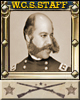
Here's the one Murat wrote for Longstreet. It's way longer than I'd like -- in other words, "Kids, don't do this at home!" -- but I think it will fit. I will specifically playtest whether this long a bio causes the game to crash or the computers at NORAD to trigger a nuclear launch or some such thing.
Lt. Gen. James "Old Pete" Longstreet (b. 1821, d. 1904). Longstreet was a West Point graduate from the class of 1842, where he met and became friends with future Union General Ulysses S. Grant, who would graduate from the academy a year later. Appointed to the U.S. Fourth Infantry, Longstreet welcomed Lt. Grant to that command and formally introduced Grant to his cousin Julia Dent (whose brother had been Grant's roommate as a plebe). Longstreet would serve as the best man at their wedding after the Mexican War. In that war, Longstreet fought at Palo Alto, Resaca de la Palma, Monterey, Vera Cruz, Cerro Gordo, San Antonio, Churubusco, and Molino del Rey, winning the brevets of captain and major, and he was subsequently wounded seriously at the Battle of Chapultepec. Longstreet was promoted to full Captain in 1852, and in 1858 full Major and paymaster, and stationed at Albuquerque, N. M. At the outbreak of the Civil War he resigned this office and reported to Richmond on June 29, 1861, receiving a commission as Brigadier General effective July 1, 1861 and was ordered to report to Gen. P.G.T. Beauregard at Manassas. At the ensuing battle there, Longstreet commanded the 1st, 11th and 17th Virginia regiments, repulsing the Federal attack at Blackburn's Ford and threatening the enemy’s rear. On October 17, 1861 he was promoted to Major General, and with this rank he commanded a division of the army under Gen. Joseph E. Johnston. As fate would have it, Johnston was wounded and Gen. Robert E. Lee took command in the defense of Richmond, intertwining the destinies of Longstreet and Lee. "Lee's Workhorse," as the nickname implies, spent most of his time with the Army of Northern Virginia, effectively acting as second in command and being partly responsible for many of its successes both by planning strategy and leading one wing of the army. Early on, Longstreet realized that the Western Theater was the key to the war. His plan was to hold the Union army in place at the Potomac River with one army, while using an offensive wing to take over areas sympathetic to the southern cause, such as Kentucky, Missouri and the southern portions of Illinois, Indiana and Ohio. When Pres. Jefferson Davis approved a plan that was the opposite, Longstreet dutifully set to work to make the Eastern Theater capable of carrying the war to the North. His idea of moving Gen. “Stonewall” Jackson's forces by rail to reinforce Beauregard and Johnston at First Manassas allowed the Confederacy to achieve the first victory of the war. Longstreet again suggested using Jackson in the summer of 1862 to augment the Army of Northern Virginia’s forces and reverse Union Gen. George B. McClellan's Peninsular Campaign. Jackson's foot-dragging in coming into line during the Seven Days Battle led Longstreet to suggest to Lee that he personally go and order Jackson to move. Instead, Lee chose to execute a frontal assault at Malvern Hill. After following the retreating enemy to Harrison's Landing, Longstreet entered upon his command of the 1st Corps of the Army of Northern Virginia, with Jackson leading the 2nd Corps. Jackson marched at once to confront Union Gen. John Pope in northern Virginia, and Longstreet soon followed. While Jackson flanked the enemy from their strong position on the Rappahannock River Longstreet engaged them at various points on the river and, finally forcing the passage of Thoroughfare Gap, participated in the crushing defeat of Pope's army. In the Maryland campaign of 1862, he moved his division from Frederick to Hagerstown, with part of his command holding the South Mountain passes, while Jackson captured Harper's Ferry, and at Antietam he won additional renown for stubborn and heroic fighting. On October 9, 1862, Longstreet was promoted to Lieutenant General. At Fredericksburg two months later, the fighting of the left wing, including the heroic defense of Marye's Hill, was under his supervision. In the spring of 1863, Longstreet operated with part of his corps at Suffolk, but rejoined Lee at Fredericksburg after the Battle of Chancellorsville and the mortal wounding of Jackson. It was decided at this crisis to create a diversion by a campaign into Pennsylvania, and in accordance with the general plan Longstreet moved his command to Chambersburg, Pennsylvania, and thence to Gettysburg, reaching the field in person on the afternoon of the first day of the battle. At Gettysburg, Longstreet immediately saw that Union Gen. George G. Meade had achieved superior field position and suggested that Lee move the army between Meade and the Union capital, forcing Meade to fight against entrenched positions as Burnside had done at Fredericksburg. Lee, having been successful thus far, decided to continue the fight on the Federal front, and chose multiple assaults to try to drive Meade from his position. Longstreet's troops arrived in time to participate in the second day's battle. On the third day, under orders from Lee, Gen. George Pickett's division, reinforced by Gen. J. Johnston Pettigrew and Gen. Isaac R. Trimble, made the memorable and ill-fated charge against the Federal position on Cemetery Hill. After the defeated Confederate army had retired to Virginia, Longstreet was finally sent west to assist in stopping the Union armies. Longstreet, along with Gen. John B. Hood’s and Gen. Lafayette McLaws' divisions, was sent to reinforce Gen. Braxton Bragg in northern Georgia, and as commander of the left wing at Chickamauga he crushed the Federal right, becoming, as D. H. Hill wrote, "The organizer of victory on the Confederate side, as Thomas was the savior of the army on the other side." In late 1863, after the Union army under Gen. William S. Rosecrans was shut up in Chattanooga, Longstreet was detached for the capture of Knoxville. Marching to that point in November by difficult roads, he began assaulting the works, but soon was apprised of the defeat of Bragg at Chattanooga. Rejoining the Army of Northern Virginia before the fighting began in the Wilderness, he took the field on May 6 and led his men in a successful assault which promised the defeat of Grant's army, until in the confusion a Confederate volley seriously wounded him within a mile of the spot where Jackson had been mortally wounded a year earlier. After returning to duty that October, Longstreet commanded on the north side of the James River during the greater part of the sieges at Richmond and Petersburg, and during final movements of the Army of Northern Virginia before its surrender at Appomattox Courthouse he commanded the advance and main portion of the army. After the war had ended, Longstreet was told by Pres. Andrew Johnson, "There are three persons of the South who can never receive amnesty: Mr. Davis, General Lee, and yourself. You have given the Union cause too much trouble." Nonetheless, the U.S. Congress did restore his citizenship in 1868. Having left military life behind, Longstreet engaged in business at New Orleans, and during Grant's presidency his old friend appointed him first as surveyor of that city’s port, and afterward supervisor of internal revenue and postmaster. In 1880, Longstreet was appointed United States minister to Turkey, and under Pres. James A. Garfield he was United States Marshal for the District of Georgia. In October, 1897, Longstreet was appointed United States Railroad Commissioner, succeeding former Confederate Gen. Wade Hampton. Having become a Republican, Longstreet he was often seen as a collaborator with the Reconstructionists and several fellow former Confederate generals tried to blame defeats on him. His own memoirs placed the blame for the defeat at Gettysburg on Lee, and he blamed other icons such as Jackson for other defeats as well – and many modern historians have come to agree with his observations.
Longstreet
Moderator: Gil R.
Longstreet
Michael Jordan plays ball. Charles Manson kills people. I torment eager potential customers by not sharing screenshots of "Brother Against Brother." Everyone has a talent.
-
jkBluesman
- Posts: 797
- Joined: Mon Feb 12, 2007 6:48 pm
RE: Longstreet
As a Longstreet supporter I like this text and it would be great if as much of it as possible could be used. One thing has to be corrected though; Lee called Longstreet after the battle of Antietam "my old war horse" though a lot of work had been done before he earned that nickname.
At some points I would like to know which sources Murat used. Where is it taken from that "Old Pete" suggested to recall Jackson from the valley? And when did Longstreet first propose to make the Western theatre the war's main theatre?
At some points I would like to know which sources Murat used. Where is it taken from that "Old Pete" suggested to recall Jackson from the valley? And when did Longstreet first propose to make the Western theatre the war's main theatre?
"War is the field of chance."
Carl von Clausewitz
Carl von Clausewitz

RE: Longstreet
Longstreet is buried at Alta Vista Cemetary in Gainesville, Georgia. It was very moving visiting his grave.
RE: Longstreet
There's no such thing as full captain and full major.
RE: Longstreet
ORIGINAL: chris0827
There's no such thing as full captain and full major.
"winning the brevets of captain and major, and he was subsequently wounded seriously at the Battle of Chapultepec. Longstreet was promoted to full Captain in 1852, and in 1858 full Major"
Not much anymore, but the army used to be big on Brevet ranks, Longstreet was a Brevet Major, until promoted in 1858 when he was a "full" major. This is why "General" Custer was commanding a regiment at Little Big Horn, his Generals rank was brevet, his actual rank was Lt. Col.
Wiki "...Custer was mustered out of the volunteer service, reduced to the rank of captain in the regular army. At the request of Maj. Gen. Phillip H. Sheridan, a bill was introduced into congress to promote Custer to major general, but the bill failed miserably. Custer was offered command of the 10th U.S. Cavalry (otherwise known as the Buffalo Soldiers) with the rank of full colonel, but turned the command down in favor of a lieutenant colonelcy of the 7th U.S. Cavalry and was assigned to that unit at Fort Riley, Kansas. "
RE: Longstreet
It's just captain and major. Brevet ranks were honorary. Custer was not reduced to the rank of Captain in the regular army he was promoted from 1st Lt to captain. His generals rank was in the volunteer army.
RE: Longstreet
Thanks for the input. I still need to shorten this one. I'll first work on the most recent submissions, though, since everyone currently active on the project should get as many of their bios into this upcoming patch as possible.
Michael Jordan plays ball. Charles Manson kills people. I torment eager potential customers by not sharing screenshots of "Brother Against Brother." Everyone has a talent.
-
jkBluesman
- Posts: 797
- Joined: Mon Feb 12, 2007 6:48 pm
RE: Longstreet
In order to get it near the 3900 character limit, I had to rewrite and intervene in Murat's writing style more than I wanted to. But now, it is not very far to go (roughly 30 characters).
What I would like to discuss with others is raising Longstreet's command rating from 6 to 7 or 8 as he really was a master of directing large bodies of troops even over difficult terrain like at Gettysburg and Chickamauga. And he had an exellent staff, one of the best in the war, whose members got the authority to order up reinforcements, place batteries and the like.
Lt. Gen. James Longstreet (b. 1821, d. 1904). Born in South Carolina but raised in Georgia, Longstreet graduated from West Point in 1842. At the academy he became friends with future Union Gen. Ulysses S. Grant. Longstreet would serve as the best man at the wedding of his cousin Julia Dent and Grant after the Mexican War. In that conflict, Longstreet won two brevets and was wounded once. After his recovery he served on the frontier, before resigning at the outbreak of the Civil War to join the Confederacy. Receiving a commission as brigadier general effective July 1, 1861 Longstreet reported to Gen. P.G.T. Beauregard at Manassas. On the day previous to the main battle, Longstreet’s brigade repulsed an attack at Blackburn's Ford. On October 7, 1861 “Old Pete”, as he was often called, received promotion to major general, and got in command of a division in the army under Gen. Joseph Johnston. During the Peninsula Campaign the next year, Longstreet handled the fighting at Williamsburg well, but performed poorly at Seven Pines, the battle in which Johnston was wounded. Gen. Robert E. Lee took over army command and Longstreet soon became his most trusted lieutenant. During the Seven Days Longstreet showed his ability of directing large bodies of troops. At Second Manassas his counterattack on the second day almost destroyed Gen. John Pope’s army. At Antietam Longstreet won additional renown for stubborn fighting, leading to Lee’s remark of Longstreet being his “old war horse”. On October 9, 1862, Longstreet was promoted to lieutenant general as first Southerner and a month later given command of the I corps, the largest in the Army of Northern Virginia. At Fredericksburg the fighting on the left wing, including Marye's Heights, was under his supervision. Operating with part of his corps at Suffolk, he did not rejoin Lee until after the Battle of Chancellorsville. In the following strategical discussion Longstreet–who thought the Western Theatre to be the key to victory–favoured an offensive in Tennessee, while Lee preferred invading Pennsylvania. At Gettysburg, Longstreet suggested to Lee on the first day to shift the II corps to the right thus interposing between the Army of the Potomac and Washington, forcing the Federals to attack. Lee, having been successful so far, decided to continue his own attack and ordered Longstreet to turn the Federal right. But the attempt failed after heavy fighting. On the third day, again under pressure from Lee, Longstreet ordered Pickett's Charge. After the defeated Confederates had retired to Virginia, Longstreet was finally sent west. Gen. Braxton Bragg made Longstreet commander of the left wing at Chickamauga, where he crushed the Federal right, earning the nickname “Bull of the Woods”. While the Union army was besieged in Chattanooga, Longstreet was after quarrels with Bragg detached for the capture of Knoxville. The operation failed and Longstreet’s command rejoined the Army of Northern Virginia in spring of 1864. In the Wilderness the general led his men in a promising assault against Grant's army, when he was seriously wounded by friendly fire. Returning to duty in October, Longstreet commanded on the north side of the James River during the greater part of the siege of Petersburg and surrendered at Appomattox Court House with Lee. After the war, Longstreet engaged in business at New Orleans, and during Grant's presidency his old friend appointed him to various posts in the city and in 1880, minister to Turkey. By becoming a Republican, Longstreet alienated many Southerners and after Lee’s death in 1870 former comrades started a campaign against Longstreet, making him the scapegoat for Confederate defeats. He defended himself until his death in 1904 in writings and lectures. But it took almost a century until he regained the reputation as one of the best tacticians and corps commanders of the war. (Bio by “Murat”)
What I would like to discuss with others is raising Longstreet's command rating from 6 to 7 or 8 as he really was a master of directing large bodies of troops even over difficult terrain like at Gettysburg and Chickamauga. And he had an exellent staff, one of the best in the war, whose members got the authority to order up reinforcements, place batteries and the like.
Lt. Gen. James Longstreet (b. 1821, d. 1904). Born in South Carolina but raised in Georgia, Longstreet graduated from West Point in 1842. At the academy he became friends with future Union Gen. Ulysses S. Grant. Longstreet would serve as the best man at the wedding of his cousin Julia Dent and Grant after the Mexican War. In that conflict, Longstreet won two brevets and was wounded once. After his recovery he served on the frontier, before resigning at the outbreak of the Civil War to join the Confederacy. Receiving a commission as brigadier general effective July 1, 1861 Longstreet reported to Gen. P.G.T. Beauregard at Manassas. On the day previous to the main battle, Longstreet’s brigade repulsed an attack at Blackburn's Ford. On October 7, 1861 “Old Pete”, as he was often called, received promotion to major general, and got in command of a division in the army under Gen. Joseph Johnston. During the Peninsula Campaign the next year, Longstreet handled the fighting at Williamsburg well, but performed poorly at Seven Pines, the battle in which Johnston was wounded. Gen. Robert E. Lee took over army command and Longstreet soon became his most trusted lieutenant. During the Seven Days Longstreet showed his ability of directing large bodies of troops. At Second Manassas his counterattack on the second day almost destroyed Gen. John Pope’s army. At Antietam Longstreet won additional renown for stubborn fighting, leading to Lee’s remark of Longstreet being his “old war horse”. On October 9, 1862, Longstreet was promoted to lieutenant general as first Southerner and a month later given command of the I corps, the largest in the Army of Northern Virginia. At Fredericksburg the fighting on the left wing, including Marye's Heights, was under his supervision. Operating with part of his corps at Suffolk, he did not rejoin Lee until after the Battle of Chancellorsville. In the following strategical discussion Longstreet–who thought the Western Theatre to be the key to victory–favoured an offensive in Tennessee, while Lee preferred invading Pennsylvania. At Gettysburg, Longstreet suggested to Lee on the first day to shift the II corps to the right thus interposing between the Army of the Potomac and Washington, forcing the Federals to attack. Lee, having been successful so far, decided to continue his own attack and ordered Longstreet to turn the Federal right. But the attempt failed after heavy fighting. On the third day, again under pressure from Lee, Longstreet ordered Pickett's Charge. After the defeated Confederates had retired to Virginia, Longstreet was finally sent west. Gen. Braxton Bragg made Longstreet commander of the left wing at Chickamauga, where he crushed the Federal right, earning the nickname “Bull of the Woods”. While the Union army was besieged in Chattanooga, Longstreet was after quarrels with Bragg detached for the capture of Knoxville. The operation failed and Longstreet’s command rejoined the Army of Northern Virginia in spring of 1864. In the Wilderness the general led his men in a promising assault against Grant's army, when he was seriously wounded by friendly fire. Returning to duty in October, Longstreet commanded on the north side of the James River during the greater part of the siege of Petersburg and surrendered at Appomattox Court House with Lee. After the war, Longstreet engaged in business at New Orleans, and during Grant's presidency his old friend appointed him to various posts in the city and in 1880, minister to Turkey. By becoming a Republican, Longstreet alienated many Southerners and after Lee’s death in 1870 former comrades started a campaign against Longstreet, making him the scapegoat for Confederate defeats. He defended himself until his death in 1904 in writings and lectures. But it took almost a century until he regained the reputation as one of the best tacticians and corps commanders of the war. (Bio by “Murat”)
"War is the field of chance."
Carl von Clausewitz
Carl von Clausewitz
RE: Longstreet
Wow, thanks. This makes my life much easier.
I'll wait to edit it until others have had a chance to weigh in, but it looks pretty good to me at first skim.
I'll wait to edit it until others have had a chance to weigh in, but it looks pretty good to me at first skim.
Michael Jordan plays ball. Charles Manson kills people. I torment eager potential customers by not sharing screenshots of "Brother Against Brother." Everyone has a talent.
RE: Longstreet
Thanks in no small part to jkBluesman's shortening of the original massive bio, Longstreet's all done.
Lt. Gen. James “Old Pete” Longstreet (b. 1821, d. 1904). Destined to become one of the Union’s greatest foes, Longstreet, who was born in South Carolina and raised in Georgia, graduated from West Point in 1842 nearly last in his class. While there, he became friends with Ulysses S. Grant, who would later marry his cousin and make him best man. In Mexico, Longstreet won two brevets and was wounded once; afterwards, he served on the frontier until resigning on June 1, 1861 to join the Confederacy. Commissioned a brigadier general effective July 1, 1861, Longstreet reported to Gen. P.G.T. Beauregard’s Army of the Potomac at Manassas, Virginia. On July 18, three days before First Manassas, Longstreet’s brigade repulsed an attack at Blackburn’s Ford, but it saw little action in the battle itself. On October 7, he received promotion to major general, and gained command of a division in what would be Gen. Joseph E. Johnston’s Army of Northern Virginia. During the Peninsula Campaign of spring 1862, Longstreet handled the fighting at Williamsburg well, but performed poorly at Seven Pines, the battle in which Johnston was wounded. Gen. Robert E. Lee took over army command and Longstreet soon became his most trusted lieutenant. During the Seven Days’ Campaign of June 25-July 1, Longstreet first showed his ability to direct large bodies of troops. At Second Manassas two months later his counterattack on the second day almost destroyed Gen. John Pope’s army, and at Antietam he won additional renown for stubborn fighting, leading Lee to refer to him as his “old war horse.” On October 9, 1862, Longstreet was promoted to lieutenant general and a month later given command of the I Corps. At Fredericksburg that December, Longstreet supervised the fighting on the left wing, including Marye’s Heights. Operating with part of his corps at Suffolk, he did not rejoin Lee until after the Battle of Chancellorsville in May 1863. As they debated strategies, Longstreet, who thought the western theater the key to victory, favored an offensive in Tennessee, while Lee preferred to invade Pennsylvania, setting the stage for Gettysburg. On the battle’s first day, Longstreet suggested that Lee shift the II Corps so as to come between the Union army and Washington, D.C., forcing an attack. Lee, having been successful so far, decided to continue his own attack and ordered Longstreet to turn the Union right, but the attempt failed after heavy fighting. On the third day, again under pressure from Lee, Longstreet ordered Pickett’s Charge, a disaster from which the army never recovered. In September, Longstreet was finally sent west, arriving just in time to command the left wing under Gen. Braxton Bragg at Chickamauga and crush the Union right. While the Union army was besieged in Chattanooga, Longstreet quarreled with Bragg and was detached for the capture of Knoxville. The operation failed and Longstreet’s corps rejoined the Lee’s army in spring 1864. While fighting in the Wilderness, Longstreet led his men in a promising assault but was seriously wounded by friendly fire. Returning to duty in October, he commanded on the north side of the James River for most of the Siege of Petersburg, and ultimately surrendered at Appomattox Court House with Lee the following April. After the war, Longstreet engaged in business at New Orleans, and during Grant’s presidency his old friend appointed him to various posts there, and also made him minister to Turkey. By becoming a Republican, Longstreet alienated many Southerners, and after Lee’s death in 1870 former comrades began a campaign of scapegoating Longstreet for Confederate defeats. He defended himself in writings and lectures until his death on January 2, 1904, but it took almost a century until he regained the reputation as one of the war’s best tacticians and corps commanders. (Bio by “Murat,” with Joern Kaesebier)
Leadership: 7
Tactics: 7
Initiative: 6
Command: 6 (I’m raising this to 7, since it’s absolutely true that Longstreet excelled at directing troop movements in battle)
Lt. Gen. James “Old Pete” Longstreet (b. 1821, d. 1904). Destined to become one of the Union’s greatest foes, Longstreet, who was born in South Carolina and raised in Georgia, graduated from West Point in 1842 nearly last in his class. While there, he became friends with Ulysses S. Grant, who would later marry his cousin and make him best man. In Mexico, Longstreet won two brevets and was wounded once; afterwards, he served on the frontier until resigning on June 1, 1861 to join the Confederacy. Commissioned a brigadier general effective July 1, 1861, Longstreet reported to Gen. P.G.T. Beauregard’s Army of the Potomac at Manassas, Virginia. On July 18, three days before First Manassas, Longstreet’s brigade repulsed an attack at Blackburn’s Ford, but it saw little action in the battle itself. On October 7, he received promotion to major general, and gained command of a division in what would be Gen. Joseph E. Johnston’s Army of Northern Virginia. During the Peninsula Campaign of spring 1862, Longstreet handled the fighting at Williamsburg well, but performed poorly at Seven Pines, the battle in which Johnston was wounded. Gen. Robert E. Lee took over army command and Longstreet soon became his most trusted lieutenant. During the Seven Days’ Campaign of June 25-July 1, Longstreet first showed his ability to direct large bodies of troops. At Second Manassas two months later his counterattack on the second day almost destroyed Gen. John Pope’s army, and at Antietam he won additional renown for stubborn fighting, leading Lee to refer to him as his “old war horse.” On October 9, 1862, Longstreet was promoted to lieutenant general and a month later given command of the I Corps. At Fredericksburg that December, Longstreet supervised the fighting on the left wing, including Marye’s Heights. Operating with part of his corps at Suffolk, he did not rejoin Lee until after the Battle of Chancellorsville in May 1863. As they debated strategies, Longstreet, who thought the western theater the key to victory, favored an offensive in Tennessee, while Lee preferred to invade Pennsylvania, setting the stage for Gettysburg. On the battle’s first day, Longstreet suggested that Lee shift the II Corps so as to come between the Union army and Washington, D.C., forcing an attack. Lee, having been successful so far, decided to continue his own attack and ordered Longstreet to turn the Union right, but the attempt failed after heavy fighting. On the third day, again under pressure from Lee, Longstreet ordered Pickett’s Charge, a disaster from which the army never recovered. In September, Longstreet was finally sent west, arriving just in time to command the left wing under Gen. Braxton Bragg at Chickamauga and crush the Union right. While the Union army was besieged in Chattanooga, Longstreet quarreled with Bragg and was detached for the capture of Knoxville. The operation failed and Longstreet’s corps rejoined the Lee’s army in spring 1864. While fighting in the Wilderness, Longstreet led his men in a promising assault but was seriously wounded by friendly fire. Returning to duty in October, he commanded on the north side of the James River for most of the Siege of Petersburg, and ultimately surrendered at Appomattox Court House with Lee the following April. After the war, Longstreet engaged in business at New Orleans, and during Grant’s presidency his old friend appointed him to various posts there, and also made him minister to Turkey. By becoming a Republican, Longstreet alienated many Southerners, and after Lee’s death in 1870 former comrades began a campaign of scapegoating Longstreet for Confederate defeats. He defended himself in writings and lectures until his death on January 2, 1904, but it took almost a century until he regained the reputation as one of the war’s best tacticians and corps commanders. (Bio by “Murat,” with Joern Kaesebier)
Leadership: 7
Tactics: 7
Initiative: 6
Command: 6 (I’m raising this to 7, since it’s absolutely true that Longstreet excelled at directing troop movements in battle)
Michael Jordan plays ball. Charles Manson kills people. I torment eager potential customers by not sharing screenshots of "Brother Against Brother." Everyone has a talent.
-
jkBluesman
- Posts: 797
- Joined: Mon Feb 12, 2007 6:48 pm
RE: Longstreet
Thanks for the co-authorship. I found one typo. The operation failed and Longstreet’s corps rejoined the Lee’s army in spring 1864.
"War is the field of chance."
Carl von Clausewitz
Carl von Clausewitz
RE: Longstreet
Good catch, thanks.
Giving you co-writing credit seemed appropriate, seeing as how it must have taken you quite a bit of time to pare it down to size.
Giving you co-writing credit seemed appropriate, seeing as how it must have taken you quite a bit of time to pare it down to size.
Michael Jordan plays ball. Charles Manson kills people. I torment eager potential customers by not sharing screenshots of "Brother Against Brother." Everyone has a talent.