The amazing uniformity of measurement systems across a number of sites suggests that the Indus Valley Civilization was a single state. However, it seems that the large cities were controlled by small groups of merchants, landowners and priests. Therefore, no standing armies were involved. The artifacts and texts from contemporaneous Egypt and Mesopotamia clearly depict battles. But the excavations at Harappan sites have not revealed a single artifact that depicts military, battles, prisoners or a human killing another human. Very few bronze weapons have been found. Fortified cities have been excavated which seems to indicate some defensive capability. Excavations do not indicate a well developed martial culture, which may be a reason for the eventual decline of the civilisation.
If there is little evidence for war in a civilization, it doesn't mean that they did have war. I personally believe that from 2500 - 1500 B.C, there was generally no warfare in the Indus River Valley, but there is just no evidence for warfare. Invasions would not have been common, as the Deccan Plateau was to the South and the Himalayas to the North. Defensive walls around the major cities don't mean that they actively sought war with other peoples.
I'd say that aggression and violence are part human nature, but "war", isn't partially because it's an artificial construct of our design (chimps don't plan preemptive strikes on the other guys). In the end war really is often for power or land, etc, because the point of animal violence is to protect themselves and their territory.
And that thing about Neanderthal, there is evidence that Neanderthal actually died out because of the glacial period that began 40,000 years ago, the one that ended at the beginning of the Neolithic. Neanderthal physiology was suited for hunting in forests, but the forests died out when the weather became too cold. The plains that were left behind were good hunting ground for Cro-Magnon with his spearthrowers. Thus most of the species died out in a few thousand years. If anyone competed for food, likely the Neanderthals would have attacked us for it, and they would have gotten thrashed anyway. How did the Austrilopithecines die out?
From what I've read, nuclear detonation propulsion is the most practical option- and this is illegal because of the test ban treaty.
Thats just the most practical version right now, although there are theories on fusion engines and "laser sails". We need something like an Alcubierre drive and interdimensional warping to get somewhere fast, but we need to straigthen out the physics first.
Using the 3+1 formalism of general relativity, the spacetime is described by a foliation of space-like hypersurfaces of constant coordinate time
t. The general form of the Alcubierre metric is:

where á is the lapse function that gives the interval of proper time between nearby hypersurfaces, â
i is the shift vector that relates the spatial coordinate systems on different hypersurfaces and ã
ij is a positive definite metric on each of the hypersurfaces. The particular form that Alcubierre studied (1994) is defined by:


â
y = â
z = 0
ã
ij = ä
ij
where


and

with
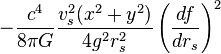
R > 0 and ó > 0 arbitrary parameters. With this particular form of the metric, it can be shown that the energy density measured by observers whose 4-velocity is normal to the hypersurfaces is given by
What does this mean?