

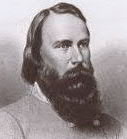
Maj. Gen. Gordon Granger (b. 1822, d. 1876). A brave and aggressive commander, Granger was also outspoken and hot-tempered thus displeasing some superiors who stopped his rising star. Born in Joy, New York he graduated from West Point in 1845 as 35th of 41. Fighting with the mounted rifleman in the Mexican War he received two brevets. After the war he served on various frontier posts in the West. The outbreak of the Civil War brought him promotion to captain and the assignment to the 3rd cavalry. For his bravery at Wilson’s Creek he was promoted to colonel in August 1861. After some months on guard duty at St. Louis Granger and his 2nd Michigan Cavalry became part of Gen. John Pope’s Army of the Mississippi. Pope made him commander of the army’s whole cavalry and Granger was subsequently promoted to brigadier general of volunteers on March 26, 1862. In this capacity he served through the New Madrid campaign, capture of Island No. 10 and siege of Corinth. In late summer he was sent to Kentucky to command the Army of Kentucky. Made commander of the District of Central Kentucky he was promoted to major general of volunteers in November dating from September 17. In the spring of 1863, his army was incorporated in the Army of the Cumberland as the Reserve Corps. He led his men in the Tullahoma campaign and at Chickamauga. In this battle he was charged with covering one of the possible retreat routes. However, when he heard of the imminent defeat he sent reinforcements forward on his own responsibility that arrived just in time to save the command of Gen. George Thomas on Horseshoe Ridge, who could thus cover the army’s retreat. When in October 1863 the IV corps was created by merging the XX and XXI corps, Granger became its commander. During the battles for Chattanooga he justified his appointment, especially during the great victory at Missionary Ridge. His corps was part of the relief force for Knoxville under Gen. William T. Sherman but it was his last action with the Army of the Cumberland: On April 10, 1864 he was relieved as corps commander and sent to the Department of the Gulf. There is evidence that the outspoken general had run into trouble with Gen. Ulysses S. Grant at Chattanooga who tried afterwards to get rid of him. Although Andrew Johnson, then governor of Tennessee, protested Granger’s transfer, Pres. Abraham Lincoln sided with Grant. In July 1864 Granger was involved in the naval expedition of David Farragut at Mobile, which resulted in the battle of Mobile Bay. Granger attacked Fort Morgan during the expedition that brought the Union control of the bay. The following months he served as commander of the District of West Florida and South Alabama until becoming commander of the XIII corps, Department of the Gulf. With this force he participated in the Mobile campaign of 1865 which resulted in the city being captured. In the final months of the war Granger was sent to Galveston, Texas, where he enforced the Emancipation Proclamation on June 19, 1865. Freeing the Texan slaves made him a hero for the African-Americans and founded the "Juneteenth" celebration. Mustered out of the volunteer service, Granger stayed in the army serving as colonel on the frontier, primarily in New Mexico. The hard-drinking Granger died on duty in Santa Fe, New Mexico on January 10, 1876 and was buried in Lexington, Kentucky.
Ldr: 5
Tact: 4
Init: 5
Cmd: 4
Cav: 3
Teaches: Brave (2)
Maj. Gen. Gordon Granger
Moderator: Gil R.
-
jkBluesman
- Posts: 797
- Joined: Mon Feb 12, 2007 6:48 pm
Maj. Gen. Gordon Granger
"War is the field of chance."
Carl von Clausewitz
Carl von Clausewitz
RE: Maj. Gen. Gordon Granger
Copied, thanks.
Michael Jordan plays ball. Charles Manson kills people. I torment eager potential customers by not sharing screenshots of "Brother Against Brother." Everyone has a talent.
-
jkBluesman
- Posts: 797
- Joined: Mon Feb 12, 2007 6:48 pm
RE: Maj. Gen. Gordon Granger
Granger edited for more information on battles.
"War is the field of chance."
Carl von Clausewitz
Carl von Clausewitz
RE: Maj. Gen. Gordon Granger
Thanks for the edits.
Michael Jordan plays ball. Charles Manson kills people. I torment eager potential customers by not sharing screenshots of "Brother Against Brother." Everyone has a talent.
RE: Maj. Gen. Gordon Granger
Here's Granger, midway through the process. I ended up puffing it up beyond the maximum 3900 characters, but before I shrink it back down I'm hoping you can answer the two questions. Thanks!
Maj. Gen. Gordon Granger (b. 1822, d. 1876). A brave and aggressive commander, Granger was also outspoken and hot-tempered, thus displeasing some superiors who prevented his star from rising further. Born in Joy, New York, he graduated from West Point in 1845 as the 35th of 41. Fighting with the mounted rifleman in the Mexican War, Granger received two brevets, and after the war he served on various frontier posts in the West. The outbreak of the Civil War brought him promotion to captain and assignment to the 3rd U.S. Cavalry. For his bravery at Wilson’s Creek, the battle on August 10, 1861 between Gen. Nathaniel Lyons’s Army of the West and the joint forces of Gen. Sterling Price’s Missouri State Guard and Gen. Benjamin McCulloch’s Confederate army that ended in a Union defeat, he was promoted to colonel. After some months on guard duty at St. Louis, Granger and his 2nd Michigan Cavalry became part of Gen. John Pope’s Army of the Mississippi. Pope made him commander of the army’s whole cavalry and Granger was subsequently promoted to brigadier general of volunteers on March 26, 1862. (Did Granger get command of the army’s cavalry as soon as he joined Pope, or later?) In this capacity he served through the New Madrid Campaign, capture of Island No. 10 and siege of Corinth, Mississippi. (New Madrid surrendered on March 13, which was before Granger’s promotion to general. Was it also before he was commanding the cavalry?) In late summer Granger was sent to Kentucky to command the Army of Kentucky, and as commander of the District of Central Kentucky he was promoted to major general of volunteers in November (dating from September 17). In the spring of 1863, Granger’s army was incorporated into Gen. William S. Rosecrans’s Army of the Cumberland as the Reserve Corps. He led his men in the Tullahoma Campaign of June 24-26 and at Chickamauga on September 18-20. In this battle Granger was charged with covering one of the possible retreat routes, but when he heard of the army’s imminent defeat as the center was nearly swept away he sent forward Gen. James Steedman’s division as reinforcements on his own responsibility, and this force arrived just in time to save the command of Gen. George Thomas on Horseshoe Ridge and enabled him to cover the army’s retreat. When the IV Corps was created by merging the XX and XXI Corps the following month, Granger became its commander. During the battles for Chattanooga that followed the Union’s retreat there he justified his appointment, especially during the great victory at Missionary Ridge, when Gen. Ulysses S. Grant forced back Gen Braxton Bragg’s besieging Army of Tennessee and opened the way for the invasion of Georgia. Granger corps was part of the relief force sent to Knoxville under Gen. William T. Sherman in the immediate aftermath, but it was his last action with the Army of the Cumberland: on April 10, 1864 he was relieved as corps commander and sent to the Department of the Gulf. There is evidence that while both men were at Chattanooga the outspoken Granger had run into trouble with Grant, who tried afterwards to get rid of him. Although Andrew Johnson, then governor of Tennessee, protested Granger’s transfer, Pres. Abraham Lincoln sided with Grant. In July, Granger was involved in the naval expedition of Adm. David Farragut at Mobile, which resulted in the Battle of Mobile Bay on August 5. Immediately after the Confederate fleet’s surrender, Granger and Farragut began a siege of Fort Morgan that lasted until August 23, when the Union finally gained control of the bay. Over the following months he served as commander of the District of West Florida and South Alabama until becoming commander of the XIII Corps, Department of the Gulf. With this force he participated in the Mobile campaign of 1865, which resulted in the city itself being captured. In the final months of the war Granger was sent to Galveston, Texas, where he enforced the Emancipation Proclamation on June 19, 1865. Freeing the Texan slaves made him a hero for the African-Americans and prompted the first “Juneteenth” celebration. Mustered out of the volunteer service, Granger stayed in the army serving as colonel on the frontier, primarily in New Mexico. The hard-drinking Granger died on duty in Santa Fe, New Mexico on January 10, 1876 and was buried in Lexington, Kentucky. (Bio by Joern Kaesebier)
Maj. Gen. Gordon Granger (b. 1822, d. 1876). A brave and aggressive commander, Granger was also outspoken and hot-tempered, thus displeasing some superiors who prevented his star from rising further. Born in Joy, New York, he graduated from West Point in 1845 as the 35th of 41. Fighting with the mounted rifleman in the Mexican War, Granger received two brevets, and after the war he served on various frontier posts in the West. The outbreak of the Civil War brought him promotion to captain and assignment to the 3rd U.S. Cavalry. For his bravery at Wilson’s Creek, the battle on August 10, 1861 between Gen. Nathaniel Lyons’s Army of the West and the joint forces of Gen. Sterling Price’s Missouri State Guard and Gen. Benjamin McCulloch’s Confederate army that ended in a Union defeat, he was promoted to colonel. After some months on guard duty at St. Louis, Granger and his 2nd Michigan Cavalry became part of Gen. John Pope’s Army of the Mississippi. Pope made him commander of the army’s whole cavalry and Granger was subsequently promoted to brigadier general of volunteers on March 26, 1862. (Did Granger get command of the army’s cavalry as soon as he joined Pope, or later?) In this capacity he served through the New Madrid Campaign, capture of Island No. 10 and siege of Corinth, Mississippi. (New Madrid surrendered on March 13, which was before Granger’s promotion to general. Was it also before he was commanding the cavalry?) In late summer Granger was sent to Kentucky to command the Army of Kentucky, and as commander of the District of Central Kentucky he was promoted to major general of volunteers in November (dating from September 17). In the spring of 1863, Granger’s army was incorporated into Gen. William S. Rosecrans’s Army of the Cumberland as the Reserve Corps. He led his men in the Tullahoma Campaign of June 24-26 and at Chickamauga on September 18-20. In this battle Granger was charged with covering one of the possible retreat routes, but when he heard of the army’s imminent defeat as the center was nearly swept away he sent forward Gen. James Steedman’s division as reinforcements on his own responsibility, and this force arrived just in time to save the command of Gen. George Thomas on Horseshoe Ridge and enabled him to cover the army’s retreat. When the IV Corps was created by merging the XX and XXI Corps the following month, Granger became its commander. During the battles for Chattanooga that followed the Union’s retreat there he justified his appointment, especially during the great victory at Missionary Ridge, when Gen. Ulysses S. Grant forced back Gen Braxton Bragg’s besieging Army of Tennessee and opened the way for the invasion of Georgia. Granger corps was part of the relief force sent to Knoxville under Gen. William T. Sherman in the immediate aftermath, but it was his last action with the Army of the Cumberland: on April 10, 1864 he was relieved as corps commander and sent to the Department of the Gulf. There is evidence that while both men were at Chattanooga the outspoken Granger had run into trouble with Grant, who tried afterwards to get rid of him. Although Andrew Johnson, then governor of Tennessee, protested Granger’s transfer, Pres. Abraham Lincoln sided with Grant. In July, Granger was involved in the naval expedition of Adm. David Farragut at Mobile, which resulted in the Battle of Mobile Bay on August 5. Immediately after the Confederate fleet’s surrender, Granger and Farragut began a siege of Fort Morgan that lasted until August 23, when the Union finally gained control of the bay. Over the following months he served as commander of the District of West Florida and South Alabama until becoming commander of the XIII Corps, Department of the Gulf. With this force he participated in the Mobile campaign of 1865, which resulted in the city itself being captured. In the final months of the war Granger was sent to Galveston, Texas, where he enforced the Emancipation Proclamation on June 19, 1865. Freeing the Texan slaves made him a hero for the African-Americans and prompted the first “Juneteenth” celebration. Mustered out of the volunteer service, Granger stayed in the army serving as colonel on the frontier, primarily in New Mexico. The hard-drinking Granger died on duty in Santa Fe, New Mexico on January 10, 1876 and was buried in Lexington, Kentucky. (Bio by Joern Kaesebier)
Michael Jordan plays ball. Charles Manson kills people. I torment eager potential customers by not sharing screenshots of "Brother Against Brother." Everyone has a talent.
-
jkBluesman
- Posts: 797
- Joined: Mon Feb 12, 2007 6:48 pm
RE: Maj. Gen. Gordon Granger
All sources say Granger was promoted to brigadier general in MArch 1862. Historycentral.com and Wikipedia give the 26th as date. Wikipedia gives the additional information that Granger was brigadier during the battle for Island No.10.
Heidler does not make a difference between Granger as commander of a cavalry brigade and of Granger as commander of the whole cavalry in the Army of the Mississippi.
Eicher in "The Longest Night" writes that Granger was in charge of the army's cavalry during the campaign which starts on March 3 for him.
My guess is that Granger was given command of the cavalry when he joined Pope but that it took some time to secure his promotion.
Heidler does not make a difference between Granger as commander of a cavalry brigade and of Granger as commander of the whole cavalry in the Army of the Mississippi.
Eicher in "The Longest Night" writes that Granger was in charge of the army's cavalry during the campaign which starts on March 3 for him.
My guess is that Granger was given command of the cavalry when he joined Pope but that it took some time to secure his promotion.
"War is the field of chance."
Carl von Clausewitz
Carl von Clausewitz
RE: Maj. Gen. Gordon Granger
Okay, a slightly changed how his promotion is handled, based on your comments, and then shortened it a bit by taking out the info I added about Wilson’s Creek and Missionary Ridge. I declare this bio finished.
Maj. Gen. Gordon Granger (b. 1822, d. 1876). A brave and aggressive commander, Granger was also outspoken and hot-tempered, thus displeasing some superiors who prevented his star from rising further. Born in Joy, New York, he graduated from West Point in 1845 as the 35th of 41. Fighting with the mounted rifleman in the Mexican War, Granger received two brevets, and after the war he served on various frontier posts in the West. The outbreak of the Civil War brought him promotion to captain and assignment to the 3rd U.S. Cavalry. For his bravery at Wilson’s Creek, the first significant battle in the western theater, on August 10, 1861, he was promoted to colonel. After some months on guard duty at St. Louis, Granger and his 2nd Michigan Cavalry became part of Gen. John Pope’s Army of the Mississippi, with Granger gaining command of the army’s whole cavalry and rising to brigadier general of volunteers, effective on March 26, 1862. In this capacity he served through the New Madrid Campaign, capture of Island No. 10 and siege of Corinth, Mississippi. In late summer Granger was sent to Kentucky to command the Army of Kentucky, and as commander of the District of Central Kentucky he was promoted to major general of volunteers in November (dating from September 17). In the spring of 1863, Granger’s army was incorporated into Gen. William S. Rosecrans’ Army of the Cumberland as the Reserve Corps. He led his men in the Tullahoma Campaign of June 24-26 and at Chickamauga on September 18-20. In this battle Granger was charged with covering one of the possible retreat routes, but when he heard of the army’s imminent defeat as the center was nearly swept away he sent forward Gen. James Steedman’s division as reinforcements on his own responsibility, and this force arrived just in time to save the command of Gen. George Thomas on Horseshoe Ridge and enabled him to cover the army’s retreat. When the IV Corps was created by merging the XX and XXI Corps the following month, Granger became its commander. During the battles for Chattanooga that followed the Union’s retreat there he justified his appointment, especially during the Union victory at Missionary Ridge. In the immediate aftermath, Granger’s corps was part of the relief force sent to Knoxville under Gen. William T. Sherman, but it was his last action with the Army of the Cumberland: on April 10, 1864 he was relieved as corps commander and sent to the Department of the Gulf. There is evidence that while both men were at Chattanooga the outspoken Granger had run into trouble with Grant, who tried afterwards to get rid of him. Although Andrew Johnson, then governor of Tennessee, protested Granger’s transfer, Pres. Abraham Lincoln sided with Grant. In July, Granger was involved in the naval expedition of Adm. David Farragut at Mobile, which resulted in the Battle of Mobile Bay on August 5. Immediately after the Confederate fleet’s surrender, Granger and Farragut began a siege of Fort Morgan that lasted until August 23, when the Union finally gained control of the bay. Over the following months he served as commander of the District of West Florida and South Alabama until becoming commander of the XIII Corps, Department of the Gulf. With this force he participated in the Mobile campaign of 1865, which resulted in the city itself being captured. In the final months of the war Granger was sent to Galveston, Texas, where he enforced the Emancipation Proclamation on June 19, 1865. Freeing the Texan slaves made him a hero for the African-Americans and prompted the first “Juneteenth” celebration. Mustered out of the volunteer service, Granger stayed in the army serving as colonel on the frontier, primarily in New Mexico. The hard-drinking Granger died on duty in Santa Fe, New Mexico on January 10, 1876 and was buried in Lexington, Kentucky. (Bio by Joern Kaesebier)
Maj. Gen. Gordon Granger (b. 1822, d. 1876). A brave and aggressive commander, Granger was also outspoken and hot-tempered, thus displeasing some superiors who prevented his star from rising further. Born in Joy, New York, he graduated from West Point in 1845 as the 35th of 41. Fighting with the mounted rifleman in the Mexican War, Granger received two brevets, and after the war he served on various frontier posts in the West. The outbreak of the Civil War brought him promotion to captain and assignment to the 3rd U.S. Cavalry. For his bravery at Wilson’s Creek, the first significant battle in the western theater, on August 10, 1861, he was promoted to colonel. After some months on guard duty at St. Louis, Granger and his 2nd Michigan Cavalry became part of Gen. John Pope’s Army of the Mississippi, with Granger gaining command of the army’s whole cavalry and rising to brigadier general of volunteers, effective on March 26, 1862. In this capacity he served through the New Madrid Campaign, capture of Island No. 10 and siege of Corinth, Mississippi. In late summer Granger was sent to Kentucky to command the Army of Kentucky, and as commander of the District of Central Kentucky he was promoted to major general of volunteers in November (dating from September 17). In the spring of 1863, Granger’s army was incorporated into Gen. William S. Rosecrans’ Army of the Cumberland as the Reserve Corps. He led his men in the Tullahoma Campaign of June 24-26 and at Chickamauga on September 18-20. In this battle Granger was charged with covering one of the possible retreat routes, but when he heard of the army’s imminent defeat as the center was nearly swept away he sent forward Gen. James Steedman’s division as reinforcements on his own responsibility, and this force arrived just in time to save the command of Gen. George Thomas on Horseshoe Ridge and enabled him to cover the army’s retreat. When the IV Corps was created by merging the XX and XXI Corps the following month, Granger became its commander. During the battles for Chattanooga that followed the Union’s retreat there he justified his appointment, especially during the Union victory at Missionary Ridge. In the immediate aftermath, Granger’s corps was part of the relief force sent to Knoxville under Gen. William T. Sherman, but it was his last action with the Army of the Cumberland: on April 10, 1864 he was relieved as corps commander and sent to the Department of the Gulf. There is evidence that while both men were at Chattanooga the outspoken Granger had run into trouble with Grant, who tried afterwards to get rid of him. Although Andrew Johnson, then governor of Tennessee, protested Granger’s transfer, Pres. Abraham Lincoln sided with Grant. In July, Granger was involved in the naval expedition of Adm. David Farragut at Mobile, which resulted in the Battle of Mobile Bay on August 5. Immediately after the Confederate fleet’s surrender, Granger and Farragut began a siege of Fort Morgan that lasted until August 23, when the Union finally gained control of the bay. Over the following months he served as commander of the District of West Florida and South Alabama until becoming commander of the XIII Corps, Department of the Gulf. With this force he participated in the Mobile campaign of 1865, which resulted in the city itself being captured. In the final months of the war Granger was sent to Galveston, Texas, where he enforced the Emancipation Proclamation on June 19, 1865. Freeing the Texan slaves made him a hero for the African-Americans and prompted the first “Juneteenth” celebration. Mustered out of the volunteer service, Granger stayed in the army serving as colonel on the frontier, primarily in New Mexico. The hard-drinking Granger died on duty in Santa Fe, New Mexico on January 10, 1876 and was buried in Lexington, Kentucky. (Bio by Joern Kaesebier)
Michael Jordan plays ball. Charles Manson kills people. I torment eager potential customers by not sharing screenshots of "Brother Against Brother." Everyone has a talent.