

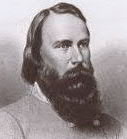
Lt. Gen. John Bell Hood (b. 1831, d. 1879). Being one of the most aggressive generals of the war, Hood achieved great success as brigade and division commander but proved not sufficient for corps and army command. Born in Owingsville, Kentucky, he graduated from West Point in 1853 with future Union generals Philip Sheridan and John M. Schofield. Prior to the war Hood served in the infantry and cavalry in Texas. As Kentucky did not secede in 1861, Hood offered his service to the provisional Confederate government in Montgomery, Alabama. He was sent to Virginia to train cavalry troops. However in September he got in command of the 4th Texas regiment and in March, 1862, he gained promotion to Brig. Gen., as leader of the Texas Brigade. During the Battle of the Seven Days Hood earned the reputation as dashing fighter after leading a charge at Gaines’ Mill (June 27, 1862). His shining moments came two and three months later: At Second Manassas Hood and his division spearheaded the attack of Gen. James Longstreet’s corps that crushed the Federal left flank. At Antietam, Hood’s Texans saved the Confederate left by pushing the Union I corps back over the cornfield. For his performance Hood rose to the rank of Maj. Gen. in October. He played only a minor role at Fredericksburg and was at Suffolk, Virginia to gather supplies while the Battle of Chancellorsville was fought. At Gettysburg his division was assigned to turn the Federal left flank on the battle’s second day. While he was preparing the assault, Hood was taken out of action by an artillery shell. Without him the attack on Little Round Top failed. Having barely recovered from the wound that had crippled his left arm, Hood went with his division when it was transferred to Tennessee in fall of 1863. He was assigned to lead Longstreet’s attack column in the Battle of Chickamauga but was shot in his right leg – which had to be amputated later – shortly after the beginning of the successful assault. While recovering in Richmond, Hood developed strong ties to Pres. Jefferson Davis and secured the promotion to Lt. Gen. (September 20, 1863). When he reported for duty, he was sent to Tennessee as corps commander. But unknown to his superior Gen. Joseph Johnston Hood got also the task to report to Davis directly about Johnston’s conduct in the coming Atlanta-campaign. Johnston thought of Hood as his sword (while Gen. William Hardee’s corps should be the shield) that would strike the enemy. But Hood did not attack two times at least when ordered to: At Cassville and New Hope Church Hood blamed the circumstances and when he did strike at Resaca, the results where indecisive. His lobbying in Richmond paid of nevertheless when the army retreated closer to the Atlanta. On July 18, 1864 Hood replaced Johnston as army commander and rose temporarily to the rank of full general. But he could not hold the city and evacuated it on September 2, after four unsuccessful attacks on Gen. William Sherman’s army. Hood tried to regain the initiative by launching an invasion of Tennessee. By that he only “played into our cards” as Sherman wrote in his memoirs. While the Union commander conquered Georgia, Gen. George Thomas checked Hood’s advance. Though Hood almost managed to destroy a part of the Federal army under Schofield at Spring Hill (November 29), the campaign ended in disaster. Hood wrecked his army by making a frontal attack at Franklin and was beaten badly by Thomas at Nashville. Hood resigned and was reverted to Lt. Gen. in January, 1865. While on his way to Texas to raise troops, he surrendered to Union forces in Mississippi, May 31, 1865. After the war, Hood entered the insurance and cotton business in New Orleans. In the battle of the books with Johnston he defended his military actions by writing “Advance and Retreat”. The feud ended before the book was published, when Hood, his wife and their oldest child died from yellow fever in 1879. Former Gen. P.G.T. Beauregard sold the book to raise money for the ten orphans (who were later adopted by seven families) – but it could not change Hood’s reputation as an aggressive but limited general.
Ldr: 5 (voted 6)
Tact: 6
Init: 6
Cmd: 6 (voted 5)
Cav: 3
Teaches: Brave, Wild, Woodsmen, Heroes
Lt. Gen. John Bell Hood
Moderator: Gil R.
-
jkBluesman
- Posts: 797
- Joined: Mon Feb 12, 2007 6:48 pm
Lt. Gen. John Bell Hood
"War is the field of chance."
Carl von Clausewitz
Carl von Clausewitz
-
jkBluesman
- Posts: 797
- Joined: Mon Feb 12, 2007 6:48 pm
RE: Lt. Gen. John Bell Hood
I know that there was a discussion on the question which general should get a cavalry rating, but I could not find it. I gave Hood a 3, becaus he was cavalry instructor at the beginning of the war just like Ewell and Hood had been offered to teach cavalry skills at West Point in 1860 (though he had declined it).
As leadership incrases mainly the chances for rallying, I lowered it. The 6 for "Initiative" and "Tactics" are reasonable if you look at his record. I raised "Command" to 6 though it is arguable. As corps and army commander Hood had difficulties to direct the different bodys of his command. However, he was pretty good in making his troops resist charges and certainly enabled his men to enter dangerous zones.
Gil, the text is roughly 200 characters too long, but I wanted to wait for your remarks (and those from others ) before shortening further. It is easy to shorten in the last part and perhaps in the middle.
What I could not include is the story of Hood being arrested by Evans after 2nd Manassas and being restored in the wake of South Mountain. Sally Preston (who had rejected Hood's proposal to become his wife during his stay in Richmond in 1863) does not appear either.
As leadership incrases mainly the chances for rallying, I lowered it. The 6 for "Initiative" and "Tactics" are reasonable if you look at his record. I raised "Command" to 6 though it is arguable. As corps and army commander Hood had difficulties to direct the different bodys of his command. However, he was pretty good in making his troops resist charges and certainly enabled his men to enter dangerous zones.
Gil, the text is roughly 200 characters too long, but I wanted to wait for your remarks (and those from others ) before shortening further. It is easy to shorten in the last part and perhaps in the middle.
What I could not include is the story of Hood being arrested by Evans after 2nd Manassas and being restored in the wake of South Mountain. Sally Preston (who had rejected Hood's proposal to become his wife during his stay in Richmond in 1863) does not appear either.
"War is the field of chance."
Carl von Clausewitz
Carl von Clausewitz
RE: Lt. Gen. John Bell Hood
I guess wait a bit and if there are no comments, feel free to shorten away. It looks good, even if you couldn't fit everything in.
Michael Jordan plays ball. Charles Manson kills people. I torment eager potential customers by not sharing screenshots of "Brother Against Brother." Everyone has a talent.
-
jkBluesman
- Posts: 797
- Joined: Mon Feb 12, 2007 6:48 pm
RE: Lt. Gen. John Bell Hood
Here is the shortened version. After adding my name it should be only two dozen characters too much.
Lt. Gen. John Bell Hood (b. 1831, d. 1879). Being one of the most aggressive generals of the war, Hood achieved great success as brigade and division commander but proved not sufficient for corps and army command. Born in Owingsville, Kentucky, he graduated from West Point in 1853 with his late antagonist John M. Schofield. Prior to the war Hood served in the infantry and cavalry in Texas. As Kentucky did not secede in 1861, Hood offered his service to the provisional Confederate government in Montgomery, Alabama. He was sent to Virginia to train cavalry. However in September he got in command of a regiment and in March, 1862, he gained promotion to Brig. Gen., as leader of the Texas Brigade. During the Battle of the Seven Days Hood earned the reputation as dashing fighter after leading a charge at Gaines’ Mill (June 27, 1862). His shining moments came two and three months later: At Second Manassas Hood and his division spearheaded the attack of Gen. James Longstreet’s corps that crushed the Federal left flank. At Antietam, Hood’s Texans saved the Confederate left by pushing the Union I corps back over the cornfield. For his performance Hood rose to the rank of Maj. Gen. in October. He played only a minor role at Fredericksburg and was at Suffolk, Virginia to gather supplies while the Battle of Chancellorsville was fought. At Gettysburg his division was assigned to turn the Federal left flank on the battle’s second day. While preparing the assault, Hood was taken out of action by an artillery shell. Without him the attack on Little Round Top failed. Having barely recovered from the wound that had crippled his left arm, Hood went with his division when it was transferred to Tennessee in fall of 1863. He led Longstreet’s attack column at Chickamauga but was shot in his right leg – which had to be amputated later – during the successful assault. While recovering in Richmond, Hood developed strong ties to Pres. Jefferson Davis and secured the promotion to Lt. Gen. (September 20, 1863). When he reported for duty, he was sent to Tennessee as corps commander. But unknown to his superior Gen. Joseph Johnston Hood got also the task to report to Davis directly about Johnston’s conduct in the coming Atlanta-campaign. Johnston thought of Hood as his sword that would strike the enemy. But Hood did not attack at least two times when ordered to: At Cassville and New Hope Church he blamed the circumstances and when he did strike at Resaca, the results where indecisive. His lobbying in Richmond paid of nevertheless when the army retreated closer to Atlanta. On July 18, 1864 Hood replaced Johnston as army commander and rose temporarily to the rank of full general. But he could not hold the city and evacuated it on September 2, after fighting four unsuccessful battles for it. Hood tried to regain the initiative by launching an invasion into Tennessee. By that he only “played into our cards” as Gen. William T. Sherman wrote in his memoirs. While the Union commander conquered Georgia, Gen. George Thomas checked Hood’s advance. Though Hood almost managed to destroy part of the Federal army under Schofield at Spring Hill (November 29), the campaign ended in disaster. Hood wrecked his army in a frontal attack at Franklin and was beaten badly by Thomas at Nashville. Hood resigned and was reverted to Lt. Gen. in January, 1865. While on his way to Texas to raise troops, he surrendered in Mississippi, May 31, 1865. After the war, Hood entered the insurance and cotton business in New Orleans. In the battle of the books with Johnston he defended himself by writing “Advance and Retreat”. The feud ended before the book was published, when Hood, his wife and their oldest child died from yellow fever in 1879. Former Gen. P.G.T. Beauregard sold the memoirs to raise money for the ten orphans – but it could not change Hood’s reputation as an aggressive but limited general.
Ldr: 5 (voted 6)
Tact: 6
Init: 6
Cmd: 6 (voted 5)
Cav: 3 (like Ewell he was cavalry instructor and even considered to teach it at West Point in 1860)
Teaches: Brave, Wild, Woodsmen, Heroes
Lt. Gen. John Bell Hood (b. 1831, d. 1879). Being one of the most aggressive generals of the war, Hood achieved great success as brigade and division commander but proved not sufficient for corps and army command. Born in Owingsville, Kentucky, he graduated from West Point in 1853 with his late antagonist John M. Schofield. Prior to the war Hood served in the infantry and cavalry in Texas. As Kentucky did not secede in 1861, Hood offered his service to the provisional Confederate government in Montgomery, Alabama. He was sent to Virginia to train cavalry. However in September he got in command of a regiment and in March, 1862, he gained promotion to Brig. Gen., as leader of the Texas Brigade. During the Battle of the Seven Days Hood earned the reputation as dashing fighter after leading a charge at Gaines’ Mill (June 27, 1862). His shining moments came two and three months later: At Second Manassas Hood and his division spearheaded the attack of Gen. James Longstreet’s corps that crushed the Federal left flank. At Antietam, Hood’s Texans saved the Confederate left by pushing the Union I corps back over the cornfield. For his performance Hood rose to the rank of Maj. Gen. in October. He played only a minor role at Fredericksburg and was at Suffolk, Virginia to gather supplies while the Battle of Chancellorsville was fought. At Gettysburg his division was assigned to turn the Federal left flank on the battle’s second day. While preparing the assault, Hood was taken out of action by an artillery shell. Without him the attack on Little Round Top failed. Having barely recovered from the wound that had crippled his left arm, Hood went with his division when it was transferred to Tennessee in fall of 1863. He led Longstreet’s attack column at Chickamauga but was shot in his right leg – which had to be amputated later – during the successful assault. While recovering in Richmond, Hood developed strong ties to Pres. Jefferson Davis and secured the promotion to Lt. Gen. (September 20, 1863). When he reported for duty, he was sent to Tennessee as corps commander. But unknown to his superior Gen. Joseph Johnston Hood got also the task to report to Davis directly about Johnston’s conduct in the coming Atlanta-campaign. Johnston thought of Hood as his sword that would strike the enemy. But Hood did not attack at least two times when ordered to: At Cassville and New Hope Church he blamed the circumstances and when he did strike at Resaca, the results where indecisive. His lobbying in Richmond paid of nevertheless when the army retreated closer to Atlanta. On July 18, 1864 Hood replaced Johnston as army commander and rose temporarily to the rank of full general. But he could not hold the city and evacuated it on September 2, after fighting four unsuccessful battles for it. Hood tried to regain the initiative by launching an invasion into Tennessee. By that he only “played into our cards” as Gen. William T. Sherman wrote in his memoirs. While the Union commander conquered Georgia, Gen. George Thomas checked Hood’s advance. Though Hood almost managed to destroy part of the Federal army under Schofield at Spring Hill (November 29), the campaign ended in disaster. Hood wrecked his army in a frontal attack at Franklin and was beaten badly by Thomas at Nashville. Hood resigned and was reverted to Lt. Gen. in January, 1865. While on his way to Texas to raise troops, he surrendered in Mississippi, May 31, 1865. After the war, Hood entered the insurance and cotton business in New Orleans. In the battle of the books with Johnston he defended himself by writing “Advance and Retreat”. The feud ended before the book was published, when Hood, his wife and their oldest child died from yellow fever in 1879. Former Gen. P.G.T. Beauregard sold the memoirs to raise money for the ten orphans – but it could not change Hood’s reputation as an aggressive but limited general.
Ldr: 5 (voted 6)
Tact: 6
Init: 6
Cmd: 6 (voted 5)
Cav: 3 (like Ewell he was cavalry instructor and even considered to teach it at West Point in 1860)
Teaches: Brave, Wild, Woodsmen, Heroes
"War is the field of chance."
Carl von Clausewitz
Carl von Clausewitz
RE: Lt. Gen. John Bell Hood
Thanks. I'm sure I can shop a few characters easily enough.
Michael Jordan plays ball. Charles Manson kills people. I torment eager potential customers by not sharing screenshots of "Brother Against Brother." Everyone has a talent.
RE: Lt. Gen. John Bell Hood
Hood’s almost done, with only minimal changes, the only significant ones being that for space reasons I took out the mention of Schofield being his classmate at West Point and that he was gathering supplies during Chancellorsville. I also wrote that his promotion to lt.gen. was “effective” on Sept. 20, 1863, based on the fact that Chickamauga ended that day, and he couldn’t have reached Richmond by then. Not an easy bio to squeeze into the space limit...
Once the sword business is cleared up I'll be able to pronounce it ready to go.
Lt. Gen. John Bell Hood (b. 1831, d. 1879). Being one of the most aggressive generals of the war, Hood achieved great success as brigade and division commander but proved inadequate for corps and army command. Born in Owingsville, Kentucky, he graduated from West Point in 1853, and served in the infantry and cavalry in Texas. As Kentucky did not secede in 1861, Hood offered his services to the Confederate government and was sent to Virginia to train cavalry. By September he commanded a regiment, and in March 1862 was promoted to brigadier general, as leader of the Texas Brigade. Hood soon earned the reputation as a dashing fighter after leading a charge at Gaines’ Mill on June 27, 1862. His most shining moments came later that summer, as a division commander: at Second Manassas Hood spearheaded the attack of Gen. James Longstreet’s corps that crushed the Union’s left flank, and at Antietam his Texans saved the Confederate left by pushing the Union I Corps back over “the Cornfield.” For his performance Hood rose to the rank of major general in October. He played only a minor role at Fredericksburg and was not present for Chancellorsville. At Gettysburg, his division was assigned to turn the Union left flank on July 2, 1863, the battle’s second day. While preparing the assault, Hood was taken out of action by an artillery shell. Without him the attack on Little Round Top failed, dealing the Confederates a serious blow. Barely recovered from the wound that had crippled his left arm, Hood joined his division when the corps was transferred to Tennessee that September. As he led Longstreet’s devastating assault at Chickamauga, he was shot in the right leg, which had to be amputated later. While recovering in Richmond, Hood developed strong ties to Pres. Jefferson Davis and secured a promotion to lieutenant general, effective September 20, 1863 – the date of his wounding. When he reported for duty once more, he was sent to the Army of Tennessee as a corps commander. But unknown to his superior Gen. Joseph E. Johnston, Hood also was instructed to report to Davis directly about Johnston’s conduct in the coming Atlanta Campaign. Johnston thought of Hood as his sword that would strike the enemy (Is this from a quote? If so, “sword” should go in quotation marks.). But Hood did not attack at least two times when ordered to – at Cassville and New Hope Church he blamed the circumstances – and when he did strike at Resaca the results where indecisive. Nevertheless, his lobbying in Richmond paid off when the army retreated closer to Atlanta. On July 18, 1864, Hood replaced Johnston as army commander and rose temporarily to the rank of full general. However, he could not hold the city and evacuated it on September 2, after fighting four unsuccessful battles for it. Hood tried to regain the initiative by launching an invasion into Tennessee, but by that he only “played into our cards,” as opposing commander Gen. William T. Sherman wrote in his memoirs. While Sherman conquered Georgia, Gen. George H. Thomas checked Hood’s advance. Though Hood almost managed to destroy part of the Union army under Gen. John M. Schofield at Spring Hill on November 29, the campaign ended in disaster: Hood wrecked his army in a frontal attack at Franklin and was beaten badly by Thomas at Nashville. Hood resigned and was reverted to lieutenant general in January 1865. He surrendered in Mississippi on May 31 while heading to Texas to raise troops. After the war, he entered the insurance and cotton business in New Orleans. In a battle of books with Johnston he defended his record by writing “Advance and Retreat.” The feud ended before the book was published, when Hood, his wife and their oldest child died from yellow fever in 1879. Former Gen. P.G.T. Beauregard sold the memoirs to raise money for the ten surviving children – but it could not change Hood’s reputation as an aggressive but limited general. (Bio by Joern Kaesebier)
Once the sword business is cleared up I'll be able to pronounce it ready to go.
Lt. Gen. John Bell Hood (b. 1831, d. 1879). Being one of the most aggressive generals of the war, Hood achieved great success as brigade and division commander but proved inadequate for corps and army command. Born in Owingsville, Kentucky, he graduated from West Point in 1853, and served in the infantry and cavalry in Texas. As Kentucky did not secede in 1861, Hood offered his services to the Confederate government and was sent to Virginia to train cavalry. By September he commanded a regiment, and in March 1862 was promoted to brigadier general, as leader of the Texas Brigade. Hood soon earned the reputation as a dashing fighter after leading a charge at Gaines’ Mill on June 27, 1862. His most shining moments came later that summer, as a division commander: at Second Manassas Hood spearheaded the attack of Gen. James Longstreet’s corps that crushed the Union’s left flank, and at Antietam his Texans saved the Confederate left by pushing the Union I Corps back over “the Cornfield.” For his performance Hood rose to the rank of major general in October. He played only a minor role at Fredericksburg and was not present for Chancellorsville. At Gettysburg, his division was assigned to turn the Union left flank on July 2, 1863, the battle’s second day. While preparing the assault, Hood was taken out of action by an artillery shell. Without him the attack on Little Round Top failed, dealing the Confederates a serious blow. Barely recovered from the wound that had crippled his left arm, Hood joined his division when the corps was transferred to Tennessee that September. As he led Longstreet’s devastating assault at Chickamauga, he was shot in the right leg, which had to be amputated later. While recovering in Richmond, Hood developed strong ties to Pres. Jefferson Davis and secured a promotion to lieutenant general, effective September 20, 1863 – the date of his wounding. When he reported for duty once more, he was sent to the Army of Tennessee as a corps commander. But unknown to his superior Gen. Joseph E. Johnston, Hood also was instructed to report to Davis directly about Johnston’s conduct in the coming Atlanta Campaign. Johnston thought of Hood as his sword that would strike the enemy (Is this from a quote? If so, “sword” should go in quotation marks.). But Hood did not attack at least two times when ordered to – at Cassville and New Hope Church he blamed the circumstances – and when he did strike at Resaca the results where indecisive. Nevertheless, his lobbying in Richmond paid off when the army retreated closer to Atlanta. On July 18, 1864, Hood replaced Johnston as army commander and rose temporarily to the rank of full general. However, he could not hold the city and evacuated it on September 2, after fighting four unsuccessful battles for it. Hood tried to regain the initiative by launching an invasion into Tennessee, but by that he only “played into our cards,” as opposing commander Gen. William T. Sherman wrote in his memoirs. While Sherman conquered Georgia, Gen. George H. Thomas checked Hood’s advance. Though Hood almost managed to destroy part of the Union army under Gen. John M. Schofield at Spring Hill on November 29, the campaign ended in disaster: Hood wrecked his army in a frontal attack at Franklin and was beaten badly by Thomas at Nashville. Hood resigned and was reverted to lieutenant general in January 1865. He surrendered in Mississippi on May 31 while heading to Texas to raise troops. After the war, he entered the insurance and cotton business in New Orleans. In a battle of books with Johnston he defended his record by writing “Advance and Retreat.” The feud ended before the book was published, when Hood, his wife and their oldest child died from yellow fever in 1879. Former Gen. P.G.T. Beauregard sold the memoirs to raise money for the ten surviving children – but it could not change Hood’s reputation as an aggressive but limited general. (Bio by Joern Kaesebier)
Michael Jordan plays ball. Charles Manson kills people. I torment eager potential customers by not sharing screenshots of "Brother Against Brother." Everyone has a talent.
-
jkBluesman
- Posts: 797
- Joined: Mon Feb 12, 2007 6:48 pm
RE: Lt. Gen. John Bell Hood
The "sword"-thought is taken from Symonds' bio of Johnston. But it is not a quote from Johnston as far as I know.
"War is the field of chance."
Carl von Clausewitz
Carl von Clausewitz
RE: Lt. Gen. John Bell Hood
Thanks for letting me know. I've slightly rewritten the sentence, then, to read "...as a sword with which to strike the enemy."
Hood's ready to go, then.
Hood's ready to go, then.
Michael Jordan plays ball. Charles Manson kills people. I torment eager potential customers by not sharing screenshots of "Brother Against Brother." Everyone has a talent.