Torpedo Re-Loads: How did it work?

This new stand alone release based on the legendary War in the Pacific from 2 by 3 Games adds significant improvements and changes to enhance game play, improve realism, and increase historical accuracy. With dozens of new features, new art, and engine improvements, War in the Pacific: Admiral's Edition brings you the most realistic and immersive WWII Pacific Theater wargame ever!

Moderators: wdolson, MOD_War-in-the-Pacific-Admirals-Edition

User avatar
Q-Ball
Posts: 7678
Joined: Tue Jun 25, 2002 4:43 pm
Location: Chicago, Illinois

Torpedo Re-Loads: How did it work?

Post by Q-Ball »

I am curious how the Long-Lance reloads worked on Japanese DDs, particularly in combat conditions. IJN DDs were the only ones in the world at the time (I think), that carried torpedo re-loads. The Long Lance was a beast of a torpedo, and touchy to boot, so it could not have been easy to get it into the launcher during combat.

It appears from what I can tell that re-loads were stored on-deck? I can't tell for sure, but look at this line drawing of Yugumo; there are clearly LL-sized tracks forward and aft of each torpedo mount atop the superstructure, that appear to align with the launcher, so probably are meant for torpedos.

Were they just stored on deck then? If so, was there a crane or lift to move them into position? If they were on those tracks, it does seem like it would be relatively easy to slide them into an empty tube as long as the mount is rotated to the proper position.

Having torpedos on deck though strikes me as a damage control nightmare. Why not just stack the 5in ammo up there too?

Anyone know more about this?

Image
Attachments
rys-yugumo.gif
rys-yugumo.gif (27.85 KiB) Viewed 2184 times
User avatar
Q-Ball
Posts: 7678
Joined: Tue Jun 25, 2002 4:43 pm
Location: Chicago, Illinois

RE: Torpedo Re-Loads: How did it work?

Post by Q-Ball »

For comparison, here is a line drawing of the Kagero-class DD Yukikaze. This one appears to have the actual Torpedos in-place, with some sort of cover (just canvas, maybe?). The configuration is in other respects identical to the Yugumos

Image
Attachments
rysyukikaze.gif
rysyukikaze.gif (33.38 KiB) Viewed 2190 times
User avatar
JuanG
Posts: 906
Joined: Sun Dec 28, 2008 8:12 pm

RE: Torpedo Re-Loads: How did it work?

Post by JuanG »

On the second picture the reloads are very visible, being the darker grey things near the mounts. My understanding was that they were either stored under canvas or other materials, or in compartments/boxes.

The mount would be trained so that the rack aligned with the launch tube and the torpedo could be moved into place reasonably quickly.

Also, it WAS a DC nightmare. Atleast in the launchers they were afforded some measure of protection. I imagine that many DD's dumped torpedoes overboard during air attacks later in the war like the CA's did to improve survival.
herwin
Posts: 6047
Joined: Thu May 27, 2004 9:20 pm
Location: Sunderland, UK
Contact:

RE: Torpedo Re-Loads: How did it work?

Post by herwin »

ORIGINAL: Q-Ball

I am curious how the Long-Lance reloads worked on Japanese DDs, particularly in combat conditions. IJN DDs were the only ones in the world at the time (I think), that carried torpedo re-loads. The Long Lance was a beast of a torpedo, and touchy to boot, so it could not have been easy to get it into the launcher during combat.

It appears from what I can tell that re-loads were stored on-deck? I can't tell for sure, but look at this line drawing of Yugumo; there are clearly LL-sized tracks forward and aft of each torpedo mount atop the superstructure, that appear to align with the launcher, so probably are meant for torpedos.

Were they just stored on deck then? If so, was there a crane or lift to move them into position? If they were on those tracks, it does seem like it would be relatively easy to slide them into an empty tube as long as the mount is rotated to the proper position.

Having torpedos on deck though strikes me as a damage control nightmare. Why not just stack the 5in ammo up there too?

Anyone know more about this?

Image

The reload magazines are shown in the drawing ahead of the forward launcher and abaft portside of the rear launcher. As I recall, they provided protection from the weather. Yes, they were a damage control nightmare--a number of Japanese cruisers were sunk after gunnery hits on launchers.
Harry Erwin
"For a number to make sense in the game, someone has to calibrate it and program code. There are too many significant numbers that behave non-linearly to expect that. It's just a game. Enjoy it." herwin@btinternet.com
User avatar
Gilbert
Posts: 243
Joined: Sat Aug 08, 2009 1:28 pm
Location: Hendaye, France

RE: Torpedo Re-Loads: How did it work?

Post by Gilbert »

And the spare (reload) torps were indeed stored in the compartments shown above, which were made of steel (never canvas) on most of IJN DD classes.

Regards
Gilbert
UMI YUKABA
"If I go away to sea, I shall return a corpse awash, if duty calls me to the mountain, a verdant will be my pall, thus for the sake of the Emperor, I will not die peacefully at home...."
User avatar
Iridium
Posts: 932
Joined: Fri Apr 01, 2005 7:50 pm
Location: Jersey

RE: Torpedo Re-Loads: How did it work?

Post by Iridium »

ORIGINAL: Gilbert

And the spare (reload) torps were indeed stored in the compartments shown above, which were made of steel (never canvas) on most of IJN DD classes.

Regards
Gilbert

Typically 5mm Ducol steel iirc. Splinter protection at best but better than nothing.
Yamato, IMO the best looking Battleship.
Image
"Hey, a packet of googly eyes! I'm so taking these." Hank Venture
Cavalry Corp
Posts: 4281
Joined: Tue Sep 02, 2003 5:28 pm
Location: Sampford Spiney Devon UK

RE: Torpedo Re-Loads: How did it work?

Post by Cavalry Corp »

I wish we had ship pictures this big in the game !!!!!!!!!!!!
User avatar
Local Yokel
Posts: 1494
Joined: Sun Feb 04, 2007 12:55 pm
Location: Somerset, U.K.

RE: Torpedo Re-Loads: How did it work?

Post by Local Yokel »

There’s quite a lot of information available about the torpedo reload system of Japanese destroyers, the USNTMJ report on above-water Japanese torpedo tubes being a particularly valuable source.

Reload torpedoes were housed in watertight steel containers in the positions that have been noted on the plans posted in this thread. They must have been constructed of thin gauge steel since the Japanese reported problems that arose from heavy weights being placed upon them. These presumably distorted the housings and thus increased frictional resistance in moving the reload into the tube.

Reloading was accomplished by attachment of a loading bridle to the rear of the weapon. This bridle was in turn attached to an endless hauling cable. The cable, with torpedo attached via the bridle, was drawn towards the receiving torpedo tube by means of a friction drive pulley turned by a 10 horsepower air motor. The arrangement permitted the simultaneous reloading of multiple torpedoes into a mount with a rate of advance of about 0.65 feet per second. Within its storage housing, a reload would rest upon four close-set pairs of wheels that would act as rollers as the weapon was drawn forward into its tube.

The frictional resistance in this drive arrangement seems to have been fairly critical. Obstructions or added resistance (such as that induced by distortion of the housing) would tend to cause the hauling cable to slip upon its drive pulley. The amount of friction in the drive arrangement could be varied by a turnbuckle device attached to one of the pulleys around which the hauling cable passed. Sometimes this was still not enough to provide sufficient friction for the drive to operate correctly. In such a case it might be necessary to attach a hauling cable to the nose of the torpedo and manually haul it into the tube.

Using the motor-driven reloading equipment a reload could be accomplished in about 3 minutes. Manual reloading could take as little as 5 minutes. However, if something went wrong during the evolution it could take up to 30 minutes to complete, and in certain cases it might become necessary to abandon the reload of one of the tubes. Bear in mind that in night actions the work had to be carried out by feel and familiarity in the dark – a safety nightmare! No wonder the Japanese emphasised the need for intensive practice of the operation until it became instinctive.

Another point to note is that in most installations the reload housings for at least one of the mounts were separated into two parts – one on each side of a boiler uptake. Obviously this meant that a full reload of all tubes would take twice as long, since it would be necessary to reload two tubes from one of the housings, pivot the mount to align it with the second housing, then repeat the operation to load the remaining tubes. The Hatsuharus were an exception to this, in that there was no such splitting of the reload containers.

Probably too much information, but may be of interest.
Image
bklooste
Posts: 1104
Joined: Mon Apr 10, 2006 12:47 am

RE: Torpedo Re-Loads: How did it work?

Post by bklooste »

I dont see it as an issue , all other destroyers had racks of 250lb+ depth charges on Deck with similar power in fact i think the depth charges were worse . Depth charges were made from Torpex. .

Some Japanese destoryers carried reloads below ( prob for non combat) , the extra reloads on deck were for combat especially night time . At SUnda straight the destroyers requested extra time for reloads but it wasnt granted. If they expected Naval combat than they would keep the reloads .

Vs guns fire at 20 K yards , reload fire at 12 K yards few hits can be expected at those ranges.

Vs aircraft your in trouble but with an unarmoured hull a torpedo explotion in the hull would be almost 100% fatal. With them on deck obviously a sharp commander will ditch them if it is a significant attack like the Mogami did at Midway , a ship with torpedos below cant do this..

Also long lances war heads were not temporamental it was the oxygen which made them temporamental , which would not be done until expecing combat thats what all those pipes are for.

ORIGINAL: Q-Ball

I am curious how the Long-Lance reloads worked on Japanese DDs, particularly in combat conditions. IJN DDs were the only ones in the world at the time (I think), that carried torpedo re-loads. The Long Lance was a beast of a torpedo, and touchy to boot, so it could not have been easy to get it into the launcher during combat.

It appears from what I can tell that re-loads were stored on-deck? I can't tell for sure, but look at this line drawing of Yugumo; there are clearly LL-sized tracks forward and aft of each torpedo mount atop the superstructure, that appear to align with the launcher, so probably are meant for torpedos.

Were they just stored on deck then? If so, was there a crane or lift to move them into position? If they were on those tracks, it does seem like it would be relatively easy to slide them into an empty tube as long as the mount is rotated to the proper position.

Having torpedos on deck though strikes me as a damage control nightmare. Why not just stack the 5in ammo up there too?

Anyone know more about this?
Underdog Fanboy
mike scholl 1
Posts: 1265
Joined: Wed Feb 17, 2010 8:20 pm

RE: Torpedo Re-Loads: How did it work?

Post by mike scholl 1 »

ORIGINAL: JuanG

On the second picture the reloads are very visible, being the darker grey things near the mounts. My understanding was that they were either stored under canvas or other materials, or in compartments/boxes.

The mount would be trained so that the rack aligned with the launch tube and the torpedo could be moved into place reasonably quickly.

Also, it WAS a DC nightmare. Atleast in the launchers they were afforded some measure of protection. I imagine that many DD's dumped torpedoes overboard during air attacks later in the war like the CA's did to improve survival.

Actually the re-load capacity was sacrificed in favor of more AAA mounts as the war went on. In combat, re-loading generally involved the DD temporarily retiring from action while the tubes were re-loaded. Process seems to have taken 15-20 minutes.
bklooste
Posts: 1104
Joined: Mon Apr 10, 2006 12:47 am

RE: Torpedo Re-Loads: How did it work?

Post by bklooste »

That makes sense.. the reloads were pointless when the war became air , air and more air.
 
15-20 minutes seems very long to move 4 2-3 ton torps from place A to place B 20 m away.  I know some DDs had reloads nearby as well as reloads below.
Underdog Fanboy
mike scholl 1
Posts: 1265
Joined: Wed Feb 17, 2010 8:20 pm

RE: Torpedo Re-Loads: How did it work?

Post by mike scholl 1 »

ORIGINAL: bklooste

That makes sense.. the reloads were pointless when the war became air , air and more air.

15-20 minutes seems very long to move 4 2-3 ton torps from place A to place B 20 m away.  I know some DDs had reloads nearby as well as reloads below.


Would you want to try dealing with 3 tons of torpedo on a wildly moving deck at high speed under fire? By hand in the dark? Doctrine called for the DD to retire from the action, re-load it's tubes, then return to the fray---and 15-20 minutes was regarded as necessary to do so.
User avatar
Shark7
Posts: 7936
Joined: Tue Jul 24, 2007 4:11 pm
Location: The Big Nowhere

RE: Torpedo Re-Loads: How did it work?

Post by Shark7 »

ORIGINAL: Q-Ball

For comparison, here is a line drawing of the Kagero-class DD Yukikaze. This one appears to have the actual Torpedos in-place, with some sort of cover (just canvas, maybe?). The configuration is in other respects identical to the Yugumos

Image

Armored boxes actually. And it was as 'simple' as it looks. You line up the launcher in line with the box you intend to reload from and manhandle it into the launcher. A good crew under ideal conditions might be able to reload quickly, but in combat?
Distant Worlds Fan

'When in doubt...attack!'
bklooste
Posts: 1104
Joined: Mon Apr 10, 2006 12:47 am

RE: Torpedo Re-Loads: How did it work?

Post by bklooste »

Yes that time makes sense to leave and enter combat .. but not for just the reloading part.
ORIGINAL: mike scholl 1

ORIGINAL: bklooste

That makes sense.. the reloads were pointless when the war became air , air and more air.

15-20 minutes seems very long to move 4 2-3 ton torps from place A to place B 20 m away.  I know some DDs had reloads nearby as well as reloads below.


Would you want to try dealing with 3 tons of torpedo on a wildly moving deck at high speed under fire? By hand in the dark? Doctrine called for the DD to retire from the action, re-load it's tubes, then return to the fray---and 15-20 minutes was regarded as necessary to do so.
Underdog Fanboy
User avatar
Local Yokel
Posts: 1494
Joined: Sun Feb 04, 2007 12:55 pm
Location: Somerset, U.K.

RE: Torpedo Re-Loads: How did it work?

Post by Local Yokel »

As I posted above, motor-driven reloading of the tubes is recorded as taking 3 minutes, provided it went without a hitch. This figure may only be the time it took for the reloads to be hauled forward from their housings into the mount. I strongly suspect that additional time was required to set up the haulage system, attach bridles to the rear of the reloads, etc.

I am not aware of any formal prescription by the IJN of the time completing a reload was to take. The time actually taken to reload can be deduced approximately from Japanese battle reports.

At Kolombangara on 12/13 July 1943, DesDiv 16 (Yukikaze flag) commenced firing guns and torpedoes at 2312, withdrew to reload torpedoes and returned to the battle area at 2340 – 28 minutes.

Off Vella Lavella on 6 August 1943 Shigure launched a spread of 8 Type 93’s at 2145, and completed reloading her tubes at 2209 – 24 minutes.

These seem to have been reloading operations that proceeded without undue difficulty. At Kula Gulf on 5/6 July 1943 Suzukaze and Tanikaze were so beset with problems as the reloading operation proceeded that it took them 1 hour and 14 minutes to complete it. Suzukaze’s torpedo officer made the following rather understated comment:

“While we were reloading, and enemy 15.2 cm shell passed through the port machine gun mount and exploded the 25 mm m/g ammunition. Since the torpedo reloading was going on directly below this, presence of mind and calmness failed.”

I fear it may mislead to describe the reloading system as involving ‘manhandling’ of the reload torpedoes into the mount. Motor-driven reloading would be the normal method used. However, the pulleys imparting the drive to the haulage cables were mounted on a drive shaft used in common both by the motor drive and by a drum around which a rope could be wound to provide a manual method of cable hauling if the motor could not be used. Rope-and-drum manual reloading required a team of about ten men.

Akula, I’m interested by your statement that the reload boxes were armoured, as I couldn’t reconcile this with Japanese comments that they suffered from heavy weights being put upon them. Could you tell us the source for your observation?
Image
mike scholl 1
Posts: 1265
Joined: Wed Feb 17, 2010 8:20 pm

RE: Torpedo Re-Loads: How did it work?

Post by mike scholl 1 »

ORIGINAL: bklooste
Yes that time makes sense to leave and enter combat .. but not for just the reloading part.


"Retiring" and "returning" were considered part of the reloading cycle..., much like brewing the coffee is a necessary part of pouring a cup.
User avatar
Shark7
Posts: 7936
Joined: Tue Jul 24, 2007 4:11 pm
Location: The Big Nowhere

RE: Torpedo Re-Loads: How did it work?

Post by Shark7 »

ORIGINAL: Local Yokel

As I posted above, motor-driven reloading of the tubes is recorded as taking 3 minutes, provided it went without a hitch. This figure may only be the time it took for the reloads to be hauled forward from their housings into the mount. I strongly suspect that additional time was required to set up the haulage system, attach bridles to the rear of the reloads, etc.

I am not aware of any formal prescription by the IJN of the time completing a reload was to take. The time actually taken to reload can be deduced approximately from Japanese battle reports.

At Kolombangara on 12/13 July 1943, DesDiv 16 (Yukikaze flag) commenced firing guns and torpedoes at 2312, withdrew to reload torpedoes and returned to the battle area at 2340 – 28 minutes.

Off Vella Lavella on 6 August 1943 Shigure launched a spread of 8 Type 93’s at 2145, and completed reloading her tubes at 2209 – 24 minutes.

These seem to have been reloading operations that proceeded without undue difficulty. At Kula Gulf on 5/6 July 1943 Suzukaze and Tanikaze were so beset with problems as the reloading operation proceeded that it took them 1 hour and 14 minutes to complete it. Suzukaze’s torpedo officer made the following rather understated comment:

“While we were reloading, and enemy 15.2 cm shell passed through the port machine gun mount and exploded the 25 mm m/g ammunition. Since the torpedo reloading was going on directly below this, presence of mind and calmness failed.”

I fear it may mislead to describe the reloading system as involving ‘manhandling’ of the reload torpedoes into the mount. Motor-driven reloading would be the normal method used. However, the pulleys imparting the drive to the haulage cables were mounted on a drive shaft used in common both by the motor drive and by a drum around which a rope could be wound to provide a manual method of cable hauling if the motor could not be used. Rope-and-drum manual reloading required a team of about ten men.

Akula, I’m interested by your statement that the reload boxes were armoured, as I couldn’t reconcile this with Japanese comments that they suffered from heavy weights being put upon them. Could you tell us the source for your observation?

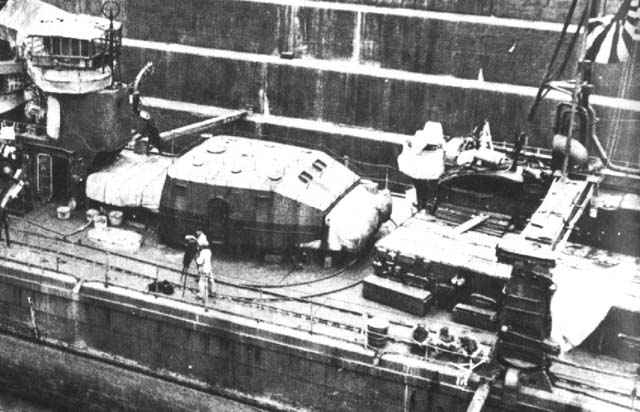
Maybe not armored in the classic sense, but certainly not the canvas mentioned elsewhere in this thread. The torpedo storage boxes were most certainly built of the same steel used to build the hull. Also, Japanese DDs did tend to have light armor splinter guards on the torpedo launchers, it only makes sense that this would extend to the rather exposed torpedo stowage boxes.

http://www.combinedfleet.com/torpmt07.jpg

The above is a good photo of the torpedo reload stowage box. As you can see it is not canvas, but rather structural steel. If not armored (which most destroyers carried little armor to begin with) it is at least built with the same protection as the rest of the ship.
Distant Worlds Fan

'When in doubt...attack!'
User avatar
Iridium
Posts: 932
Joined: Fri Apr 01, 2005 7:50 pm
Location: Jersey

RE: Torpedo Re-Loads: How did it work?

Post by Iridium »

On the Takao class their torpedo armament reloads were protected by 25mm Ducol Steel casings. Originally built it was 50mm but then during the upgrade to type 93s and to quad mounts it seems they had to save some weight somewhere.

Since Takao is a heavy cruiser I would assume this protection is higher than DDs, too bad Janusz Skulski never wrote an Anatomy of the Ship for say, Kagero or Akisuki.
Yamato, IMO the best looking Battleship.
Image
"Hey, a packet of googly eyes! I'm so taking these." Hank Venture
User avatar
Shark7
Posts: 7936
Joined: Tue Jul 24, 2007 4:11 pm
Location: The Big Nowhere

RE: Torpedo Re-Loads: How did it work?

Post by Shark7 »

Also in the photo I linked to above, you can very clearly see the torpedo reload rigging system positioned above the box...the square frame over it. You'll also note the rails built into the deck, most likely for some type of cart to move the torpedoes as well.

Judging from the location of the launchers, reload storage boxes and general layout of the ship in the picture, I believe it is in fact an Asashio class DD, though it could be any number of the Japanese DDs, they all had similar torpedo layouts.
Distant Worlds Fan

'When in doubt...attack!'
minnowguy
Posts: 86
Joined: Tue Jul 12, 2005 5:42 pm
Location: St Louis

RE: Torpedo Re-Loads: How did it work?

Post by minnowguy »

From Naval Weapons of World War Two, (p 202) by John Campbell ...

"The most feared risk seems to have been that splinters might pierce the the torpedo oxygen vessel, and the local heat of impact be sufficient to ignite the steel and in this way detonate the warhead.  In surface ships, four or five men were detailed for water hoses and an emergency tank by the TT mounting, and if the situation appeared critical the torpedoes were fired.  To slow down splinters the sides of TT were extended with 5mm protective plate."

Also some good pictures, including the one that Shark7 linked to above.  If anybody is hugely interested, I can scan and post the pics.


Post Reply

Return to “War in the Pacific: Admiral's Edition”