

Every war game I have seen dealing with this subject has failed miserably to allow for an adequate rate of advance of the PanzerGruppe. We know from Guderian that the XXIV PanzerKorps reached Bobruisk on June 28. In other games dealing with Barbarossa, you could not get nearly that far even if you removed the Red Army entirely from the frontier area. I saw an AAR on the World in Flames site where the whole advance was bogged down in thunderstorms. I wrote that baby off right then.
To compare to the actual event, Minsk must be effectively surrounded on the first turn (or do I remember seeing somewhere that the first turns are not weekly?) In any event, Minsk must be surrounded by June 29. Can this happen? If not, you need to fix something, because that is what happened).
Panzer Division Speed of Advance
Moderators: Joel Billings, elmo3, Sabre21

RE: Panzer Division Speed of Advance
As you can see from Elmo's excellent AAR of Barbarossa above and which I have copied below, he took Minsk in the first turn (which is only 4 days BTW). You can take Riga too apparently. From everything I have seen, I think you will like this one!
'As you can see in the screen shot 9th Army and 4th Army sliced southeast and northeast respectively to create a large pocket that has trapped much of the Soviet 10th Army and parts of 3rd Army as well. The 3rd Pz Grp was able to drive through and capture Vilnius (just north of the screen shot) and Minsk while 2nd Pz Grp took Brest Litovsk easily and pushed aside all resistance from there toward Minsk. A few divisions of 2nd Pz Grp are off the southern edge of the screen shot. The pocket we created looks solid and I see no way for the Soviets to break out, so they are doomed next turn.'
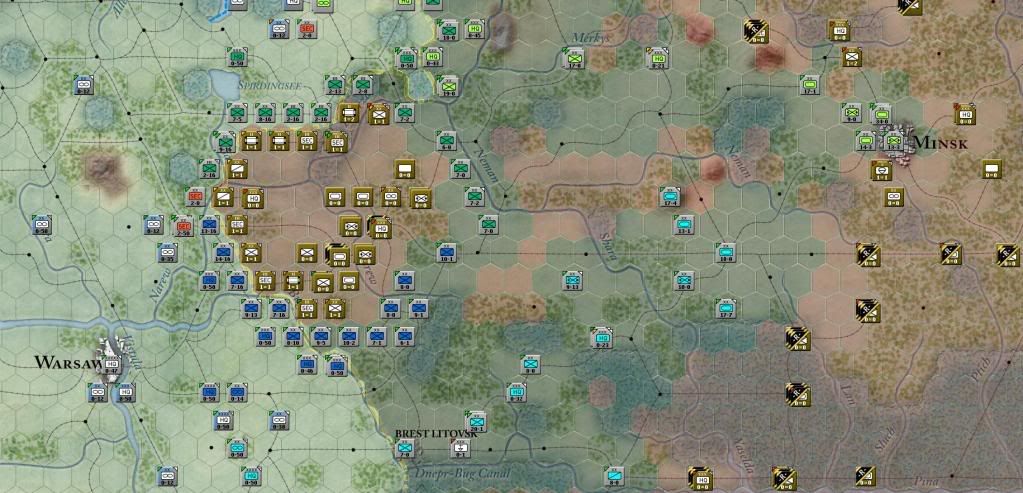
'As you can see in the screen shot 9th Army and 4th Army sliced southeast and northeast respectively to create a large pocket that has trapped much of the Soviet 10th Army and parts of 3rd Army as well. The 3rd Pz Grp was able to drive through and capture Vilnius (just north of the screen shot) and Minsk while 2nd Pz Grp took Brest Litovsk easily and pushed aside all resistance from there toward Minsk. A few divisions of 2nd Pz Grp are off the southern edge of the screen shot. The pocket we created looks solid and I see no way for the Soviets to break out, so they are doomed next turn.'
Stuart 'von Jaeger' Hunt
WitE Alpha, Beta Tester
WitE Alpha, Beta Tester
-
Joel Billings

- Posts: 33577
- Joined: Wed Sep 20, 2000 8:00 am
- Location: Santa Rosa, CA
- Contact:
RE: Panzer Division Speed of Advance
The first turn is 4 days. Minsk can be taken on the first turn, but more often a unit just gets next to it and it is taken on the next turn. The Berezina is crossed on turn 2. If anything, it's a little too easy to get to the land bridge on turn 2 (which ends on July 2). We had the AI putting up a good defense line on turn 1 but some recent OB changes caused that defense line to be dismantled so we have to put a little work into getting it back to where it was. You can keep to historical timetables in this game, unlinke most other east front games (if anything, our Soviet expert thinks they are too fast in the first few turns).
Here's my latest turn 1.

Here's my latest turn 1.
- Attachments
-
- endofGemranturn1.jpg (264.21 KiB) Viewed 400 times
All understanding comes after the fact.
-- Soren Kierkegaard
-- Soren Kierkegaard
-
Joel Billings
- Posts: 33577
- Joined: Wed Sep 20, 2000 8:00 am
- Location: Santa Rosa, CA
- Contact:
RE: Panzer Division Speed of Advance
Here's the end of German turn 2.

- Attachments
-
- endofGermanturn2.jpg (283.38 KiB) Viewed 400 times
All understanding comes after the fact.
-- Soren Kierkegaard
-- Soren Kierkegaard
RE: Panzer Division Speed of Advance
ORIGINAL: Joel Billings
if anything, our Soviet expert thinks they are too fast in the first few turns
Well he would, wouldn't he?[;)]
Stuart 'von Jaeger' Hunt
WitE Alpha, Beta Tester
WitE Alpha, Beta Tester
-
PyleDriver

- Posts: 5906
- Joined: Tue Apr 18, 2006 10:38 pm
- Location: Occupied Mexico aka Rio Grand Valley, S.Texas
RE: Panzer Division Speed of Advance
The problem with speed of advance is you outrun supply. Supply range is 25 hexs (100 mps) to a HQ, Then 5 hexs (25 mps) to the units. Your out of supply if you go farther. Then the further from a railhead you go the less supplies you recieve also...So theres a balance act, the Soviets are always near their railheads...
Jon Pyle
AWD Beta tester
WBTS Alpha tester
WitE Alpha tester
WitW Alpha tester
WitE2 Alpha tester
AWD Beta tester
WBTS Alpha tester
WitE Alpha tester
WitW Alpha tester
WitE2 Alpha tester

RE: Panzer Division Speed of Advance
the Soviets are always near their railheads...
Not necessarily, at least in late 43 [:D], I out ran my rails and the 4th Ukrainian and South Western Fronts were out of fuel fast.
The tank armies are so much better then the vaunted panzer corps anyway...[:)]

Beta Tester for: War in the East 1 & 2, WarPlan & WarPlan Pacific, Valor & Victory, Flashpoint Campaigns: Sudden Storm, Computer War In Europe 2
SPWW2 & SPMBT scenario creator
Tester for WDS games
RE: Panzer Division Speed of Advance
Yes! It looks, and more importantly, acts marvelous. I'm already digging up all my old reference material, mostly everything from Colonel Glantz.
I actually spoke to Colonel Glantz one time, telling him that the Soviet OOB didn't look right at Kursk in "Clash of Titans." He agreed that it was wrong and would be corrected in his (then) new book, "The Battle of Kursk." It was, indeed, corrected. Nice guy.
I actually spoke to Colonel Glantz one time, telling him that the Soviet OOB didn't look right at Kursk in "Clash of Titans." He agreed that it was wrong and would be corrected in his (then) new book, "The Battle of Kursk." It was, indeed, corrected. Nice guy.
HHi
RE: Panzer Division Speed of Advance
Do you recommend "Slaughterhouse: The Handbook of the Eastern Front" by David Glantz?
RE: Panzer Division Speed of Advance
In the first few turns of elmo's AAR, the Germans were at least a week ahead of their historical advance. In real life, the Germans were approaching Mogilev and the Dnepr around the 10th of July, as can be seen in the Across the Dnepr games. That isn't a problem per se, but it does mean that it's likely that the first few turns will see the Germans capture more terrain than they historically did.
Of course, when the Soviets take the initiative, they might also be able to capture more terrain than a formation of their size could capture in real life in a certain amount of time.
Of course, when the Soviets take the initiative, they might also be able to capture more terrain than a formation of their size could capture in real life in a certain amount of time.
SSG tester
WitE Alpha tester
Panzer Corps Beta tester
Unity of Command scenario designer
WitE Alpha tester
Panzer Corps Beta tester
Unity of Command scenario designer

RE: Panzer Division Speed of Advance
Im currently reading ther second book in his Stalingrad trilogy.
RE: Panzer Division Speed of Advance
Wodin, I am almost finished with the second book, going to start the 3rd book soon. This game looks great and I look forward to it, instant buy and digital download for me. I just hope it has a good tutorial. The one thing I could never grasp in the war in russia game was the HQ unit. I never understood the transferring of units out of the HQ and creating new units.

RE: Panzer Division Speed of Advance
ORIGINAL: demjansk
Wodin, I am almost finished with the second book, going to start the 3rd book soon. This game looks great and I look forward to it, instant buy and digital download for me. I just hope it has a good tutorial. The one thing I could never grasp in the war in russia game was the HQ unit. I never understood the transferring of units out of the HQ and creating new units.
It was my understanding that the 3rd book in the series hasn't been released yet...where did you find it?
WitE Alpha/Beta Tester
WitE Research Team
WitE2.0 Alpha/Beta Tester
WitE2.0 Research Team
WitW Alpha/Beta Tester
WitW Research Team
Piercing Fortress Europa Research Team
Desert War 1940-1942 Alpha/Beta Tester
WitE Research Team
WitE2.0 Alpha/Beta Tester
WitE2.0 Research Team
WitW Alpha/Beta Tester
WitW Research Team
Piercing Fortress Europa Research Team
Desert War 1940-1942 Alpha/Beta Tester
RE: Panzer Division Speed of Advance
hi Brad,
This is the third volume and I bought all three from Amazon
just type in david glantz and it will list the books
http://www.amazon.com/After-Stalingrad- ... 995&sr=8-4
This is the third volume and I bought all three from Amazon
just type in david glantz and it will list the books
http://www.amazon.com/After-Stalingrad- ... 995&sr=8-4
RE: Panzer Division Speed of Advance
http://www.amazon.com/Operation-Barbaro ... pd_sim_b_4
i also bought this one, i have so many books on this stuff its ridiculous
i also bought this one, i have so many books on this stuff its ridiculous
RE: Panzer Division Speed of Advance
ORIGINAL: demjansk
hi Brad,
This is the third volume and I bought all three from Amazon
just type in david glantz and it will list the books
http://www.amazon.com/After-Stalingrad- ... 995&sr=8-4
That's a good book, (Mr. Glantz described the "After Stalingrad" book as the "fourth in the Trilogy") but not the 3rd in the Stalingrad Trilogy - rumor has it that Mr. Glantz won't start on the last book until May.
WitE Alpha/Beta Tester
WitE Research Team
WitE2.0 Alpha/Beta Tester
WitE2.0 Research Team
WitW Alpha/Beta Tester
WitW Research Team
Piercing Fortress Europa Research Team
Desert War 1940-1942 Alpha/Beta Tester
WitE Research Team
WitE2.0 Alpha/Beta Tester
WitE2.0 Research Team
WitW Alpha/Beta Tester
WitW Research Team
Piercing Fortress Europa Research Team
Desert War 1940-1942 Alpha/Beta Tester
RE: Panzer Division Speed of Advance
Hi brad,
OH, I just assumed that the book was the third volume since I ordered three of them, oh well more money to amazon when it comes out, thanks for the insight
OH, I just assumed that the book was the third volume since I ordered three of them, oh well more money to amazon when it comes out, thanks for the insight
RE: Panzer Division Speed of Advance
hi brad,
did you ever look at the book publisher Federowicz? They're out of canada and have a bunch of great titles
http://www.jjfpub.mb.ca/
did you ever look at the book publisher Federowicz? They're out of canada and have a bunch of great titles
http://www.jjfpub.mb.ca/
RE: Panzer Division Speed of Advance
ORIGINAL: demjansk
Hi brad,
OH, I just assumed that the book was the third volume since I ordered three of them, oh well more money to amazon when it comes out, thanks for the insight
Glantz's comments on the Trilogy:
"The Stalingrad Trilogy, to be published by the University Press of Kansas, is a major effort on my part to rid the entire subject of its many "myths" contained in numerous previously published single-volume histories of the battle. It differs from After Stalingrad in that the latter is a fundamental revision of my older book, From the Don to the Dnepr, which I wrote before I learned about the many so-called "forgotten battles" that occurred during that period. By "forgotten," I mean military operations, mostly failures, which former Soviet historians have covered up or otherwise concealed. Therefore, After Stalingrad is actually a "fourth volume" in the trilogy.
As for the trilogy itself, it addresses the three periods of the Stalingrad campaign, as follows:
1) To the Gates of Stalingrad -- covering operations from 28 June-August 1942, including the preliminary operations in April-May 1942, the German advance on Stalingrad and into the Caucasus region (Operations Blau I, II, and III), and the battles on the distant flanks of Operation Blau;
2) The Fight for Stalingrad City -- covering operations from September-18 November 1942, including Sixth Army's fighting with 62nd and 64th Armies in Stalingrad and along the adjacent flanks, German operation Edelweiss in the Caucasus, and the battles on the distant flanks; and
3) The Soviet Counteroffensive and Winter Campaign - covering operations from 19 November 1942-February 1943, including the Red Army's counteroffensive (Operation Uranus), German attempts to rescue encircled Sixth Army, and the subsequent Soviet expansion of the offensive to the West, with a summary chapter on the end of the Soviet's winter campaign (the same subject as After Stalingrad).
Unlike previous studies on military operations during the Soviet-German War, the trilogy, in particular, the second volume, is the first study containing what I call "ground truth," This means that it is based on the daily records of German Sixth Army, Soviet 62nd Army, and most of 62nd Armies' subordinate divisions and brigades. By virtue of these sources, we now know precisely who did what to whom and when on an hourly and street-by-street and building-by-building basis. Since I have decided to cover all of the fighting, both in the city and along the city's flanks, the second volume is very detailed and, frankly, must be studied rather than simply read. I have done this for two reasons: first, I know of no-one else who will make this effort and, second, someone else can use this information to write a more popular and less detailed account. Thus, it will be no "easy read."
In answer to your specific questions:
1) This work destroys the many myths associated with the "Battle for Stalingrad" and fundamentally alters previous facts and interpretations regarding the battle.
2) As such, the study is exhaustive and an attempt to be definitive.
3) The trilogy covers the fighting strategically, operationally, and tactically, that is, from German army group and Red Army front level down to battalion and company level regarding the fighting in the city.
4) After Stalingrad includes everything missing from Don to Dnepr, in particular, the role of the Southern Front in the February 1943 Donbas operation (operation Gallop), the major offensive by Rokossovsky's Central Front through Kursk toward the Dnepr River, the supporting offensives by the Western and Briansk Fronts, and Zhukov's failed Operation Polar Star, the Soviet offensive in February 1943 designed to defeat and destroy German Army Group North.
5) The major new points made by the trilogy include but are not limited to the following:
-- When confronted by German forces advancing in Operation Blau, Stalin ordered his Southwestern and Southern Fronts to stand and fight instead of conducting a general fighting withdrawal previous sources have claimed .
-- As a result of Stalin's belligerence, the fighting on the road to Stalingrad was far more intense and damaging to both sides than previously supposed.
-- The Stavka began attempting counteroffensive action as early as late July 1942, when it committed three tank armies into action, the 5th Tank Army near Voronezh, and the 1st and 4th Tank Armies in the "Great Bend" of the Don. Although this counteroffensive failed, it inflicted damaging losses on German Second and Sixth Armies.
-- Thereafter, the Stavka repeatedly attempted to organize new counteroffensives and counterstrokes against German forces in the Stalingrad region, primarily just northwest and south of the city. These occurred from late August to early October 12942.
-- During the fighting in the Donbas region, the Soviet lost the better part of six armies, including the 40th, 28th, 38th, 9th, 24th, and 57th Armies. However, despite encircling these armies, German Army Group B had insufficient infantry to "capture" the encircled forces, most of which escaped or simply "went to ground."
-- Paulus's Sixth Army was too weak to clear Soviet forces from the Great Bend of the Don within the period planned (one-two weeks). Thereafter, it took several more weeks of heavy combat and high losses for Sixth Army to reach the Don River, combat attrition that left Sixth Army too weak to seize Stalingrad from the march.
-- Paulus's plan to seize Stalingrad by envelopment from north to south (by XIV and XXXXVII Panzer Corps) failed because of heavy counterattacks the Stavka organized in the Kotluban' region northwest of the city. The four-five major counterstrokes in that region from late August through October prevented XIV Panzer Corps from seizing the city's factory district from the march and, later, joining the fight for the city in sufficient strength to make a difference.
-- The battle in Stalingrad city proper occurred in distinct stages, the earliest of which involved considerable maneuver in urban terrain. These stages unfolded in specific locations in the city and at specific times. In other words, rather than a generalized "urban brawl," the battle in the city was a genuine urban campaign.
-- The forces involved in the fight for Stalingrad city were far weaker than previously believed. For example, Sixth Army's forces which fought in the city comprised well under half the army's total strength and the divisions which fought in the city were well under 50 percent strength. This weakness applied in particular to combat forces such as infantry, panzer grenadiers, and combat engineers (sappers). The 62nd Army's (and 64th Army's) divisions and brigades were, in reality, regiments, battalions, and companies.
-- The Stavka authorized the Southeastern Front and, later, Stalingrad Front to commit just enough forces into the city fight to tie down Sixth Army's forces and prevent them from seizing the entire city -- and not a man more.
-- The newly available archival materials demonstrate that the order of battle for both sides contained in previous histories is inaccurate. For example, the German 76th Infantry Division never fought in the city. Instead, it was decimated in the fighting northwest of the city. These new materials also show the combat strength and losses of both German and Soviet forces throughout the city fight.
-- At the peak of the fighting in the city, during late October and early November 1942, approximately 50,000 German forces fought a slightly lower number of Soviet forces in the city. The final fight in the city's factory district in the first half of November involved a clash between of battalion-and company-size units rather than divisions, brigades, and regiments.
-- The decision by Hitler to attempt to seize the Caucasus region and Stalingrad, simultaneously, led to ultimate German defeat.
I hope these comments both answer your questions and kindle your interest.
All the best,
David"
Found here:
Glantz Trilogy
WitE Alpha/Beta Tester
WitE Research Team
WitE2.0 Alpha/Beta Tester
WitE2.0 Research Team
WitW Alpha/Beta Tester
WitW Research Team
Piercing Fortress Europa Research Team
Desert War 1940-1942 Alpha/Beta Tester
WitE Research Team
WitE2.0 Alpha/Beta Tester
WitE2.0 Research Team
WitW Alpha/Beta Tester
WitW Research Team
Piercing Fortress Europa Research Team
Desert War 1940-1942 Alpha/Beta Tester