Gary Grigsby’s War in the East: The German-Soviet War 1941-1945 is a turn-based World War II strategy game stretching across the entire Eastern Front. Gamers can engage in an epic campaign, including division-sized battles with realistic and historical terrain, weather, orders of battle, logistics and combat results.
The critically and fan-acclaimed Eastern Front mega-game Gary Grigsby’s War in the East just got bigger and better with Gary Grigsby’s War in the East: Don to the Danube! This expansion to the award-winning War in the East comes with a wide array of later war scenarios ranging from short but intense 6 turn bouts like the Battle for Kharkov (1942) to immense 37-turn engagements taking place across multiple nations like Drama on the Danube (Summer 1944 – Spring 1945).
ORIGINAL: Mehring
You may turn out to be right about the airfields but your interpretation at this point is a choice, not evidence based. Given the weather conditions of Russia, which were well known to Russians, they might just have concreted the entire runway? I'm still looking for evidence here, before interpreting anything.
All my posts have emphasised that I had no direct evidence, but quoted that much of pre- and early war aviation that I had reliable evidence to support. I am going goggle eyed on google searches, to try an fill the holes.
This is what I have so far, as quotes, reliability unknown :
Winter of 1941/42 was very severe for the Wehrmacht, but our permanent air base near Lake Ladoga had a concrete runway and this allowed the unit to remain operational. Our mission was to keep the skies clear of the enemy and we kept a lane on the runway clear of snow so that our Staffel could take off.
German Pilot, Leningrad Front, late 1941, don't know who built the runway, either original Russian base (possible), or German works (unlikely), but no direct evidence
Winter 1941 - Vaenga, their base, was on a sandy silver birch-covered plateau a few miles from Murmansk Sound. It lacked concrete runways and tarmacked roads and there were no hangars - the aircraft were scattered in wooden pens screened by branches
British pilots in the far North sent to help Russians, extreme weather, but no concrete runway.
It had been a disastrous mission for the 1st Squadron of the 420th BAP, as well. Not only were its Yer-2s overloaded with fuel, but its pilots--experienced only in flying from concrete runways--were also appalled to find nothing but a grass airstrip at Pushkino (near Leningrad) August 1941, Russian attack on Berlin, with aircraft staging through Leningrad area to get into range. Looks like aircraft were originally based at Ramenskoye, near Moscow, highly possible with concrete runway.
All the references to runway construction in the UK start in 1941 and later, which is what I thought.
Floyd Bennett Field, New York, credited with a long concrete runway in 1932.
So what does this all mean, there may have been some concrete runways in the USSR at the time of Barbarossa. The Germans reported that Russian airfields they captured had poor facilities, but at least one German JG was flying from a concrete runway in the Leningrad area probably built by the Russians.
Does any of this affect the game mechanics at the scale WiTE operates, I still think that the vast majority of operations by both sides took place from grass tactical airfields, which the game portrays. When the fighting reached the Leningrad and Moscow regions there are likely to be some concrete airbases, whether that is worth reflecting in the game I leave to others to fight for. I would be surprised if many of the hundreds of airfield sites that were used by both sides, as the front swung East and West, through 1941-45, had more than rudimentary facilities, as they were mostly quickly established and just as quickly abandoned..
My view on roads in unchanged. [:)]
"In politics stupidity is not a handicap" - Napoleon
“A people which is able to say everything becomes able to do everything” - Napoleon
“Among those who dislike oppression are many who like to oppress" - Napoleon
Interesting. So Mehring does have a point about those. But I'm still leaning towards the Sarge's findings that tail-draggers preferred grass to indicate that most ops were from those types.
I concur with Wild and others that roads are irrelevant at this scale. [8D]
"Measure civilization by the ability of citizens to mock government with impunity" -- Unknown
Found this passage from the Time/Life Epic of Flight Series book; The Soviet Air Force at War, pages 92-93
"Now came the time for the Luftwaffe to pay the price for the heady successes of the summer months. Forever advancing it's bases so as to stay close behind the armies it was committed to support, Air Fleet 2 was forced to use airfields of the crudest conceivable sort. Even at such cities as Minsk and Orel, the municipal airports taken over by German air units were little more than grass strips; elsewhere the Luftwaffe tried to fly from wherever it could find reasonably level ground....
...conversely, as the Russian lines contracted, Soviet aircraft could operate from permanent bases with paved runways and adequate maintenance facilities guarding the capital at Vnukovo, Fili, Tushino, Khimki, and Moscow central itself."
I also seem to recall reading the the Russian airfields around Moscow often had the luxury of heated hangers as opposed to the Luftwaffe units operating in wretched, freezing outdoor conditions, during the German advance on Moscow.
By the way, how about the concept that all clear hexes are the same?
I mean, the game assumes that you can fly any aircraft in any clear hex in the same way as flying from Minsk. True the Minsk runway might be just a grass strip, but consider this:
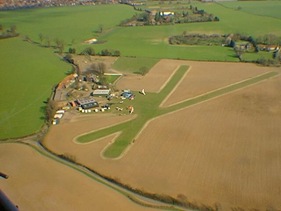
This is a prepared facility; the dirt is compacted, and covered with grass to prevent erosion; it has a drainage system, and has supporting buildings. The crews can sleep indoors and enjoy the patronage of the local Ukrainians. It is not the O'Hare airport, but seems a better place to fly than some far-away wilderness that never saw a bulldozer.
While I'm sold on the idea that air units can operate from anywhere and 99% of the airfields are dirt/grass fields, I still kind imagine that operating from or nearby a big city should have some bonus as compared to operating from X=122,Y=7 (if you can find that on map)...
Very good, I think that everybody has placed good arguments here. I appreciate everybody's input.
My perspective was in a good part due to the fact that everywhere US engineers went they laid down Marsden Mattings (steel plates) for airstrips, and that was developed *before* WW2. So I always thought that there would be benefits for running aircrafts on hard surfaces (otherwise those plates wouldn't be developed). Now, it is true that I didn't actually see those devices in use in any soviet photos, but I assumed that was more an issue of having the resources for that, rather than having little benefits.
Anyway, I think that the common wisdom here is that either for lack of need or lack of resources, east front means by and large dirt airstrips, and that's fair. Thanks all.
To the best of my knowledge the steel plates were used for parking planes (preventing them from sinking into the ground) or for patch jobs on runways where they could place steel plates over a hole and put some topsoil on top temporarily to allow immediate use of a runway instead of having to bulldoze in a large quanity of dirt and level everything off again.
Kind branching from the SU side of the discussion, but I felt it worth pointing out that airstrips weren't made of steel plates.
To the best of my knowledge the steel plates were used for parking planes (preventing them from sinking into the ground) or for patch jobs on runways where they could place steel plates over a hole and put some topsoil on top temporarily to allow immediate use of a runway instead of having to bulldoze in a large quanity of dirt and level everything off again.
Hah... living and learning. I always thought the entire runway was steeled up and covered with whatever was available at hand, as substitute for concrete or asphalt. Appreciate for the info.
ORIGINAL: fbs
Hah... living and learning. I always thought the entire runway was steeled up and covered with whatever was available at hand, as substitute for concrete or asphalt. Appreciate for the info.
Later in the war the Allies made extensive use of PSP, Perforated Steel Planking, or Marsden matting, which was used to provide both parking and landing areas and would include entire runways. It's cheap and simple and it would inconceivable that it was not supplied to the Russians, or that they would not produce their own. I have no direct evidence, but it would be safe to assume that Russian tactical airfields would have been similar to the hundreds of Allied tactical airfields used on the Western and Mediterranean Fronts.
There is no doubt that existing airfields, however well built they were, with or without concrete runways, were used by advancing forces in France, Italy and Russia, at various stages of the war on all Fronts. Surely the question is, does this make any measurable difference, when you take into account the game scale that WiTE uses.
This is not a small scale tactical game, it's at the Strategic and Operational level. Each hex is of a size that could hold several landing strips and airfields of various sizes and facilities, the hundreds of sites may have included a handful of well prepared pre-war bases (whatever survived air attack), but is any of this significant enough to reflect in a game of this size. On balance the way the game handles airfields is very close to reality. [:)]
"In politics stupidity is not a handicap" - Napoleon
“A people which is able to say everything becomes able to do everything” - Napoleon
“Among those who dislike oppression are many who like to oppress" - Napoleon
By the way, how about the concept that all clear hexes are the same?
I mean, the game assumes that you can fly any aircraft in any clear hex in the same way as flying from Minsk. True the Minsk runway might be just a grass strip, but consider this:
You could say that all clear hexes are generally the same, my maths is not good enough to work out how many square miles there are in a 10 mile hexagon, but it will be plenty of space and ground surface types to fit in several landing areas. You could say that generally airfields cannot be built in swamp areas, but a close survey of the real ground may find somewhere that a strip could be fitted in. The game has to make choices, clear hex yes - swamp hex no.
In your picture, any one of the green fields shown around the prepared airfield would serve just as well as a landing strip, with minimal work required for WW2 aircraft operations. Within 5 miles in any direction (a WiTE hex) of that airfield, there will be hundreds of suitable fields, the presence of a prepared airfield doesn't make much difference to the usefulness of that hex. Today a we expect aviation operations to be perfect, but in WW2 the wastage was huge, the WiTE operational losses reflect the fact that you are operating your air forces from barely prepared airfields.
Generally there will be more roads and tracks in clear terrain and less in forest areas, the cost in MP reflects this. Whether the few hard surfaced roads should have special treatment is debatable. The main Moscow highway became the 'Rollbahn' a main German truck supply route (bit like the 'Red Ball Express' in France '44). A game of this size has to work in generalities and it would be questionable to try and map a huge ill-defined Russian dirt road and track net.
The game doesn't pretend to be a microscopic representation of Russia at war, it a huge strategic scale with a vast map, millions of men, 10,000s of AFVs, 100,000s of trucks, etc.. You just have to accept some generalities. [:)]
"In politics stupidity is not a handicap" - Napoleon
“A people which is able to say everything becomes able to do everything” - Napoleon
“Among those who dislike oppression are many who like to oppress" - Napoleon
Generally there will be more roads and tracks in clear terrain and less in forest areas, the cost in MP reflects this. Whether the few hard surfaced roads should have special treatment is debatable. The main Moscow highway became the 'Rollbahn' a main German truck supply route (bit like the 'Red Ball Express' in France '44). A game of this size has to work in generalities and it would be questionable to try and map a huge ill-defined Russian dirt road and track net.
The game doesn't pretend to be a microscopic representation of Russia at war, it a huge strategic scale with a vast map, millions of men, 10,000s of AFVs, 100,000s of trucks, etc.. You just have to accept some generalities. [:)]
I agree.
As an aside, it should be noted that paved Minsk-Moscow highway was totally broken up the end of 1941 by heavy use. It wasn't engineered to take the traffic load - poor subgrade and insufficient stone base material. Basically asphalt on dirt. The Germans spent an enormous amount of engineering assets doing road construction in Russia in 1942-44. Even some fully paved construction in western Ukraine - but mostly stone or wood cordoroy. It should also be noted that there were relatively few paved highway roads even in France in 1940 - most were stone, albeit well engineered. The US Army experienced similar problems in the fall of 1944 as the Germans did in Russia.
Regarding airfields, there were a small number of concrete strips in most capital cities, (I grew up next to one that was laid down in 1940 and is now a race track for corporate events) but they were rare and most military fields were just fields... Given the level of abstraction in the game, I think that the air base approach is acceptable (though not perfect) and it's somewhat consistent with the traditional approach of 'building' a little airfield marker in the selected hex from the board game era.
The American steel matting reflects and American approach to the problem and probably can't be compared to the approaches taken by other nations. They used bulldozers where others used women with shovels or slave labour.
On the subject of roads, while there were indeed some key paved roads in the Soviet Union in 1941 (designated Rollbahn by the Germans, IIRC) most of these were torn up by the advance of the German Panzer forces. If you read Raus on his advance to Leningrad, he describes how his tanks created absolute misery for the supply columns and infantry trying to come up behind them - heavy rain wasn't required; the tanks created their own mini Rasputitsa just because of the water table. At one stage his entire division was isolated for 2 weeks waiting for the infantry to catch up.
At this scale, there are permanent or semi-permanent airfields in every hex
This statement seem to be a bit exaggerated. If one consider the deployments of soviet air groups in 1941 (as they are quite precisely given in the Источник: "Советская авиация в ВОВ в цифрах"- here is the link for the Western military district : www.rkka.ru/22/vvs/zapovo.htm (and I suppose that the design team had ample access to this kind of material) you see clearly that the number of airfields suitable for large-scale military operations is quite limited and that the airgoups are dispersed on a very wide geographic area. A practice that is not encouraged by the game model where the player is freed of real-life limitations,and may stack its bases 3 by 3 near the air command hq.
basically, this model allows a potential of 20 aircrafts x 9 airgroups x 3 airbases = 540 combat aircrafts to be setup pretty much on any hex of the map, provided this hex is clear terrain or light woods.
Considering these references, I do not see many occurences (at least on the soviet side of the border) of this scale of aircraft concentration. And I suppose it is for good reasons.
I understand that you could setup the logistics for one or maybe two or 3 air divisions on almost every town (not hex) of the map provided it is linked to the logistics network - in this game : the railways - to deliver correctly the huge quantities of kerosene and ammo required).
but being able to concentrate without any penalties enough ammo, facilities and kero for 540 combat aircraft that conduct intensive air warfare from patches of mud lost in a 25 miles hexagon of a god-forsaken forest seem a little bit too much for me.
Maybe a clean solution to this design dilemma exist, but I do not see it clearly right now. Possibly some sort of penalty (no more than 2 airbases when no town is present in the hex, and a 10% additional fatigue when the hex is not connected by a railways) could help and channel the deployment of airbases to historically plausible locations.
Kein Operationsplan reicht mit einiger Sicherheit
über das erste Zusammentreffen
mit der feindlichen Hauptmacht hinaus.
Roads - The only road that the Germans considered to be comparable to European standards, is the paved highway running from Minsk to Moscow, which parallels rail lines:
Attachments
RussianRoad.jpg (400.06 KiB) Viewed 853 times
WitE Alpha/Beta Tester
WitE Research Team
WitE2.0 Alpha/Beta Tester
WitE2.0 Research Team
WitW Alpha/Beta Tester
WitW Research Team
Piercing Fortress Europa Research Team
Desert War 1940-1942 Alpha/Beta Tester
Airfields - The Soviet Airfields with circles around them were considered "Primary" by German Intelligence, the others "Secondary" and "Tertiary."
Attachments
RussianAF.jpg (475.8 KiB) Viewed 862 times
WitE Alpha/Beta Tester
WitE Research Team
WitE2.0 Alpha/Beta Tester
WitE2.0 Research Team
WitW Alpha/Beta Tester
WitW Research Team
Piercing Fortress Europa Research Team
Desert War 1940-1942 Alpha/Beta Tester
It's the German "Official Histories." They were published in German in the 70s and 80s, and are slowly being translated to English by Oxford. There is a Map Book that comes with Volume IV, which focuses on Barbarossa.
WitE Alpha/Beta Tester
WitE Research Team
WitE2.0 Alpha/Beta Tester
WitE2.0 Research Team
WitW Alpha/Beta Tester
WitW Research Team
Piercing Fortress Europa Research Team
Desert War 1940-1942 Alpha/Beta Tester
There were several thousand miles of paved roads in the Soviet Union in 1941. Not just the road to Moscow. It's just that the vast majority of roads were not. I don't think it makes a difference one way or the other if they are or are not portrayed.
Those roads would be clogged with trucks carrying supply/fuel, and would have priority. To use them with your military, would probably slow them down more then if they went cross country or on back roads.
“My logisticians are a humorless lot … they know if my campaign fails, they are the first ones I will slay.” – Alexander the Great
Common sense tells anyone more than a few years old that they know what a road is, it’s taken for granted. Unfortunately, such assumptions are laden with prejudice which becomes apparent when the subject is approached in ways that experience has not taught one to deal with. It’s evident from the discussion here that everyone opposed to depicting roads on map is fixated by one narrow aspect of a road- the quality of its surface. To fixate on this is to quite miss the point of what a road is and what it does.
Roads have existed for thousands of years, long before they were metalled, cobbled or in any way improved surfaces. People have followed them through restricted terrain, deserts, and everything in between. The two belligerents in this war were no exception. What is general to all roads is that they connect places, they go from one place to another, while fields, woods and plains do not. How they do so has not remained the same, however, and one of the most fundamental changes to them, which has changed the nature of roads, has been the development of obstacle passing technologies.
Wheeled carts cannot traverse the same ground as horses or feet, and their routes were, then, largely restricted to the ground that was naturally passable to a wheel. I have no problem regarding such tracks as inherent terrain in every hex. I see no need to depict these.
But there were other dirt tracks, of no better, or little better surface, which should be depicted on a map of this scale because they were too rare to be considered inherent terrain. Why?
Consider what happens when you are able to bridge an obstacle, rather than find nature’s circuitous way around it. You are able to shorten and straighten the road’s route to the extent of your obstacle bridging technology. Put another way, to an ever greater extent, as your technology improves, you are able to determine the route from A to B, in stead of having it determined for you by the lie of the land.
The improvement of bridge technology also allows bridges to carry ever larger and heavier loads.
The comparison between Russian roads and west European roads of the day is relevant only in determining the former’s qualitative inferiority. Such a comparison does not determine whether they affect mobility enough to make their possession a military benefit or not and whether they should be depicted on the map. There is an historical fact being overlooked on this question which alludes to the importance of roads in Russia- however much the invading Germans bemoaned the state of the Russian road net, they used it and at a tactical and operational level, were dependent upon it.
Before dismissing the depiction of roads on map on account of their poor quality, consider the arguments presented in defence of the present situation. I pick on Rasputitsa’s arguments not because they are more inconsistent and self-contradictory than other peoples’, but because they are the best and most fully articulated. But they are constructed from impressions and de-contextualised generalisations. The facts within them, when thought through and placed in proper relation to each other, demonstrate the opposite of what was intended.
To begin with-
“… after 6th. PZ had advanced towards Leningrad, they became isolated for several days because their passage had wrecked the roads and tracks so much, that following divisions could not move without laying mile after mile of 'corduroy' roads (felled tree trunks). Point is that there wasn't much to choose between the roads and the 'normal' terrain.”
and-
“In Russia, in summer, you could probably drive just about anywhere (excluding swamps, mountains and forests), road or no road, when it rained you couldn't… …German soldiers described the land as an endless sea stretching to the horizon… …The hedges, walls, etc., that you describe are are a feature of Western Europe.”
This begs the questions, “why then, did the German divisions not just go cross country? Why did they laboriously rebuild the road the advanced division had just destroyed? It doesn’t add up. Either swamps and forests (and other obstacles Rasputitsa and the German soldiers have overlooked) were far more prevalent than Rasputitsa realises, or, for some reason yet to be discovered, you could not drive just about anywhere in Russia, or at least, not at a speed necessary to maintain logistical support for an advancing army, and not if you were trying to avoid undue damage to your truck fleet. Clearly, roads, even without hard surfaces, have vital properties that fly under the ‘no need for roads on map’ camp’s radar. Otherwise, 6. Pz Div. would not have become isolated either, would it?
It is true that Russian terrain generally differs from that of western Europe, but is the “sea” described by Rasputitsa’s German soldiers (without doubt of all the German occupied areas only the southern steppes fits such a description) as calm as the sea in Rasputitsa’s mind’s eye? I think not.
This also reminds me of a friend who turned up one night complaining there was nobody in a club he’d been to. It turned out it was a busy as usual but just nobody he knew there. Rasputitsa has evidenced what’s happening, but hasn’t joined up the dots- The German is confronted by an unfamiliar landscape and simply does not register in detail the terrain features he is unused to. Had he survived an attempt to cross a gully in the steppes without use of a road bridge, it would doubtless have made an impression on him and his lorry.
Rasputitsa tells us-
“the bridges were mainly wood for crossing on foot, or at most a horse and cart.”
I dare say “mainly” they were. But if that’s all there was in Russia, Barbarossa would have stalled in its first week for lack of bridging equipment. Neither would the Russians ever have motorised a significant part of their own army and built heavy tanks like the KVs and T34, vehicles which at the tactical and operational levels, are dependent upon road bridges of considerable width and strength. Rasputitsa’s generalisation does not acknowledge the significance of the numerous exceptions to his rule.
As with hard surfaced runways, significant load baring bridges are not frequently encountered, so on a map of this scale they cannot be considered inherent terrain. If they are important, then, it follows that they should be depicted.
Does their scarcity make them unimportant? This is basic supply and demand. The demand is screaming for good roads with bridges that can carry tanks and lorries. Their scarcity makes them more important than in the west, in fact more worthy of depiction as operational objectives of considerable importance. The quality of the surface is of secondary importance. Strong bridges over obstacles is the main issue. These bridges were part of the roads! But Rasputitsa tells us-
“There was not much fighting just to gain a section of road, there was almost always a way round”
What is a bridge if not a section of road? A bridge over a large water obstacle is an obvious choke point in a stretch of road, and there was plenty of fighting for bridges. Most famous on the eastern front would be the bridge at Kalach-on-Don. You can say what you like about the quality of the dirt track on either side of it, but the bridge at Kalach, like 99.999% of all bridges, was part of a road (or railway). To separate bridges from their roads is to abstract them from the context in which they almost invariably exist.
It is fairly self-evident that the half million multi-axle vehicles Rasputitsa cites as lend-leased to Russia were not present at the start of Barbarossa and would not have been present in any number before 1943. That the Axis were overly dependent upon low quality, under maintained captured trucks, and that they lost so many only emphasises, once again, that any cross country option was, apart from short term expediency, unviable. Roads rule at the tactical and operational levels.
You might argue, then, that given the fairly universal quality of roads in Russia, that only ‘stone’ bridges should be represented over major river obstacles. That would certainly be an improvement but I would still disagree. To give a movement benefit for the entire road is to nicely abstract the direct route generally taken by such a road and all the invisible, hex inherent obstacles traversed by the road, not just the major choke points like fat rivers.
As for the argument that roads are already represented in rail lines, anyone who has studied the excellent 5km hex Operational Combat Series maps of Russia will tell you different. Yes, there is some overlap. But there’s a lot of rail line without road and a load of ‘good’ road (by Russian standards) without rail. Hard surfaced road? Probably not, and to anyone who’s waded through this and still hasn’t got why it’s of secondary importance, I’ll have to give up.
“Old age is the most unexpected of all things that can happen to a man.”
-Leon Trotsky