


Most conflicts during that time are unconventional in nature. It is very difficult to make a fun and convincing wargame on asymmetric warfare involving insurgents. Same with the present day conflicts. That's why you don't get many games about the Vietnam War as well. May also end up being controversial if you want historical accuracy. Pacification of natives / insurgents is a cruel business and may still be a sensitive subject for some.
This the reason why we have Ancient, Medieval, Napoleonic, WWII and WWWIII games. These are conventional warfare. Even modern games that tackle insurgencies end up simulating conventional warfare.
The neglected time period - 1870-1920...
Moderator: maddog986
RE: The neglected time period - 1870-1920...
ORIGINAL: Perturabo
I have noticed that 19th century rifles have pretty crazy effective ranges - like in over 1km without optics. In 20th century effective ranges drop to ~500 metres despite higher muzzle velocities and more aerodynamic projectiles.
Then I have read an article about Chassepot rifle and it wrote that:Does it mean that 19th century rifles had longer effective range because they were aimed at crowds, not on point targets?Dossiers at the French Army Archives at Vincennes (the S.H.A.T-Service Historique de l'Armée de Terre) seem to bear out this published account. According to trials carried out in May 1867 by the Chasseurs batallion of the 1st Division and the Chasseurs of the Imperial Guard, two-rank fires for three minutes under less than ideal conditions resulted in 25.4% hits at 600 meters on a target 50 meters long and 2 meters high;
While researching the Stg44 online last week I came across a quote similar to the following:
The rifle was chambered for the 7.92 x 33mm Kurz cartridge, also known as 7.92 mm Kurz
(German for "short"). This shorter version of the German standard (7.92 x 57mm Mauser)
rifle round, in combination with the weapon's selective-fire design, provided a
compromise between the controllable firepower of a submachine gun at close quarters with
the accuracy and power of a Karabiner 98k bolt action rifle at intermediate ranges.
While the StG44 had less range and power than the more powerful infantry rifles of the
day, Wehrmacht studies had shown that most combat engagements occurred at less than 300
meters with the majority within 200 meters. Full-power rifle cartridges were overpowered
for the vast majority of uses for the average soldier.
In the German case at least I think they were moving towards designs that were optimal for engagements at those ranges.
"When they get in trouble they send for the sonsabitches" - Adm. King

RE: The neglected time period - 1870-1920...
The thing is that it includes practically all the full-powered infantry rifles since Mosin-Nagant. They can fire up to 800+ metres but only with a scope. Effective range without a scope is only 500 metres, while rifles from 10-30 years earlier have an effective range of over 1km without a scope. The only reasonable reason I can think of is that the definition of effective range changed over time.ORIGINAL: Vyshka
ORIGINAL: Perturabo
I have noticed that 19th century rifles have pretty crazy effective ranges - like in over 1km without optics. In 20th century effective ranges drop to ~500 metres despite higher muzzle velocities and more aerodynamic projectiles.
Then I have read an article about Chassepot rifle and it wrote that:Does it mean that 19th century rifles had longer effective range because they were aimed at crowds, not on point targets?Dossiers at the French Army Archives at Vincennes (the S.H.A.T-Service Historique de l'Armée de Terre) seem to bear out this published account. According to trials carried out in May 1867 by the Chasseurs batallion of the 1st Division and the Chasseurs of the Imperial Guard, two-rank fires for three minutes under less than ideal conditions resulted in 25.4% hits at 600 meters on a target 50 meters long and 2 meters high;
While researching the Stg44 online last week I came across a quote similar to the following:
The rifle was chambered for the 7.92 x 33mm Kurz cartridge, also known as 7.92 mm Kurz
(German for "short"). This shorter version of the German standard (7.92 x 57mm Mauser)
rifle round, in combination with the weapon's selective-fire design, provided a
compromise between the controllable firepower of a submachine gun at close quarters with
the accuracy and power of a Karabiner 98k bolt action rifle at intermediate ranges.
While the StG44 had less range and power than the more powerful infantry rifles of the
day, Wehrmacht studies had shown that most combat engagements occurred at less than 300
meters with the majority within 200 meters. Full-power rifle cartridges were overpowered
for the vast majority of uses for the average soldier.
In the German case at least I think they were moving towards designs that were optimal for engagements at those ranges.
-
ilovestrategy
- Posts: 3614
- Joined: Sat Jun 11, 2005 8:41 pm
- Location: San Diego
- Contact:
RE: The neglected time period - 1870-1920...
ORIGINAL: redcoat
and the wars in the Philippines probably aren't obscure to Filipinos.
Actually, they are. I know, I've been married into a Filipino family for 21 years and have tried discussing the topic with them. Some Filipino's actually DOUBT the existence of the Philippine Insurrection. It's surprising, I've done a lot of research into the conflicts there in the 1890s-early 1900s and it's really hard to find anyone with any knowledge of that period. Mostly just internet forum rants and that's about it.
After 16 years, Civ II still has me in it's clutches LOL!!!
Now CIV IV has me in it's evil clutches!
Now CIV IV has me in it's evil clutches!
RE: The neglected time period - 1870-1920...
Here is a nice site about the Russo-Japanese war:
http://www.russojapanesewar.com
It includes an article about company tactics.
http://www.russojapanesewar.com/lesser-3.html
http://www.russojapanesewar.com
It includes an article about company tactics.
http://www.russojapanesewar.com/lesser-3.html
RE: The neglected time period - 1870-1920...
I'd assume a major change in fighting conditions plus a change in definition of effective range.
You have 25% against a 50x 2m target @ 600. This is 100 men (roughly) standing in a dense body.
With the reasonable assumption that hit % is mostly dependent on height (vertical dispersion, plus ranging errors here), and only slightly dependent on lateral size (though no doubt it helps having a slightly wider target), then you can immediately account for a lot of the 'drop' in effectiveness.
Modern targets are generally assumed to be half-figure (1m high).
If the effective range is taken as not 25%, but rather a 50% hit on an exposed stationary target (or even 'better'), then that also eats into the maximum usable range - then you also have the effect of lighter ammunition, body armour, and the penetration of cover/armour, and ranges (might) again take a nudge downwards. In real-world fighting, where a target might only be a few inches square, rather than a full 2m high target... and even finding something to shoot at, let alone hit becomes the primary problem.
You have 25% against a 50x 2m target @ 600. This is 100 men (roughly) standing in a dense body.
With the reasonable assumption that hit % is mostly dependent on height (vertical dispersion, plus ranging errors here), and only slightly dependent on lateral size (though no doubt it helps having a slightly wider target), then you can immediately account for a lot of the 'drop' in effectiveness.
Modern targets are generally assumed to be half-figure (1m high).
If the effective range is taken as not 25%, but rather a 50% hit on an exposed stationary target (or even 'better'), then that also eats into the maximum usable range - then you also have the effect of lighter ammunition, body armour, and the penetration of cover/armour, and ranges (might) again take a nudge downwards. In real-world fighting, where a target might only be a few inches square, rather than a full 2m high target... and even finding something to shoot at, let alone hit becomes the primary problem.

RE: The neglected time period - 1870-1920...
The most important study from this period is the Russian Civil War. The results changed everything for more than 70 years.
Germany's unforgivable crime before the Second World War was her attempt to extricate her economy from the world's trading system and to create her own exchange mechanism which would deny world finance its opportunity to profit.
— Winston Churchill
— Winston Churchill
RE: The neglected time period - 1870-1920...
The resulting civil war eliminated Libertarian and Constitutionalist forces in Russia and enabled Communist Provocateurs to infiltrate the West supported by the Commintern setting the stage for reactionaries to gain power and trigger WWII. Stalinism would trigger wars around the world for decades following.Russian Civil War
The Russian Civil War, which broke out in 1918 shortly after the revolution, brought death and suffering to millions of people regardless of their political orientation. The war was fought mainly between the Red Army ("Reds"), consisting of the uprising majority, and the "Whites" — the monarchists, conservatives, liberals and moderate socialists who opposed the drastic restructuring championed by the Bolsheviks. The Whites had backing from nations such as Great Britain, France, USA and Japan.
Also during the Civil War, Nestor Makhno led a Ukrainian anarchist movement, the Black Army allied to the Bolsheviks thrice, one of the powers ending the alliance each time. However, a Bolshevik force under Mikhail Frunze destroyed the Makhnovist movement, when the Makhnovists refused to merge into the Red Army. In addition, the so-called "Green Army" (peasants defending their property against the opposing forces) played a secondary role in the war, mainly in the Ukraine.
Germany's unforgivable crime before the Second World War was her attempt to extricate her economy from the world's trading system and to create her own exchange mechanism which would deny world finance its opportunity to profit.
— Winston Churchill
— Winston Churchill

RE: The neglected time period - 1870-1920...
ORIGINAL: redcoat
I don’t remember seeing any scenarios for the Paraguayan War ...
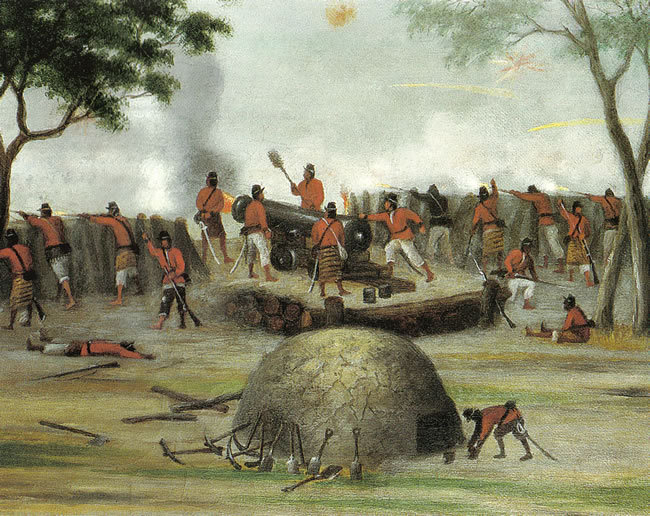
After searching I’ve managed to find a couple of scenarios for the Paraguayan War: the battles of Tuyutí and Curupayty. I’ve attached them for anyone who might be interested.
- Attachments
-
- Paraguay.zip
- (43.56 KiB) Downloaded 18 times
“‘Who controls the past,’ ran the Party slogan, ‘controls the future: who controls the present controls the past.’”
George Orwell, 1984
George Orwell, 1984

RE: The neglected time period - 1870-1920...
ORIGINAL: Perturabo
And finally WWI. But never on tactical level because everyone knows that WWI on tactical level is all about running at a machine gun and getting killed.
Educate yourself and read some decent WW1 books...you'd be very surprised. It always makes me go tut tut when I read this sort of comment. The image in everyones heads is the men walking in line on the Somme...there where reasons for that...wrong ones as it happens but a reason from High command to adopt this basic attack....other battles we have fire and movemnt at platoon level and as the war went on squad level...tactics weren't invented after WW1 but during.
Jack Sheldon "The German Army on..." series is superb and highley recommended..
RE: The neglected time period - 1870-1920...
I was sarcastic - it's sadly a popular myth, though, which makes this period unavailable for us, wargamers on tactical level.ORIGINAL: wodin
ORIGINAL: Perturabo
And finally WWI. But never on tactical level because everyone knows that WWI on tactical level is all about running at a machine gun and getting killed.
Educate yourself and read some decent WW1 books...you'd be very surprised. It always makes me go tut tut when I read this sort of comment. The image in everyones heads is the men walking in line on the Somme...there where reasons for that...wrong ones as it happens but a reason from High command to adopt this basic attack....other battles we have fire and movemnt at platoon level and as the war went on squad level...tactics weren't invented after WW1 but during.
Jack Sheldon "The German Army on..." series is superb and highley recommended..
I read about WW1 a lot, it's my favourite time period lately.
From what I've read, BeF was using fire and manoeuvre tactics learned during the Second Boer War long before Somme, but they eventually got almost wiped out and the command thought that the raw recruits won't be able to use such tactics (and that the artillery bombardment will wipe out the defenders).
If I understand correctly, generally, the main problem was that when attacks captured the first line of enemy trenches, there would be a bombardment from pre-sighted enemy guns and a counter attack. Also, transporting guns for firing on further enemy lines would be a problem.
RE: The neglected time period - 1870-1920...
C^3 breakdown and the inability to react fast enough (and in the right manner) to the changing situation was the biggest problem. The eventual solution was to make the attacks 'smaller' and more manageable. To not attempt to break-through, but to break-in and then hold (which was easily done (most of the time)) and caused far fewer casualties than protracted attacks against the same sector for months on end (against steadily increasing enemy commitments). The German counter-attacks were frequently unsuccessful, and in any case exposed their troops to the same risks that the 'attackers' faced if they attempted to move further forward.
The next attack would go in against an adjacent sector, where the reserves and guns had been stripped, and this could be repeated.
Advances in artillery prediction and met, plus air-corrected shoots with w/t eventually allowed a dramatic reduction in preparatory fires with accurate counter-battery and strong-point reduction with 'modern' ammunition requirements, albeit without the flexibility of response of wire-less voice of higher reliability - most needed to be pre-planned and then called as required, although the late system of aircraft observation did allow fires on targets of opportunity "from the map".
The next attack would go in against an adjacent sector, where the reserves and guns had been stripped, and this could be repeated.
Advances in artillery prediction and met, plus air-corrected shoots with w/t eventually allowed a dramatic reduction in preparatory fires with accurate counter-battery and strong-point reduction with 'modern' ammunition requirements, albeit without the flexibility of response of wire-less voice of higher reliability - most needed to be pre-planned and then called as required, although the late system of aircraft observation did allow fires on targets of opportunity "from the map".
RE: The neglected time period - 1870-1920...
I made a first release of my AB_Wonderland mod for Armored Brigade. It's a fantasy age of rifles mod with two playable races - Humans and Elves. It includes basic units for these races. I plan to add more detail to both races in subsequent releases.
Feedback would be welcome.
http://www.armoredbrigade.com/forums/vi ... f=12&t=289
Feedback would be welcome.
http://www.armoredbrigade.com/forums/vi ... f=12&t=289
RE: The neglected time period - 1870-1920...
ORIGINAL: Zorch
<Applause>
Let's hear it for games about obscure periods!
How about the South American wars of Chile vs Peru and Bolivia, Bolivia vs Paraguay, and Paraguay vs Brazil, Argentina, and Uruguay?
There is actually a scenario about the War of The Tripple Alliance for Advanced Tactics. If i may tute my own horn a little.
My Advanced Tactics Mod page
http://atgscenarios.wordpress.com
30+ scenarios, maps and mods for AT and AT:G
http://atgscenarios.wordpress.com
30+ scenarios, maps and mods for AT and AT:G
RE: The neglected time period - 1870-1920...
Interesting post Grymme. I don’t have Advanced Tactics. I did not know that the game could be used to create 19th Century scenarios. I found a few on your mod page and some more on this site.
“‘Who controls the past,’ ran the Party slogan, ‘controls the future: who controls the present controls the past.’”
George Orwell, 1984
George Orwell, 1984
RE: The neglected time period - 1870-1920...
Redcoat. Yeah. Its a great game that can mimic practicly any historical period at the right scale. Although i wouldnt recommend buying it just to get those scenarios. But there are many more.
Here is a somewhat outdated list of the scenarios available for the game
tm.asp?m=2759761
By the way. For what game was the scenarios you found for Paraguayan war?
Here is a somewhat outdated list of the scenarios available for the game
tm.asp?m=2759761
By the way. For what game was the scenarios you found for Paraguayan war?
My Advanced Tactics Mod page
http://atgscenarios.wordpress.com
30+ scenarios, maps and mods for AT and AT:G
http://atgscenarios.wordpress.com
30+ scenarios, maps and mods for AT and AT:G
RE: The neglected time period - 1870-1920...
ORIGINAL: Grymme
Redcoat. Yeah. Its a great game that can mimic practicly any historical period at the right scale. Although i wouldnt recommend buying it just to get those scenarios. But there are many more.
Here is a somewhat outdated list of the scenarios available for the game
tm.asp?m=2759761
If I bought AT I might think about putting together a scenario for the Franco-Prussian War. Possibly based on the SPI game The Franco Prussian War.
ORIGINAL: Grymme
By the way. For what game was the scenarios you found for Paraguayan war?
The old DOS game Age of Rifles. [:D]
“‘Who controls the past,’ ran the Party slogan, ‘controls the future: who controls the present controls the past.’”
George Orwell, 1984
George Orwell, 1984
RE: The neglected time period - 1870-1920...
Ok, cool.
Well, one of my scenarios: The Russo-Turkish war is based on a series of boardgame that also include a Franco-Prussian boardgame and a Austrian-Prussian boardgame. So i cant see why it couldnt be done.
http://www.boardgamegeek.com/boardgame/ ... ar-1877-78
Well, one of my scenarios: The Russo-Turkish war is based on a series of boardgame that also include a Franco-Prussian boardgame and a Austrian-Prussian boardgame. So i cant see why it couldnt be done.
http://www.boardgamegeek.com/boardgame/ ... ar-1877-78
My Advanced Tactics Mod page
http://atgscenarios.wordpress.com
30+ scenarios, maps and mods for AT and AT:G
http://atgscenarios.wordpress.com
30+ scenarios, maps and mods for AT and AT:G