


Does anyone know if tanks can suffer damage like radio knocked out or crew member killed or immobilised, the kind of damage where the tank isn't knocked out just damaged that reduces performance?
Question about Tanks and damage
Moderators: Panther Paul, Arjuna
RE: Question about Tanks and damage
It is possible to lose personnel without losing vehicles. Once losses are high enough a vehicle will be abandoned, even if the unit has good morale (crews insufficient for vehicles present).
Other than that, there are only morale and logistics limitations on vehicles. No incremental damage from direct combat ~ even a partially crewed vehicle will operate identically to the others in the unit (though the overall effectiveness drops with casualties).
As far as I have seen, it is possible to (slowly) attrit a tank unit with sufficient "non-effective" fires with individual crew members being lost. Whether these are 'kills' or surrendering elements I'm unsure. After a few casualties the remaining elements frequently need to displace (retreat or rout) and with a close engagement it is not infrequent to capture some proportion during the withdrawal.
Other than that, there are only morale and logistics limitations on vehicles. No incremental damage from direct combat ~ even a partially crewed vehicle will operate identically to the others in the unit (though the overall effectiveness drops with casualties).
As far as I have seen, it is possible to (slowly) attrit a tank unit with sufficient "non-effective" fires with individual crew members being lost. Whether these are 'kills' or surrendering elements I'm unsure. After a few casualties the remaining elements frequently need to displace (retreat or rout) and with a close engagement it is not infrequent to capture some proportion during the withdrawal.

RE: Question about Tanks and damage
Actually an AFV with less than its optimal crew will have its rate of fire reduced.
RE: Question about Tanks and damage
ORIGINAL: Arjuna
Actually an AFV with less than its optimal crew will have its rate of fire reduced.
Hmm, let's say the radio operator and the commander of a tank operated by 5 crew members had been hit or even killed, then the gunner and the loader would still be able to maintain the main gun's fire rate, they could just not operate the hull MG, but the gunner could still operate the (coax) turret MG.
Say driver and radio operator were killed, then a tank basically would have lost both drivers (driver + assistant driver), forcing the rest of the crew to put one member as driver, maybe resulting in choppy movement or even ruining the tank's gear and clutch (well depending on skill), but the other 2 could still maintain the main gun's regular fire rate. This setup would also still allow to operate the turret MG.
Say a tank lost 3 (out of 5, that's 60% of the crew) crew members, driver, commander and radio operator (or loader). Then the gunner could still maintain the fire rate, since the loader (or radio operator) could still serve as loader.
With these examples, I would see a severe reduction of fire power (-1 MG), or even a total reduction of speed/mobility, but no reduction of fire rate. Only if a tank had lost the trained/skilled gunner and if there was no suficciently skilled/trained backup (a commander actually had the knowledge and most likely the skill too, the loader could have jumped in too, I guess), then the fire rate would have dropped significantly. Only such occurrence could seriously impact the fire rate of the main gun, imho.
When an Allied shell penetrated the frontal (vertical) armor (of a Tiger I, for example), either the radio operator or the driver was killed or severely wounded, usually, with the tank (compartment and the rest of the crew) remaining fully operational, quite some times. With the first version of the Panther tank's frontal (movable) turret armor, when hit, the curved design of the 110mm gun mantlet caused shells to bounce and deflect vertically right down into the radio operator's compartment, killing the operator instantly, usually. These tanks may have lost the radio too, but, to the surprise of their opponents, these tanks remained fully operational in all cases, afaik, even though the opponents may have wiped off the damaged tank off of their to-do list already [;)].
Whatsoever, this led the German designers to change the angle of the curved mantlet, and there are no reports of such evil deflections after the change had been implemented in the production line.
"Aw Nuts"
General Anthony McAuliffe
December 22nd, 1944
Bastogne
---
"I've always felt that the AA (Alied Assault engine) had the potential to be [....] big."
Tim Stone
8th of August, 2006
General Anthony McAuliffe
December 22nd, 1944
Bastogne
---
"I've always felt that the AA (Alied Assault engine) had the potential to be [....] big."
Tim Stone
8th of August, 2006

RE: Question about Tanks and damage
ORIGINAL: Arjuna
Actually an AFV with less than its optimal crew will have its rate of fire reduced.
That makes sense as cross-training should not fully compensate for lost personnel.
Stratford, Connecticut, U.S.A.[center] [/center]
[center]"The Angel of Okinawa"[/center]
Home of the Chance-Vought Corsair, F4U
The best fighter-bomber of World War II
[/center][center]"The Angel of Okinawa"[/center]
Home of the Chance-Vought Corsair, F4U
The best fighter-bomber of World War II
RE: Question about Tanks and damage
ORIGINAL: Joe D.
ORIGINAL: Arjuna
Actually an AFV with less than its optimal crew will have its rate of fire reduced.
That makes sense as cross-training should not fully compensate for lost personnel.
Well, certain levels of losses may result in either a tank's immobilization (or in reduction of speed), or in the reduction of fire power. Just a reduction of firepower isn't realistic, imho.
ORIGINAL: GoodGuy
Say a tank lost 3 (out of 5, that's 60% of the crew) crew members, driver, commander and radio operator (or loader). Then the gunner could still maintain the fire rate, since the loader (or radio operator) could still serve as loader.
Btw, German tank units used to distribute their personnel, if necessary. Say tank B's driver and assistant driver were killed or wounded, then tank A would tell its assistant driver (radio operator) to drive tank B.
"Aw Nuts"
General Anthony McAuliffe
December 22nd, 1944
Bastogne
---
"I've always felt that the AA (Alied Assault engine) had the potential to be [....] big."
Tim Stone
8th of August, 2006
General Anthony McAuliffe
December 22nd, 1944
Bastogne
---
"I've always felt that the AA (Alied Assault engine) had the potential to be [....] big."
Tim Stone
8th of August, 2006
RE: Question about Tanks and damage
ORIGINAL: GoodGuy
ORIGINAL: Joe D.
ORIGINAL: Arjuna
Actually an AFV with less than its optimal crew will have its rate of fire reduced.
That makes sense as cross-training should not fully compensate for lost personnel.
Well, certain levels of losses may result in either a tank's immobilization (or in reduction of speed), or in the reduction of fire power. Just a reduction of firepower isn't realistic, imho.
In Panzer Command, the player knows what vehicles are damaged, how extensive -- immobilization, main gun, etc. -- that damage is, and who is WiA/KiA; of course, PC is tactical.
ORIGINAL: GoodGuy
Say a tank lost 3 (out of 5, that's 60% of the crew) crew members, driver, commander and radio operator (or loader). Then the gunner could still maintain the fire rate, since the loader (or radio operator) could still serve as loader.
ORIGINAL: GoodGuy
Btw, German tank units used to distribute their personnel, if necessary. Say tank B's driver and assistant driver were killed or wounded, then tank A would tell its assistant driver (radio operator) to drive tank B.
That could prove tricky under fire, or do these tanks retreat to an assemby area for redistribution?
Stratford, Connecticut, U.S.A.[center][/center]
[center]"The Angel of Okinawa"[/center]
Home of the Chance-Vought Corsair, F4U
The best fighter-bomber of World War II
[/center][center]"The Angel of Okinawa"[/center]
Home of the Chance-Vought Corsair, F4U
The best fighter-bomber of World War II
RE: Question about Tanks and damage
ORIGINAL: Joe D.
[That could prove tricky under fire, or do these tanks retreat to an assemby area for redistribution?
The tanks could fire smoke screens either with external smoke dischargers (like on the PzIV on the pic below, 2 or 3 little cups/pipes on both sides of the turret)
http://img3.imagebanana.com/img/gtrfqtk/Pz4G14.jpg ,

or with internal dischargers (eg. in the Panther after around summer 1943), with the 92mm "Nahverteidungswaffe" (translation would be "close defense weapon", i guess?), which was mounted inside the tank and attached to a small armored hatch (with an even smaller 92mm shutter) on the top of the turret or on the carriage.
With the internal dischargers German tanks had received the best solution to cover a retreat or to cover such reorganizations. If the hatch was opened, then the crew could also fire flares and several types of grenades, maybe even hand grenades (not sure what types were used there). This discharger avoided incidents where external pipes had been triggered by enemy small arms fire, which had put the tanks right into the middle of their own smoke screen, where then the smoke could or even did affect the crews:
http://i28.photobucket.com/albums/c245/ ... anther.jpg (red arrow)
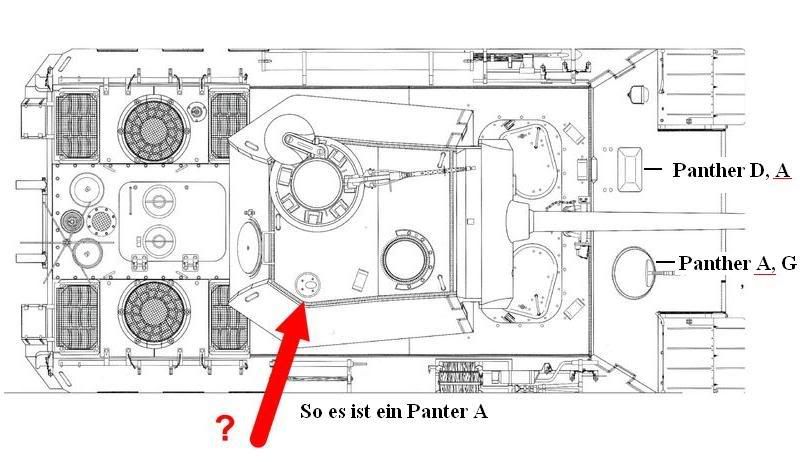
http://upload.wikimedia.org/wikipedia/c ... swaffe.jpg

Once the smoke screen was big enough, crew members could be redistributed, or - probably the method of choice most of the time, in order to avoid that crew members got caught by "random" enemy fire pouring through the fog - the troubled tank could try to go into reverse (maybe even slowly and choppy, if the "cook" had to drive [;)]) and pull out of the immediate danger zone, to allow for a covered and organized redistribution of crew members. There are also quite some reports, where other tanks moved up right in front of the damaged vehicle, in order to protect bailing crew members from the bullet rain of enemy small arms or MGs (trained crews were precious), or to grab the attention of the enemy's AT guns, allowing the damaged tank and its crew to pull back or to prepare explosives to destroy the tank and bail. Often, Panther tanks would take over that job, ignoring the fact that their side armors were relatively weak (resulting in a corresponding amount of damaged or even lost vehicles).
For temp reorganizations, crew members were indeed also reassigned at assembly areas.
Before/after the unit was transfered (railroad) to the next hot spot, permanent replacements joined the ranks, as well as during rest (behind the front) and during general R+R.
"Aw Nuts"
General Anthony McAuliffe
December 22nd, 1944
Bastogne
---
"I've always felt that the AA (Alied Assault engine) had the potential to be [....] big."
Tim Stone
8th of August, 2006
General Anthony McAuliffe
December 22nd, 1944
Bastogne
---
"I've always felt that the AA (Alied Assault engine) had the potential to be [....] big."
Tim Stone
8th of August, 2006