Civil War 150th

Gamers can also use this forum to chat about any game related subject, news, rumours etc.

Moderator: maddog986

User avatar
Capt. Harlock
Posts: 5379
Joined: Sat Sep 15, 2001 8:00 am
Location: Los Angeles
Contact:

RE: Civil War 150th

Post by Capt. Harlock »

150 Years Ago Today:

At Morris Island outside Charleston harbor, the Federals were ready for their second try at seizing Fort Wagner. Admiral John Dahlgren had lined up a flotilla of ships for bombardment, and General Quincy Gillmore had selected units totaling 5,000 men for the ground assault. The spearhead would be the 54th Massachusetts Volunteer Infantry, a regiment of black soldiers commanded by Colonel Robert Shaw.

The Confederates were aware that something was up, for their observers in Fort Sumter and other points had reported "a forest of masts" just off the coast. When the bombardment started a little before noon, many of the Rebel soldiers took shelter in a "bombproof" built for just such an occasion. After eight hours of mostly ineffective shelling, the Union ground attack got underway at 7:45 P.M.

The approach had to be made over the beach, without cover. Rebel musketry and grape-shot tore through the ranks, but the 54th managed to scale the first set of walls. There they were held, and Colonel Shaw was shot through the heart just as he reached the top of the parapet. There were 1,800 Confederates in the fort, and they counter-attacked. The hand-to-hand fighting was fierce, with Union reinforcements arriving piecemeal or sometimes not at all, driven away by the fort's cannon.

Finally a fresh Georgia regiment came to the aid of the fort's defenders, and the Northerners were shot down or taken prisoner. The Union lost 246 killed, 880 wounded, and 389 missing or captured, while the Confederate losses were only 36 killed, 133 wounded, and 5 captured. But the bravery of the 54th Massachusetts in making the charge and fighting on the fort walls for two hours convinced the North that black soldiers were ready, willing, and able to fight.

The Southerners buried Colonel Shaw in a mass grave with the majority of the 54th's dead, which they meant as a great dishonor. Confederate General Johnson Hagood remarked, "Had he been in command of white troops, I should have given him an honorable burial; as it is, I shall bury him in the common trench with the negroes that fell with him." Efforts were made to recover the body until Gould's father wrote, "We can imagine no holier place than that in which he lies, among his brave and devoted followers, nor wish for him better company."

Image

Image
Attachments
Robert_Gould_Shaw.jpg
Robert_Gould_Shaw.jpg (47.36 KiB) Viewed 258 times
The_Stormi..son_1890.jpg
The_Stormi..son_1890.jpg (89.33 KiB) Viewed 258 times
Civil war? What does that mean? Is there any foreign war? Isn't every war fought between men, between brothers?

--Victor Hugo
User avatar
Capt. Harlock
Posts: 5379
Joined: Sat Sep 15, 2001 8:00 am
Location: Los Angeles
Contact:

RE: Civil War 150th

Post by Capt. Harlock »

150 Years Ago Today:

John Hunt Morgan's raid into Ohio was not going well. In terms of frightening the civilian population and the state government, the effect was all that could be desired, but the Southern cavalrymen were doing very little in the way of actual military damage. More, the Union pursuit was getting organized, and the Northerners knew the area better. Morgan decided it was time to head back to friendlier territory.

On this date, Morgan's 1700-man force had reached a river ford at Buffington Island to cross into West Virginia, through which they hoped to return to Virginia proper. But there was a force of militia guarding the crossing, who had erected earthwork defenses. Morgan had rested his men the night before, which turned out to be unwise.

Scarcely had the Confederate troopers begun to move against the militia when two brigades of pursuing Union infantry attacked them from the rear. Even more, the USS Moose and the USS Allegheny Belle, and later a third gunboat, showed up to deliver punishing artillery fire into the Southern ranks. A few made it across, and Morgan himself managed to escape into the woods with about 700 of his men, less than half his force. The remainder were captured. The Northerners lost only 25 men.

Morgan and his tired and hungry men continued on, but they were forced to go north.

Image
Attachments
Buffington..ttlemap.jpg
Buffington..ttlemap.jpg (42.31 KiB) Viewed 258 times
Civil war? What does that mean? Is there any foreign war? Isn't every war fought between men, between brothers?

--Victor Hugo
User avatar
Capt. Harlock
Posts: 5379
Joined: Sat Sep 15, 2001 8:00 am
Location: Los Angeles
Contact:

RE: Civil War 150th

Post by Capt. Harlock »

Late July, 1863:

After the second failure to take Fort Wagner, Union general Quincy Gillmore turned back to his strong suit: artillery. Form his lines on Morris Island, he believed he could emplace guns that would reach Fort Sumter, neutralize it, and thus allow the Union Navy to sail close enough to bottle up the harbor. His plans were upgraded when he learned that a foundry in the North was now making a Parrott rifled cannon firing a 200-pound (91 kg) up to a range of 8,000 yards (7300 m). This might be far enough to reach the city of Charleston itself. The problem was that the gun weighed 16,300 pounds (7390 kg) even without the carriage. Constructing a platform for it on the marshy ground of Morris Island looked impossible to the lieutenant who first surveyed the area. But his colonel was determined to make it happen.


In Virginia, General Meade and the Army of the Potomac had not given up on catching Robert E. Lee and the Army of Northern Virginia. The Confederates had returned to the Shenandoah Valley, and were marching south but also west, as the geography dictated. This meant that they were not heading directly towards Richmond, which was to the southeast. Meade marched his men on the other side of the eastern ridge of the valley, hoping to cut the Southerners off.


Along the Mississippi River, lethargy had overtaken Grant's army. He had proposed to take his forces down to Louisiana and then march across to Mobile, Alabama, thus closing the major Confederate port in the Gulf of Mexico. But the plan was vetoed in Washington. Grant found himself having to put a 75,000-man army now consisting of some of the fittest and most experienced soldiers in the world into camp. Some left when their enlistments expired, and some were sent away by the War Department to lesser theaters.
Civil war? What does that mean? Is there any foreign war? Isn't every war fought between men, between brothers?

--Victor Hugo
User avatar
Capt. Harlock
Posts: 5379
Joined: Sat Sep 15, 2001 8:00 am
Location: Los Angeles
Contact:

RE: Civil War 150th

Post by Capt. Harlock »

150 Years Ago Today:

George Meade had a problem. Being on the other side of the Blue Ridge Mountains, he could not know just where in the Shenandoah Valley the Confederate army was. If Meade marched his army too slowly, Robert E. Lee and his men would exit the valley through one of the mountain passes or gaps, and head for Richmond. If the Yankees went too far and too fast, the Rebels could exit one of the gaps behind them, and escape.

On this date, Meade ordered his III Corps to go through Manassas Gap to the town of Front Royal, which he hoped would be just ahead of the retreating Southerners. He was close in his guess: as it happened, the Army of Northern Virginia was strung out in a column, with some of it beyond Front Royal, and some behind. The Northerners had an opportunity to cut the Rebel army in half, destroy it piecemeal, and quite possibly end the war.

But Lee had thoughtfully posted a Georgia brigade to defend the pass. The Rebels put up a stout resistance, though they were slowly pushed back by superior numbers. Just as the Yankees were coming out of the pass, a full Confederate division with artillery came to the rescue of the Georgians. Union progress stalled for a time, then advanced with the arrival of reinforcements of their own, but finally ran out of time with the arrival of dusk. Meanwhile the bulk of the Confederates continued their march towards safety. The Battle of Manassas Gap, which could have been one of the decisive battles of American history, would be forgotten as a skirmish producing a total of less than 500 casualties.

Civil war? What does that mean? Is there any foreign war? Isn't every war fought between men, between brothers?

--Victor Hugo
User avatar
Capt. Harlock
Posts: 5379
Joined: Sat Sep 15, 2001 8:00 am
Location: Los Angeles
Contact:

RE: Civil War 150th

Post by Capt. Harlock »

150 Years Ago Today:

The Union Army of the Potomac advanced into the Shenandoah Valley, occupying the town of Front Royal and its environs. But they were too late: the Confederate army was now beyond effective pursuit. This marks what is generally considered the end of the Gettysburg Campaign.

The Battle of Gettysburg had been a clear Union victory. Morale went upward throughout the North, and when the news reached Britain, it put an end to the last lingering hopes of intervention. But the overall campaign is less clear, and Robert E. Lee considered it had actually been an advantage to the Confederacy. He would write that his army had "behaved nobly and cheerfully, and though it did not win a victory it conquered a success." They had inflicted a total of approximately 30,000 casualties on the Yankees, while losing 28,000 themselves. This, as Lee later pointed out, was as good as the battles that would have happened in Virginia could be expected to produce. Most important of all, the Southerners had lived off Northern land for nearly a month, and brought back another six weeks of captured supplies. The farms of the eastern Confederacy had been given a badly needed period to recover.
Civil war? What does that mean? Is there any foreign war? Isn't every war fought between men, between brothers?

--Victor Hugo
User avatar
SLAAKMAN
Posts: 2556
Joined: Wed Jul 24, 2002 9:50 am
Contact:

RE: Civil War 150th

Post by SLAAKMAN »

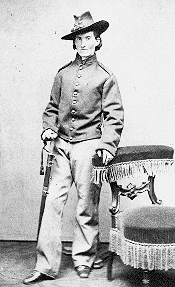
http://americancivilwar.com/women/

Image
Francis Clayton Civil War Soldier
More than 600 women disguised themselves as men to fight in the American Civil War. This documentary tells their stories through the women's own letters, diaries, and testimonials. 'The Forgotten Grave' also follows the lives of other women who took part in the Civil War, such as nurses, spies, and other brave heroines.
(cont)
Germany's unforgivable crime before the Second World War was her attempt to extricate her economy from the world's trading system and to create her own exchange mechanism which would deny world finance its opportunity to profit.
— Winston Churchill
User avatar
Capt. Harlock
Posts: 5379
Joined: Sat Sep 15, 2001 8:00 am
Location: Los Angeles
Contact:

RE: Civil War 150th

Post by Capt. Harlock »

150 Years Ago Today:

Congressman John J. Crittenden died in Frankfurt, Kentucky, probably of heart failure. Crittenden had one of the most varied careers in American politics, having been a Senator, U. S. Attorney General, and Governor of Kentucky. But the thing he is most remembered for is the Crittenden Compromise, the most important attempt to resolve the crisis after Lincoln's election. It was a compromise heavily weighted towards the South, for it would have made slavery a permanent, unamendable part of the Constitution. (Details at http://www.tulane.edu/~latner/CrittendenComp.html )

Though he was a pro-slavery man, Crittenden stayed loyal to the Union. His family was divided, however: he had both sons and grandsons fighting on both sides of the Civil War.


In Ohio, near Salineville and Lisbon, a Union brigade cut off John Hunt Morgan and his remaining cavalry (about 800 men). The Southerners had been riding almost constantly for days, seeking a way back to Confederate territory, and so were in no condition to fight over three times their number. Nonetheless, the engagement lasted an hour and a half, giving Morgan and a few others time to slip away. The remainder surrendered after losing 23 dead and several more wounded. The Yankees had no recorded casualties.

Morgan's freedom did not last the day. A group of Union cavalry commanded by Major George Rue caught up to the Rebels about eight miles on, and Morgan surrendered. At first, Morgan claimed that he had surrendered to an Ohio Militia Captain, who had granted him parole. Major Rue refused to recognize this, and had Morgan brought to the Ohio Penitentiary and imprisoned there. (Later on, Ohio Governor David Tod would hold an inquiry, concluding that the man Morgan claimed to have surrendered to was a private citizen not authorized to accept surrender or grant parole. Morgan would find another way to escape captivity.)

It was the furthest north that a body of regular Confederate soldiers would ever get:

Image
Attachments
892pxMorg..110204.jpg
892pxMorg..110204.jpg (134 KiB) Viewed 258 times
Civil war? What does that mean? Is there any foreign war? Isn't every war fought between men, between brothers?

--Victor Hugo
User avatar
Capt. Harlock
Posts: 5379
Joined: Sat Sep 15, 2001 8:00 am
Location: Los Angeles
Contact:

RE: Civil War 150th

Post by Capt. Harlock »

About 82 Years Ago:

Winston Churchill wrote an essay titled "If Lee Had Not Won The Battle Of Gettysburg". This appeared in "If It Had Happened Otherwise", a volume of alternate history writings by various authors including G. K. Chesterton. Churchill's essay was written as if Lee had actually won, and mused on the unfortunate things that "might" have happened -- including World War I, which was supposedly prevented by the "English Speaking Association", an alliance of North, South, and the British Empire. With all due respect to the late Sir Winston, this time he blew it.

A key turning point was Lee's "august declaration that the victorious Confederacy would pursue no policy toward the African negroes which was not in harmony with the moral conceptions of western Europe". This is a roundabout way of saying that Lee would have freed the slaves. But at this time Lee was still only the commander of the Army of Northern Virginia, not even General-in-Chief of the Confederate armies. (He would receive that position at the end of January 1865.) Anyone familiar with Lee's devotion to duty will have a very hard time believing that Lee would seize such authority and defy the Confederate Constitution. Nor is it likely that the rest of the South would have automatically fallen into line behind him: Jefferson Davis had quite a bit of trouble with the independent-minded Governors of several Southern states, and after the fall of Vicksburg, General Edmund Kirby Smith governed Texas and Arkansas as he saw fit.

One last interesting point about "If It had Happened Otherwise". One of the other essays was "If Booth Had Missed Lincoln". That story actually ended badly: Lincoln's generosity towards the South enraged many in Congress, and he was about to be impeached (much like Andrew Johnson in reality) when he died in 1867. Your humble amateur historian finds this, sadly, to be much more credible than Churchill's effort.
Civil war? What does that mean? Is there any foreign war? Isn't every war fought between men, between brothers?

--Victor Hugo
User avatar
Capt. Harlock
Posts: 5379
Joined: Sat Sep 15, 2001 8:00 am
Location: Los Angeles
Contact:

RE: Civil War 150th

Post by Capt. Harlock »

150 Years Ago Today:

Black soldiers had shown themselves both courageous and capable at Port Hudson and Honey Springs. But the assault on Fort Wagner captured the public attention as no such action before it. One of the reasons was that it did not end with the end of the fight: unlike previous actions, this time the Confederates had captured black prisoners.

The confederacy had stated that such prisoners would be delivered to the state where they were taken, and any former slaves were to be re-enslaved. As it happened, only four of the twenty-four men were former slaves, and none were from South Carolina. To his credit, General Beauregard wished to treat them the same as his other prisoners of war. but he was quickly over-ruled by both the governor and President Davis, and the men were sent to a nearby prison to be put on trial.

Lincoln's response was prompt:

[font="Times New Roman"]
Executive Mansion, Washington D.C July 30, 1863

It is the duty of every government to give protection to its citizens, of whatever class, color, or condition, and especially to those who are duly organized as soldiers in the public service. The law of nations and the usages and customs of war as carried on by civilized powers, permit no distinction as to color in the treatment of prisoners of war as public enemies. To sell or enslave any captured person, on account of his color, and for no offence against the laws of war, is a relapse into barbarism and a crime against the civilization of the age.

The government of the United States will give the same protection to all its soldiers, and if the enemy shall sell or enslave anyone because of his color, the offense shall be punished by retaliation upon the enemy's prisoners in our possession.

It is therefore ordered that for every soldier of the United States killed in violation of the laws of war, a rebel soldier shall be executed; and for every one enslaved by the enemy or sold into slavery, a rebel soldier shall be placed at hard labor on the public works and continued at such labor until the other shall be released and receive the treatment due to a prisoner of war

ABRAHAM LINCOLN
[/font]

Interestingly, the principled insistence on "the same protection to all its soldiers" would have the greatest consequences. Jefferson Davis was willing to suspend executions and enslavements under the threat of retaliation. But the idea of treating a black man as equal to a white man was unacceptable in Southern eyes. And it would soon be put to the test in prisoner exchanges.
Civil war? What does that mean? Is there any foreign war? Isn't every war fought between men, between brothers?

--Victor Hugo
User avatar
SLAAKMAN
Posts: 2556
Joined: Wed Jul 24, 2002 9:50 am
Contact:

RE: Civil War 150th

Post by SLAAKMAN »

Dispelling the myths of the Civil War-
Less than 5% of Southerners owned Slaves
Less than 5% of the whites in the South owned slaves. Fully 3/4's of the white people of the South had neither slaves nor an immediate economic interest in the maintenance of slavery or the plantation system.

This was written by none other than the late John Hope Franklin in From Slavery to Freedom, McGraw-Hill, 1994., p. 123. Franklin was a Harvard educated Professor Emeritus of History and Professor of Legal History at Duke University. Dr. Franklin also happened to be a Black man. This may come as an inconvient truth to some here.

So, why did they fight. As Prof. V.L. Parrington said in his Pulitizer Prize winning book Main Currents in American Thought, "slavery was only the immediate casus belli. The deeper cause was the antagonistic conceptions of the theory and functions of the political state that emerged from antagonistic economic systems." Bingo.
Germany's unforgivable crime before the Second World War was her attempt to extricate her economy from the world's trading system and to create her own exchange mechanism which would deny world finance its opportunity to profit.
— Winston Churchill
User avatar
SLAAKMAN
Posts: 2556
Joined: Wed Jul 24, 2002 9:50 am
Contact:

RE: Civil War 150th

Post by SLAAKMAN »

Manifest Destiny caused the Civil War~
The term "Manifest Destiny" refers to the belief of antebellum (pre-Civil War) Americans that not only was it this nation's destiny to be contiguous from sea-to-sea, but that this conclusion was "obvious to all" (ie. manifest). Books and newspapers urged people to go west ("go west, young man, go west") - which resulted in large wagon trains headed for California and Oregon using the "Santa Fe Trail" and other routes. The migration west went through several territories which later became states: Colorado, New Mexico, - and more importantly, Oklahoma, Texas and Kansas. Even before the Civil War began, there was a brutal "war" of sorts between northern and supporters in these states. The violent and extreme emotions stirred by this on-going conflict became a major cause of the subsequent Civil War. It has been said that abolition and slavery were used only as an excuse by some of the combatants.
Image
Germany's unforgivable crime before the Second World War was her attempt to extricate her economy from the world's trading system and to create her own exchange mechanism which would deny world finance its opportunity to profit.
— Winston Churchill
User avatar
Capt. Harlock
Posts: 5379
Joined: Sat Sep 15, 2001 8:00 am
Location: Los Angeles
Contact:

RE: Civil War 150th

Post by Capt. Harlock »

150 Years Ago Today:

On Morris Island outside of Charleston, the Northerners were hard at work emplacing some of the war's most massive cannon. The "Marsh Battery", which would eventually mount an 8-inch 200-pounder gun to be known as the "Swamp Angel", was making slow but steady progress. By this date, however, several other guns aimed at the Confederate batteries in the area were ready. Major General Quincy Gillmore gave the order to open fire, and what had been a fight of ships versus shore batteries, and then failed infantry assaults against forts, was now a duel between heavy (very heavy) artillery.

It would get heavier still, for Gillmore had been informed of an even bigger cannon being produced. This would be a ten-inch Parrott Rifle throwing a 300-pound shell up to the previously unheard-of range of 9,000 yd (8,200 m). Gillmore decided this was just the thing to use against Fort Sumter, and requisitioned one.

Image
Attachments
parrott_ri..arleston.jpg
parrott_ri..arleston.jpg (111.88 KiB) Viewed 258 times
Civil war? What does that mean? Is there any foreign war? Isn't every war fought between men, between brothers?

--Victor Hugo
User avatar
Capt. Harlock
Posts: 5379
Joined: Sat Sep 15, 2001 8:00 am
Location: Los Angeles
Contact:

RE: Civil War 150th

Post by Capt. Harlock »

150 Years Ago Today:

Although the song "Chattanooga Choo-Choo" would not be written until the 20th century, in 1863 the city was already a major railroad hub. It was also the key to eastern Tennessee and its largely pro-Union inhabitants, which Lincoln had long wanted free from Confederate rule. He and General-in-Chief Henry Halleck had instructed that General Ambrose Burnside would move in from the north and capture Knoxville, while General William Rosecrans would resume his advance from Tullahoma and capture Chattanooga from the west.

But neither general was moving. Burnside had a good excuse: many of his troops had been siphoned off for to block the movements of John Hunt Morgan and his raiders in Indiana and Ohio. But now Morgan and most of his cavalry had been captured, and Burnside's forces were being returned to him. It was clear, however, that if Burnside moved without a supporting move from Rosecrans he risked being overwhelmed by the Southern Army of Tennessee.

And time had become a factor. Many in the South could read maps as well, and knew that Chattanooga was now an obvious Union objective. In Mississippi, the scratch army that Joseph E. Johnston had put together was no longer needed to relieve Vicksburg, so it was decided to use a good part of it to reinforce the Army of Tennessee. In the east as well, with the Gettysburg campaign ended, it was suggested that some of Robert E. Lee's army be sent where it would do some good. (Lee himself refused to leave Virginia, but he could spare his best subordinate, James Longstreet.) Word of these ideas reached Washington, and General-in-Chief Halleck ordered a move on Chattanooga before the Southerners could reinforce.

But Rosecrans did not feel that his army was ready. The railroads up to his current position were taking some time to repair, and he was not getting the supplies and troop replacements he wanted. Well aware that few generals in history have ever been happy with the numbers of men and the level of supplies, on this date Halleck ordered Rosecrans forward "without further delay". Halleck hoped to ensure obedience by commanding that daily reports on the position of Rosecrans' troops be given. Unsurprisingly unhappy, Rosecrans inquired whether this was meant to take away his "discretion as to the time and manner" of moving his forces. Halleck wired back that his orders were "peremptory".
Civil war? What does that mean? Is there any foreign war? Isn't every war fought between men, between brothers?

--Victor Hugo
User avatar
Capt. Harlock
Posts: 5379
Joined: Sat Sep 15, 2001 8:00 am
Location: Los Angeles
Contact:

RE: Civil War 150th

Post by Capt. Harlock »

150 Years Ago Today:

Robert E. Lee had been thinking over his defeat at Gettysburg. Although in the years to come, many "Lost Cause" writers would blame Stuart for showing up late, A. P. Hill for not taking Cemetery Hill, and James Longstreet for mishandling Pickett's Charge, Lee blamed himself. He submitted his resignation:

[font="Times New Roman"]Camp Orange, August 8, 1863

His Excellency Jefferson Davis,
President of the Confederate States

Mr. President,

Your letters of July 28 and August 2 have been received, and I have waited for a leisure hour to reply, but I fear that will never come. I am extremely obliged to you for the attention given to the wants of this army, and the efforts made to supply them. Our absentees are returning, and I hope the earnest and beautiful appeal may stir up the virtue of the whole people; and that they may see their duty and perform it. Nothing is wanted but their fortitude should equal their bravery to insure the success of our cause. We must expect reverses, even defeats. They are sent to teach us wisdom and prudence, to call forth greater energies and to prevent our falling into greater disasters. Our people have only to be true and united, to bear manfully the misfortunes incident to war, and all will come right in the end.

I know how prone we are to censure and how ready to blame others for the non-fulfillment of our expectations. This is unbecoming in a generous people, and I grieve to see its expression. The general remedy for the want of success in a military commander is his removal. This is natural, and in many instances, proper. For, no matter what may be the ability of the officer, if he loses the confidence of his troops disaster must sooner or later ensue.

I have been prompted by these reflections more than once since my return from Pennsylvania to propose to Your Excellency the propriety of selecting another commander for this army. I have seen and heard of expression of discontent in the public journals at the result of the expedition. I do not know how far this feeling exends in the army. My brother officers have been too kind to report it, and so far the troops have been too generous to exhibit it. It is fair, however, to suppose that it it does exist, and success is so necessary to us that nothing should be risked to secure it. I therefore, in all sincerity, request Your Excellency to take measures to supply my place. I do this with the more earnestness because no one is more aware than myself of my inability for the duties of my position. I cannot even accomplish what I myself desire. How can I fulfill the expectations of others? In addition I sensibly feel the growing failure of my bodily strength. I have not yet recovered from the attack I experienced the past spring. I am becoming more and more incapable of exertion, and am thus prevented from making the personal examinations and giving the personal supervision to the operations of the field which I feel to be necessary. I am so dull that in making use of the eyes of others I am frequently misled. Everything, therefore, points to the advantages to be derived from a new commander, and I the more anxiously urge the matter upon Your Excellency from my belief that a younger and abler man than myself can readily be attained. I know that he will have as gallant and brave an army as ever existed to second his efforts, and it would be the happiest day of my life to see at its head a worthy leader -- one that would accomplish more than I could perform and all that I have wished. I hope Your Excellency will attribute my request to the true reason, the desire to serve my country, and to do all in my power to insure the success of her righteous cause.

I have no complaints to make of any one but myself. I have received nothing but kindness from those above me, and the most considerate attention from my comrades and companions in arms. To Your Excellency I am specially indebted for uniform kindness and consideration. You have done everything in your power to aid me in the work committed to my charge, without omitting anything to promote the general welfare. I pray that your efforts may at length be crowned with success, and that you may long live to enjoy the thanks of grateful people.

[right]With sentiments of great esteem, I am, very respectfully and truly, yours,

R.E. Lee,
General[/right]
[/font]

But Jefferson Davis was no fool. Whatever critiques certain newspapers might write, he knew that Lee still had the loyalty of his army and the support of the vast majority of the South. Moreover, even if Lee was a bit aggressive on the battlefield, he was far and away the best theater commander in the Confederacy. Davis promptly refused the resignation, writing that "To ask me to substitute you by someone ... more fit to command, or who would possess more of the confidence of the army ... is to demand an impossibility."


Image
Attachments
LeeandHorse.jpg
LeeandHorse.jpg (53.68 KiB) Viewed 260 times
Civil war? What does that mean? Is there any foreign war? Isn't every war fought between men, between brothers?

--Victor Hugo
User avatar
Capt. Harlock
Posts: 5379
Joined: Sat Sep 15, 2001 8:00 am
Location: Los Angeles
Contact:

RE: Civil War 150th

Post by Capt. Harlock »

Early August, 1863:

The bloodshed of the Civil War was nowhere darker than the partisan warfare in Missouri. Although nearly all of the regular Confederate troops had been driven from the state, the congress in Richmond had passed the Partisan Ranger Act in 1862, which allowed men to form companies on their own. In theory, they were supposed to be "subject to the same regulations as other soldiers". In practice, they acted as guerrillas, banding together to raid, loot, burn, and kill, and then disappearing, going into hiding or back to their homes to pass as ordinary citizens. Many Northerners were quick to follow the example, reviving the groups of "Jayhawkers" that had helped make Kansas a bloody place in the 1850's.

Among the worst of the Southern bands were the raiders led by William Clarke Quantrill, who had gathered a group including such eventually famous outlaws as the Younger brothers, and Frank and Jesse James. Oddly, Quantrill had been born in Ohio, and it is not clear why he joined the Southern rather than the Northern cause. But the most brutal of the bunch was William T. "Bloody Bill" Anderson, who would eventually decorate his horse with scalps of the men he had murdered.

Although both sides committed crime after crime, the one thing that they almost always avoided was rape. There was still a code which held that women were not to be physically harmed (although stealing their livestock and burning their houses was apparently permissible). But this rough chivalry changed somewhat when Union General Thomas Ewing declared that women helping Rebel partisans were subject to arrest. "Bloody Bill" Anderson had two teen-aged sisters, who were swept up by this order.

Image
Attachments
Bloodybillanderson.jpg
Bloodybillanderson.jpg (86.63 KiB) Viewed 258 times
Civil war? What does that mean? Is there any foreign war? Isn't every war fought between men, between brothers?

--Victor Hugo
User avatar
Capt. Harlock
Posts: 5379
Joined: Sat Sep 15, 2001 8:00 am
Location: Los Angeles
Contact:

RE: Civil War 150th

Post by Capt. Harlock »

150 Years Ago Today:

Soldiers had taken to the air in observation balloons. Now sailors were going underwater -- but it was a much slower process. On this date the Confederacy's first true submersible warship arrived at Charleston, though she came by rail instead of by sea. She was also not a part of the Confederate Navy, having been designed and built by private inventors and investors headed by one Horace Lawson Hunley. At this point, she was probably named the Pioneer III, though she would eventually be known to fame as the Hunley.

Since she was a true submersible, she had to be powered by a human crew. (Other experimental craft were built to run with most of their mass below the surface, but with an intake and a smokestack above it for a steam engine.) It was not a job for anyone with claustrophobia: the vessel was just over four feet high inside. Originally it had been planned to tow an explosive charge behind her, but it soon became clear that there was a risk of fouling her propeller with the line. Instead, a long spar was fitted on the front, with the explosive charge or "torpedo" meant to be embedded into an enemy hull with a spike. Finally, there was a torpedo that acted something like a modern torpedo.

Upon her arrival she was commandeered by the Confederate military authorities, headed by General P. G. T. Beauregard, making her technically an Army project rather than a Navy one. She would prove to be even more lethal to Southern sailors than to Northern ones.
Image


Outside Charleston Harbor on Morris Island, the Union troops had been busy digging trenches and building artillery emplacements. It was brutal work in the hot, humid weather of early August, and let it be admitted that it was most often assigned to the black soldiers in the Northern ranks. It was made even worse by Confederate snipers and artillery, some from Fort Wagner on the island, and some from Fort Sumter across the channel. But on this date, at least one Federal gun was ready to reply. About a dozen ranging shots were fired at Fort Sumter. Since the gun was a massive Parrott Rifle throwing a 200-pound (91 kg) shell, it did some actual damage to the fort, blowing at least one hole in a wall, and wounding both Confederate soldiers and slaves working there.

This was good news for Union commander Quincy Gillmore. He had several more 200-pounders, and even a 300-pounder. And it also suggested his "Swamp Angel" gun might be able to reach Charleston itself.
Attachments
CSS_Hunley_2.jpg
CSS_Hunley_2.jpg (68.05 KiB) Viewed 258 times
Civil war? What does that mean? Is there any foreign war? Isn't every war fought between men, between brothers?

--Victor Hugo
User avatar
Capt. Harlock
Posts: 5379
Joined: Sat Sep 15, 2001 8:00 am
Location: Los Angeles
Contact:

RE: Civil War 150th

Post by Capt. Harlock »

150 Years Ago Today:

In Missouri, a number of the female relatives of the pro-southern guerrillas had been detained by the Union army. To be fair, many did indeed provide help to the Rebels such as information, food, and clothing (including sewing shirts with extra pockets to hold pre-loaded cylinders for revolvers). Setting up places to hold the women and girls was not easy, and in Kansas City a Women's Prison had been improvised from a house belonging to the State Treasurer.

On this date, the building collapsed with at least ten females, all age 20 or less, inside. Four were killed: Charity McCorkle Kerr, Susan Crawford Vandever, Armenia Crawford Selvey, and Josephine Anderson. This last was the 15-year-old sister of William "Bloody Bill" Anderson. To add even more, Anderson's 13-year old sister, shackled to a ball-and-chain inside the jail, had both legs broken and was permanently lamed.

As a member of William C. Quantrill's band of partisans, "Bloody Bill" Anderson was already a brutal killer. When the rumor reached the band that the makeshift jail had been deliberately undermined by Union soldiers, he was obsessed with revenge. Since some of the injured girls were also relatives of Quantrill's men, there was little difficulty convincing Quantrill to mount a major retaliatory raid. It is likely that Quantrill had a raid on Lawrence, Kansas, already in mind. It had been the center of the abolitionists during the "Bleeding Kansas" violence, and it was the home of Senator James Lane, hated since the Osceola atrocity. Now Quantrill's plan was finalized. The word went out to collect as many Confederate raiders as possible.
Civil war? What does that mean? Is there any foreign war? Isn't every war fought between men, between brothers?

--Victor Hugo
User avatar
Lecivius
Posts: 4845
Joined: Sun Aug 05, 2007 12:53 am
Location: Denver

RE: Civil War 150th

Post by Lecivius »

Interesting. As usual, there is always layers underneath the history books. Interesting reading here, Capt.
If it ain't broke, don't fix it!
User avatar
Capt. Harlock
Posts: 5379
Joined: Sat Sep 15, 2001 8:00 am
Location: Los Angeles
Contact:

RE: Civil War 150th

Post by Capt. Harlock »

150 Years Ago Today:

Although Major General William Rosecrans had received "peremptory" orders to advance on Chattanooga a dozen days ago, it was not until this date that he finally considered his Army of the Cumberland to be ready. (Among other things, a custom railroad locomotive built for the steep grades in the area had needed repairs.) As he had done for the Tullahoma campaign, Rosecrans opened with Wilder's Lightning Brigade.

But this time it was a feint: the horsemen rode to elevated ground to the northeast of Chattanooga. They were duly spotted by the Southerners, and General Braxton Bragg began preparing for an attack focused from that direction. In actuality, Rosecrans' bluecoats would be marching all over the map, looking for wherever Bragg withdrew troops.

Image
Map by Hal Jespersen, www.cwmaps.com
Attachments
OpenChattanooga.jpg
OpenChattanooga.jpg (139.22 KiB) Viewed 260 times
Civil war? What does that mean? Is there any foreign war? Isn't every war fought between men, between brothers?

--Victor Hugo
User avatar
Capt. Harlock
Posts: 5379
Joined: Sat Sep 15, 2001 8:00 am
Location: Los Angeles
Contact:

RE: Civil War 150th

Post by Capt. Harlock »

150 Years Ago Today:

On Morris Island, Fort Wagner was still in Confederate hands, but Quincy Gillmore's men had emplaced a formidable battery of heavy guns elsewhere. There were nine 100-pounder Parrott Rifles, six 200-pounder Parrotts, and a massive 300-pounder Parrott. There are also reported to have been two Whitworth cannons, which used pre-gooved projectiles for extra range. There had been a number a ranging shots previously, but on this date when they opened fire against Fort Sumter, they meant business. By the end of the day, nearly 1,000 shells had been lobbed towards the island fortress. Sumter's guns could not effectively reply to the land batteries (but managed a lucky shot against the blockading Federal warships that killed Captain G. W. Rodgers, Admiral Dahlgren's chief of staff).

The ranging shots on the previous days had not been wasted, and the siege guns scored hit after hit. The Confederates had learned from their own bombardment of Sumter at the beginning of the war, and covered or removed anything flammable. No serious fires broke out. But they could not prevent the masonry walls, thick as they were, from being slowly battered down. Gillmore was on his way to repeating his success against Fort Pulaski.

Image
Attachments
200pdrParrott.jpg
200pdrParrott.jpg (63.22 KiB) Viewed 258 times
Civil war? What does that mean? Is there any foreign war? Isn't every war fought between men, between brothers?

--Victor Hugo
Post Reply

Return to “General Discussion”