

Enlarged? 6 times 42 inches wide is 252 inches or about 6.40 metres. How big is your gaming room? [;)]
Cheers, Neilster
Matrix Games World in Flames: 7 Moments of Wow!
Moderator: Shannon V. OKeets
RE: Matrix Games World in Flames: 7 Moments of Wow!
Cheers, Neilster
RE: Matrix Games World in Flames: 7 Moments of Wow!
Or wall space [:)]
RE: Matrix Games World in Flames: 7 Moments of Wow!
My basement is 1200 sq.ft. However my gaming area will be 2 chest of drawers about 4' x 8' x 6' containing 32 drawers each. I have plenty of space for a multitude of wargames or a few extremely large ones. In this case, however, this is for one game. I need maps 45km across and MWIF is 90km. So I just need to double the size and retrace on hex paper. IF I feel the need too...
save the carrots; eat a vegan!
RE: Matrix Games World in Flames: 7 Moments of Wow!
Cool. Good luck! [:)]ORIGINAL: shaddock
My basement is 1200 sq.ft. However my gaming area will be 2 chest of drawers about 4' x 8' x 6' containing 32 drawers each. I have plenty of space for a multitude of wargames or a few extremely large ones. In this case, however, this is for one game. I need maps 45km across and MWIF is 90km. So I just need to double the size and retrace on hex paper. IF I feel the need too...
Be aware that that MWiF hexes aren't exactly 90km, the global map is biased towards the Northern Hemisphere and there's a fair bit of distortion near the poles.
Cheers, Neilster
Cheers, Neilster
-
Shannon V. OKeets
- Posts: 22165
- Joined: Wed May 18, 2005 11:51 pm
- Location: Honolulu, Hawaii
- Contact:
RE: Matrix Games World in Flames: 7 Moments of Wow!
If I were doing this, I would start with the size of the chest drawers. Let's say that they are 6' tall, making each drawer roughly 4' by 8' (i.e., 48" by 96"). The simplest solution would be to place each of the map segments (42" by 27") in a separate drawer. Or you could fit two map segments per drawer (42" by 54", or 27" by 84").ORIGINAL: shaddock
My basement is 1200 sq.ft. However my gaming area will be 2 chest of drawers about 4' x 8' x 6' containing 32 drawers each. I have plenty of space for a multitude of wargames or a few extremely large ones. In this case, however, this is for one game. I need maps 45km across and MWIF is 90km. So I just need to double the size and retrace on hex paper. IF I feel the need too...
But you might get lucky. For example, 252" by 108" is the disassembled 6 map segments across by 4 vertically. But there are hex rows and hex columns of overlap. There is also some extra white space vertically for the 6 map segments in the bottom row. I don't have a physical copy of the maps (yet) so I can't give you precise measurements, but I think that there is a good chance that the vertical might fit in your available 96". If that were true, then you would only need to use 6 drawers to store the full map, with each drawer holding a vertical set of 4.
Steve
Perfection is an elusive goal.
Perfection is an elusive goal.
RE: Matrix Games World in Flames: 7 Moments of Wow!
I love this discussion. I think I used to have a whole basement to play this game. I am eager to have it all on my computer.
RE: Matrix Games World in Flames: 7 Moments of Wow!
I want to create a giant version of my avatar. It will be a steel sphere to be magnetic, and rotatable. Then I'll just need some form of special effects-style flying harness to move up and down and back and forth to observe and move my magnetic unit counters. Easy [;)]
Cheers, Neilster
Cheers, Neilster
Cheers, Neilster
RE: Matrix Games World in Flames: 7 Moments of Wow!
Neilster - It's been a thought of mine to do precisely that. At the scale of MWIF the globe would need to be around 7-8 meters in diameter. For my game 14-16 meters. Ahhh, a man can dream...
save the carrots; eat a vegan!
RE: Matrix Games World in Flames: 7 Moments of Wow!
Awesome! Looking forward to purchasing the computer game, and thanks for making printed maps available!
Anthony DeChristopher
Anthony DeChristopher
RE: Matrix Games World in Flames: 7 Moments of Wow!
ORIGINAL: shaddock
Neilster - It's been a thought of mine to do precisely that. At the scale of MWIF the globe would need to be around 7-8 meters in diameter. For my game 14-16 meters. Ahhh, a man can dream...
Well if...
d is diameter
c is circumference
then c=pi*d
I've calculated the width to be 6.4 metres above. Ignore the pole to pole height. On the MWiF global map the Arctic and Antarctic are missing. So 6.4 metres would be the circumference of a MWiF sphere.
So 6.4=pi*d
Thus d=6.4/pi which is almost exactly 2 metres
So unless I'm mistaken, our MWiF globe would be 2 metres tall (about 6 feet).
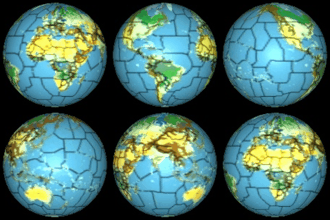
Incidentally, the way you would wrap it around the sphere is to slice the map into gores (see below) but that won't really work because the map wasn't printed that way. The hexes would be all screwed up. However, if you are going to redraw everything at double scale, you could do it using the gore method and it would work to make a 12 foot tall MWiF globe.
A computerised spherical map would be much easier [:)]
Cheers, Neilster

- Attachments
-
- GoreEarthmap.jpg (34.46 KiB) Viewed 1427 times
Cheers, Neilster
RE: Matrix Games World in Flames: 7 Moments of Wow!
ORIGINAL: Neilster
ORIGINAL: shaddock
Neilster - It's been a thought of mine to do precisely that. At the scale of MWIF the globe would need to be around 7-8 meters in diameter. For my game 14-16 meters. Ahhh, a man can dream...
Well if...
d is diameter
c is circumference
then c=pi*d
I've calculated the width to be 6.4 metres above. Ignore the pole to pole height. On the MWiF global map the Arctic and Antarctic are missing. So 6.4 metres would be the circumference of a MWiF sphere.
So 6.4=pi*d
Thus d=6.4/pi which is almost exactly 2 metres
So unless I'm mistaken, our MWiF globe would be 2 metres tall (about 6 feet).
Incidentally, the way you would wrap it around the sphere is to slice the map into gores (see below) but that won't really work because the map wasn't printed that way. The hexes would be all screwed up. However, if you are going to redraw everything at double scale, you could do it using the gore method and it would work to make a 12 foot tall MWiF globe.
A computerised spherical map would be much easier [:)]
Cheers, Neilster
I am still voting for your world map Neilster [&o]
Bo
RE: Matrix Games World in Flames: 7 Moments of Wow!
oops, funny how drastically things change when you forget to take into consideration the differences between feet and meters.
save the carrots; eat a vegan!
RE: Matrix Games World in Flames: 7 Moments of Wow!
Actually 2 metres is about 6'7"
Cheers, Neilster
Cheers, Neilster
Cheers, Neilster
RE: Matrix Games World in Flames: 7 Moments of Wow!
Informational and Decision Making Forms
While the maps are used for roughly half the decisions a player makes, the other half are made using forms. As a player uses the various forms, he reaches the fourth level of Wow. There are 27 informative forms. One shows all the units in off-map pools: arriving reinforcements, reserves, repair pool, force pool (available to be build), future force pool for later years in the war, and the lend lease pool of air units

Other forms show, for example: (1) the current weather and the probabilities for changes in the weather

(2) the sequence of play

which dynamically updates during a game, Supply sources and paths

and (3) units in review, which, for instance, lets a player immediately identify the location of enemy carriers on and off map, or his own on-map armor and mechanized units.
There are 60+ other unique forms used for making decisions, from the simple Yes/No decision to intercept enemy naval units moving through a sea area being patrolled by friendly units, to complex decisions resolving air,

naval,

and land combats.

Production planning (to get resources from overseas sources to factories in the homeland) and building units (i.e., production) are both quite complex. But almost all the information a player needs to make good decisions is visible on a single form; the rest is available with the click of a button.
One unique aspect of the MWIF forms is the use of color coded backgrounds to differentiate each of the 9 major powers: China, the Commonwealth, France,

United States, the USSR, Germany, Italy, Japan, and Vichy France. As a player makes decisions for each of these major powers, the background colors of the forms (including the omnipresent main form) change. So when moving the German units, the background is gray. When the Axis player switches to moving the Italian units, the background changes to light green.

The rules of the game restrict movement and combat for each major power, so it is vital that the player is always aware of for which major power he is making decisions, especially when using the forms. Many of the forms (e.g., production) also display the flag for the current major power to reinforce this information.
The most heavily used new form introduced by MWIF is the Selectable Units form.

What this does is display, in a vertical list, the units which can currently move. By clicking to the right of a displayed unit, the detailed map centers on the unit’s hex. By clicking on the unit itself, the player can pick it up and move it to a desired destination.
While this form appears automatically in 50+ places in the sequence of play, it is frequently seen during air missions. Most of the time 6 or fewer air units are eligible to move in a phase/subphase. Rather than requiring the player to search the map looking for which units can move, they are immediately visible in the Selectable Units form.
Of course older game mechanisms for identifying which units are eligible to move are also available in MWIF, such as having the eligible units highlighted with a green outline and a lit green status indicator or cycling through all eligible units.
Regardless, the Selectable Units form saves time and effort, and avoids you forgetting a long range bomber far from the battlefield. When you want to have multiple strategic bombers, escorted by fighters, attack the same hex, it’s easiest to pick them up from the Selectable Units form and drop them on the target hex.
While the maps are used for roughly half the decisions a player makes, the other half are made using forms. As a player uses the various forms, he reaches the fourth level of Wow. There are 27 informative forms. One shows all the units in off-map pools: arriving reinforcements, reserves, repair pool, force pool (available to be build), future force pool for later years in the war, and the lend lease pool of air units
Other forms show, for example: (1) the current weather and the probabilities for changes in the weather
(2) the sequence of play
which dynamically updates during a game, Supply sources and paths
and (3) units in review, which, for instance, lets a player immediately identify the location of enemy carriers on and off map, or his own on-map armor and mechanized units.
There are 60+ other unique forms used for making decisions, from the simple Yes/No decision to intercept enemy naval units moving through a sea area being patrolled by friendly units, to complex decisions resolving air,
naval,
and land combats.
Production planning (to get resources from overseas sources to factories in the homeland) and building units (i.e., production) are both quite complex. But almost all the information a player needs to make good decisions is visible on a single form; the rest is available with the click of a button.
One unique aspect of the MWIF forms is the use of color coded backgrounds to differentiate each of the 9 major powers: China, the Commonwealth, France,
United States, the USSR, Germany, Italy, Japan, and Vichy France. As a player makes decisions for each of these major powers, the background colors of the forms (including the omnipresent main form) change. So when moving the German units, the background is gray. When the Axis player switches to moving the Italian units, the background changes to light green.
The rules of the game restrict movement and combat for each major power, so it is vital that the player is always aware of for which major power he is making decisions, especially when using the forms. Many of the forms (e.g., production) also display the flag for the current major power to reinforce this information.
The most heavily used new form introduced by MWIF is the Selectable Units form.
What this does is display, in a vertical list, the units which can currently move. By clicking to the right of a displayed unit, the detailed map centers on the unit’s hex. By clicking on the unit itself, the player can pick it up and move it to a desired destination.
While this form appears automatically in 50+ places in the sequence of play, it is frequently seen during air missions. Most of the time 6 or fewer air units are eligible to move in a phase/subphase. Rather than requiring the player to search the map looking for which units can move, they are immediately visible in the Selectable Units form.
Of course older game mechanisms for identifying which units are eligible to move are also available in MWIF, such as having the eligible units highlighted with a green outline and a lit green status indicator or cycling through all eligible units.
Regardless, the Selectable Units form saves time and effort, and avoids you forgetting a long range bomber far from the battlefield. When you want to have multiple strategic bombers, escorted by fighters, attack the same hex, it’s easiest to pick them up from the Selectable Units form and drop them on the target hex.

RE: Matrix Games World in Flames: 7 Moments of Wow!
Also, if you click on the white space to the right of units in the Selectable Units form, it centers the main map on that unit. Very useful.
RE: Matrix Games World in Flames: 7 Moments of Wow!
World in Flames Tactics
Once a player starts to play World in Flames he experiences a fifth moment of Wow, for the game itself. World in Flames was war game of the year in 1985 and it has received improvements every year since. The interaction of the 3 branches of service: air, naval, and land, in combination with merchant marine which make up the convoy pipelines carrying resources overseas to factories, is unique. This is the heart of the game design and provides players with a wide range of possibilities for engaging in combat around the world with units from over a hundred countries.
There are 70 unit types: 38 for land units, 15 for naval units, 7 for air units, and 10 for special units (e.g., synthetic oil plants, fortifications).

As expected, there are infantry, cavalry, armor, and many more land unit types. Some unusual ones are Chinese Warlords, City Based Volunteers, and the German Rail Gun. The Queens Liners (Elizabeth and Mary) and Frogmen are unusual naval unit types, while the German V Weapons and the American A Bomb are a couple of the unusual air unit types. But the diversity of the combat units goes far beyond their categorization by type. There are 1000+ unique land units,

1100+ unique naval units,

and 1300+ unique air units.

Each unit’s ability to move, fight, and perform special functions is defined for that unit based on an historical unit. In addition all units have arrival dates (corresponding to when they were historically available) which dictate when the players can start building them.
After playing the game for a while a player is struck by how well the simulation handles the tactics of land combat, air-to-air combat, antiaircraft fire,

port attacks, submarine versus convoys combat, naval air combat, and naval combat between surface ships. There are separate rules for paradrops, marine invasions,

air resupply, partisans, garrisons, and territorial units.

The breadth of the tactical simulation is extensive, but mercifully many elements are optional rules which can be layered in gradually, heightening the game’s realism - along with its complexity.
The USSR can build a formidable defensive line against the Germans, making use of cities, factories, forest, swamps, and rivers to maximize the strength of the defenders.

Building fortifications and wisely placing antitank and antiaircraft units can slow down enemy armor. Both the attacker and the defender use armor, engineers, HQs, tactical bombers, and shore bombardment in land attacks. The attacker can also call upon his strategic bombers to perform carpet bombing on the enemy’s frontline units. How to best use these elements defines how well you play the game. In MWIF, the best defense can always be broken by the best offensive, but the price paid by the attacker may leave him so weakened that he is unable to take advantage of the hole he has punched in the defender’s frontline. Even when the attacker has fulsome reserves, the defender still has the opportunity to withdraw and regroup, forming another defensive line farther to the rear. In Russia that can happen again and again as the frontline moves east towards the Urals when the Germans are attacking, and later moves west towards Berlin once the red bear begins its counteroffensive.

The war at sea and in the air both require the players to hone their tactical skills. As the war progressed, the Allies introduced anti-submarine escorts and anti-submarine carriers to protect their convoys from the Axis submarines and land based naval air units.

Then the Axis responded by building snorkel, supply, Milchcow, and Walther submarines. Early in the war there are twin engine fighters and the most of the air units had a limited range. Later in the war there were jets and 4 engine bombers with enormous ranges, capable of penetrating deep within enemy controlled countries. The air-to-air combats can be fierce over homeland factories, over crucial hexes in the frontline, and at sea trying to support naval operations and invasions.
Once a player starts to play World in Flames he experiences a fifth moment of Wow, for the game itself. World in Flames was war game of the year in 1985 and it has received improvements every year since. The interaction of the 3 branches of service: air, naval, and land, in combination with merchant marine which make up the convoy pipelines carrying resources overseas to factories, is unique. This is the heart of the game design and provides players with a wide range of possibilities for engaging in combat around the world with units from over a hundred countries.
There are 70 unit types: 38 for land units, 15 for naval units, 7 for air units, and 10 for special units (e.g., synthetic oil plants, fortifications).
As expected, there are infantry, cavalry, armor, and many more land unit types. Some unusual ones are Chinese Warlords, City Based Volunteers, and the German Rail Gun. The Queens Liners (Elizabeth and Mary) and Frogmen are unusual naval unit types, while the German V Weapons and the American A Bomb are a couple of the unusual air unit types. But the diversity of the combat units goes far beyond their categorization by type. There are 1000+ unique land units,
1100+ unique naval units,
and 1300+ unique air units.
Each unit’s ability to move, fight, and perform special functions is defined for that unit based on an historical unit. In addition all units have arrival dates (corresponding to when they were historically available) which dictate when the players can start building them.
After playing the game for a while a player is struck by how well the simulation handles the tactics of land combat, air-to-air combat, antiaircraft fire,
port attacks, submarine versus convoys combat, naval air combat, and naval combat between surface ships. There are separate rules for paradrops, marine invasions,
air resupply, partisans, garrisons, and territorial units.
The breadth of the tactical simulation is extensive, but mercifully many elements are optional rules which can be layered in gradually, heightening the game’s realism - along with its complexity.
The USSR can build a formidable defensive line against the Germans, making use of cities, factories, forest, swamps, and rivers to maximize the strength of the defenders.
Building fortifications and wisely placing antitank and antiaircraft units can slow down enemy armor. Both the attacker and the defender use armor, engineers, HQs, tactical bombers, and shore bombardment in land attacks. The attacker can also call upon his strategic bombers to perform carpet bombing on the enemy’s frontline units. How to best use these elements defines how well you play the game. In MWIF, the best defense can always be broken by the best offensive, but the price paid by the attacker may leave him so weakened that he is unable to take advantage of the hole he has punched in the defender’s frontline. Even when the attacker has fulsome reserves, the defender still has the opportunity to withdraw and regroup, forming another defensive line farther to the rear. In Russia that can happen again and again as the frontline moves east towards the Urals when the Germans are attacking, and later moves west towards Berlin once the red bear begins its counteroffensive.
The war at sea and in the air both require the players to hone their tactical skills. As the war progressed, the Allies introduced anti-submarine escorts and anti-submarine carriers to protect their convoys from the Axis submarines and land based naval air units.
Then the Axis responded by building snorkel, supply, Milchcow, and Walther submarines. Early in the war there are twin engine fighters and the most of the air units had a limited range. Later in the war there were jets and 4 engine bombers with enormous ranges, capable of penetrating deep within enemy controlled countries. The air-to-air combats can be fierce over homeland factories, over crucial hexes in the frontline, and at sea trying to support naval operations and invasions.

RE: Matrix Games World in Flames: 7 Moments of Wow!
Nice, this advertorial... However: don't forget the biggest advantage about MWIF as compared to the board game... No more wifes complaining about using a whole room for a year or so for the board game and no more "invasions" by cats on the maps... [:D]
Peter

RE: Matrix Games World in Flames: 7 Moments of Wow!
Excellent. Posted a link on my FB page;)

RE: Matrix Games World in Flames: 7 Moments of Wow!
Well smack my bishop! Times are tight, but I hope to have some money for this and WITW.
"Venimus, vidimus, Deus vicit" John III Sobieski as he entered Vienna on 9/12/1683. "I came, I saw, God conquered."
He that has a mind to fight, let him fight, for now is the time. - Anacreon
He that has a mind to fight, let him fight, for now is the time. - Anacreon
RE: Matrix Games World in Flames: 7 Moments of Wow!
World in Flames Strategies
The sixth moment of Wow can only be reached once a player has learned how to play World in Flames reasonably well. At that point he begins to see the decisions that the world leaders faced. Hitler has to decide which minor countries to gobble up, risking the wrath of the US

Historically he had to choose between invading Great Britain or the USSR. Or perhaps the Axis should strive to take Suez and Gibraltar, by going through Spain

turning the Mediterranean into an Italian lake reminiscent of the heydays of Rome. Stalin has to decide how far forward, or towards the rear, to position his army and air force

to best thwart the looming German onslaught. Prior to the war with Germany, Stalin exerted his dominance over smaller countries

not all of those decisions worked out as planned. Churchill has decisions about routing and protecting the convoys which provide the United Kingdom with essential resources

and how many land and air units to leave at home to protect against invasion

and how many to send to Egypt,

Gibraltar, Malta, the Middle East (to oppose the Italians), and to the Far East (to protect against impending Japanese attacks)

Prior to entering the war, Roosevelt has to carefully choose how much aid to send to the Commonwealth, China, France, and the USSR.

If in the game the US sends too much, then the isolationists in the United States can prevent the US from ever entering the war. If he sends too little, his future allies may be conquered by the Axis before the US fully enters the war. And so on for the strategic decisions made by the Italian, Chinese, and Japanese leaders. None of these decisions is easy and each affects the progress and eventual outcome of the war. It’s up to the players to decide what to do when, and how to cope with the consequences of their decisions.
If the actual history of World War II is of interest to you, then you can read the MWIF unit descriptions.

There are over 1300 descriptions of historical air units (1.2 megabytes), over 800 of land units (1.5 megabytes), and over 1000 of naval units (4.3 megabytes). Rob Jenkins wrote almost all of the naval unit writeups and in addition to the basics on a ship’s size, speed, armor, and fighting capabilities, he describes deployments, missions, and patrols for each of the capital ships. Reading all of that should keep you engrossed for a while.
No matter whether they win or lose, players always think that they could have done better, that there were other strategic choices they should have explored. The joy of MWIF is that no two games are ever alike. The sheer number of player decisions and random die rolls, when applied to the breadth of tactical and strategic choices available, make the game endlessly intriguing.
The sixth moment of Wow can only be reached once a player has learned how to play World in Flames reasonably well. At that point he begins to see the decisions that the world leaders faced. Hitler has to decide which minor countries to gobble up, risking the wrath of the US
Historically he had to choose between invading Great Britain or the USSR. Or perhaps the Axis should strive to take Suez and Gibraltar, by going through Spain
turning the Mediterranean into an Italian lake reminiscent of the heydays of Rome. Stalin has to decide how far forward, or towards the rear, to position his army and air force
to best thwart the looming German onslaught. Prior to the war with Germany, Stalin exerted his dominance over smaller countries
not all of those decisions worked out as planned. Churchill has decisions about routing and protecting the convoys which provide the United Kingdom with essential resources
and how many land and air units to leave at home to protect against invasion
and how many to send to Egypt,
Gibraltar, Malta, the Middle East (to oppose the Italians), and to the Far East (to protect against impending Japanese attacks)
Prior to entering the war, Roosevelt has to carefully choose how much aid to send to the Commonwealth, China, France, and the USSR.
If in the game the US sends too much, then the isolationists in the United States can prevent the US from ever entering the war. If he sends too little, his future allies may be conquered by the Axis before the US fully enters the war. And so on for the strategic decisions made by the Italian, Chinese, and Japanese leaders. None of these decisions is easy and each affects the progress and eventual outcome of the war. It’s up to the players to decide what to do when, and how to cope with the consequences of their decisions.
If the actual history of World War II is of interest to you, then you can read the MWIF unit descriptions.
There are over 1300 descriptions of historical air units (1.2 megabytes), over 800 of land units (1.5 megabytes), and over 1000 of naval units (4.3 megabytes). Rob Jenkins wrote almost all of the naval unit writeups and in addition to the basics on a ship’s size, speed, armor, and fighting capabilities, he describes deployments, missions, and patrols for each of the capital ships. Reading all of that should keep you engrossed for a while.
No matter whether they win or lose, players always think that they could have done better, that there were other strategic choices they should have explored. The joy of MWIF is that no two games are ever alike. The sheer number of player decisions and random die rolls, when applied to the breadth of tactical and strategic choices available, make the game endlessly intriguing.