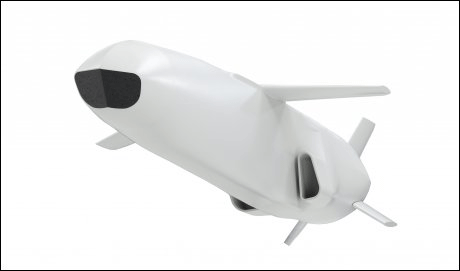
The paint scheme would even make it hard to detect visually. Certainly enough innovation here for the Russians and Chinese to sit up and take notice. Expect a Chinese version next week....
lol, copying these defense projects seems to be the pattern. There's some secrets with the paint scheme, info alludes to it which makes the whole system even more stealthy in the IR and radar regions, visible wavelenth the grey is effective as well in the haze near the ocean surface.
Online public info about the paint publicly is referenced here.
https://www.fbo.gov/index?s=opportunity&mode=form&id=2d666c108252bf8f89e628fc2caaf380&tab=core&_cview=1
http://www.f-16.net/forum/viewtopic.php?t=9561
http://evangelidis.gr/embry/F35LO-ShortReport-HTML.htm
[...] On the F-35 several special materials are used, including Radar Absorbing Materials (RAM), Radar Absorbing Structure and Infrared (IR) Topcoat. Unlike the F-117, which was totally coated with 2,000 pounds of RAM, these materials are more selectively used on the JSF. Lockheed Martin developed paint-type RAM which is applied around the edges of doors and control surfaces. RAS is used on the body, wing and tail edges. For the application of this paint robots will be used, like the CASPER (Computer Aided Spray Paint Expelling Robot) system used for F-22 and the Have Glass II program used for painting 1,700 F-16s with RAM. Robots are essential because they can reach confined areas, as the inlet ducts, and can work without stepping on the aircraft.
These materials comprise ferromagnetic particles, embedded in a high-dielectric-constant polymer base. The dielectric material slows down the wave and the ferromagnetic particles absorb the energy. These coatings are also designed in a way that the small reflection from the front face of the absorber is cancelled by a residual reflection from the structure beneath it. This is not an easy procedure, and it makes RAM design much more tricky than most people believe.
JSF’s entire airframe is also painted with a camouflage topcoat that suppresses IR. [...]
International Defense Review (January 1, 2004) wrote:
[...] US and European aircraft manufacturers have used specially developed materials to reduce the RCS of basically non-stealthy aircraft for many years. Notable examples include the Have Glass and Have Glass II modifications to the F-16. [...]
danshistory.com wrote:
Have Glass is the code name for a series of RCS reduction measures for the F-16 fighter. Its primary aspect is the addition of an indium-tin-oxide layer to the gold tinted cockpit canopy. This is reflective to radar frequencies, while it may seem odd, adding a radar reflective coating actually reduces the plane's visibility to radar. An ordinary canopy would let radar signals straight through where they would strike the many edges and corners inside and bounce back strongly to the source, the reflective layer dissipates these signals instead. Overall, Have Glass reduces an F-16's RCS (radar-cross section) by some 15 percent.
Not too much of a stretch to enhance these cruise missiles using special top coats of the types of paint being described above. The U.S. has a lot of experience with stealth materials and coatings.