Interesting analysis of an Australian F-35B purchase

Take command of air and naval assets from post-WW2 to the near future in tactical and operational scale, complete with historical and hypothetical scenarios and an integrated scenario editor.

Moderator: MOD_Command

User avatar
Dutchie999
Posts: 117
Joined: Wed Oct 08, 2014 2:46 pm

RE: Interesting analysis of an Australian F-35B purchase

Post by Dutchie999 »

Which is why the Russians build the SA-22. Precisely to deal with PGM like the JASSM, SDB-II and AARGM.
Pantsir is relatively easily swamped when compared to the assets it is protecting. The approach times are too small for it to handle more than 2-3 targets.

The SA-22 can engage 4 targets simustaneously (three by radar and one by EO). Lets say a engagement radar is protected by two of these systems you need more then 8 PGM -at exactly the same time- to overwhelm the system. That is pretty secure.
And by the way you can't shoot at something that isn't radiating
All three of the systems I named were designed to handle non-radiating threats. SDB-II and AARGM incorporate sophisticated millimeter wave radars, and JASSM has IIR terminal guidance.

What I meant was that they are not going to be in the same place after they turned off their engagement radar. The weapons you mentioned can only search a limited space in which the last known contact was seen.
Shoot and scoot practices would be a hell to find or even defeat
Good luck shoot-and-scoot with S-400. It takes 2-3 hours to pack up and move.

Ah come on. That is just incorrect. And I don't believe it for a minute. Modern Russian SAM systems are highly mobile and highly automated and for the TELS of the S-400 stow times are given of under 5 minutes. Which seem very realistic. Radars take a little bit longer. Although the new radars of the Nebo M system are impressively fast:
All antenna components employ hydraulic stow/deploy and chassis levelling mechanisms for rapid “hide, shoot and scoot” operations. Cited stow and deploy times are 15 minutes, which is highly competitive, and consistent with a number of other recent designs.
Why do you think that VHF and SARH missile are not compatible? Because of accuracy?
Physics. The antennas needed to receive the VHF signal are too big for the missile to carry. This is why the HARM can't engage the EW radars, and also makes VHF SARH SAMs physically impossible.

Good point. I didn't think of that. But it still leaves two other capable radars to guide the missile
And the VHF radar (RLM-M) is also capable of staring at a target with sufficient accuracy (something low band radars always lacked) to guide a missile.
An ARH missile which patently doesn't exist outside of the US.

Don't know about that. Which missile is that?
ckfinite
Posts: 208
Joined: Fri Jul 19, 2013 10:33 pm

RE: Interesting analysis of an Australian F-35B purchase

Post by ckfinite »

The SA-22 can engage 4 targets simustaneously (three by radar and one by EO). Lets say a engagement radar is protected by two of these systems you need more then 8 PGM -at exactly the same time- to overwhelm the system. That is pretty secure.

SA-22 is ACLOS, so multiple target engagement with 1 tracker isn't possible with it. The best that it can do seems to be two missiles on two (radar/EO) guidance vectors, so you only really need 4 PGM.
What I meant was that they are not going to be in the same place after they turned off their engagement radar. The weapons you mentioned can only search a limited space in which the last known contact was seen.

They will be for AARGM at least. TOF is < 2 minutes, typically.
Ah come on. That is just incorrect. And I don't believe it for a minute. Modern Russian SAM systems are highly mobile and highly automated and for the TELS of the S-400 stow times are given of under 5 minutes. Which seem very realistic. Radars take a little bit longer. Although the new radars of the Nebo M system are impressively fast:

For the TELs. Not the radars.

96L6E (APA, numbers are likely optimistically low):
The system has an interface for digital data transmission directly to a 30N6E/E1/E2 Flap Lid, using cabled links to the S-300PMU/PMU1 and optical fibre cables or microwave links to the S-300PMU2. Deployment and stow time is 5 minutes for the mobile variant, and 30 to 120 minutes for the semi-mobile and mast mounted variants respectively.
This is likely typical of all of the S-400 battery component radars, especially Clam Shell and its variants. TELs are much simpler than the radars that are the real targets, and have correspondingly shorter stow times.

Furthermore, we're talking about moving nearly 28 vehicles, in an operation potentially involving a mobile crane and about 150 people. While the radars and TELs individually can move quickly, it is highly unlikely that the entire battery will be able to move anything like that fast.
Good point. I didn't think of that. But it still leaves two other capable radars to guide the missile
No, it doesn't. First, remember that your argument is based on the increased RCS of F-35 at long wavelengths, so at these ranges only the VHF radar is able to resolve the F-35. Secondly, Nebo can only provide midcourse updates to the missile, not guidance. Guidance has to happen with the FCR, which works on X-band, which the F-35 has excellent LO characteristics against.

Also, F-35 likely has a very small VHF RCS. If we assume that F-35 has similar RCS to F-117 in the VHF band, it's about .01 sq m. Nebo can detect it at about 50km then, but only with its VHF radars, and this is also assuming that the aircraft is not leveraging ground clutter to minimize signal-to-noise.
Don't know about that. Which missile is that?
Patriot PAC-3 and SM-6. There aren't any other ARH SAMs yet.
User avatar
Dutchie999
Posts: 117
Joined: Wed Oct 08, 2014 2:46 pm

RE: Interesting analysis of an Australian F-35B purchase

Post by Dutchie999 »

SA-22 is ACLOS, so multiple target engagement with 1 tracker isn't possible with it. The best that it can do seems to be two missiles on two (radar/EO) guidance vectors, so you only really need 4 PGM.

Well everything I read about the SA-22 says that it is capable of engaging 4 separate targets simultaneously. What do you want me to say? When I read that I tend to believe it.
For the TELs. Not the radars.

96L6E (APA, numbers are likely optimistically low):

The system has an interface for digital data transmission directly to a 30N6E/E1/E2 Flap Lid, using cabled links to the S-300PMU/PMU1 and optical fibre cables or microwave links to the S-300PMU2. Deployment and stow time is 5 minutes for the mobile variant, and 30 to 120 minutes for the semi-mobile and mast mounted variants respectively.

This is likely typical of all of the S-400 battery component radars, especially Clam Shell and its variants. TELs are much simpler than the radars that are the real targets, and have correspondingly shorter stow times.

Furthermore, we're talking about moving nearly 28 vehicles, in an operation potentially involving a mobile crane and about 150 people. While the radars and TELs individually can move quickly, it is highly unlikely that the entire battery will be able to move anything like that fast.

So to be safe let's keep it somewhere between the 5 minutes claimed and the deploy and stow times of the Nebo M system of 15 minutes. That is still incredibly fast. And enormously complicates SEAD and DEAD operations. Besides in your last sentence you talk about shoot and scoot operations of an entire battalion. But the entire S-400 system with radars, command posts and TEL's is completely wirelessly linked. With range limits of a 100 kilometers. So all elements can be randomly placed in a huge area. After an engagement only the elements which have exposed themselves a TEL and engagement radar have to shoot and scoot.
No, it doesn't. First, remember that your argument is based on the increased RCS of F-35 at long wavelengths, so at these ranges only the VHF radar is able to resolve the F-35. Secondly, Nebo can only provide midcourse updates to the missile, not guidance. Guidance has to happen with the FCR, which works on X-band, which the F-35 has excellent LO characteristics against.

I don't know how the Russians plan to guide their missiles to LO and VLO aircraft. But one thing to note is that the F-35 is only partially effective against X-band. A very small sphere from the front with the much quoted 0.001 RCS. The rest is much worse. It isn't comparably at all to an all aspect stealth aircraft like the F-22. So it seems that although range is limited the L band FCR and the S/X band FCR of the Nebo system are certainly capable. But I don't think long range engagement is very important anyway against fighter aircraft. The best strategy is to let your enemy get in close (which you see through long range search radars far behind your engagement systems) and then light up your engagement radar, fire multiple missiles at multiple targets and after engagement immediately shut down and scoot!

Image
Also, F-35 likely has a very small VHF RCS. If we assume that F-35 has similar RCS to F-117 in the VHF band, it's about .01 sq m. Nebo can detect it at about 50km then, but only with its VHF radars, and this is also assuming that the aircraft is not leveraging ground clutter to minimize signal-to-noise.

I quote:
The aircraft performs best in the X-band, and Ku-band, with performance declining through the S-band with increasing wavelength. In the L-band the axisymmetric nozzle design no longer produces useful effect, and the length of the inlet edges sits in resonant mode scattering rather than clean optical scattering, degrading performance. In the VHF band (~2 metres) Joint Strike Fighter airframe shaping has become largely ineffective.

I wonder where you got that number of 0.1 RCS @ VHF band. But it seems to me wildly optimistic. That sounds more like the B-2. Which is much bigger and has no tail. Maybe 2 metres is a bit much but lets say 1 metre. That is still 350+ kilometres for the Nebo M RLM-ME. I don't know if that is in stare mode or rotating mode.
ckfinite
Posts: 208
Joined: Fri Jul 19, 2013 10:33 pm

RE: Interesting analysis of an Australian F-35B purchase

Post by ckfinite »

Well everything I read about the SA-22 says that it is capable of engaging 4 separate targets simultaneously. What do you want me to say? When I read that I tend to believe it.
The X-band component of the SSTsR is used for target tracking, and uplink of missile steering commands., the Ku-band component for target and missile beacon tracking. The system typically guides one or two missile rounds against a single target.
Ability to capture 4 missiles after launch;

This argues for 2 simultaneous target engagement, 1 with radar, 1 with EO, given that most engagements are made with two missiles.
So to be safe let's keep it somewhere between the 5 minutes claimed and the deploy and stow times of the Nebo M system of 15 minutes. That is still incredibly fast. And enormously complicates SEAD and DEAD operations. Besides in your last sentence you talk about shoot and scoot operations of an entire battalion. But the entire S-400 system with radars, command posts and TEL's is completely wirelessly linked. With range limits of a 100 kilometers.

This isn't keeping it safe, though. Nebo are not engagement radars! They are surveillance radars, and aren't particularly informative when discussing the very different radars that actually control SAM batteries. Furthermore, the TELs are not typically targeted, so the 5 minutes number for them is not relevant.

Instead, the 96L6E provides a much better indicator of the true mobility of the systems, with a movement time for a non-tactical system of about 30 minutes.
After an engagement only the elements which have exposed themselves a TEL and engagement radar have to shoot and scoot

Taking 15 minutes of downtime for a single shot. Oh, and remember that the AARGM is already in the air and about 2/3rds of the way there by the time that the SAM has either impacted or missed. The illuminator cannot go down before impact/miss, or else SARH will lose lock. As such, you only really have 20-30 seconds from SNR off to AARGM arrival.
I don't know how the Russians plan to guide their missiles to LO and VLO aircraft
TVM SARH.
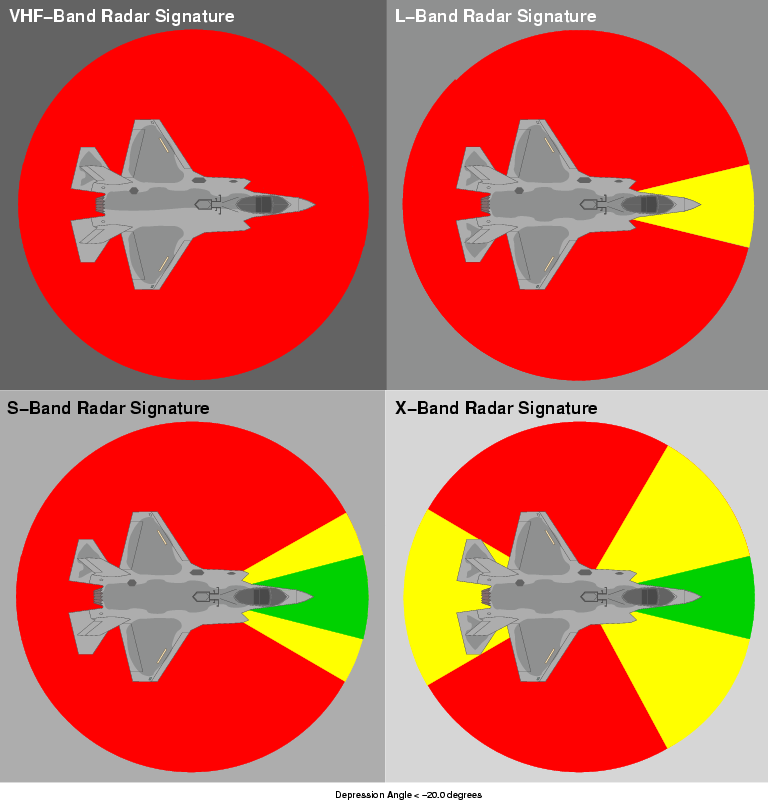
(figure)

That figure is actually rather silly. Here's why:
Study of the shaping of the aircraft and comparison with other designs shows that the Joint Strike Fighter can provide genuinely good stealth performance only in a fairly narrow ~29° sector about the aircraft’s nose, where the shaping of the nose, engine inlets, panel edge serrations, and alignment of the leading and trailing edges of the wings and stabilators results in the absence of major lobes or “spikes” in the radar signature. The ±14.5° angular limit is constrained by the principal reflecting lobe of the leading and trailing edges of the wings and stabilators. The signature degrades rapidly due to the influence of the lower centre fuselage as the angle swings past ±45° off the nose, refer Diagram 4.

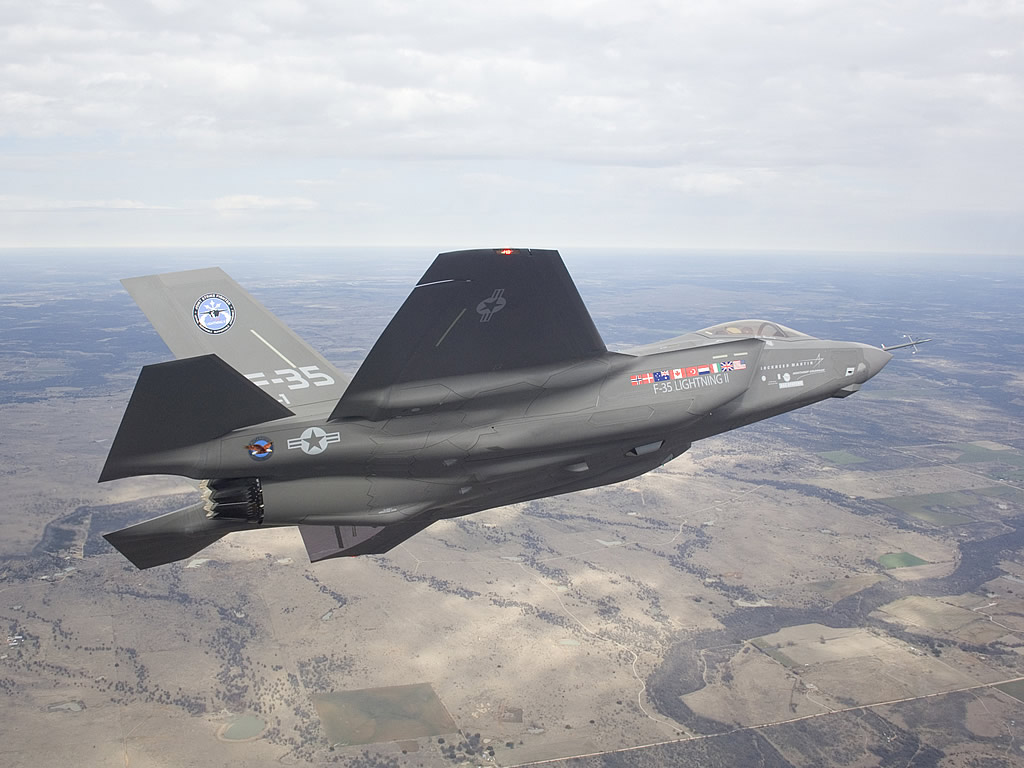
That assessment is entirely based on him eyeballing a schematic, and a relatively early one at that. If you look at real pictures of the F-35, you'll notice that the schematics that he's using are rather wrong, especially when it comes to the "tight" corners that he uses to criticize the X-band side-on characteristics. Kopp is mildly reliable when it comes to the SAM systems, but lets his bias show in a very large way when it comes to the F-35 itself.

Example of larger radius corners than he claims:
Image

F-35 is certainly designed for all-aspect stealth, and you'll note that F-22 has similar curve radius in these "sharp" areas.
I wonder where you got that number of 0.1 RCS @ VHF band

Projecting Serbian experience with the F-117 onto F-35. They only got that far with a bistatic approach, too. I don't exactly remember the source, but it was from interviews with the crew who shot the F-117 down.

Edit to add:
Also, the main defense against VHF radar is RAM and substrate material. Nobody knows what that is, exactly, so it's impossible for Kopp to really know how much the VHF signature of F-35 has been reduced from what can be inferred from geometry. Additionally, he didn't even do that, as the real way to have done the analysis is to use FEA software, which he did do for PAK-FA. However, he didn't do the same for F-35, I wonder why?

Edit 2: Amusingly, Kopp calls the far less stealthy J-20 and PAK-FA (by his own computational analyses, even) all aspect stealth, while ripping on the F-35 for not having all aspect stealth, despite its better geometry than either of those two.
User avatar
Dutchie999
Posts: 117
Joined: Wed Oct 08, 2014 2:46 pm

RE: Interesting analysis of an Australian F-35B purchase

Post by Dutchie999 »


Well lets close this discussion of ours because this can go on for days. My broad conclusion is basically this. For decades, starting with the first F-117 in the early eighties and then later the B-2 the US has possessed a unmatched capability to effectively destroy any IADS. This has always been the basis in theory and practice for the US to establish air supremacy and therefore also ground superiority. With the proliferation of modern Russian IADS systems (+ PAK-FA) the US has lost this advantage (and lost its monopoly on stealth). And its capabilities are now basically matched. The only militarily advantage the US has when it comes to SEAD/DEAD and establishing air supremacy is numbers. That is still a very powerful advantage. And probably enough to win any conflict. But still, the impunity the US has enjoyed for decades is gone.
thewood1
Posts: 10295
Joined: Sun Nov 27, 2005 6:24 pm
Location: Boston

RE: Interesting analysis of an Australian F-35B purchase

Post by thewood1 »

Hold on a second here...while the F-35 is only now reaching some form of operational level, the PAK-FA is not even in series production yet. And most of the newer SAM-based IADSs are in limited deployment due to costs and politics.

It looks like the assumption is that the US just stands still at a certain point and lets SAM technology overtake it. If we can make assumptions and take an advertiser's word on Russian and Chinese system performance, I think we can assume there is a lot more the F-22s, F-35s, and F/A-18Gs. Those are deployed systems evolved from years of war. I would like to think certain people on the board would give that some credence.

What I see is that when a US company or org makes a claim about a system like the F-35, there is immediate poo-pooing and denigration of it. But China shows a freaking model of a missile and people see China immediately shifting the balance of power. I just don't get it.

I am no flag-waver, but I am not seeing a balance view from some people.
NickD
Posts: 163
Joined: Fri Feb 14, 2014 8:47 pm

RE: Interesting analysis of an Australian F-35B purchase

Post by NickD »

ORIGINAL: thewood1
What I see is that when a US company or org makes a claim about a system like the F-35, there is immediate poo-pooing and denigration of it. But China shows a freaking model of a missile and people see China immediately shifting the balance of power. I just don't get it.

I am no flag-waver, but I am not seeing a balance view from some people.

Well put. There's also often an assumption that China and Russia will be able to field large numbers of their new F-22 and F-35-equivalent aircraft, and in the near future. Given that it took about 20 years to develop each fighter type and the richest countries in the world have struggled a bit to pay for them, it seems odd to assume that poorer countries with less-developed (though still pretty good) aviation industries will somehow do better.
User avatar
cf_dallas
Posts: 303
Joined: Thu Apr 13, 2006 3:35 pm
Location: Grapevine, TX

RE: Interesting analysis of an Australian F-35B purchase

Post by cf_dallas »

ORIGINAL: NickD
ORIGINAL: thewood1
What I see is that when a US company or org makes a claim about a system like the F-35, there is immediate poo-pooing and denigration of it. But China shows a freaking model of a missile and people see China immediately shifting the balance of power. I just don't get it.

I am no flag-waver, but I am not seeing a balance view from some people.

Well put. There's also often an assumption that China and Russia will be able to field large numbers of their new F-22 and F-35-equivalent aircraft, and in the near future. Given that it took about 20 years to develop each fighter type and the richest countries in the world have struggled a bit to pay for them, it seems odd to assume that poorer countries with less-developed (though still pretty good) aviation industries will somehow do better.


In a good year China builds 50 J-10s... possibly a very good fighter, but still a 4th gen. For comparison, F-16 production rates peaked around 20-25 per MONTH.

The F-35 LRIP-8 contract is being finalized for around 40-45 aircraft delivered in 2016, and that will be after EIGHT YEARS of low-rate production and slow ramp-up. Those aircraft will deliver 10 years after first flight. Building 5th generation fighters is HARD. And it's not just the LO that makes it tough... sensor fusion and highly-integrated mission- and aircraft-control computers aren't easy either. We'll see where the T-50 (2020), J-20 (2021) and J-31 (2022) are 10 years after their first flights.

And as to the earlier argument... if you've got a billion dollars to spend, and your sole mission is to knock the crap out of someone from distance, buy a bunch of TLAMs. If your sole mission is to defend a relatively compact airspace, buy a bunch of S-400s. But if your missions are a bit broader, you need fighters (or down the road, maybe UCAVs). They can defend airspace, execute strike missions, patrol maritime areas, support ground troops, and about 30 other things that a single-role weapon can't do.
Formerly cwemyss
User avatar
Dutchie999
Posts: 117
Joined: Wed Oct 08, 2014 2:46 pm

RE: Interesting analysis of an Australian F-35B purchase

Post by Dutchie999 »

ORIGINAL: thewood1

Hold on a second here...while the F-35 is only now reaching some form of operational level, the PAK-FA is not even in series production yet. And most of the newer SAM-based IADSs are in limited deployment due to costs and politics.

It looks like the assumption is that the US just stands still at a certain point and lets SAM technology overtake it. If we can make assumptions and take an advertiser's word on Russian and Chinese system performance, I think we can assume there is a lot more the F-22s, F-35s, and F/A-18Gs. Those are deployed systems evolved from years of war. I would like to think certain people on the board would give that some credence.

What I see is that when a US company or org makes a claim about a system like the F-35, there is immediate poo-pooing and denigration of it. But China shows a freaking model of a missile and people see China immediately shifting the balance of power. I just don't get it.

I am no flag-waver, but I am not seeing a balance view from some people.

I forgot to mention that I was talking technology-wise and not reality. The sames goes for the flagwaiving. I am neither Russian or American and I dont have a stake in the game. I just call it as I see it.
ckfinite
Posts: 208
Joined: Fri Jul 19, 2013 10:33 pm

RE: Interesting analysis of an Australian F-35B purchase

Post by ckfinite »

Oh, Kopp managed to discredit himself in even more detail, in this. The PAK-FA has worse stealth characteristics than the F-35 in more or less every way (that is, every criticism he makes about the F-35 (- the patently false ones) can equally be applied to PAK FA, though to a larger magnitude). Despite this, the aircraft, according to his own analysis, has reasonably good frontal characteristics against VHF radar. It's hard to imagine that the F-35 has worse stealth than the PAK-FA.

The fundamental issue seems to be that you're expecting that the US always be able to produce a weapon that's decades ahead of the opponent, when that is very much the exception. The US fighters were always reasonably closely matched with their Russian counterparts, and stealth was basically happenstance with the advent of computers.
thewood1
Posts: 10295
Joined: Sun Nov 27, 2005 6:24 pm
Location: Boston

RE: Interesting analysis of an Australian F-35B purchase

Post by thewood1 »

But that was when Russia's defense budget was on par with the US. Even in down times, its not even close. China is the only standalone country that can afford to do it on par with the US, but even then its a huge economic risk. It also doesn't have the history and culture of having a very sophisticated logistics operation. I posted a couple months ago an analysis on China's readiness and training of its fighter and bomber units. It was pretty pathetic when you look at all of the hype around China's military.

btw, I completely disagree that any country can, in this economic environment, come close to catching up with US spend and results. That is especially true when you consider the UK and Germany closely cooperating with the US R&D. The US can afford to try big things and fail. Other countries can't.

Example: Operational combat lasers. The US is already deploying them. Are they a silver bullet; No. But it shows the level of continuing R&D investment that ANY other country would have to support. Russia has the minds, but not the money. China has the money, but not enough of the minds. And they are rivals and will not truly cooperate. One of these programs requires huge national commitment. The US and UK run dozens of them simultaneously. China would have to be able to play huge catch up just to meet the R&D capabilities of the US and UK combined. In the meantime, the US has moved forward.
ckfinite
Posts: 208
Joined: Fri Jul 19, 2013 10:33 pm

RE: Interesting analysis of an Australian F-35B purchase

Post by ckfinite »

Sorry, I was referring to this desire for a perfect silver bullet, another world-beater like stealth, and expecting a new one for every new fighter. I agree that the US is basically unbeatable for another 40-50 years at least.
batek688
Posts: 92
Joined: Thu Oct 16, 2014 11:49 am

RE: Interesting analysis of an Australian F-35B purchase

Post by batek688 »

Y'all also went into a tangent discussing US versus Russia/China when this thread began as AUS purchasing the F35. Does the US have a role for the F35? Sure, for all the things discussed. But does AUS? Does AUS envision sustained offensive operations against a tier1 IADS when the US won't be there? I say no. AUS may have a reason for a pinpoint strike, but I don't see the threat where they need to establish the long-term superiority for all the follow-on ordinance where the cost of the 4 F35s becomes less than the price of 250 Tomahawks. They won't be controlling a battlespace ala Iraq/Afghanistan in any foreseeable future. Those scenarios are ones where the US is out there doing that and AUS is supporting -- which they can do with far less expensive platforms. I would rather see our allies (I'm US) load up with the secondary platforms and the US shrink down to the tier1s. That way we don't need a plethora of multi-role aircraft. US can populate the SEAD/DEAD space, maybe air superiority, and allow platforms provided by allies (or hell, UAVs) for the strike missions, close air, etc. Spread the cost around rather than everyone building duplicate capability.
ckfinite
Posts: 208
Joined: Fri Jul 19, 2013 10:33 pm

RE: Interesting analysis of an Australian F-35B purchase

Post by ckfinite »

I would rather see our allies (I'm US) load up with the secondary platforms and the US shrink down to the tier1s. That way we don't need a plethora of multi-role aircraft. US can populate the SEAD/DEAD space, maybe air superiority, and allow platforms provided by allies (or hell, UAVs) for the strike missions, close air, etc. Spread the cost around rather than everyone building duplicate capability.

What secondary platforms are you proposing? F/A-18 is shutting down, F-16 is old, F-15 is too expensive, Gripen too short ranged, and Rafale or Eurofighter too expensive. You're left with F-35, which isn't that expensive in the modern air war context. The only aircraft I listed with lower asking prices are F-16 (10-15% price advantage) and Gripen (20-25% price advantage), neither of which are suitable for the Australian role.
User avatar
Dutchie999
Posts: 117
Joined: Wed Oct 08, 2014 2:46 pm

RE: Interesting analysis of an Australian F-35B purchase

Post by Dutchie999 »

Martin says she expects the per-unit cost of the F-35A in 2019 – when full-rate production begins – to be $85 million in then-year dollars, or $75 million in current dollars. This includes an aircraft with the Pratt & Whitney F135 engine and all mission systems, she says.

Martin claims this pricing will be better than competitors at the time. Boeing said that in today’s money, an F/A-18E/F would cost $50 million. However, Boeing is facing a production rate reduction by as much as half from 48 annually.

The target cost for aircraft in low-rate initial production lot 7 is just less than $100 million based on the most recent contract agreement between Lockheed Martin and the Penatgon. An LRIP 8 deal is expected to be signed next spring, Martin says.

Now I am not believing 75 million since they also claimed that aircraft of lot 7 were less then 100 million (which it wasn't, see my link earlier in this topic it was $140mil). But lets say 100 million in 2014 dollars. That is more realistic and still a very nice reduction in price from LRIP to FRP. Boeing claimed 50 million for the F/A-18E/F but I am not believing that either since they are going to produce less planes + manufactures are great at creative accounting. So lets say 75 million. Lets also assume that the Griphen is also somewhere up there.

So there are basically three options as I see it:
1) go for the F-35 at 100mil a piece and get the newest tech
2) go for the cheap option (F/A-18 or Griphen) and save yourself 25% (+ much cheaper operation costs) but lose the stealth
3) go for the Rafale/Eurofighter which are more expensive and don't bring anything new to the table (so why would you go for that?)

So that basically is it. New tech/capability vs cheap(er).
ckfinite
Posts: 208
Joined: Fri Jul 19, 2013 10:33 pm

RE: Interesting analysis of an Australian F-35B purchase

Post by ckfinite »

2) go for the cheap option (F/A-18 or Griphen) and save yourself 25% (+ much cheaper operation costs) but lose the stealth
F/A-18 isn't really an option, because the line's shutting down circa 2016. Because of this, the only cheaper option is Gripen, and Gripen has substantially less payload and range than F-35 does.
User avatar
cf_dallas
Posts: 303
Joined: Thu Apr 13, 2006 3:35 pm
Location: Grapevine, TX

RE: Interesting analysis of an Australian F-35B purchase

Post by cf_dallas »

To the original point of the thread.... there's even less options than that. If you operate CVL/LHD type ships and want fixed wing aviation, your choices are F-35B or used Harriers.
Formerly cwemyss
User avatar
Anathema
Posts: 93
Joined: Fri Oct 04, 2013 8:51 pm
Location: Australia

RE: Interesting analysis of an Australian F-35B purchase

Post by Anathema »

ORIGINAL: batek688

Y'all also went into a tangent discussing US versus Russia/China when this thread began as AUS purchasing the F35. Does the US have a role for the F35? Sure, for all the things discussed. But does AUS? Does AUS envision sustained offensive operations against a tier1 IADS when the US won't be there? I say no. AUS may have a reason for a pinpoint strike, but I don't see the threat where they need to establish the long-term superiority for all the follow-on ordinance where the cost of the 4 F35s becomes less than the price of 250 Tomahawks. They won't be controlling a battlespace ala Iraq/Afghanistan in any foreseeable future. Those scenarios are ones where the US is out there doing that and AUS is supporting -- which they can do with far less expensive platforms. I would rather see our allies (I'm US) load up with the secondary platforms and the US shrink down to the tier1s. That way we don't need a plethora of multi-role aircraft. US can populate the SEAD/DEAD space, maybe air superiority, and allow platforms provided by allies (or hell, UAVs) for the strike missions, close air, etc. Spread the cost around rather than everyone building duplicate capability.

In relation to Australia most of this discussion hasn't really been relevant simply because we aren't a superpower like the US or located in Europe, so our defence needs are somewhat different and we obviously aren't going to be attacking Russia or China by ourselves. For example there are no advanced IADS or S-300/400s in our region and we simply don't have the ships to launch 250 Tomahawks, so the Tomahawks would probably end up costing way more than the F-35 once you add in the cost of the ships as well.

Given we are an island continent and most of the country would be well out of range of enemy fighters based in another country, any threat would have to come from the sea and we have long planned to stop any invasion before it reaches our shores much like what happened in the Battle of the Coral Sea, so a multi-role fighter with an anti-shipping capability is far more useful than a IADS or the Tomahawk.

Although we have purchased 12 Growlers and the AGM-88E, so presumably the RAAF will be developing a SEAD/DEAD capability in the future, even if it is rather limited.
ORIGINAL: ckfinite
2) go for the cheap option (F/A-18 or Griphen) and save yourself 25% (+ much cheaper operation costs) but lose the stealth
F/A-18 isn't really an option, because the line's shutting down circa 2016. Because of this, the only cheaper option is Gripen, and Gripen has substantially less payload and range than F-35 does.

We actually have just received 24 Super Hornets to replace the F-111 and wait for the 72 F-35As already on order to replace the F/A-18A and B models, so theoretically Australia could hang on to those Super Hornets if we wanted. Although they will eventually be replaced by the F-35 as well, so really the debate here is between the F-35A and B, or in reference to the LHDs, the F-35B vs just helicopters.

I can't be certain, but it appears to me that the F-35B option is coming from the government and Prime Minister, along with defence analysts or commentators because defence admitted in Senate hearings they hadn't really considered the B model until now. They had always denied they were interested in the past whenever they were asked and that seems to be the most strange aspect to me, especially given they are about to commission the first LHD and yet they are not even suitable to operate the F-35B!
Post Reply

Return to “Command: Modern Operations series”