


I would, but I expect their answer could be "ABM is also ASAT."
Well, this isn't entirely wrong. Such missile can reach above the atmosphere, and can hit nearly anything it guided to. It is just, my base assumption, is in post-cold war none will be willing to shoot ICBM for this moment.
But that doesn't mean the threat of other ballistic missiles should be disregarded. Even for ICBM, US and Russia are keeping them in a very good amount, while China only have 'paethetic' amount (even medias are hyped about their underground Great Wall that allow to store much more missiles, and can resist from bombardment). In Chinese perspective, the ABM capability is much direly needed than US do.
It just... a sort of bias. Typical bias would be too obvious, so they report such test can hit something, but 'not' for minuteman or trident 'yet'.
Naval and Defense News
Moderator: MOD_Command
RE: Naval and Defense News
Chinese Military Aviation has updated its description on the J-11D, stating:
http://chinese-military-aviation.blogsp ... html#J-11D
If true, and there are some indications about it, seeing the three sets of 'dots' under the wing, we can assume that the J-11D is actually derived from the Su-33/J-15, which also has 12 hardpoints vs 10 of the original Flanker/J-11.
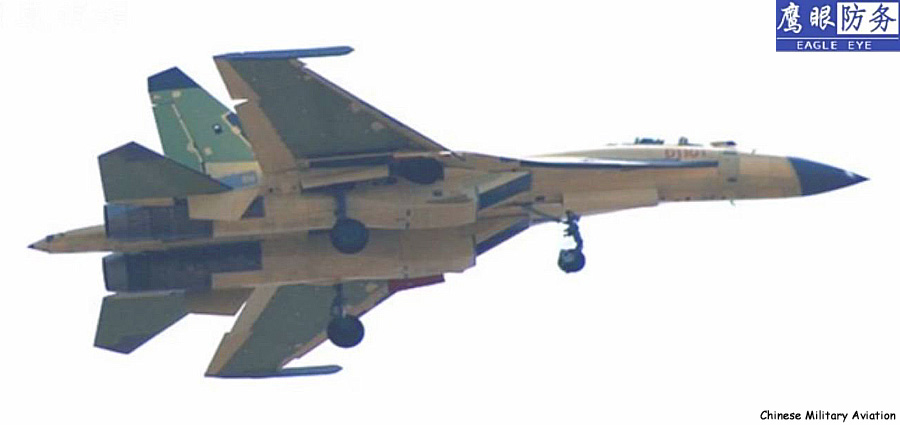
^Notice the yellow dots at the bottom of the wing, which seem to be fixing points for weapon hardpoints.
A further improved variant of J-11B has been under development at 601/SAC as J-11D. Compared to J-11B, it features a new AESA radar in a reshaped nose cone and an improved digital FBW system which are similar to those of J-16. J-11D can also carry new generation of AAMs including PL-10 and PL-15. Two extra hardpoints were added to the inner wings. As the result up to 12 AAMs can be carried. More composite material was used in its wing and tail sections in order to reduce weight.
http://chinese-military-aviation.blogsp ... html#J-11D
If true, and there are some indications about it, seeing the three sets of 'dots' under the wing, we can assume that the J-11D is actually derived from the Su-33/J-15, which also has 12 hardpoints vs 10 of the original Flanker/J-11.
^Notice the yellow dots at the bottom of the wing, which seem to be fixing points for weapon hardpoints.
RE: Naval and Defense News
The myth of "inner wing pylons may break flankers" may comes to end for PLAAF as well. But seriously, what kind of scenario would make PLAAF have to carry 10 BVRAAMs for J-11D?
RE: Naval and Defense News
ORIGINAL: Dysta
The myth of "inner wing pylons may break flankers" may comes to end for PLAAF as well. But seriously, what kind of scenario would make PLAAF have to carry 10 BVRAAMs for J-11D?
Seeing ther PoH (or PonH lol) of the PL-12 against semi-modern fighters in CMANO, 10 per bird is too few, actually. Joke.
No, I actually think that the inner pylons would be used for dedicated OECM pods, fuel-tanks or strike weapons.
But still, having more BVRAAMs is always good, as you will be able to achieve more potential splashes per sortie.
Also, where did the 'inner wing pylon may break flankers' myth come from?
The Su-30 regularily carry their heavier armaments on the inner pylons. Here, a PLAAF Su-30MKK with Kh-29L training dummies on the innermost pylons:

It is to be assumed that the J-16 and J-15 both feature these two additional hardpoints.
RE: Naval and Defense News
An interesting piece of news, that might give us some insights into the Chinese RAM-coating/RCS reduction research. Further comments are made by veroth, a PhD of RF-engineering over at China-Defese forum discussing several things about RCS reduction and stealth-coating:
http://www.defenseone.com/technology/20 ... gh/123622/
veroth's review of that article:
So, if this has any indication of the J-20's and future Chinese stealth fighter/bomber concepts, it would look to me that China's pursuit for broadband-stealth, like with the B-2 Spirit, indicates that China has strike and "AWACS assassination" roles in mind.
Generally, what he also says, is that larger planes are inherently more capable to achieve broadband stealth than smaller stealth fighters, as portrayed in the database with the superior stealth capabilities of the B-2 compared to even the F-22 and F-35.
His quote in a very technical thread:
I'm just a layman and cant understand everything, but this might be a indication to why China decided to develop a large stealth fighter like the J-20, and not a lower risk and cheaper smaller stealth fighter like most other asian powers (Japan, South Korea) pursue at the moment. IIRC the J-31/FC-31 still isnt sanctioned by the PLAAF and remains a privately funded venture by Shenyang Aircraft Company. This would give some credence to the "AWACS-killer/Stealth-Striker" theory about the J-20, which is something I'm personally not a fan of... [:(]
http://www.defenseone.com/technology/20 ... gh/123622/
Chinese Scientists Unveil New Stealth Material Breakthrough
NOVEMBER 11, 2015 BY PATRICK TUCKER
Planes and warships just got a lot harder to see with microwave radar. Technology
A group of scientists from China may have created a stealth material that could make future fighter jets very difficult to detect by some of today’s most cutting-edge anti-stealth radar.
The researchers developed a new material they say can defeat microwave radar at ultrahigh frequencies, or UHF. Such material is usually too thick to be applied to aircraft like fighter jets, but this new material is thin enough for military aircraft, ships, and other equipment.
Today’s synthetic aperture radar use arrays of antennas directing microwave energy to essentially see through clouds and fog and provide an approximate sense of the object’s size, the so-called radar cross section. With radar absorbent material not all of the signal bounces back to the receiver. A plane can look like a bird.
“Our proposed absorber is almost ten times thinner than conventional ones,” said Wenhua Xu, one of the team members from China’s Huazhong University of Science and Technology, in a statement.
In their paper, published today in the Journal of Applied Physics, the team describes a material composed of semi-conducting diodes (varactors) and capacitors that have been soldered onto a printed circuit board. That layer is sitting under a layer of copper resistors and capacitors just .04 mm thick, which they called an “active frequency selective surface material” or AFSS. The AFSS layer can effectively be stretched to provide a lot of absorption but is thin enough to go onto an aircraft. The next layer is a thin metal honeycomb and final is a metal slab.
The good news: the material isn’t locked away in a lab but published openly, so it’s not going to surprise anyone.
Stealth is considered by many to be one of the key technologies that enabled U.S. military dominance throughout the last century, effectively neutralizing, or offsetting, technological gains made by rival nations and the Soviet empire.
“In the 1970s, Secretary of Defense Harold Brown, working closely with Undersecretary – and future Defense Secretary – Bill Perry, shepherded their own offset strategy, establishing the Long-Range Research and Development Planning Program that helped develop and field revolutionary new systems, such as extended-range precision-guided munitions, stealth aircraft, and new intelligence, surveillance, and reconnaissance platforms,” former Defense Secretary Chuck Hagel said at a November 2014 event outlining the Pentagon’s newest technological push.
The F-35’s stealth capabilities are often touted as the jet’s most valuable feature. But in 2009, China was reportedly able to steal design and electronics data related to the program. China’s J-31 fighter resembles the F-35 to an uncanny degree, leaving many to wonder if the electronics on the inside are a match as well.
The publication today won’t answer that question but does speak to a growing Chinese capability in stealth technology, an area where the United States once had clear dominance.
veroth's review of that article:
http://www.defenseone.com/technology/20 ... gh/123622/
Chinese Scientists Unveil New Stealth Material Breakthrough
NOVEMBER 11, 2015 BY PATRICK TUCKER
From this journalist's LinkedIn profile, he has no credential in engineering or physics. Nonetheless, it's surprising that he makes certain reading comprehension mistakes.
The DOI link to the paper in the Journal of Applied Physics was not copied when posted in CDF. Here is the link: http://dx.doi.org/10.1063/1.4934683
Today’s synthetic aperture radar use arrays of antennas
This is absolutely wrong. Synthetic aperture radars do not need to use antenna arrays (using antenna arrays is an option, not a necessity). SAR works by transmitting and then recording the time varying return signal at multiple radar positions (i.e. the radar system is physically moved multiple times). After performing signal processing, one can obtain spatial resolution that is far smaller than the size of the radar beam. This is the main advantage of SAR.
In their paper, published today in the Journal of Applied Physics, the team describes a material composed of semi-conducting diodes (varactors) and capacitors that have been soldered onto a printed circuit board. That layer is sitting under a layer of copper resistors and capacitors just .04 mm thick, which they called an “active frequency selective surface material” or AFSS. The AFSS layer can effectively be stretched to provide a lot of absorption but is thin enough to go onto an aircraft. The next layer is a thin metal honeycomb and final is a metal slab.
This is a very retarded mistake because it's simply basic reading comprehension. The honeycomb isn't metal. It's low loss dielectric as written in the paper:
Quote from: 'JAP paper'
The third layer, used as a separation layer, is a 7.0-mm honeycomb with very low dielectric loss (ε=1.07(1-i0.0024) and μ=1) in the frequency range studied here.
Finally, I don't think this journalist understands that the metal slab that forms the final layer is a representation of the aircraft's metallic structure.
Hongjian on Today at 13:13:36: Thanks for the clarification and review, veroth. So, do you regard this concept as a viable solution for achieving broadband RCS reduction?
I don't pretend to be able to predict the future. It might work, it might fail because of compatibility issues for RCS reduction at the more important X-band. Who knows.
One thing to note is that this concept of tunable absorption bandwidth is not new. Just read the citations of past works, they cited this paper ( http://www.crossref.org/iPage?doi=10.10 ... 3A20030685 ) by a UK group from 2003 (Why didn't the journalist pick this up? Cuz he's dumb.). The Chinese work here is still very interesting and novel because it operates at lower frequency and with much wider tuning range (both absolute and relative), and it was made and tested for conditions that are more appropriate for aircraft RCS reduction.
EDIT: For those that cannot access the papers, I want to add that there are significant differences in architecture between the 2003 UK paper and what is presented here. Objectively, the concept in the Chinese publication is far superior for radar stealth applications (far thinner, actually designed with this application in mind).
So, if this has any indication of the J-20's and future Chinese stealth fighter/bomber concepts, it would look to me that China's pursuit for broadband-stealth, like with the B-2 Spirit, indicates that China has strike and "AWACS assassination" roles in mind.
Generally, what he also says, is that larger planes are inherently more capable to achieve broadband stealth than smaller stealth fighters, as portrayed in the database with the superior stealth capabilities of the B-2 compared to even the F-22 and F-35.
His quote in a very technical thread:
For starters, what is RCS?
RCS is a purely made up parameter. It's designed to serve as a short hand description of the relationship between the magnitude of the electric field of an electromagnetic plane wave incident on an object, and the magnitude of the electric field of the plane wave scattered off of it in one particular direction. As a made up parameter, RCS is designed in such a way that it can be conveniently used. Which is why it has units of area, and that it was defined with a metal sphere as a reference. Hence my previous posts on a metal sphere's RCS and its geometric cross section.
Qualitatively, the larger magnitude of the scattered electric field toward one direction, the larger the RCS for that direction. Since a lot of radar systems are monostatic, where the transmitter and receiver are located in the same place, therefore monostatic RCS is a description of the scattered electric field magnitude in the direction that is the same as the incident wave.
Monostatic radar stealth is achieved by reducing the electric field strength going back into the radar. Because drastically attenuating EM waves with lossy layers is not practical (require very thick layers hence weight and size issues), stealth is achieved mostly by designing the aircraft such that most of EM wave energy is scattered in a direction that is not the same as the incident direction. (One of the consequence of this point is why bistatic and multistatic radar systems receive attention and money for counter-stealth applications.)
The control of the direction to which the EM wave is scattered is accomplished by the shape of the aircraft's surface, the material properties of the dielectric coating(s), by the coating's (or coatings') thickness(es), and by the shape of the metal skin underneath, all being equally important.
One of the problems with a layman's evaluation of an aircraft's stealthiness is that it tends to default into scattering regime in the optical sense (λ<<feature size) because that's what is most intuitive. The problem is that optical scattering regime is not applicable at all. Thus, the effectively scattered EM wave's electric field is a superposition of fields from multiple scattering points off of the aircraft. Hence stealth aircraft is made possible only with computers, which allows engineers to predict the RCS of a certain design in a reasonable amount of time, then optimize and iterate the entire process before manufacturing.
This brings back to the original discussion of stealth. The shapes and materials on the aircraft is designed to direct most of incident EM wave energy onto other directions. To do this in problematic areas such as discontinuities in surfaces (*not true for all cases*) or simply surfaces, the shapes and dielectric layers in that area have to be of comparable size to the EM wavelength. If the shape is much smaller than the wavelength (i.e. Rayleigh scattering regime), it will not be able to achieve this EM wave energy re-direction. Which means, in very general terms, there is no hope of achieving super low RCS using only shaping features that are small compared to the radar wavelength, because these small shapes cannot direct most of the EM wave energy in a way that is desired.
This is why broadband stealth is achievable only in large, not small, aircrafts. Large aircrafts have the surface area to simultaneously fit in large features to direct long wavelength EM waves away from their source, and fit in small features (possibly next to or on top of the large features) to direct the short wavelength EM waves away from their source. Small aircrafts only have room for the small features.
I'm just a layman and cant understand everything, but this might be a indication to why China decided to develop a large stealth fighter like the J-20, and not a lower risk and cheaper smaller stealth fighter like most other asian powers (Japan, South Korea) pursue at the moment. IIRC the J-31/FC-31 still isnt sanctioned by the PLAAF and remains a privately funded venture by Shenyang Aircraft Company. This would give some credence to the "AWACS-killer/Stealth-Striker" theory about the J-20, which is something I'm personally not a fan of... [:(]
RE: Naval and Defense News
Finally we have a serial-number for the 1st J-10B unit: 10631. A 1xx3x number indicates the 5. Fighter Regiment of the 2nd Air Division, Guilin/Li Chia Tsun, according to Scramble.nl, replacing the previously equipped J-10A/S. They are a bit far inland, but they do face the South China Sea and could be forward deployed quickly in a war. Heads up, scenario designers!
https://www.google.nl/maps/place//@25.1 ... !1s0x0:0x0
The photo evidence in question: J-10B, 2nd division 5th regiment - AL-31FN series 3 powered (137KN):

Currently, there are around 90 J-10B/J-10B block II (sometimes known as J-10C, with improved ECM, 2nd gen AESA radar and improved WS-10B) produced:
"J-10C" with new 'smooth' 2nd gen AESA and for comparisson, the earlier AESA with parasitic IIF-poles:

http://i67.tinypic.com/3589v9s.jpg
(???what happened with the earlier picture? my uploader screwed up the image???)
"J-10C" no unit-marks, fresh from production facility, WS-10B block II powered (140kn), additional VLOC and ECM antennae.

DS
A J-10 regiment has usually 28 birds, which means we should have 3-4 J-10B equipped regiments soon, with 90 produced so far. Not a bad number of 4.5 gen multirole fighters and I expect it to get over 100 by the end of this year, completely filling out all 4 regiments.
https://www.google.nl/maps/place//@25.1 ... !1s0x0:0x0
The photo evidence in question: J-10B, 2nd division 5th regiment - AL-31FN series 3 powered (137KN):
Currently, there are around 90 J-10B/J-10B block II (sometimes known as J-10C, with improved ECM, 2nd gen AESA radar and improved WS-10B) produced:
"J-10C" with new 'smooth' 2nd gen AESA and for comparisson, the earlier AESA with parasitic IIF-poles:
http://i67.tinypic.com/3589v9s.jpg
(???what happened with the earlier picture? my uploader screwed up the image???)
"J-10C" no unit-marks, fresh from production facility, WS-10B block II powered (140kn), additional VLOC and ECM antennae.
DS
A J-10 regiment has usually 28 birds, which means we should have 3-4 J-10B equipped regiments soon, with 90 produced so far. Not a bad number of 4.5 gen multirole fighters and I expect it to get over 100 by the end of this year, completely filling out all 4 regiments.
-
Broncepulido
- Posts: 443
- Joined: Thu Sep 26, 2013 6:12 pm
RE: Naval and Defense News
My answer can only be political, and that's not the forum (Ban the Islam).
RE: Naval and Defense News
Not here guys. There are other strings on the matrix forum to discuss this. Off topic and the relevant info in this string is likely to get lost.
Thanks!
Mike
RE: Naval and Defense News
Whoops, unintentionally stepped a red line. Sorry.
What I am try to imply is the possible scenario involved with it. But I think I get the answer.
What I am try to imply is the possible scenario involved with it. But I think I get the answer.
RE: Naval and Defense News
ORIGINAL: Hongjian
Also, where did the 'inner wing pylon may break flankers' myth come from?
The Su-30 regularily carry their heavier armaments on the inner pylons. Here, a PLAAF Su-30MKK with Kh-29L training dummies on the innermost pylons:
Su-27 family have a wide-spread debates of their absence of inner-wing pylons, especially the Su-27K that Chinese purchased for their J-11A in 90s.
Su-27(K?):

And J-11A (and B?):
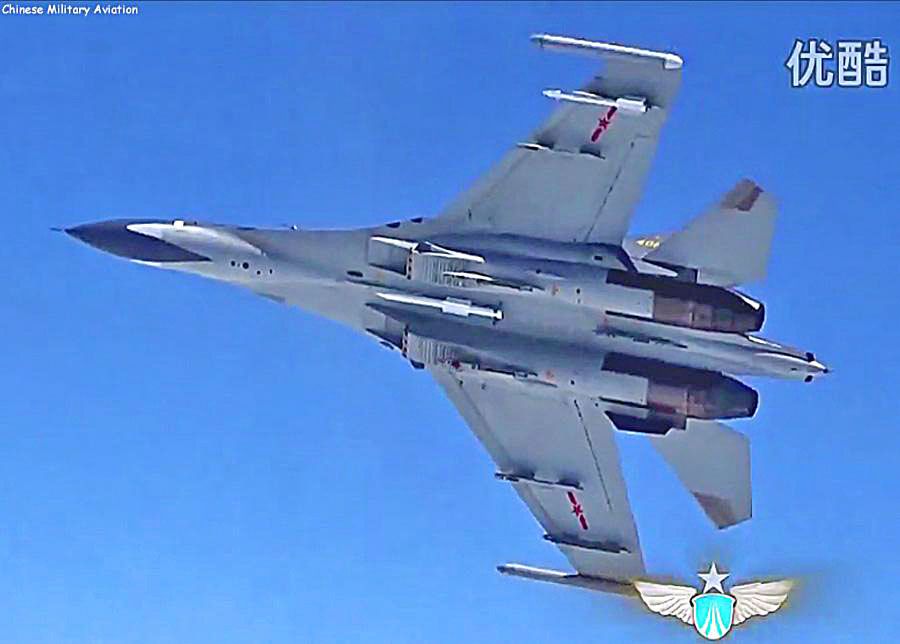
Those are clearly mounted at the center and outer side of the wings, and yet to see the inner one from both Su-27 and J-11A. Numerous suggestions are pointing out the structural weakness and/or the sensor obstruction when mounting missiles at inner-wing pylons, so they leave them empty.

RE: Naval and Defense News

GOD'S EYE DISABLED.
-
Broncepulido
- Posts: 443
- Joined: Thu Sep 26, 2013 6:12 pm
RE: Naval and Defense News
The media are reporting wrongly (How not!) France has begun today his air bombing campaign against Daesh targets in Syria, but it's not true.
The campaign, named Operation Chammal, begun on 27 September 2015, just three days before the Putin bombing actions from Latakia.
But even before France was attacking Daesh targets in Irak from 18 September 2014, a year before:
https://fr.wikipedia.org/wiki/Op%C3%A9ration_Chammal
Other references: Air Fan magazine, October 2015 issue: 6xRafale, 1xC-135, 1xAtlantique in Al Dhafra, UAE, and 3xMirage 2000D and 3xMirage 2000N operating from Jordania.
The search engine (I was looking for Operation Chammal) in L'Armee de l'Air official site is temporally down.
The campaign, named Operation Chammal, begun on 27 September 2015, just three days before the Putin bombing actions from Latakia.
But even before France was attacking Daesh targets in Irak from 18 September 2014, a year before:
https://fr.wikipedia.org/wiki/Op%C3%A9ration_Chammal
Other references: Air Fan magazine, October 2015 issue: 6xRafale, 1xC-135, 1xAtlantique in Al Dhafra, UAE, and 3xMirage 2000D and 3xMirage 2000N operating from Jordania.
The search engine (I was looking for Operation Chammal) in L'Armee de l'Air official site is temporally down.
-
Broncepulido
- Posts: 443
- Joined: Thu Sep 26, 2013 6:12 pm
RE: Naval and Defense News
More on Operation Chammal and details, from 21 July 2015: http://www.air-cosmos.com/1000e-mission ... mmal-39840
-
NakedWeasel

- Posts: 500
- Joined: Tue Jan 14, 2014 2:40 pm
RE: Naval and Defense News
Next level jammer for the Growler seems to be well on its way. http://www.spacedaily.com/reports/Raytheons_Next_Generation_Jammer_completes_preliminary_design_review_999.html
Though surrounded by a great number of enemies
View them as a single foe
And so fight on!
View them as a single foe
And so fight on!
-
Glenn Beasley
- Posts: 77
- Joined: Sat Feb 21, 2015 4:10 pm
RE: Naval and Defense News
Thailand orders More A-129"s. http://www.strategypage.com/htmw/htairm ... 51116.aspx
-
Glenn Beasley
- Posts: 77
- Joined: Sat Feb 21, 2015 4:10 pm
RE: Naval and Defense News
Japanese New Missile system. http://thediplomat.com/2015/11/100-perc ... ile-in-us/
-
Glenn Beasley
- Posts: 77
- Joined: Sat Feb 21, 2015 4:10 pm
RE: Naval and Defense News
New Indigneous South Korean SAM/ABM system, http://thediplomat.com/2015/11/south-ko ... nse-needs/
-
Vici Supreme
- Posts: 568
- Joined: Wed Dec 04, 2013 6:06 pm
- Location: Southern Germany
RE: Naval and Defense News
Russian Blackjacks, Backfires and Bears are now also engaging in Syria: http://theaviationist.com/2015/11/17/ru ... a-air-war/