Distant Worlds 2 - Dev Diary #3

The Galaxy Lives On! Distant Worlds, the critically acclaimed 4X space strategy game is back with a brand new 64-bit engine, 3D graphics and a polished interface to begin an epic new Distant Worlds series with Distant Worlds 2. Distant Worlds 2 is a vast, pausable real-time 4X space strategy game. Experience the full depth and detail of turn-based strategy, but with the simplicity and ease of real-time, and on the scale of a massively-multiplayer online game.

Moderator: MOD_DW2

User avatar
Mantuvec
Posts: 113
Joined: Mon Oct 12, 2020 10:06 pm

Distant Worlds 2 - Dev Diary #3

Post by Mantuvec »

Procedural Rendering in Distant Worlds 2

Hello to all. My name is Elliot Gibbs, and I am the developer for Distant Worlds 2. This article has a slightly different focus. It will give you a behind-the-scenes look at a small slice of the game with an important on-screen role: the natural environment of the Distant Worlds galaxy.

While this article is more technical, it will help you see “under-the-hood.” It will give you insight into how we solved some of the unique problems faced in a game as vast as Distant Worlds 2.
Image

Procedural Rendering versus Hand-made Art

What is procedural rendering? This refers to drawing various parts of the game without using hand-made art assets. In other words, an item is rendered on the screen without using any artist-created models or images. Instead the item is drawn using only software instructions – the item is rendered in code.

That might not sound very useful. Why would you bother writing a lot of software to draw something in code instead of just having an artist make a 3D model, or draw a 2D image?

That depends on what you are drawing and the number of different items that need to be drawn.
Image

The old way: the Galactic Environment in DW1

As you probably appreciate, in Distant Worlds there is a vast galactic environment, filled with many items to explore and discover: stars, planets, moons, black holes, nebula clouds, and many others.

In Distant Worlds 1 (Universe and earlier) these items were mostly hand-drawn 2D images: there were a set of images for desert planets, another set of images for ocean planets, a set of images for nebula clouds, etc. In total there were about 250 images for planets alone. So there was a lot of hand-drawn art!
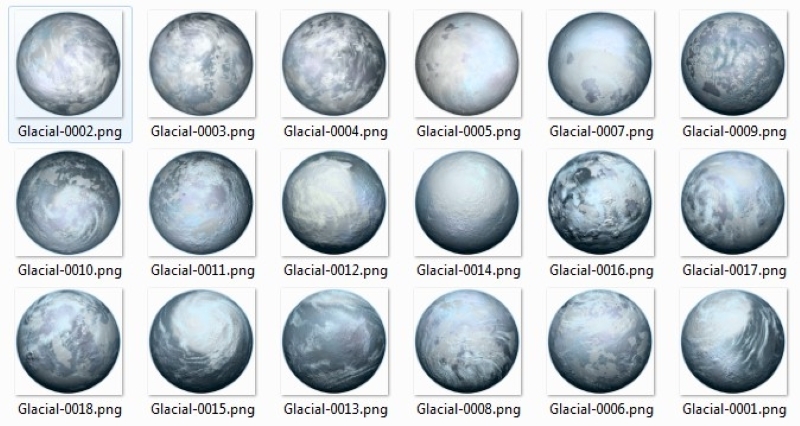
Image

The advantage with static, hand-drawn art is that you can have very specific details in the art. For example you could have an image of the planet Earth in the game, complete with the continents, islands and oceans we know so well.

However there are some big drawbacks with static art:

[*] 2D images and textured models have a resolution limit that is constrained by memory, thus when zoomed in their appearance can become blurry or pixelated
[*] you typically need to draw each image or texture by hand, limiting how many variations you can realistically have. Although tools can help automate the generation of some images, you still have to store them and load them in game, which can take a lot of memory and storage

Procedural rendering is an alternative to making a lot of hand-drawn art. It means writing software that knows how to draw a particular item. We can then draw as many variations of this item as needed, tweaking parameters to make changes to its appearance.
Image

The new, better way in DW2

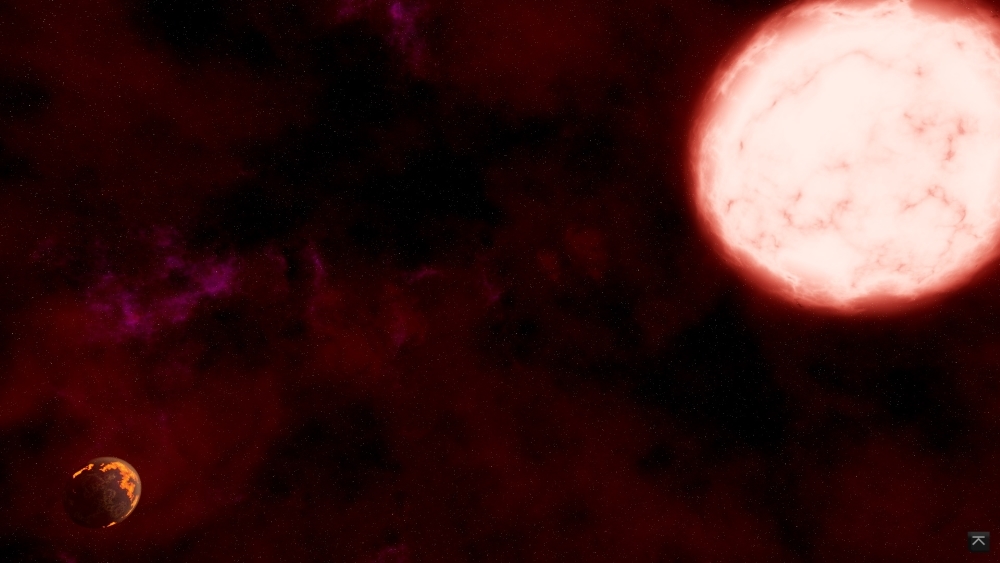
In Distant Worlds 2 nearly all of the galactic environment is procedurally rendered. That means that we use minimal hand-made art to draw the stars, planets, moons, black holes or nebula clouds in the game.

Instead there are a set of custom shader programs that know how to draw each of these items:

[*] a star shader that can draw brightly glowing coronas of semi-transparent gas and plasma
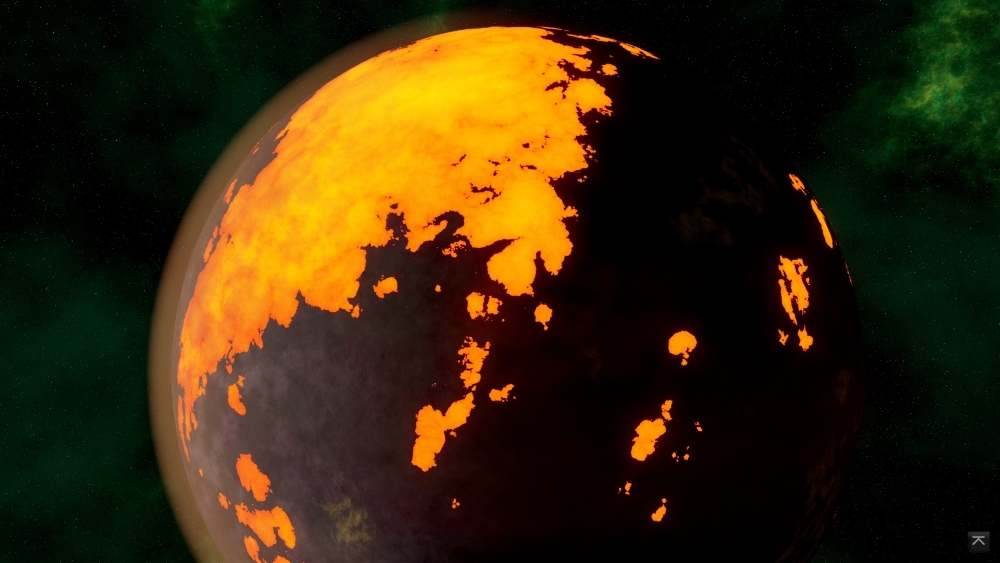
[*] several shaders that draw planets with solid surfaces: some with a lot of mountains, others with deep oceans, others with glowing lava lakes
[*] a shader that draws planets with gaseous surfaces with colored bands and swirling storms
[*] another shader draws black holes
[*] other shaders draw nebula clouds
Image

How does it work?

At the core of these shaders is a concept called fractal noise. Fractal noise refers to a set of special random values that are tuned for drawing a natural environment in a realistic manner.

Fractal noise is a huge subject, which I won’t go into detail about here. But if you want to learn more you should look it up. You’ll see terms like Perlin noise and Simplex noise, which are good starting points.

But how do these procedural shaders work? What process do they follow, and what do they allow us to do?

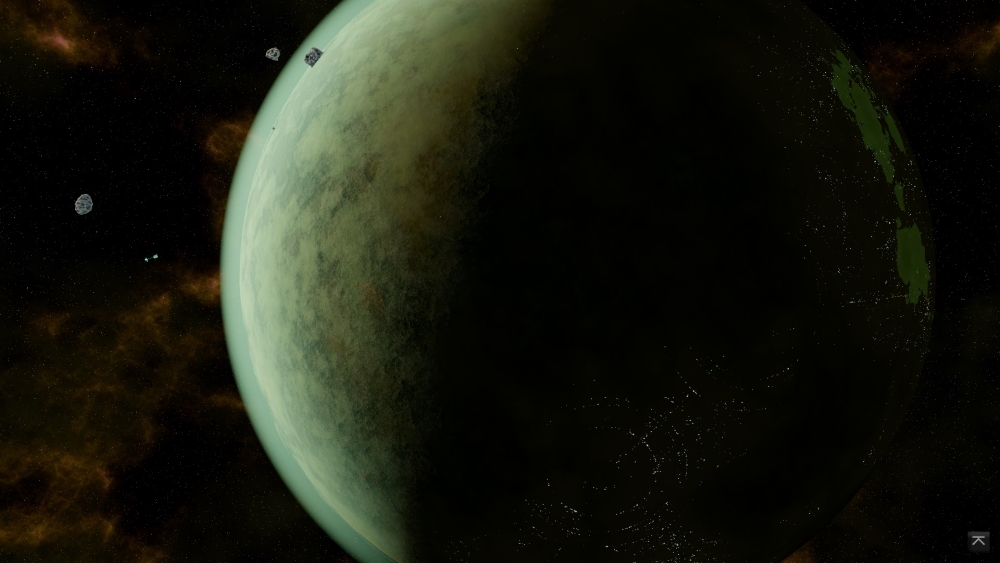
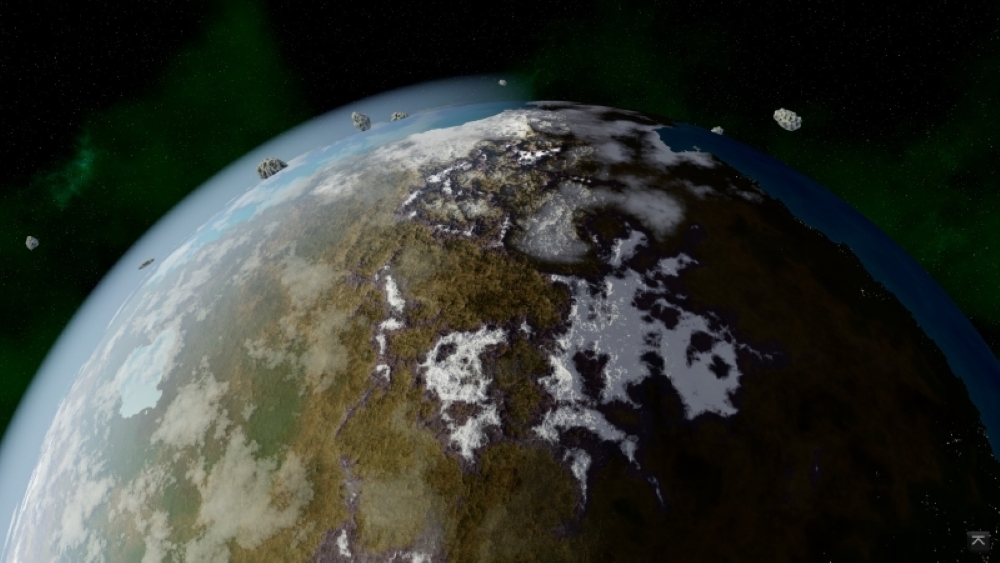
[*] Firstly they use fractal noise to make a unique height map for each planet, allowing us to generate mountains, valleys, plains, coastlines and sub-oceanic terrain
[*] applies shadowing from sun light on the mountains and hills to provide subtle realism to the terrain
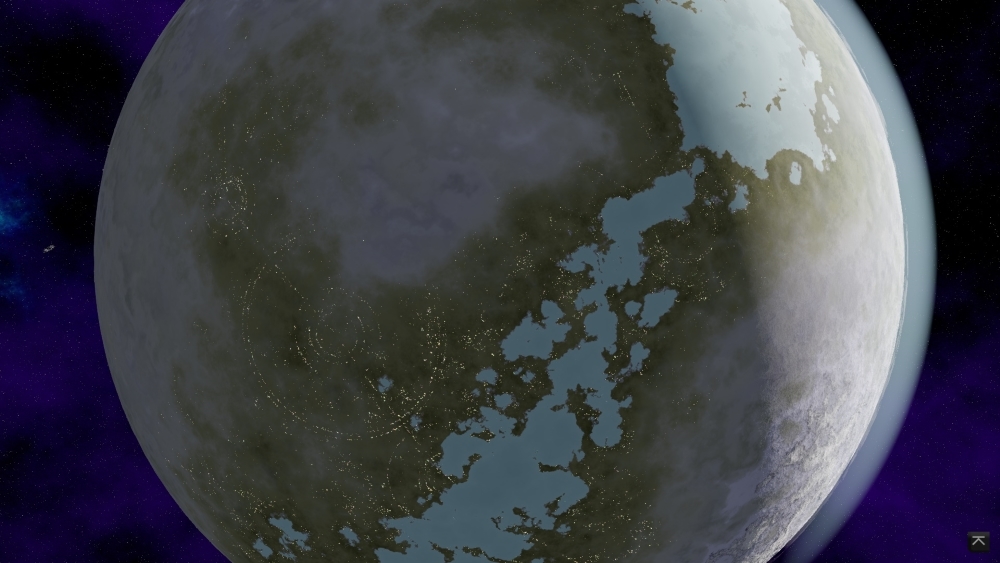
[*] if the planet is populated , adds city night lights that follow the natural geography of the planet, preferring low-lying and coastal areas (including underwater cities in shallow coastal regions)
[*] provides light-emitting features like lava lakes and oceans
[*] adds cloud layers with animated storm systems and shadows on the planet below
[*] allows latitude-specific features: polar ice caps, equatorial jungle belts, deserts
[*] allows altitude-specific terrain: snowy mountain tops, forested valleys, grassy plains and coastal areas, shallow underwater continental shelves, deep ocean basins
Image

Thus procedural shaders provide a vast improvement when rendering the natural environment in Distant Worlds, giving us an incredible level of detail and variety. The advantages of procedural rendering directly address the weaknesses of static art that we had in DW1:

[*] because the shader programs operate on each pixel on the screen, there is no resolution limit. You can keep zooming in closely to an item without blurriness or loss of quality
[*] by varying the input parameters for each shader you can obtain nearly infinite variety for an item, thus every planet in DW2 is unique
[*] because no static images or textures are needed, there is a dramatic reduction in memory and storage requirements

Image

A Living, Animated Galaxy

Procedural rendering also enables another feature: animation. The fractal noise used in the shaders can be multi-dimensional, so you can use one of the dimensions to represent change over time. This allows you to smoothly animate things that you draw. For example, we have the following in Distant Worlds 2:

[*] cloud layers on planets that move and change
[*] star coronas with prominences that rise and fall
[*] gas giant planets with animated cloud surfaces
[*] nebula clouds that smoothly change over time
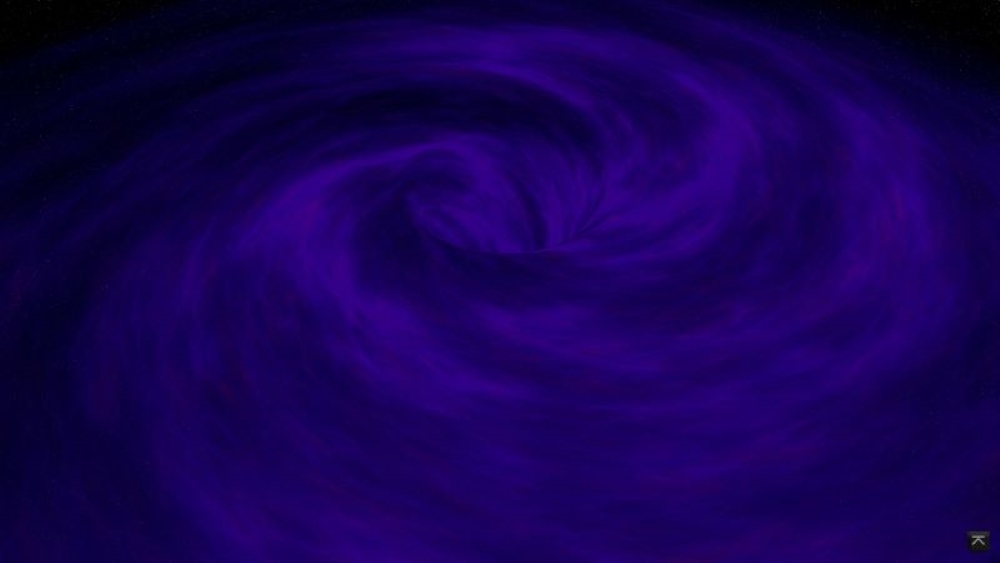
[*] black holes with swirling vortexes of light and energy

Thus procedural rendering helps to bring the galaxy of Distant Worlds to life, with motion and activity even in the natural environment. It gives infinite variety and depth of appearance to all of the planets and stars.
Image

Modding

You might be thinking: how does this affect modding? Can you easily mod new planet and star types into DW2? Or does this require special coding or shader skills?

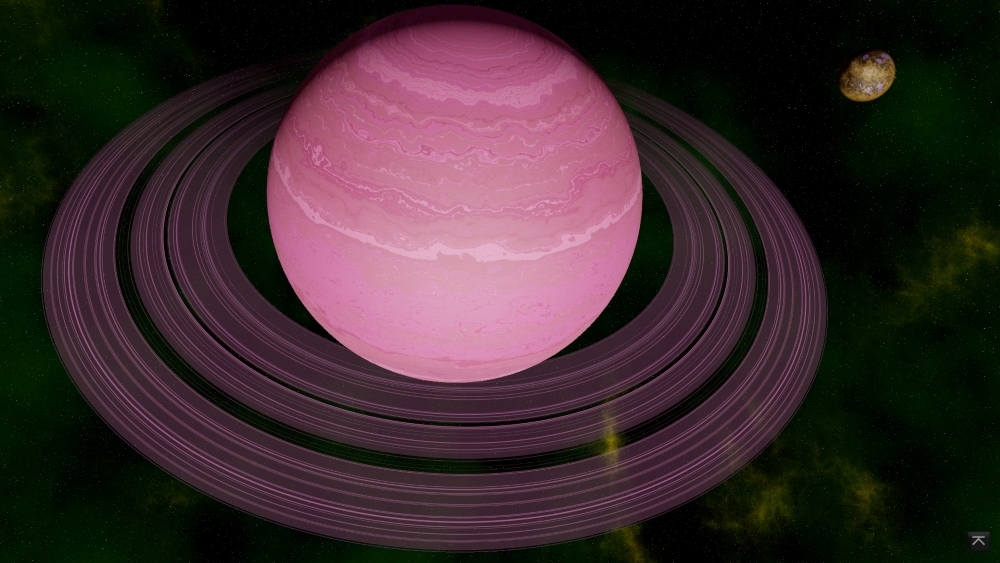
The good news is that modders also have access to these same shaders to make their own unique planets and stars – no special skills are required. By simply adding a few values to a file you can have a completely new type of planet available in the game. Your planet will have all the same features as the built-in planet types: hyper-detailed height maps with shadowing, animated cloud layers, city night lights when populated, planetary rings, etc.
Image

Summary

So how does procedural rendering improve the galactic environment in Distant Worlds?

[*] provides infinite variety – no two planets in the galaxy are the same. They all have their own unique geographical features and coastlines
[*] eliminates blurriness or pixelation. Everything remains sharp and clear even when zoomed in close
[*] allows animation of features like star coronas, planetary clouds and nebula clouds
[*] uses a lot less memory, thus freeing up resources for other rendering

I hope you enjoyed this look at the galactic environment of Distant Worlds. I’ll be back later with more behind-the-scenes information about other features in Distant Worlds 2.
Image
timothyfarley
Posts: 7
Joined: Tue Jan 26, 2021 3:50 pm

RE: Distant Worlds 2 - Dev Diary #3

Post by timothyfarley »

Very informative & interesting; thanks for the update! Really loving the appearance of the planets, especially the sense of scale. Looking forward to release.
Jorgen_CAB
Posts: 877
Joined: Wed Mar 17, 2010 7:53 pm

RE: Distant Worlds 2 - Dev Diary #3

Post by Jorgen_CAB »

I think the game looks quite impressive... especially given that you have a relatively small team that work on this title in comparison to other similar games.

This game seem to be a beauty to play as well as mentally challenging.
User avatar
rxnnxs
Posts: 628
Joined: Sat Jun 01, 2013 10:25 am
Location: what goes on
Contact:

RE: Distant Worlds 2 - Dev Diary #3

Post by rxnnxs »

Thank you very much for your insight!
I am very much awaiting this game. As I saw today earlier the DevDiary Number 2, I loved those pictures and models!
Tonight I came here to watch them again and let my fantasy imagine what an awesome game this is going to be!

And now, you talk about the procedural generated planets and the kosmos! Very very nice!
I love it, I love those games that always generate a new world to play in.
But ther are some drawbacks that I really do not like.
If you take for instance diablo or other games that also generate new worlds, you very quick find out: it always looks the same..
Even worse, they have small levels, dungeons whatsoever, and this generated stuff is not very much giving life to the game.

I am sure this can not be compared to distant worlds, because this kosmos is huge (I try not to use universe, because just yesterday I saw a video that talked about the name: universe: uni and verse, and this is not uni and it is not really verse, so better is to say kosmos, which much more describes the uniqueness and vastness of our multigalaxy spanning endless creation).
sorry, back to what I just wanted to say in some short words and a question integrated:

Is then every generated object in the game exactly the same after a save?
I hope it will be, because it takes my immersion backwards when there is a planet, that had yesterday a astonishing coastline, and the next day when i zoom in, it is generated again, maybe in a fractal way, but still, its different than before!
Now I know that it could be solved through a seed algorythm and I hope it is, but if not, I would prefer a switch that enables us to have the whole generated kosmos unique in a way that it will stay this way.

You could now say this is impossible or has limitations, because when you (we, the player) zoom in for instance to a coastline, as said before, and the further we zoom in, the generated coast has to be saved for the next time we zoom in here it has to look the same as before.
it is just the problem as for other space faring games where you can land on a planet where everything is genereated and then forgotten - otherwise the savegame file would break the gigabyte size limit (but there you can even manipulate the ground and build bases).
to make my question not even longer than it already is -

TLDR:
could you please say if all the uni-verse that is then created stays the way or is forgotten the next zoom out?

P.S.: Also, I really dislike games like the new elite (what was the name?) where you have a huuuuge galaxy but everywhere are ships. you fly to a saturn like planet, go into the belt, fly in, and there they are. WHAT?? I want to see places that no one ever has seen before, but then there they are: NPC ships that attack you and so on... Even here on earth, whereever we go, into the woods, as deep as you can.. well, everywhere is plastic stuff and garbage.. over the head there is a plane and so on... let this uni-verse have many places where no one was before, and other places where others were - aeons ago...
Thank you for reading!

P.P.S.:
I just want to mention this idea you probably already discussed/implemented:
The ability for you as well as for modders to implement partially or fully hand drawn objects into this procedural generated graphic.
This way missions and special locations and races and missile silos and industry as well as other land marks can be placed and looked at even with a tactical advantage (amount of population, well defended planet, habitability..).
User avatar
Galaxy227
Posts: 157
Joined: Tue Dec 01, 2020 9:51 pm

RE: Distant Worlds 2 - Dev Diary #3

Post by Galaxy227 »

ORIGINAL: Mantuvec

Hello to all. My name is Elliot Gibbs, and I am the developer for Distant Worlds 2.
Interesting, Elliot is finally coming out of his shell to talk about DW2...
This article has a slightly different focus. It will give you a behind-the-scenes look at a small slice of the game with an important on-screen role: the natural environment of the Distant Worlds galaxy. While this article is more technical, it will help you see “under-the-hood.” It will give you insight into how we solved some of the unique problems faced in a game as vast as Distant Worlds 2.
I first read "technical," then "behind-the-scenes..." Blah, blah, blah. Ugh. What a waste of energy to anticipate this diary. Time to get bombarded with the mundanities of coding.
What is procedural rendering? This refers to drawing various parts of the game without using hand-made art assets. In other words, an item is rendered on the screen without using any artist-created models or images. Instead the item is drawn using only software instructions – the item is rendered in code.
Oh wow! Procedural rendering? I love this stuff. I've spent way too much time in map-making software, story generators, dwarf fortress... This is getting interesting. Perhaps I doubted Elliot too soon.
That might not sound very useful. Why would you bother writing a lot of software to draw something in code instead of just having an artist make a 3D model, or draw a 2D image?
Ah, yes. As a long-time user of procedural generation, I am now prepared to brag about how I already know this field better than most.
That depends on what you are drawing and the number of different items that need to be drawn.
So true, Elliot. So true.
As you probably appreciate, in Distant Worlds there is a vast galactic environment, filled with many items to explore and discover: stars, planets, moons, black holes, nebula clouds, and many others.

In Distant Worlds 1 (Universe and earlier) these items were mostly hand-drawn 2D images: there were a set of images for desert planets, another set of images for ocean planets, a set of images for nebula clouds, etc. In total there were about 250 images for planets alone. So there was a lot of hand-drawn art!
Oh man... is he suggesting celestial objects are going to be procedurally generated? This could be huge.
However there are some big drawbacks with static art:

[*] 2D images and textured models have a resolution limit that is constrained by memory, thus when zoomed in their appearance can become blurry or pixelated
[*] you typically need to draw each image or texture by hand, limiting how many variations you can realistically have. Although tools can help automate the generation of some images, you still have to store them and load them in game, which can take a lot of memory and storage

Procedural rendering is an alternative to making a lot of hand-drawn art. It means writing software that knows how to draw a particular item. We can then draw as many variations of this item as needed, tweaking parameters to make changes to its appearance.
Okay, yep. I know all this already. Let's get to the good stuff...
In Distant Worlds 2 nearly all of the galactic environment is procedurally rendered.

I FOUND THE GOOD STUFF
That means that we use minimal hand-made art to draw the stars, planets, moons, black holes or nebula clouds in the game.

Instead there are a set of custom shader programs that know how to draw each of these items:

[*] a star shader that can draw brightly glowing coronas of semi-transparent gas and plasma
[*] several shaders that draw planets with solid surfaces: some with a lot of mountains, others with deep oceans, others with glowing lava lakes
[*] a shader that draws planets with gaseous surfaces with colored bands and swirling storms
[*] another shader draws black holes
[*] other shaders draw nebula clouds
Um... we're drawing entire PLANETS with procedural generation? Holy crap. I'm such a map nerd, this is huge. Everything will be so unique. I wonder how realistic it'll be.
At the core of these shaders is a concept called fractal noise. Fractal noise refers to a set of special random values that are tuned for drawing a natural environment in a realistic manner.

Fractal noise is a huge subject, which I won’t go into detail about here. But if you want to learn more you should look it up. You’ll see terms like Perlin noise and Simplex noise, which are good starting points.

But how do these procedural shaders work? What process do they follow, and what do they allow us to do?

[*] Firstly they use fractal noise to make a unique height map for each planet, allowing us to generate mountains, valleys, plains, coastlines and sub-oceanic terrain
[*] applies shadowing from sun light on the mountains and hills to provide subtle realism to the terrain
[*] if the planet is populated , adds city night lights that follow the natural geography of the planet, preferring low-lying and coastal areas (including underwater cities in shallow coastal regions)
[*] provides light-emitting features like lava lakes and oceans
[*] adds cloud layers with animated storm systems and shadows on the planet below
[*] allows latitude-specific features: polar ice caps, equatorial jungle belts, deserts
[*] allows altitude-specific terrain: snowy mountain tops, forested valleys, grassy plains and coastal areas, shallow underwater continental shelves, deep ocean basins
This is beautiful. I've never read anything more beautiful.

Let me explain. Firstly, I was raised as a Star Wars fan, through and through. Secondly, I have a wild fascination for all things related to the development of civilizations. Economics, warfare, traditions, technology, the rise and fall of empires—you get the gist. Thirdly, I'm obsessed with maps. I make maps about everything. For example, earlier this year I mapped my last playthrough in DW:U (here, unfinished). Now here I am, a lover of space operas, society, and maps, finding myself reading a developer diary perfectly encapsulating all three at once! And to think I called this diary boring for being too "technical." Hilarious.
Thus procedural shaders provide a vast improvement when rendering the natural environment in Distant Worlds, giving us an incredible level of detail and variety. The advantages of procedural rendering directly address the weaknesses of static art that we had in DW1:

[*] because the shader programs operate on each pixel on the screen, there is no resolution limit. You can keep zooming in closely to an item without blurriness or loss of quality
[*] by varying the input parameters for each shader you can obtain nearly infinite variety for an item, thus every planet in DW2 is unique
[*] because no static images or textures are needed, there is a dramatic reduction in memory and storage requirements
"...giving us an incredible level of detail and variety." Fantastic. Words can't describe how excited that makes me.
Procedural rendering also enables another feature: animation. The fractal noise used in the shaders can be multi-dimensional, so you can use one of the dimensions to represent change over time. This allows you to smoothly animate things that you draw. For example, we have the following in Distant Worlds 2:

[*] cloud layers on planets that move and change
[*] star coronas with prominences that rise and fall
[*] gas giant planets with animated cloud surfaces
[*] nebula clouds that smoothly change over time
[*] black holes with swirling vortexes of light and energy

Thus procedural rendering helps to bring the galaxy of Distant Worlds to life, with motion and activity even in the natural environment. It gives infinite variety and depth of appearance to all of the planets and stars.
I'm speechless. This is by far my favorite diary so far. Elliot is my favorite person. My mind, body, and soul belong to the DW2 development team. I will now devote my life to Code Force; start a cult, organize funding, and develop a means to make Elliot immortal. He will code for the rest of eternity, and I will play Distant Worlds 2. Perfect.
You might be thinking: how does this affect modding? Can you easily mod new planet and star types into DW2? Or does this require special coding or shader skills?

The good news is that modders also have access to these same shaders to make their own unique planets and stars – no special skills are required. By simply adding a few values to a file you can have a completely new type of planet available in the game. Your planet will have all the same features as the built-in planet types: hyper-detailed height maps with shadowing, animated cloud layers, city night lights when populated, planetary rings, etc.
I've never modded before but a planet generator has me excited. I can make maps and play them in a simulated galaxy, teeming with life? Count me in.
So how does procedural rendering improve the galactic environment in Distant Worlds?

[*] provides infinite variety – no two planets in the galaxy are the same. They all have their own unique geographical features and coastlines
[*] eliminates blurriness or pixelation. Everything remains sharp and clear even when zoomed in close
[*] allows animation of features like star coronas, planetary clouds and nebula clouds
[*] uses a lot less memory, thus freeing up resources for other rendering
"Provides infinite variety..." This. A million times over. The other changes are great as well, especially the elimination of pixelation when zoomed in, but the infinite variety... this is what I needed.
I hope you enjoyed this look at the galactic environment of Distant Worlds. I’ll be back later with more behind-the-scenes information about other features in Distant Worlds 2.
You're doing god's work Elliot. I don't think I've ever followed the development of a game as closely as I have with Distant Worlds 2. Words cannot describe how much I look forward to playing. Thank you for your work, and for this diary. Now I'm hungry for the next one!
TSBasilisk
Posts: 4
Joined: Wed Aug 25, 2021 5:53 pm

RE: Distant Worlds 2 - Dev Diary #3

Post by TSBasilisk »

Would it be possible to get like a video or gif showing a zoom in on a planet?
ORIGINAL: rxnnxs
TLDR:
could you please say if all the uni-verse that is then created stays the way or is forgotten the next zoom out?
In this case I think the save file will include the fractal noise seed and other modifiers. So long as you have those values, it will always render the same. It's like using the same Minecraft seed - even though the game is generating the world new each time, the result will be the same. Computer "random" generation is only as random as we make the variables.
User avatar
elliotg
Posts: 3936
Joined: Mon Sep 10, 2007 9:32 am

RE: Distant Worlds 2 - Dev Diary #3

Post by elliotg »

ORIGINAL: rxnnxs
TLDR:
could you please say if all the uni-verse that is then created stays the way or is forgotten the next zoom out?
Yes, the appearance will be retained across views and game sessions. You'll see the same-looking planet next time you look at it.
P.S.: Also, I really dislike games like the new elite (what was the name?) where you have a huuuuge galaxy but everywhere are ships. you fly to a saturn like planet, go into the belt, fly in, and there they are. WHAT?? I want to see places that no one ever has seen before, but then there they are: NPC ships that attack you and so on... Even here on earth, whereever we go, into the woods, as deep as you can.. well, everywhere is plastic stuff and garbage.. over the head there is a plane and so on... let this uni-verse have many places where no one was before, and other places where others were - aeons ago...
Thank you for reading!
Yes, there's plenty of that kind of thing out there to find - DW2 galaxies are big places.

Of course, all the other factions are also keen to explore too, so you shouldn't waste time getting out into the galaxy yourself :)
User avatar
Bleek
Posts: 817
Joined: Wed Oct 26, 2011 7:55 am
Location: United Kingdom

RE: Distant Worlds 2 - Dev Diary #3

Post by Bleek »

I have to say, that's pretty impressive.
I've been beta testing myself for decades.
muncuss
Posts: 7
Joined: Tue Sep 25, 2018 9:42 am

RE: Distant Worlds 2 - Dev Diary #3

Post by muncuss »

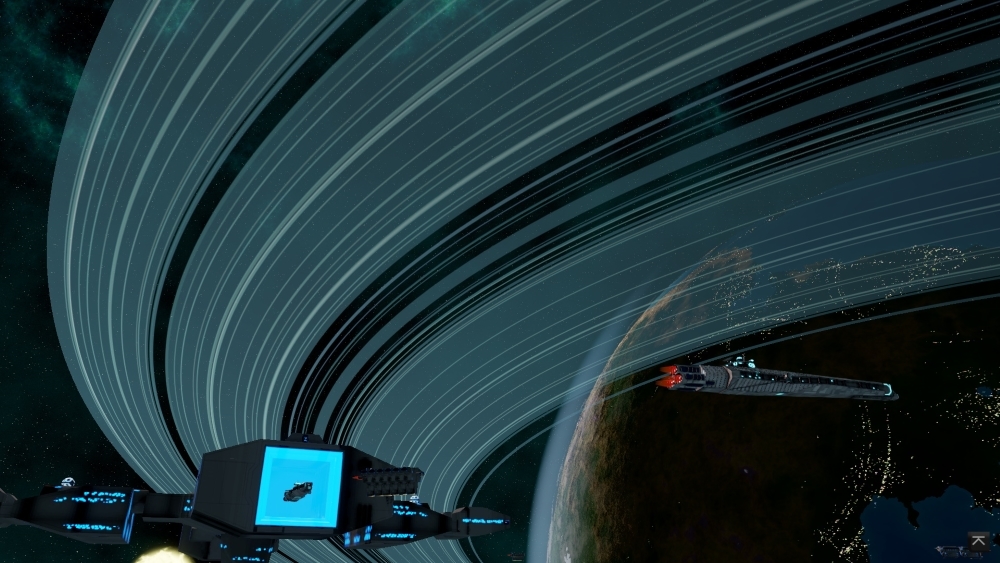
that last picture is very good
User avatar
Ranbir
Posts: 157
Joined: Sun Mar 28, 2010 1:26 pm

RE: Distant Worlds 2 - Dev Diary #3

Post by Ranbir »

I'd love a gif showing vortex swirls.
"The imaginary number is a fine and wonderful resource of the human spirit, almost an amphibian between being and not being." - Gottfried Leibniz
ElanaAhova_slith
Posts: 54
Joined: Tue Dec 28, 2010 1:53 pm

RE: Distant Worlds 2 - Dev Diary #3

Post by ElanaAhova_slith »

ORIGINAL: elliotg
ORIGINAL: rxnnxs
TLDR:
could you please say if all the uni-verse that is then created stays the way or is forgotten the next zoom out?
Yes, the appearance will be retained across views and game sessions. You'll see the same-looking planet next time you look at it.
P.S.: Also, I really dislike games like the new elite (what was the name?) where you have a huuuuge galaxy but everywhere are ships. you fly to a saturn like planet, go into the belt, fly in, and there they are. WHAT?? I want to see places that no one ever has seen before, but then there they are: NPC ships that attack you and so on... Even here on earth, whereever we go, into the woods, as deep as you can.. well, everywhere is plastic stuff and garbage.. over the head there is a plane and so on... let this uni-verse have many places where no one was before, and other places where others were - aeons ago...
Thank you for reading!
Yes, there's plenty of that kind of thing out there to find - DW2 galaxies are big places.

Of course, all the other factions are also keen to explore too, so you shouldn't waste time getting out into the galaxy yourself :)
I prefer to play on smaller maps. Will playing on smaller maps eliminate the unexplored by anyone aspect of the game? Yes, smaller game map means less 'unexplored by anyone' space -- but will it scale according to map size?

BTW - Elliot - I haven't posted in many years. Enjoyed our posts when I helped play-test original DW. Glad to be back and looking forward to DW2. Your work has always been awesome.
Do as you would be done by.
Anonymous

[Deleted]

Post by Anonymous »

[Deleted by Admins]
arvcran2
Posts: 2911
Joined: Fri Dec 11, 2020 3:17 pm

RE: Distant Worlds 2 - Dev Diary #3

Post by arvcran2 »

This gives me a whole new appreciation for the DW2 planets!
Intel(R) Core(TM) i7-6700HQ CPU @ 2.60GHz 2.59 GHz
16.0 GB (15.9 GB usable)
64-bit operating system, x64-based processor
NVIDIA GeForce GTX 965M (4053MB VRAM, 8136MB Shared Memory)
Intel(R) HD Graphics 530 (integrated GPU)
User avatar
USSAmerica
Posts: 19211
Joined: Mon Oct 28, 2002 4:32 am
Location: Graham, NC, USA
Contact:

RE: Distant Worlds 2 - Dev Diary #3

Post by USSAmerica »

Beautiful stuff, Elliot!
Mike

"Good times will set you free" - Jimmy Buffett

"They need more rum punch" - Me

Image
Artwork by The Amazing Dixie
WiZz
Posts: 543
Joined: Wed Sep 28, 2011 1:28 pm
Location: Ukraine

RE: Distant Worlds 2 - Dev Diary #3

Post by WiZz »

It's very nice, but... I'm still missing moving planets and moons from DW1.[:(]
User avatar
elliotg
Posts: 3936
Joined: Mon Sep 10, 2007 9:32 am

RE: Distant Worlds 2 - Dev Diary #3

Post by elliotg »

ORIGINAL: ElanaAhova_slith
I prefer to play on smaller maps. Will playing on smaller maps eliminate the unexplored by anyone aspect of the game? Yes, smaller game map means less 'unexplored by anyone' space -- but will it scale according to map size?
If you start in the default PreWarp mode then all the factions will be in their home system and will move out to explore from there. So there's still plenty to find even in small galaxies.
BTW - Elliot - I haven't posted in many years. Enjoyed our posts when I helped play-test original DW. Glad to be back and looking forward to DW2. Your work has always been awesome.
Thanks for your help back then :) Nice to see you around.
User avatar
elliotg
Posts: 3936
Joined: Mon Sep 10, 2007 9:32 am

RE: Distant Worlds 2 - Dev Diary #3

Post by elliotg »

ORIGINAL: Grognerd_INC
Will it be possible to add hand-drawn graphics to mod in planet Earth?
Yes, you can use static textures on a planet if you wish.

The asteroids work that way. They are actually the only element of the natural environment that don't use procedural rendering.
ElanaAhova_slith
Posts: 54
Joined: Tue Dec 28, 2010 1:53 pm

RE: Distant Worlds 2 - Dev Diary #3

Post by ElanaAhova_slith »

Thank you for reply.
Do as you would be done by.
TSBasilisk
Posts: 4
Joined: Wed Aug 25, 2021 5:53 pm

RE: Distant Worlds 2 - Dev Diary #3

Post by TSBasilisk »

For drawing your own custom planets, is that able to benefit from the secondary features of the fractal generation - city lights, clouds, etc.? I imagine you'd have something like that for any unique planets you might add to the game, such as homeworlds. Would you need to create a height map to accompany the terrain drawing for example or would the engine be able to do that on its own?
sinbuster
Posts: 62
Joined: Sat Jul 29, 2006 7:26 pm

RE: Distant Worlds 2 - Dev Diary #3

Post by sinbuster »

ORIGINAL: muncuss

that last picture is very good

It's very much this why I'm so excited for DW2. The scale of planets to ships is so much more realistic now. Those city lights are likewise excellent. I can't wait to just set up the camera and watch.
Post Reply

Return to “Distant Worlds 2”