

Historically I believe the Pripyat Marshes split the eastern front in two because it was so difficult to move in it. I don't think any panzer formations moved through it. In War Plan it is much too easy. You can even move from a a non road hex to a road hex in marsh and only pay 1 MP.
If the movement cost for the Pripyat Marshes were increased it would have the effect of shortening the front for the Russians in 1941 and for the Germans in 1944. I think you should pay 1 MP only when you move from a connected road hex. If this is too difficult to code then how about if the entire move is on hexes that have a road?
The other option is to increase the movement cost of roads in marsh hexes. Russian roads were bad enough in clear terrain let alone marsh hexes.
Pripyat Marshes Suggestions for next patch
Moderator: AlvaroSousa
-
canuckgamer
- Posts: 1153
- Joined: Wed Jun 23, 2004 3:20 am
RE: Pripyat Marshes Suggestions for next patch
I agree. The Pripyet Superhighway as we have been calling it recently should be tamed
RE: Pripyat Marshes Suggestions for next patch
I agree too. Not the first priority, but if possible to improve it would be nice.
-
AlvaroSousa

- Posts: 12108
- Joined: Mon Jul 29, 2013 7:13 pm
- Contact:
RE: Pripyat Marshes Suggestions for next patch
Thanks for suggestion. That would mean removing all the roads.
Creator Kraken Studios
- WarPlan
- WarPlan Pacific
Designer Strategic Command
- Brute Force (mod) SC2
- Assault on Communism SC2
- Assault on Democracy SC2
- Map Image Importer SC3
- WarPlan
- WarPlan Pacific
Designer Strategic Command
- Brute Force (mod) SC2
- Assault on Communism SC2
- Assault on Democracy SC2
- Map Image Importer SC3
RE: Pripyat Marshes Suggestions for next patch
I wonder if a simple solution would not be te remove only the western part of the roads? The Germans would have to go through the first halves of the marches to reach the roads eventually (not very practical, not with armor anyway). But at the same time, it will still help the Soviets to send reinforcements (and keep them well supplied!) to protect the middle and Eastern parts?
RE: Pripyat Marshes Suggestions for next patch
This is how the marshes look like in WitE2 in case it is useful.
Railroad in black and roads in red.
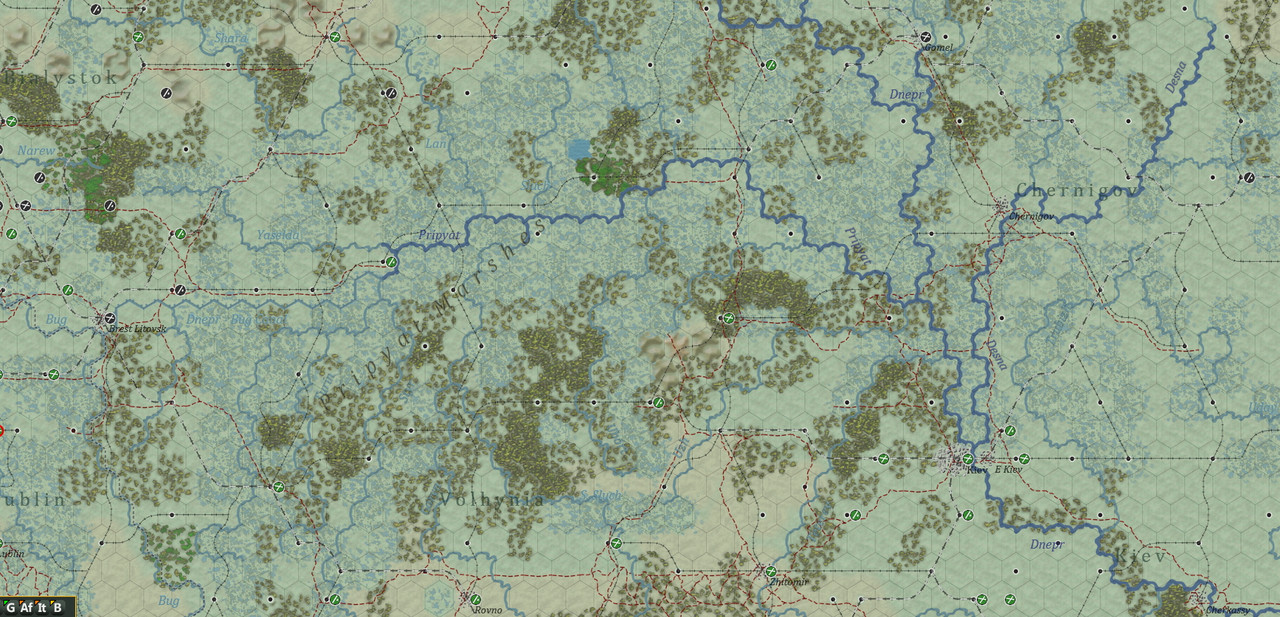
Railroad in black and roads in red.
-
AlvaroSousa
- Posts: 12108
- Joined: Mon Jul 29, 2013 7:13 pm
- Contact:
RE: Pripyat Marshes Suggestions for next patch
And that is what I based it on.
Creator Kraken Studios
- WarPlan
- WarPlan Pacific
Designer Strategic Command
- Brute Force (mod) SC2
- Assault on Communism SC2
- Assault on Democracy SC2
- Map Image Importer SC3
- WarPlan
- WarPlan Pacific
Designer Strategic Command
- Brute Force (mod) SC2
- Assault on Communism SC2
- Assault on Democracy SC2
- Map Image Importer SC3

RE: Pripyat Marshes Suggestions for next patch
A road is not a road sadly. Quality varies widely.

RE: Pripyat Marshes Suggestions for next patch
Is the problem with the roads or with the marsh and swamp hexes that are only costing 2 OPs?

- Attachments
-
- swamp.jpg (108.11 KiB) Viewed 607 times
Chancellor Gorkon to Captain James T. Kirk:
You don't trust me, do you? I don't blame you. If there is to be a brave new world, our generation is going to have the hardest time living in it.
You don't trust me, do you? I don't blame you. If there is to be a brave new world, our generation is going to have the hardest time living in it.
RE: Pripyat Marshes Suggestions for next patch
IMHO Marsh should definitely higher than 2op’s. Shame we can’t have tracks. Something like Marsh = 3 op’s. Tracks thru the Marsh=2op’s

RE: Pripyat Marshes Suggestions for next patch
Why not treat Russia roads as trails .... not far from the point ... and the Marsh should have high Op pts .....
B. Highways
1. Background of the Existing Highway Net
In 1941 European Russia did not have a highway net comparable to those in western European countries. The few roads which existed had only a limited capacity and apparently had not undergone any appreciable change in construction or lay-out during the past 100 year3, a condition due primarily to the relatively small demands of peacetime traffic. There were two types of roads:
a. the long, straight thoroughfares intended for commercial and military traffic, which usually followed the valleys of the larger rivers and connected cultural and industrial areas;
b. the unimproved roads which had developed through constant use of the same route connecting small settlements with nearby fields and forests,
2. Condition and Capacity of Roads
In contrast to the former Baltic States, where paved roads were common, the roads in European Russia had paved or asphalt surfacing only in and near large cities and industrial centers. The only road which had been bui1t according to western European standards and which was given constant maintenance was the Minsk - Moscow highway. The Germans designated this highway as Army Group Canter's "Rollbahn.”
The terms "Trakte" or "Greter" were used to refer to those through roads which cut straight across country and were often more than 100 yards wide. In summer these roads were extremely dusty. After a rain or thaw they became so mired that they could not be used by wheeled vehicles. Deep gullies cutting across these roads were particularly troublesome. Attempts to overcome the effects of weather by digging drainage ditches or by rolling were of little help because the roads did not have a hard top.
In an effort to overcome mud and snow the Germans often improvised wooden or ice roads. Wooden roads were constructed by laying down ribbons of planks spaced the width of the vehicular tread. Ice roads made use of frozen bodies of water or were fashioned by pouring water over deep snow. The use of corduroy roads and the tremendous amount of labor needed to construct them will be described later in this study.
https://www.allworldwars.com/Comments-o ... -Bork.html
B. Highways
1. Background of the Existing Highway Net
In 1941 European Russia did not have a highway net comparable to those in western European countries. The few roads which existed had only a limited capacity and apparently had not undergone any appreciable change in construction or lay-out during the past 100 year3, a condition due primarily to the relatively small demands of peacetime traffic. There were two types of roads:
a. the long, straight thoroughfares intended for commercial and military traffic, which usually followed the valleys of the larger rivers and connected cultural and industrial areas;
b. the unimproved roads which had developed through constant use of the same route connecting small settlements with nearby fields and forests,
2. Condition and Capacity of Roads
In contrast to the former Baltic States, where paved roads were common, the roads in European Russia had paved or asphalt surfacing only in and near large cities and industrial centers. The only road which had been bui1t according to western European standards and which was given constant maintenance was the Minsk - Moscow highway. The Germans designated this highway as Army Group Canter's "Rollbahn.”
The terms "Trakte" or "Greter" were used to refer to those through roads which cut straight across country and were often more than 100 yards wide. In summer these roads were extremely dusty. After a rain or thaw they became so mired that they could not be used by wheeled vehicles. Deep gullies cutting across these roads were particularly troublesome. Attempts to overcome the effects of weather by digging drainage ditches or by rolling were of little help because the roads did not have a hard top.
In an effort to overcome mud and snow the Germans often improvised wooden or ice roads. Wooden roads were constructed by laying down ribbons of planks spaced the width of the vehicular tread. Ice roads made use of frozen bodies of water or were fashioned by pouring water over deep snow. The use of corduroy roads and the tremendous amount of labor needed to construct them will be described later in this study.
https://www.allworldwars.com/Comments-o ... -Bork.html
RE: Pripyat Marshes Suggestions for next patch
B. Highways
Even though truck transportation ranked behind the railroad in transporting supplies to German units in Russia, because of its limited capacity over extensive distances, its mission was just as important as that of the railroad. It remained for the trucks to carry the supplies from the railheads to the front - line units. The truck float was a reliable means of transportation provided that adequate fuel was available and the roads were in good condition.
However, there were only few roads in Russia which were capable of handling heavy traffic. There were practically no improved roads in Ninth Army's area north of the Minsk - Moscow highway. Even the latter highway did not. come up to western European standards. From Minsk to Smolensk it had an asphalt or concrete surface. Between Smolensk and Vyazma granite slabs constituted the paving. East of Vyazma the highway was still under construction. A stone-paved surface permitted the use of trailer trucks, thus affording considerable relief for the overtaxed railroads. Truck transportation assumed great importance for the support of the front-line units. In the beginning, however, full utilization of the Minsk-Moscow highway was not possible because of the following reasons:
First of all, the Russians had laid delayed-action mines in the roadbed which left some craters the entire width of the pavement. These craters were either filled with earth — in which case traffic could resume at a snail's pace - or else the trucks had to detour cross¬-country a feat that could often be accomplished only with the greatest difficulty.
Moreover, during the first half of 1942 traffic was sometimes blocked for days at a time as a result of enemy interference. Finally, the Minsk - Moscow highway suffered greatly from the heavy flow of traffic since its surface could not withstand indefinitely the strain of the heavy loads (up to twenty tons).
Nevertheless, the Minsk - Moscow highway remained the only usable supply route for Army Group Center's left wing, and was used simultaneously by Fourth and Ninth Armies, as well as by Fourth Panzer Army. It was of vital importance for the supply of the above-mentioned units since the railroad alone could not carry all the supplies.
In dry weather and in winter, unless the snow was too deep, almost all Russian roads were passable, provided that they were not subjected to excessive stress. Unfortunately, such overloading did result from the truck convoys hauling heavy loads over large distances. For this reason, they were directed over improved roads.
During the two muddy seasons, each of which lasted about six weeks in the spring and autumn, otherwise passable unimproved roads sometimes became a morass which could be traversed by prime movers and other tracked vehicles but not by the average commercial trucks, such as the Germans had commandered and turned over to the armed forces. These trucks had been designed for operation on the relatively good roads of western Europe. The Russian three-axle truck accomplished wonders on muddy roads and in muddy terrain, for which it had been specifically designed.
Since German trucks were not equipped with all-wheel drive and thus lacked cross-country mobility, their use was restricted to the better roads. Such roads increased in importance whenever the axis of movement led through forests, swamps, and other types of difficult terrain.
The few good roads that there were in Russia might assume the greatest importance if combat units and reinforcements had to be moved as quickly as possible in non-organic trucks or other supply vehicles to threatened sectors of the front. Throughout the Russian campaign this means of strengthening weak sectors never failed, and reinforcements always arrived in time. Consequently, in planning military operations, the Germans had to give special consideration to the road net.
In many instances the railroad could not be used for the lateral movement of troop units, either because of inadequate trackage or the long, time-consuming marches between the front and the railhead. Trucks, on the other hand, picked up troops close to the front and moved them close to their new sector.
The truck drivers were frequently ordered to take a longer route if this meant traveling on better roads. The disadvantage of having to travel farther was always compensated for by the higher speed at which the vehicles could proceed.
Passable roads were indeed necessary to assure a steady flow of supplies to the combat units. This flow was maintained throughout the Russian campaign, but could have proceeded even more smoothly if the weight and design of the trucks had been adapted to Russian road conditions.
The utilization of trucks would have been even more efficient if the road net had been extensive enough to permit the designation of Rollbahnen, which would be used only by motorized units and supply trucks. However, since only few improved roads were available motorized units and other march columns, cars, trucks, and horse-drawn vehicles all had to use one and the same road. As a result, the speed of motor traffic was considerably reduced, especially if the road was used for two-way traffic.
Motor traffic never did come to a complete standstill at any point along the Russian front, and there never was a complete breakdown of the German supply system.
Road quality and/or weather influence may be too difficult to code differently between western europe and russia, but there certainly was a noticable distinction relative to road quality, capability, weather impact and capacity ....
Even though truck transportation ranked behind the railroad in transporting supplies to German units in Russia, because of its limited capacity over extensive distances, its mission was just as important as that of the railroad. It remained for the trucks to carry the supplies from the railheads to the front - line units. The truck float was a reliable means of transportation provided that adequate fuel was available and the roads were in good condition.
However, there were only few roads in Russia which were capable of handling heavy traffic. There were practically no improved roads in Ninth Army's area north of the Minsk - Moscow highway. Even the latter highway did not. come up to western European standards. From Minsk to Smolensk it had an asphalt or concrete surface. Between Smolensk and Vyazma granite slabs constituted the paving. East of Vyazma the highway was still under construction. A stone-paved surface permitted the use of trailer trucks, thus affording considerable relief for the overtaxed railroads. Truck transportation assumed great importance for the support of the front-line units. In the beginning, however, full utilization of the Minsk-Moscow highway was not possible because of the following reasons:
First of all, the Russians had laid delayed-action mines in the roadbed which left some craters the entire width of the pavement. These craters were either filled with earth — in which case traffic could resume at a snail's pace - or else the trucks had to detour cross¬-country a feat that could often be accomplished only with the greatest difficulty.
Moreover, during the first half of 1942 traffic was sometimes blocked for days at a time as a result of enemy interference. Finally, the Minsk - Moscow highway suffered greatly from the heavy flow of traffic since its surface could not withstand indefinitely the strain of the heavy loads (up to twenty tons).
Nevertheless, the Minsk - Moscow highway remained the only usable supply route for Army Group Center's left wing, and was used simultaneously by Fourth and Ninth Armies, as well as by Fourth Panzer Army. It was of vital importance for the supply of the above-mentioned units since the railroad alone could not carry all the supplies.
In dry weather and in winter, unless the snow was too deep, almost all Russian roads were passable, provided that they were not subjected to excessive stress. Unfortunately, such overloading did result from the truck convoys hauling heavy loads over large distances. For this reason, they were directed over improved roads.
During the two muddy seasons, each of which lasted about six weeks in the spring and autumn, otherwise passable unimproved roads sometimes became a morass which could be traversed by prime movers and other tracked vehicles but not by the average commercial trucks, such as the Germans had commandered and turned over to the armed forces. These trucks had been designed for operation on the relatively good roads of western Europe. The Russian three-axle truck accomplished wonders on muddy roads and in muddy terrain, for which it had been specifically designed.
Since German trucks were not equipped with all-wheel drive and thus lacked cross-country mobility, their use was restricted to the better roads. Such roads increased in importance whenever the axis of movement led through forests, swamps, and other types of difficult terrain.
The few good roads that there were in Russia might assume the greatest importance if combat units and reinforcements had to be moved as quickly as possible in non-organic trucks or other supply vehicles to threatened sectors of the front. Throughout the Russian campaign this means of strengthening weak sectors never failed, and reinforcements always arrived in time. Consequently, in planning military operations, the Germans had to give special consideration to the road net.
In many instances the railroad could not be used for the lateral movement of troop units, either because of inadequate trackage or the long, time-consuming marches between the front and the railhead. Trucks, on the other hand, picked up troops close to the front and moved them close to their new sector.
The truck drivers were frequently ordered to take a longer route if this meant traveling on better roads. The disadvantage of having to travel farther was always compensated for by the higher speed at which the vehicles could proceed.
Passable roads were indeed necessary to assure a steady flow of supplies to the combat units. This flow was maintained throughout the Russian campaign, but could have proceeded even more smoothly if the weight and design of the trucks had been adapted to Russian road conditions.
The utilization of trucks would have been even more efficient if the road net had been extensive enough to permit the designation of Rollbahnen, which would be used only by motorized units and supply trucks. However, since only few improved roads were available motorized units and other march columns, cars, trucks, and horse-drawn vehicles all had to use one and the same road. As a result, the speed of motor traffic was considerably reduced, especially if the road was used for two-way traffic.
Motor traffic never did come to a complete standstill at any point along the Russian front, and there never was a complete breakdown of the German supply system.
Road quality and/or weather influence may be too difficult to code differently between western europe and russia, but there certainly was a noticable distinction relative to road quality, capability, weather impact and capacity ....
RE: Pripyat Marshes Suggestions for next patch
ORIGINAL: ncc1701e
Is the problem with the roads or with the marsh and swamp hexes that are only costing 2 OPs?
Will it ruin the AI if we change the following?
Forest - OP = 3
Marsh - OP = 3
Swamp - OP = 3
Chancellor Gorkon to Captain James T. Kirk:
You don't trust me, do you? I don't blame you. If there is to be a brave new world, our generation is going to have the hardest time living in it.
You don't trust me, do you? I don't blame you. If there is to be a brave new world, our generation is going to have the hardest time living in it.
RE: Pripyat Marshes Suggestions for next patch
Wouldn’t forest be OP2 if swamp was 3?
RE: Pripyat Marshes Suggestions for next patch
Well one value that allows this terrain to slow down something.

- Attachments
-
- north.jpg (123.81 KiB) Viewed 607 times
Chancellor Gorkon to Captain James T. Kirk:
You don't trust me, do you? I don't blame you. If there is to be a brave new world, our generation is going to have the hardest time living in it.
You don't trust me, do you? I don't blame you. If there is to be a brave new world, our generation is going to have the hardest time living in it.
RE: Pripyat Marshes Suggestions for next patch
The one with trees Swamp and the one without is Marsh right?
The rule that frozen swamps become forest in Blizzard would be effected by that. If both were 3 then there would no effect in winter.
There are 2 types of forest as well. Light(<50%) and Heavy >51%) Should they be differentiated?
Something like :
Light Forest 1
Heavy Forest 2
Marsh 3
Swamp 3 (2 in winter)
That would be much more consistent with other types of games - although that doesn't necessarily mean anything!
The rule that frozen swamps become forest in Blizzard would be effected by that. If both were 3 then there would no effect in winter.
There are 2 types of forest as well. Light(<50%) and Heavy >51%) Should they be differentiated?
Something like :
Light Forest 1
Heavy Forest 2
Marsh 3
Swamp 3 (2 in winter)
That would be much more consistent with other types of games - although that doesn't necessarily mean anything!
RE: Pripyat Marshes Suggestions for next patch
Actually I just realised that rugged hexes (both types of forest, marsh and swamp) cost oil consuming troops an extra OP anyway. So the basic OP cost only effects infantry with a +1 OP for Tanks, Mech and Motorized units.
In that case 3 for forest is definitely too harsh.
I think the scale of -
Light Forest 1
Heavy Forest 2
Marsh 3
Swamp 3 (2 in winter)
Would work better
In that case 3 for forest is definitely too harsh.
I think the scale of -
Light Forest 1
Heavy Forest 2
Marsh 3
Swamp 3 (2 in winter)
Would work better
RE: Pripyat Marshes Suggestions for next patch
I just tested that rule and it doesn't seem to apply.
The rules say :
"Rugged – Oil dependent land units cost 1 more operation point to move into the hex; tank factors and retreat chance is halved."
However testing it in game show that Tank units only pay 1 mp to enter a forest despite it being Rugged terrain. Is that a bug?
I might question that in the tech section.
---------------------------
Some further investigation shows :
Forest is listed as Rugged. Woods are not. All the wooded areas on the map come up as "Forest" in the mouse rollover yet testing it in game show that Mech and Motorised infantry units only pay 1 OP to enter. The rule does not seem to apply to them despite them being oil dependant units.
Also a tank unit entering a hex with a rail in it from any direction seems to negate the rugged classification. i.e. you don't need to follow the rail line to negate the +1OP.
Certainly inconsistent with the rules
The rules say :
"Rugged – Oil dependent land units cost 1 more operation point to move into the hex; tank factors and retreat chance is halved."
However testing it in game show that Tank units only pay 1 mp to enter a forest despite it being Rugged terrain. Is that a bug?
I might question that in the tech section.
---------------------------
Some further investigation shows :
Forest is listed as Rugged. Woods are not. All the wooded areas on the map come up as "Forest" in the mouse rollover yet testing it in game show that Mech and Motorised infantry units only pay 1 OP to enter. The rule does not seem to apply to them despite them being oil dependant units.
Also a tank unit entering a hex with a rail in it from any direction seems to negate the rugged classification. i.e. you don't need to follow the rail line to negate the +1OP.
Certainly inconsistent with the rules
-
AlvaroSousa
- Posts: 12108
- Joined: Mon Jul 29, 2013 7:13 pm
- Contact:
RE: Pripyat Marshes Suggestions for next patch
If they move through a rail line they pay 1.
Creator Kraken Studios
- WarPlan
- WarPlan Pacific
Designer Strategic Command
- Brute Force (mod) SC2
- Assault on Communism SC2
- Assault on Democracy SC2
- Map Image Importer SC3
- WarPlan
- WarPlan Pacific
Designer Strategic Command
- Brute Force (mod) SC2
- Assault on Communism SC2
- Assault on Democracy SC2
- Map Image Importer SC3