How real is this? The seem to have around 30% PH. Is there such a heat signal in a GBU to make it an Igla target?
Observe the 2 F15s approaching Socotra from the north
[1776] Hitting GBUs with Iglas
Moderator: MOD_Command
-
Knightpawn
- Posts: 425
- Joined: Mon Dec 02, 2024 12:28 pm
[1776] Hitting GBUs with Iglas
- Attachments
-
- Indian Fury 4 - The Gate of Tears, 1994_0219_0710.zip
- (3.82 MiB) Downloaded 16 times
Re: [1776] Hitting GBUs with Iglas
In terms of IR signature yes, this is plausible. Any object warmer than absolute zero Kelvin (ie. -273 C) radiates some heat, and at short range this can be detected by normal IR seekers. The Igla has a fairly modern IR seeker so detecting a "cold object" against empty sky is not inconceivable.
Where things are more problematic is the post-impact damage. One of the handicaps of our current damage model is that successful impacts against weapons are a one-shot kill affair (with the exception of ballistic missiles & RVs). This assumption works well when the target weapon is heavily "aerodynamic", ie. it uses extensive flight surfaces and an overall structure that is optimized for aerodynamic flight and thus relatively fragile in sturdiness. A good example of this may be the Walleye glide bomb:

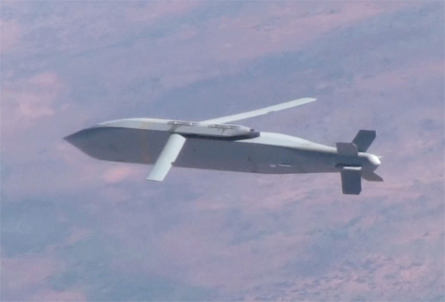
Or any of a number of glide weapons with pop-out wings, e.g. JSOW:

Or even most cruise missiles, like ALCM:

Guided bomb kits are a different case. Their aerodynamic elements are optimized for short-duration, high-speed flight rather than prolonged flight or glide, and this is reflected in their compact dimensions. GBU-24 is a good example:

Such weapons are less vulnerable to a typical proximity-fuzed AAM/SAM warhead detonation in close distance, both because of the less exposed aerodynamic surfaces and also because their structure is itself a strong bomb case, rather than a minimum-weight supporting structure containing the warhead and all other elements (as e.g. in a cruise missile).
So, accurately modelling this would require some form of post-impact damage assessment stage, possibly similar to what we currently have for the ABM warhead modifiers. It's an interesting case, but it will have to compete for a dev slot against some big things coming in 2026.
Added on the issue tracker (#17085). We'll see what we can do.
Where things are more problematic is the post-impact damage. One of the handicaps of our current damage model is that successful impacts against weapons are a one-shot kill affair (with the exception of ballistic missiles & RVs). This assumption works well when the target weapon is heavily "aerodynamic", ie. it uses extensive flight surfaces and an overall structure that is optimized for aerodynamic flight and thus relatively fragile in sturdiness. A good example of this may be the Walleye glide bomb:
Or any of a number of glide weapons with pop-out wings, e.g. JSOW:

Or even most cruise missiles, like ALCM:

Guided bomb kits are a different case. Their aerodynamic elements are optimized for short-duration, high-speed flight rather than prolonged flight or glide, and this is reflected in their compact dimensions. GBU-24 is a good example:
Such weapons are less vulnerable to a typical proximity-fuzed AAM/SAM warhead detonation in close distance, both because of the less exposed aerodynamic surfaces and also because their structure is itself a strong bomb case, rather than a minimum-weight supporting structure containing the warhead and all other elements (as e.g. in a cruise missile).
So, accurately modelling this would require some form of post-impact damage assessment stage, possibly similar to what we currently have for the ABM warhead modifiers. It's an interesting case, but it will have to compete for a dev slot against some big things coming in 2026.
Added on the issue tracker (#17085). We'll see what we can do.
-
Knightpawn
- Posts: 425
- Joined: Mon Dec 02, 2024 12:28 pm
Re: [1776] Hitting GBUs with Iglas
Interesting.Dimitris wrote: Mon Dec 01, 2025 9:39 am Guided bomb kits are a different case. Their aerodynamic elements are optimized for short-duration, high-speed flight rather than prolonged flight or glide, and this is reflected in their compact dimensions.
Such weapons are less vulnerable to a typical proximity-fuzed AAM/SAM warhead detonation in close distance, both because of the less exposed aerodynamic surfaces and also because their structure is itself a strong bomb case, rather than a minimum-weight supporting structure containing the warhead and all other elements (as e.g. in a cruise missile).
So, accurately modelling this would require some form of post-impact damage assessment stage, possibly similar to what we currently have for the ABM warhead modifiers. It's an interesting case, but it will have to compete for a dev slot against some big things coming in 2026.
Added on the issue tracker (#17085). We'll see what we can do.
1. Intuitively I believe that completing the OODA loop for such a shot (as in the example) would also be "challenging". The GBUs are being released at 25,000ft 4m away and, I guess that someone would need to eyeball the plane, then wonder what is it doing, somehow understand that it might have has released bombs using binoculars(?), tap his body next to him with the manpad on his back to aim the thing, and the latter would need to spot the thermal image of the GBU and shoot.
2. As to the modeling you can always apply a pragmatic/intuitive probability hit in the calculation as temporary "patchwork" and then take you time and be scientific
Re: [1776] Hitting GBUs with Iglas
The Kill chain of a MANPADS begins at knowing that a target (in this case bombs) are incoming.
This trigger starts a reaction time to put the launcher on the shoulder and to begin to look for targets in the desired direction.
Secondly the shooter should acquire the target, seeing the target with his Mk1 eyes, aligning the weapon and putting it in the crosshairs, acquire a lock with the seeker and fire.
CMO uses a base PH for a SA-18 sensor (which came into service in 1983...) at a base PH of 50%! for a GBU-10! So almost every second MANPADS shooter can hit a incoming bomb...
CMO's reaction from Dimitis chooses the scientific approach by saying "Any object warmer than absolute zero Kelvin (ie. -273 C) radiates some heat, and at short range this can be detected by normal IR seekers" Fine to start of with. But then we need some theory checks which can be useful to come to a more deeper conclusion than only one sentence. But remember the term "short range".
The boms have no engine, were flying in temperatures of minus 34.5 deg C/ -30F which is standare temperature @25.00 feet according to AI.
This is supported by: One of the critical problems Ukrainian forces face with the Russian D-30 glide bombs is their lack of a thermal signature. Unlike other types of munitions that emit detectable infrared heat, these glide bombs do not provide the thermal energy needed for Ukraine’s Man-Portable Air Defense Systems [MPADS] to lock on. Source: https://bulgarianmilitary.com/2024/12/3 ... heres-why/
In the attached scenario, a GBU-10 (4.3m long and a width of 0.46m, span of 1.68m is detected flying at 8.000 feet by people on the ground: (CMO seeker generation '80's-'90's)
- with an IR sensor of a ATGM at 3.4 Nm/6.3km; ( (Note a T-80 thermal camera can only see another armoured vehicels @ 1350 meters, but in CMO it finds a bomb at 6.3 km. That is a big difference!
- and guys with a binocular even at 6.7 Nm/12.4 Km flying at 8.000 feet! - with only their eyes... even more. From an average of 5Nm but some even at 19.6Nm/36 km! : That is too good to be true eyesight. This is too much to say they can be detected at short range.
Please take a look at this video https://www.youtube.com/watch?v=MzGGbG8cf_I from 1:21 to 1:25 and try to locate the bombs in IR with a sensor from 2025 instead of the very small Field of View SA-18 MANPADS seeker of the 1980's. I don't see the incoming bombs, do you?
Not yet convinced?
Watch these: https://www.youtube.com/shorts/FswKQQkH ... ture=share or
https://www.youtube.com/watch?v=kLc0P_EMn_w or
https://www.youtube.com/watch?v=Q1cyBeZmC60 or
https://www.youtube.com/watch?v=aaC1t8hQBRo
I changed the scenario to night and changed the settings to weather and day/night affect aircraft sorties (I hoped it also would affect others..) But even at night, personell with binoculars spot an incoming GBU-10 at 2Nm/3.7 Km at 7.000 feet! Three SA-18s engage incoming LGB's In darkness! Conclusion #1 There must be a significant difference between night and day for a MANPADS shooter. Because if you can't aquire the bomb with your eyes you cannot aim with a sensor with only a FOV Of les than 1.9 degrees to scan the skies.
Conclustion #2 The assumption that a MANPAD can shoot down incoming bombs is highly debatable. The plus side? You don't have to model post impact damage
Conclusion #3 What I do, is turn in the doctrine & ROE/ Weapon Release Authorisation/MANPAD TYPE SA-18/Guided Weapon - Subsonic to: do not use this weapon. Yes on a very good day it is possible to shoot down a cruismissile and I will miss that opportunity , but I rather take that loss of videlity than frustratenly see bombs being shot down by these old weapons.
@CMO: Is there a possibility to turn down the PH probability of the MANPADS, the extended ranges personell can see small object on the battlefield, and decrease the visibility of bombs in the IR and visible spectrum?
This trigger starts a reaction time to put the launcher on the shoulder and to begin to look for targets in the desired direction.
Secondly the shooter should acquire the target, seeing the target with his Mk1 eyes, aligning the weapon and putting it in the crosshairs, acquire a lock with the seeker and fire.
CMO uses a base PH for a SA-18 sensor (which came into service in 1983...) at a base PH of 50%! for a GBU-10! So almost every second MANPADS shooter can hit a incoming bomb...
CMO's reaction from Dimitis chooses the scientific approach by saying "Any object warmer than absolute zero Kelvin (ie. -273 C) radiates some heat, and at short range this can be detected by normal IR seekers" Fine to start of with. But then we need some theory checks which can be useful to come to a more deeper conclusion than only one sentence. But remember the term "short range".
The boms have no engine, were flying in temperatures of minus 34.5 deg C/ -30F which is standare temperature @25.00 feet according to AI.
This is supported by: One of the critical problems Ukrainian forces face with the Russian D-30 glide bombs is their lack of a thermal signature. Unlike other types of munitions that emit detectable infrared heat, these glide bombs do not provide the thermal energy needed for Ukraine’s Man-Portable Air Defense Systems [MPADS] to lock on. Source: https://bulgarianmilitary.com/2024/12/3 ... heres-why/
In the attached scenario, a GBU-10 (4.3m long and a width of 0.46m, span of 1.68m is detected flying at 8.000 feet by people on the ground: (CMO seeker generation '80's-'90's)
- with an IR sensor of a ATGM at 3.4 Nm/6.3km; ( (Note a T-80 thermal camera can only see another armoured vehicels @ 1350 meters, but in CMO it finds a bomb at 6.3 km. That is a big difference!
- and guys with a binocular even at 6.7 Nm/12.4 Km flying at 8.000 feet! - with only their eyes... even more. From an average of 5Nm but some even at 19.6Nm/36 km! : That is too good to be true eyesight. This is too much to say they can be detected at short range.
Please take a look at this video https://www.youtube.com/watch?v=MzGGbG8cf_I from 1:21 to 1:25 and try to locate the bombs in IR with a sensor from 2025 instead of the very small Field of View SA-18 MANPADS seeker of the 1980's. I don't see the incoming bombs, do you?
Not yet convinced?
Watch these: https://www.youtube.com/shorts/FswKQQkH ... ture=share or
https://www.youtube.com/watch?v=kLc0P_EMn_w or
https://www.youtube.com/watch?v=Q1cyBeZmC60 or
https://www.youtube.com/watch?v=aaC1t8hQBRo
I changed the scenario to night and changed the settings to weather and day/night affect aircraft sorties (I hoped it also would affect others..) But even at night, personell with binoculars spot an incoming GBU-10 at 2Nm/3.7 Km at 7.000 feet! Three SA-18s engage incoming LGB's In darkness! Conclusion #1 There must be a significant difference between night and day for a MANPADS shooter. Because if you can't aquire the bomb with your eyes you cannot aim with a sensor with only a FOV Of les than 1.9 degrees to scan the skies.
Conclustion #2 The assumption that a MANPAD can shoot down incoming bombs is highly debatable. The plus side? You don't have to model post impact damage
Conclusion #3 What I do, is turn in the doctrine & ROE/ Weapon Release Authorisation/MANPAD TYPE SA-18/Guided Weapon - Subsonic to: do not use this weapon. Yes on a very good day it is possible to shoot down a cruismissile and I will miss that opportunity , but I rather take that loss of videlity than frustratenly see bombs being shot down by these old weapons.
@CMO: Is there a possibility to turn down the PH probability of the MANPADS, the extended ranges personell can see small object on the battlefield, and decrease the visibility of bombs in the IR and visible spectrum?
Re: [1776] Hitting GBUs with Iglas
This video gives a very good perspective how long you can possibly see the bombs.
Within 3 seconds they are invisible.
Please see the video:
https://x.com/Archer83Able/status/19907 ... 67/video/1
Within 3 seconds they are invisible.
Please see the video:
https://x.com/Archer83Able/status/19907 ... 67/video/1
-
Knightpawn
- Posts: 425
- Joined: Mon Dec 02, 2024 12:28 pm
Re: [1776] Hitting GBUs with Iglas
I believe that your Conclusion 3 approach is the most neat one until the issue is addressed in a more systematic manner.
Re: [1776] Hitting GBUs with Iglas
Agree that by default MANPAD vs. weapon is optimistic but here's a couple of points to assess on this one.
Mike
- Higher end MANPADS and upgraded older systems have multispectral seekers and sights on their launchers. Some have the ability to gate out flare decoys.
- The older systems that are around are still here for a good reason. They throw metal.
- Lower end systems without night sights should be penalized in the detection phase of the kill chain.
Many MANPADS are part of systems that include a search radars and separate optical sensors. (QW-3, MIstal-3, etc).
- Radars are subject to sensor gating mostly due to environmental things that move (birds, debris, friendly drones..). Gating got looser as sensor technology and now AI target discrimination progressed.
- Militaries have adapted either the characteristics of the weapons or how they are delivered to move it out of the envelope of an engagement. There are some common sense things like higher-risk (drop later with optimal terminal angles) but other stuff is too secret to dig out and just handled generally.
- Address IR detection values for temperature if not doing already (arctic greater variation then desert)
- Address the advantages of multispectral system guidance. Might be easier to go to an overall sensor generation model.
- Continue to address kill chain advantages with early detection from mounts and connected system sensors.
- Look at giving glide bombs more options with generational end game characteristics to model optical angles (and outside MANPAD engagement ability to hit targets on a reverse slope) without getting lost in the details of any particular system. . The drop parameters are in loadouts which currently do a good job helping players weight risks.
- Somebody above mentioned this but using areas to modify detection values would be great. You can sorta due this by redefining the terrain type but you're kind of locked in to fixed values. It didn't work well for me as the detection was still relatively good in the worst terrain.
Mike
"Smart people just shrug and admit they're dazed and confused. The only ones left with any confidence at all are the New Dumb". HST
Re: [1776] Hitting GBUs with Iglas
For reasons of complexity, I assume that the visual recording CMO is interpreted as extremely optimistic in some cases and very pessimistic in others.
In the case of the GBU, it is overly optimistic. Looking up at a clear sky, the atmospheric background radiation is between -20° and -40° C, slightly higher under optimal conditions. With a cloudy sky, the only background temperature would be that of the clouds, between -5° and 10° C. This would reduce the IR contrast of the GBU to practically zero.
Optically, a normal human eye has an angular resolution of about one arc minute, and someone with very good eyesight has 0.5 arc minutes. This means that a human eye can see a 10 cm spot on a white surface from about 350 to 700 m away. However, this only applies to optimal contrast. Haze, twilight, and the color of the weapon lead to significantly worse values.
CMO is pessimistic, for example, when it comes to fireballs from rockets. An ICBM, for example, disappears from view after a few miles at night, even though it should be visible for hundreds of kilometers. I've been toying with the idea of preparing this neatly in a test scenario for a while. I just have other things to do at the moment, and CMO developers probably do too, as IMHO this is a problem that affects a rather small marginal area of the model.
In the case of the GBU, it is overly optimistic. Looking up at a clear sky, the atmospheric background radiation is between -20° and -40° C, slightly higher under optimal conditions. With a cloudy sky, the only background temperature would be that of the clouds, between -5° and 10° C. This would reduce the IR contrast of the GBU to practically zero.
Optically, a normal human eye has an angular resolution of about one arc minute, and someone with very good eyesight has 0.5 arc minutes. This means that a human eye can see a 10 cm spot on a white surface from about 350 to 700 m away. However, this only applies to optimal contrast. Haze, twilight, and the color of the weapon lead to significantly worse values.
CMO is pessimistic, for example, when it comes to fireballs from rockets. An ICBM, for example, disappears from view after a few miles at night, even though it should be visible for hundreds of kilometers. I've been toying with the idea of preparing this neatly in a test scenario for a while. I just have other things to do at the moment, and CMO developers probably do too, as IMHO this is a problem that affects a rather small marginal area of the model.