


If this game has been abandoned, can the devs get me access to the Soviet player's side? I'd like to see some of the details around the state of things. There's likely a case to be made that PvP among experienced players have pretty much ended when it comes to a full 41 GC. The Red Army hasn't sniffed German soil in any posted games over the last couple years.Sertorius21 wrote: Sat Aug 29, 2026 2:38 pm The game closed as no turn was played for about two months. If one of the administrators could allow the map and the various reports to be consulted, it would be easy to post pictures of these, even if no further turn is played.
Grand Campaign --- Q-Ball vs Sertorius21
Moderator: Joel Billings
Re: Grand Campaign --- Q-Ball vs Sertorius21

Re: Grand Campaign --- Q-Ball vs Sertorius21
That is interesting. In my current game against a very experienced Axis player I am not going to sniff german soil either. My opponent went on the defensive in 1942. Every 2nd hex has a fort of 3 and a def cv of 50+. Every weak Axis unit only faces one Soviet hex. I can create a hole in the line but cannot exploit it due to cd or zoc. Not complaining as I am enjoying the game. And I am a novice at going this far in a game.M60A3TTS wrote: Fri Sep 04, 2026 10:58 pmIf this game has been abandoned, can the devs get me access to the Soviet player's side? I'd like to see some of the details around the state of things. There's likely a case to be made that PvP among experienced players have pretty much ended when it comes to a full 41 GC. The Red Army hasn't sniffed German soil in any posted games over the last couple years.Sertorius21 wrote: Sat Aug 29, 2026 2:38 pm The game closed as no turn was played for about two months. If one of the administrators could allow the map and the various reports to be consulted, it would be easy to post pictures of these, even if no further turn is played.
Molotov : This we did not deserve.
Foch : This is not peace. This is a 20 year armistice.
C'est la guerre aérienne
Foch : This is not peace. This is a 20 year armistice.
C'est la guerre aérienne
-
Sammy5IsAlive
- Posts: 670
- Joined: Sun Aug 03, 2014 11:01 pm
Re: Grand Campaign --- Q-Ball vs Sertorius21
I'm not really sure there is the sample size to draw many conclusions? It's rare for a 41 campaign to make it to 43, let alone to 45. The only one on the front page of this forum is tyrone's from a year and a half ago. I think that is more a function of the difficulty of finding a closely matched opponent and then if you are both on the same level both players maintaining the interest and commitment to see the campaign through rather than any indication of the Axis being o/p. The games now 5 years old and I think a lot of players have moved on naturally which means the PvP scene is always going to be less active.M60A3TTS wrote: Fri Sep 04, 2026 10:58 pmIf this game has been abandoned, can the devs get me access to the Soviet player's side? I'd like to see some of the details around the state of things. There's likely a case to be made that PvP among experienced players have pretty much ended when it comes to a full 41 GC. The Red Army hasn't sniffed German soil in any posted games over the last couple years.Sertorius21 wrote: Sat Aug 29, 2026 2:38 pm The game closed as no turn was played for about two months. If one of the administrators could allow the map and the various reports to be consulted, it would be easy to post pictures of these, even if no further turn is played.
I think it's also difficult when this campaign and your own were abandoned at the end of 43 rather than the end of 44. 1944 is when the Soviets can really start getting up some momentum - the German NM drops to 60, the western front TB requirement increases, Soviet AFV survivability improves and the Axis start running out of good defensible terrain. In comparison I think 1943 is always going to be much more bloody and frustrating for the Soviet player. As an example - in that tyrone game already mentioned the Soviet VP score went from 340 in mid 1943 to 380 at the end of 1943 to around 650 by the end of 1944
All that said I do wonder if an Axis strategy of being conservative in 1941/42, setting a decent HWM whilst not threatening any of the auto-victory conditions and preserving their army before digging in 1943 onwards might be a little over-effective. You might say that had the IRL Germans not over extended themselves at Moscow and Stalingrad, and not bled away many of their best troops at Kursk, it might have taken the Soviets considerably longer to get to Berlin. But I'm not sure that that approach was politically possible under Hitler. Maybe players could agree an unofficial 'auto-draw' VP target that the Axis have to reach by the end of 1942 which limits them to a draw if they miss it (so no major victory possible at the check at the end of 1944 and no marginal victory possible if Berlin is still held at the end of the game). That might force Axis players to be a bit more ambitious and make the campaign a little more dynamic?
Re: Grand Campaign --- Q-Ball vs Sertorius21
One thing is that noone tried to use the reduced Combat Delay afaik, when looking at the Tyronec game the Soviet simply could not advance much quicker since there was always high MP requirements after combats (as also Ajax mentioned).
Then there have been several changes that favour the Soviets later on.
So successful Soviet Attacks which had 10k KIA despite winning MAY be less frequent but generally for sure less painful now.
So that is one thing.
[Sidenote: The pre-battle-DISruption for rivers always worked (at least a bit) this now also has more impact in the attacker's firepower]
These are two things which were only relatively recently "fixed". One being the general Fort Reduction by Artillery (a bit longer ago it was fixed) and further there are some Soviet guns which just recently were re-classified as heavier gun types, this further improves their capability at reducing forts.
Another thing is the whole Air situation.
One of it being the GA/UNIT/INTERDICTION debate.
When you are slow in advance but leave 10-15k++ IL-2 in the Pool there certainly is room to improve (not just when you are starting to advance larter on but already earlier, so you get attrition going and reduce the MOR values of units, MOR which often does not automatically go down when well supplied - even when NM levels decrease).
The other being the GS situation.
If I look at the recently posted combats I do barely see any Soviet GS active, but mostly wasted Fighters without own bombers. Especially defensive GS is nothing to sneeze at but TacBs (which IL-2s are) do also perform well in the offense (untill they don't). Like there is no need to have fighters not be on REST when you have defensive GS off or no bombers on MAP as the Soviets. Your Fighters are there to shield your bombers not to shoot down the enemy bombers.
Then there have been several changes that favour the Soviets later on.
Regarding losses I have compared Soviet losses later in the game between game versions before the DISruption fix and after (when attacking with sufficient Artillery/Artillery Divisions). I won't state figures but there are some percentages (...okay a number ...maybe 10-15% ....do not quote me on that) of losses to be saved.V1.04.21 – 9th July 2026
Fixed artillery bombardment phase of ground combat so that ground elements that are disrupted before the phase begins will not fire during the bombardment phase.
So successful Soviet Attacks which had 10k KIA despite winning MAY be less frequent but generally for sure less painful now.
So that is one thing.
[Sidenote: The pre-battle-DISruption for rivers always worked (at least a bit) this now also has more impact in the attacker's firepower]
Another thing is the Fort reduction.V1.04.14 – 18th February 2026
o 152mm Br-2 Field Gun (0818) – Type changed to Super-Heavy Artillery.
o 203mm B-4 Howitzer (0822) – Type changed to Super-Heavy Artillery.
o 280mm Br-5 Siege Mortar (0823) – Type changed to Super-Heavy Artillery.
These are two things which were only relatively recently "fixed". One being the general Fort Reduction by Artillery (a bit longer ago it was fixed) and further there are some Soviet guns which just recently were re-classified as heavier gun types, this further improves their capability at reducing forts.
Another thing is the whole Air situation.
One of it being the GA/UNIT/INTERDICTION debate.
When you are slow in advance but leave 10-15k++ IL-2 in the Pool there certainly is room to improve (not just when you are starting to advance larter on but already earlier, so you get attrition going and reduce the MOR values of units, MOR which often does not automatically go down when well supplied - even when NM levels decrease).
The other being the GS situation.
If I look at the recently posted combats I do barely see any Soviet GS active, but mostly wasted Fighters without own bombers. Especially defensive GS is nothing to sneeze at but TacBs (which IL-2s are) do also perform well in the offense (untill they don't). Like there is no need to have fighters not be on REST when you have defensive GS off or no bombers on MAP as the Soviets. Your Fighters are there to shield your bombers not to shoot down the enemy bombers.
“Amateurs study tactics; professionals study logistics.”
My Mods:
GE Gui & Sym Mod Depot (continued)
Rasputitsa for your eyes. Soviet colours redone.
My Tools:
Turn-Dates-Converter
Command Efficiency with Command Range Modifier
Planning map 1.02.45_Beta
My Mods:
GE Gui & Sym Mod Depot (continued)
Rasputitsa for your eyes. Soviet colours redone.
My Tools:
Turn-Dates-Converter
Command Efficiency with Command Range Modifier
Planning map 1.02.45_Beta
Re: Grand Campaign --- Q-Ball vs Sertorius21
I am waiting on Sertorious21 to give his permission for me to have access to the save so I can better discern what the Red Army looks like by the end of 1943.
-
Sertorius21
- Posts: 136
- Joined: Mon Sep 16, 2024 3:40 pm
Re: Grand Campaign --- Q-Ball vs Sertorius21
No problem for me, if the devs can give you access, please go aheadM60A3TTS wrote: Tue Sep 15, 2026 2:37 pm I am waiting on Sertorious21 to give his permission for me to have access to the save so I can better discern what the Red Army looks like by the end of 1943.
-
Sertorius21
- Posts: 136
- Joined: Mon Sep 16, 2024 3:40 pm
Re: Grand Campaign --- Q-Ball vs Sertorius21
The last turn we played was in January 1944 and it didn't quite bring changes to patterns that we had seen before. The only difference is that there were less Pz divisions south of the Dnepr, so I was glad to find a few weak stacks.
2Pz is not visible here, I think it was the southernmost unit under the Rumanians, having rested for a couple of turns. I hoped to use it the following week because it was due to be withdrawn soon after. This would leave only a covering force to cause a few losses and slow down the Russian infantry which was plentiful in the area although the Guards corps looked entangled along the river. The initial line of defense was the mixture of swamps and river, and then the plan called for a short withdrawal on the line running from Kherson to Krivoi Rog. This may have been sufficient to hold until almost the end of winter and the raspoutitsa.
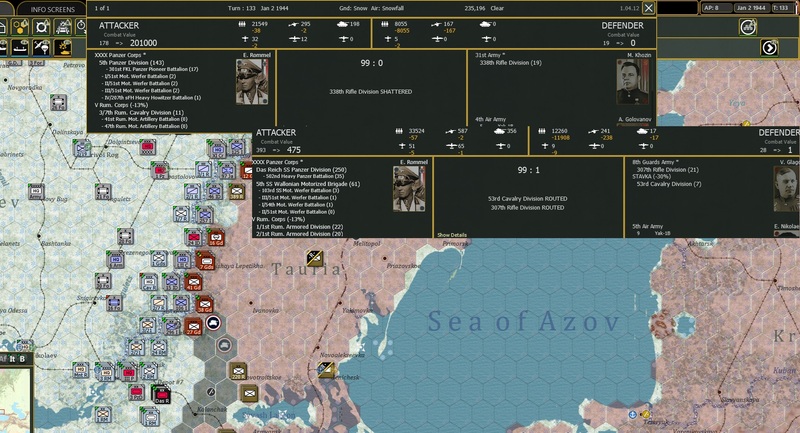
A few heavier blows were traded in the bend of the Dnepr. Bittrich's III SSPzK staged a moderately successful attack close to Zaporozhye while most of the heavy elements in the zone went for two Soviet stacks that had their back against the river or would have to withdraw in ZOCs. They were fairly successful and, from the detailed loss report, it seems that the retreat was very costly to the defenders because of this combination of major river and ZOCs. Meanwhile, ants pushed back the control of terrain as much as possible. Virtually all the German line had been committed in these actions, hence my prudence.
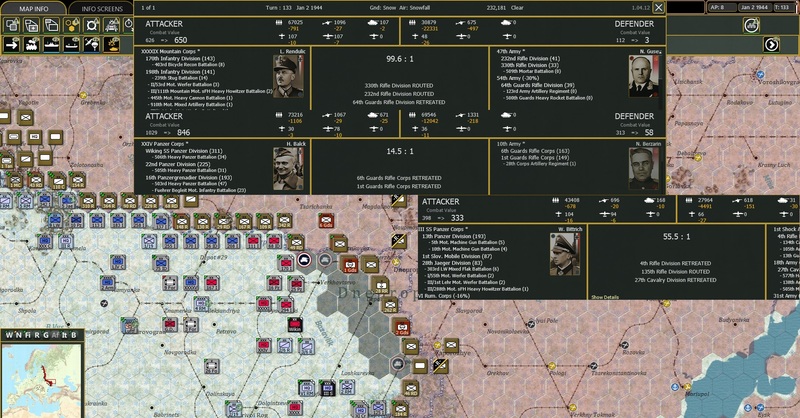
It should be noted that, on the Russian side, 6 Guards XXX had previously operated against 4 Army and Army Group Centre, whereas 1 Guards XXX was in the Melitopol area. Given how shallow my line was, I thought that it needed a bit of support. So 3SSPz moved 30 km north, under the Rumanians next to 3SSPzK, after refitting for about 3 weeks. GD was railed to Kivorograd and set itself to support either 2 Army in blue or 1 Pz Army. The value of a large river to offset a thin line is quite obvious here and I was lucky to have a mild winter, otherwise the line would have had to be withdrawn much faster than it did.
This was it then, I hope to provide a few points of conclusion during the week-end. One thing I can say is that this was a lot of fun, a very tense game that I thought I had lost early in 1942 after Q-Ball deftly organised his winter counter offensive. Although the Axis managed to control the pace of withdrawal in late 1942 / 1943, it was touch and go a couple of times. Once the dam bursts, losses mount and ground is surrendered very rapidly, hence my attempts at preventing such an occurrence.
2Pz is not visible here, I think it was the southernmost unit under the Rumanians, having rested for a couple of turns. I hoped to use it the following week because it was due to be withdrawn soon after. This would leave only a covering force to cause a few losses and slow down the Russian infantry which was plentiful in the area although the Guards corps looked entangled along the river. The initial line of defense was the mixture of swamps and river, and then the plan called for a short withdrawal on the line running from Kherson to Krivoi Rog. This may have been sufficient to hold until almost the end of winter and the raspoutitsa.

A few heavier blows were traded in the bend of the Dnepr. Bittrich's III SSPzK staged a moderately successful attack close to Zaporozhye while most of the heavy elements in the zone went for two Soviet stacks that had their back against the river or would have to withdraw in ZOCs. They were fairly successful and, from the detailed loss report, it seems that the retreat was very costly to the defenders because of this combination of major river and ZOCs. Meanwhile, ants pushed back the control of terrain as much as possible. Virtually all the German line had been committed in these actions, hence my prudence.
It should be noted that, on the Russian side, 6 Guards XXX had previously operated against 4 Army and Army Group Centre, whereas 1 Guards XXX was in the Melitopol area. Given how shallow my line was, I thought that it needed a bit of support. So 3SSPz moved 30 km north, under the Rumanians next to 3SSPzK, after refitting for about 3 weeks. GD was railed to Kivorograd and set itself to support either 2 Army in blue or 1 Pz Army. The value of a large river to offset a thin line is quite obvious here and I was lucky to have a mild winter, otherwise the line would have had to be withdrawn much faster than it did.

This was it then, I hope to provide a few points of conclusion during the week-end. One thing I can say is that this was a lot of fun, a very tense game that I thought I had lost early in 1942 after Q-Ball deftly organised his winter counter offensive. Although the Axis managed to control the pace of withdrawal in late 1942 / 1943, it was touch and go a couple of times. Once the dam bursts, losses mount and ground is surrendered very rapidly, hence my attempts at preventing such an occurrence.
-
Joel Billings

- Posts: 33766
- Joined: Wed Sep 20, 2000 8:00 am
- Location: Santa Rosa, CA
- Contact:
Re: Grand Campaign --- Q-Ball vs Sertorius21
Saves for both sides sent in a PM.M60A3TTS wrote: Tue Sep 15, 2026 2:37 pm I am waiting on Sertorious21 to give his permission for me to have access to the save so I can better discern what the Red Army looks like by the end of 1943.
All understanding comes after the fact.
-- Soren Kierkegaard
-- Soren Kierkegaard
-
Joel Billings
- Posts: 33766
- Joined: Wed Sep 20, 2000 8:00 am
- Location: Santa Rosa, CA
- Contact:
Re: Grand Campaign --- Q-Ball vs Sertorius21
BTW, what strikes me about the game is the very low German HWM. I realize this is a no early end game, but will remind everyone that we designed the victory conditions to pressure the Axis player to achieve at least minimal goals in 41/42 or they lose. You could argue that we should even have a higher HWM in 1942 to require the Germans to launch a 42 offensive. For those wanting to play no early end, you still may want to consider adding some Axis minimum HWM limits.
All understanding comes after the fact.
-- Soren Kierkegaard
-- Soren Kierkegaard
-
Sertorius21
- Posts: 136
- Joined: Mon Sep 16, 2024 3:40 pm
Re: Grand Campaign --- Q-Ball vs Sertorius21
Given the beating I took in the winter of 1941-42 and all the ground lost, I was never going to go very far. If I had reduced reserves that were not plentiful but still sat idle during the summer of 1942, I would have been able to take Stalino possibly, but would not have had enough to force my way to Rostov. Or maybe a way to gather more VPs would have been to take Sevastopol. Not an impossible task if I had shifted 3 infantry divisions from the centre and north and committed a couple more in Crimea. So my HWM would have been improved by 30 points possibly. Not a great outcome but starting from a banks of the Dnepr in 1942 doesn't get you to the Kuban.Joel Billings wrote: Thu Sep 17, 2026 4:37 pm BTW, what strikes me about the game is the very low German HWM. I realize this is a no early end game, but will remind everyone that we designed the victory conditions to pressure the Axis player to achieve at least minimal goals in 41/42 or they lose. You could argue that we should even have a higher HWM in 1942 to require the Germans to launch a 42 offensive. For those wanting to play no early end, you still may want to consider adding some Axis minimum HWM limits.
Re: Grand Campaign --- Q-Ball vs Sertorius21
First, thanks to Joel for arranging delivery of the saves.
Kudos to the two players; one of who emerged with the win and the other who endured a lot of beatings in a game that saw spates of activity and then a good amount of inactivity as well.
As Sertorious21 said, he didn’t go full aggression during the game. His VP total maxxed out with the capture of Orel and Kursk towards the end of November 1941 and that was that. Getting to the Donets around Kharkov in the Spring and Summer of 1942 was fine with him, As mentioned in this thread, cities like Leningrad, Voronezh, Rostov, even Sevastopol never changed hands. Architecting a solid Ostwall featuring reserves that inflicted extra strength pain at times was the dominating Axis strategy by 1943, one that even Q-Ball admitted he had no experience dealing with.
The forum thread here as well as the Q-Ball offshoot “Let us reform the Red Army of Workers and Peasants” gave some inkling of what was going on and these saves help fill in some of the gaps as to how this game flowed.
You can never talk about a game like this without mentioning numbers. The Red Army by the Spring of 1943 had grown on the map to a near 7.6 million monster. The cupboard was largely empty of Soviet manpower reserves by this stage. For the Axis forces, they had reached 5.2 million with likely a million of that being Axis allies and on top of that another 800k in their manpower pool. The German Army would have been around 600k greater than their historical counterpart which of course paid a heavy price for Case Blue.
Q-Ball had mentioned he was short guns at one point. It was rather hard to believe until one looks under the hood of this Red Army that was built. The historical Red Army ran about 55 Combined Arms Armies. Numbers varied as some armies disappeared from the Order of Battle. On top of that, they featured 5 shock and another 5 tank armies. But here, Q-Ball at least by games end featured a total of 64 Combined Arms Armies. A breakdown of the rifle and rifle-type forces alone revealed an end game strength on the map of
84 corps
236 divisions
21 airborne divisions
7 mountain divisions
25 Naval Infantry Brigades
12 rifle brigades
18 ski Brigades
Ignoring the ski brigades, that is about 540 rifle division equivalents that implies a lot of equipment slots. The manpower was largely there, due to so much Soviet territory not overrun, but this made it difficult even for the vast Soviet industrial apparatus from meeting the full needs of the Red Army.
Organizationally, this Red Army took something of a Swiss army knife approach when it came to combined arms armies. Some had tank, mech and cavalry corps mixed in with rifle corps and divisions, airborne divisions, cavalry divisions. It was a strange concept to me personally as I like to keep things a bit more streamlined, say with an army of 9 airborne divisions. Because of this assorted collection of unit types filled armies, their leaders quite often really struggled to give their best performance. Army commanders with mech strength 3 might find themselves with a pair of tank corps. There is something of a double penalty here as one slot taken with 4 command points might be used for a unit that better matched the performance of a given leader.
The artillery park similarly found itself scattered among the armies. A typical army might have quite the assortment; a heavy rocket unit, a light rocket unit, a mortar battalion, a gun regiment, and a couple army artillery regiments. If these variable combinations were meant to achieve something, it’s not entirely clear.
Concerning on-map artillery we had the following for the Soviets.
3 breakthough artillery divisions
3 artillery divisions
20 howitzer brigades
6 light artillery brigades
66 army artillery regiments
18 cannon regiments
16 howitzer regiments
1 mortar brigade
14 mortar regiments
32 mortar battalions
7 guards rocket launcher divisions
18 guards heavy rocket brigades
33 light rocket regiments
34 heavy rocket battalions
Armor on the map was 118 units. It totaled 27 corps, 16 regular brigades, 5 other brigade types, and 68 regiments. There were two battalions. Mech forces included 16 corps, half guards. Total AFVs among all these units was 10,733.
Here I’ve been kind of bouncing back and forth between the Summer of 43 to the end of 1944. What happened in between? Well, the advance of the Red Army started out by losing about 450k men in roughly 6 weeks. Axis end strength really didn’t change. This reflected the cost of a Red Army trying to break through multiple defensive belts. Thereafter the size of both forces ocellated somewhat but ended up not changing much from August to December. I don’t suggest that Q-Ball was just going through the motions at the end, but the manpower stabilization of on-map Red Army forces suggested a significant drop in casualties and associated fighting in the waning months of 1943. Kiev was just within reach of the Red Army by August 1943, but they just never got there. It’s hard to believe the Soviet side just ran out of steam for the better part of four months.
Only Q-Ball can say whether he got tired of the same story of losing thousands of men to a level 3 fort, only then for Rommel to show up with GrossDeutschland and his SS friends, adding insult to injury by routing a full strength Guards Rifle Corps. I sincerely doubt that any Soviet player would consider that either fun or challenging. But it is the reality of the Soviet player today against an experienced Axis player, even if Sertorious21 labeled himself as a limited experienced one.
There are a number of things I could add, but might be better suited for another thread. Wiedrock, 56ajax, and Sammy5IsAlive have all made some valid observations in this thread and the Reforming the Red Army one. We may not have enough examples of late GC games to go on, but given how long this game has been out, we likely won’t suddenly get a spate of new ones. It seems that in 1944 if battle lines are somewhat historical, generated manpower numbers are pretty equal between the two sides. The Axis doesn’t just run out of manpower, and it doesn’t send vast numbers of men to the west to await Overlord. It requires the Soviet player to inflict large casualties on his opponent. Q-Ball as much as admitted that himself. Yet in this game not a single week went by since the First Blizzard where Axis manpower losses exceeded the Soviets. If you don’t have a thought as how to flip that script, looking for an “experienced Axis player” in the forums may not be among your best life choices.
Kudos to the two players; one of who emerged with the win and the other who endured a lot of beatings in a game that saw spates of activity and then a good amount of inactivity as well.
As Sertorious21 said, he didn’t go full aggression during the game. His VP total maxxed out with the capture of Orel and Kursk towards the end of November 1941 and that was that. Getting to the Donets around Kharkov in the Spring and Summer of 1942 was fine with him, As mentioned in this thread, cities like Leningrad, Voronezh, Rostov, even Sevastopol never changed hands. Architecting a solid Ostwall featuring reserves that inflicted extra strength pain at times was the dominating Axis strategy by 1943, one that even Q-Ball admitted he had no experience dealing with.
The forum thread here as well as the Q-Ball offshoot “Let us reform the Red Army of Workers and Peasants” gave some inkling of what was going on and these saves help fill in some of the gaps as to how this game flowed.
You can never talk about a game like this without mentioning numbers. The Red Army by the Spring of 1943 had grown on the map to a near 7.6 million monster. The cupboard was largely empty of Soviet manpower reserves by this stage. For the Axis forces, they had reached 5.2 million with likely a million of that being Axis allies and on top of that another 800k in their manpower pool. The German Army would have been around 600k greater than their historical counterpart which of course paid a heavy price for Case Blue.
Q-Ball had mentioned he was short guns at one point. It was rather hard to believe until one looks under the hood of this Red Army that was built. The historical Red Army ran about 55 Combined Arms Armies. Numbers varied as some armies disappeared from the Order of Battle. On top of that, they featured 5 shock and another 5 tank armies. But here, Q-Ball at least by games end featured a total of 64 Combined Arms Armies. A breakdown of the rifle and rifle-type forces alone revealed an end game strength on the map of
84 corps
236 divisions
21 airborne divisions
7 mountain divisions
25 Naval Infantry Brigades
12 rifle brigades
18 ski Brigades
Ignoring the ski brigades, that is about 540 rifle division equivalents that implies a lot of equipment slots. The manpower was largely there, due to so much Soviet territory not overrun, but this made it difficult even for the vast Soviet industrial apparatus from meeting the full needs of the Red Army.
Organizationally, this Red Army took something of a Swiss army knife approach when it came to combined arms armies. Some had tank, mech and cavalry corps mixed in with rifle corps and divisions, airborne divisions, cavalry divisions. It was a strange concept to me personally as I like to keep things a bit more streamlined, say with an army of 9 airborne divisions. Because of this assorted collection of unit types filled armies, their leaders quite often really struggled to give their best performance. Army commanders with mech strength 3 might find themselves with a pair of tank corps. There is something of a double penalty here as one slot taken with 4 command points might be used for a unit that better matched the performance of a given leader.
The artillery park similarly found itself scattered among the armies. A typical army might have quite the assortment; a heavy rocket unit, a light rocket unit, a mortar battalion, a gun regiment, and a couple army artillery regiments. If these variable combinations were meant to achieve something, it’s not entirely clear.
Concerning on-map artillery we had the following for the Soviets.
3 breakthough artillery divisions
3 artillery divisions
20 howitzer brigades
6 light artillery brigades
66 army artillery regiments
18 cannon regiments
16 howitzer regiments
1 mortar brigade
14 mortar regiments
32 mortar battalions
7 guards rocket launcher divisions
18 guards heavy rocket brigades
33 light rocket regiments
34 heavy rocket battalions
Armor on the map was 118 units. It totaled 27 corps, 16 regular brigades, 5 other brigade types, and 68 regiments. There were two battalions. Mech forces included 16 corps, half guards. Total AFVs among all these units was 10,733.
Here I’ve been kind of bouncing back and forth between the Summer of 43 to the end of 1944. What happened in between? Well, the advance of the Red Army started out by losing about 450k men in roughly 6 weeks. Axis end strength really didn’t change. This reflected the cost of a Red Army trying to break through multiple defensive belts. Thereafter the size of both forces ocellated somewhat but ended up not changing much from August to December. I don’t suggest that Q-Ball was just going through the motions at the end, but the manpower stabilization of on-map Red Army forces suggested a significant drop in casualties and associated fighting in the waning months of 1943. Kiev was just within reach of the Red Army by August 1943, but they just never got there. It’s hard to believe the Soviet side just ran out of steam for the better part of four months.
Only Q-Ball can say whether he got tired of the same story of losing thousands of men to a level 3 fort, only then for Rommel to show up with GrossDeutschland and his SS friends, adding insult to injury by routing a full strength Guards Rifle Corps. I sincerely doubt that any Soviet player would consider that either fun or challenging. But it is the reality of the Soviet player today against an experienced Axis player, even if Sertorious21 labeled himself as a limited experienced one.
There are a number of things I could add, but might be better suited for another thread. Wiedrock, 56ajax, and Sammy5IsAlive have all made some valid observations in this thread and the Reforming the Red Army one. We may not have enough examples of late GC games to go on, but given how long this game has been out, we likely won’t suddenly get a spate of new ones. It seems that in 1944 if battle lines are somewhat historical, generated manpower numbers are pretty equal between the two sides. The Axis doesn’t just run out of manpower, and it doesn’t send vast numbers of men to the west to await Overlord. It requires the Soviet player to inflict large casualties on his opponent. Q-Ball as much as admitted that himself. Yet in this game not a single week went by since the First Blizzard where Axis manpower losses exceeded the Soviets. If you don’t have a thought as how to flip that script, looking for an “experienced Axis player” in the forums may not be among your best life choices.
Re: Grand Campaign --- Q-Ball vs Sertorius21
What MOR do...M60A3TTS wrote: Sat Sep 19, 2026 6:07 pm Only Q-Ball can say whether he got tired of the same story of losing thousands of men to a level 3 fort, only then for Rommel to show up with GrossDeutschland and his SS friends, adding insult to injury by routing a full strength Guards Rifle Corps.
1. the units defending in the lvl 3 Fort have?
2. the MOT/Reserve units have?
...or better....how much MOR are they above their individual NM level for the period?
Since...there is one funny rule, which I don't know which game it originated from.
Besides this there are some more ways to lose MOR but they are largely irrelevant for the German situation in 43/44.Each turn there is a chance that a unit’s morale will be lowered by 1 or 2 points if its morale exceeds its national morale by 30 points or more.
“Amateurs study tactics; professionals study logistics.”
My Mods:
GE Gui & Sym Mod Depot (continued)
Rasputitsa for your eyes. Soviet colours redone.
My Tools:
Turn-Dates-Converter
Command Efficiency with Command Range Modifier
Planning map 1.02.45_Beta
My Mods:
GE Gui & Sym Mod Depot (continued)
Rasputitsa for your eyes. Soviet colours redone.
My Tools:
Turn-Dates-Converter
Command Efficiency with Command Range Modifier
Planning map 1.02.45_Beta
-
Sertorius21
- Posts: 136
- Joined: Mon Sep 16, 2024 3:40 pm
Re: Grand Campaign --- Q-Ball vs Sertorius21
I would say
German infantry:
- About 25 divisions between 65 and 69
- Maybe 15-20 at or above 75 of which 5-6 above 80
- All the rest in the low 70s
LW field divisions mostly between 55 and 60 with a couple at or very near 70
Standard PzGr divisions about 80, possibly marginally more on average.
Standard PzD averaging about 82-83 (from 78 for 10 and 12Pz to 89 for 1Pz if my memory is correct)
GD and the four SS Pz: 90 or 91
Hungarians at about 55 except mountain, cavalry and armour at or above 70
Rumanians around 50 except mountain and cavalry around 70 and armour at 75 or so
German infantry:
- About 25 divisions between 65 and 69
- Maybe 15-20 at or above 75 of which 5-6 above 80
- All the rest in the low 70s
LW field divisions mostly between 55 and 60 with a couple at or very near 70
Standard PzGr divisions about 80, possibly marginally more on average.
Standard PzD averaging about 82-83 (from 78 for 10 and 12Pz to 89 for 1Pz if my memory is correct)
GD and the four SS Pz: 90 or 91
Hungarians at about 55 except mountain, cavalry and armour at or above 70
Rumanians around 50 except mountain and cavalry around 70 and armour at 75 or so
-
Sertorius21
- Posts: 136
- Joined: Mon Sep 16, 2024 3:40 pm
Re: Grand Campaign --- Q-Ball vs Sertorius21
From the moment that it was clear that the campaign had been a failure and after recovering a bit during the early 1942 mud turns, I thought that I may be able to capture Kharkov and Stalino. In hindsight, lowering my security level in the centre and north should have yielded Stalino. I am not sure that Sevastopol was doable in June / early July without weakening the drive for Kharkov by removing a further two divisions. But then maybe I am wrong on one count, which is that I would have needed 6 German divisions to storm the fortress in two attacks with a week of rest in-between. The indications I had were of a defense strength of 450.M60A3TTS wrote: Sat Sep 19, 2026 6:07 pm As Sertorious21 said, he didn’t go full aggression during the game. His VP total maxxed out with the capture of Orel and Kursk towards the end of November 1941 and that was that. Getting to the Donets around Kharkov in the Spring and Summer of 1942 was fine with him, As mentioned in this thread, cities like Leningrad, Voronezh, Rostov, even Sevastopol never changed hands. Architecting a solid Ostwall featuring reserves that inflicted extra strength pain at times was the dominating Axis strategy by 1943, one that even Q-Ball admitted he had no experience dealing with.
Once it is clear that any further German offensives will bring attrition on the wrong side of the balance, the question is more the ability of the Russians to find a way. Ideally of course, a weak spot is ideal and Q-Ball did find one in the winter of 1942, but after that it looked as if the choice was between:
- trying to jump a major river or a strong segment (near Leningrad). Usually there was next to nothing behind. Can this be achieved?
- going for the easy attack route which definitely works at the cost of heavy counter attacks. If there are not two but three or four waves of decently strong Guards / Cav / Mech corps, there can be a point where the local Pz reserves are exhausted. Once a front collapses locally, it takes a lot of energy and resource to recreate a decent line. This is obviously contingent on the Russians being able to line up such forces and the supply reserves to sustain a massive effort.
Any better option?