A Competitive GW (Solo) Scenario by the Numbers.
Moderator: Shannon V. OKeets
Re: A Competitive GW (Solo) Scenario by the Numbers.
Turn 22. Mar/Apr 1943. Allied #1. Allied Command.
Weather & Actions Matrix. Current Allied CP Lines & Production. U-boat/Sub Threats
Ronnie
Re: A Competitive GW (Solo) Scenario by the Numbers.
Turn 22. Mar/Apr 1943. Allied #1. Allied Command.
Actions (Revision).
(1) Action revision for the CW who will take a combine & not a land.
(2) This revision comes after the Western Allies spot a 50/50 high risk/high gain opportunity to really shake things up against Germany.
(3) If successful, will be (should eventually be) a major blow against Germany.
(4) If it fails, then while painful (11 BPs, 1 mar corps, 2 mar divs lost) won't/shouldn't change the strategic situation vs Germany vs not trying this mission.
(5) Will the planned mission be this counterfactual's Dieppe?
(6) Or will it be possibly the end of the beginning for Germany & a major assist to the Soviets fighting on the Eastern Front?
Actions (Revision).
(1) Action revision for the CW who will take a combine & not a land.
(2) This revision comes after the Western Allies spot a 50/50 high risk/high gain opportunity to really shake things up against Germany.
(3) If successful, will be (should eventually be) a major blow against Germany.
(4) If it fails, then while painful (11 BPs, 1 mar corps, 2 mar divs lost) won't/shouldn't change the strategic situation vs Germany vs not trying this mission.
(5) Will the planned mission be this counterfactual's Dieppe?
(6) Or will it be possibly the end of the beginning for Germany & a major assist to the Soviets fighting on the Eastern Front?
Ronnie
Re: A Competitive GW (Solo) Scenario by the Numbers.
u]Turn 22. Mar/Apr 1943. Allied #1. Eastern Front.[/u]
Baltic Sea.
(1) USSR use their 1 NM to move 2 BBs from Leningrad to Baltic Sea[3] hoping to find & sink/abort 4 unescorted German CPs.
(2) Soviet BB miss finding & once again unescorted/under protected German convoys in the Baltic escape detection.
Baltic Sea.
(1) USSR use their 1 NM to move 2 BBs from Leningrad to Baltic Sea[3] hoping to find & sink/abort 4 unescorted German CPs.
(2) Soviet BB miss finding & once again unescorted/under protected German convoys in the Baltic escape detection.
Ronnie
Re: A Competitive GW (Solo) Scenario by the Numbers.
u]Turn 22. Mar/Apr 1943. Allied #1. Asian/Pacific Theater.[/u]
USN Strategic Bombing Raids.
Ronnie
Re: A Competitive GW (Solo) Scenario by the Numbers.
u]Turn 22. Mar/Apr 1943. Allied #1. Asian/Pacific Theater.[/u]
Ground Strikes.
Ground Strikes.
Ronnie
Re: A Competitive GW (Solo) Scenario by the Numbers.
Turn 22. Mar/Apr 1943. Allied #1. Western Front.
Amphibious Invasion. Kiel, Germany.
(1) Germany has left northern Germany ungarrisoned.
(2) The Western Allies Joint Chiefs approve of a high risk/high reward amphibious invasion to seize the undefended port city of Kiel, Germany.
(3) If successful, this invasion would immediately open a path to the heart of Germany, take significant pressure off the Soviets on the Eastern Front and significantly shorten the war.
(4) The risk is the total loss of the invasion force (UK mar corps, div & US mot corps = 12 BPs); but more significantly, revealing this vulnerability to the Germans who could immediately address it.
(5) A major impediment is the lack of offensive shore bombardment support due to three primary issues:
(a) surprise invasion required CW to take a combine, use both naval moves to position troops in the [4] box for the invasion & leaving no naval moves from moving BBs for shore bombardment
(b) even with move(s) available, RN BBs would only be able to reach North Sea[2] which would reduce each BB's shore bombardment factors by 2,
(c) most USN BBs in the Pacific & not available.
(6) RN NM 1/2. TRS w/Royal Mar. Liverpool ->Hull (French Amph Gp. Southampton -> North Sea[4], embarks Royal Mar for invasion).
(7) RN NM 2/2. 2 RN CAs to North Sea[4], embarks UK & USN CBs Eng mar divs.
Amphibious Invasion. Kiel, Germany.
(1) Germany has left northern Germany ungarrisoned.
(2) The Western Allies Joint Chiefs approve of a high risk/high reward amphibious invasion to seize the undefended port city of Kiel, Germany.
(3) If successful, this invasion would immediately open a path to the heart of Germany, take significant pressure off the Soviets on the Eastern Front and significantly shorten the war.
(4) The risk is the total loss of the invasion force (UK mar corps, div & US mot corps = 12 BPs); but more significantly, revealing this vulnerability to the Germans who could immediately address it.
(5) A major impediment is the lack of offensive shore bombardment support due to three primary issues:
(a) surprise invasion required CW to take a combine, use both naval moves to position troops in the [4] box for the invasion & leaving no naval moves from moving BBs for shore bombardment
(b) even with move(s) available, RN BBs would only be able to reach North Sea[2] which would reduce each BB's shore bombardment factors by 2,
(c) most USN BBs in the Pacific & not available.
(6) RN NM 1/2. TRS w/Royal Mar. Liverpool ->Hull (French Amph Gp. Southampton -> North Sea[4], embarks Royal Mar for invasion).
(7) RN NM 2/2. 2 RN CAs to North Sea[4], embarks UK & USN CBs Eng mar divs.
Ronnie
Re: A Competitive GW (Solo) Scenario by the Numbers.
Turn 22. Mar/Apr 1943. Allied #1. Western Front.
Kiel, Germany. Ground Support.
(1) A max effort ground support effort by both sides plays out as shown below.
Kiel, Germany. Ground Support.
(1) A max effort ground support effort by both sides plays out as shown below.
Ronnie
Re: A Competitive GW (Solo) Scenario by the Numbers.
Turn 22. Mar/Apr 1943. Allied #1. Western Front.
Kiel, Germany. Land Combat (Amphibious Landing) Resolution.
(1) Best laid plans of mice and men ...
(2) While the 12 BP loss stings; the worse pain is tipping Germany off to the Kiel/northern Germany vulnerability.
(3) A vulnerability that Germany will most surely address next impulse, which if they don't will give the Western Allies another shot at all this.
Kiel, Germany. Land Combat (Amphibious Landing) Resolution.
(1) Best laid plans of mice and men ...
(2) While the 12 BP loss stings; the worse pain is tipping Germany off to the Kiel/northern Germany vulnerability.
(3) A vulnerability that Germany will most surely address next impulse, which if they don't will give the Western Allies another shot at all this.
Ronnie
Re: A Competitive GW (Solo) Scenario by the Numbers.
Turn 22. Mar/Apr 1943. Allied #1. Western Front.
(1) In addition to support the failed allied invasion of Kiel, the US used their super combine to:
(a) transport 2 corps (A/B, inf) from US and debark into the UK,
(b) reorg 2 UK bombers wings both of which, in addition to a 3rd that wasn't flown, are within normal range of Kiel & southern Denmark,
(c) rebase 2 US ATR within air lift range of 3 US army A/B corps and normal range of Kiel & southern Denmark,
(d) rebase 2 Lightening FTR-3 within normal range of Kiel & southern Denmark.
(2) The US & UK, even after their failed invasion of Kiel, have in place credible invasion assets for another go at Kiel or a go at southern Denmark.
(3) Weather permitting, which is 30% fine + 20% rain or 50% next allied impulse.
(4) Given that German is NOW alerted to the Kiel, northern German, southern Denmark invasion vulnerability, Germany ignores the Western Allied "reconstituted" threat at their own peril.
Reorg. Kiel/southern Denmark Invasion, Ground Support & Escort Assets. Weather Forecast. Map.
(1) In addition to support the failed allied invasion of Kiel, the US used their super combine to:
(a) transport 2 corps (A/B, inf) from US and debark into the UK,
(b) reorg 2 UK bombers wings both of which, in addition to a 3rd that wasn't flown, are within normal range of Kiel & southern Denmark,
(c) rebase 2 US ATR within air lift range of 3 US army A/B corps and normal range of Kiel & southern Denmark,
(d) rebase 2 Lightening FTR-3 within normal range of Kiel & southern Denmark.
(2) The US & UK, even after their failed invasion of Kiel, have in place credible invasion assets for another go at Kiel or a go at southern Denmark.
(3) Weather permitting, which is 30% fine + 20% rain or 50% next allied impulse.
(4) Given that German is NOW alerted to the Kiel, northern German, southern Denmark invasion vulnerability, Germany ignores the Western Allied "reconstituted" threat at their own peril.
Reorg. Kiel/southern Denmark Invasion, Ground Support & Escort Assets. Weather Forecast. Map.
Ronnie
Re: A Competitive GW (Solo) Scenario by the Numbers.
Turn 22. Mar/Apr 1943. Allied #1. Western Front.
USAAF Fighter Rebase (Arctic Route).
(1) The US also used their super combine for two fighter wings to move their first leg of the artic rebase from the US to the UK.
USAAF Fighter Rebase (Arctic Route).
(1) The US also used their super combine for two fighter wings to move their first leg of the artic rebase from the US to the UK.
Ronnie
Re: A Competitive GW (Solo) Scenario by the Numbers.
Turn 22. Mar/Apr 1943. Allied #1. Atlantic Theater.
(1) The US did with they could with air & sea (i.e., ships) assets not required for the Kiel amphibious invasion to protect allied convoys in the Atlantic.
(2) No RN air & naval assets to this mission was available this impulse due to their need for the Kiel amphibious invasion (i.e., CW took a combine & both naval moves were dedicated to the amph invasion).
(3) Allied convoys in the Atlantic are more vulnerable than the Western Allies would like; however, the Western Allies have it on VERY good intelligence that Germany will take a land action to address their invasion vulnerability.
(4) This leaves the threat of Italian subs, which the Western Allies hope they have adequate escorts & patrols to deal with until next impulse when the RN could (might) take a naval to get their ships out.
(5) However; the situation in the Pacific may limit the CW to another combine next impulse with one & maybe both naval moves going to the Pacific.
(6) So allied convoy susceptibility/vulnerability to the German U-boat & Italian sub threat may persist next impulse pair.
(1) The US did with they could with air & sea (i.e., ships) assets not required for the Kiel amphibious invasion to protect allied convoys in the Atlantic.
(2) No RN air & naval assets to this mission was available this impulse due to their need for the Kiel amphibious invasion (i.e., CW took a combine & both naval moves were dedicated to the amph invasion).
(3) Allied convoys in the Atlantic are more vulnerable than the Western Allies would like; however, the Western Allies have it on VERY good intelligence that Germany will take a land action to address their invasion vulnerability.
(4) This leaves the threat of Italian subs, which the Western Allies hope they have adequate escorts & patrols to deal with until next impulse when the RN could (might) take a naval to get their ships out.
(5) However; the situation in the Pacific may limit the CW to another combine next impulse with one & maybe both naval moves going to the Pacific.
(6) So allied convoy susceptibility/vulnerability to the German U-boat & Italian sub threat may persist next impulse pair.
Ronnie
Re: A Competitive GW (Solo) Scenario by the Numbers.
Turn 22. Mar/Apr 1943. Allied #1. Pacific Theater.
USN naval moves in the Pacific made in priority of:
(1) Increasing allied ground forces in China (more on that in next post),
(2) China Sea & South China Sea blockade & allied ground forces support task forces,
(3) Getting Formosa RP to US factory,
(4) Adequate ASW escort & patrols vs lone IJN I-boat flotilla.
Pre Naval Move. Naval Move.
(5) US CP. San Diego ->West Coast, US CP. San Diego -> Mendicino.
(6) US routes Formosa RP to Long Beach, saving US 1 additional oil.
(7) Both 1 LL BP deficiency from US to France & idle UK factory (Hull) still unaddressed. Pacific CP, Risk, Patrol & Escort Matrix. Pacific Ships, Boats & Air Matrix.
USN naval moves in the Pacific made in priority of:
(1) Increasing allied ground forces in China (more on that in next post),
(2) China Sea & South China Sea blockade & allied ground forces support task forces,
(3) Getting Formosa RP to US factory,
(4) Adequate ASW escort & patrols vs lone IJN I-boat flotilla.
Pre Naval Move. Naval Move.
(5) US CP. San Diego ->West Coast, US CP. San Diego -> Mendicino.
(6) US routes Formosa RP to Long Beach, saving US 1 additional oil.
(7) Both 1 LL BP deficiency from US to France & idle UK factory (Hull) still unaddressed. Pacific CP, Risk, Patrol & Escort Matrix. Pacific Ships, Boats & Air Matrix.
Ronnie
Re: A Competitive GW (Solo) Scenario by the Numbers.
Turn 22. Mar/Apr 1943. Allied #1. Asian/Pacific Theater.
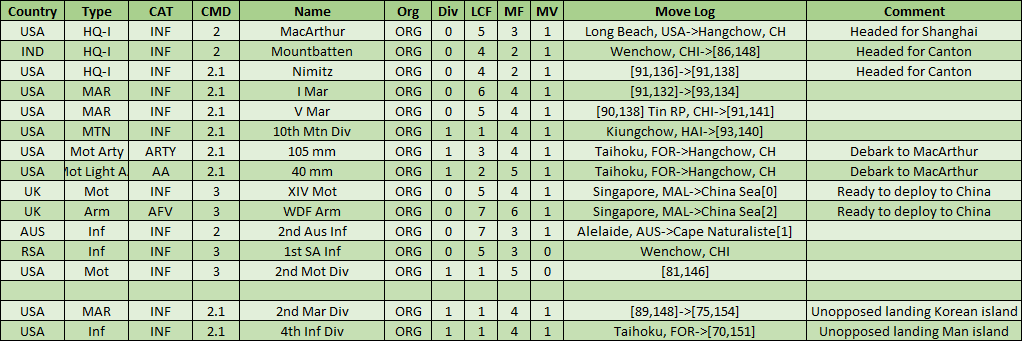
(1) Very most high sea lift priority given to getting General MacArthur & his command from US West Coast (Long Beach) to China.
(2) And that was achieved with two transport legs, first from Long Beach to Hawaii and the second from Hawaii to China Sea.
(3) The General & his HQ then debarked from the China Sea to Hangchow, with priority mission to liberate Shanghai as soon as practical.
(4) Nimitz & Mountbatten are given the joint mission to liberate Canton as soon as practical.
(5) UK armor & mot corps are at sea and ready to debark.
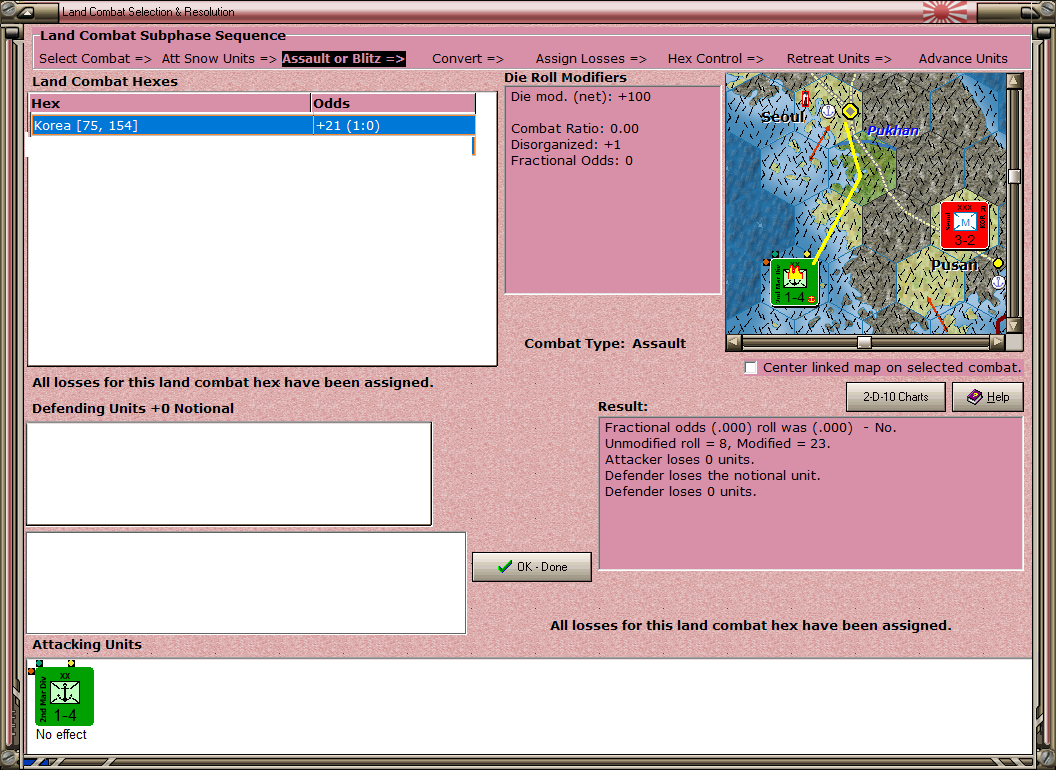
(6) Three USN ground strikes vs IJA targets in China & Korea all failed.
(7) The one in Korea against the KOR Terr would have almost ensured that the US would capture Seoul and conquer/liberate Korea.
(8) Now, however it's a race between the USMC 2nd div and the Korea Terr, which weather playing a big part.
(9) The USMC 2nd div landed unopposed on an outer Korea island west of the Korean pensulina.
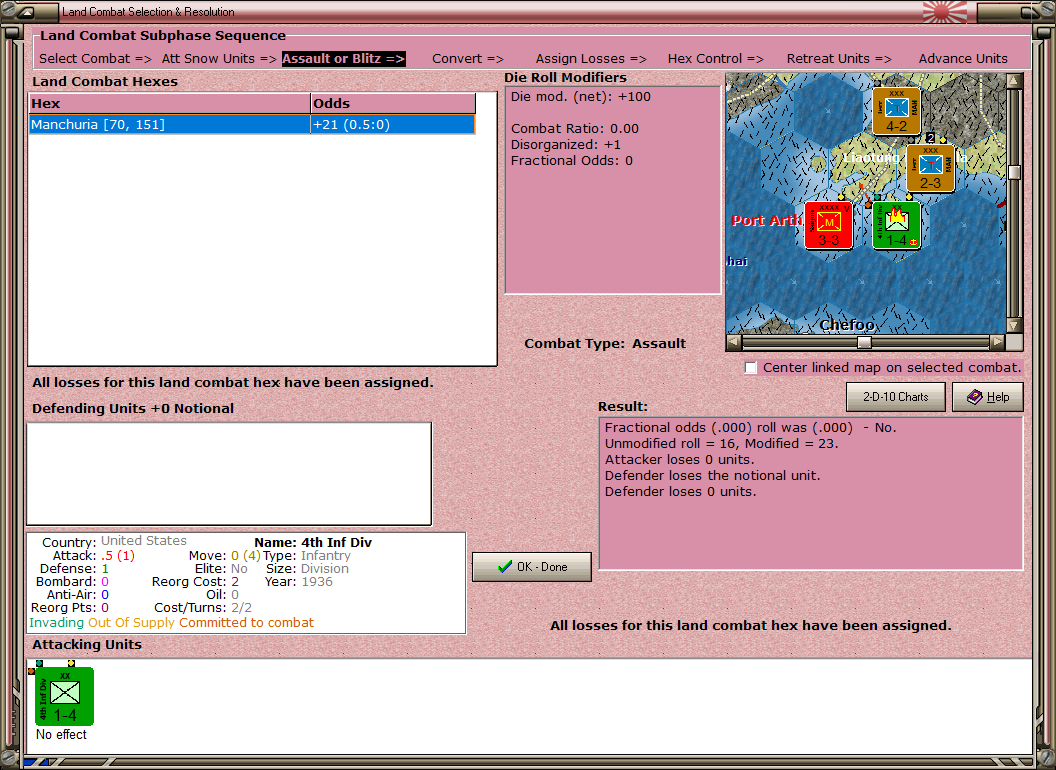
(10) US Army 4th inf div secured the Manchurian island east of Port Arthur, also in an unopposed landing.
(11) However; only marines will be able to attack Port Arthur from that island.
(12) The 4th, if it participate, will have to from direct amphibious landing on Port Arthur; but that's one or most likely several turns away.
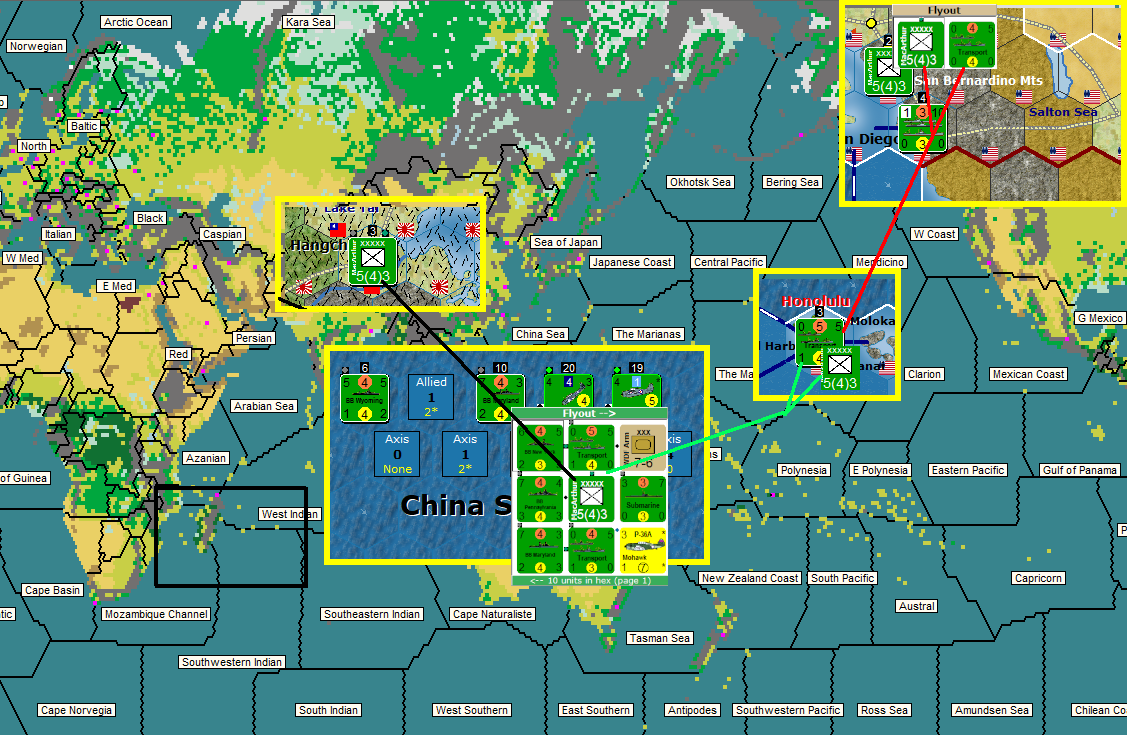
(1) Very most high sea lift priority given to getting General MacArthur & his command from US West Coast (Long Beach) to China.
(2) And that was achieved with two transport legs, first from Long Beach to Hawaii and the second from Hawaii to China Sea.
(3) The General & his HQ then debarked from the China Sea to Hangchow, with priority mission to liberate Shanghai as soon as practical.
(4) Nimitz & Mountbatten are given the joint mission to liberate Canton as soon as practical.
(5) UK armor & mot corps are at sea and ready to debark.
(6) Three USN ground strikes vs IJA targets in China & Korea all failed.
(7) The one in Korea against the KOR Terr would have almost ensured that the US would capture Seoul and conquer/liberate Korea.
(8) Now, however it's a race between the USMC 2nd div and the Korea Terr, which weather playing a big part.
(9) The USMC 2nd div landed unopposed on an outer Korea island west of the Korean pensulina.
(10) US Army 4th inf div secured the Manchurian island east of Port Arthur, also in an unopposed landing.
(11) However; only marines will be able to attack Port Arthur from that island.
(12) The 4th, if it participate, will have to from direct amphibious landing on Port Arthur; but that's one or most likely several turns away.
Ronnie
Re: A Competitive GW (Solo) Scenario by the Numbers.
Turn 22. Mar/Apr 1943. Allied #1. Pacific Theater.
Ronnie
Re: A Competitive GW (Solo) Scenario by the Numbers.
Turn 22. Mar/Apr 1943. Axis #3. Axis Command.
Actions. Impulse #149.
(1) Germany - land.
(2) Italy - land.
(3) Japan - combine.
Actions. Impulse #149.
(1) Germany - land.
(2) Italy - land.
(3) Japan - combine.
Ronnie
Re: A Competitive GW (Solo) Scenario by the Numbers.
Turn 22. Mar/Apr 1943. Axis #3. Pacific Theater.
Bay of Bengal.
Bay of Bengal.
Ronnie
Re: A Competitive GW (Solo) Scenario by the Numbers.
Turn 22. Mar/Apr 1943. Axis #3. Pacific Theater.
China Sea (1/4).
China Sea (1/4).
Ronnie
Re: A Competitive GW (Solo) Scenario by the Numbers.
Turn 22. Mar/Apr 1943. Axis #3. Pacific Theater.
China Sea (2/4).
China Sea (2/4).
Ronnie
Re: A Competitive GW (Solo) Scenario by the Numbers.
Turn 22. Mar/Apr 1943. Axis #3. Pacific Theater.
China Sea (3/4).
China Sea (3/4).
Ronnie
Re: A Competitive GW (Solo) Scenario by the Numbers.
Turn 22. Mar/Apr 1943. Axis #3. Pacific Theater.
China Sea (4/4).
China Sea (4/4).
Ronnie