AFTER ACTION REPORT (AAR)
Command: Modern Operations — Kashmir Fire: Border Skirmish (Scenario 1)
"Outsmarting the Beast: Cold Blood and Baburs on the Deck"
Side: Pakistan Air Force (PAF) & Strategic Missile Forces
Theater Date: October 19, 2024, 05:00 Local / Dark Night
Final Score: 55 POINTS (Triumph) | Friendly Aircraft Losses: ZERO | Civilian Casualties: ZERO
1. The Scenario and the "Psychological Trap"
The opening scenario of the Kashmir Fire campaign presents a brutal tactical dilemma. High Command tasks us with neutralizing three Indian Forward Operating Bases (FOBs) —FOB Serpent, FOB Hydra, and FOB Harpy— alongside halting several armored spearheads that have crossed the international border.
At first glance, any player's immediate instinct is to climb strike fighters to 25,000 feet with Laser-Guided Bombs (LGBs). However, the scenario designer deliberately placed a dense cloud deck between 7,000 ft and 16,000 ft. If you fly high, laser designators cannot penetrate the overcast; if you descend below 7,000 ft to designate, you fly straight into the lethal engagement envelope of SA-24 Igla-S infrared MANPADS and, far worse, under the deadly umbrella of the SPYDER-MR air defense system in Jammu.
The SPYDER is a terrifying system with which I ran several prior tests in isolated scenarios to see if there was an effective way to destroy it using the assets provided in the scenario. I had a 100% casualty rate across all attempts, which very clearly defined my operational strategy for this mission: do not engage head-on.
2. Operational Decision: Outsmarting the SPYDER Instead of Committing Suicide
The Indian SPYDER-MR system in Jammu features an EL/M-2084 3D AESA radar paired with active radar-homing Derby missiles (20 nm range) and high-off-boresight, 50G-capable Python-5 imaging infrared missiles. Without dedicated long-range Anti-Radiation Missiles (like HARM or MAR-1) in our inventory, seeking a head-on "fighter vs. SAM" duel was an unacceptable doctrinal blunder.
In modern air warfare, victory does not consist of destroying enemy systems that are irrelevant to the core mission at the cost of losing pilots and jets (-10 pts per aircraft); it consists of achieving strategic objectives right in their face without taking a single scratch on your paint. Our ultimate weapon was the Hatf-7 Babur land-attack cruise missile from the strategic battery at PAF Murid: subsonic, terrain-following at 295 ft AGL (89 meters) at 500 knots, completely immune to cloud cover and cruising well below the radar horizon.


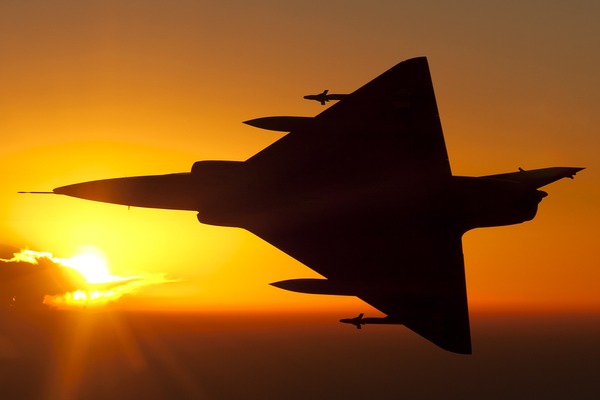
Hatf-7 Babur TEL cruise missile launcher | Tactical Burraq/Shahpar UAV Platform | PAF Mirage 5 ROSE strike fighter
3. Phase I: Lightning Strikes in Lahore and FOB Serpent
The Z-10 attack helicopters stationed at PAF Murid lacked the combat radius required to operate effectively in the Lahore sector without a Forward Arming and Refueling Point (FARP). Consequently, the tank-hunting tasking fell squarely on two Burraq tactical MALE UAVs. Cruising at 4,500 ft AGL (just underneath the cloud base) and utilizing their FLIR payloads, they immediately acquired the distinct thermal signatures of Indian armor. Eight Barq ATGMs were launched: eight direct hits, pulverizing 3x Arjun Mk.1 MBTs and 3x BMP-2 Sarath IFVs with zero enemy return fire.


Primary Ground Threat: Indian Army Arjun Mk.1 MBT (left) and BMP-2 Sarath IFV (right) neutralized in the opening hour.
Immediately following, two Hatf-7 Babur cruise missiles flying on the deck slammed directly into FOB Serpent, reducing it to burning rubble. Simultaneously, another pair of Baburs penetrated toward Adampur Air Force Station at 295 ft AGL. The objective was to attrit the MiG-29 fighter base to see if we got lucky and caught aircraft parked on the ramps; in the end, we took out a couple of large revetments/hangars, completely bypassing the Pechora batteries (which notoriously struggle with ground-skimming targets) and Akash SAMs, leaving the main runway with light damage—enough to keep Indian combat engineers busy filling craters, though without rendering the MiG-29s permanently grounded.

Figure 1: Babur cruise missile skimming the terrain at 295 ft AGL en route to Adampur AFS, beneath the Pechora radar beam.
4. Phase II: The "Ravi Gorge" and the Collapse of FOB Hydra
Our initial direct approach toward FOB Hydra revealed that flying straight over the open plains allowed Indian tank crews on the ground to issue visual radio warnings to local air defenses. We completely overhauled the ingress routing: plotting a tactical flight plan that swung north to avoid the armored formations in Shakargarh, entered the winding canyon of the Ravi River alongside the Ranjit Sagar reservoir, and snaked southward tightly masked by the Himalayan foothills.
The mountainous terrain completely masked the missile signatures from Pathankot's Pechora radar (which we already knew was its critical blind spot). The Baburs burst out of the river mouth at 500 knots and 293 ft AGL, slamming into the unprotected rear quadrant of FOB Hydra with pinpoint devastation.
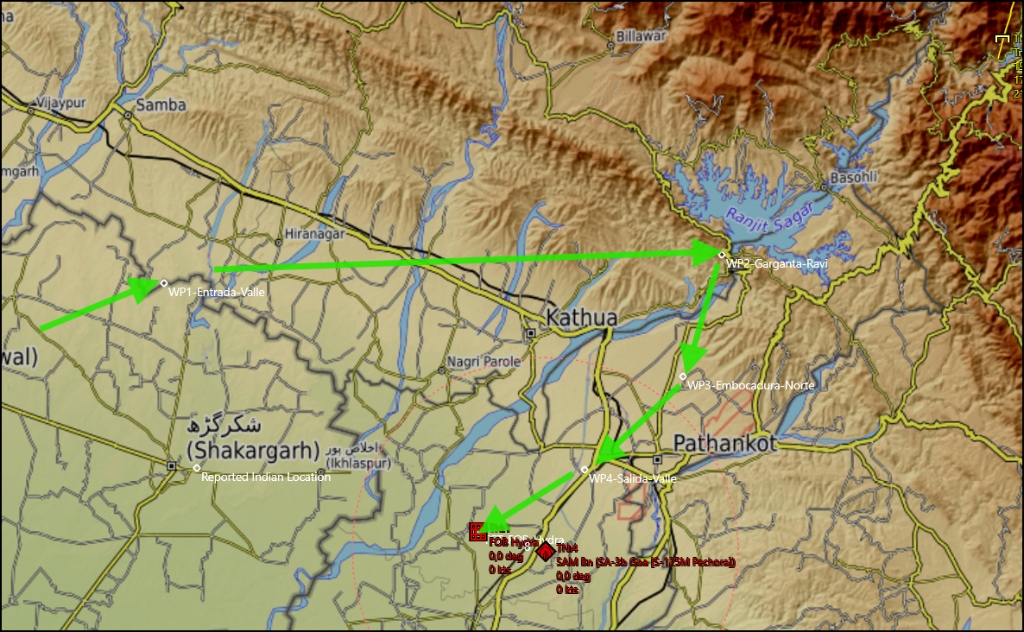

Figure 2 & 3: Left: Tactical ingress flight plan snaking through the Ravi River canyon. Right: 3D Tacview view of Babur #1195 skimming treetops at 293.9 ft AGL on terminal run.
5. Phase III: The Western Corridor Incursion Against FOB Harpy
FOB Harpy was the hardest nut to crack due to the direct presence of the SPYDER-MR battery. Flying high was completely out of the question—the clouds are a trap in this scenario.

The Beast to Avoid: Indian Air Force SPYDER-MR mobile quick-reaction air defense system.
With our remaining 6 Babur missiles at PAF Murid, we drafted the final strike plan. Rather than swinging through the eastern mountains, we launched the entire salvo along the shortest vector from the West (Kotla Arab Ali Khan / Gujrat sector) in a tight terrain-following run at 295 ft AGL. Meanwhile, our Falcon 20 (Hornet #1) orbited at 36,000 ft over Sialkot, pumping active Electronic Countermeasures (OECM) straight into Indian search radars. Blind in their side-lobes and lacking line-of-sight beneath the ground roll, the SPYDER radar never acquired the incoming salvo. At 04:42, FOB Harpy was utterly demolished without a single cruise missile intercepted.

Final salvo of Baburs on the deck penetrating via the Western Corridor into FOB Harpy.
6. Phase IV: Mop-Up Operations Against Isolated Armor
With all three FOB command nodes obliterated and regional SAMs suppressed, PAF strike aircraft commenced low-level mop-up runs against isolated Indian armored spearheads in Chaprar and Mohal. Although armed with gun-launched LAHAT anti-tank missiles, the Indian Arjun tanks had zero anti-aircraft umbrella left and were methodically wiped out using iron bombs and precision ordnance.

Figure 5: Airborne interception and mop-up of isolated Indian MBTs in the Chaprar sector.
7. Official Losses and Expenditures (In-Game Debrief)
Code: Select all
AS OF: 19/10/2024 5:50:12

SIDE: India
===========================================================
LOSSES:
-------------------------------
5x Arjun Mk.1 Main Battle Tank
6x BMP-2 Sarath [AT-5 Spandrel A] IFV
3x Structure (Forward Operating Base)

EXPENDITURES:
------------------
8x AA-12 Adder A [R-77, RVV-AE]
4x Python 5 [SPYDER-MR]

SIDE: Pakistan
===========================================================
LOSSES:
-------------------------------
(ZERO)

EXPENDITURES:
------------------
8x Barq ATGM
4x Generic Chaff Salvo [4x Cartridges]
16x Hatf 7 [700kg HE Conventional, Babur]
24x Mk82 500lb LDGP
8x T.25 250kg GPB
8. Conclusions & Tactical Lessons Learned
* The deck is your armor: In high-threat night environments saturated with modern AESA radars and thermal MANPADS, terrain-following cruise at 295 ft AGL completely levels the technological playing field.
* Recognize scenario design traps: Not every SAM system on the map is meant to be engaged. Bypassing an enemy A2/AD bubble and neutralizing its primary command nodes is the true hallmark of an efficient commander.
* EW Synchronization: Stand-off jamming from the orbiting Falcon 20 was indispensable in degrading enemy side-lobes and blinding early-warning radars during low-altitude ingress runs.