


IIRC, several ships of PC and DD sizes were credited as being destroyed by strafing fighters, esp. if they had cannons (i.e. P-38s are credited with destroying warships with 4 x .50 cal, and 1 x 20 mm cannon.) So losing 6 ships in a campaign to MG fire does not seem excessive.
Also, rockets were used on warships from fighters, and rockets aren't modelled here (or if they are, the model doesn't work, i think), so any "freebies" might be attributed to rockets. A rocket broadside (from a P-38 with "christmas tree" harness) was equivalent to a broadside from a cruiser.
Review of armor on IJN destroyers
Moderators: wdolson, Don Bowen, mogami
-
el cid again
- Posts: 16984
- Joined: Mon Oct 10, 2005 4:40 pm
RE: Review of armor on IJN destroyers
Here is the problem that was happening in the game that caused the CHS guys to add armor: Ships were being sunk on a semi-regular basis because of magazine explosions. Yes, they did tweak magazine explosions in a later patch, but they still happen. In the game, a DD being strafed will take a small amount of damage, and I doubt that either player will be bothered by this. However, there is a significant chance that that same DD will explode from a MG hit. If it happens more than 2-3 times in the entire war, then something is wrong. That is what the 5mm of armor was trying to stop.
I can think of only one example of a ship being sunk by a MG round in the real war. A Japanese PC or DE was sunk by magazine explosion from a strafing fighter. There was footage of it happening. I don't know of any other large ship that MG's sank. I don't know everything, so I'm sure there were more. But, the current rules say that about 2% of penetrating hits will cause a magazine explosion. That seems too much to me, especially if people use fighters and PT's in great quantities to strafe ships.
I do not think it is well understood that there are in reality three ways to sink a ship with a MG: you might set off explosives on board; you might start fires; and you might cause flooding. I also do not think it is understood that the MG model is not literally every shot fired, but a statistical thing: you get only one hit for a large number of shots fired. Most shots are presumed to miss altogether. In all cases, every hit is a lucky shot. This is also true of naval gunfire in general: getting 0.5% hits is very fine shooting at very close range (just what is "close" being a function of caliber). At point blank you only get about 2% hits - on the average - and only 5% in a special case under ideal conditions. The trick in modeling is to try to get the actual numbers right - and this is not very easy to do. Even the spin of the Earth is a factor put into real fire control solutions at long range!
The idea that 2% of ships blowing up is too big is to misunderstand the nature of warships: about 2% are going to blow up ON THEIR OWN WITHOUT ENEMY ACTION! [For capital ships, for which records are very good, approaching perfect, that is the overall number that blew up when not in action!] The number of ships that blow up or suffer fatal damage (blowing up is not the worst cause: fire is) is much more than 2%. Ships get hurt when shot at!
The idea that only one or two ships were sunk by machine guns is a complete misunderstanding of naval technology: While statistics cannot be correct (because we often do not know what caused what, particularly in a multiple weapon case), it is clear that machine guns sink many vessels, are very dangerous, and the US Army officer at Inchon who set out to sink 100% of an invasion force when he only had some volunteers and machine guns was entirely realistic - confirmed by his success. It is not a topic really controversial among gunners: talk to a few. If faced by a ship not filled with explosives, you can quite deliberately sink her with holes, assuming you don't get a fire before you do (a very high probability).
-
Ron Saueracker

- Posts: 10967
- Joined: Mon Jan 28, 2002 10:00 am
- Location: Ottawa, Canada OR Zakynthos Island, Greece
RE: Review of armor on IJN destroyers
ORIGINAL: Nikademus
ORIGINAL: Ron Saueracker
So, you have not seen it so it does not exist, but if others have their word is just that and they must prove it?
I didn't say it didn't exist, I said i have not seen it....and there are no "others"....just you Ron with your typically derogratory statements toward the game such as:
The damage model leans toward the extreme and adding a little bit of steel to a data based DD and other ships to simulate steel hulls compensates for the extremems of the damage model and makes sense to boot.
Makes sense? ok....prove it to me in the manner suggested by Andrew.
How's that durogatory? Actually, many other guys on this board are more durogatory than I've ever been. By extreme I mean all or nothing. Look at BBs, they are either impervious to thousands of bomb hits or sucumb to a torp hit due to the flooding model.


Yammas from The Apo-Tiki Lounge. Future site of WITP AE benders! And then the s--t hit the fan
-
Ron Saueracker
- Posts: 10967
- Joined: Mon Jan 28, 2002 10:00 am
- Location: Ottawa, Canada OR Zakynthos Island, Greece
RE: Review of armor on IJN destroyers
ORIGINAL: Tankerace
I agree that MGs should not sink destroyers, at least in terms of opening the hull to the sea (which we have found doesn't happen, only sys and fire damage is added, so its a non issue). But so far the only instance we have of them doing so, is 2 times as quoted by Ron. So we have gone to the extreme, and nerfed tin cans where they are invulnearable to strafing, which is not historically correct. So what in effect is done by adding armor is nerfing a rare occurance as observed by one player (Ron), yet in effect nerfed a very real, historical occurance that was common practice.
It seems to me if there is any extreme involved in WitP, Destroyers, and armor, it was adding the armor in the first place.The Destroyer Kagero (as in the passage I quoted above) had her hull flooded by strafing planes. Now strafing a destroyer was a common practice (If you talk to Billy Mitchell, it was textbook), yet by adding armor to destoyers strafing acheives nothing. So it seems to me that adding armor to destroyers is far more ahistorical, gamey, and extrme than the one or two odd occurances of tin cans blowing up (which again, did happen, as torpedoes and depth charges could be touched off).
To a more serious note, in WPO beta we added the 5mm armor at first, because I bought into it at first. But we found at normal combat ranges, 12 pounder shells (roughly 75mm guns) would not penetrate a US destroyer at ranges over about 5,000 yards. What does this mean in the WitP context? Well, you can pretty much right off the US Destroyer escorts, because in a surface fight their 3in/50s will have no effect. The larger 4, Japanese 4.7, and 5 inch gunned destroyers will still be able to score penetrations, that is up to about 12,000 yards, when the 5mm armor becomes proof even against Japanese 5.5" guns.
So, I will now ask for a simple answer. Which is more gamey:
1) Maybe 6 destroyers at maximum blow up to Machine Guns in the campaign ( a rate of 1 a year) [No armor]
2a) Destroyers being immune to strafing attacks. [Armor added]
2b) Destroyers being proof against small (<75mm) shells at normal destroyer combat ranges. [Armor added]
2c) Destroyers able to defeat light cruiser shells at long ranges. [Armor added]
It seems to me that 1 is potentially true (that rate never seen, only 2 instances documented, and both only by Ron), while all three of the "2's" are complete fiction, and are documented by several players, as happened several times, with repeatable results. It seems to me that the only thing that needs to be tweaked here is the removal of armor from the DDs.
We've seen reports that cannons bounce off PT boats that mistakenly have armor added to them, So its a sure fire certainty that they'll bounce off destroyers. And 20mm, and especially 30mm, 37mm, and 40mm Guns should chew up a destroyer, and leave it a burning wreck, temporarily out of action.
Heres a closeup of the destroyer Livermore (DD-429). Note the seams that you can clearly see on the bow, because the metal is so relatively thin! Now, are you trying to tell me .50MGs and 20mm cannons won't penetrate that? Now granted on other destroyers it is harder to see, but it is still there. These were thin hulled ships, and they were vulnerable to machineguns. Maybe that's a hideous fact to some people, but limiting one thing because you don't like it, and creating a ton of ahistorical inaccuracies is exactly what the CHS mod was supposed to prevent.
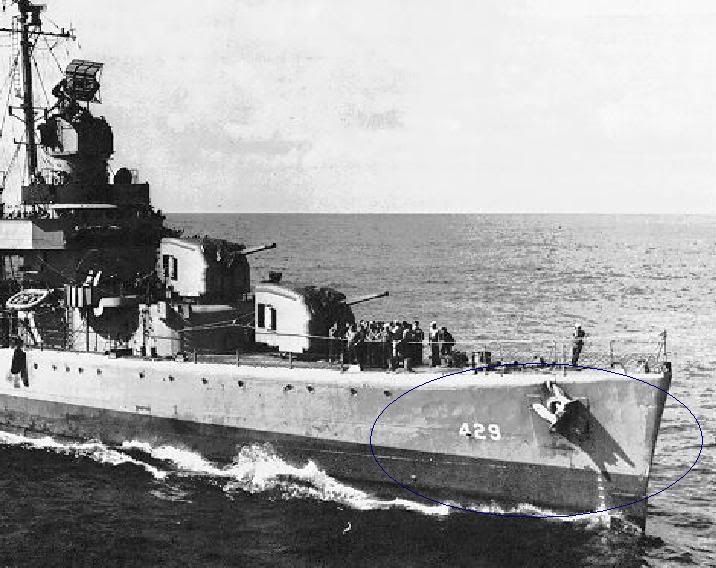
Look at the hull...fine, we all understand that, the skin is relatively thin on some ship classes like US DDs as shown above. I'd have no problem with penetrations that did relatively little damage aside from some incidental flooding, a few fires the odd large explosion. But WITP does not have alot of variety when it comes to penetrations. "Massive explosive damage" or "severe flooding" or some such is the norm. Why did we push for more hit locations like flight deck, superstructure, near miss etc? As well, why don't penetrating hits on weapons mounts cause criticals? Because of this very all or nothing damage model we have presently.
Also, this armor was not just added because of machine guns. It was also added to compensate for the whacky coastal defence capacity of not just dedicated coast defence guns, but every gun and tube larger than rifle calibre which gets to fire at moving ships with director control like accuracy.
Yammas from The Apo-Tiki Lounge. Future site of WITP AE benders! And then the s--t hit the fan
RE: Review of armor on IJN destroyers
ORIGINAL: Ron Saueracker
How's that durogatory?
[8|]
By extreme I mean all or nothing. Look at BBs, they are either impervious to thousands of bomb hits or sucumb to a torp hit due to the flooding model.
The fact that the damage model has a mostly all or nothing aspect in terms of damage via penetration is not of itself, extreme. Have you examined a BB that has been hit by "thousands" of bombs? Impervious? I think not. A BB surcomb to a single torp without an accompanying mag explosion? Again....I think not.
But we wander as is typical when you get going on your horse.....are you going to do Andrew's test or not?
-
Ron Saueracker
- Posts: 10967
- Joined: Mon Jan 28, 2002 10:00 am
- Location: Ottawa, Canada OR Zakynthos Island, Greece
RE: Review of armor on IJN destroyers
ORIGINAL: Nikademus
ORIGINAL: Ron Saueracker
How's that durogatory?
[8|]
By extreme I mean all or nothing. Look at BBs, they are either impervious to thousands of bomb hits or sucumb to a torp hit due to the flooding model.
The fact that the damage model has a mostly all or nothing aspect in terms of damage via penetration is not of itself, extreme. Have you examined a BB that has been hit by "thousands" of bombs? Impervious? I think not. A BB surcomb to a single torp without an accompanying mag explosion? Again....I think not.
But we wander as is typical when you get going on your horse.....are you going to do Andrew's test or not?
The number of individuals playing games using stock scenarios with no armour can accomplish this admirably. Just look at the thread where the guy was complaining about the wholesale slaughter of his amphibious ships to mortar and howitzer fire posted not too long ago. I can't think of a better example for the need for some armour to counter the game mechanics than that one. But, if we see nothing or nobody cares, then I'll put one together for all the good it will do. Both sides are entrenched it seems to me.
You know what I meant by thousands of bombs,,,what was the latest example of this, Chez's? Where he attempted to nuke an Allied airfield with the strategic wonder bombardment but got hit by Allied LBA. He thought his ships were goners but only a light cruiser was heavily damaged, the cruisers and larger ships just shrugged off 5 and more 500 and 1000lb bombs, suffering only slight system damage, a few fires and the loss of a few open mounts.
Yammas from The Apo-Tiki Lounge. Future site of WITP AE benders! And then the s--t hit the fan
RE: Review of armor on IJN destroyers
ORIGINAL: Ron Saueracker
The number of individuals playing games using stock scenarios with no armour can accomplish this admirably.
They arn't the ones taking constant pot-shots at the game. They are also not the ones defending this armor change. Personally Ron, I could give a *&(*( whether or not CHS has armor for DD's....its not my mod, I don't call the shots. However i wrote my view because of your typical posting style which tends to suggest "extreme" results are the norm and that it MUST be countered by whatever pet theory your chucking. As such...YOU need to back up what your saying with test results. Andrew was right in that much.....one or two people saying "I don't see it....I see it" isn't helpful. So prove it.
You know what I meant by thousands of bombs,,,what was the latest example of this, Chez's?
No Ron....i don't know what you mean.....and neither do alot of other people who may not be as familar with the game. For all person A knows.....he might walk away and say "Gosh....a BB can ignore 1000 bomb hits!" which even if you tone it down by a factor of 10 might still mean, "Gosh, a BB can ignore 100 bomb hits!" I don't know what game your playing, but in the tests i've done internally on this issue, i certainly don't have a BB being quote....."Impervious" to said number of hits. What is the definition of "impervious" Ron?
God...and you wonder why the testers and devs get so fed up with you. You often exagerate issues negatively and use imprecise language such as "IMPERVIOUS to 1000's of bomb hits!" and of course you NEVER back it up with anything concrete that you've done yourself. Its always...well someone else said...or "everyone knows"....or "just look at the thread where that guy was complaining about such and such...."
I'm done......banging my head on a brick wall is more productive than arguing with you. Do the test. Show El Sid and everyone else that armor on DD's is critical.

RE: Review of armor on IJN destroyers
Here is a web site with .50 caliber MG info:
http://www.inetres.com/gp/military/infantry/mg/50_ammo.html
The page is too long to cut and paste, so here are a few excerpts.
Note that the web page has an interesting table near the end - have a look. It lists M2 Ball AP ammo as piercing 5.1mm of Armor Plate (face-hardened) at 1,640 yards (1,500 meters). "Armor Plate (homogenous)" I take to be the same as a steel hull.
I've pasted here all of the ammo types that list armor penetration (except the types introduced in recent years, of course). I've bolded the armor penetration sections.
I'm sure there are many other sources out there if you want to search for yourself.
________________________
Cartridge, Caliber .50, Ball, Armor Piercing, M2
Used by M2 and M85 machine guns. The cartridge is for use against light-armored or unarmored targets, concrete shelters, and similar bullet-resisting targets.
Armor Penetration.
500 meters: 0.75 in (19 mm)
1,200 meters: 0.39 in (10 mm)
The cartridge is identified by a black bullet tip.
Type Classification: OBS - MSR 11756003
________________________
Cartridge, Caliber .50, Ball, Armor Piercing Incendiary, M8
Used by M2 and M85 machine guns, and the M107 Long Range Sniper Rifle. The cartridge combines the functions of the M2 armor piercing bullet and the incendiary bullet, and is used against flammable targets and light-armored or unarmored targets, concrete shelters, and similar bullet-resisting targets.
Armor Penetration.
500 meters: 0.63 in (16 mm)
1,200 meters: 0.32 in (8 mm)
Incendiary composition: 15 grains (0.97 gm) IM 11
The cartridge is identified by an aluminum bullet tip.
Type Classification: OBS - MSR 11756003
________________________
Cartridge, Caliber .50, Armor Piercing Incendiary-Tracer, M20
Used by M2 and M85 machine guns, and the M107 Long Range Sniper Rifle. The cartridge combines the functions of the armor piercing and the incendiary bullet, and is used against flammable targets and light-armored or unarmored targets, concrete shelters, and similar bullet-resisting targets. This tracer is dim at near ranges, but increases to bright as it moves further from the gun.
Armor Penetration.
500 meters: 0.83 in (21 mm)
1,200 meters: 0.43 in (11 mm)
Incendiary composition: 27 grains (1.74 gm) IM 161
Trace range: 328 - 1,914 yards (300 - 1,750 m)
Tracer: R256
The cartridge is identified by a red bullet tip with an aluminum colored ring to the rear of the red tip.
Type Classification: OBS - MSR 04776009
________________________
Cartridge, Caliber .50, Ball, M33
Used by M2 and M85 machine guns, and the M107 Long Range Sniper Rifle. The cartridge is intended for use against personnel or unarmored targets.
Armor Penetration.
500 meters: 0.32 in (8 mm)
1,200 meters: 0.16 in (4 mm)
The cartridge is identified by a plain bullet tip.
Type Classification: STD - OTCM 36841
________________________
http://www.inetres.com/gp/military/infantry/mg/50_ammo.html
The page is too long to cut and paste, so here are a few excerpts.
Note that the web page has an interesting table near the end - have a look. It lists M2 Ball AP ammo as piercing 5.1mm of Armor Plate (face-hardened) at 1,640 yards (1,500 meters). "Armor Plate (homogenous)" I take to be the same as a steel hull.
I've pasted here all of the ammo types that list armor penetration (except the types introduced in recent years, of course). I've bolded the armor penetration sections.
I'm sure there are many other sources out there if you want to search for yourself.
________________________
Cartridge, Caliber .50, Ball, Armor Piercing, M2
Used by M2 and M85 machine guns. The cartridge is for use against light-armored or unarmored targets, concrete shelters, and similar bullet-resisting targets.
Armor Penetration.
500 meters: 0.75 in (19 mm)
1,200 meters: 0.39 in (10 mm)
The cartridge is identified by a black bullet tip.
Type Classification: OBS - MSR 11756003
________________________
Cartridge, Caliber .50, Ball, Armor Piercing Incendiary, M8
Used by M2 and M85 machine guns, and the M107 Long Range Sniper Rifle. The cartridge combines the functions of the M2 armor piercing bullet and the incendiary bullet, and is used against flammable targets and light-armored or unarmored targets, concrete shelters, and similar bullet-resisting targets.
Armor Penetration.
500 meters: 0.63 in (16 mm)
1,200 meters: 0.32 in (8 mm)
Incendiary composition: 15 grains (0.97 gm) IM 11
The cartridge is identified by an aluminum bullet tip.
Type Classification: OBS - MSR 11756003
________________________
Cartridge, Caliber .50, Armor Piercing Incendiary-Tracer, M20
Used by M2 and M85 machine guns, and the M107 Long Range Sniper Rifle. The cartridge combines the functions of the armor piercing and the incendiary bullet, and is used against flammable targets and light-armored or unarmored targets, concrete shelters, and similar bullet-resisting targets. This tracer is dim at near ranges, but increases to bright as it moves further from the gun.
Armor Penetration.
500 meters: 0.83 in (21 mm)
1,200 meters: 0.43 in (11 mm)
Incendiary composition: 27 grains (1.74 gm) IM 161
Trace range: 328 - 1,914 yards (300 - 1,750 m)
Tracer: R256
The cartridge is identified by a red bullet tip with an aluminum colored ring to the rear of the red tip.
Type Classification: OBS - MSR 04776009
________________________
Cartridge, Caliber .50, Ball, M33
Used by M2 and M85 machine guns, and the M107 Long Range Sniper Rifle. The cartridge is intended for use against personnel or unarmored targets.
Armor Penetration.
500 meters: 0.32 in (8 mm)
1,200 meters: 0.16 in (4 mm)
The cartridge is identified by a plain bullet tip.
Type Classification: STD - OTCM 36841
________________________
Intel Monkey: https://sites.google.com/view/staffmonkeys/home

RE: Review of armor on IJN destroyers
Not sure I understand the logic behind that one. You add the armor to keep Army weapons from scoring penetrating hits, knowning full well naval weapons of the same caliber are also nerfed? So in effect, to "fix" (and I use that term loosely) one historical inaccuracy, you create a far larger historical inaccuracy? To me that makes absolutely no sense whatso ever, especially for a "historical" mod. Destroyers will engage other destroyers (and aircraft) far more than coastal batteries, so all that has been done if that is the case is subsitiute one small problem for a larger problem. Sounds like backpedalling to me.
Though Ron, Nik is right, if you want to convince everyone to keep the armor in, do tests. Try and see how many mag explosions occur from MGs, or how many DDs get sunk from AT guns. We've provided tests and historical fact as to why they shouldn't be armored, now lets hear a convincing argument as to why they should (I'm always open, but I need to be convinced before I switch viewpoints).
Though Ron, Nik is right, if you want to convince everyone to keep the armor in, do tests. Try and see how many mag explosions occur from MGs, or how many DDs get sunk from AT guns. We've provided tests and historical fact as to why they shouldn't be armored, now lets hear a convincing argument as to why they should (I'm always open, but I need to be convinced before I switch viewpoints).
ORIGINAL: Ron Saueracker
ORIGINAL: Tankerace
I agree that MGs should not sink destroyers, at least in terms of opening the hull to the sea (which we have found doesn't happen, only sys and fire damage is added, so its a non issue). But so far the only instance we have of them doing so, is 2 times as quoted by Ron. So we have gone to the extreme, and nerfed tin cans where they are invulnearable to strafing, which is not historically correct. So what in effect is done by adding armor is nerfing a rare occurance as observed by one player (Ron), yet in effect nerfed a very real, historical occurance that was common practice.
It seems to me if there is any extreme involved in WitP, Destroyers, and armor, it was adding the armor in the first place.The Destroyer Kagero (as in the passage I quoted above) had her hull flooded by strafing planes. Now strafing a destroyer was a common practice (If you talk to Billy Mitchell, it was textbook), yet by adding armor to destoyers strafing acheives nothing. So it seems to me that adding armor to destroyers is far more ahistorical, gamey, and extrme than the one or two odd occurances of tin cans blowing up (which again, did happen, as torpedoes and depth charges could be touched off).
To a more serious note, in WPO beta we added the 5mm armor at first, because I bought into it at first. But we found at normal combat ranges, 12 pounder shells (roughly 75mm guns) would not penetrate a US destroyer at ranges over about 5,000 yards. What does this mean in the WitP context? Well, you can pretty much right off the US Destroyer escorts, because in a surface fight their 3in/50s will have no effect. The larger 4, Japanese 4.7, and 5 inch gunned destroyers will still be able to score penetrations, that is up to about 12,000 yards, when the 5mm armor becomes proof even against Japanese 5.5" guns.
So, I will now ask for a simple answer. Which is more gamey:
1) Maybe 6 destroyers at maximum blow up to Machine Guns in the campaign ( a rate of 1 a year) [No armor]
2a) Destroyers being immune to strafing attacks. [Armor added]
2b) Destroyers being proof against small (<75mm) shells at normal destroyer combat ranges. [Armor added]
2c) Destroyers able to defeat light cruiser shells at long ranges. [Armor added]
It seems to me that 1 is potentially true (that rate never seen, only 2 instances documented, and both only by Ron), while all three of the "2's" are complete fiction, and are documented by several players, as happened several times, with repeatable results. It seems to me that the only thing that needs to be tweaked here is the removal of armor from the DDs.
We've seen reports that cannons bounce off PT boats that mistakenly have armor added to them, So its a sure fire certainty that they'll bounce off destroyers. And 20mm, and especially 30mm, 37mm, and 40mm Guns should chew up a destroyer, and leave it a burning wreck, temporarily out of action.
Heres a closeup of the destroyer Livermore (DD-429). Note the seams that you can clearly see on the bow, because the metal is so relatively thin! Now, are you trying to tell me .50MGs and 20mm cannons won't penetrate that? Now granted on other destroyers it is harder to see, but it is still there. These were thin hulled ships, and they were vulnerable to machineguns. Maybe that's a hideous fact to some people, but limiting one thing because you don't like it, and creating a ton of ahistorical inaccuracies is exactly what the CHS mod was supposed to prevent.
Look at the hull...fine, we all understand that, the skin is relatively thin on some ship classes like US DDs as shown above. I'd have no problem with penetrations that did relatively little damage aside from some incidental flooding, a few fires the odd large explosion. But WITP does not have alot of variety when it comes to penetrations. "Massive explosive damage" or "severe flooding" or some such is the norm. Why did we push for more hit locations like flight deck, superstructure, near miss etc? As well, why don't penetrating hits on weapons mounts cause criticals? Because of this very all or nothing damage model we have presently.
Also, this armor was not just added because of machine guns. It was also added to compensate for the whacky coastal defence capacity of not just dedicated coast defence guns, but every gun and tube larger than rifle calibre which gets to fire at moving ships with director control like accuracy.
Designer of War Plan Orange
Allied Naval OOBer of Admiral's Edition
Naval Team Lead for War in the Med
Author of Million-Dollar Barrage: American Field Artillery in the Great War coming soon from OU Press.
Allied Naval OOBer of Admiral's Edition
Naval Team Lead for War in the Med
Author of Million-Dollar Barrage: American Field Artillery in the Great War coming soon from OU Press.
-
Ron Saueracker
- Posts: 10967
- Joined: Mon Jan 28, 2002 10:00 am
- Location: Ottawa, Canada OR Zakynthos Island, Greece
RE: Review of armor on IJN destroyers
ORIGINAL: Nikademus
ORIGINAL: Ron Saueracker
The number of individuals playing games using stock scenarios with no armour can accomplish this admirably.
They arn't the ones taking constant pot-shots at the game. They are also not the ones defending this armor change. Personally Ron, I could give a *&(*( whether or not CHS has armor for DD's....its not my mod, I don't call the shots. However i wrote my view because of your typical posting style which tends to suggest "extreme" results are the norm and that it MUST be countered by whatever pet theory your chucking. As such...YOU need to back up what your saying with test results. Andrew was right in that much.....one or two people saying "I don't see it....I see it" isn't helpful. So prove it.
You know what I meant by thousands of bombs,,,what was the latest example of this, Chez's?
No Ron....i don't know what you mean.....and neither do alot of other people who may not be as familar with the game. For all person A knows.....he might walk away and say "Gosh....a BB can ignore 1000 bomb hits!" which even if you tone it down by a factor of 10 might still mean, "Gosh, a BB can ignore 100 bomb hits!" I don't know what game your playing, but in the tests i've done internally on this issue, i certainly don't have a BB being quote....."Impervious" to said number of hits. What is the definition of "impervious" Ron?
God...and you wonder why the testers and devs get so fed up with you. You often exagerate issues negatively and use imprecise language such as "IMPERVIOUS to 1000's of bomb hits!" and of course you NEVER back it up with anything concrete that you've done yourself. Its always...well someone else said...or "everyone knows"....or "just look at the thread where that guy was complaining about such and such...."
I'm done......banging my head on a brick wall is more productive than arguing with you. Do the test. Show El Sid and everyone else that armor on DD's is critical.
Guess we are even.
taking constant pot-shots at the game
Guess I should add a disclaimer saying I am not being critical and am supportive of the game system 100% before I post anything or make a mod?
Yammas from The Apo-Tiki Lounge. Future site of WITP AE benders! And then the s--t hit the fan
-
Ron Saueracker
- Posts: 10967
- Joined: Mon Jan 28, 2002 10:00 am
- Location: Ottawa, Canada OR Zakynthos Island, Greece
RE: Review of armor on IJN destroyers
ORIGINAL: Tankerace
Not sure I understand the logic behind that one. You add the armor to keep Army weapons from scoring penetrating hits, knowning full well naval weapons of the same caliber are also nerfed? So in effect, to "fix" (and I use that term loosely) one historical inaccuracy, you create a far larger historical inaccuracy? To me that makes absolutely no sense whatso ever, especially for a "historical" mod. Destroyers will engage other destroyers (and aircraft) far more than coastal batteries, so all that has been done if that is the case is subsitiute one small problem for a larger problem. Sounds like backpedalling to me.
Though Ron, Nik is right, if you want to convince everyone to keep the armor in, do tests. Try and see how many mag explosions occur from MGs, or how many DDs get sunk from AT guns. We've provided tests and historical fact as to why they shouldn't be armored, now lets hear a convincing argument as to why they should (I'm always open, but I need to be convinced before I switch viewpoints).
ORIGINAL: Ron Saueracker
ORIGINAL: Tankerace
I agree that MGs should not sink destroyers, at least in terms of opening the hull to the sea (which we have found doesn't happen, only sys and fire damage is added, so its a non issue). But so far the only instance we have of them doing so, is 2 times as quoted by Ron. So we have gone to the extreme, and nerfed tin cans where they are invulnearable to strafing, which is not historically correct. So what in effect is done by adding armor is nerfing a rare occurance as observed by one player (Ron), yet in effect nerfed a very real, historical occurance that was common practice.
It seems to me if there is any extreme involved in WitP, Destroyers, and armor, it was adding the armor in the first place.The Destroyer Kagero (as in the passage I quoted above) had her hull flooded by strafing planes. Now strafing a destroyer was a common practice (If you talk to Billy Mitchell, it was textbook), yet by adding armor to destoyers strafing acheives nothing. So it seems to me that adding armor to destroyers is far more ahistorical, gamey, and extrme than the one or two odd occurances of tin cans blowing up (which again, did happen, as torpedoes and depth charges could be touched off).
To a more serious note, in WPO beta we added the 5mm armor at first, because I bought into it at first. But we found at normal combat ranges, 12 pounder shells (roughly 75mm guns) would not penetrate a US destroyer at ranges over about 5,000 yards. What does this mean in the WitP context? Well, you can pretty much right off the US Destroyer escorts, because in a surface fight their 3in/50s will have no effect. The larger 4, Japanese 4.7, and 5 inch gunned destroyers will still be able to score penetrations, that is up to about 12,000 yards, when the 5mm armor becomes proof even against Japanese 5.5" guns.
So, I will now ask for a simple answer. Which is more gamey:
1) Maybe 6 destroyers at maximum blow up to Machine Guns in the campaign ( a rate of 1 a year) [No armor]
2a) Destroyers being immune to strafing attacks. [Armor added]
2b) Destroyers being proof against small (<75mm) shells at normal destroyer combat ranges. [Armor added]
2c) Destroyers able to defeat light cruiser shells at long ranges. [Armor added]
It seems to me that 1 is potentially true (that rate never seen, only 2 instances documented, and both only by Ron), while all three of the "2's" are complete fiction, and are documented by several players, as happened several times, with repeatable results. It seems to me that the only thing that needs to be tweaked here is the removal of armor from the DDs.
We've seen reports that cannons bounce off PT boats that mistakenly have armor added to them, So its a sure fire certainty that they'll bounce off destroyers. And 20mm, and especially 30mm, 37mm, and 40mm Guns should chew up a destroyer, and leave it a burning wreck, temporarily out of action.
Heres a closeup of the destroyer Livermore (DD-429). Note the seams that you can clearly see on the bow, because the metal is so relatively thin! Now, are you trying to tell me .50MGs and 20mm cannons won't penetrate that? Now granted on other destroyers it is harder to see, but it is still there. These were thin hulled ships, and they were vulnerable to machineguns. Maybe that's a hideous fact to some people, but limiting one thing because you don't like it, and creating a ton of ahistorical inaccuracies is exactly what the CHS mod was supposed to prevent.
Look at the hull...fine, we all understand that, the skin is relatively thin on some ship classes like US DDs as shown above. I'd have no problem with penetrations that did relatively little damage aside from some incidental flooding, a few fires the odd large explosion. But WITP does not have alot of variety when it comes to penetrations. "Massive explosive damage" or "severe flooding" or some such is the norm. Why did we push for more hit locations like flight deck, superstructure, near miss etc? As well, why don't penetrating hits on weapons mounts cause criticals? Because of this very all or nothing damage model we have presently.
Also, this armor was not just added because of machine guns. It was also added to compensate for the whacky coastal defence capacity of not just dedicated coast defence guns, but every gun and tube larger than rifle calibre which gets to fire at moving ships with director control like accuracy.
No we did not know it (5mm) was going to "nerf" other weapons. How could we? People play the mod and find out...call it testing. Heck, WITP is being tested now and has been since release this way. So 5mm is too much? Reduce it. But I don't believe it should be zeroed. This was causing DDs to explode...why Lemurs decided to try it in the first place.
We've provided tests and historical fact as to why they shouldn't be armored
Where exactly is this...I must have missed it.
Yammas from The Apo-Tiki Lounge. Future site of WITP AE benders! And then the s--t hit the fan
RE: Review of armor on IJN destroyers
A Test:
Historical evidence:
and
PLus some evidence of what it does, in game which is nerf all destroyer caliber shells:
So, all I (and I think others) are asking is show us tests of unarmored DDs that explode. And not 1.2, or 1.3, but 1.795. Others have shown they don't explode, I've showed historical context where they shouldn't be armored (at all, and for sure not 5mm). But in this entire thread, I have yet to see a test where the destroyer exploded under MG fire, or cannon fire from shore was way out of proportion (and that could be somehow corrected by adding armor). In fact, the only thing regarding that is "I say 2 DDs explode under fire, hence the original changes." Which is fine, but these changes were done under what, 1.1? 1.2? A lot has changed since then code wise.
ORIGINAL: KDonovan
Just thought i'd run a few test's on strafing DD's just to add some numbers to the discussion. Its not a proper test as you would need lots more runs, but i don't have the time to do it...so i just compiled a little one. I set up strafing attacks from Zero's on DD's and Kittyhawks on DD's. Any bomb hits on DD's disqualified them from the test since it would skew the result. Not sure if "durability (Dur.)" of the ships affects the outcome so i listed those values also....but here are my results from a short test:
Zero's attacking DD's
DD Sims (9 Dur) - 8 Hits --> 1 Sys
DD Dewey (7 Dur) - 16 Hits --> 1 Sys, 3 Fire
DD Phelps (10 Dur) - 24 Hits --> 2 Sys, 8 Flt
DD Aylwin (7 Dur) - 24 Hits --> 3 Sys, 12 Flt
DD Russell (9 Dur) - 20 Hits --> 1 Sys, 12 Flt
Kittyhawks attacking DD's (all Jap DD's have 6 Dur. rating)
DD Yayoi - 8 Hits --> 2 Flt
DD Uzuki - 8 Hits --> 14 Flt
DD Mochizuki - 4 Hits --> no damage
DD Oite - 12 Hits --> 7 Flt
DD Asangi - 32 Hits --> 26 Flt
DD Mutsuki - 4 Hits --> 2 Sys, 3 Flt
This is a stock game on Scen 3, so take what you want from my little test. To me it seems like MG's are well moddled in the game as only 1 DD was moderately damaged by MG fire and all the rest encountered light damage.
Historical evidence:
ORIGINAL: Tankerace
I can think of at least one Japanese DD sunk by .50s (can't remember the name, it was in the Solomon's). The MGs touched off DCs I believe (which can't happen with an armored hull). I mean, we've all seen the gun camera footage of the ship being shot up, and then exploding as ammunition/torpedoes/depth charges explode with it.) However, with armor on the DDs, it would prevent this.
One potential example is the destroyer Kisaragi (sunk at Wake). Some sources cite 100lb bombs, others the Wildcat's strafing runs. It is a definate possibility, but adding armor would prevent this.
As further evidence to allow this, strafing (according to numerous records) has always caused significant damage to destroyers, often touching off AA ammo, and killing crew (which could be reflected in high sys damage). However, adding armor to them would make them immune, which is just as gamey as having them sunk outright.
From Combined Fleet's website, about the destroyer Kagero:
21 September:
Troop transport run to Guadalcanal. Light damage: strafing aircraft caused waterline damage, flooded bow area.
Based on that alone, I say scrap the armor. Destroyers are vulnerable to strafing runs, and here is proof. Yet by adding armor, no damage at all could be inflicted, beyond destroying some small gun mounts.
ORIGINAL: Don Bowen
ORIGINAL: Andrew Brown
Actually there is. Something I didn't realise. I don't know when it was added.
So, what ships SHOULD have "armour" added to them and for what reason? It already seems that, with the changes to ASW attack routines, there is no longer justification for having it on subs; but what about AKs, APs, TKs, DDs, PGs, SCs, not to mention PT boats?
Andrew
Probably my fault - the price of using an automated tool!
Anyway, I do not believe there should be any armour on PTs or SCs.
I disagree about armour on most other ships. It may well be possible to sink a DD or large merchantman with MGs but I am not aware of it ever happening in real life. Game mechanics make it more than possible and non-historic armour seems the best answer.
Has anyone heard of a significant ship being sunk by MGs alone?
and
ORIGINAL: Tankerace
Interrogation of: Lieut. Comdr. YASUMOTO, Shisei, IJN; Commander of the escort vessel Shiokaze, March 1944 to June 1945; Staff Officer of 103rd Convoy Escort Squadron, Seventh Fleet, from June 1945 to end of war.
Q. To what extent did single search planes flying in the YELLOW SEA interfere with the shipping?
A. They never were much trouble. I think there was some difficulty in the Western YELLOW SEA from four-motored search planes. There we were using nothing but small ships of about 1000 tons in order to use inward passages as much as possible, and on ships of this size strafing attacks were very serious factor.
(from ibolio.org)
So Japanese DEs and most DDs fit within this category. So, we have proof that 1) Strafing could flood out a destroyer, 2) that Japanese commanders acknowledged that it could cause serious damage, and 3) potential proof of one or two sinking by strafings.
I'll try and find more evidence to support this aswell.
PLus some evidence of what it does, in game which is nerf all destroyer caliber shells:
ORIGINAL: Tankerace
ORIGINAL: Mike Tremblay
ORIGINAL: Mike Scholl
Then the problem is in the balistics tables..., a 10" shell WILL PENETRATE 5mm armor at ANY range it can reach. Period!
Don't mean to be nit-picky Mike but that's not true. The chance that any size round will penetrate anything is dependant upon physics. If there is not enough kinetic energy left in a round it won't penetrate a sheet of paper. Another factor to consider is armour slope - if that 10" round hits that 5mm armour at a very steep slope it might as well be hitting armour that is 1000mm thick. I don't know if the ballistics tables in WITP take slope and KE into account so I can't say if there is a problem with WITP based upon that.
Sorry for the confusion. I just dug up the old thread. It was a Japanese 14cm (5.5inch) round at 14,000 yards that hit on the deck of a US Flush Deck DD, and several instances of 12 pounder shells not penetrating. The shells hit, but failed to penetrate. From Mike Wood's response to the problems noted in WPO's Beta Forum:
ORIGINAL: Mike Wood
Hello...
Armor was added to destroyers and other small ships by mistake. The program does not expect this and becomes confused. Have already requested armor for these ships be removed.
Thanks...
Michael Wood
ORIGINAL: Brady
Below you can see a couple screan from a Day time engagement at 10,000, repatedly the Japanese 12 pounders would get Deck Armor Hits and no efect, Conways lists No Armor for the Allied Class's present.
The result of this:


So, all I (and I think others) are asking is show us tests of unarmored DDs that explode. And not 1.2, or 1.3, but 1.795. Others have shown they don't explode, I've showed historical context where they shouldn't be armored (at all, and for sure not 5mm). But in this entire thread, I have yet to see a test where the destroyer exploded under MG fire, or cannon fire from shore was way out of proportion (and that could be somehow corrected by adding armor). In fact, the only thing regarding that is "I say 2 DDs explode under fire, hence the original changes." Which is fine, but these changes were done under what, 1.1? 1.2? A lot has changed since then code wise.
Designer of War Plan Orange
Allied Naval OOBer of Admiral's Edition
Naval Team Lead for War in the Med
Author of Million-Dollar Barrage: American Field Artillery in the Great War coming soon from OU Press.
Allied Naval OOBer of Admiral's Edition
Naval Team Lead for War in the Med
Author of Million-Dollar Barrage: American Field Artillery in the Great War coming soon from OU Press.
-
el cid again
- Posts: 16984
- Joined: Mon Oct 10, 2005 4:40 pm
RE: Review of armor on IJN destroyers
Also, this armor was not just added because of machine guns. It was also added to compensate for the whacky coastal defence capacity of not just dedicated coast defence guns, but every gun and tube larger than rifle calibre which gets to fire at moving ships with director control like accuracy.
The problem is that this criticism is plain incorrect: anything bigger than rifle caliber IS dangerous to ships (and indeed so are weapons of rifle caliber). There is a reason USN ships (then and now) are under standing orders to avoid fights with shore guns - and the vast majority of them are NOT dedicated CD units. In Viet Nam we faced ONLY army type 122, 130 and 152mm army type weapons - as far as we know. They were deadly and dangerous. They used a variety of fire control systems most assurredly NOT naval director like in nature. The coast defense problem is much easier than naval gunfire is. For starters, the shore guns are NOT moving!!! A big deal, ship guns move in all three dimensions! Finding a target from a known location is a major simplification of the problem. For another thing, shore guns can use aiming stakes, or optical sighting from surveyed, fixed, known locations (bearings from two such locations yield the range; an aiming stake yields the range directly). You cannot jam the fire control radar and impact these sorts of aiming techniques. Trying to "correct" the game for saying land based artillery is dangerous is to actually make the game worse - assuming it actually shoots land guns at ships in the first place. Really - the main reason that CD weapons are rare is that land artillery is quite up to performing their mission - and being mobile not so easy to plan an attack against.
-
el cid again
- Posts: 16984
- Joined: Mon Oct 10, 2005 4:40 pm
RE: Review of armor on IJN destroyers
The number of individuals playing games using stock scenarios with no armour can accomplish this admirably. Just look at the thread where the guy was complaining about the wholesale slaughter of his amphibious ships to mortar and howitzer fire posted not too long ago.
The question is this: WHY did he complain in the first place? It was CORRECT. And WHY do you agree with his complaint? Any army officer who has to defend against a landing plans to use howitzers and mortars first of all. He may well not have any mines to place. But he always has those - and they work fine for that mission.
RE: Review of armor on IJN destroyers
I'm forced to agree. Just look at Omaha Beack, 120s, 88s, and the big 12cm Mortars gave the invasion force Hell. An invasion shouldn't be a walk in the park, it should be a bloody affair. Mortars and ATGs will chew up landing craft, and 88s and 12cms can knock out destroyers (again, see Omaha Beach).
ORIGINAL: el cid again
The number of individuals playing games using stock scenarios with no armour can accomplish this admirably. Just look at the thread where the guy was complaining about the wholesale slaughter of his amphibious ships to mortar and howitzer fire posted not too long ago.
The question is this: WHY did he complain in the first place? It was CORRECT. And WHY do you agree with his complaint? Any army officer who has to defend against a landing plans to use howitzers and mortars first of all. He may well not have any mines to place. But he always has those - and they work fine for that mission.
Designer of War Plan Orange
Allied Naval OOBer of Admiral's Edition
Naval Team Lead for War in the Med
Author of Million-Dollar Barrage: American Field Artillery in the Great War coming soon from OU Press.
Allied Naval OOBer of Admiral's Edition
Naval Team Lead for War in the Med
Author of Million-Dollar Barrage: American Field Artillery in the Great War coming soon from OU Press.
-
Ron Saueracker
- Posts: 10967
- Joined: Mon Jan 28, 2002 10:00 am
- Location: Ottawa, Canada OR Zakynthos Island, Greece
RE: Review of armor on IJN destroyers
This whole arguement got me thinking and I thought it would be interesting to dig up some old docs on the subject of ship damage. The following is a copy of an email by Nik regarding ship fragility we had been discussing (I'll post my Word Document that Steve (Nik) commented on (adding fire levels I believe)
----- Original Message -----
From: "Nikademus"
To: "David Heath [Matrix Games]"
Sent: Thursday, December 12, 2002 3:42 AM
Subject: New Hit Location (HL) and ship damage model preposals
> I apologize for the extreme length of this email. Originally posted on
the
> WitP forum, as i realize that some of the changes preposed here might be
> above and beyond the scope of "patching" UV.
>
> Corrosponding thread is here and contains responses to questions and
further
> elaborations and comparisons with other ship models, including Gary's own
> 1986 game "Warship" and "Battlecruiser" whose simple yet effective system
> could help make the ship damage model in UV/WitP far more flexible and
> realistic than currently experienced. Some of these preposals have
> already been acted on of course particularily the SYS/FLT issue which has
> been improved greatly in 2.11 , but i'm including them for complete-ness
> not to mention retyping and summerizing might take hours and it's almost
1am
> in the morning
>
>
> Proposal #1
>
>
> 1) Additional Hit Locations
>
> Right now, the proto-WitP game engine, Uncommon Valor has the following
HL's
>
> 1) Belt Armor Hit
> 2) Deck Armor Hit
> 3) Tower armor Hit
> 4) Weapon mount Hit*
>
> *-Number 4 is in effect, only a "partial" HL in the sense that any weapon
> that ends up getting this type of HL also will hit either numbers 1, or 2
as
> well and roll against their armor rating for penetration. (the effect of
> damage appears to be less though vs. just striking those other HL's)
>
> This level of detail is a huge step forward compared to the non HL type
> damage models present in previous Grigsby designed games such as Pacific
> War, Carrier Strike, Carrier Force, Bomb Alley and others. However, in my
> opinion, the UV/WitP game engine shares one very serious common trait with
> it's ancestors in terms of warship damage; Ship Fragility.
>
> The simple reason for this, is because the 'only' HL's that can be struck
in
> the UV game are critical locations. By "critical" damage, I mean any sort
of
> incoming damage that creates substantial increases in either the SYS or
FLT
> counters (or both). Belt and Deck armor hits in particular are nasty hits
if
> one is dealing with any medium or heavy caliber weapon, bombs or
torpedoes.
> PacWar did introduce the "armor" and "durability" statistics which were
> designed to regulate the level of damage sustained and therefore decrease
> ship fragility and were successful to a degree (ironically, too successful
> in the case of torpedoes) UV also has armor and durability ratings and
since
> the first patch, armor has come to be one of the most important factors as
> weapons that cannot penetrate the HL's armor stat will be unable to cause
> that critical damage to which I am referring too.
>
> But there is still a problem. For one, many ship classes in the game
either
> do not have armor at all (DD's in particular), or in the case of most
> cruisers, only a small level of armor, good in most cases only against
small
> caliber fire but useless against anything stronger. A ship in this
> predicament can only rely on two things...the warhead size of the incoming
> weapon (hopefully small.otherwise, trouble) and the warship's Durability
> rating. The DUR rating is a good feature and I'm not bashing it, but in
> play-test after play-test, and after game after game, in the end, it is
not
> enough to stem the tide of ship fragility. When equivalent ship classes
> engage, this effect is not as noticeable as both sides either have
defensive
> ratings designed to limit the effect of this damage, or have weapons so
> small that the penetrating damage does not appear to skewed on a per hit
> basis. However if disparate ship types fight, the general trend will be
> something more like this;
>
> The bigger ships with the bigger weapons will be able to cripple and/or
sink
> the smaller class ships with only a few hits, the ratio of which gets more
> extreme as the weapon size goes up and the ship size (the DUR rating) goes
> down.
>
> Thus, as in PacWar and it's predecessor wargames, One tends to see DD's
> routinely crippled and/or sunk after only 1-3 heavy weapon hits (BB or
large
> bomb), or around a half dozen for medium-heavy weapons (8 inch/medium
bomb)
> or no more than a dozen smaller weapon hits on average. (even DD vs DD
tends
> to cause around 10% SYS per penetrating hit from their own weapons)
>
> Medium warships are in a better position, having higher DUR ratings given
> their bigger size but they too can be reduced to crippled status after
only
> a couple hits. A great, dare I say "classic" example was the recent
> experience of one of my CA's in a campaign night battle in which the only
> damage it suffered in all the shooting was two 16.1 inch shell hits.
>
> Obviously there was no way the armor of the CA was going to stop the
shell,
> thus the predictable result was experienced.. Something close to the order
> of ; SYS 65 FLT 30
>
> Pretty incredible results for two hits. Granted, a BB caliber weapon can
> indeed be devastating to warships. They were after all, designed to take
out
> the biggest most heavily protected ships built during the period. However
> the "problem" here is not that two hits by a big weapon can cause critical
> damage, its that this type of effect happens **9.5 times out 10!!***
>
> The reason for this is because the only HL's available to mark these
impacts
> are critical locations, i.e. locations that can accrue substantial damage
in
> the form of SYS and/or FLT (almost always a proportion of both too, but
more
> on that later)
>
> Yet in real life...warships, even small unarmored ones tended to prove
very
> durable in the face of heavy damage. Unless water-tight integrity was too
> severely compromised, one can find numerous examples of ships of all types
> that absorbed huge amounts of damages from weapons large to small that
lived
> to either fight another day, or at least just survive to either be retired
> or scrapped.
>
> Here was an interesting statistic that I uncovered in my research that I
> think gives merit to my point. I had posted this in an answer over at the
UV
> forum in regards to ship fragility.
> This info is from an official statistical analysis conducted by BuShips
> (USN) after the war vis-à-vis DD survivability
>
> BuShips, (USN: Bureau of ships) compiled the following data
>
> 251 cases of war-damage involving destroyers were reported between 1941
and
> 45
>
> Of 192 DD's struck by bombs, gunfire or Kamikaze, 162 or 84% survived.
>
> In contrast, 27 DD's out of 48 damaged by torpedoes or mines went down, a
> survival rate of only 44%
>
> A player will certainly not experience anything close to this statistic
with
> small sized ships in UV or any previous ancestor because again, all
> penetrating damage is assumed to cause some critical level of damage. It
is
> also because 97% of all belt/deck armor penetrations produces both SYS and
> FLT damage at the same time, regardless of weapon type.
>
> What's missing then? We have Armor ratings, we have weapons ratings, we
even
> have DUR ratings (which I assume also represents ship "size") All seems
> correct and well researched.
>
> What's missing is what I call the "non-critical penetrating hit." Warships
> tend to be large structures that displace many thousands of tons of water.
> Even DD's of later generations tended to displace over a 1500 tons. As
such
> they contain a lot of volume that contains non-essential systems or at
> least, areas that if hit, would be considered non-essential to either the
> ship's immediate survival or the continuation of it's function. Further,
> warships, even mighty battleships will only have armor covering the areas
> that are considered critical to both the ship's survival and to it's
> continued functioning as an operating and contributing member of whatever
> force it's attached too. But there is also a large volume of non-armored
> area which will house non-critical systems and storage space...crew
berths,
> galleys, wardrooms, storage and refrigeration systems etc etc.
> Included in this as well would be unarmored or lightly armored sub systems
> for primary and secondary weapons systems that for design reasons, cannot
be
> protected as heavily as those systems considered critical.
>
> To generalize, a hit in these areas will not be life threatening to the
> ship. The biggest effect would be the causing of crew casualties, and the
> possible and temporary disruption of internal communications.., all
serious
> things but not modeled in the current engine nor would they permanent in
> nature. So in effect, the larger the warship is, the more likely
probability
> will favor a weapon hit in one of these large areas contained in the
> superstructure of ship of the upper unarmored portions of it's hull vs. a
> hit on one of the heavily protected areas, which are usually concentrated
> and small to save weight (armor of course being very heavy and sucking up
> valuable displacement)
>
> This leads to my proposal for additional HL's
>
> They would be;
>
> 5) Superstructure
>
> 6) Flight Deck (carriers only- replaces #5)
>
> 7) Near Miss
>
>
> Detail:
>
> 5) Superstructure
>
> This, as I have related in past threads is a very real HL on all warships.
> It would represent all the non-critical locations aboard the ship above
the
> waterline, including the upper hull above the armor belt (assuming the
ship
> has one) Critical or perhaps better described, "Sensitive" locations in a
> ship's superstructure already have their own HL in the form of "Tower
Armor"
> . The 'Superstructure' HL represents the rest of it, all usually either
> unarmored or at the most, sheathed in light armor alloys to help protect
> against strafing or splinters.
>
> Being a "non-critical" location of the warship, this HL should by virtue
be
> immune to accruing SYS damage. Since it's above the waterline like a
"Tower
> Armor" hit, it should naturally be immune to FLT damage as well. This HL
> should have an armor rating of zero so that any and all weapons systems,
> even 5-inch "pop-guns" of DD's, would be able to penetrate it. Depending
on
> 'range' it should have a very high probability of being chosen as the HL
> when a weapon impacts it. (due to it's volume)
> Lastly, it should be have a high chance of causing a FIRE level, since
that
> form of damage is what all that unarmored volume is most vulnerable too in
> real life. Fire damage is a serious threat aboard any warship as testified
> by later war USN efforts
> To make their warships as inflammable as possible (followed much later by
> the IJN) If accrued in sufficient levels, it would be FIRE damage that can
> cause vital SYS damage which would represent the real life effects of a
ship
> badly damaged by sustained fire effect thereby suffering a loss of
> efficiency. Sufficient FIRE levels would also increase Detection Levels
> aboard the afflicted ships and/or impair the firepower accuracy of them
when
> they attempt to engage enemy ships (also a representation of disrupted
> command/control)
>
> One of the best examples of this comes from the very period covered by UV.
> At Third
> Guadalcanal, the battleship Hiei was beseeched by numerous light and
medium
> warship assets. In particular her unprotected upperworks (Superstructure)
> were riddled by dozens of 5 inch HE shellfire which started heavy fires
> which proved hard to extinguish. In "critical" terms, the fires never
> compromised the ship's WT integrity or critical ship's functions, however
> the massive fires obviously increased her DL, drawing even more firepower
> her way. More importantly still, the fires disrupted her command crew's
> efforts to control the battle and fight the ship at acceptable levels of
> efficiency (in game terms, a serious hit against accuracy and ROF of the
> weapons carried aboard)
>
> This type of situation cannot currently happen in UV. Battleships and most
> cruisers are immune to small caliber weapons and since the current damage
> model gives little chance of FIRE levels being accrued when a weapon does
> not penetrate a HL's armor. Thus, a BB, any BB can sail blithely through a
> short range night surface battle, only fearing either another of it's kind
> or worse...a torpedo hit..a very unlikely happenstance if the BB is
Japanese
> and the period of time is early in the war.
>
> To put it another way, there's no true representation of the disadvantages
> of having capital ships (and to a lesser degree large well protected
> cruisers) fight at close range in restricted waters where said range would
> allow them to be pummeled with sustained small caliber gunfire which,
while
> it cant harm the critical systems, can certainly cause topside damage,
start
> fires and kill valuable crew members. There was a reason why Battle-lines
of
> the past fought at longer ranges, screened by light and medium forces,
part
> of that reason was to keep the enemy's light and medium forces at arm's
> length so that they could neither launch effective torpedo attacks or
> distract the battleline's efficient gunnery exercise against the enemy
> battleline with bee-sting like hits. Having a "Superstructure" HL would
help
> solve this in my opinion.
>
> More importantly though, it would decrease ship fragility among the
smaller
> more humble warships. We would see less instances of the one-two knockout
> blow against cruisers when hit by heavy-medium or heavy caliber hits (and
> bombs) and particularly with small ship classes (DD's) being knocked out
> and/or sunk after only an extremely modest number of incoming hits of
nearly
> an size (4.7 inch or higher). Ship's die hard as a rule...something I've
> said many times here and in other boards. It's true that a ship can suffer
a
> true "critical hit" that can sink or cripple it in spectacular
> fashion...hits like those on Arizona, Wasp, Exeter etc. But there are many
> many more examples of ships that were hit, some by large weapons that were
> not immediately crippled or knocked out.
>
> Another small point to remember is that in the case of large caliber hits
> (BB size), if they are firing AP and the target is a cruiser or destroyer,
> the shell is most likely to plow in and out of the hull or superstructure
> without exploding because the shell is designed to first punch through
heavy
> armor before it's now activated fuse sets it off. Just because a weapon as
a
> big "effect" rating should not automatically equate to heavy damage (SYS)
> and/or FLT damage.
>
> The ultimate effect of this HL would be to in effect 'soak up' some of the
> hits that impact on a warship vs. the current "all critical" nature of
> incoming rounds via the current damage model. While immune to critical
types
> of damage , the HL would still represent an FIRE hazard which if
accumulated
> in sufficient levels would increase the detection level of the ship and
> hinder it's effectiveness through accumulated SYS and weapons hit damage
and
> penalties to weapons accuracy when the ship itself fires. We would see
less
> ships being sunk on a dime from a routinely small number of hits, which is
a
> marked contrast to real life experiences among the majority of warships
not
> struck by some specific critical type of hit.
>
> 6) Flight Deck
>
> I had originally meant to combine this with proposed HL #5 to ease coding
> issues. One would simply swap the terms when CV class ships were hit. I
> realized though that this would not work because the dynamics of the two
HL'
> s are very different. For one, this HL should not be immune to SYS damage
> since for CV's this is directly linked to the ability to operate aircraft,
> the sole reason for this type of warship's existence. Thus I'm now
proposing
> this new separate HL, one for carriers only. I still think however that it
> could be put "in place" of HL #5 because of concerns the two HL's in
tandem
> would lead to too high a level of survivability for this class of
warships.
> Also, they would both accomplish by themselves many of the same aspects of
> simulating damage.
>
> The main reason for this HL would be to resolve the problem of blurred
> definition between true "armored" carriers and unarmored carriers as seen
in
> UV. The blur occurs because of the way the armor model interacts with the
HL
> choices available in UV. Right now the only horizontal HL choice is "Deck
> Armor". A large majority of major warships in the game have armor decks,
> "including" unarmored carriers. These decks are usually located well
inside
> the hull, capping the protective belt armor and are responsible for
> shielding the ammo/bomb magazines and propulsion machinery of the ship.
Thus
> all the IJN and USN carriers sport substantial armor decks. I suspect that
> this integration may be a large motivator behind the current Bomb Pen
> ratings given to GP weapons carried by the bombers of the day. Carriers of
> the Pacific war were of course, very vulnerable to bomb damage because
they
> have wooden flight decks which expose the lower hanger decks to damage and
> fire hazard. Some of these same classes of CV had very substantial lower
> armor deck protection at the same time thus, bombs in UV, in order to act
as
> they did in real life were given high pen ratings because it was realized
> that they had to be able to penetrate these lower armor decks within the
UV
> game engine in order to cause historical levels of damage.
>
> Whatever the reason for the bomb pen ratings, this has caused two
problems.
> First, that any penetrating damage to carriers is 95% of the time the
usual
> proportion of SYS/FLT/FIRE which can take out even the best crewed USN
> carrier (with damage control bonus "on") since a "Deck armor" hit is
> interpreted by the game engine as a below the waterline hit and thus there
> must be FLT damage. The 2nd problem is, as I've campaigned and continue
> campaigning, the GP/SAP bomb pen ratings are absurdly too strong, making
> only one or two classes of Battleship resistant to them leaving all else
> hidiously vulnerable.
>
> This HL, replacing HL#5 for CV/CVL/CVE class warships only would resolve
> these issues and allow a better differentiation between true armored
> carriers (flight deck armored) and unarmored carriers. Damage that
> penetrates this HL would be allowed SYS damage, it would carry with it a
> very high chance of FIRE damage (regulated by nationality and time period
> i.e. USN Damage control bonus) It should have the tie-in to the "Fuel" and
> "Ammo" explosion critical hit generator. Lastly it should naturally be
> immune to generating FLT damage.
>
> While most hanger/flight deck hits did not result in substantial hull
damage
> (much less FLT damage), the SYS damage is necessary to represent the
ability
> to knock out a CV's ability to operate planes. I believe right now a total
> damage level of 50% (FLT and SYS) is required to cancel air ops. A good
> number of hits, particularly bomb hits of 1000ILB's would quickly generate
> this level if past penetration results are any indicator.
>
>
> 7) Near Miss
>
> This proposed HL is in answer to those who pointed out (correctly) that
> bombs could and did on occasion cause FLT damage to warships. My research
> into this issue confirmed that to a large degree, FLT causing damage from
> bombs resulted not from direct hits which usually caused topside and below
> decks damage and FIRE levels, but from very close near misses which in
> effect created a "mining effect" against the hull compromising to varying
> degrees WT integrity. The larger the warship, the less likely direct bomb
> hits would cause FLT damage.
>
> HL #1 actually accomplishes this to a degree right now, however there are
> two issues; the first and most important being that the "mining effect" is
> always dependant on the weapon being able to penetrate the armor belt. The
> 2nd is that if it does penetrate, the FLT damage almost always would not
> disgrace a LL torpedo.
>
> While belt armor thickness can be a factor in protecting a ship from the
> mining effect, this should not be an absolute, especially as a large
> proportion of bombs do not have the pen ability to defeat substantial belt
> armors (BB's mainly) A near miss should also contain the possibility to
> explode and cause damage "below" the armor belt, loosening plates down
below
> where the hull is not armored. This leads to point #2. While the effect of
a
> near miss "can" be serious on occasion, this should not be the fast rule.
> Just as often or more often the "mining" effect should produce smaller FLT
> damage numbers than a actual torpedo striking the hull as a torpedo
strikes
> with no cushioning between the exposed hull and the sea. Inclusion of this
> HL would also ensure that even the most heavily armored battleship would
> still have to be cautious in the face of enemy airpower since belt armor
> thickness alone would not protect against near misses. In other words..no
> absolute immunity to damage, because there is no such thing in real life.
>
> **
>
> Proposal #2
>
> Re-alignment of damage allocation for penetrating hits for greater
> differentiation of
> warship damage.
>
> Detail:
>
> One of the very first things I noticed about the UV game engine was that,
> regardless of weapons system, and regardless of HL (Tower Armor excepted),
> that all incoming damages result in a proportional allocation of damage
> among the three avail stat counters, SYS/FLT/FIRE.
>
> In my opinion, this defeats the purpose of having such great increase in
the
> level of detail available for the UV/WitP game engine. One might almost as
> well go back to the single all-encompassing damage % that PacWar and
> previous Grigsby wargames were built around. FIRE accumulation, I have
> little problem with as FIRE was often the result of shell and torpedo
hits,
> and very much so in the case of bomb hits, the major issue is with the 97%
> SYS/FLT combo that results from incoming damage. On average, for bomb and
> shell hits which strike "Deck Armor", the ratio between SYS/FLT is on the
> order of 2:1. Belt hits are the worst cases since the game engine seems to
> consider 99% of hits in that HL to be waterline or below waterline strikes
> that generally reverse the ratio to 1:2 or worse.
>
> The result of this is a major contribution to ship fragility. My recent
2.0
> tests for bomb hits bore this out to a high degree and showed that this
> constant proportional distribution of damage quickly led to even large
> battleships suffering extreme levels of damage from relatively small #'s
of
> penetrating bomb strikes giving them both high SYS and FLT damages that
> often resulted in a sinking a few turns later due to progressive flooding
> rules. Carriers are also badly affected by this. For the USN player in
> particular this can be frustrating as even the damage control bonus cannot
> often contain both serious FLT damage and SYS damage at the same time, the
> result often being a completely crippled ship or even a sunken one. A good
> recent example was at the start of my last campaign game as USN when the
> carrier Yorktown suffered but a 2 x 250kg strike which resulted in a 1:2
> proportional allotment of SYS and FLT. No torpedo hits were scored yet the
> ship very nearly sank before reaching base as the 55% FLT damage
progressed
> to almost 90% in the four turn period it took to reach base. What is the
> most amazing about all these examples listed above is that torpedo-bombers
> and their torpedoes made zero contribution to the hits, yet if one looked
at
> the combo of SYS/FLT damage without knowing the specifics of how it
> happened, I believe most would assume that they had!
> Given the results against these big targets, one can easily imagine what
> happens when smaller class warships are also put through this wringer.
>
> My suggestions to address this would be, in addition to the 3 new HL's I
am
> campaigning for, would be to re-code or adjust how damage is doled out
based
> on HL;
>
> 1) Belt Armor hit
>
> If the new HL's are implemented I do not see much of a need to change
> anything here, As a HL that would be generated less by virtue of the new
HL'
> s and small adjustments elsewhere this HL can well and truly be considered
a
> 'critical' HL, with the assumption made that incoming weapons hit to this
> region "would" be very likely to cause FLT damage. Torpedo hits of course
> can only get HL #1 as an option so obviously, FLT damage cannot be toned
> down "if" the HL is the primary determiner of whether or not FLT damage is
> scored. If that is so, then one has the obvious explanation of why so much
> FLT damage is dealt out..as the engine has no choice but to consider "any"
> hit to this HL to be a FLT causer. I would hope that that is not the case,
> but if so..a reduction of this HL being chosen (torpedoes excepted) would
go
> a long way to addressing the issue. Players would be surprised at how few
a
> % of shells ever hits along this area. In WW1 I believe the statistic was
4%
>
>
> 2) Deck Armor hit.
>
> Due to the "torpedo effect" of bombs observed in UV, I feel that FLT
damage
> caused by this hit location needs to be severely toned down, toned down
> enough so that one can regularly see 0 FLT damage being caused (SYS and
FIRE
> only). While FLT damage from plunging fire is possible and should not be
> eliminated entirely, one must remember that, unlike "Belt Armor" hits, it
> cannot and should not be assumed that every plunging hit is going to
breach
> either the keel or outer hull plates. Given my observations and playtests,
> this is exactly what the game engine is doing, particularly for larger
> weapons. Unless a weapons hit location is triggered I have yet to see any
> bomb hit that did "not" cause to some degree, FLT damage along with SYS
and
> FIRE damage. This needs to be corrected. It was argued reasonably that
such
> a change would reduce ship sinkings. That is exactly the point. Some
players
> have complained in UV that the operational pace of the game is entirely
too
> quick. The primary reasons for this are in the order of
>
> 1) Unlimited supply base (UV only)
> 2) Player aggressiveness (no real-life considerations for loss of life or
> one's own job if performance is deemed unacceptable by higher commands)
> 3) AI fumbling (in SP mode)
> 4) Ship fragility (due to the 97% SYS/FLT/FIRE combo)
>
> 4 of course being my focus here...players including myself have oft
reported
> sinking huge numbers of ships, often in a very accelerated time frame that
> belies the losses suffered by both sides historically. The primary culprit
> for this is the proportional SYS/FLT combo tied in with the all-critical
hit
> HL's in the game engine, tied in with the progressive flooding rules. Make
> no mistake on the PF rules, I like them and seek no change, but due to
it's
> severe-ness and critical danger to all warships, the occurrence of FLT
> damage needs to be pared down to a more reasonable level. Doing so will
> reduce ship fragility/loss and better differentiate torpedoes from other
> weapons systems making them the true and deadliest threat to a warship's
> health and survival.
>
> 3) Tower armor hit
>
> No serious problem here..immune to FLT damage due to it's location far
above
> the waterline. I would suggest 'one' change though. Tower armor hits seem
to
> be un-selectable by bombs for some reason. This should be changed to
reflect
> the possibility
>
>
> 4) Weapons mount hit
>
> Little change needed here if any. Immune to FLT damage due to location,
> chance for FIRE level should probably be increased due to the proximity of
> ready ammunition. Perhaps a chance for critical event should be worked in
> too for primary weapons only
> (additional SYS damage and FIRE levels)
>
>
> Properly allocating incoming weapons hits would be critical as well. Belt
> hits, as previously mentioned can and should retain their critical hit
> stature but the chance to hit this location should be reduced (torpedoes
> excepted) to properly represent a more realistic chance of shells striking
> this narrow area (water-line) as a result. This is especially important
for
> short ranged night combat in which shell-fire is the primary weapon used.
> The closer the range of the battle, the flatter the trajectory of the
> incoming shells. Thus, 'deck armor' hits would be very rare, and if they
do
> happen, the extreme obliquity of the shell will almost always prevent a
> penetration. More importantly the closer the range in a night battle the
> greater the number of hits will likely strike higher up on the target
ship,
> i.e. the superstructure. BB Hiei had her upperworks and upper decks
riddled
> by close range and point blank 5-inch fire. Only one 8 inch shell was
> documented to have hit around the waterline (the famous hit that resulted
in
> the steering engine room slowly flooding, the stern area was unarmored
along
> the waterline and was a vulnerable point in this particular class of
> warship) San Francisco and Atlanta had their superstructures very badly
> damaged by close range fire ranging from 14 inch all the way down to 5
inch
> and both ships survived the battle initially with little FLT damage
(Atlanta
> was scuttled due the heavy damage which disabled her power-plant, San Fran
> made her own way back to Pearl). This tendency is very important in terms
of
> ship fragility and is probably the biggest reason why ships accrue such
high
> FLT damage in the game, because of the over-propagation of Belt armor
hits,
> followed by the over producing of FLT damage by deck armor hits. Including
> the new non-critical HL #5 along with a proportionate system of
determining
> HL's by range and weapon type would cure most if not all of this problem
>
> **
>
> Proposal #3
>
>
> FIRE levels needs to be re-accessed in my opinion. Being a Grigsby veteran
> from the early 80's onward, I had grown accustomed to FIRE levels working
a
> certain way and naturally expected them to do the same in UV. I could not
> have been more wrong.
>
> In previous games such as "Carrier Force, Carrier Strike, and
> Warship/Battlecruiser, FIRE levels all worked something like this;
>
> 1) FIRE levels were accumulated based on weapons size and a RANDOM
> 2) FIRE levels accumulation was usually moderate (i.e. 1 fire level per
> weapons hit) **unless** a critical hit was scored, such as carrier struck
by
> bombs while servicing loaded and fueled planes, in which case each
destroyed
> plane might contribute 3+ FL's per destruction, 'or' a critical hit to the
> warship itself which might produce a high multiple of FIRE levels.
> 3) The higher the FIRE level, the higher the chance that additional FL's
> would be generated.
> 4) The higher the FIRE level, the greater the chance of additional damage
> (either SYS accruing or a weapons system being destroyed ****no FLT damage
> was accrued!!***
>
> What #1 and 2 meant was that in "general" a modest # of FL's was of
concern
> but usually did not threaten the safety and function of the ship (usually
> 1-10 FIRE levels based on ship size) If >10 Fire levels were produced on a
> warship, then there was serious cause for concern. FIRE levels of 20+ were
> critical and in many cases eventually represented out of control blazes
that
> would be very unlikely to be contained due to rule #3..the greater the
FIRE
> levels, the more likely an additional FIRE level would be generated. This
> was a clever way to represent either the size an/or number of Fires
burning
> aboard a warship, small sized fires were both the easiest to contain and
> reduce...larger fires were exponentially more difficult. Thus, FIRE levels
> were in their own way as deadly as the possibility of progressive flooding
> (virtually if not completely absent from older wargames)
>
> The deadly nature of FIRE is not represented in UV at all. My very first
> experience in UV was a good example of this. A carrier strike on the AO
> Neosho (in an ironic repeat of history) resulted in several 250kg hits
that
> blasted the ship up to 45 FIRE levels. On seeing that, I naturally
expected
> the ship to burn uncontrollably given my previous experiences with older
> Grigsby games. One can imagine my surprise when one turn later those 45
FIRE
> levels were reduced to 12, then reduced to 0 the next turn. Less than 10
SYS
> points were accumulated from these fires (Did not notice or exp the add'l
> FLT damage effect fortunately either)
>
> Now I do realize that UV and WitP represent 24 hour turns. However I do
not
> believe this fact alone justifies all FIRE levels being summarily reduced
> automatically 100% of the time.. We must remember that most cases of
> Progressive Flooding do not occur over multiple 24-hour turns either yet
> this facet does not prevent those rules from being implemented on a per
> turn-basis. This is a necessary "fudge" on realism in order to implement
the
> very real danger of progressive flooding while maintaining an acceptible
> time period between turns for an operational level wargame. I have no
> problem with this and support it 100%. However by that reasoning FIRE
levels
> should be treated the same way. Most firefights, like Progressive flooding
> battles take place within a 24 hour bracket or at best a 48 hour bracket
> (Midway for example) but since we cant expect (or want!) less than 24 hour
> turns we must again fudge things a bit and extend this battle over
multiple
> 24 hour turns to represent the battle against flames.
>
> My proposal is thus;
>
> 1) FIRE level accumulation should be adjusted downward on a per hit basis
> 2) FIRE level accumulation due to FIRE damage rolls should be implemented
> 3) FIRE level accumulation should be made independent of HL armor factor
> 4) A chance for critical event should be modeled in dependant on DC
rating,
> a RANDOM and the current # of FIRE levels
> 5)chance for additional FLT damage due to FIRE damage rolls should be
> suppressed
>
>
> Detail:
>
> 1) Given that most penetrating hits, especially larger weapons hits can
> cause large numbers of FIRE levels to accumulate with the current game
> engine, the chance for high FIRE levels must be severely pared down or
else,
> like the progressive flooding rules, we'll see a bunch of SYS 99% ships
> drifting around the ocean with no power.
>
> My tests with bomb penetrations pointed this fact out...an average between
> 10+ FL's being generated by multiple large bomb hits (up to 10-15 FIRE
> levels per 1000ILBer)
>
> Put simply, if FIRE levels are made truly dangerous, it should be harder
to
> put a warship in such dire straits...either through numerous and frequent
> hits or a critical hit. CV types should be especially vulnerable to a
> "critical hit" and are right now in UV. Fuel or Ammo explosions should
> produce the most # of FIRE levels and, like Lexington, Shokaku, Akagi,
> Soryu, Hiryu and Kaga, be a deadly threat to the carrier.
>
> Carriers are also the best case for my argument. Right now it is
impossible
> to reproduce the effect that doomed all of the above mentioned. FIRE is no
> real threat to these beasties, it's the 97% proportional SYS/FLT damage
from
> all incoming weapons that dooms them. One can argue that if the result is
> the same, who cares how it's produced?
> Well...if the carrier was hard hit enough, I suppose that's a valid
> argument, but what of the carriers that are not? Remember my Yorktown
> example after all. Same goes for other warship types, particularly
> battleships.
>
> 2) Simply put..the higher the FIRE level..the greater the chance of
> producing an additional FIRE level. This represents the effect of fires
> spreading or increasing in intensity. DC efforts should attempt to produce
> the opposite effect, lowering the FL's until zero is reached...often it's
a
> seesaw battle unless the # of FIRE levels was low to start with. DC
> effectiveness and RANDOMS should be key here. 1 level accrued up or down
> does not have to be the hard fast rule, again I realize that these are 24
> hour turns, the point is that the higher the FIRE level or the more
intense
> the fire(s), the greater the chance for additional FIRE levels being
> generated and/or additional SYS and weapons hits being scored.
>
> 3) A possibly unnecessary step "if" HL #5 is worked into the game
> (Superstructure). That is due to the fact that HL#5 would be "unarmored"
> allowing any and all weapons to penetrate and roll properly for FIRE level
> accumulation. However just for the sake of completeness I include this
> sub-proposal separately. Right now in UV, it is very hard to
> impossible to generate a FIRE level without first penetrating the HL. No
> penetration, no FIRE level is the usual norm. This is what makes
battleships
> and large cruisers in particular so safe during night battles. 5-inch "pop
> guns" have zero chance of penetrating their thick skins in the
all-critical
> hit HL's available (unarmored secondary and tertiary weapons mounts
> excepted ) thus their guns, even at point blank range are useless leaving
> only torpedoes as an effective counter. Not so bad for the IJN
> player..**very** bad for the USN player given the high tendency for that
> side to not score any torpedo hits in a heated night battle..thus, one
> cannot possibly repeat the sequence of events at Third Guadalcanal..hit
the
> BB Hiei forty times with 5 inch guns and the ship will still laugh at you
> and fire away little effected, maybe suffering 1-2% SYS damage due to 1 or
2
> FIRE levels being accrued.
>
> Allowing small HE weapons like the 5 inch gun (and bombs!) to better
chance
> to produce FIRE levels, either via HL #5 or this proposal (via
> non-penetrating hits) will make short ranged contests with high value
assets
> a much more serious choice to make. Right now? Read any AAR...you see TF's
> routinely made up of all CA's and BB's in order to maximize their
firepower
> because players have figured out a basic "gamey" tactic, that BB's in a
> properly balanced TF might not contribute but an all-TF BB will even in
> proportion, deliver devastating results because each unit firing is using
a
> sledgehammer. Combine that with the one-two knockout blow to DD's caused
by
> all-critical HL's and you have massive disproportionate sunken
> ships...unrealistic tactics..unrealistic results. The players know that
> later generations of CA's and all BB's are pretty much immune to small
> weapons fire in the game thus they send them in, unescorted to wreak
havoc,
> fearing only the chance of torpedo strike.
>
> There was a reason why BB's needed escorts at nights and it wasn't simply
to
> prevent torpedo attack, it was also to prevent valuable assets from being
> assailed by hundreds of HE incendiary attacks. Properly simulating the
> effects and potential effects of FIRE would help curb such gamey
tendencies.
> It might also reduce their easy deployment to such unfavorable
battlefields
> due to the risk involved. Reduction in mass sinkings would further
encourage
> this (due to non critical HL's being scored)
>
> 4) This sub-proposal is especially critical for CV types. Right now there
is
> zero chance for a burning warship to suffer a critical hit produced by
FIRE
> levels. Yet this was a very real danger. Lexington, Wasp, and at least two
> of the four IJN CV's at Midway were lost due to critical explosions either
> sinking them outright or ensuring that high FIRE levels would be
maintained
> putting them beyond the ability of DC teams to reduce.
> Tying in a chance for catastrophe proportionate to the current FIRE level
> would help address this. The higher the number of FIRE levels, the greater
> the chance based on time period, warship type, and DC rating. CV types and
> merchants carrying fuel or ammo should be especially vulnerable to this.
> Other warships less so as often in their cases the most likely explanation
> for an explosion would be a Magazine detonation which almost always sinks
> the ship.
>
> 5) My tests showed that a major factor in ship fragility was that the
> current routines for FIRE generated damage on top of weapon hit damages
are
> due to the combination of Progressive Flooding rule and FIRE generated FLT
> damage. While not an impossible occurrence it is historically unlikely in
> the extreme! Lexington, the four IJN carriers at Midway, Franklin, and
> Bunker Hill are among the best examples...Fires burning out of control
> produced little to no FLT effect and the ships either all had to be
> scuttled, they were eventually saved or else they suffered a critical
event
> (bomb magazines, fuel explosion etc) that sent them to the bottom. A
burning
> ship will rarely produce FLT damage due to fire. The fires themselves are
> the threat, if they cannot be contained the ship will be forced to be
> abandoned, or in a least case scenario, will be so badly damaged it might
as
> well have been.
>
> In game terms this double blow of progressive flooding + FLT caused fire
> damage often produces an overkill effect that endangers both IJN and USN
> ships to a high degree. PF rules are heavy enough in my opinion, *more* so
> given the over-propagation of FLT damage in the first place. I would
submit
> that FLT damage should be exempted from FIRE damage rolls and restricted
to
> critical events only due to FIRE (explosions)
Original Word Document....sent to Nik and returned with Niks analysis and suggestions (he added Fire Level to Doc.
ADDITIONAL HIT LOCATIONS
Present hit locations in UV and Alpha WITP are:
1) Belt Armor Hit
2) Deck Armor Hit
3) Tower Armor Hit
4) Weapon Mount/Armor Hit (this HL is basically a collateral damage hit as a hit here also results in a Belt or Deck Armor hit)
The problem which arises with such a limited amount of hit locations is skewed ship resiliency. Small or less durable ships tend to succumb to a small amount of shell/bomb hits of any size, while large or more durable ships either are impervious to smaller calibre shell/bomb hits or are too vulnerable to larger shell/bomb hits. By limiting hit locations to these four areas, one has removed the survivability historically illustrated with ships because one has overlooked many areas of a ship (new hit locations) that were substantial in area and insubstantial for survivability.
New hit locations proposed are:
5) Superstructure/Hull Hit
6) Flight Deck Hit
7) Near Miss
Superstructure/Hull Hits represent non vital areas of a ship. This should be a high probability hit location. Given that a ship's armor is roughly 20/30% of a ships displacement (if it has armor), one may suggest it is protecting a further 20/30% of the ships displacement in the form of vital systems. This leaves roughly 40/60% of a ship as a Superstructure/Hull hit location. Therefore, perhaps the chance to hit the Superstructure/Hull HL be between 40 or 50% of the total hit location percentage.
Flight Deck Hits are for CVs only. The reasoning for this is obvious, as it will allow a distinction between wooden decked CVs and truly armored deck carriers. With a simple Deck Armor HL, it was impossible to distinguish between actual flight deck armor which protected the hanger deck (limited to armored deck CVs) and lower deck armor over machinery spaces, magazines etc (present in both armored and wooden decked CVs). As a result, Rich Dionne had to "tweak" bomb penetration ratings and deck armor ratings on all ships to get around this omission. As "Flight Deck" hits are now observed in 2.20, perhaps this Hit Location has been satisfied and deck ratings for ships reverted back to actual ratings. Perhaps, as with Weapons Mount/Armor hits, a chance for a Deck Armor Hit be implemented as AP bombs often penetrated multiple decks before detonation.
Near Miss Hits are exactly that. Historically, many ships accrued damage from bombs or shells which, while not actually "striking" the ship, damage was accrued through the resultant "mining" effect.
****note to ron: As observed currently in 2.20 it appears that the only thing that has been done is to replace the term “deck armor” with “flight deck” when the HL for deck armor is selected with a carrier. Outside of the general toning down of FLT damage caused by this HL, there appears to have not been any additional changes and armor pen ratings of the GP bombs remains at 2.0 levels…..not as severe as 1.4 but still overpenetrative by a large magin…such that even armored carriers would be penetrated I have submitted info and penetration figures for true AP and SAP bombs and given my estimates as to the penetration levels that should be assigned to HE (GP) bombs
RE-ALLIGNMENT OF DAMAGE (FLOTATION/SYSTEM/FIRE)
At present, regardless of weapons system or Hit Location (Tower Hit excepted), all penetrating hits result in a proportional allocation of damage among the three stat counters, flotation, system, and fire.
This appears to defeat the purpose of the level of detail available with UV engine; one might as well revert to the all-encompassing damage % of previous games such as PacWar and Guadalcanal Campaign.
Fire allocation is not the real culprit here, as fires can be caused by most weapons and most damage. The problem lies with the combination of system/flotation damage accrued through the vast majority of hits, with the ratio being 2:1(sys/flot) with deck armor hits and reversed to 1:2(sys/flot) with belt armor hits. This system/flotation combination is a determining factor leading to ship fragility in UV/WITP.
Proposed damage re-allignment:
1) Belt Armor Hit: If the new Hit Locations are implemented (especially the high probability to hit Superstructure/Hull HL), no adjustments need be made to sys/flot/fire allocation, as the simple reduction in Belt Armor hits will address the issue.
2) Deck Armor Hit: Frequency of flotation damage shoud be severely toned down as not all deck hits breach the hull integrity of a ship. No flotation damage should be a common occurance.
3) Tower Armor Hit: No problem here really as this hit location appears immune to flotation damage. However, it appears Tower Armor Hit is immune to bombs, if so this should be rectified.
4) Weapon Mount/Armor Hit: No problem here if new Hit Locations and re-allignment of damage are implemented. That way there is a high probability that Superstructure/Hull will be the collateral damage HL, not always the disasterous Deck or Belt Armor hit. However, it may be prudent with regard to main gun turrets to tone down the chance of this collateral damage, leaving only the mount destroyed.
5) Superstructure/Hull Hit: As this represents the "non-vital" areas of a ship, only minor system and flotation damage should occur (if any---random factor), but resultant fire probability needs to be high compared to other armored (and more critical) locations. (A high FIRE level probabilty would take care of most of the SYS and weapons system damage issues if not contained, thus a ship such as BB Hiei at Third Guadalcanal, at close range to rapid fire DD’s firing HE, could, within the game, suffer the same effect as historical, many hits to the superstructure area which while of a non vital nature to the ship SYS-wise, did cause many fires which hindered the ship’s ability to command the battle and fire efficiently. The fires burned for almost 24 hours and resulted in light SYS, confined mainly to the topside areas on and around the tower superstructure) Implementation of this non critical HL will also increase ship durability and reduce the chronic instances of warships being crippled and sunk with 6-12 hits on average.
note to Ron…….steering gear in most ship classes do have armored protection, steering gear hits I would tie to a “deck penetration”, not superstructure/hull hit
6) Flight Deck : As with Deck Armor, the frequency of flotation damage should be severely toned down. (A flight deck hit should incur no FLT damage, unless subsequently the main armor deck (over machinery) is penetrated ((no IJN carrier hit at midway suffered lower hull or propulsion damage as the GP bombs detonated either on the flight or hanger decks…..FIRE and explosion did all the dirty work))
7) Near Miss: Minor flotation and system damage only. Chance of fire seems minimal. **Chance of FLT damage should be a roll, based on a random as not ‘all’ near misses resulted in mine effect. Some resulted in minor FLT, others more serious, some not at all. Weapon size should also factor into the calculation
FIRE MODEL:
Historically the danger of fire aboard ship was potentially a very serious threat as atested to USN damage control efforts prior and during WWII to minimize the risk of fire aboard carriers and other surface warships by the removal of all potentially flamable materials not considered vital to the operation of the ship.
Fire levels as currently portrayed in the UV game engine do not come close to representing this danger. The primary reason for this is the auto-reduction of Fire levels on a per turn basis, regardless of intensity level, coupled with a resultant small chance of increase of SYS (and FLT) damange per turn dependant on current FL. No instance of weapons mount disablement or destruction caused by spreading fires has been
Evidenced in the game either.
Summary of preposed modifications to FIRE levels and damage routine;
1) FIRE level accumulation should be adjusted downward on a per hit basis
Simply put, if the danger of FIRE levels are dramatically increased in the game, then the acumulation of Fire levels themselves must be reduced to prevent warships from being too greatly affected by the rules change. Currently it is fairly easy to accumulate large numbers of FL’s from a few hits, avg results usually scoring 30+ Fire levels after several large penetrating hits. In Grigsby games of old, anything over 20 Fire levels was a fairly serious fire or number of fires and it took a lot of weapons strikes, penetrating and non penetrating over time to reach such levels
2) FIRE level accumulation due to FIRE damage rolls should be implemented
Right now FL’s only reduce on a per turn basis. My preposal is that, like FLT damage via the progressive flooding rules, they should be given the chance to “increase” per turn as well based on random/DC factor, the “level intensity” or “size” of the Fire(s) as represented by the 0-99 scale as with FLT damage. An estimate below would read
0-20 : minor fire(s)
20-30 : moderate
30-50 : severe
50-70 : very severe
70+: critical
as FL’s increase in intensity, the chance for additional FL’s should increase, same as with FLT damage. Obviously once a certain threshold is reached (50+) Fire level accumulation probability will outmatch DC rolls to reduce resulting in an uncontrollable blaze(s) SYS and weapons damage should also increase in probability as FL’s go up. If SYS 99 is reached and fires still burn, a small FLT damage roll can begin assuming the player does not scuttle to save VP’s
Carriers in particular during the early war period should be particularily vulnerable to the outbreak and spreading of fires.
3) FIRE level accumulation should be made independent of HL armor factor
Right now non-penetrative hits have little probability to score a FL. This makes it impossible for small caliber weapons to impart any kind of deterence on the employment of larger armored warships in close quarter situations (i.e. night battles) This ties in directly with the superstructure hit location. Largely unnecessary “if” the superstructure HL is implemented as that will in effect be a HL penetratble by any weapon in the game as it will be an unarmored location. Still Belt, weapon hits, and deck armor hits that do not penetrate should still have some chance for causing a FL based on shell/weapon size and a random factor. Example: a 1000ILB GP bomb that detonates on an armored deck within a hull but does not penetrate can still cause a blaze that will need to be fought.
4) A chance for critical event should be modeled in dependant on DC rating, a RANDOM and the current # of FIRE levels
The greater the FL, the greater the chance should be that some critical event is triggered, modified by DC rating. Especially important for carriers that burn. Historically they were extremely vulnerable to explosion resulting in later war USN efforts to minimize the chance of fire and in leiu of that, prevention of explosion as the blaze is being contained. Also important for merchants which should receive DC penalties as the crews were not as disciplined or well trained as naval crews.
5)chance for additional FLT damage due to FIRE damage rolls should be suppressed
Fire themselves rarely caused FLT damage. Explosions caused by fire could and did occasionally cause FLT damage along with SYS (and add’l Fire levels) so should be modeled in. Another reason to suppress FLT damage from FL’s is because when combined with the FLT progressive flooding rules, it tends to result in ships being too fragile in their resistance to damage.
Conclusion
While it is true that most cases of fire at sea werel be resolved within or around a 24 hour period, the same is also true for progressive flooding. However because of the necessity of 24 hour turns, the effects of accumulative flooding, and the spreading/damage caused by fire must be represented across this spacing of turns. Still, the system works very well for the former system and should work good for the latter in just the same way. Implementation of these more dynamic Fire rules would bring the UV engine more in line with the damage model of Grigsby games of the past and help represent more diverse and historical hazzards that faced warships (and merchants) at sea.
Additional suggestion
If at all possible, propulsion damage should be seperated from the general “SYS” damage and be made a possible (by roll) result of a belt or deck armor penetration. This way it would be possible to represent ships with large degrees of SYS damage that represent vital communication, power and weapons systems being badly damaged but with more negligable propulsion (and steering) damages.
----- Original Message -----
From: "Nikademus"
To: "David Heath [Matrix Games]"
Sent: Thursday, December 12, 2002 3:42 AM
Subject: New Hit Location (HL) and ship damage model preposals
> I apologize for the extreme length of this email. Originally posted on
the
> WitP forum, as i realize that some of the changes preposed here might be
> above and beyond the scope of "patching" UV.
>
> Corrosponding thread is here and contains responses to questions and
further
> elaborations and comparisons with other ship models, including Gary's own
> 1986 game "Warship" and "Battlecruiser" whose simple yet effective system
> could help make the ship damage model in UV/WitP far more flexible and
> realistic than currently experienced. Some of these preposals have
> already been acted on of course particularily the SYS/FLT issue which has
> been improved greatly in 2.11 , but i'm including them for complete-ness
> not to mention retyping and summerizing might take hours and it's almost
1am
> in the morning
>
>
> Proposal #1
>
>
> 1) Additional Hit Locations
>
> Right now, the proto-WitP game engine, Uncommon Valor has the following
HL's
>
> 1) Belt Armor Hit
> 2) Deck Armor Hit
> 3) Tower armor Hit
> 4) Weapon mount Hit*
>
> *-Number 4 is in effect, only a "partial" HL in the sense that any weapon
> that ends up getting this type of HL also will hit either numbers 1, or 2
as
> well and roll against their armor rating for penetration. (the effect of
> damage appears to be less though vs. just striking those other HL's)
>
> This level of detail is a huge step forward compared to the non HL type
> damage models present in previous Grigsby designed games such as Pacific
> War, Carrier Strike, Carrier Force, Bomb Alley and others. However, in my
> opinion, the UV/WitP game engine shares one very serious common trait with
> it's ancestors in terms of warship damage; Ship Fragility.
>
> The simple reason for this, is because the 'only' HL's that can be struck
in
> the UV game are critical locations. By "critical" damage, I mean any sort
of
> incoming damage that creates substantial increases in either the SYS or
FLT
> counters (or both). Belt and Deck armor hits in particular are nasty hits
if
> one is dealing with any medium or heavy caliber weapon, bombs or
torpedoes.
> PacWar did introduce the "armor" and "durability" statistics which were
> designed to regulate the level of damage sustained and therefore decrease
> ship fragility and were successful to a degree (ironically, too successful
> in the case of torpedoes) UV also has armor and durability ratings and
since
> the first patch, armor has come to be one of the most important factors as
> weapons that cannot penetrate the HL's armor stat will be unable to cause
> that critical damage to which I am referring too.
>
> But there is still a problem. For one, many ship classes in the game
either
> do not have armor at all (DD's in particular), or in the case of most
> cruisers, only a small level of armor, good in most cases only against
small
> caliber fire but useless against anything stronger. A ship in this
> predicament can only rely on two things...the warhead size of the incoming
> weapon (hopefully small.otherwise, trouble) and the warship's Durability
> rating. The DUR rating is a good feature and I'm not bashing it, but in
> play-test after play-test, and after game after game, in the end, it is
not
> enough to stem the tide of ship fragility. When equivalent ship classes
> engage, this effect is not as noticeable as both sides either have
defensive
> ratings designed to limit the effect of this damage, or have weapons so
> small that the penetrating damage does not appear to skewed on a per hit
> basis. However if disparate ship types fight, the general trend will be
> something more like this;
>
> The bigger ships with the bigger weapons will be able to cripple and/or
sink
> the smaller class ships with only a few hits, the ratio of which gets more
> extreme as the weapon size goes up and the ship size (the DUR rating) goes
> down.
>
> Thus, as in PacWar and it's predecessor wargames, One tends to see DD's
> routinely crippled and/or sunk after only 1-3 heavy weapon hits (BB or
large
> bomb), or around a half dozen for medium-heavy weapons (8 inch/medium
bomb)
> or no more than a dozen smaller weapon hits on average. (even DD vs DD
tends
> to cause around 10% SYS per penetrating hit from their own weapons)
>
> Medium warships are in a better position, having higher DUR ratings given
> their bigger size but they too can be reduced to crippled status after
only
> a couple hits. A great, dare I say "classic" example was the recent
> experience of one of my CA's in a campaign night battle in which the only
> damage it suffered in all the shooting was two 16.1 inch shell hits.
>
> Obviously there was no way the armor of the CA was going to stop the
shell,
> thus the predictable result was experienced.. Something close to the order
> of ; SYS 65 FLT 30
>
> Pretty incredible results for two hits. Granted, a BB caliber weapon can
> indeed be devastating to warships. They were after all, designed to take
out
> the biggest most heavily protected ships built during the period. However
> the "problem" here is not that two hits by a big weapon can cause critical
> damage, its that this type of effect happens **9.5 times out 10!!***
>
> The reason for this is because the only HL's available to mark these
impacts
> are critical locations, i.e. locations that can accrue substantial damage
in
> the form of SYS and/or FLT (almost always a proportion of both too, but
more
> on that later)
>
> Yet in real life...warships, even small unarmored ones tended to prove
very
> durable in the face of heavy damage. Unless water-tight integrity was too
> severely compromised, one can find numerous examples of ships of all types
> that absorbed huge amounts of damages from weapons large to small that
lived
> to either fight another day, or at least just survive to either be retired
> or scrapped.
>
> Here was an interesting statistic that I uncovered in my research that I
> think gives merit to my point. I had posted this in an answer over at the
UV
> forum in regards to ship fragility.
> This info is from an official statistical analysis conducted by BuShips
> (USN) after the war vis-à-vis DD survivability
>
> BuShips, (USN: Bureau of ships) compiled the following data
>
> 251 cases of war-damage involving destroyers were reported between 1941
and
> 45
>
> Of 192 DD's struck by bombs, gunfire or Kamikaze, 162 or 84% survived.
>
> In contrast, 27 DD's out of 48 damaged by torpedoes or mines went down, a
> survival rate of only 44%
>
> A player will certainly not experience anything close to this statistic
with
> small sized ships in UV or any previous ancestor because again, all
> penetrating damage is assumed to cause some critical level of damage. It
is
> also because 97% of all belt/deck armor penetrations produces both SYS and
> FLT damage at the same time, regardless of weapon type.
>
> What's missing then? We have Armor ratings, we have weapons ratings, we
even
> have DUR ratings (which I assume also represents ship "size") All seems
> correct and well researched.
>
> What's missing is what I call the "non-critical penetrating hit." Warships
> tend to be large structures that displace many thousands of tons of water.
> Even DD's of later generations tended to displace over a 1500 tons. As
such
> they contain a lot of volume that contains non-essential systems or at
> least, areas that if hit, would be considered non-essential to either the
> ship's immediate survival or the continuation of it's function. Further,
> warships, even mighty battleships will only have armor covering the areas
> that are considered critical to both the ship's survival and to it's
> continued functioning as an operating and contributing member of whatever
> force it's attached too. But there is also a large volume of non-armored
> area which will house non-critical systems and storage space...crew
berths,
> galleys, wardrooms, storage and refrigeration systems etc etc.
> Included in this as well would be unarmored or lightly armored sub systems
> for primary and secondary weapons systems that for design reasons, cannot
be
> protected as heavily as those systems considered critical.
>
> To generalize, a hit in these areas will not be life threatening to the
> ship. The biggest effect would be the causing of crew casualties, and the
> possible and temporary disruption of internal communications.., all
serious
> things but not modeled in the current engine nor would they permanent in
> nature. So in effect, the larger the warship is, the more likely
probability
> will favor a weapon hit in one of these large areas contained in the
> superstructure of ship of the upper unarmored portions of it's hull vs. a
> hit on one of the heavily protected areas, which are usually concentrated
> and small to save weight (armor of course being very heavy and sucking up
> valuable displacement)
>
> This leads to my proposal for additional HL's
>
> They would be;
>
> 5) Superstructure
>
> 6) Flight Deck (carriers only- replaces #5)
>
> 7) Near Miss
>
>
> Detail:
>
> 5) Superstructure
>
> This, as I have related in past threads is a very real HL on all warships.
> It would represent all the non-critical locations aboard the ship above
the
> waterline, including the upper hull above the armor belt (assuming the
ship
> has one) Critical or perhaps better described, "Sensitive" locations in a
> ship's superstructure already have their own HL in the form of "Tower
Armor"
> . The 'Superstructure' HL represents the rest of it, all usually either
> unarmored or at the most, sheathed in light armor alloys to help protect
> against strafing or splinters.
>
> Being a "non-critical" location of the warship, this HL should by virtue
be
> immune to accruing SYS damage. Since it's above the waterline like a
"Tower
> Armor" hit, it should naturally be immune to FLT damage as well. This HL
> should have an armor rating of zero so that any and all weapons systems,
> even 5-inch "pop-guns" of DD's, would be able to penetrate it. Depending
on
> 'range' it should have a very high probability of being chosen as the HL
> when a weapon impacts it. (due to it's volume)
> Lastly, it should be have a high chance of causing a FIRE level, since
that
> form of damage is what all that unarmored volume is most vulnerable too in
> real life. Fire damage is a serious threat aboard any warship as testified
> by later war USN efforts
> To make their warships as inflammable as possible (followed much later by
> the IJN) If accrued in sufficient levels, it would be FIRE damage that can
> cause vital SYS damage which would represent the real life effects of a
ship
> badly damaged by sustained fire effect thereby suffering a loss of
> efficiency. Sufficient FIRE levels would also increase Detection Levels
> aboard the afflicted ships and/or impair the firepower accuracy of them
when
> they attempt to engage enemy ships (also a representation of disrupted
> command/control)
>
> One of the best examples of this comes from the very period covered by UV.
> At Third
> Guadalcanal, the battleship Hiei was beseeched by numerous light and
medium
> warship assets. In particular her unprotected upperworks (Superstructure)
> were riddled by dozens of 5 inch HE shellfire which started heavy fires
> which proved hard to extinguish. In "critical" terms, the fires never
> compromised the ship's WT integrity or critical ship's functions, however
> the massive fires obviously increased her DL, drawing even more firepower
> her way. More importantly still, the fires disrupted her command crew's
> efforts to control the battle and fight the ship at acceptable levels of
> efficiency (in game terms, a serious hit against accuracy and ROF of the
> weapons carried aboard)
>
> This type of situation cannot currently happen in UV. Battleships and most
> cruisers are immune to small caliber weapons and since the current damage
> model gives little chance of FIRE levels being accrued when a weapon does
> not penetrate a HL's armor. Thus, a BB, any BB can sail blithely through a
> short range night surface battle, only fearing either another of it's kind
> or worse...a torpedo hit..a very unlikely happenstance if the BB is
Japanese
> and the period of time is early in the war.
>
> To put it another way, there's no true representation of the disadvantages
> of having capital ships (and to a lesser degree large well protected
> cruisers) fight at close range in restricted waters where said range would
> allow them to be pummeled with sustained small caliber gunfire which,
while
> it cant harm the critical systems, can certainly cause topside damage,
start
> fires and kill valuable crew members. There was a reason why Battle-lines
of
> the past fought at longer ranges, screened by light and medium forces,
part
> of that reason was to keep the enemy's light and medium forces at arm's
> length so that they could neither launch effective torpedo attacks or
> distract the battleline's efficient gunnery exercise against the enemy
> battleline with bee-sting like hits. Having a "Superstructure" HL would
help
> solve this in my opinion.
>
> More importantly though, it would decrease ship fragility among the
smaller
> more humble warships. We would see less instances of the one-two knockout
> blow against cruisers when hit by heavy-medium or heavy caliber hits (and
> bombs) and particularly with small ship classes (DD's) being knocked out
> and/or sunk after only an extremely modest number of incoming hits of
nearly
> an size (4.7 inch or higher). Ship's die hard as a rule...something I've
> said many times here and in other boards. It's true that a ship can suffer
a
> true "critical hit" that can sink or cripple it in spectacular
> fashion...hits like those on Arizona, Wasp, Exeter etc. But there are many
> many more examples of ships that were hit, some by large weapons that were
> not immediately crippled or knocked out.
>
> Another small point to remember is that in the case of large caliber hits
> (BB size), if they are firing AP and the target is a cruiser or destroyer,
> the shell is most likely to plow in and out of the hull or superstructure
> without exploding because the shell is designed to first punch through
heavy
> armor before it's now activated fuse sets it off. Just because a weapon as
a
> big "effect" rating should not automatically equate to heavy damage (SYS)
> and/or FLT damage.
>
> The ultimate effect of this HL would be to in effect 'soak up' some of the
> hits that impact on a warship vs. the current "all critical" nature of
> incoming rounds via the current damage model. While immune to critical
types
> of damage , the HL would still represent an FIRE hazard which if
accumulated
> in sufficient levels would increase the detection level of the ship and
> hinder it's effectiveness through accumulated SYS and weapons hit damage
and
> penalties to weapons accuracy when the ship itself fires. We would see
less
> ships being sunk on a dime from a routinely small number of hits, which is
a
> marked contrast to real life experiences among the majority of warships
not
> struck by some specific critical type of hit.
>
> 6) Flight Deck
>
> I had originally meant to combine this with proposed HL #5 to ease coding
> issues. One would simply swap the terms when CV class ships were hit. I
> realized though that this would not work because the dynamics of the two
HL'
> s are very different. For one, this HL should not be immune to SYS damage
> since for CV's this is directly linked to the ability to operate aircraft,
> the sole reason for this type of warship's existence. Thus I'm now
proposing
> this new separate HL, one for carriers only. I still think however that it
> could be put "in place" of HL #5 because of concerns the two HL's in
tandem
> would lead to too high a level of survivability for this class of
warships.
> Also, they would both accomplish by themselves many of the same aspects of
> simulating damage.
>
> The main reason for this HL would be to resolve the problem of blurred
> definition between true "armored" carriers and unarmored carriers as seen
in
> UV. The blur occurs because of the way the armor model interacts with the
HL
> choices available in UV. Right now the only horizontal HL choice is "Deck
> Armor". A large majority of major warships in the game have armor decks,
> "including" unarmored carriers. These decks are usually located well
inside
> the hull, capping the protective belt armor and are responsible for
> shielding the ammo/bomb magazines and propulsion machinery of the ship.
Thus
> all the IJN and USN carriers sport substantial armor decks. I suspect that
> this integration may be a large motivator behind the current Bomb Pen
> ratings given to GP weapons carried by the bombers of the day. Carriers of
> the Pacific war were of course, very vulnerable to bomb damage because
they
> have wooden flight decks which expose the lower hanger decks to damage and
> fire hazard. Some of these same classes of CV had very substantial lower
> armor deck protection at the same time thus, bombs in UV, in order to act
as
> they did in real life were given high pen ratings because it was realized
> that they had to be able to penetrate these lower armor decks within the
UV
> game engine in order to cause historical levels of damage.
>
> Whatever the reason for the bomb pen ratings, this has caused two
problems.
> First, that any penetrating damage to carriers is 95% of the time the
usual
> proportion of SYS/FLT/FIRE which can take out even the best crewed USN
> carrier (with damage control bonus "on") since a "Deck armor" hit is
> interpreted by the game engine as a below the waterline hit and thus there
> must be FLT damage. The 2nd problem is, as I've campaigned and continue
> campaigning, the GP/SAP bomb pen ratings are absurdly too strong, making
> only one or two classes of Battleship resistant to them leaving all else
> hidiously vulnerable.
>
> This HL, replacing HL#5 for CV/CVL/CVE class warships only would resolve
> these issues and allow a better differentiation between true armored
> carriers (flight deck armored) and unarmored carriers. Damage that
> penetrates this HL would be allowed SYS damage, it would carry with it a
> very high chance of FIRE damage (regulated by nationality and time period
> i.e. USN Damage control bonus) It should have the tie-in to the "Fuel" and
> "Ammo" explosion critical hit generator. Lastly it should naturally be
> immune to generating FLT damage.
>
> While most hanger/flight deck hits did not result in substantial hull
damage
> (much less FLT damage), the SYS damage is necessary to represent the
ability
> to knock out a CV's ability to operate planes. I believe right now a total
> damage level of 50% (FLT and SYS) is required to cancel air ops. A good
> number of hits, particularly bomb hits of 1000ILB's would quickly generate
> this level if past penetration results are any indicator.
>
>
> 7) Near Miss
>
> This proposed HL is in answer to those who pointed out (correctly) that
> bombs could and did on occasion cause FLT damage to warships. My research
> into this issue confirmed that to a large degree, FLT causing damage from
> bombs resulted not from direct hits which usually caused topside and below
> decks damage and FIRE levels, but from very close near misses which in
> effect created a "mining effect" against the hull compromising to varying
> degrees WT integrity. The larger the warship, the less likely direct bomb
> hits would cause FLT damage.
>
> HL #1 actually accomplishes this to a degree right now, however there are
> two issues; the first and most important being that the "mining effect" is
> always dependant on the weapon being able to penetrate the armor belt. The
> 2nd is that if it does penetrate, the FLT damage almost always would not
> disgrace a LL torpedo.
>
> While belt armor thickness can be a factor in protecting a ship from the
> mining effect, this should not be an absolute, especially as a large
> proportion of bombs do not have the pen ability to defeat substantial belt
> armors (BB's mainly) A near miss should also contain the possibility to
> explode and cause damage "below" the armor belt, loosening plates down
below
> where the hull is not armored. This leads to point #2. While the effect of
a
> near miss "can" be serious on occasion, this should not be the fast rule.
> Just as often or more often the "mining" effect should produce smaller FLT
> damage numbers than a actual torpedo striking the hull as a torpedo
strikes
> with no cushioning between the exposed hull and the sea. Inclusion of this
> HL would also ensure that even the most heavily armored battleship would
> still have to be cautious in the face of enemy airpower since belt armor
> thickness alone would not protect against near misses. In other words..no
> absolute immunity to damage, because there is no such thing in real life.
>
> **
>
> Proposal #2
>
> Re-alignment of damage allocation for penetrating hits for greater
> differentiation of
> warship damage.
>
> Detail:
>
> One of the very first things I noticed about the UV game engine was that,
> regardless of weapons system, and regardless of HL (Tower Armor excepted),
> that all incoming damages result in a proportional allocation of damage
> among the three avail stat counters, SYS/FLT/FIRE.
>
> In my opinion, this defeats the purpose of having such great increase in
the
> level of detail available for the UV/WitP game engine. One might almost as
> well go back to the single all-encompassing damage % that PacWar and
> previous Grigsby wargames were built around. FIRE accumulation, I have
> little problem with as FIRE was often the result of shell and torpedo
hits,
> and very much so in the case of bomb hits, the major issue is with the 97%
> SYS/FLT combo that results from incoming damage. On average, for bomb and
> shell hits which strike "Deck Armor", the ratio between SYS/FLT is on the
> order of 2:1. Belt hits are the worst cases since the game engine seems to
> consider 99% of hits in that HL to be waterline or below waterline strikes
> that generally reverse the ratio to 1:2 or worse.
>
> The result of this is a major contribution to ship fragility. My recent
2.0
> tests for bomb hits bore this out to a high degree and showed that this
> constant proportional distribution of damage quickly led to even large
> battleships suffering extreme levels of damage from relatively small #'s
of
> penetrating bomb strikes giving them both high SYS and FLT damages that
> often resulted in a sinking a few turns later due to progressive flooding
> rules. Carriers are also badly affected by this. For the USN player in
> particular this can be frustrating as even the damage control bonus cannot
> often contain both serious FLT damage and SYS damage at the same time, the
> result often being a completely crippled ship or even a sunken one. A good
> recent example was at the start of my last campaign game as USN when the
> carrier Yorktown suffered but a 2 x 250kg strike which resulted in a 1:2
> proportional allotment of SYS and FLT. No torpedo hits were scored yet the
> ship very nearly sank before reaching base as the 55% FLT damage
progressed
> to almost 90% in the four turn period it took to reach base. What is the
> most amazing about all these examples listed above is that torpedo-bombers
> and their torpedoes made zero contribution to the hits, yet if one looked
at
> the combo of SYS/FLT damage without knowing the specifics of how it
> happened, I believe most would assume that they had!
> Given the results against these big targets, one can easily imagine what
> happens when smaller class warships are also put through this wringer.
>
> My suggestions to address this would be, in addition to the 3 new HL's I
am
> campaigning for, would be to re-code or adjust how damage is doled out
based
> on HL;
>
> 1) Belt Armor hit
>
> If the new HL's are implemented I do not see much of a need to change
> anything here, As a HL that would be generated less by virtue of the new
HL'
> s and small adjustments elsewhere this HL can well and truly be considered
a
> 'critical' HL, with the assumption made that incoming weapons hit to this
> region "would" be very likely to cause FLT damage. Torpedo hits of course
> can only get HL #1 as an option so obviously, FLT damage cannot be toned
> down "if" the HL is the primary determiner of whether or not FLT damage is
> scored. If that is so, then one has the obvious explanation of why so much
> FLT damage is dealt out..as the engine has no choice but to consider "any"
> hit to this HL to be a FLT causer. I would hope that that is not the case,
> but if so..a reduction of this HL being chosen (torpedoes excepted) would
go
> a long way to addressing the issue. Players would be surprised at how few
a
> % of shells ever hits along this area. In WW1 I believe the statistic was
4%
>
>
> 2) Deck Armor hit.
>
> Due to the "torpedo effect" of bombs observed in UV, I feel that FLT
damage
> caused by this hit location needs to be severely toned down, toned down
> enough so that one can regularly see 0 FLT damage being caused (SYS and
FIRE
> only). While FLT damage from plunging fire is possible and should not be
> eliminated entirely, one must remember that, unlike "Belt Armor" hits, it
> cannot and should not be assumed that every plunging hit is going to
breach
> either the keel or outer hull plates. Given my observations and playtests,
> this is exactly what the game engine is doing, particularly for larger
> weapons. Unless a weapons hit location is triggered I have yet to see any
> bomb hit that did "not" cause to some degree, FLT damage along with SYS
and
> FIRE damage. This needs to be corrected. It was argued reasonably that
such
> a change would reduce ship sinkings. That is exactly the point. Some
players
> have complained in UV that the operational pace of the game is entirely
too
> quick. The primary reasons for this are in the order of
>
> 1) Unlimited supply base (UV only)
> 2) Player aggressiveness (no real-life considerations for loss of life or
> one's own job if performance is deemed unacceptable by higher commands)
> 3) AI fumbling (in SP mode)
> 4) Ship fragility (due to the 97% SYS/FLT/FIRE combo)
>
> 4 of course being my focus here...players including myself have oft
reported
> sinking huge numbers of ships, often in a very accelerated time frame that
> belies the losses suffered by both sides historically. The primary culprit
> for this is the proportional SYS/FLT combo tied in with the all-critical
hit
> HL's in the game engine, tied in with the progressive flooding rules. Make
> no mistake on the PF rules, I like them and seek no change, but due to
it's
> severe-ness and critical danger to all warships, the occurrence of FLT
> damage needs to be pared down to a more reasonable level. Doing so will
> reduce ship fragility/loss and better differentiate torpedoes from other
> weapons systems making them the true and deadliest threat to a warship's
> health and survival.
>
> 3) Tower armor hit
>
> No serious problem here..immune to FLT damage due to it's location far
above
> the waterline. I would suggest 'one' change though. Tower armor hits seem
to
> be un-selectable by bombs for some reason. This should be changed to
reflect
> the possibility
>
>
> 4) Weapons mount hit
>
> Little change needed here if any. Immune to FLT damage due to location,
> chance for FIRE level should probably be increased due to the proximity of
> ready ammunition. Perhaps a chance for critical event should be worked in
> too for primary weapons only
> (additional SYS damage and FIRE levels)
>
>
> Properly allocating incoming weapons hits would be critical as well. Belt
> hits, as previously mentioned can and should retain their critical hit
> stature but the chance to hit this location should be reduced (torpedoes
> excepted) to properly represent a more realistic chance of shells striking
> this narrow area (water-line) as a result. This is especially important
for
> short ranged night combat in which shell-fire is the primary weapon used.
> The closer the range of the battle, the flatter the trajectory of the
> incoming shells. Thus, 'deck armor' hits would be very rare, and if they
do
> happen, the extreme obliquity of the shell will almost always prevent a
> penetration. More importantly the closer the range in a night battle the
> greater the number of hits will likely strike higher up on the target
ship,
> i.e. the superstructure. BB Hiei had her upperworks and upper decks
riddled
> by close range and point blank 5-inch fire. Only one 8 inch shell was
> documented to have hit around the waterline (the famous hit that resulted
in
> the steering engine room slowly flooding, the stern area was unarmored
along
> the waterline and was a vulnerable point in this particular class of
> warship) San Francisco and Atlanta had their superstructures very badly
> damaged by close range fire ranging from 14 inch all the way down to 5
inch
> and both ships survived the battle initially with little FLT damage
(Atlanta
> was scuttled due the heavy damage which disabled her power-plant, San Fran
> made her own way back to Pearl). This tendency is very important in terms
of
> ship fragility and is probably the biggest reason why ships accrue such
high
> FLT damage in the game, because of the over-propagation of Belt armor
hits,
> followed by the over producing of FLT damage by deck armor hits. Including
> the new non-critical HL #5 along with a proportionate system of
determining
> HL's by range and weapon type would cure most if not all of this problem
>
> **
>
> Proposal #3
>
>
> FIRE levels needs to be re-accessed in my opinion. Being a Grigsby veteran
> from the early 80's onward, I had grown accustomed to FIRE levels working
a
> certain way and naturally expected them to do the same in UV. I could not
> have been more wrong.
>
> In previous games such as "Carrier Force, Carrier Strike, and
> Warship/Battlecruiser, FIRE levels all worked something like this;
>
> 1) FIRE levels were accumulated based on weapons size and a RANDOM
> 2) FIRE levels accumulation was usually moderate (i.e. 1 fire level per
> weapons hit) **unless** a critical hit was scored, such as carrier struck
by
> bombs while servicing loaded and fueled planes, in which case each
destroyed
> plane might contribute 3+ FL's per destruction, 'or' a critical hit to the
> warship itself which might produce a high multiple of FIRE levels.
> 3) The higher the FIRE level, the higher the chance that additional FL's
> would be generated.
> 4) The higher the FIRE level, the greater the chance of additional damage
> (either SYS accruing or a weapons system being destroyed ****no FLT damage
> was accrued!!***
>
> What #1 and 2 meant was that in "general" a modest # of FL's was of
concern
> but usually did not threaten the safety and function of the ship (usually
> 1-10 FIRE levels based on ship size) If >10 Fire levels were produced on a
> warship, then there was serious cause for concern. FIRE levels of 20+ were
> critical and in many cases eventually represented out of control blazes
that
> would be very unlikely to be contained due to rule #3..the greater the
FIRE
> levels, the more likely an additional FIRE level would be generated. This
> was a clever way to represent either the size an/or number of Fires
burning
> aboard a warship, small sized fires were both the easiest to contain and
> reduce...larger fires were exponentially more difficult. Thus, FIRE levels
> were in their own way as deadly as the possibility of progressive flooding
> (virtually if not completely absent from older wargames)
>
> The deadly nature of FIRE is not represented in UV at all. My very first
> experience in UV was a good example of this. A carrier strike on the AO
> Neosho (in an ironic repeat of history) resulted in several 250kg hits
that
> blasted the ship up to 45 FIRE levels. On seeing that, I naturally
expected
> the ship to burn uncontrollably given my previous experiences with older
> Grigsby games. One can imagine my surprise when one turn later those 45
FIRE
> levels were reduced to 12, then reduced to 0 the next turn. Less than 10
SYS
> points were accumulated from these fires (Did not notice or exp the add'l
> FLT damage effect fortunately either)
>
> Now I do realize that UV and WitP represent 24 hour turns. However I do
not
> believe this fact alone justifies all FIRE levels being summarily reduced
> automatically 100% of the time.. We must remember that most cases of
> Progressive Flooding do not occur over multiple 24-hour turns either yet
> this facet does not prevent those rules from being implemented on a per
> turn-basis. This is a necessary "fudge" on realism in order to implement
the
> very real danger of progressive flooding while maintaining an acceptible
> time period between turns for an operational level wargame. I have no
> problem with this and support it 100%. However by that reasoning FIRE
levels
> should be treated the same way. Most firefights, like Progressive flooding
> battles take place within a 24 hour bracket or at best a 48 hour bracket
> (Midway for example) but since we cant expect (or want!) less than 24 hour
> turns we must again fudge things a bit and extend this battle over
multiple
> 24 hour turns to represent the battle against flames.
>
> My proposal is thus;
>
> 1) FIRE level accumulation should be adjusted downward on a per hit basis
> 2) FIRE level accumulation due to FIRE damage rolls should be implemented
> 3) FIRE level accumulation should be made independent of HL armor factor
> 4) A chance for critical event should be modeled in dependant on DC
rating,
> a RANDOM and the current # of FIRE levels
> 5)chance for additional FLT damage due to FIRE damage rolls should be
> suppressed
>
>
> Detail:
>
> 1) Given that most penetrating hits, especially larger weapons hits can
> cause large numbers of FIRE levels to accumulate with the current game
> engine, the chance for high FIRE levels must be severely pared down or
else,
> like the progressive flooding rules, we'll see a bunch of SYS 99% ships
> drifting around the ocean with no power.
>
> My tests with bomb penetrations pointed this fact out...an average between
> 10+ FL's being generated by multiple large bomb hits (up to 10-15 FIRE
> levels per 1000ILBer)
>
> Put simply, if FIRE levels are made truly dangerous, it should be harder
to
> put a warship in such dire straits...either through numerous and frequent
> hits or a critical hit. CV types should be especially vulnerable to a
> "critical hit" and are right now in UV. Fuel or Ammo explosions should
> produce the most # of FIRE levels and, like Lexington, Shokaku, Akagi,
> Soryu, Hiryu and Kaga, be a deadly threat to the carrier.
>
> Carriers are also the best case for my argument. Right now it is
impossible
> to reproduce the effect that doomed all of the above mentioned. FIRE is no
> real threat to these beasties, it's the 97% proportional SYS/FLT damage
from
> all incoming weapons that dooms them. One can argue that if the result is
> the same, who cares how it's produced?
> Well...if the carrier was hard hit enough, I suppose that's a valid
> argument, but what of the carriers that are not? Remember my Yorktown
> example after all. Same goes for other warship types, particularly
> battleships.
>
> 2) Simply put..the higher the FIRE level..the greater the chance of
> producing an additional FIRE level. This represents the effect of fires
> spreading or increasing in intensity. DC efforts should attempt to produce
> the opposite effect, lowering the FL's until zero is reached...often it's
a
> seesaw battle unless the # of FIRE levels was low to start with. DC
> effectiveness and RANDOMS should be key here. 1 level accrued up or down
> does not have to be the hard fast rule, again I realize that these are 24
> hour turns, the point is that the higher the FIRE level or the more
intense
> the fire(s), the greater the chance for additional FIRE levels being
> generated and/or additional SYS and weapons hits being scored.
>
> 3) A possibly unnecessary step "if" HL #5 is worked into the game
> (Superstructure). That is due to the fact that HL#5 would be "unarmored"
> allowing any and all weapons to penetrate and roll properly for FIRE level
> accumulation. However just for the sake of completeness I include this
> sub-proposal separately. Right now in UV, it is very hard to
> impossible to generate a FIRE level without first penetrating the HL. No
> penetration, no FIRE level is the usual norm. This is what makes
battleships
> and large cruisers in particular so safe during night battles. 5-inch "pop
> guns" have zero chance of penetrating their thick skins in the
all-critical
> hit HL's available (unarmored secondary and tertiary weapons mounts
> excepted ) thus their guns, even at point blank range are useless leaving
> only torpedoes as an effective counter. Not so bad for the IJN
> player..**very** bad for the USN player given the high tendency for that
> side to not score any torpedo hits in a heated night battle..thus, one
> cannot possibly repeat the sequence of events at Third Guadalcanal..hit
the
> BB Hiei forty times with 5 inch guns and the ship will still laugh at you
> and fire away little effected, maybe suffering 1-2% SYS damage due to 1 or
2
> FIRE levels being accrued.
>
> Allowing small HE weapons like the 5 inch gun (and bombs!) to better
chance
> to produce FIRE levels, either via HL #5 or this proposal (via
> non-penetrating hits) will make short ranged contests with high value
assets
> a much more serious choice to make. Right now? Read any AAR...you see TF's
> routinely made up of all CA's and BB's in order to maximize their
firepower
> because players have figured out a basic "gamey" tactic, that BB's in a
> properly balanced TF might not contribute but an all-TF BB will even in
> proportion, deliver devastating results because each unit firing is using
a
> sledgehammer. Combine that with the one-two knockout blow to DD's caused
by
> all-critical HL's and you have massive disproportionate sunken
> ships...unrealistic tactics..unrealistic results. The players know that
> later generations of CA's and all BB's are pretty much immune to small
> weapons fire in the game thus they send them in, unescorted to wreak
havoc,
> fearing only the chance of torpedo strike.
>
> There was a reason why BB's needed escorts at nights and it wasn't simply
to
> prevent torpedo attack, it was also to prevent valuable assets from being
> assailed by hundreds of HE incendiary attacks. Properly simulating the
> effects and potential effects of FIRE would help curb such gamey
tendencies.
> It might also reduce their easy deployment to such unfavorable
battlefields
> due to the risk involved. Reduction in mass sinkings would further
encourage
> this (due to non critical HL's being scored)
>
> 4) This sub-proposal is especially critical for CV types. Right now there
is
> zero chance for a burning warship to suffer a critical hit produced by
FIRE
> levels. Yet this was a very real danger. Lexington, Wasp, and at least two
> of the four IJN CV's at Midway were lost due to critical explosions either
> sinking them outright or ensuring that high FIRE levels would be
maintained
> putting them beyond the ability of DC teams to reduce.
> Tying in a chance for catastrophe proportionate to the current FIRE level
> would help address this. The higher the number of FIRE levels, the greater
> the chance based on time period, warship type, and DC rating. CV types and
> merchants carrying fuel or ammo should be especially vulnerable to this.
> Other warships less so as often in their cases the most likely explanation
> for an explosion would be a Magazine detonation which almost always sinks
> the ship.
>
> 5) My tests showed that a major factor in ship fragility was that the
> current routines for FIRE generated damage on top of weapon hit damages
are
> due to the combination of Progressive Flooding rule and FIRE generated FLT
> damage. While not an impossible occurrence it is historically unlikely in
> the extreme! Lexington, the four IJN carriers at Midway, Franklin, and
> Bunker Hill are among the best examples...Fires burning out of control
> produced little to no FLT effect and the ships either all had to be
> scuttled, they were eventually saved or else they suffered a critical
event
> (bomb magazines, fuel explosion etc) that sent them to the bottom. A
burning
> ship will rarely produce FLT damage due to fire. The fires themselves are
> the threat, if they cannot be contained the ship will be forced to be
> abandoned, or in a least case scenario, will be so badly damaged it might
as
> well have been.
>
> In game terms this double blow of progressive flooding + FLT caused fire
> damage often produces an overkill effect that endangers both IJN and USN
> ships to a high degree. PF rules are heavy enough in my opinion, *more* so
> given the over-propagation of FLT damage in the first place. I would
submit
> that FLT damage should be exempted from FIRE damage rolls and restricted
to
> critical events only due to FIRE (explosions)
Original Word Document....sent to Nik and returned with Niks analysis and suggestions (he added Fire Level to Doc.
ADDITIONAL HIT LOCATIONS
Present hit locations in UV and Alpha WITP are:
1) Belt Armor Hit
2) Deck Armor Hit
3) Tower Armor Hit
4) Weapon Mount/Armor Hit (this HL is basically a collateral damage hit as a hit here also results in a Belt or Deck Armor hit)
The problem which arises with such a limited amount of hit locations is skewed ship resiliency. Small or less durable ships tend to succumb to a small amount of shell/bomb hits of any size, while large or more durable ships either are impervious to smaller calibre shell/bomb hits or are too vulnerable to larger shell/bomb hits. By limiting hit locations to these four areas, one has removed the survivability historically illustrated with ships because one has overlooked many areas of a ship (new hit locations) that were substantial in area and insubstantial for survivability.
New hit locations proposed are:
5) Superstructure/Hull Hit
6) Flight Deck Hit
7) Near Miss
Superstructure/Hull Hits represent non vital areas of a ship. This should be a high probability hit location. Given that a ship's armor is roughly 20/30% of a ships displacement (if it has armor), one may suggest it is protecting a further 20/30% of the ships displacement in the form of vital systems. This leaves roughly 40/60% of a ship as a Superstructure/Hull hit location. Therefore, perhaps the chance to hit the Superstructure/Hull HL be between 40 or 50% of the total hit location percentage.
Flight Deck Hits are for CVs only. The reasoning for this is obvious, as it will allow a distinction between wooden decked CVs and truly armored deck carriers. With a simple Deck Armor HL, it was impossible to distinguish between actual flight deck armor which protected the hanger deck (limited to armored deck CVs) and lower deck armor over machinery spaces, magazines etc (present in both armored and wooden decked CVs). As a result, Rich Dionne had to "tweak" bomb penetration ratings and deck armor ratings on all ships to get around this omission. As "Flight Deck" hits are now observed in 2.20, perhaps this Hit Location has been satisfied and deck ratings for ships reverted back to actual ratings. Perhaps, as with Weapons Mount/Armor hits, a chance for a Deck Armor Hit be implemented as AP bombs often penetrated multiple decks before detonation.
Near Miss Hits are exactly that. Historically, many ships accrued damage from bombs or shells which, while not actually "striking" the ship, damage was accrued through the resultant "mining" effect.
****note to ron: As observed currently in 2.20 it appears that the only thing that has been done is to replace the term “deck armor” with “flight deck” when the HL for deck armor is selected with a carrier. Outside of the general toning down of FLT damage caused by this HL, there appears to have not been any additional changes and armor pen ratings of the GP bombs remains at 2.0 levels…..not as severe as 1.4 but still overpenetrative by a large magin…such that even armored carriers would be penetrated I have submitted info and penetration figures for true AP and SAP bombs and given my estimates as to the penetration levels that should be assigned to HE (GP) bombs
RE-ALLIGNMENT OF DAMAGE (FLOTATION/SYSTEM/FIRE)
At present, regardless of weapons system or Hit Location (Tower Hit excepted), all penetrating hits result in a proportional allocation of damage among the three stat counters, flotation, system, and fire.
This appears to defeat the purpose of the level of detail available with UV engine; one might as well revert to the all-encompassing damage % of previous games such as PacWar and Guadalcanal Campaign.
Fire allocation is not the real culprit here, as fires can be caused by most weapons and most damage. The problem lies with the combination of system/flotation damage accrued through the vast majority of hits, with the ratio being 2:1(sys/flot) with deck armor hits and reversed to 1:2(sys/flot) with belt armor hits. This system/flotation combination is a determining factor leading to ship fragility in UV/WITP.
Proposed damage re-allignment:
1) Belt Armor Hit: If the new Hit Locations are implemented (especially the high probability to hit Superstructure/Hull HL), no adjustments need be made to sys/flot/fire allocation, as the simple reduction in Belt Armor hits will address the issue.
2) Deck Armor Hit: Frequency of flotation damage shoud be severely toned down as not all deck hits breach the hull integrity of a ship. No flotation damage should be a common occurance.
3) Tower Armor Hit: No problem here really as this hit location appears immune to flotation damage. However, it appears Tower Armor Hit is immune to bombs, if so this should be rectified.
4) Weapon Mount/Armor Hit: No problem here if new Hit Locations and re-allignment of damage are implemented. That way there is a high probability that Superstructure/Hull will be the collateral damage HL, not always the disasterous Deck or Belt Armor hit. However, it may be prudent with regard to main gun turrets to tone down the chance of this collateral damage, leaving only the mount destroyed.
5) Superstructure/Hull Hit: As this represents the "non-vital" areas of a ship, only minor system and flotation damage should occur (if any---random factor), but resultant fire probability needs to be high compared to other armored (and more critical) locations. (A high FIRE level probabilty would take care of most of the SYS and weapons system damage issues if not contained, thus a ship such as BB Hiei at Third Guadalcanal, at close range to rapid fire DD’s firing HE, could, within the game, suffer the same effect as historical, many hits to the superstructure area which while of a non vital nature to the ship SYS-wise, did cause many fires which hindered the ship’s ability to command the battle and fire efficiently. The fires burned for almost 24 hours and resulted in light SYS, confined mainly to the topside areas on and around the tower superstructure) Implementation of this non critical HL will also increase ship durability and reduce the chronic instances of warships being crippled and sunk with 6-12 hits on average.
note to Ron…….steering gear in most ship classes do have armored protection, steering gear hits I would tie to a “deck penetration”, not superstructure/hull hit
6) Flight Deck : As with Deck Armor, the frequency of flotation damage should be severely toned down. (A flight deck hit should incur no FLT damage, unless subsequently the main armor deck (over machinery) is penetrated ((no IJN carrier hit at midway suffered lower hull or propulsion damage as the GP bombs detonated either on the flight or hanger decks…..FIRE and explosion did all the dirty work))
7) Near Miss: Minor flotation and system damage only. Chance of fire seems minimal. **Chance of FLT damage should be a roll, based on a random as not ‘all’ near misses resulted in mine effect. Some resulted in minor FLT, others more serious, some not at all. Weapon size should also factor into the calculation
FIRE MODEL:
Historically the danger of fire aboard ship was potentially a very serious threat as atested to USN damage control efforts prior and during WWII to minimize the risk of fire aboard carriers and other surface warships by the removal of all potentially flamable materials not considered vital to the operation of the ship.
Fire levels as currently portrayed in the UV game engine do not come close to representing this danger. The primary reason for this is the auto-reduction of Fire levels on a per turn basis, regardless of intensity level, coupled with a resultant small chance of increase of SYS (and FLT) damange per turn dependant on current FL. No instance of weapons mount disablement or destruction caused by spreading fires has been
Evidenced in the game either.
Summary of preposed modifications to FIRE levels and damage routine;
1) FIRE level accumulation should be adjusted downward on a per hit basis
Simply put, if the danger of FIRE levels are dramatically increased in the game, then the acumulation of Fire levels themselves must be reduced to prevent warships from being too greatly affected by the rules change. Currently it is fairly easy to accumulate large numbers of FL’s from a few hits, avg results usually scoring 30+ Fire levels after several large penetrating hits. In Grigsby games of old, anything over 20 Fire levels was a fairly serious fire or number of fires and it took a lot of weapons strikes, penetrating and non penetrating over time to reach such levels
2) FIRE level accumulation due to FIRE damage rolls should be implemented
Right now FL’s only reduce on a per turn basis. My preposal is that, like FLT damage via the progressive flooding rules, they should be given the chance to “increase” per turn as well based on random/DC factor, the “level intensity” or “size” of the Fire(s) as represented by the 0-99 scale as with FLT damage. An estimate below would read
0-20 : minor fire(s)
20-30 : moderate
30-50 : severe
50-70 : very severe
70+: critical
as FL’s increase in intensity, the chance for additional FL’s should increase, same as with FLT damage. Obviously once a certain threshold is reached (50+) Fire level accumulation probability will outmatch DC rolls to reduce resulting in an uncontrollable blaze(s) SYS and weapons damage should also increase in probability as FL’s go up. If SYS 99 is reached and fires still burn, a small FLT damage roll can begin assuming the player does not scuttle to save VP’s
Carriers in particular during the early war period should be particularily vulnerable to the outbreak and spreading of fires.
3) FIRE level accumulation should be made independent of HL armor factor
Right now non-penetrative hits have little probability to score a FL. This makes it impossible for small caliber weapons to impart any kind of deterence on the employment of larger armored warships in close quarter situations (i.e. night battles) This ties in directly with the superstructure hit location. Largely unnecessary “if” the superstructure HL is implemented as that will in effect be a HL penetratble by any weapon in the game as it will be an unarmored location. Still Belt, weapon hits, and deck armor hits that do not penetrate should still have some chance for causing a FL based on shell/weapon size and a random factor. Example: a 1000ILB GP bomb that detonates on an armored deck within a hull but does not penetrate can still cause a blaze that will need to be fought.
4) A chance for critical event should be modeled in dependant on DC rating, a RANDOM and the current # of FIRE levels
The greater the FL, the greater the chance should be that some critical event is triggered, modified by DC rating. Especially important for carriers that burn. Historically they were extremely vulnerable to explosion resulting in later war USN efforts to minimize the chance of fire and in leiu of that, prevention of explosion as the blaze is being contained. Also important for merchants which should receive DC penalties as the crews were not as disciplined or well trained as naval crews.
5)chance for additional FLT damage due to FIRE damage rolls should be suppressed
Fire themselves rarely caused FLT damage. Explosions caused by fire could and did occasionally cause FLT damage along with SYS (and add’l Fire levels) so should be modeled in. Another reason to suppress FLT damage from FL’s is because when combined with the FLT progressive flooding rules, it tends to result in ships being too fragile in their resistance to damage.
Conclusion
While it is true that most cases of fire at sea werel be resolved within or around a 24 hour period, the same is also true for progressive flooding. However because of the necessity of 24 hour turns, the effects of accumulative flooding, and the spreading/damage caused by fire must be represented across this spacing of turns. Still, the system works very well for the former system and should work good for the latter in just the same way. Implementation of these more dynamic Fire rules would bring the UV engine more in line with the damage model of Grigsby games of the past and help represent more diverse and historical hazzards that faced warships (and merchants) at sea.
Additional suggestion
If at all possible, propulsion damage should be seperated from the general “SYS” damage and be made a possible (by roll) result of a belt or deck armor penetration. This way it would be possible to represent ships with large degrees of SYS damage that represent vital communication, power and weapons systems being badly damaged but with more negligable propulsion (and steering) damages.
Yammas from The Apo-Tiki Lounge. Future site of WITP AE benders! And then the s--t hit the fan
-
Ron Saueracker
- Posts: 10967
- Joined: Mon Jan 28, 2002 10:00 am
- Location: Ottawa, Canada OR Zakynthos Island, Greece
RE: Review of armor on IJN destroyers
ORIGINAL: el cid again
The number of individuals playing games using stock scenarios with no armour can accomplish this admirably. Just look at the thread where the guy was complaining about the wholesale slaughter of his amphibious ships to mortar and howitzer fire posted not too long ago.
The question is this: WHY did he complain in the first place? It was CORRECT. And WHY do you agree with his complaint? Any army officer who has to defend against a landing plans to use howitzers and mortars first of all. He may well not have any mines to place. But he always has those - and they work fine for that mission.
C'mon. The results were not correct. First, given the scale it is hard to believe that every weapon capable of firing vs the landing is fortuitously available. Second, most of these weapons are indirect fire types and direct fire is a poor second cousin in terms of utility. Third, the hits should primarily be vs landing craft (not modelled), not the APs and AKs as is the case now. Hence the need for some way to get around the "coastal guns firing in defence" code.
Yammas from The Apo-Tiki Lounge. Future site of WITP AE benders! And then the s--t hit the fan
RE: Review of armor on IJN destroyers
As you point out the landing craft are not modeled so hits on the AP's abstract that. Also, you will recall they did make a change that reduced hits to ships like AP's that stand farther offshore. LST's, etc. get hit more often. My understanding is IRL there was plenty of carnage off invasion beaches.
And who said 'every weapon capable of firing vs the landing' actually fired or fired effectively? You are just presuming that.
We've gone from ".50 cal MG's can't penetrate hulls at more than 200 yards" - which they could and can as shown by historical evidence and as shown by known, tested ballistics (US Army documents) - to "destroyers need armor because anti-tank guns and indirect artillery shouldn't be able to hurt them during landings or bombardments".
Good grief.
And who said 'every weapon capable of firing vs the landing' actually fired or fired effectively? You are just presuming that.
We've gone from ".50 cal MG's can't penetrate hulls at more than 200 yards" - which they could and can as shown by historical evidence and as shown by known, tested ballistics (US Army documents) - to "destroyers need armor because anti-tank guns and indirect artillery shouldn't be able to hurt them during landings or bombardments".
Good grief.
Intel Monkey: https://sites.google.com/view/staffmonkeys/home
-
Wallymanowar

- Posts: 171
- Joined: Tue Aug 01, 2000 8:00 am
- Location: Vernon, B.C., Canada
RE: Review of armor on IJN destroyers
ORIGINAL: rtrapasso
Again, not true. As the angle of the object striking the armor increases the relative thickness of the armour increases, until infinity. If the angle of contact =180 degrees you will miss the target, in other words no penetration. Using physics you will also find that as the angle of strike increases the kinetic energy imparted from the projectile to its target decreases - in effect less of the weight of the shell comes into play. If you want to get into the exact math go to this site: http://www.navweaps.com/index_nathan/Hstfrmla.htm
It is theoretically possible for 1mm of steel to resist an 18" shell penetrating it - it would be extremely rare but not impossible.
Again, you are ignoring real life facts: the physics you have set up says that the shell is in effect a point centered around the center of mass. In real life, it is not. What will happen is when the shell is plunging straight down, it will be split in two - one half falling outside the armor, the other half falling inside (i.e. penetrating). But this is totally ludicrous situation, and not encountered in shell testing, nor in real life unless you wanted to try a carefully staged event.
EDIT: if the shell hit even with low velocity but exploded the bursting charge in a non-AP 10" shell is going to probably destroy 5 mm. of armor - and it going to "penetrate", again, even if the shell is technically defeated.
Formulas are useful in some cases, but when you try applying them in weird circumstances that they were not intended for (i.e. this case), you get weird and unrealistic results.

Go to the link I gave and read all about it. The strike at 180 Degrees is to the surface of the armour - you won't be hitting the armour at the side and splitting it down the middle, that would constitute a hit at the surface at 90 degrees with the armour thickness now being the former width of the plate. A 180 degree approach to the surface of the armour would move parallel to the armour's surface and would be a miss.
I never blame myself when I'm not hitting. I just blame the bat and if it keeps up, I change bats. After all, if I know it isn't my fault that I'm not hitting, how can I get mad at myself?
Yogi Berra
Yogi Berra
-
Ron Saueracker
- Posts: 10967
- Joined: Mon Jan 28, 2002 10:00 am
- Location: Ottawa, Canada OR Zakynthos Island, Greece
RE: Review of armor on IJN destroyers
ORIGINAL: witpqs
As you point out the landing craft are not modeled so hits on the AP's abstract that. Also, you will recall they did make a change that reduced hits to ships like AP's that stand farther offshore. LST's, etc. get hit more often. My understanding is IRL there was plenty of carnage off invasion beaches.
And who said 'every weapon capable of firing vs the landing' actually fired or fired effectively? You are just presuming that.
We've gone from ".50 cal MG's can't penetrate hulls at more than 200 yards" - which they could and can as shown by historical evidence and as shown by known, tested ballistics (US Army documents) - to "destroyers need armor because anti-tank guns and indirect artillery shouldn't be able to hurt them during landings or bombardments".
Good grief.
To me it seems (after few later war invasions in CHS against AI) that using LST/LCIs actually increases my casualties when amphibiously invading than opposite! And if I add LCI(G)s etc. for fire support (I know they are broken) I get massacred even more !!
It seems to me that using especially LCIs makes your task force very vulnerable. While landing ships should land troops in better shape (less disruption) it seems that they give extra combat round for every pea shooter defending...and also draw other soft-skinned ships (DD, DE, DMS) to same fate. And adding LCI(G)s and other similar fire support ships seems to give CD again one more round against your TF (and those don't even fire against CD).
Funnily, it seems that I'm better of landing from APs and AKs than using dedicated landing ships !! While troops may land in better shape from landing ships it's small consolation when 75% of them are drilled with MG and AA cannon fire to 80+ sys and 50+ flt... That makes troops so rattled that benefit is actually negative.
Somehow this seems to me bit odd... It's not possible to suppress CD so much that the small guns like MGs and AA stop firing...and those are the ones murdering the landing ships...who don't seem to fire back at all even when armed...
Anyhow, my conclusion from couple of late 1943 invasions is to use bigger ships now on...
ORIGINAL: Sardaukar
To me it seems (after few later war invasions in CHS against AI) that using LST/LCIs actually increases my casualties when amphibiously invading than opposite! And if I add LCI(G)s etc. for fire support (I know they are broken) I get massacred even more !!
I always find when I have a larger invasion I have higher casualties.
IF you are unloaded faster with LST/LCI you are going to have more men ashore for them to be hurt. However, do remember that casualties aren't KIA....most of them do recover.
Worr, out
RE: Amphibious invasion woes... - 12/27/2005 10:27:12 AM
Well, I was only landing with 2 Ind Divisions and Regimental Combat Team... . And I had hammered the island for month with 4-6 BB + CAs TFs. Judging that CD wasn't capable of hurting those, I thought 15 000 Japanese was not a big deal... Had even 4 CAs in Invasion TF to soak up fire...turned out that only things soaking up fire were LCIs and LSTs... . DMS & DEs too... I just don't get how defenses can maul landing ships like that, even when they don't have big guns. I mean, they shot 75 % of LSTs/LCIs to 80-99 sys and 50+ flt !! I had about 40 of those total plus APs and AKs. None of APs were hit badly and only 1 AK was sunk...unlike some 10 LSTs/LCIs. And there is nothing on that island that can hurt CA...so go figure.
< Message edited by Sardaukar -- 12/27/2005 10:29:11 AM >
So you agree with the results this guy is getting, and the majority gets? Well, then, good grief to you to.[8|]
Yammas from The Apo-Tiki Lounge. Future site of WITP AE benders! And then the s--t hit the fan