


I didn't know that trick either on the depots....I'll try that, have a 1941 winter coming-up as Germans
I'll comment on that probing attack after hearing everyone's responses.....there was a reason for that attack, and also a mis-click (I accidently launched it before committing a couple more units, but probably wouldn't have mattered)
The 1942 Summer campaign, I decided to build a defense in depth. That meant that up-front Rifle Units were single-stacked and therefore pretty easy to rout or pick-off, but the payback is that 3 rows of troops means it take a big effort to get Panzers into the open.
By May of 1942, I had 6.3 million men on the map; that's enough to have defense in depth. At this stage it was almost all Rifle and Cav Divisions, with Guards Rifle Corps, Cav Corps, and Tank Corps lurking in the back for possible counterattacks (NEVER on the front line, where they could be cut-off). I was OK with getting Rifle Divisions pocketed, just didn't want to lose any GRC or Cav Corps. I also had the Airborne Brigades and some Naval Brigades on the map in the WAY back (4-6 hexes) as "last ditch" defenders in case of breakout.
The primary objective in 1942 was to not get large concentrations of units pocketed....period. I was willing to surrender territory and chunks of troops to do that.
Grand Campaign --- Q-Ball vs Sertorius21
Moderator: Joel Billings
-
Sertorius21
- Posts: 137
- Joined: Mon Sep 16, 2024 3:40 pm
Re: Grand Campaign --- Q-Ball vs Sertorius21
Before moving on to Cannae III, a word about the German strategy in 1942.
Clearly the objectives had to take into account the outcome of winter fighting and the relative balance of strength, which would rapidly tilt in the Russian's favour. So I wanted to cause the maximum level of losses without damaging the Heer too much, regain Kharkov, then regain the Donbass, finally just dig in.
The first two operations aimed at giving enough room to manoeuvre and to benefit from decent rail lines. The rest of the front was quiet, with infantry in reserve behind 18th Army, the 29th Mot behind the front near Starya Russa, one Pz and 1 Mot at VL, 4 Pz and 2 Mot in the Smolensk - Mogilev area, plus a relatively deep layout of level 3 fortifications manned by some infantry (not enough, never enough), then a few Germans around Gomel, prolonged by a screen of mostly Hungarians behind the Dnepr, then a mixture of Germans and Italians, barely strong enough, between Kiev and Kremenchug. All this enabled to assemble enough troops to mount a few operations.
One of the major issues of the winter crisis I have not mentioned is that, before receiving Q-Ball's help on how to refit in the Axis Reserve, I merged units, ending up effectively short of 3 German divisions and 3 Rumanian ones. A very smart move, wasn't it, considering that I still had plenty of resource in the pool? Had these units been available, I may have been able to stage a secondary offensive, but I have to admit that with limited means of action, no serious objective could be threatened, so it may at best have tied a few Russian reserves.
Clearly the objectives had to take into account the outcome of winter fighting and the relative balance of strength, which would rapidly tilt in the Russian's favour. So I wanted to cause the maximum level of losses without damaging the Heer too much, regain Kharkov, then regain the Donbass, finally just dig in.
The first two operations aimed at giving enough room to manoeuvre and to benefit from decent rail lines. The rest of the front was quiet, with infantry in reserve behind 18th Army, the 29th Mot behind the front near Starya Russa, one Pz and 1 Mot at VL, 4 Pz and 2 Mot in the Smolensk - Mogilev area, plus a relatively deep layout of level 3 fortifications manned by some infantry (not enough, never enough), then a few Germans around Gomel, prolonged by a screen of mostly Hungarians behind the Dnepr, then a mixture of Germans and Italians, barely strong enough, between Kiev and Kremenchug. All this enabled to assemble enough troops to mount a few operations.
One of the major issues of the winter crisis I have not mentioned is that, before receiving Q-Ball's help on how to refit in the Axis Reserve, I merged units, ending up effectively short of 3 German divisions and 3 Rumanian ones. A very smart move, wasn't it, considering that I still had plenty of resource in the pool? Had these units been available, I may have been able to stage a secondary offensive, but I have to admit that with limited means of action, no serious objective could be threatened, so it may at best have tied a few Russian reserves.

Re: Grand Campaign --- Q-Ball vs Sertorius21
Quite a while ago, this Axis player on YouTube, Strategy Gaming Dojo, would livestream his campaign game. Those of us online cringed as he merged panzer divisions. So yeah, don't do that. The Soviets can get away with some of that. You can't.
Re: Grand Campaign --- Q-Ball vs Sertorius21
Generally as Germans, IMO you shouldn't disband or merge anything (except forts), except in very narrow cicrumstances. Mostly, when you're out of Manpower and it's "end times" for Germany or Romania; in 1945 the Germans can probably disband FBD and other units if you're desperate for infantry. But I think that's the only time it should be done......

Re: Grand Campaign --- Q-Ball vs Sertorius21
Thanks for this HLYA. I have played some games where I have been absolutely thumped 24/7 hail, blizzard or shine. As you say it is all about supply.HardLuckYetAgain wrote: Fri Oct 31, 2025 8:12 pmThe trick is to stockpile supplies behind the line and leave them at level 4 then release those stockpiles forward when needed in the winter since they won't have to travel far. As you can see in this picture I have 3k - 8k of supply in these depots waiting for winter right now turn 14ish of my current game. I do this in all the areas on the map and will do wonders for surviving the winter.Sertorius21 wrote: Fri Oct 31, 2025 10:16 am "well stocked depot"?
This was definitely not a fashionable concept during the 1941-1942 winter, most of the units south of Bryansk being around 50% on supplies, fuel and ammo. So I did refit a number of divisions on the map, but sent probably 15-20 back in Reserve including a few small allies. Those units were no longer absorbing on map supplies that were so sorely needed for the front line and when they came back, the strain on the supply system was not so acute.
depot stockpiling.png
As a Soviet player I'm looking for a more historical game. Can you suggest perhaps a house rule or 2 to mitigate the above or even better, some tactic to try?
Cheers
Molotov : This we did not deserve.
Foch : This is not peace. This is a 20 year armistice.
C'est la guerre aérienne
Foch : This is not peace. This is a 20 year armistice.
C'est la guerre aérienne
-
Sertorius21
- Posts: 137
- Joined: Mon Sep 16, 2024 3:40 pm
Re: Grand Campaign --- Q-Ball vs Sertorius21
Indeed disbanding units was not the smartest of moves and looking at the current German pool, in January 1943, there was strictly no need.
Anyway let's go back to to the mid-July surge towards Kharkov, once the 17th Army had cleared Poltava.
This time, the 2 Army, 17 Army, 11 Army and 1 Pz Army are able to field 50 (!) divisions for the offensive. I no longer count on any level of surprise or Russian reserves being spread out, so brute force has to replace any thoughts of outmanoeuvring Q-Ball. Contrary to what happened in previous attacks, Russian reserves are set to react, which brings a couple of initial odds back to 4:1 or 5:1 from the 30:1 calibration I am looking for. In a couple of instances, I had to add a bit more weight than I intended in order to avoid any nasty surprise, and the two-pronged operation is rather successful. A couple of half attacks are also possible once ZOCs preclude further reactions, helping to form a pocket.
The only snag is the depth of the defence, which also means that a counterattack batters the 3 Pz after a miscalculation over the number of mouvement points left to withdraw by one hex. Das Reich is also pushed back, although not out of action for 5 weeks as 3 Pz which lost nearly 2,000 men and a number of tanks.
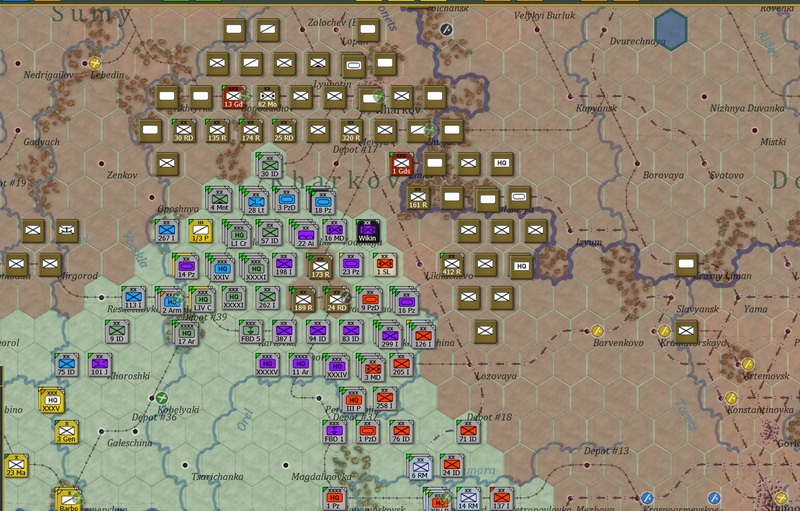
So far the outcome is positive, although Cannae III is not yet brought to a close. The benefit of having such a large strike force is that the ring was pretty secure and follow-up moves could be envisaged, in particular with all the armour of 3 PzK.
What is probably obvious is the Germans' tendency to replicate the Hannibal model wherever possible. So far, the Army Group South planners have perfectly grasped the concepts taught at the Kesselbewegungskrieglehrhochschule. Not sure about my sources for this renowned academy...
Anyway let's go back to to the mid-July surge towards Kharkov, once the 17th Army had cleared Poltava.
This time, the 2 Army, 17 Army, 11 Army and 1 Pz Army are able to field 50 (!) divisions for the offensive. I no longer count on any level of surprise or Russian reserves being spread out, so brute force has to replace any thoughts of outmanoeuvring Q-Ball. Contrary to what happened in previous attacks, Russian reserves are set to react, which brings a couple of initial odds back to 4:1 or 5:1 from the 30:1 calibration I am looking for. In a couple of instances, I had to add a bit more weight than I intended in order to avoid any nasty surprise, and the two-pronged operation is rather successful. A couple of half attacks are also possible once ZOCs preclude further reactions, helping to form a pocket.
The only snag is the depth of the defence, which also means that a counterattack batters the 3 Pz after a miscalculation over the number of mouvement points left to withdraw by one hex. Das Reich is also pushed back, although not out of action for 5 weeks as 3 Pz which lost nearly 2,000 men and a number of tanks.

So far the outcome is positive, although Cannae III is not yet brought to a close. The benefit of having such a large strike force is that the ring was pretty secure and follow-up moves could be envisaged, in particular with all the armour of 3 PzK.
What is probably obvious is the Germans' tendency to replicate the Hannibal model wherever possible. So far, the Army Group South planners have perfectly grasped the concepts taught at the Kesselbewegungskrieglehrhochschule. Not sure about my sources for this renowned academy...
Re: Grand Campaign --- Q-Ball vs Sertorius21
It was a good attack there, and generally took advantage of how I arranged my defenses
Once I identified where the Panzers were, I had lines of units 3 or 4 hexes deep. The advantage there is that it's really tough to get a runaway breakout as Germans, which was the primary thing I was trying to avoid.....a giant encirclement or massive advance into my rear that caused a huge pullback from other sectors.
The disadvantage is that each individual line can be routed and pushed, so that it should be possible, with enough force, for the Germans to just bully forward, which is what he did. I didn't have a ton of units encircled, but losses from routs and whatnot were pretty high
And of course, I always had counterattack units in the 3rd or 4th line; basically Guards Rifle Corps and Cav Corps, to hit any exposed units....that's also part of the plan
I don't feel like I got good mileage out of the VVS in Summer of '42; GA missions were mostly just shot down, and GS missions pretty much the same thing, without causing tons of damage
Once I identified where the Panzers were, I had lines of units 3 or 4 hexes deep. The advantage there is that it's really tough to get a runaway breakout as Germans, which was the primary thing I was trying to avoid.....a giant encirclement or massive advance into my rear that caused a huge pullback from other sectors.
The disadvantage is that each individual line can be routed and pushed, so that it should be possible, with enough force, for the Germans to just bully forward, which is what he did. I didn't have a ton of units encircled, but losses from routs and whatnot were pretty high
And of course, I always had counterattack units in the 3rd or 4th line; basically Guards Rifle Corps and Cav Corps, to hit any exposed units....that's also part of the plan
I don't feel like I got good mileage out of the VVS in Summer of '42; GA missions were mostly just shot down, and GS missions pretty much the same thing, without causing tons of damage
-
Sertorius21
- Posts: 137
- Joined: Mon Sep 16, 2024 3:40 pm
Re: Grand Campaign --- Q-Ball vs Sertorius21
Indeed there was no opportunity for any kind of deep exploitation, which at this stage may anyway prove reckless if there are a few Guards corps lurking deeper in Russian lines.
I indicated previously that part of the striking force had not joined the initial onslaught, so now was their time to help maintain momentum.
First, the surrounded troops had to be liquidated, to avoid tying up troops. This should have been a simple enough task, but one of the attacks turned out to be a 2:0 outcome, sparing blushes to a corps commander who had apparently missed all its tests. And it was not even a half attack.
Then the Panzer rolled forward and hit several Guards or Cav corps quite hard. The only trouble with these guys is that they do not rout easily, plus are well supported by their leaders. Losses were clearly not too high for the defending side, at least units would be quickly refitted.
Note that while Mackensen's III PzK hit the Kharkov area, Rommel's XXXX PzK, with quite a bit of infantry, secured the forest bend in the Donetz, which was subsequently occupied by an 11th Army division.
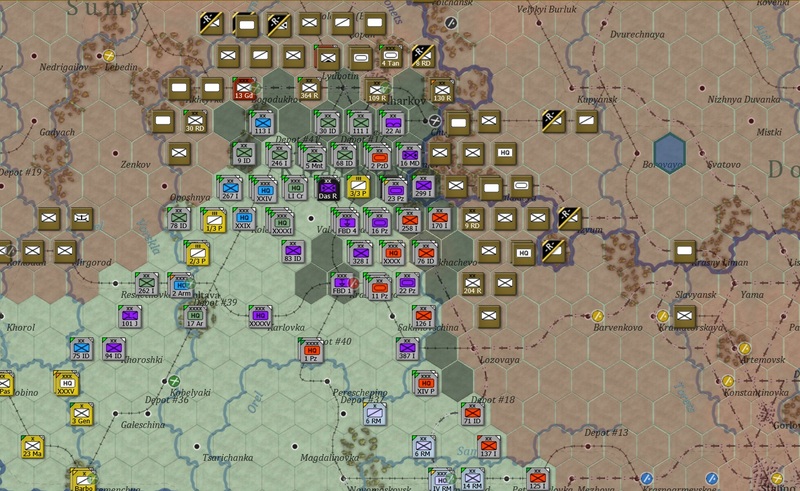
I indicated previously that part of the striking force had not joined the initial onslaught, so now was their time to help maintain momentum.
First, the surrounded troops had to be liquidated, to avoid tying up troops. This should have been a simple enough task, but one of the attacks turned out to be a 2:0 outcome, sparing blushes to a corps commander who had apparently missed all its tests. And it was not even a half attack.
Then the Panzer rolled forward and hit several Guards or Cav corps quite hard. The only trouble with these guys is that they do not rout easily, plus are well supported by their leaders. Losses were clearly not too high for the defending side, at least units would be quickly refitted.
Note that while Mackensen's III PzK hit the Kharkov area, Rommel's XXXX PzK, with quite a bit of infantry, secured the forest bend in the Donetz, which was subsequently occupied by an 11th Army division.

-
Sertorius21
- Posts: 137
- Joined: Mon Sep 16, 2024 3:40 pm
Re: Grand Campaign --- Q-Ball vs Sertorius21
The Russians decided to reduce the risk of presenting a salient to German Armour, so withdrew in front of 2 Pz group and the Italian expeditionary force. Gaining a few swamp hexes and giving more room is always welcome, insofar of course as I had no intention of striking north or north-east.
For now, the priority was just Kharkov and a traditional pincer mouvement was launched, with what strong mechanised units were still available, isolating the city. Decent infantry was transferred to Rommel's corps as well as all the usual heavy artillery assets. The storming troops were reinforced with countless engineer battalions, helping secure this important hub rather easily for this type of assault.
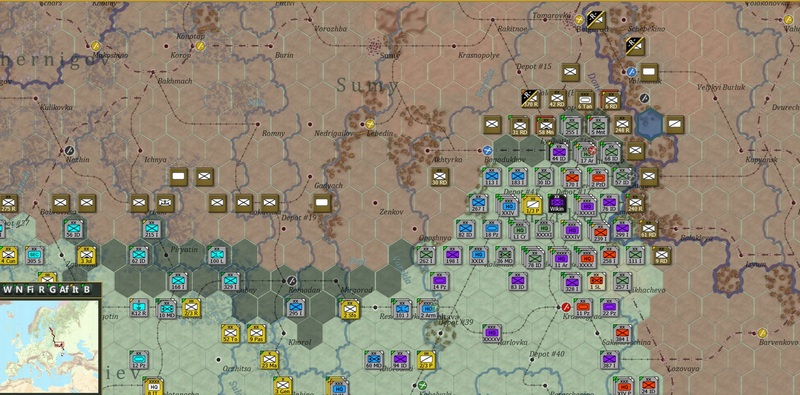
The downside to this success was that after 3 turns of attacking entrenched infantry, plus a rifle division in a forest behind a major river, plus guards corps, plus an urban centre, the striking force was blunted. Four infantry / mountain divisions were sent north of the newly-captured city immediately, to secure it and apply more pressure. Q-Ball ejected them all, bringing a temporary lull in the area at the beginning of August.
OKH felt that there might just be enough time to play on internal lines and switch the effort back towards Stalino, taking the Donbass before mud set in.
For now, the priority was just Kharkov and a traditional pincer mouvement was launched, with what strong mechanised units were still available, isolating the city. Decent infantry was transferred to Rommel's corps as well as all the usual heavy artillery assets. The storming troops were reinforced with countless engineer battalions, helping secure this important hub rather easily for this type of assault.

The downside to this success was that after 3 turns of attacking entrenched infantry, plus a rifle division in a forest behind a major river, plus guards corps, plus an urban centre, the striking force was blunted. Four infantry / mountain divisions were sent north of the newly-captured city immediately, to secure it and apply more pressure. Q-Ball ejected them all, bringing a temporary lull in the area at the beginning of August.
OKH felt that there might just be enough time to play on internal lines and switch the effort back towards Stalino, taking the Donbass before mud set in.
Last edited by Sertorius21 on Sat Dec 06, 2025 8:22 pm, edited 3 times in total.
-
Sertorius21
- Posts: 137
- Joined: Mon Sep 16, 2024 3:40 pm
Re: Grand Campaign --- Q-Ball vs Sertorius21
I did not take any screenshots for quite a while, but here is what happened in a nutshell.
Elated at having secured Kharkov with another large bag of POWs, the high command ordered the immediate preparation and earliest execution of Cannae IV. A few snags did not help this offensive to get off the ground as successfully as the previous ones:
- there had been 3 turns of heavy fighting instead of only one or two in previous offensives, so CPP and supply depletion was more acute;
- the Russians refused to stay quiet and, after a while, stormed a couple of hexes despite level 3 fortifications, including just east of Kharkov. Two units in reserves were activated but insufficient to repulse the 300,000 odd men and vast artillery concentrated on just one hex. For several weeks, the Germans would keep losing that battle, sending one German + one Alpini fresh units each time, with stronger reserves, yet nothing worked to regain full control of that hex. At one point, the Wiking reacted and caused vast Soviet losses, but Q-Ball immediately launched a second, obviously less powerful attack which proved successful as the other reserves mostly sat idle. Despite being just behind the frontline, being supported by a leader with an initiative rating of 8 and belonging to the same corps as the attached infantry, 5 Pz did not react once in 3 or 4 of these battles. At some point, the drain was just too much for the Wehrmacht and the line was straightened, with 57 ID relinquishing its position on the bank of the Donetz.
- whilst positive overall, the third offensive had created a salient hence more troops were needed to defend the flanks.
- finally the drive towards Stalino implied, in my view, to remove any Russian bridgehead on the wrong side of the Donetz.
All this converted into a decent effort by about 40 divisions, but against a deep defensive network with a river to cross if Stalino were to be enveloped from the north. So this did not stand a chance to unsettle Q-Ball.
T64 - mid or end of September
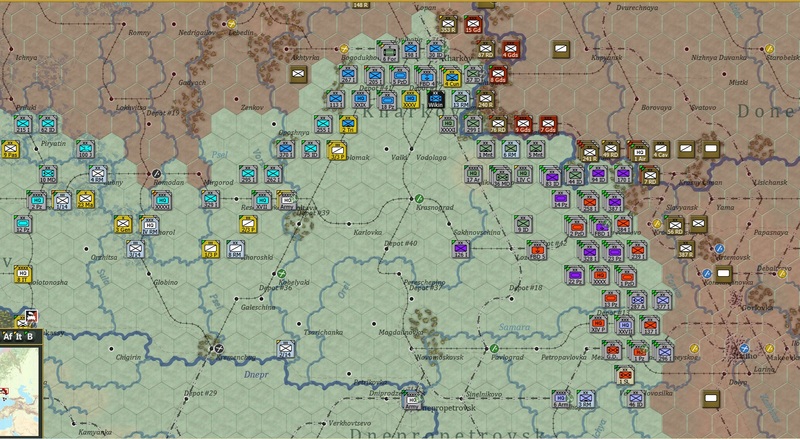
There was also a big battle ground in the woods on the eastern end of the Donetz, where the German reserves proved useless, as infantry posted just behind did not react. Hence what could have been a trap for the Russians turned out to be attritional losses and farming out Guards. Better reserves performance was observed further south during one of the Russian counterattacks. So although Soviet losses had been high, there was just no way to contemplate going any further.
Elated at having secured Kharkov with another large bag of POWs, the high command ordered the immediate preparation and earliest execution of Cannae IV. A few snags did not help this offensive to get off the ground as successfully as the previous ones:
- there had been 3 turns of heavy fighting instead of only one or two in previous offensives, so CPP and supply depletion was more acute;
- the Russians refused to stay quiet and, after a while, stormed a couple of hexes despite level 3 fortifications, including just east of Kharkov. Two units in reserves were activated but insufficient to repulse the 300,000 odd men and vast artillery concentrated on just one hex. For several weeks, the Germans would keep losing that battle, sending one German + one Alpini fresh units each time, with stronger reserves, yet nothing worked to regain full control of that hex. At one point, the Wiking reacted and caused vast Soviet losses, but Q-Ball immediately launched a second, obviously less powerful attack which proved successful as the other reserves mostly sat idle. Despite being just behind the frontline, being supported by a leader with an initiative rating of 8 and belonging to the same corps as the attached infantry, 5 Pz did not react once in 3 or 4 of these battles. At some point, the drain was just too much for the Wehrmacht and the line was straightened, with 57 ID relinquishing its position on the bank of the Donetz.
- whilst positive overall, the third offensive had created a salient hence more troops were needed to defend the flanks.
- finally the drive towards Stalino implied, in my view, to remove any Russian bridgehead on the wrong side of the Donetz.
All this converted into a decent effort by about 40 divisions, but against a deep defensive network with a river to cross if Stalino were to be enveloped from the north. So this did not stand a chance to unsettle Q-Ball.
T64 - mid or end of September

There was also a big battle ground in the woods on the eastern end of the Donetz, where the German reserves proved useless, as infantry posted just behind did not react. Hence what could have been a trap for the Russians turned out to be attritional losses and farming out Guards. Better reserves performance was observed further south during one of the Russian counterattacks. So although Soviet losses had been high, there was just no way to contemplate going any further.
Re: Grand Campaign --- Q-Ball vs Sertorius21
Overall, I wasn't sure what to expect in the Summer '42 campaign.....as Sertorius said, my defensive strategy was based on (where he was attacking):
1. 2 rows or so of Rifle Divisions (of course dug-in as much as possible)
2. 3rd row of mostly "Counterattack" units; Guards Rifle Corps, Cav Corps, Tank Corps
3. Behind the third row, some Cavalry/On-Map Brigades as kind of "Last Stand" in case there was a breakout
I rarely set that third row on RESERVE. I tried to be aggressive in counterattacking the spearheads, to keep him honest, and bank some wins in the summer for Guards (mostly Rifle and Tank Brigade SU wins)
Basically, I allowed him to grind through those first 2 rows (where he caused ALOT of casualties!) in order to keep the Germans in front of me. Maybe I should've surrendered more terrain instead of fighting it out in clear terrain around Kharkov, but I guess that was a choice.....I feel like Soviets need to run in 1941 in open terrain, but in 1942 if you have the unit density it might be better to fight it out.
I had to rotate in/out ALOT of rifle units to keep this going, a constant stream of fresh units. I had a system of having stacks of depleted units around Saratov, gaining CPP, while awaiting enough Manpower to fill-up (as Saratov is a NSS). That way rebuilt units had 100 CPP and were rested, ready to go....just had to be railed. That uses Rail Capacity, but I found 1942 Red Army doesn't really have supply issues.
Thoughts from the gallery on this?
1. 2 rows or so of Rifle Divisions (of course dug-in as much as possible)
2. 3rd row of mostly "Counterattack" units; Guards Rifle Corps, Cav Corps, Tank Corps
3. Behind the third row, some Cavalry/On-Map Brigades as kind of "Last Stand" in case there was a breakout
I rarely set that third row on RESERVE. I tried to be aggressive in counterattacking the spearheads, to keep him honest, and bank some wins in the summer for Guards (mostly Rifle and Tank Brigade SU wins)
Basically, I allowed him to grind through those first 2 rows (where he caused ALOT of casualties!) in order to keep the Germans in front of me. Maybe I should've surrendered more terrain instead of fighting it out in clear terrain around Kharkov, but I guess that was a choice.....I feel like Soviets need to run in 1941 in open terrain, but in 1942 if you have the unit density it might be better to fight it out.
I had to rotate in/out ALOT of rifle units to keep this going, a constant stream of fresh units. I had a system of having stacks of depleted units around Saratov, gaining CPP, while awaiting enough Manpower to fill-up (as Saratov is a NSS). That way rebuilt units had 100 CPP and were rested, ready to go....just had to be railed. That uses Rail Capacity, but I found 1942 Red Army doesn't really have supply issues.
Thoughts from the gallery on this?

Re: Grand Campaign --- Q-Ball vs Sertorius21
Q-Ball wrote: Mon Nov 24, 2025 5:31 pm Overall, I wasn't sure what to expect in the Summer '42 campaign.....as Sertorius said, my defensive strategy was based on (where he was attacking):
1. 2 rows or so of Rifle Divisions (of course dug-in as much as possible)
2. 3rd row of mostly "Counterattack" units; Guards Rifle Corps, Cav Corps, Tank Corps
3. Behind the third row, some Cavalry/On-Map Brigades as kind of "Last Stand" in case there was a breakout
I rarely set that third row on RESERVE. I tried to be aggressive in counterattacking the spearheads, to keep him honest, and bank some wins in the summer for Guards (mostly Rifle and Tank Brigade SU wins)
Basically, I allowed him to grind through those first 2 rows (where he caused ALOT of casualties!) in order to keep the Germans in front of me. Maybe I should've surrendered more terrain instead of fighting it out in clear terrain around Kharkov, but I guess that was a choice.....I feel like Soviets need to run in 1941 in open terrain, but in 1942 if you have the unit density it might be better to fight it out.
I had to rotate in/out ALOT of rifle units to keep this going, a constant stream of fresh units. I had a system of having stacks of depleted units around Saratov, gaining CPP, while awaiting enough Manpower to fill-up (as Saratov is a NSS). That way rebuilt units had 100 CPP and were rested, ready to go....just had to be railed. That uses Rail Capacity, but I found 1942 Red Army doesn't really have supply issues.
Thoughts from the gallery on this?
Hi
A couple of things
Is this sudden match as I cant see if that was posted or I missed it.
Either way can we see the current score card please.
If this is a sudden death match he has till turn 68 to secure 750 points and unless he has captured a lot northern objectives this does not look good.
What is the situation on the Northern front ( Leningrad ) and the Moscow front
I cant speak to you on your situation as I am not a Soviet player also I am a PVE player so my 2 cents might be quite worthless since I play against the AI

Back to the assault on Kharkov your opponent seems to have thrown everything into an offensive towards the Kharkov / Kursk regions which fine there strategic cities.
Cant tell exactly but it looks to me he is attacking on a narrow front, looks like you still might control areas as far up as Chernigov on the Desna river which means you could launch an offensive in the Poltava area towards Cherkassy or Kremenchug to Kirovograd and if you reach Krivoo Rog that could be a disaster for your opponent.
I note now in the last screen shot your opponent is shifting his forces towards Stallino, to me there are 4 cities / towns of important value Stallino being the most obvious but also Makeevka, Gorlovka,Debaltsevo and Voroshilovgrad all resource areas.
As the Axis player its September its getting late I would push hard take those objectives and have a defensive line running along the Donets and Don rivers from Kharkov in the north to Rostov and Azov in the south, its a long line considering there is a lot of open terrain.
Alternatively a shorter line from the Mius river and the Torets river from Taganrog to Slavyansk, just my humble view.
Again I will say you appear to have been able to channel your opponents attacks on a narrow front leaving you many opportunities to launch a counter operations from both the Sumy and Chernigov regions, the coming winter should be interesting.
Anyway its a very interesting campaign by both of you, enjoying it
regards
Re: Grand Campaign --- Q-Ball vs Sertorius21
So sounds reasonable to assume you would not have general issues with Supply.Q-Ball wrote: Mon Nov 24, 2025 5:31 pm I had to rotate in/out ALOT of rifle units to keep this going, a constant stream of fresh units. I had a system of having stacks of depleted units around Saratov, gaining CPP, while awaiting enough Manpower to fill-up (as Saratov is a NSS). That way rebuilt units had 100 CPP and were rested, ready to go....just had to be railed. That uses Rail Capacity, but I found 1942 Red Army doesn't really have supply issues.
Thoughts from the gallery on this?
I don't know about a mechanic that would lower the early Soviet rail logistics or would boost them later on (maybe there are some Railyard size increases), this means to a large degree, the Network you have in 1941/42 supplying 2.7-4M Soviets is the same which supports them with 5M+ Men and way more heavy/mechanized equipment later on over longer distances.
Why are the GUARDs for Counterattack and not frontline?Q-Ball wrote: Mon Nov 24, 2025 5:31 pm 2. 3rd row of mostly "Counterattack" units; Guards Rifle Corps, Cav Corps, Tank Corps
Would actually a good topic for your Soviet Thread.

“Amateurs study tactics; professionals study logistics.”
My Mods:
GE Gui & Sym Mod Depot (continued)
Rasputitsa for your eyes. Soviet colours redone.
My Tools:
Turn-Dates-Converter
Command Efficiency with Command Range Modifier
Planning map 1.02.45_Beta
My Mods:
GE Gui & Sym Mod Depot (continued)
Rasputitsa for your eyes. Soviet colours redone.
My Tools:
Turn-Dates-Converter
Command Efficiency with Command Range Modifier
Planning map 1.02.45_Beta
Re: Grand Campaign --- Q-Ball vs Sertorius21
Yeah, the rail network and supply dynamic could be a little different.....late-war Soviets, the Rail Network and Supplies are a real constraint, but there just aren't those kinds of demands in 1941/42, so I never felt like I had a supply issue....there was always a way to on-map refit rather than send to reserve
Same with Cav Corps
As Germans, a Guards Rifle Corps is a unit I would really like to cut-off and destroy. So as Soviets, I avoid putting them on a front-line hex where they could be cut-off and destroyed. You can see in Sertorius's screen shot I am deploying them on the front line east of Kharkov, but that's on a major river, where risk of encirclement is extremely low.Wiedrock wrote: Mon Nov 24, 2025 11:32 pm Why are the GUARDs for Counterattack and not frontline?
Would actually a good topic for your Soviet Thread.
Same with Cav Corps
-
Sertorius21
- Posts: 137
- Joined: Mon Sep 16, 2024 3:40 pm
Re: Grand Campaign --- Q-Ball vs Sertorius21
I would have loved to find a few Guards corps in the front line, in order to surround them. Much as Q-Ball managed to grind me to a halt, I doubt he could field Guards corps both in the front line and in reserve to counterattack, apart from a handful of cavalry with their usual contingent of 3 brigades attached. One big additional benefit for him is that I was very seldom able to attack Guards with infantry. If they are two or three hexes behind, it means that they can only be hit by armour or motorised troops that have spent a number of MPs, with HQs that probably had to move as well, hence are less efficient and get lower artillery / Nebelwerfer support.
Re: Grand Campaign --- Q-Ball vs Sertorius21
As far as VPs, etc.....this will go to 1945, no auto-vic possible. The Red Army did not lose Leningrad in this game.tm1 wrote: Mon Nov 24, 2025 10:56 pm
Again I will say you appear to have been able to channel your opponents attacks on a narrow front leaving you many opportunities to launch a counter operations from both the Sumy and Chernigov regions, the coming winter should be interesting.
Anyway its a very interesting campaign by both of you, enjoying it
regards
You are foreshadowing Winter......an attack like you described toward Cherkassy and over the Dnepr is not possible in Summer. And anyway, i did attack south of Poltava, but very quickly ran into Panzer Reserves, so Sertorious was expecting that. I gained a couple hexes, but mostly just saw Rifle Divisions chewed-up by Panzers. OKH was expecting this.
After the Rivers all froze, however, I did make my main Winter effort in the Gomel and Chernigov sectors, right into the marshes. While you're not going to get a breakout in the marshes, it does make it easier to hold the ground you take. More on this later........
-
Sertorius21
- Posts: 137
- Joined: Mon Sep 16, 2024 3:40 pm
Re: Grand Campaign --- Q-Ball vs Sertorius21
Onto the winter season now, where my plans were to take the Russians in the open, if possible after they had exhausted themselves in a futile attack or two. I knew this would be a rare occurrence and also that the Russians could stage a lot of attacks from their fortified lines, hence repulses would not, at least initially, be major issues for them. I did not want to abandon Kharkov yet, although I doubted that it hold until March.
In early November, a preliminary push was carried against the 6th Army, bottom right on the picture (and further out to Mariupol). Although 3Pz broke the first attack, the follow-up was more successful as only one small division reacted. The Soviet line advanced in the vacant hex the following turn and could have been heavily thrown out but only a couple of Guards corps had been used for this and I didn't want to disclose too much of my reserves, or wear them down. That part of the front then went quiet.
A more serious move was made towards Kremenchug and managed to grind the defence one hex after another. My reserves were not well positioned for the main thrust, too close to Poltava or a bit too much to the east, so pitting them against large Russian stacks would have yielded Pyrrhic victories. I had to accept to be defeated regularly on this Guards farming ground. Of course, the attacker suffered losses as most assaults went against level 3 forts. These actions went on for 3 or 4 weeks if my memory is correct, so until early December. Only where I could inflict real casualties did I commit reserves, for instance against the salient that had been created between marsh hexes (shaded as the picture is taken after the counterattack). Initially cavalry went in, then regular infantry, and a few weeks later infantry corps.
View on T75
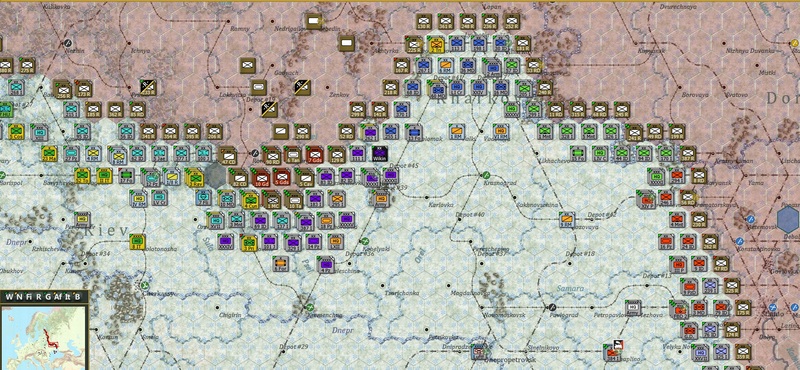
You can see or guess that a number of Rumanian corps are attached directly to the Army groups. I am not sure if this is the best way to handle the small allies when a single corps is used as second line or support to the front, away from the main Rumanian armies. A couple of divisions are also in refitting mode, hence attached to corps HQs with high administrative values. Since they are manning the second line, this corps may attach to the army group, avoiding overload at army level.
In early November, a preliminary push was carried against the 6th Army, bottom right on the picture (and further out to Mariupol). Although 3Pz broke the first attack, the follow-up was more successful as only one small division reacted. The Soviet line advanced in the vacant hex the following turn and could have been heavily thrown out but only a couple of Guards corps had been used for this and I didn't want to disclose too much of my reserves, or wear them down. That part of the front then went quiet.
A more serious move was made towards Kremenchug and managed to grind the defence one hex after another. My reserves were not well positioned for the main thrust, too close to Poltava or a bit too much to the east, so pitting them against large Russian stacks would have yielded Pyrrhic victories. I had to accept to be defeated regularly on this Guards farming ground. Of course, the attacker suffered losses as most assaults went against level 3 forts. These actions went on for 3 or 4 weeks if my memory is correct, so until early December. Only where I could inflict real casualties did I commit reserves, for instance against the salient that had been created between marsh hexes (shaded as the picture is taken after the counterattack). Initially cavalry went in, then regular infantry, and a few weeks later infantry corps.
View on T75

You can see or guess that a number of Rumanian corps are attached directly to the Army groups. I am not sure if this is the best way to handle the small allies when a single corps is used as second line or support to the front, away from the main Rumanian armies. A couple of divisions are also in refitting mode, hence attached to corps HQs with high administrative values. Since they are manning the second line, this corps may attach to the army group, avoiding overload at army level.
-
Sertorius21
- Posts: 137
- Joined: Mon Sep 16, 2024 3:40 pm
Re: Grand Campaign --- Q-Ball vs Sertorius21
The end of the previous winter had seen quite a bit of action south of Staraya Russa and this part of the front flared again around the end of 1942 (on turn 76). Q-Ball laconically sent me a message stating that he had liberated a few trees, but the reality was far worse as he had unhinged what should have been a strong part of the front. This was not helped by the fact that I had not checked the LW locally for 2 or 3 turns and this is when a whole AOG had been withdrawn, leaving most of the area devoid of bomber cover. Only one mission was flown from Velikye Luki, which proved very sore as several of the Soviet combat odds were below 3:1. So from north to south:
- the Staraya Russa division was expelled from its fortifications, with the 29 Mot just behind not reacting.
- the infantry in the marsh hex repulsed an attack if my memory is correct
- SW of it, a rgt that had just been reinforced by a LW field division repulsed a first attack and caved in with the second one.
- the forest hexes occupied on the picture below by the 268 and 45 RDs were defended by two regiments each, with the third one behind in reserve. This was a big mistake. At least one of these hexes should have had its division fully assembled, hence virtually unassailable. This would have acted as an anchor for the subsequent turns. The logic behind the regiment in reserve was to make sure that the next row of forest hexes was held and any penetration could be sealed, but with a full division in the front line, the very concept of a penetration was not valid at this point of the war.
I don't remember if the hex with the 45 cav division was stormed on that turn of later. I think on that turn.
The German reaction implied a few urgent moves:
- the 29 Mot and whatever was available counterattacked the two shaded hexes, with strong support from 502 Tiger II and other non-divisional units. The odds were not massive but even 5 or 7:1 were sufficient to achieve the initial objective of blunting the Russian spearhead.
- Units near Novgorod participated in these counterattacks, and were replaced in the line by divisions that were being railed in.
- 20 PzD was brought by rail from Velikye Luki, hence being available for the following week.
- 6 Pz was just coming on the map and sent in that direction as well.
More fighting took place on the following week, with again two big counterattacks. A couple of the Russian units to be expelled from the same two shaded hexes had already been pushed out the previous turn, hence were weakened. These were nevertheless big beasts:
- in Staraya Russa: 16 Guard XXX, 180 and 194 RDs
- further south: 1 and 7 Guards Cav XXX, 249 RD
Again the odds were not massive but largely sufficient to avoid any upset. The only issue is that this required the participation of all units with decent clout and weakened the defence of the forward marsh hex, which fell shortly thereafter. The following weeks saw more heavy fighting although not as dramatic. Q-Ball's effort shifted to the mid-point between Velikye Luki and Staraya Russa, with Vatutin in charge, throwing back the Germans almost every turn from a marsh hex, irrespective of the quality of what was sent in, the leader (with an initiative rating of 7) or the attached artillery which performed rather badly.
Situation at the end of turn 77 (December)
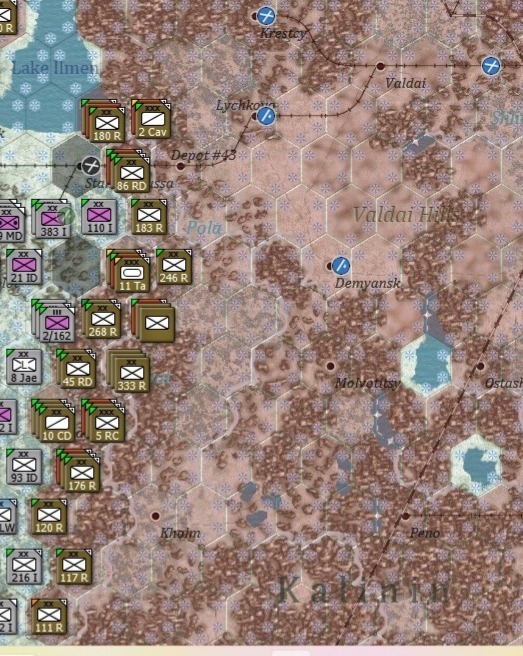
Much as the situation was, and remains by the way, unsatisfactory in this segment of the front, what happened there was overshadowed by a bigger offensive in the Smolensk - Orsha area.
- the Staraya Russa division was expelled from its fortifications, with the 29 Mot just behind not reacting.
- the infantry in the marsh hex repulsed an attack if my memory is correct
- SW of it, a rgt that had just been reinforced by a LW field division repulsed a first attack and caved in with the second one.
- the forest hexes occupied on the picture below by the 268 and 45 RDs were defended by two regiments each, with the third one behind in reserve. This was a big mistake. At least one of these hexes should have had its division fully assembled, hence virtually unassailable. This would have acted as an anchor for the subsequent turns. The logic behind the regiment in reserve was to make sure that the next row of forest hexes was held and any penetration could be sealed, but with a full division in the front line, the very concept of a penetration was not valid at this point of the war.
I don't remember if the hex with the 45 cav division was stormed on that turn of later. I think on that turn.
The German reaction implied a few urgent moves:
- the 29 Mot and whatever was available counterattacked the two shaded hexes, with strong support from 502 Tiger II and other non-divisional units. The odds were not massive but even 5 or 7:1 were sufficient to achieve the initial objective of blunting the Russian spearhead.
- Units near Novgorod participated in these counterattacks, and were replaced in the line by divisions that were being railed in.
- 20 PzD was brought by rail from Velikye Luki, hence being available for the following week.
- 6 Pz was just coming on the map and sent in that direction as well.
More fighting took place on the following week, with again two big counterattacks. A couple of the Russian units to be expelled from the same two shaded hexes had already been pushed out the previous turn, hence were weakened. These were nevertheless big beasts:
- in Staraya Russa: 16 Guard XXX, 180 and 194 RDs
- further south: 1 and 7 Guards Cav XXX, 249 RD
Again the odds were not massive but largely sufficient to avoid any upset. The only issue is that this required the participation of all units with decent clout and weakened the defence of the forward marsh hex, which fell shortly thereafter. The following weeks saw more heavy fighting although not as dramatic. Q-Ball's effort shifted to the mid-point between Velikye Luki and Staraya Russa, with Vatutin in charge, throwing back the Germans almost every turn from a marsh hex, irrespective of the quality of what was sent in, the leader (with an initiative rating of 7) or the attached artillery which performed rather badly.
Situation at the end of turn 77 (December)

Much as the situation was, and remains by the way, unsatisfactory in this segment of the front, what happened there was overshadowed by a bigger offensive in the Smolensk - Orsha area.
Re: Grand Campaign --- Q-Ball vs Sertorius21
12-7-42 Soviet View
I started taking screenshots at this point in the game, so I can start contributing a bit more regularly....we are at 3/7/43 in actual game, so posting with about a 3-month lag
As Sertorius indicated, the first winter attacks were launched into the woods/swamp just south of Lake Ilmen....the terrain favors the defender, and there isn't much of strategic value.....this was really just a preliminary attack to focus attention/reserves. Though, I might be getting uncomfortably close to the clear terrain east of Pskov, at which point it could force a withdrawl from Leningrad area....but who knows. Anyway, Vatutin leading the charge...note the Soviet Losses
As Sertorius said, we also opened a larger push around Smolensk....this was more of a serious push I had planned, but not THE main event. He has back-up units and defenses everywhere, so limits any breakthroughs. As you can see, even successful attacks had really high loss ratios; this is kind of a pyrric victory, as we had to overcome the RESERVE activation of a Motorized Division:
Loss screen sorted to Soviet Action Phase....this level of losses on the offensive is not acceptable long-term. My primary objectives other than territory at this point are farming Guards wins, so I'm doing that, but at some point we have to kill more Germans than this. The saving grace is that I am ahead in terms of territory I think (and with that I have good manpower production), but I am behind in killing Germans...that has to change
Current OOB, the Red Army is at 7 million, which is a solid number, and at this point I have another 1 million in the Active Manpower pool. I think this is mostly because, aside from keeping losses down in 41/42, is because I have pretty good chunks of territory; in 1942 I was producing roughly 120K new Manpower each turn. Of course, that drops ALOT in 1943.....only partially offset by returnees from the disabled pool.
I posted in the Red Army thread, so not a big secret, but at this stage the limitation isn't MANPOWER, and with Vehicles I am OK; it's GUNS. Except for Light Artillery, all the ACTIVE pools for important artillery types, including Mortars, AT Guns, Artillery, Heavy Artillery, are EMPTY. Not all Rifle Divisions have a full complement of Mortars and Artillery. Of course I have enough for "attack" units, but this is a problem......I'm especially surprised by the lack of AT Guns, despite disbanding nearly all my independent AT units
I started taking screenshots at this point in the game, so I can start contributing a bit more regularly....we are at 3/7/43 in actual game, so posting with about a 3-month lag
As Sertorius indicated, the first winter attacks were launched into the woods/swamp just south of Lake Ilmen....the terrain favors the defender, and there isn't much of strategic value.....this was really just a preliminary attack to focus attention/reserves. Though, I might be getting uncomfortably close to the clear terrain east of Pskov, at which point it could force a withdrawl from Leningrad area....but who knows. Anyway, Vatutin leading the charge...note the Soviet Losses
- 12-6-42Attack.jpg (389.81 KiB) Viewed 1564 times
- 12-6-42attack2.jpg (339.66 KiB) Viewed 1564 times
- 12-42-Losses.jpg (67.83 KiB) Viewed 1564 times
I posted in the Red Army thread, so not a big secret, but at this stage the limitation isn't MANPOWER, and with Vehicles I am OK; it's GUNS. Except for Light Artillery, all the ACTIVE pools for important artillery types, including Mortars, AT Guns, Artillery, Heavy Artillery, are EMPTY. Not all Rifle Divisions have a full complement of Mortars and Artillery. Of course I have enough for "attack" units, but this is a problem......I'm especially surprised by the lack of AT Guns, despite disbanding nearly all my independent AT units
- 12-20-42pool.jpg (186.11 KiB) Viewed 1564 times
Re: Grand Campaign --- Q-Ball vs Sertorius21
finally content (numbers). 
“Amateurs study tactics; professionals study logistics.”
My Mods:
GE Gui & Sym Mod Depot (continued)
Rasputitsa for your eyes. Soviet colours redone.
My Tools:
Turn-Dates-Converter
Command Efficiency with Command Range Modifier
Planning map 1.02.45_Beta
My Mods:
GE Gui & Sym Mod Depot (continued)
Rasputitsa for your eyes. Soviet colours redone.
My Tools:
Turn-Dates-Converter
Command Efficiency with Command Range Modifier
Planning map 1.02.45_Beta